Can I Buy OpenAI Stock? Not Yet – but Insiders Just Sold $7 Billion of It
Somewhere right now, someone is typing is openai going public today into Google. Then tomorrow. Then this week. Autocomplete offers all three, which is the closest thing the internet has to a pulse reading.
Here is the honest answer, and then the part that does not make the headline: you cannot buy OpenAI stock today. But on Aug. 11, a few thousand people did the opposite — they sold about $7 billion of it.
What actually happened this week
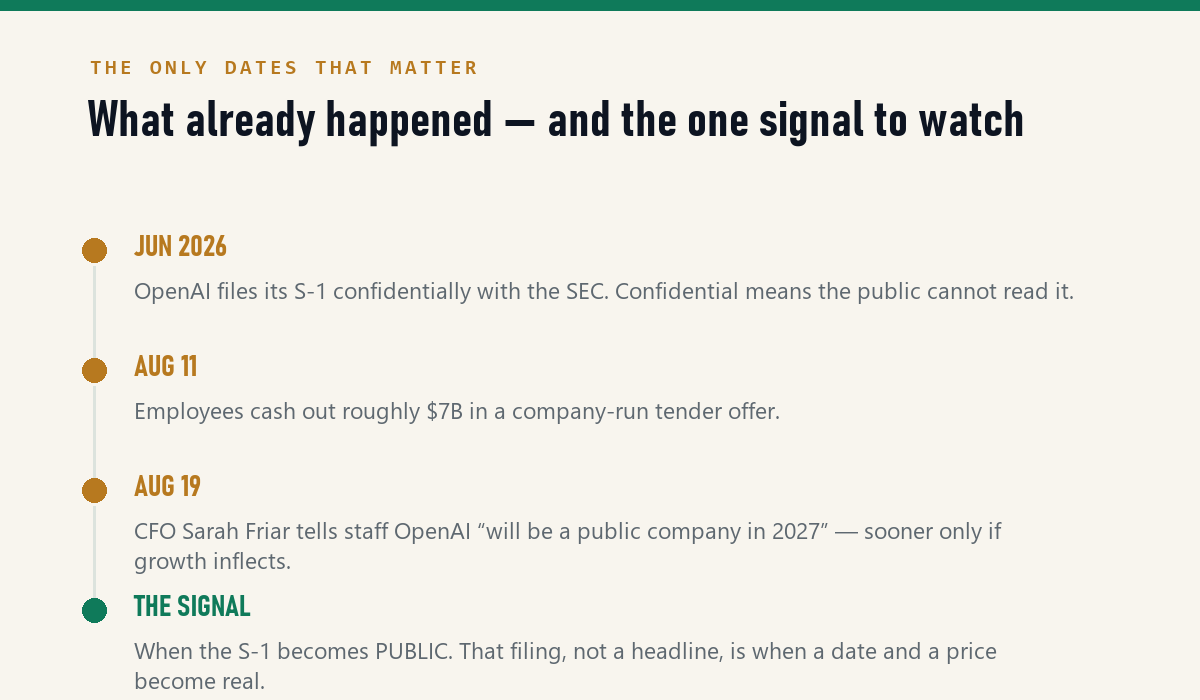
On Wednesday, Aug. 19, OpenAI chief financial officer Sarah Friar told employees at an all-hands meeting that the company will be a public company in 2027 — or sooner, if, in her words, the business continues to inflect.
She also delivered the line that deserves framing: the IPO is not a finish line, it is a milestone, another fundraise.
Translated from CFO into English: please stop asking me when we ring the bell. And she has a point. She reminded staff that the company raised $122 billion in March, which is not the balance sheet of an organization waiting on your $500.
The slides behind her showed revenue run rate up 35% quarter to date, enterprise run rate up 50%, and the coding and work products at 20 million weekly active users.
The asymmetry nobody mentions
Eight days before that meeting, OpenAI ran a tender offer: a company-organized event that lets employees and early holders sell a slice of what they already own. Reported size, roughly $7 billion.
Sit with the sequence. The people inside got a liquidity window this month. The people outside got a target year.

But my app shows something called OpenAI
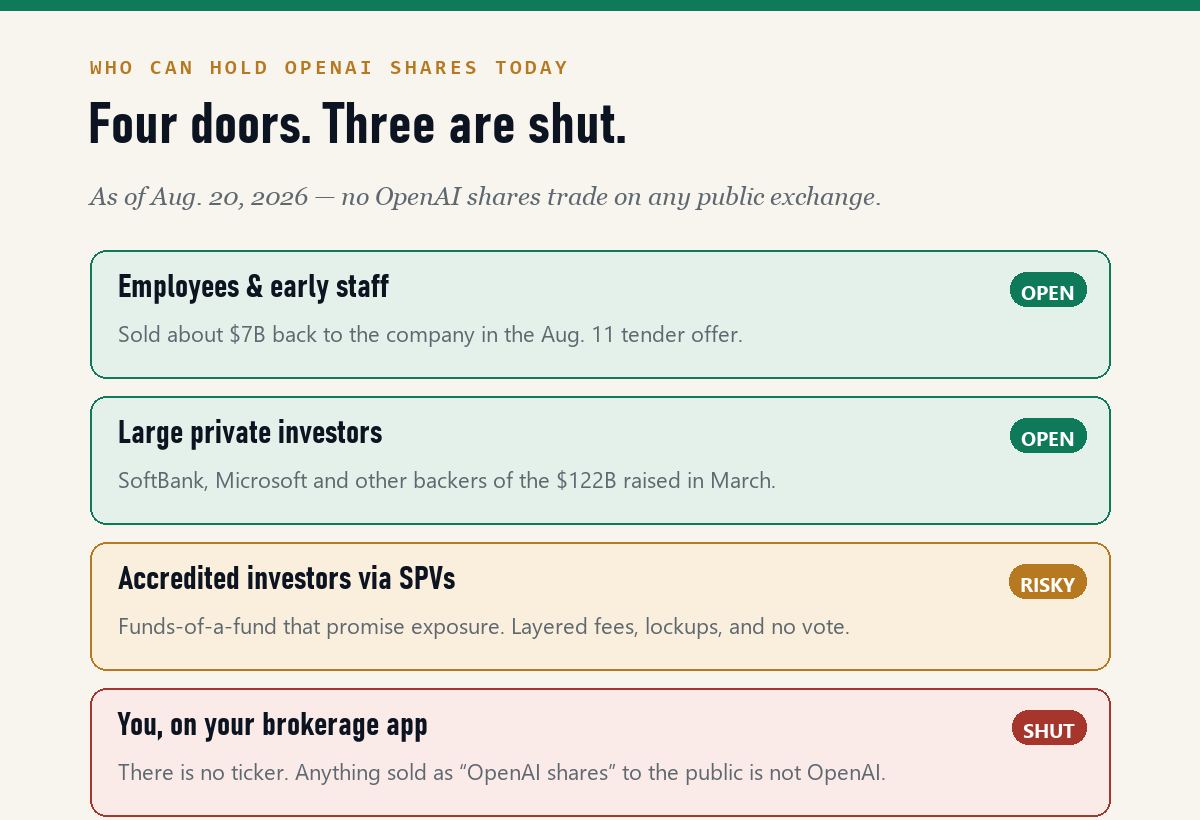
Three things get mistaken for OpenAI stock. It is worth being able to tell them apart in ten seconds.
1. Tokenized or synthetic pre-IPO products. Some platforms offer instruments that track private companies. Whatever the marketing says, you would be holding a contract with a platform, not a share carrying a shareholder’s rights.
2. SPVs, the fund-of-a-fund route. The legitimate-but-expensive door, open to accredited investors. You buy into a vehicle that holds an interest in another vehicle that holds shares. Layered fees, long lockups, no vote, and often no confirmed price until much later.
3. Anything that arrives uninvited. An email, a DM, an ad, a very friendly stranger. If pre-IPO shares in the most talked-about company on earth were being handed out by cold outreach, they would not need to cold-outreach you.
So what is it actually worth?
The August tender reportedly valued the company in the high hundreds of billions. Reports have floated a trillion-dollar listing. Both numbers are real in the sense that someone wrote them down, and unreal in the sense that no open market has voted on them yet.
That is the entire function of an IPO, stripped of ceremony: the first time strangers get to argue about the price in public.

The one signal worth an alert
Ignore the target years. Ignore the leaks. There is exactly one moment when this becomes actionable for a normal person: when the S-1 goes public.
A confidential filing — which OpenAI made in June — means regulators are reading it and you are not. When the public version lands, three things appear at once: audited financials, a proposed exchange and symbol, and a price range. Until then, every number you read is an opinion in a number costume.
Meanwhile, the other one
Anthropic, the maker of Claude, has also filed confidentially, and reporting suggests it could list as early as this fall — possibly beating OpenAI to the bell. Friar’s comment on that: that is OK, we are running our own race.
Which is what everyone says about a race they might lose, and also, occasionally, true.
Don’t chase early shares; set one alert for the S-1 filing
1. If you were about to go looking for a way in early, stop, and keep the ten-second ticker test instead.
2. If anyone has approached you with pre-IPO shares, do not reply. Report it at reportfraud.ftc.gov.
3. To follow the story properly, set one alert: OpenAI S-1 public filing. Everything before that is weather.
4. Tell the person in your life who forwards investment tips. This is the exact week they will receive one.
Why a company with $122 billion still wants public shares
Why would a company sitting on $122 billion even go public? Partly to give employees and early investors a permanent exit, partly for the currency: public shares are easier to spend on acquisitions and on talent. The phrase another fundraise was doing real work.
Is the AI boom a bubble, then? That is the argument the S-1 will start, not settle. When audited numbers land, both sides finally fight with the same data.
What does any of this change about the tools you use? Nothing this week. But pricing pressure tends to follow public shareholders. Our running record of what each assistant costs sits on the AI price tracker, re-verified monthly.
Nothing sold to the public right now is actual OpenAI stock
Can I buy OpenAI stock right now?
No. OpenAI is still a private company, so there is no ticker and no public shares. It filed its IPO paperwork confidentially with the SEC in June 2026, and its CFO told employees on Aug. 19 that the company will be a public company in 2027, or sooner only if growth accelerates. Anything currently sold to the public as OpenAI shares is not stock in OpenAI.
Can I buy OpenAI on Robinhood?
Not as OpenAI stock. Retail apps have offered tokenized products and pre-IPO style exposure that track private companies, but those are contracts with the platform, not shares in OpenAI, and they carry their own fees and risks. If you cannot find a normal ticker symbol, you are not buying the company.
Is OpenAI going public today, or this week?
No. The only public statement is the CFO’s target of 2027. A confidential filing is not a listing. The moment to watch is when the S-1 becomes public: that document, not a headline, is when a real date and a real price appear.
What was the $7 billion sale in August then?
That was a tender offer for insiders, a company-run event that lets employees and early holders sell some of the shares they already own, reportedly around $7 billion worth. It creates liquidity for existing owners. It does not create shares for the public.
Are pre-IPO OpenAI share offers legitimate?
Treat unsolicited offers as a scam until proven otherwise. Legitimate private-market access is limited to accredited investors and usually runs through funds holding an indirect interest, with layered fees and lockups. An email, DM, or ad promising you pre-IPO OpenAI shares is the oldest structure in finance wearing this year’s logo.
What about Anthropic, is Claude’s maker going public too?
Anthropic has also filed confidentially, and reporting suggests a listing could come as early as this fall. The same rule applies: until a public filing and a listing date exist, there is nothing for a retail investor to buy.
Does buying Microsoft or Nvidia give me OpenAI exposure?
Partly and indirectly. Microsoft is an investor in OpenAI and Nvidia sells the chips the industry runs on, so their results move with AI demand. But you would be buying those companies, with all of their other businesses, not a slice of OpenAI. This describes how the plumbing works; it is not a recommendation to buy anything.
Sources
- CNBC, OpenAI will be a public company in 2027 or sooner, CFO Friar tells employees (Aug. 19, 2026)
- CNBC, OpenAI confidentially files for IPO (June 8, 2026)
- Reporting on the August 2026 employee tender offer, approximately $7 billion (Quartz, TipRanks, Aug. 11-12, 2026)
- Bloomberg Tech, revenue trajectory ahead of IPO (Aug. 14, 2026)
- Google Autocomplete demand check, run Aug. 20, 2026
When a share pitch arrives: the safe-word kit and first sixty minutes
- AI scams targeting seniors — the safe-word kit, and the first sixty minutes if money already moved.
- ChatGPT ads: how to turn them off without paying $20 — what the company that wants your money is doing to your screen.
- The AI price tracker — every tool, every tier, re-verified monthly.
About the author
Prof. H is a professor of AI and robotics, a former Samsung researcher, and the author of dozens of textbooks on AI and automation. He writes hands-on, no-hype guides. More about the author →
Prof.’s H Newsletter
One short email a month, with the numbers in it
What actually moved in AI hiring, AI prices, and the scams aimed at older Americans. Counted here, dated, and linked to the source. One email a month, and your address goes nowhere else.