ChatGPT Ads: How to Turn Them Off Without Paying $20
OpenAI began testing ads inside ChatGPT in the United States on February 9, 2026. Six months on, the help page describing that test is still being edited — it was updated again today — and the price ladder it sits inside has moved. So this morning I did the only thing that settles it: I read the vendor’s own pricing page and its own help center, and wrote down what they say.
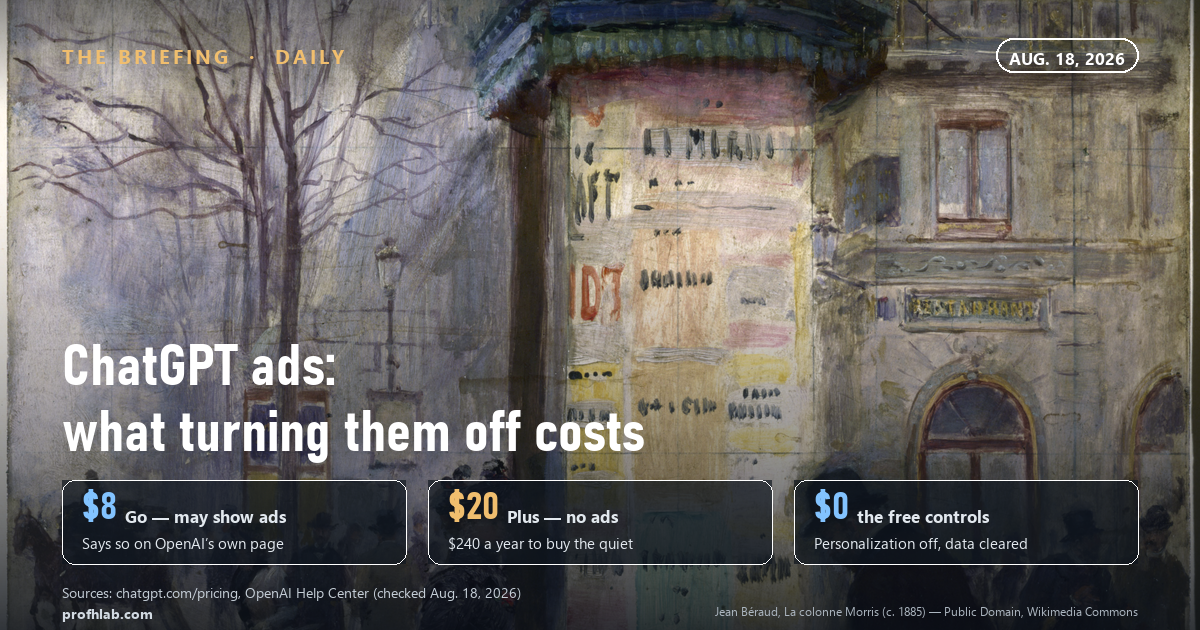
The finding that will surprise most people: the plan OpenAI flags for ads is the one you pay for. On chatgpt.com/pricing, the $8 Go card carries the line “This plan may include ads.” The free card carries no such line, even though OpenAI’s ads FAQ lists Free and Go together as ad-eligible. And the cheapest tier with a written no-ads promise is Plus, at $20 a month — $240 a year to buy the quiet.
The short version. Before you upgrade to stop ads, there are three free steps: turn off ad personalization, clear the data used for ads, and check whether the free no-ads option OpenAI describes is available to you. If none of that is enough, the ad-free upgrade costs $144 a year more than Go and $240 a year more than free.
What the four tiers cost, and who sees ads
Prices below were read off chatgpt.com/pricing on August 18, 2026. Annual figures are simply the monthly price times twelve — OpenAI bills these plans monthly.
| Plan | Per month | Per year | Ads? | What the money actually buys |
|---|---|---|---|---|
| Free | $0 | $0 | Eligible, per OpenAI’s ads FAQ | Unlimited text chats; limited uploads, images, voice, deep research and memory |
| Go | $8 | $96 | “This plan may include ads” — on the pricing page itself | More messages with tools, more uploads, more image creation, longer memory |
| Plus | $20 | $240 | No ads | Advanced reasoning models, expanded deep research, projects and scheduled tasks |
| Pro | From $100 | From $1,200 | No ads | 5× or 20× more usage, maximum research and memory. Note the “from” — Pro is now a range, not one price |
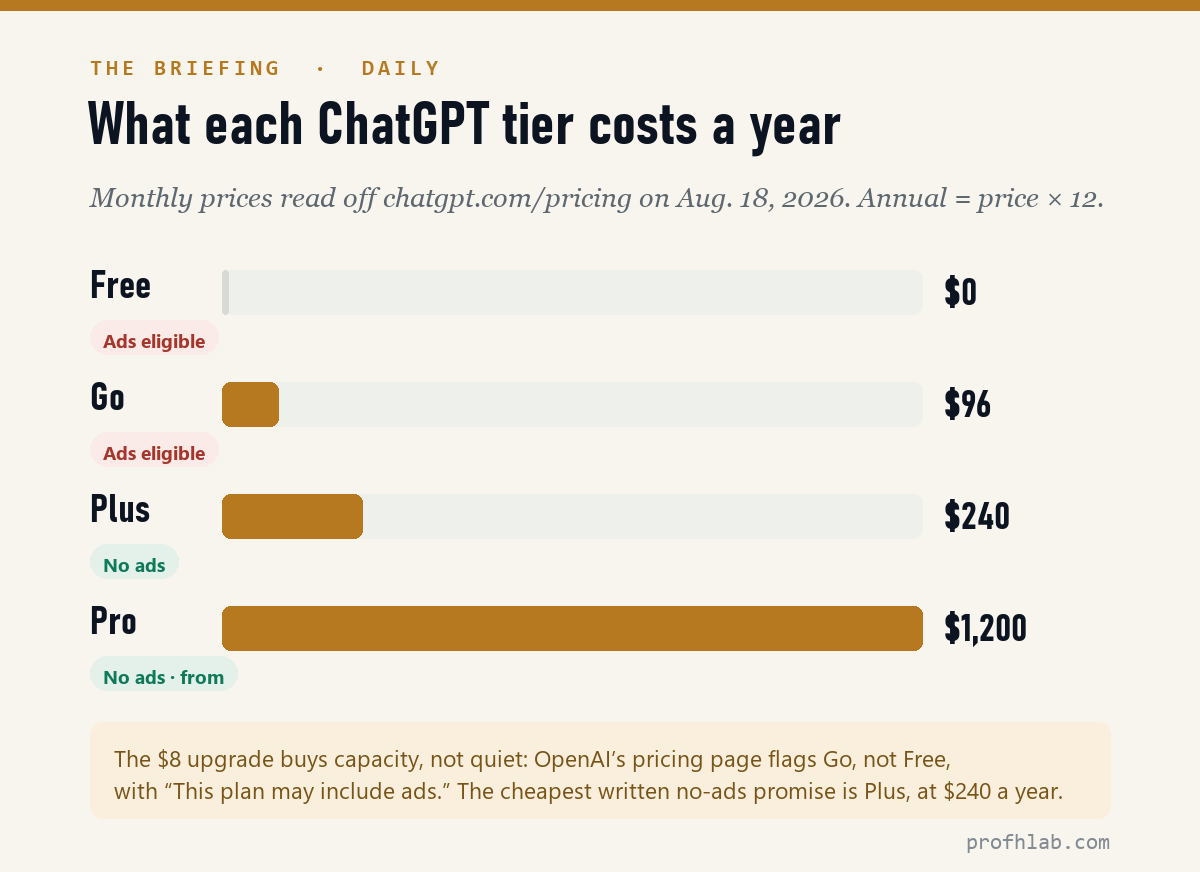
Put plainly: $8 does not buy you an ad-free ChatGPT. It buys headroom — more messages with tools, more uploads, more image generation, a longer memory. If your reason for paying was to make the ads stop, Go is the wrong purchase, and the right one costs two and a half times as much.
Four ways to see fewer ads — three of them are free
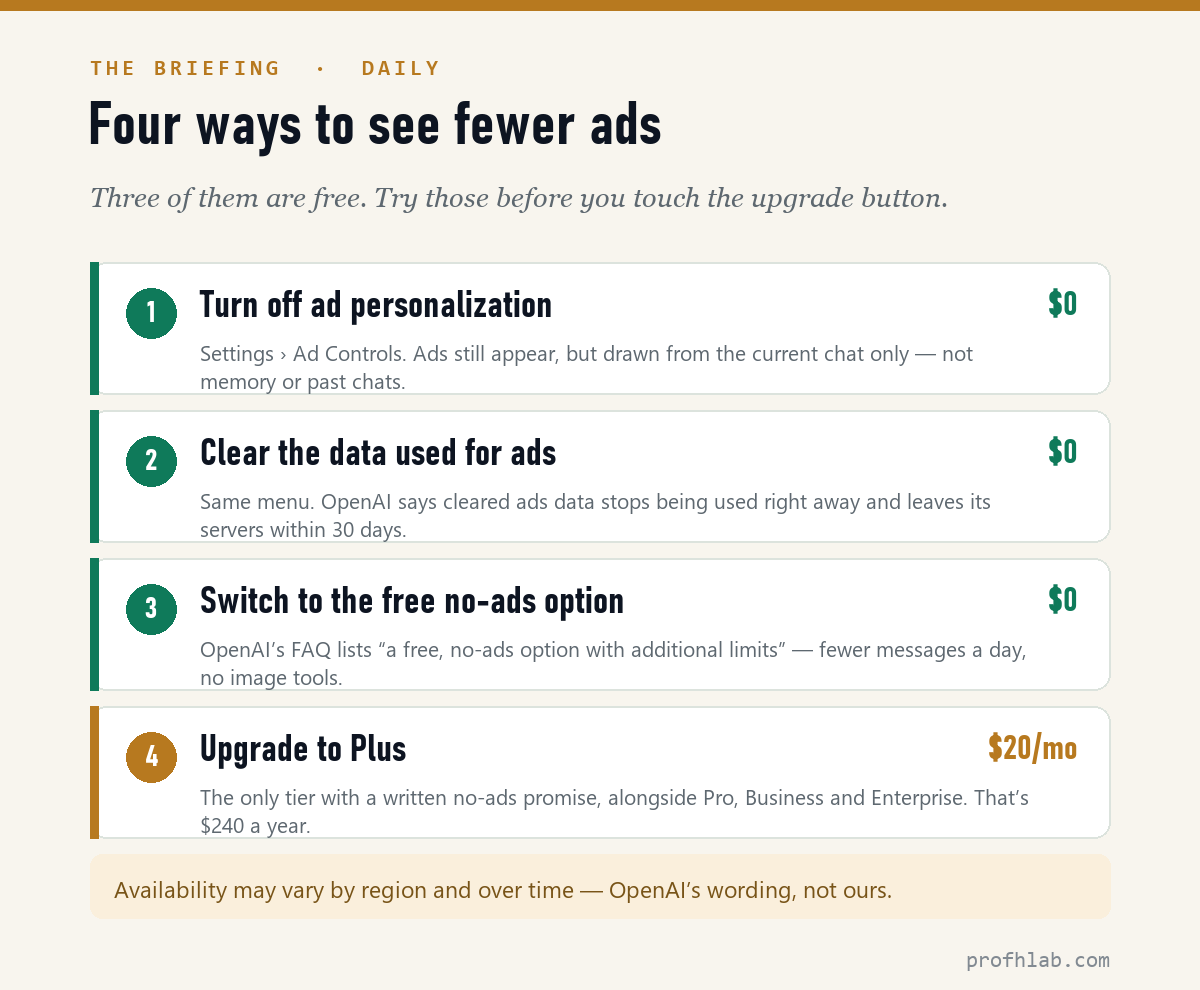
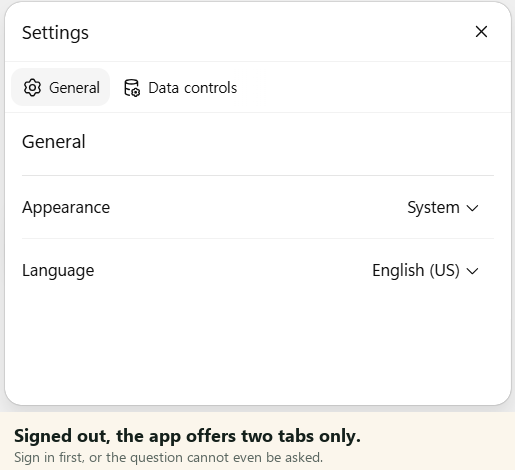
1. Turn off ad personalization ($0). OpenAI’s FAQ points to Settings › Ad Controls, where you can switch personalization off, clear the data used for ads, dismiss an ad, and ask why you are being shown a particular one. Be clear about what this does and doesn’t do: with personalization off you will still see ads, but they are drawn from the context of your current chat thread rather than from memory and past conversations.
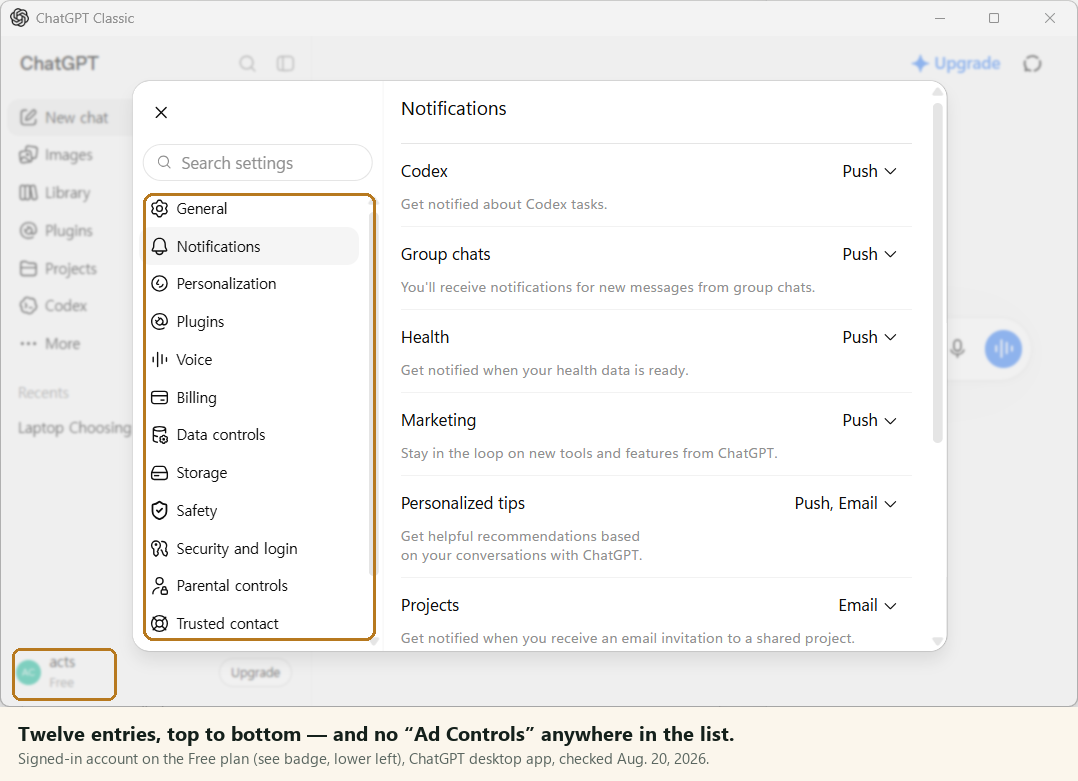
2. Clear the ads data ($0). Same menu. OpenAI’s wording: if you delete your ads data, “it’s no longer used to show you ads,” and that data “is retained for up to 30 days before being removed from our servers.”
3. Ask for the free no-ads option ($0). This is the line almost nobody has read. Under “Will there be a way to not see ads?”, OpenAI lists two routes — upgrading to Plus or Pro, and “a free, no-ads option with additional limits (fewer messages per day and no access to tools like images).” The FAQ does not spell out where that option is selected, and adds that “availability may vary by region and over time.” If quiet matters more to you than image generation, it is worth looking for before you spend $240.
4. Upgrade to Plus ($20/month). The written promise — “Plus, Pro, Business, Enterprise, and Edu accounts will not have ads” — lives in the help center, and OpenAI’s January announcement said the same. That is the honest price of silence.
A test worth running before you pay anything.
Use ChatGPT normally for one week and note the days you actually hit a wall — a refused upload, a slower model, an image you couldn’t make. Fewer than two? You are paying for headroom you don’t use. Most people upgrade on the memory of one frustrating afternoon, not on a week of evidence.
What ads can and cannot use
The privacy questions in our inbox all reduce to one: does the advertiser now know what I typed? On OpenAI’s own account, no. The FAQ states that conversations are not shared with advertisers and that data is never sold to them; advertisers receive “aggregated, non-identifying information about how their ads perform, such as total views or clicks.” If you message an advertiser through an ad, that advertiser sees only the messages you send them.
Four other limits OpenAI puts in writing, worth knowing before you go looking for a setting that does not exist:
- No ads near sensitive topics. Ads “are not eligible to appear near sensitive or regulated topics, including personal health, mental health, or politics.”
- No ads in Temporary Chats. A useful lever: if you want a conversation to sit outside all of this, start it as a Temporary Chat.
- No ads for accounts identified as under 18, based on account-level age information and age prediction.
- Ads do not steer answers. OpenAI’s stated principle is answer independence — responses are optimized for what is helpful, not for advertisers. That is a promise, not a mechanism you can inspect, and it should be read as one.
What the other two assistants are doing
Ads are not yet an industry norm, which is exactly why the ChatGPT decision matters. Here is where the other two sit today.
| Assistant | Entry paid price | Ads today |
|---|---|---|
| ChatGPT | $8 Go · $20 Plus | Ad test running in the U.S. on Free and Go since Feb. 9, 2026 |
| Claude | $17/mo billed annually ($200 upfront) · $20 monthly | None. Anthropic’s pricing page makes no mention of advertising |
| Gemini | $7.99 Google AI Plus · Ultra from $100 | None in the Gemini app. Google’s ads run in AI Mode and AI Overviews inside Search |
One quiet consequence: Claude’s annual billing now undercuts a monthly ChatGPT Plus subscription by $3 a month, and Google’s entry paid tier sits below ChatGPT Go. If ads are the thing you are trying to escape, the ad-free floor across the three is not $20 — it is $7.99.
Where this briefing stops.
Three honest limits. First, OpenAI’s own two pages disagree about Go: the ads FAQ lists Go as ad-eligible, while the “What is ChatGPT Go?” page says only that OpenAI “may start testing ads in ChatGPT Go in the future.” We quote both rather than pick one.
Second, Google’s live plan page renders local currency from wherever you load it, so we could not read U.S. dollar figures off it today. The $7.99 Google AI Plus price comes from Google’s January 27, 2026 U.S. availability post, and the Ultra figures from Google’s May 19, 2026 I/O post, which announced a cut “from $250 to $200” plus a new $100/month tier.
Third, this is a rollout: OpenAI says availability “may vary by region and over time.” What you see in your own Settings menu today is the authority; this page is a map, not a mirror.
Paying $8 for Go buys no written promise of an ad-free ChatGPT
Does ChatGPT Go have ads?
OpenAI’s ads FAQ lists Free and Go as the plans where ads may appear, and the Go card on chatgpt.com/pricing carries the line “This plan may include ads.” The separate “What is ChatGPT Go?” help page is more tentative, saying OpenAI “may start testing ads in ChatGPT Go in the future.” Either way, paying $8 does not come with a written no-ads promise.
How do I turn off ads in ChatGPT?
You cannot switch ads off on a free or Go account, but you can switch off personalization. OpenAI’s FAQ points to Settings › Ad Controls, where you can turn off ad personalization, clear the data used for ads, hide an individual ad, and see why you are being shown it. With personalization off you still see ads, drawn from your current chat thread rather than from memory or past chats.
Is there a way to use ChatGPT without ads for free?
OpenAI’s FAQ says yes: alongside upgrading to Plus or Pro, it lists “a free, no-ads option with additional limits (fewer messages per day and no access to tools like images).” The FAQ does not describe where that option is selected and notes that availability may vary by region and over time.
Does OpenAI sell my conversations to advertisers?
OpenAI states that it does not share your ChatGPT conversations with advertisers and never sells your data to them. Advertisers receive aggregated, non-identifying performance information such as total views or clicks. If you message an advertiser through an ad, that advertiser sees only the messages you send them directly.
Will ads show up when I ask about my health?
OpenAI says ads “are not eligible to appear near sensitive or regulated topics, including personal health, mental health, or politics.” Temporary Chats do not show ads at all, and accounts identified as belonging to users under 18 are not shown ads.
How much more does the ad-free version cost?
Plus is $20 a month, or $240 a year — $144 a year more than the $8 Go plan and $240 a year more than staying free. Pro starts at $100 a month, or $1,200 a year.
Sources
- OpenAI, ChatGPT Pricing — plan prices and the Go ads notice, read August 18, 2026.
- OpenAI Help Center, Ads in ChatGPT — test start date, eligible plans, controls, data handling, retention, exclusions. Page updated August 18, 2026.
- OpenAI Help Center, What is ChatGPT Go? — plan contents and availability.
- OpenAI, Our approach to advertising and expanding access to ChatGPT, January 16, 2026 — $8 U.S. price, ad testing plan, ad-free tiers, ads principles.
- Anthropic, Claude pricing — Free, Pro and Max prices, read August 18, 2026.
- Google, Google AI Plus U.S. availability, January 27, 2026, and Google AI subscription updates from I/O 2026, May 19, 2026.
Before paying: prices, rival chatbots and fake renewal emails
- The AI price tracker — every assistant, writing tool, CRM and home robot we follow, with the month each price was checked.
- How to use ChatGPT if you’re over 50 — the five-step start, including what the ad cards look like on screen.
- ChatGPT vs. Claude vs. Gemini — which of the three actually writes better, tested on the same brief.
- AI scams targeting seniors — because “your subscription has expired” emails are about to get a lot more plausible.
About the author. I teach AI and robotics, and I run this lab site the way I run a class demo: every price is read off the vendor’s own page, and dated. Nothing here is financial advice. If a figure above no longer matches what you see, that is the point of the date — tell me and I’ll re-check it.
Prof.’s H Newsletter
One short email a month, with the numbers in it
What actually moved in AI hiring, AI prices, and the scams aimed at older Americans. Counted here, dated, and linked to the source. One email a month, and your address goes nowhere else.