AI Scam Watch: September 2026 – What Are the Most Common AI Scams?
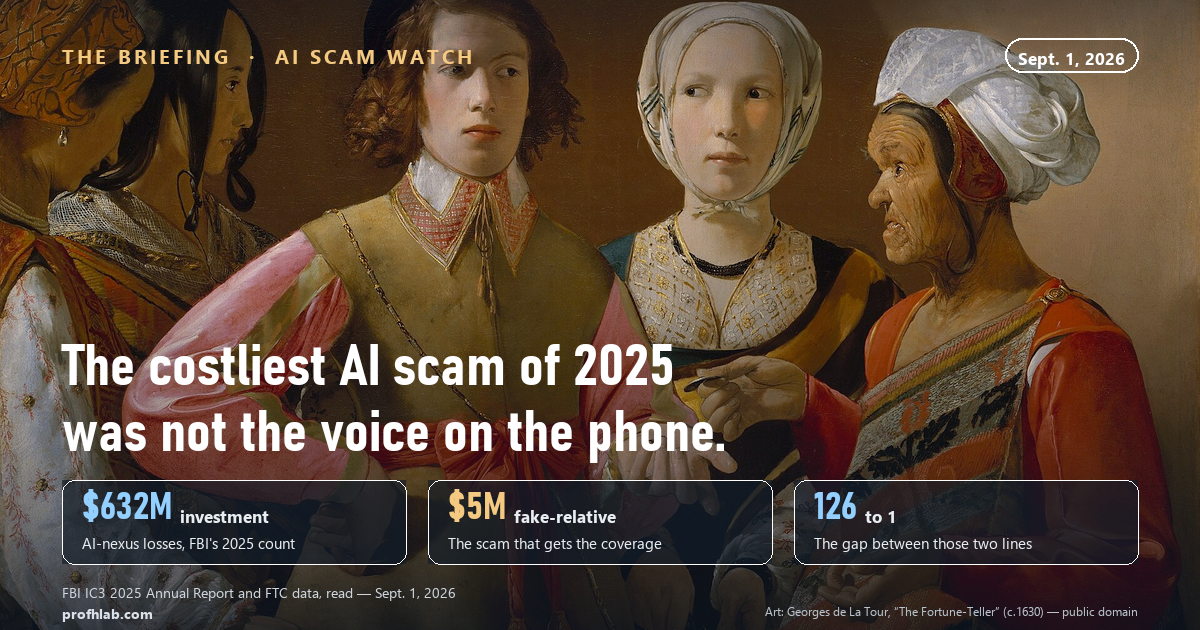
The most common AI scams are deepfaked investment pitches, business email fraud, romance schemes, fake job interviews, and the cloned-voice call from a relative in trouble. In 2025 those complaints cost Americans $893,346,472 across 22,364 reports, according to the FBI’s Internet Crime Complaint Center. But the order is not the one you know from television: deepfaked investment pitches took $632 million of that total, while the cloned-grandchild call — the scam in nearly every local news segment ever aired on this subject — took $5 million. That is a gap of 126 to 1.
This is the first edition of AI Scam Watch, a monthly read of what the federal fraud agencies actually published, rather than what got covered. We do it on the first of the month, from primary documents only.
What we counted, and when
On September 1, 2026 we read the FBI IC3 2025 Annual Report in full, the IC3 public service announcement of July 20, 2026, two FTC press releases, and all eleven consumer alerts the FTC published in August 2026. Every dollar figure below is quoted from one of those documents, or is our own arithmetic on numbers they publish themselves. Nothing here is estimated.
What are the most common AI scams?
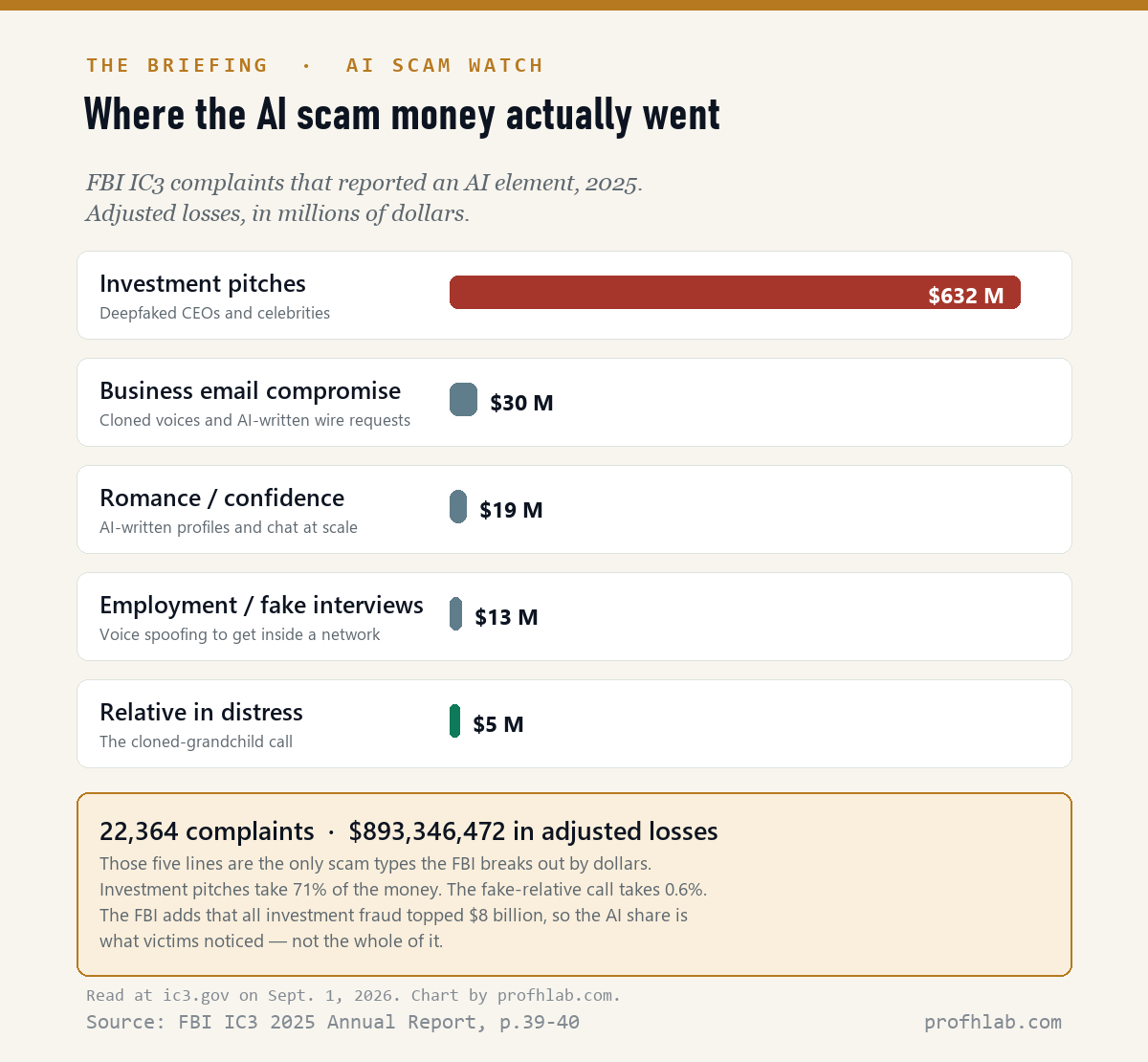
The FBI keeps the only public ledger that assigns dollars to AI-assisted fraud. In 2025 it received 22,364 complaints in which the victim reported an AI element, and it breaks those losses into five named categories.
| Scam type | 2025 AI-nexus losses | Share | How the AI is used |
|---|---|---|---|
| Investment pitches | Over $632 million | 71% | Generated video and voice of celebrities, CEOs and “trusted figures” to sell fake opportunities |
| Business email compromise | Over $30 million | 3.4% | Chat generators write executive-sounding wire requests; voice cloning confirms them |
| Romance and confidence | Over $19 million | 2.1% | Fake profiles and scripts that make the conversation believable at scale |
| Employment and fake interviews | Almost $13 million | 1.5% | Voice spoofing during interviews, usually to reach a private network rather than cash |
| Relative in distress | Over $5 million | 0.6% | The cloned voice of a grandchild or child in an invented emergency |
Read that bottom row again. The distress call is the scam that made AI fraud a household worry. It is also, in the FBI’s own accounting, the smallest line on the board.
The reason is arithmetic, not sympathy. A fake grandchild asks for bail money, and there is a ceiling on what a frightened person can wire in an afternoon. A fake portfolio manager asks you to fund an account, and then to fund it again next month, and the ceiling is whatever you have. Scammers went where the ceiling is higher.
The honest limit on this number
These are complaints in which the victim noticed AI. That is a floor, not a total, and the FBI says so plainly: overall investment fraud losses topped $8 billion in 2025, and the bureau notes that “many victims do not realize the extent AI may be involved in scams.” So do not read the $5 million distress figure as proof that voice cloning is rare — a cloned voice is precisely the thing a victim cannot detect and therefore cannot report. Read the ranking instead as what it is: of the AI fraud that victims could see, seven dollars in ten went into an investment pitch.

A second federal ledger says the same thing
The FTC keeps a separate database, and it is worth knowing that the two agencies do not produce the same total. For 2025 the FTC reported about $16 billion in fraud losses; the FBI reported $20.877 billion. Neither is wrong. They are different intake systems counting different populations of people who chose to file, and any article citing one number as “the” figure is quietly picking a side.
What matters is that they agree on direction. On April 27, 2026 the FTC reported that social media was the costliest way scammers reached people in 2025 — $2.1 billion, an eightfold increase since 2020, with nearly 30% of all loss reports starting there. And within that, investment scams took $1.1 billion, more than half.
Two agencies, two databases, two methodologies, one finding: the pitch that empties an account is an investment pitch, and it arrives on a screen you were already scrolling. If you have ever wondered whether you can buy OpenAI stock, you have felt the exact appetite these schemes are built to catch.
What changed in August 2026
Three things worth your attention, all from federal documents published in the last six weeks.
1. The fraud reporting center is itself being faked
On July 20, 2026 the FBI issued a public service announcement with an almost unbelievable title: FBI Warns of Scammers Impersonating the IC3. IC3 is the FBI’s Internet Crime Complaint Center — the exact place every article like this one tells you to report fraud. As of September 1, 2026, the warning is the first thing on the IC3 homepage.
The scheme targets people who have already lost money. Criminals build fake FBI personas on social media, and — this is the new part — publish AI-generated videos of a senior FBI official urging viewers to file a complaint on a spoofed IC3 website. The site looks right. It collects your name, phone number, email, scam type and how much you lost, gives you a reference number, and promises someone will be in touch.
The tell is beautiful, and it is the opposite of what you would guess.
The fake form is shorter than the real one
The FBI notes that the spoofed complaint page is a single step asking five fields, while the genuine IC3 intake is a longer, multi-part form. Of course it is. The criminals optimized for completion; the government optimized for evidence. If a government fraud form feels pleasantly quick, that is the warning sign — not the reassurance.

Four rules come straight from that PSA, and they are worth more than any detection app:
- IC3 has no social media presence. None. Any profile or page claiming to be it is fake by definition.
- IC3 never contacts individuals by phone, email, social media, chat or forum. Contact comes from FBI employees at local field offices.
- IC3 never asks for payment to recover funds, and never refers you to a company that does.
- Type
www.ic3.govinto the address bar. Do not search for it.
2. The FTC warned about the same second bite
Two weeks earlier, on August 3, 2026, the FTC published its own version: Have you lost money to a scam? Watch for scammers who say they can help. The mechanism it describes is cold. Refund and recovery scammers buy lists of people who have already been scammed, then call claiming to be from a government agency — the alert notes they will even claim to be the FTC itself — a consumer group, or a law firm, and ask for a “retainer fee” or your bank details to deposit the refund.
If you take one sentence from this month’s edition, take this one: the single strongest predictor of being targeted is having been targeted. A loss is not the end of the episode. It is an entry on a list that gets resold.
3. The entry point has moved to the ad slot
Here is our own count. We read all eleven consumer alerts the FTC published in August 2026 and classified them. Eight describe a specific consumer scam. Four of those eight name a paid placement as the way it reached the victim — a search ad, a feed ad, or a paid endorsement.
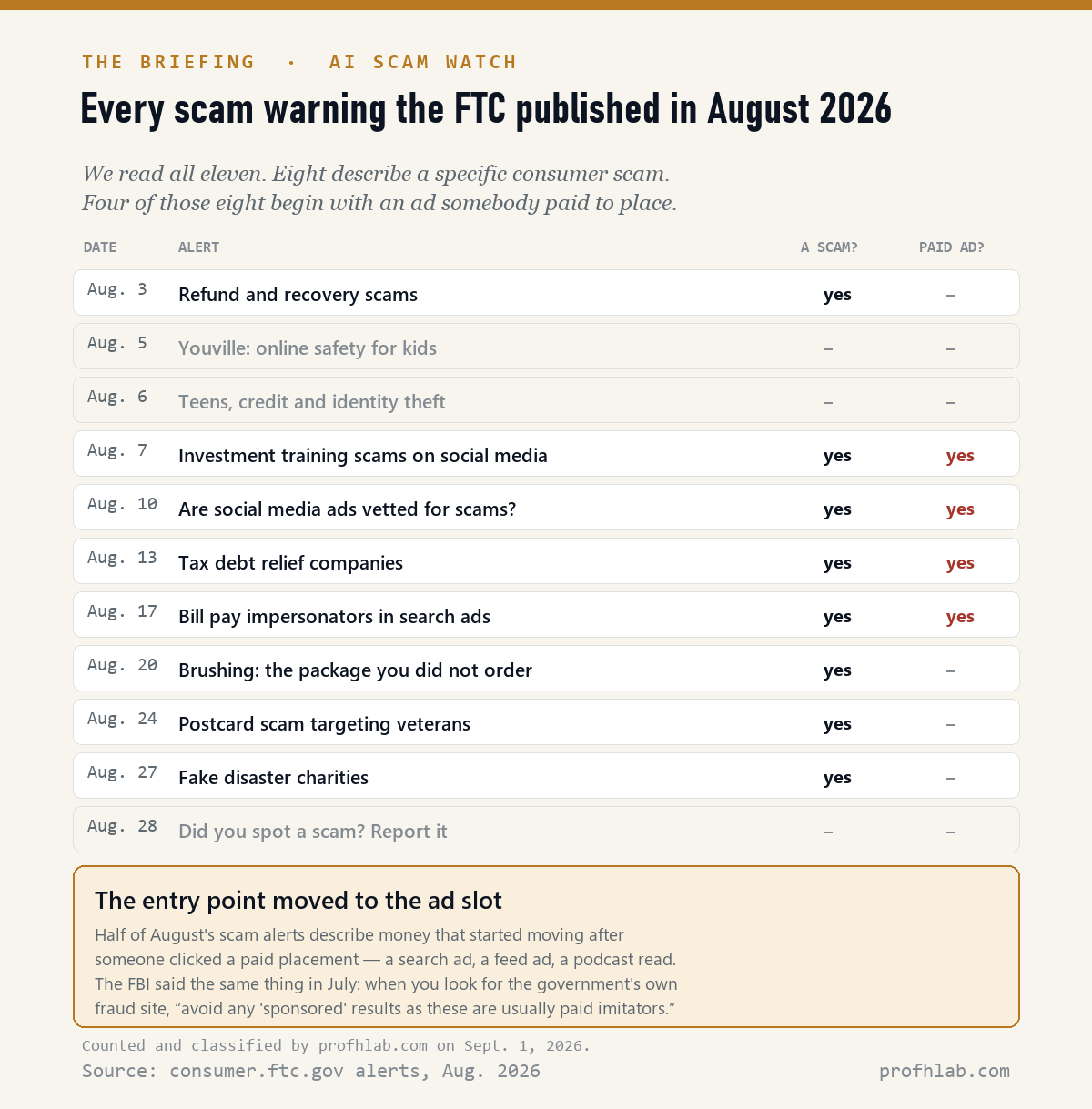
The August 17 alert is the plainest: you search for a company’s bill-pay page, and a dishonest operator has bought the ad above the real result. The August 10 alert says outright that platforms “don’t always thoroughly vet the ads you see or the advertisers behind them,” and that in 2025 people reported losing more than $95 million after ordering something from a social media ad.
And the FBI, in that same IC3 warning, gives the identical instruction from the other direction: when looking for the government’s own fraud site, “avoid any ‘sponsored’ results as these are usually paid imitators.”
Two agencies. Two documents. One month. The same sentence: the danger is now above the real result, not below it. If you want the practical version of this skill, our guide on how to tell if a Facebook ad is fake walks through it click by click.
One more thing about the AI premium
Here is a calculation the FBI does not print, but its numbers support. In 2025 the average IC3 complaint reported a loss of $20,699. Divide the AI-nexus losses by the AI-nexus complaints and you get $39,946.
An AI-assisted scam costs its victim about 1.9 times the average. AI complaints were only 2.2% of all reports but 4.3% of all dollars. The technology is not producing more scams so much as producing more expensive ones — because a convincing face and a familiar voice let a criminal ask for a much larger number without the request sounding absurd.
Why the losses land hardest after 60
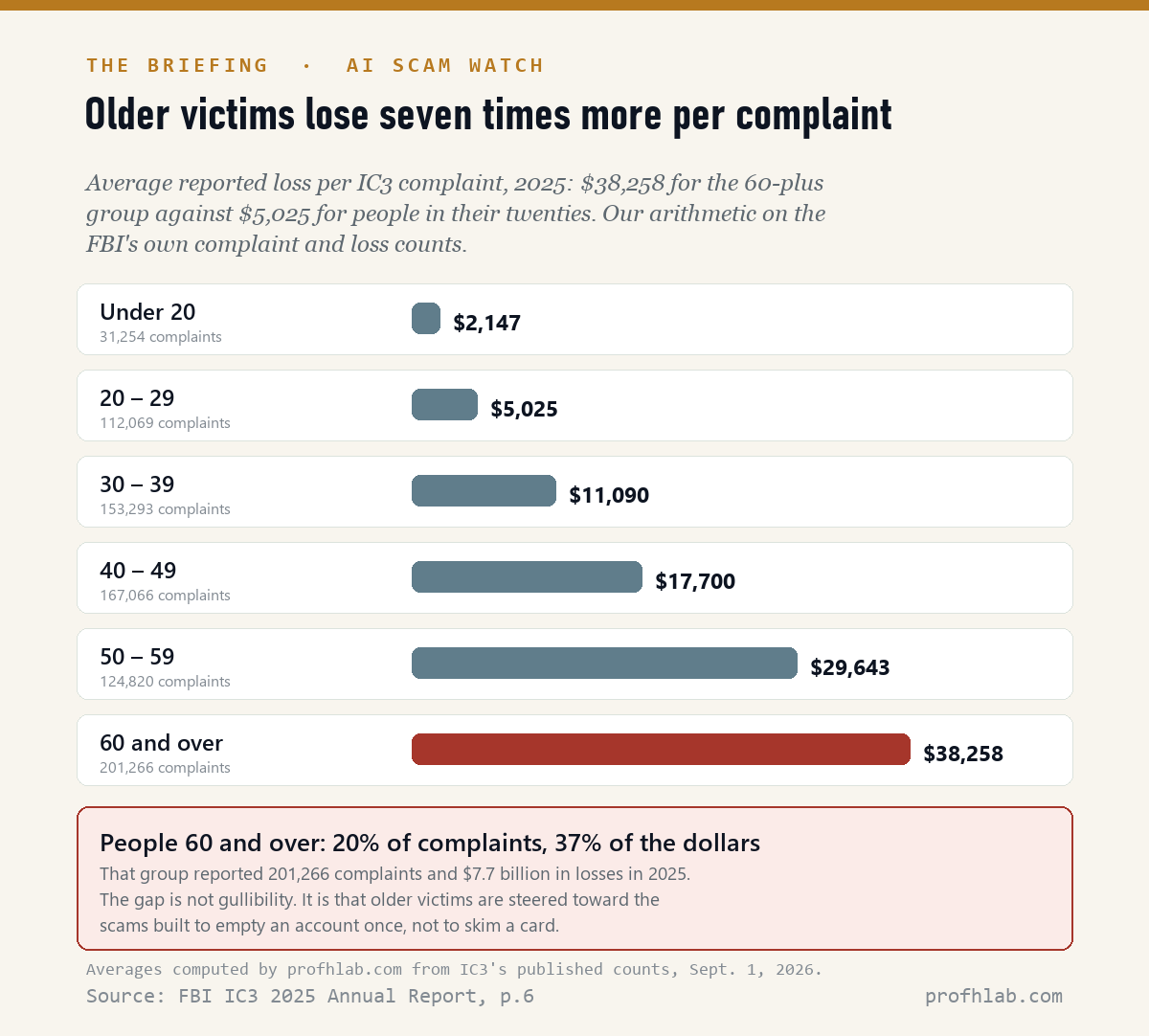
People 60 and over filed 201,266 complaints in 2025 and reported $7.7 billion in losses. That is 20% of the complaints and 37% of the money. Per complaint, an older victim lost $38,258 against $5,025 for someone in their twenties.
The usual explanation is that older people are more easily fooled. The data suggests something less flattering to the rest of us and more useful to everyone: older adults are disproportionately steered toward the schemes designed to empty an account once — investment, romance, tech support — while younger victims are more often hit by the small stuff. It is a difference in which scam finds you, not in how sharp you are.

That last detail is worth holding on to. If you are helping a parent in their eighties, the phone is still the front door, and our guide to telling whether a phone call is AI is the right place to start. If you are helping someone in their sixties or seventies, the feed is the front door.
Agree on a family safe word and one rule for investment pitches
Five things, in the order they actually help.
- Agree on a family safe word today. Not a birthday, not a pet — something absent from the internet. Any call claiming an emergency must produce it. This costs nothing and defeats the entire distress-call category.
- Make one rule about investments: no pitch that arrives on a screen. Not a video of a famous investor, not a friend’s tip in a group chat, not an “investment club.” The FBI’s $632 million line is that rule’s justification.
- Type government addresses, never search them.
ic3.gov,ftc.gov,reportfraud.ftc.gov,ssa.gov,medicare.gov. Both agencies now warn that the sponsored slot above the real result is a known attack. - If you have already lost money, expect the second approach. Nobody legitimate charges a fee to recover funds. Report at ic3.gov and reportfraud.ftc.gov, and treat every subsequent offer of help as hostile until proven otherwise.
- Tell one person. The FTC’s August 28 alert makes the case: reports feed the Consumer Sentinel database that law enforcement actually works from, and most fraud is never reported at all.
Free help, no charge, no catch
Report fraud: reportfraud.ftc.gov or ic3.gov. Identity theft recovery plans: identitytheft.gov. Free credit reports weekly: annualcreditreport.com. If someone has pressured an older adult for money, the Justice Department’s National Elder Fraud Hotline is 1-833-372-8311. None of these ever charge a fee.
The fake FBI complaint site and deepfake celebrity pitches
Stop checking fingers and check where a video came from
- “How do I check whether a video or photo is generated?” Stop looking at fingers and start checking provenance. We walked through the tools that work in how to tell if a picture is AI generated and the same test for YouTube videos.
- “Is the job offer real?” The employment category in the FBI’s table is small in dollars but aims at your network credentials. See are AI training jobs legit, and our live AI jobs tracker for postings we verify ourselves.
- “How do I reach a human at my bank?” Half of scam damage happens because the real company is hard to reach. How to talk to a real person.
- “What should an older relative actually turn off?” Start with AI scams targeting seniors, then getting AI off a phone and stopping Meta AI from using Facebook photos.
- “I want to use these tools, not just fear them.” Fair. ChatGPT for beginners over 50, the best AI tools for seniors, and making AI photos with grandparents.
- “What do these companies do with what I type?” See uploading medical records to ChatGPT, stopping AI from reading Gmail, and whether deleted chats are really deleted.
Grandparent calls, FBI versus FTC totals and recovery offers
What are the most common AI scams?
By the FBI’s 2025 count, the five categories with reported dollar losses are investment pitches (over $632 million), business email compromise (over $30 million), romance and confidence schemes (over $19 million), employment and fake-interview scams (almost $13 million), and relative-in-distress voice cloning (over $5 million). Investment pitches are 71% of the AI-related money.
Is the AI grandparent scam actually common?
It is common enough that the FBI names it as a distinct category, and it is the scam most likely to be described in local news. But in dollars it is the smallest of the five named categories: over $5 million of $893 million in 2025. One caution: this counts only complaints where the victim recognized AI, and a cloned voice is exactly the thing a victim cannot detect, so the true figure is higher than $5 million.
How much money do people lose to AI scams?
In 2025 the FBI logged 22,364 complaints reporting an AI element with $893,346,472 in adjusted losses. That is 2.2% of all complaints but 4.3% of all reported dollars. The average AI-flagged complaint reported $39,946, against an overall IC3 average of $20,699.
Why do the FTC and FBI report different fraud totals?
They run separate intake systems. For 2025 the FTC reported roughly $16 billion in fraud losses and the FBI reported $20.877 billion. Different people file with different agencies, and the categories are not aligned. Neither number is the “real” one; both are floors, since most fraud is never reported.
Is the FBI’s IC3 website really being impersonated?
Yes. In a public service announcement dated July 20, 2026, the FBI described AI-generated videos of a senior FBI official directing people to a spoofed IC3 complaint site. The warning appears at the top of ic3.gov. IC3 has no social media presence, never contacts people directly, and never charges to recover funds.
Someone says they can recover the money I lost. Is that real?
Almost certainly not. The FTC’s August 3, 2026 alert describes refund and recovery scammers who buy lists of prior victims and pose as government agencies, consumer groups or law firms. No government agency or legitimate organization asks for money or financial information in exchange for help getting a refund.
Which age group loses the most to scams?
People 60 and over, by a wide margin in dollars: 201,266 complaints and $7.7 billion in 2025, or 37% of all reported losses from 20% of complaints. Average loss per complaint rises with every age band, from $2,147 under 20 to $38,258 at 60 and over.
What is the single most effective thing I can do?
Two things, and both are free. Agree on a family safe word that appears nowhere online, and adopt a rule that no investment pitch arriving on a screen is ever acted on. Those two habits cover the largest and the most frightening categories in the FBI’s table.
Cite this
Prof. H, “AI Scam Watch: September 2026,” profhlab.com, September 1, 2026. Key figures: FBI IC3 logged 22,364 AI-related fraud complaints in 2025 with $893,346,472 in adjusted losses; deepfaked investment pitches accounted for over $632 million (71%) and relative-in-distress voice cloning over $5 million (0.6%). Average AI-flagged loss $39,946 vs. $20,699 for all IC3 complaints (profhlab.com calculation). Journalists and broadcasters are welcome to use these figures with attribution and a link.
Sources
- FBI Internet Crime Complaint Center, 2025 IC3 Annual Report (complaint and loss totals p.6; AI section pp.39–40). Read September 1, 2026.
- FBI IC3, “FBI Warns of Scammers Impersonating the IC3”, public service announcement, July 20, 2026.
- Federal Trade Commission, “FTC Data Show People Reported Losing $3.5 Billion to Imposter Scams in 2025”, June 15, 2026.
- Federal Trade Commission, “New FTC Data Show People Have Lost Billions to Social Media Scams”, April 27, 2026.
- FTC consumer alert, “Have you lost money to a scam? Watch for scammers who say they can help”, August 3, 2026.
- FTC consumer alert, “Are ads on social media vetted or checked for scams?”, August 10, 2026.
- FTC consumer alert, “Searching online: bill pay impersonators”, August 17, 2026.
- FTC consumer alert, “Did you spot a scam? Here’s what to do next”, August 28, 2026.
- All eleven FTC consumer alerts published in August 2026, read in full and classified by profhlab.com on September 1, 2026. Our method is described in how we count.
Until October 1: the plain-language companion and The Briefing
- The Briefing — our daily read of AI news that touches your wallet.
- AI scams targeting seniors — the plain-language companion to this report.
- Start here and the resources page if you are new to the site, or the FAQ if you have a specific question. You can also ask us one.
Next edition: AI Scam Watch, October 1, 2026. We will re-read the FTC’s September alerts and check two things in particular — whether the IC3 impersonation warning is still on the FBI’s homepage, and whether the share of alerts naming a paid ad as the entry point rises above four in eight.
This article is general consumer information, not financial or legal advice. Figures are as reported by the agencies named, on the dates given.
About the author
Prof. H is a robotics and AI professor who writes profhlab.com, where every article is drafted with AI assistance and then checked, corrected and signed off by a human against primary sources. Corrections are welcome at profhlab@gmail.com. One short email a month, no more, if you want new editions of AI Scam Watch when they publish.
Prof.’s H Newsletter
One short email a month, with the numbers in it
What actually moved in AI hiring, AI prices, and the scams aimed at older Americans. Counted here, dated, and linked to the source. One email a month, and your address goes nowhere else.