Are AI Training Jobs Legit? We Counted 3,681 Real Openings (August 2026)
The message usually arrives in the evening. Train AI from home. Twenty-five to forty-five dollars an hour. Choose your own hours. No experience needed. There is no company name in it, and no way to reply except the app it came from.
Search are AI training jobs legit and the first page is a wall of sites answering yes, or no, or it depends. Almost none of them counts anything.
So on August 27, 2026 we read every open role on the public job boards of 20 AI and robotics companies – 3,681 postings – and sorted them by the employment type each employer attached to its own listing.
Of the 1,920 postings that carry an explicit label, four are part-time. All four belong to one company, and every one of them is in Europe. Not one part-time role, at any of these twenty employers, is based in the United States.
How we counted
We read the public job-board feeds of OpenAI, Anthropic, xAI, Google DeepMind, Scale AI, Mercor, Perplexity, Cohere, Sierra, ElevenLabs, Cursor, Cognition, Replit, Figure AI, Apptronik, Agility Robotics, 1X, Physical Intelligence, Waymo and Nuro on August 27, 2026. Employment type is a field the employer fills in, and not every board publishes it: 1,920 of the 3,681 postings carry it, and the 1,761 that do not come from boards that omit the field entirely rather than from employers hiding something.
Every count below is of explicit labels, every rate is what the employer printed, and every quotation is verbatim from the posting or page named. We are not recruiters, we take no money from any employer here, and postings close without notice – the official page always wins.
3,681 openings, sorted into real jobs and marketplaces
- What 3,681 openings actually say
- What a real AI training job looks like
- The marketplaces, and why they confuse everyone
- The third layer, and what it costs people
- Five questions that settle it in ten minutes
- What to apply for instead
- What to do this week
- Questions people actually search
What 3,681 openings actually say
Here is the shape of the thing. Of the 1,920 labelled postings, 1,901 are full-time. Eight are contract, seven are internships or residencies, and four are part-time.
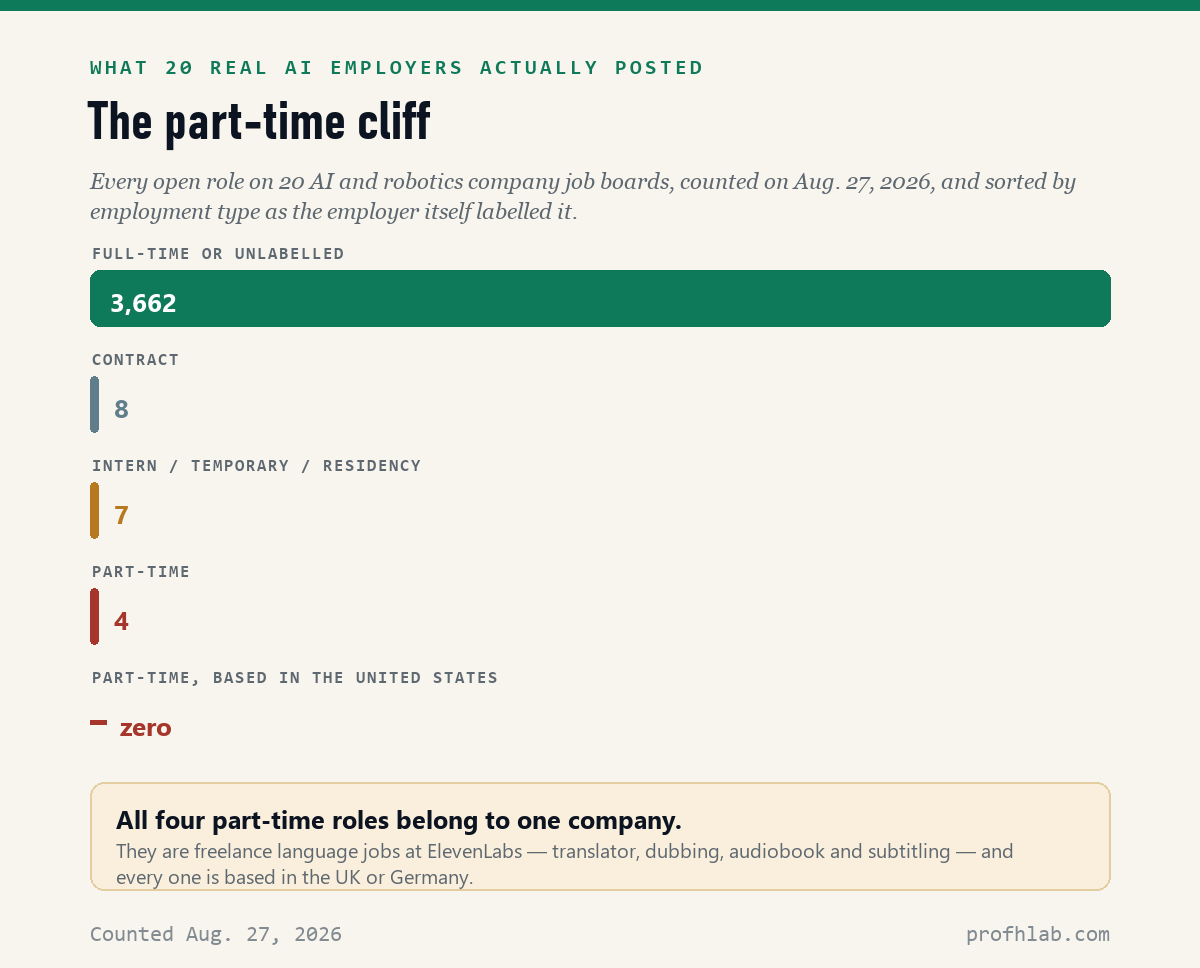
The four part-time roles are all at ElevenLabs, and they are all freelance language work: a translator and linguist role, an audiobook specialist, a dubbing specialist and a transcription and subtitling specialist. Three are based in the United Kingdom and one in Germany.
That is the finding worth sitting with. The companies building these models are not, on the whole, hiring Americans part-time to help train them. Which raises an obvious question about the enormous volume of advertising that says otherwise. That advertising is not coming from these twenty employers. It is coming from somewhere else.
What a real AI training job looks like
Cohere has six contract Data Annotation Specialist postings open right now. Read one and the difference from an advertisement becomes physical.

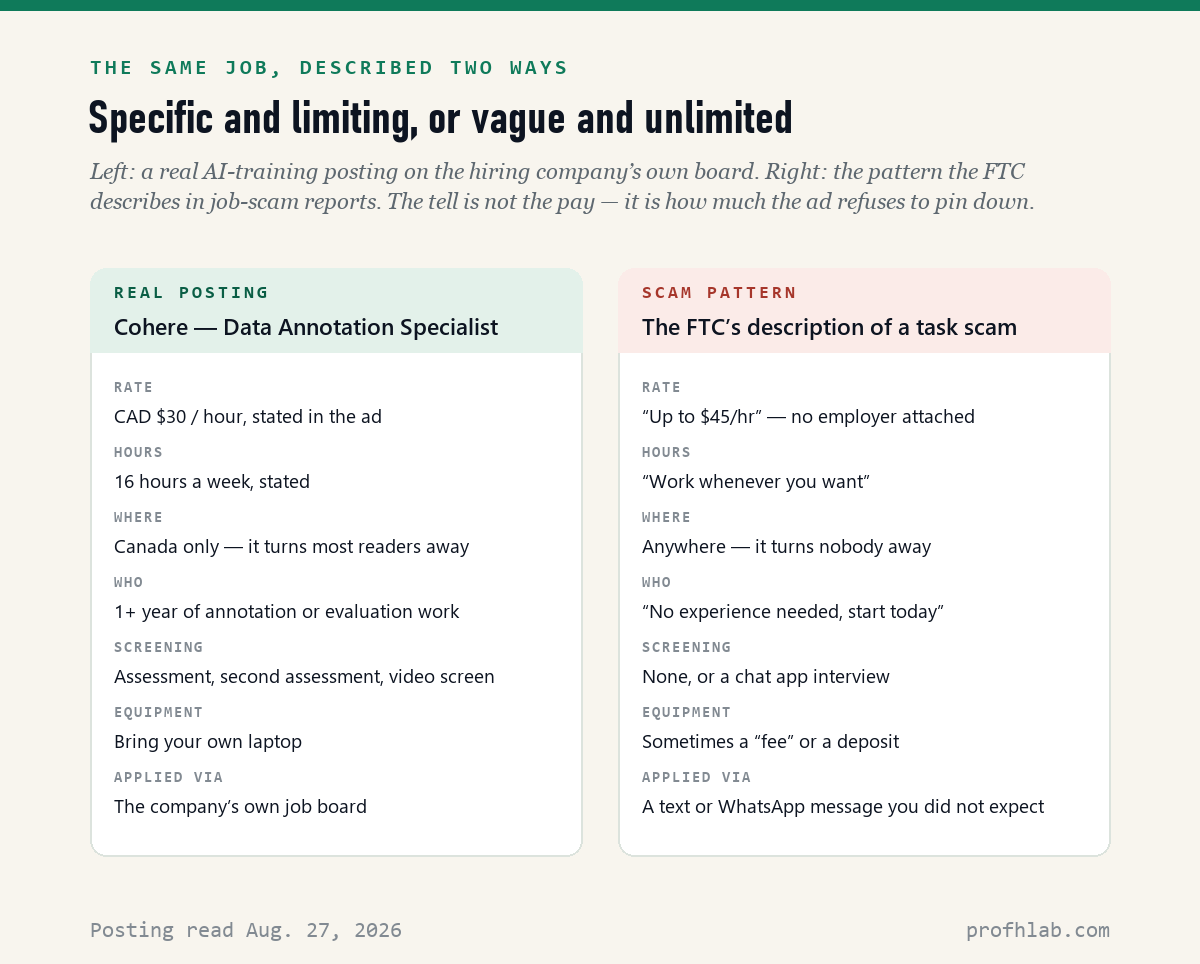
The posting says, in plain type: “This is a part-time independent contractor position available within Canada only. We seek candidates who can commit to 16 hours per week at a CAD $30/hour contract rate. This role is BYOD (Bring Your Own Device, laptop). This position is remote.”
Count what that single paragraph settles. The rate. The hours. The country. Who pays for the laptop. Now notice what it costs Cohere to say all of it: every one of those specifics turns candidates away. Anyone outside Canada is gone. Anyone needing full-time hours is gone. Anyone without a laptop is gone.
That is the tell, and it generalises. A real posting narrows. An advertisement widens. A company with sixteen hours of work to give has no reason to attract a hundred thousand applicants, so it writes the limits down. A message that wants the largest possible audience writes nothing down at all.
The posting is equally direct about the work: “This is a judgment-driven role, not passive data entry.” It asks for a year or more in annotation, model evaluation, content moderation or research, and describes a hiring process of four stages – an initial screening, a multiple-choice assessment by email, a second and more comprehensive assessment, then a video screen. Nobody builds that gauntlet for work that genuinely requires no experience.
The marketplaces, and why they confuse everyone
Between the company job board and the scam text sits a real and much larger layer: platforms that recruit contributors in bulk and place them on client projects. Outlier is the biggest name, and its own FAQ states the corporate relationship plainly: “Outlier is a platform operated by Scale AI that connects experts with leading AI companies to provide human feedback that improves language learning models.” Scale AI is one of the twenty boards in our scan, with 218 open roles this morning. Mercor is another, and it is advertising a remote US research fellowship at $40,000 to $80,000.
These are real companies. They are also the reason the question is so hard to answer, because their genuine marketing and the scam messages use identical words. Outlier’s homepage says “No AI experience needed” and “Work from wherever and whenever.” So does the text message. The phrase cannot be your test, because a legitimate platform and a criminal are both saying it.
What differs is everything around the phrase. Outlier describes onboarding that “typically takes 30 to 90 minutes and includes creating your account, selecting your areas of expertise, completing skill screenings so we can match you with the right projects, and identity verification.” It also tells you the uncomfortable part: “Available projects vary and may not always match your specific field.” That is a real limitation, printed by the platform itself. No scam advertisement has ever warned you that the work might dry up.
So the honest verdict on this middle layer is neither yes nor no. It is real work, paid per project, with no employment relationship, no guaranteed hours, and income that stops when a client’s project stops. Whether that is worth your evening is a judgement about your own finances. Whether it is a scam is a separate question, and the answer there is no.
The third layer, and what it costs people
Then there is the message that started this. The FTC has a name for its most common form – the task scam – and a count of how fast it grew. In its December 2024 data spotlight the agency reported that task-scam complaints went from zero in 2020, to 5,000 in 2023, to roughly 20,000 in the first half of 2024 alone.
Reported losses to job scams of all kinds more than tripled from 2020 to 2023, and exceeded $220 million in just the first six months of 2024. Task scams accounted for nearly 40 percent of job-scam reports that year. Cryptocurrency losses within that category hit $41 million in six months – nearly double the total for all of 2023.

The mechanics are worth knowing because they are counterintuitive. The FTC describes a scam that pays you first. You complete simple repeated tasks, small payouts arrive, and the payouts are the point: they buy your confidence. Only then does the request reverse, and you are asked to put your own money in to unlock the next set of tasks. That money does not come back.
This is why the usual advice about watching for bad grammar is useless here. Nothing looks wrong until the direction of payment flips.
The FTC’s own three rules are short enough to memorise. Ignore generic and unexpected texts or WhatsApp messages about jobs – real employers will never contact you that way. Never pay anyone to get paid. Do not trust anyone who says they will pay you to rate or like things online; that is illegal, and no honest company will do it.
Five questions that settle it in ten minutes
You do not need to research a company’s history. You need five answers.
1. Who is the employer, by name? If the advertisement does not name a company you can look up, stop. Every real posting in this article names one.
2. Is this posting on that company’s own website? Type the company’s address into the browser yourself and find the role on its careers page. Do not follow the link you were sent. This single step removes almost every impersonation.
3. What does the posting refuse me? A real one has limits – a country, an hour count, an experience minimum, a piece of equipment you must supply. If nothing in the advertisement excludes anybody, it is not a job posting.
4. Who contacted whom? If a stranger reached you first by text, WhatsApp or Telegram about work you never applied for, the FTC’s guidance is to ignore it outright.
5. Does money ever flow away from me? Not a fee, not a deposit, not equipment you must buy, not a check to deposit and partly forward. Payment runs one direction in real employment. Any exception is the scam.
What to apply for instead
The real annotation and language contracts open this morning are few, and geographically narrow. Here they are in full – this is not a selection, it is the complete set across all twenty boards.
| Role | Company | Where | Posted pay | Type |
|---|---|---|---|---|
| Data Annotation Specialist, Generalist | Cohere | Remote, Canada only | CAD $30/hr, 16 hrs a week | Contract |
| Data Annotation Specialist, Software Engineering | Cohere | Remote, Canada only | Rate on the posting | Contract |
| Data Annotation Specialist, Data Science | Cohere | Remote, Canada only | Rate on the posting | Contract |
| Translator / Linguist (Freelance) | ElevenLabs | Remote, United Kingdom | Not published | Part-time |
| Audiobook Specialists (Freelance) | ElevenLabs | Remote, United Kingdom | Not published | Part-time |
| Transcription / Subtitling Specialist (Freelance) | ElevenLabs | Remote, Germany | Not published | Part-time |
| Mercor Research Fellowship – APEX | Mercor | Remote, US | $40,000-$80,000 | Temporary |
Which is a thin market, and we would rather say so than pad it. But the same twenty companies had 812 remote US roles open this morning, most of them full-time with published pay. Several ask for coordination, support or operations skills rather than engineering.

| Remote US role | Company | Where | Posted pay |
|---|---|---|---|
| Software Quality Operations Specialist, Domain Expansion | Waymo | Remote, US | $120,000-$151,000 |
| Social Media Support Specialist (Weekend Shift) | Replit | Remote, US | $100,000-$145,000 |
| Enterprise Customer Support Specialist | Perplexity | Remote, US | $110,000-$130,000 |
| Recruiting Coordinator, Technical | OpenAI | Remote, US | $108,000-$145,000 |
| People Ops Coordinator | Perplexity | Remote, US | $105,000-$115,000 |
| Business Development Representative | Perplexity | Remote, US | $75,000-$120,000 |
Every one of those was live when we checked it on August 27, 2026, and each link goes to the employer’s own page. Our full running count, updated daily, is on the AI Jobs Tracker.
What to do this week
- If a message is sitting on your phone right now, run question 4 and question 5 against it. Those two settle most cases in under a minute.
- If you want the real annotation work, open the careers pages of Cohere, Scale AI and ElevenLabs directly and search for annotation, evaluation or linguist. Bookmark them; these postings appear and close quickly.
- If you are in the United States, accept what the count shows – the part-time channel barely exists here – and put the same hours into the full-time remote roles above, which pay several times more.
- If you already sent money or documents, report it at reportfraud.ftc.gov. Reports are what produced the numbers in this article.
If you want to go deeper
Which companies are hiring at all? We count every board – see which AI companies are hiring right now.
Is there entry-level work that is not annotation? Yes, and it pays better: how to become a data center technician with no experience.
Do you need a degree for any of this? We read 55 postings to find out: do you need a degree to be a robotics technician.
Ask the desk
Got an advertisement you are unsure about, or want this run for your state or your background? Send it over and we will go read the source and publish what we find.
Four part-time roles, none in the U.S.: can this pay a living?
Are AI training jobs legit?
The work is real; most of what is advertised as that work is not. On August 27, 2026 we read every open role on the job boards of 20 AI and robotics companies – 3,681 postings. Of the 1,920 that carry an explicit employment-type label, exactly four are part-time, and all four are freelance language jobs at ElevenLabs based in the UK and Germany. None is in the United States.
Real AI-training work does exist, but it comes through two narrow channels: contract roles posted on a company’s own job board, such as Cohere’s Data Annotation Specialist postings, and vetted marketplaces such as Outlier, which its own FAQ describes as a platform operated by Scale AI. The unsolicited text message offering $25 to $45 an hour with no experience is a third thing entirely, and the FTC counted about 20,000 reports of that pattern in the first half of 2024 alone.
How much do AI training jobs pay?
The only rate we could verify from a hiring company’s own posting was Cohere’s: CAD $30 an hour for 16 hours a week, stated in the advertisement itself. That is roughly CAD $25,000 a year if the hours hold, and the posting says candidates must bring their own laptop. ElevenLabs does not publish rates on any of its four freelance postings.
Marketplaces such as Outlier advertise widely varying per-project rates rather than a wage. For comparison, the lowest published pay band on any US remote role across the 20 boards we scanned was $40,000 to $80,000, and the next lowest was $75,000 to $120,000. If an advertisement promises a flat hourly figure well above those without naming an employer, treat the number as marketing rather than a wage.
Are AI training jobs worth it?
As a supplement, sometimes; as a job, rarely. The structural facts are these: the work is project-based, so it starts and stops without notice; Outlier’s own FAQ says project lengths vary and that available projects may not always match your specific field; and there is no employment relationship, which means no hours guarantee and no benefits. Cohere’s contract posting caps the commitment at 16 hours a week, which tells you how the companies themselves size this work. If you want predictable income, the full-time remote roles at the same companies pay several times more and are advertised openly.
How do you get an AI trainer job?
Go to the source rather than the advertisement. Open the careers page of a company that actually trains models – Cohere, Scale AI, ElevenLabs, Mercor – and search for annotation, evaluation or linguist roles. For marketplaces, type the platform’s address into the browser yourself instead of following a link from a message.
Expect real screening: Cohere’s posting lists an initial screening, a multiple-choice assessment by email, a second and more comprehensive assessment, and then a video screen. Outlier says onboarding takes 30 to 90 minutes and includes skill screenings and identity verification. A process that skips all of this is not a shortcut, it is a different thing wearing the same name.
What are the requirements for an AI trainer job?
Judgment, mostly, and more experience than the advertisements suggest. Cohere’s posting states plainly that the role is judgment-driven and not passive data entry, and asks for one or more years in AI data annotation, LLM evaluation, content moderation, research or a related analytical role, along with excellent written English and comfort with formats such as JSON, CSV and Markdown. That is the gap between the real listings and the ads: the ads say no experience needed because that phrase attracts the largest possible audience, while the postings that pay ask for a demonstrable track record.
Can you make a living training AI?
Not from the part-time channel, on the evidence we can see. The one real posting with a published rate offers 16 hours a week, and the companies label almost none of this work part-time – four roles out of 1,920 labelled postings. Marketplace earnings are per-project and stop when projects stop. People who make a living in this field generally hold full-time roles in data operations, model evaluation or quality operations, which is a different and better-paid job advertised on the same boards. Our live count of those roles is on the AI Jobs Tracker.
Why does an AI training job need my ID?
Legitimate platforms do verify identity, and that by itself is not a warning sign – Outlier lists identity verification as a normal onboarding step, and anyone who pays you must eventually collect tax information. What matters is the direction and the order.
You went to the platform, on an address you typed yourself, and the request comes through its own account system after you applied. The scam version reverses all three: the contact came to you unsolicited, the request arrives over a chat app, and it often arrives alongside a request for bank details or a payment. Never send identity documents to someone who contacted you first.
Is it a scam if they contact me by text or WhatsApp?
Treat it as one. The FTC’s guidance here is unusually blunt: ignore generic and unexpected texts or WhatsApp messages about jobs, because real employers will never contact you that way. The agency’s two other rules are just as short – never pay anyone to get paid, and do not trust anyone who offers to pay you to rate or like things online, because that is illegal and no honest company will do it. Reported losses to job scams were more than $220 million in the first six months of 2024 alone.
Next check: three of the four ElevenLabs freelance postings have been open since 2025, which suggests a standing pool rather than a live vacancy. We will re-read all twenty boards on September 3 to see whether any US part-time role appears – and if one does, it will be the first in this dataset.
Sources: the public job-board feeds of the twenty companies named above, all read August 27, 2026; Cohere, ElevenLabs and Mercor posting text quoted verbatim; Outlier FAQ; FTC, New FTC Data Show Skyrocketing Consumer Reports About Game-Like Online Job Scams (December 2024). Photographs credited in each caption. Written by Prof. H for The Jobs Desk.
Prof.’s H Newsletter
One short email a month, with the numbers in it
What actually moved in AI hiring, AI prices, and the scams aimed at older Americans. Counted here, dated, and linked to the source. One email a month, and your address goes nowhere else.