AI Jobs for People Over 50: We Read All 2,985 U.S. Openings on September 9, 2026
The short answer · read September 9, 2026
Yes — and the ads ask for more years than most people over 50 expect. We read all 2,985 open U.S. postings on 19 AI, robotics and self-driving company job boards today. 1,235 of them name a years-of-experience figure, and the median is 5 years. 178 postings ask for 10 years or more — more than the 125 that top out at 1–2 years.
We then checked every one of those 2,985 ads against the word list the federal age-discrimination rule publishes at 29 CFR § 1625.4(a) — “age 25 to 35,” “young,” “college student,” “recent college graduate,” “boy,” “girl.” Zero postings used any of them to describe the person they wanted. The barrier for a 50-year-old in this market is not in the wording of the ad. It is in the arithmetic of the requirement — and that arithmetic cuts in your favour more often than you have been told.
Six men in wide black hats sit at a table with a ledger open in front of them. They are the sampling officials of the Amsterdam drapers’ guild, painted by Rembrandt in 1662, and their entire job was to certify that a bolt of cloth was what the seller claimed. Nobody chose them for freshness. They were chosen because they had spent enough decades near cloth to know, at a glance, when something was wrong.
That is the oldest job description in the world, and it is still being posted. Today it reads: 15+ years of experience designing building mechanical systems for data centers or mission-critical facilities. It pays $320,000 to $405,000, it is remote-friendly, and Anthropic is hiring for it right now.
If you are over 50 and typing “AI jobs for people over 50” into Google, you have probably read a dozen articles about confidence, resume formatting and “showcasing your transferable skills.” None of them tell you what the openings actually say. So we read them — all of them, today — and counted.
What we counted, and how
Every weekday we pull the public job feeds of 20 AI, robotics and self-driving companies. On September 9, 2026 nineteen of those boards answered (Google DeepMind’s U.S. feed returned a 404) and together they carried 3,777 live postings, of which 2,985 are in the United States. For this piece we went one step further than usual and downloaded the full requirement text of all 2,985, then extracted every years-of-experience figure that was actually attached to a requirement.
That last qualifier matters, and we got it wrong on the first pass. Our initial parse reported that Sierra’s median ask was 18 years — an absurd result that turned out to come from a founder biography printed at the top of every Sierra posting: “Clay spent 18 years at Google.” We rewrote the parser to discard years figures sitting inside company history and founder bios. Sierra’s real median is 5. If you want the full method, it lives on our how we count page, and the daily totals are on the AI Jobs Tracker.
The ads are asking for years, not youth
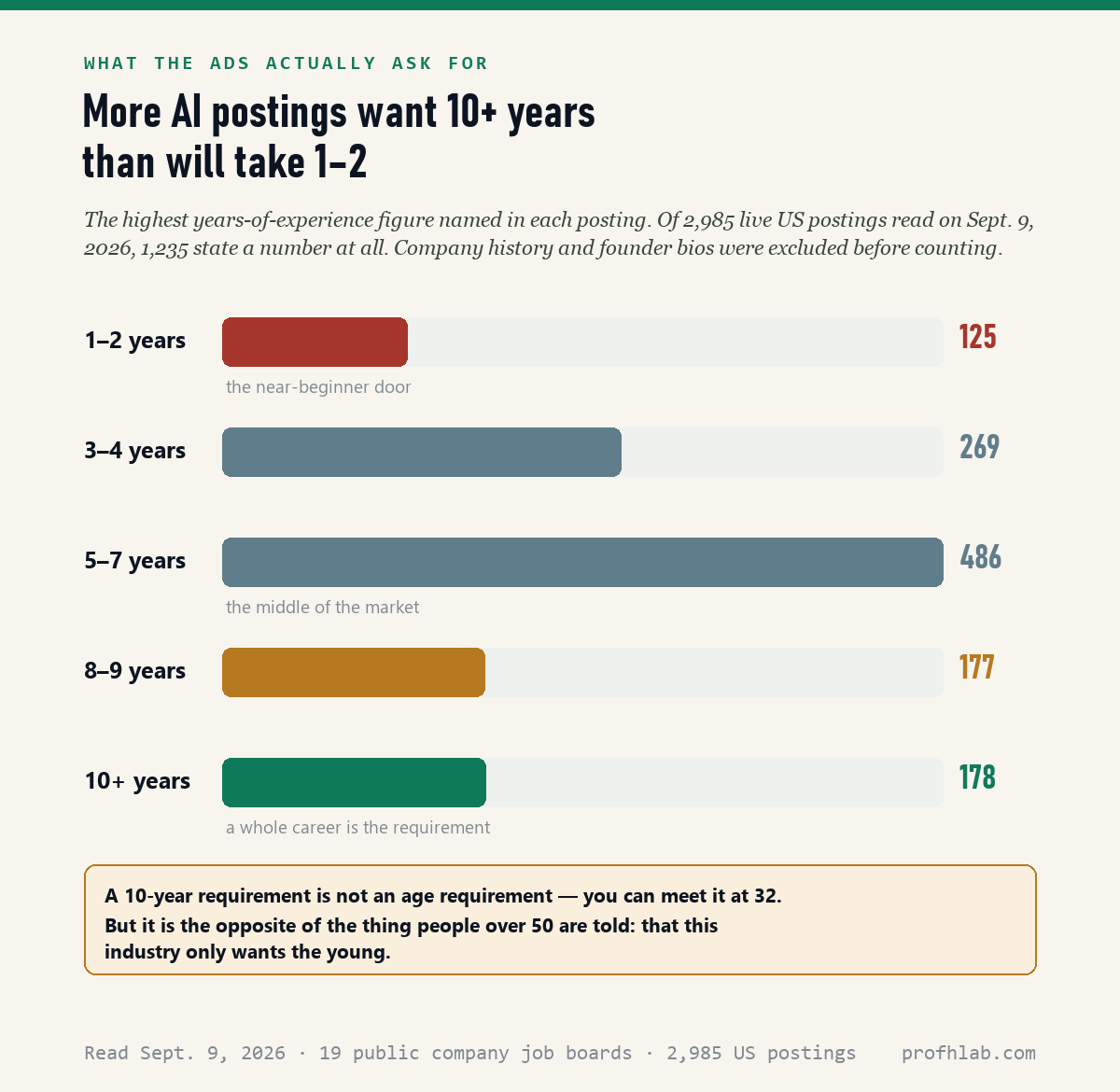
Read that bottom bar again. On the biggest AI employers’ own job boards, on a single ordinary Wednesday, there are 178 open roles that require a decade or more of working life and only 125 whose ceiling is one to two years. The near-beginner door is the narrowest door in this building.
This is the single most useful thing we found, and it is the exact inverse of the story people over 50 are told about artificial intelligence. A ten-year requirement is not an age requirement — a 32-year-old meets it comfortably. But a market that writes “15+ years” into its highest-paid postings is not a market that has decided experience is worthless.
127 of those decade-plus roles have no engineering word in the title
Of the 178 postings asking for 10+ years, only 51 have engineer, scientist, research, developer or architect anywhere in the title. The other 127 are litigation, investor relations, competitive intelligence, warehouse logistics, transaction management, program management, marketing and government sales — work where twenty-five years in insurance, construction, law, retail distribution or the military is the qualification, not a liability to be explained away.
Here are ten real openings, live and verified on September 9, 2026. Every link goes to the employer’s own application page. We are not recruiters, we take no money from any company on this list, and any of these can close without notice — the official page always wins.
| Employer & role | Years asked | Location | Posted pay range |
|---|---|---|---|
| Anthropic — Data Center Mechanical Engineer | 15+ | Remote-friendly, U.S. | $320,000–$405,000 |
| OpenAI — Technical Program Manager, Applied API & Product | 15+ | Remote (San Francisco) | $257,000–$445,000 |
| Perplexity — Director, Litigation | 15+ | San Francisco | $275,000–$375,000 |
| OpenAI — Head of Competitive Intelligence | 15+ | Remote (San Francisco) | $347,000–$385,000 |
| Cohere — Head of Investor Relations | 10+ | Remote (San Francisco) | $265,000–$410,000 |
| Anthropic — Transaction Manager (real estate) | 10+ | Remote-friendly, U.S. | $320,000–$405,000 |
| Anthropic — Warehouse & Logistics Manager, North America | none stated | San Francisco / New York | $405,000–$485,000 |
| Sierra — Executive Assistant, Office of the Co-Founders | 3+ | San Francisco | $130,000–$140,000 |
| Agility Robotics — Senior Service Technician II | none stated | Salem, Oregon (onsite) | $60,000–$78,000 |
| xAI — IT Services Technician | 2+ | Memphis, Tennessee | $61,200–$91,800 |
All ten links checked and returning a live page on September 9, 2026. Pay ranges are the employer’s own published figures, not our estimates.
Look at the top row for a moment. Anthropic wants somebody who has spent fifteen years designing chilled-water plants and air handlers, and would like them to have shipped data centers in Virginia, Ohio, Texas, Arizona and Oregon. That is not a description of a 28-year-old. It is a description of a mechanical engineer who has been doing hospitals and semiconductor fabs since the 1990s, and who now finds that the same skill is worth $400,000 because the machines being cooled happen to be GPUs.

The same logic runs down the list. Anthropic’s warehouse and logistics posting names no years at all; its minimum qualification is simply “experience managing warehouse or logistics operations for physical goods, including receiving, inventory control, and outbound shipping” plus comfort with a warehouse management system and a spreadsheet. Thirty years of running a distribution centre is a direct answer to that sentence.

And two rows down is the reason we included Memphis. xAI’s IT Services Technician there asks for two years and pays $61,200 to $91,800 — a normal American salary, in a normal American city, at an AI company. Not every door into this industry is in San Francisco, and not every one of them is guarded by a decade. We wrote about that particular site in more detail in what xAI actually pays in Memphis.

We checked all 2,985 ads against the regulator’s own word list
Most articles about ageism in hiring assert that job ads are coded against older applicants. That is a testable claim, because the federal regulator publishes the list of words it treats as violations. 29 CFR § 1625.4(a) reads:
“Notices or advertisements that contain terms such as age 25 to 35, young, college student, recent college graduate, boy, girl, or others of a similar nature violate the Act unless one of the statutory exceptions applies.”
29 CFR § 1625.4(a), Help wanted notices or advertisements
So we searched all 2,985 postings for exactly those terms. Here is what came back.
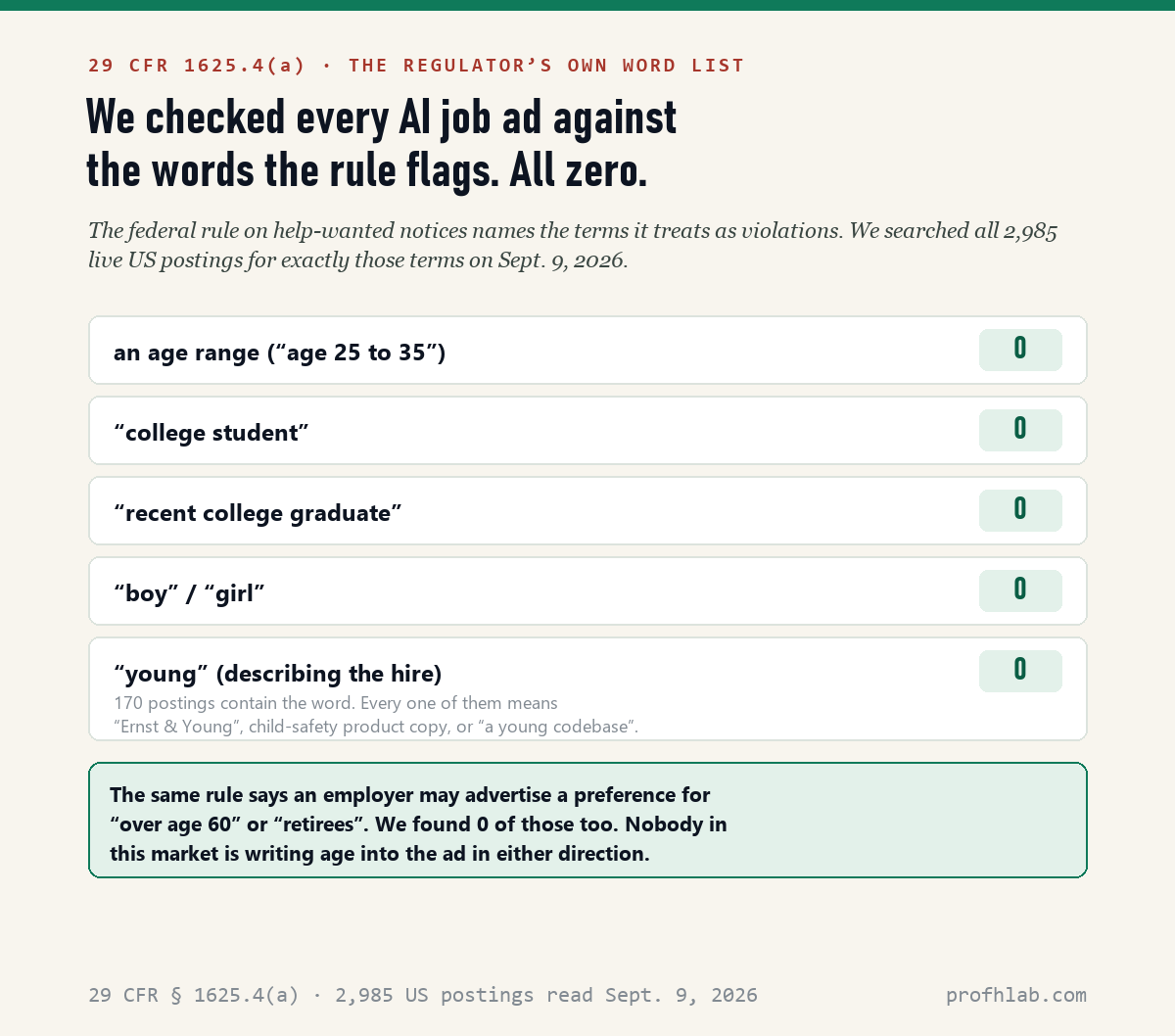
The word “young” appears in 170 postings, and we read every one. All 170 are “Ernst & Young” in a Scale AI client list, product copy about keeping young people safe online, or one Mercor engineering posting describing “a young, high-ownership codebase.” Not one describes the person the company wants to hire. The four ads mentioning “recent graduate” are three Figure AI internships and one Cohere role whose entire job is running an early-careers programme — scoped exactly the way the statutory exceptions contemplate.
Here is the finding that surprised us, though. The same regulation says an employer may advertise a preference for older workers — the permitted examples are “over age 60,” “retirees,” and “supplement your pension.” We found zero of those too. Nobody in the American AI market is writing age into a job ad in either direction. Which means the ads are simply not where this decision is being made.
What the law actually gives you
Four provisions are worth knowing by heart before you apply anywhere, and all four are short.
- You are protected from 40, not 50. 29 U.S.C. § 631(a): “The prohibitions in this chapter shall be limited to individuals who are at least 40 years of age.” If you are reading this at 52, you have been covered for twelve years.
- Refusing to hire is explicitly covered, not just firing. 29 U.S.C. § 623(a)(1) makes it unlawful “to fail or refuse to hire… because of such individual’s age.”
- The employer needs 20 or more employees. 29 U.S.C. § 630(b) defines an employer as one with “twenty or more employees for each working day in each of twenty or more calendar weeks.” Every company in our table clears that easily; a six-person startup does not.
- An employer is allowed to prefer you. The EEOC states it plainly: “It is not illegal for an employer or other covered entity to favor an older worker over a younger one, even if both workers are age 40 or older.” The protection runs one way only.
One more, because it comes up in every application form. Asking your date of birth is not automatically illegal — 29 CFR § 1625.5 says such a request “is not, in itself, a violation of the Act” — but application forms that ask “will be closely scrutinized to assure that the request is for a permissible purpose.” The regulation even supplies the disclaimer a lawful form should carry. This is general information, not legal advice; if you think you have been turned down because of your age, the EEOC’s own charge process is the place to take it.
Where a long career counts for the most
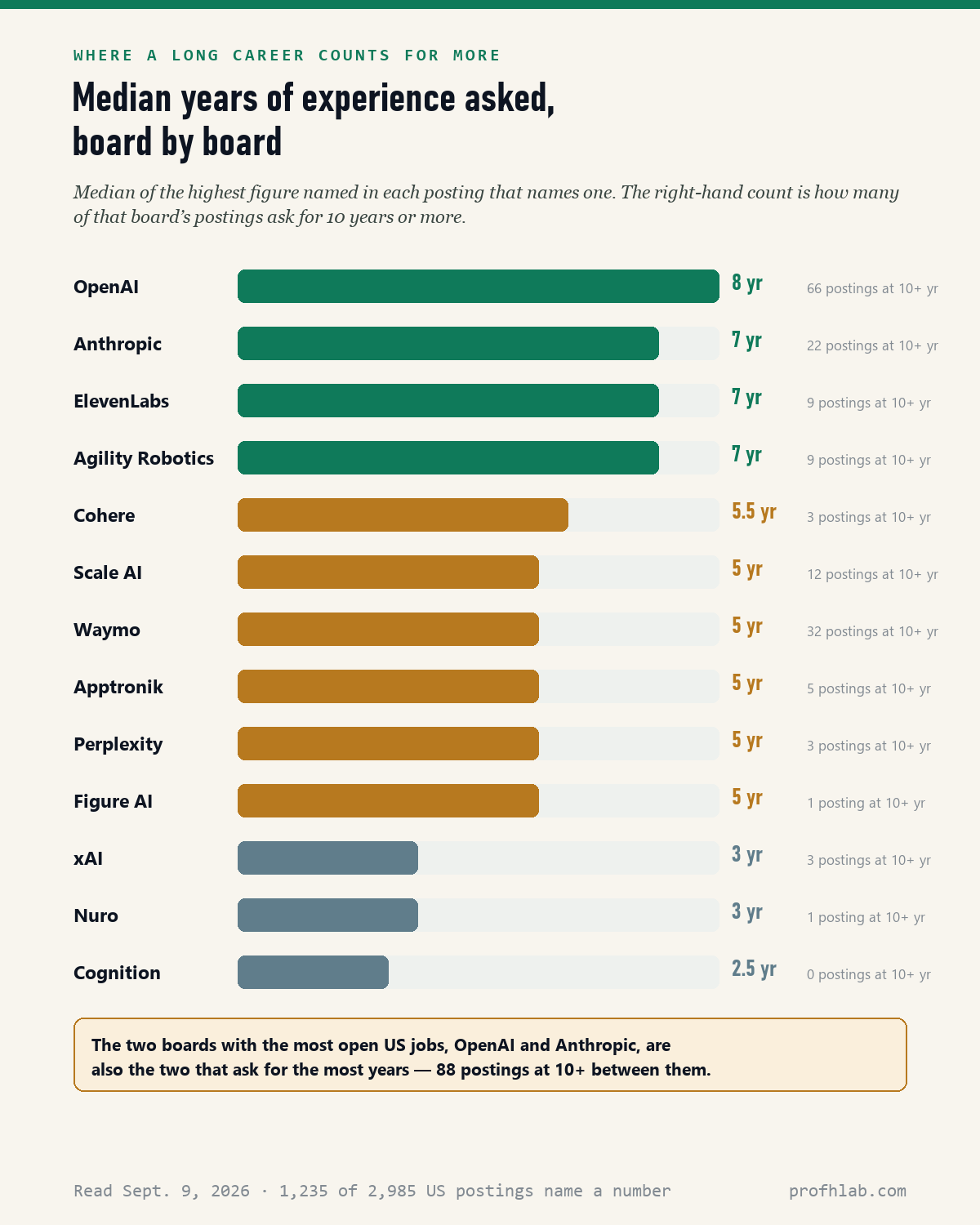
The spread here is bigger than the industry’s uniform reputation suggests. OpenAI’s median ask is 8 years and it has 66 postings at 10+; Anthropic’s is 7 with 22; Waymo has 32 postings at 10+. At the other end, Cognition sits at 2.5 years, Nuro and xAI at 3. If your asset is thirty years of doing something well, the top of that chart is where it is worth the most — and, awkwardly, the top of that chart is also where the most jobs are.
One more number worth carrying: 82.5% of all 2,985 postings never mention a degree at all. Of the 523 that do, 153 add “or equivalent experience.” Agility Robotics’ service technician role asks for a “technical associates degree or equivalent military training” — and lists it under Bonus Points. We went through this in more depth in do you need a degree to be a robotics technician and do you need a PhD to work in AI.
The part of this that our numbers cannot fix
We would be doing you no favours if we stopped at the good news. Four honest caveats:
- We audited ads, not decisions. A clean job posting tells you nothing about what happens to your resume in the fourth screening round. Age discrimination in hiring is real and it is largely invisible to a text search — which is precisely why the regulation says such practices “will be closely scrutinized” rather than relying on the wording alone.
- “10+ years” usually means 10+ years of that thing. Anthropic’s mechanical role wants fifteen years of data-centre mechanical design, not fifteen years of anything. A long career transfers when the domain transfers. Where it does not, you are competing as a beginner with a mortgage.
- The narrow bar cuts both ways. The fact that only 125 postings will take 1–2 years is good news for the argument and bad news for the practical path: if you are changing fields entirely, there are fewer than usual first rungs to stand on.
- Job searches take longer at this end of the market. Roles asking for a decade are senior roles with long, multi-stage processes. Budget months, not weeks — and read our note on whether old postings are still worth applying to before you write off anything with a stale date.
For scale, the wider picture is not bleak. In August 2026, 38.1 million Americans aged 55 and over were employed — 23.4% of everyone working in the country (Bureau of Labor Statistics, Current Population Survey, seasonally adjusted). Ten years earlier that share was 22.7%. Nearly one in four working Americans is 55 or older, and that fraction has been going up, not down.
Age bias on camera, and why to apply now rather than next spring
We picked these two deliberately, because they disagree with each other in a useful way. The first is the reason people over 50 hesitate to apply. The second is the reason to start now anyway rather than next spring.
Filter by what you used to do, not by the word AI
- Search by your old industry, not by “AI.” Open our jobs board and filter for the word that describes what you already did — logistics, mechanical, litigation, controller, facilities, procurement, program. Every posting there links straight to the employer’s own application page. That is a different search from typing “AI jobs,” and it returns different results.
- Stop treating a big years-number as a rejection. If a posting says 10+ and you have 25, you are over the line, not out of place. The ones to skip are the ones asking for a decade in a domain you have never worked in.
- Check the 20-employee threshold before you assume you are protected. The ADEA does not reach a fifteen-person startup.
- Apply only on the employer’s own domain. Every link in this article does that. If someone contacts you about an AI job over text or WhatsApp, asks for money, or sends a cheque to deposit, it is a scam — the four rules are on our Jobs Desk sources page, and are AI training jobs legit covers the most common version aimed at older applicants.
- Come back Monday. The tracker updates every morning, and the weekly hiring report reruns these counts.
Why one job can be posted with a $257,000 to $445,000 range
“Which of these companies is actually hiring the most right now?” — that changes weekly; see which AI companies are hiring right now and is Anthropic hiring right now.
“What do these ranges really mean?” — we took apart why the same job is posted at $257,000–$445,000 in why are salary ranges so wide, and ranked the boards by pay in which AI company pays the most.
“Can I do this without moving to California?” — the honest count is in are AI engineer jobs remote and part-time AI jobs you can do from home. For the public-sector route, see federal jobs with no experience and national laboratory jobs with no degree.
“Do I need to learn the tools first?” — start with our step-by-step ChatGPT guide for beginners over 50, then is an AI certificate worth it and should I put ChatGPT on my resume. The best AI tools for seniors is the gentler entry point. If academia is your field, we also keep a faculty search tracker and a list of labs recruiting.
Ask the desk
Tell us your state, your old trade and how many hours a week you want, and we will search the boards and the federal listings for you and publish the answer. Post it on the Jobs Desk request page. We are not recruiters, we take no money from employers, and postings can close at any time — the official page always wins. One short email a month if you want the weekly counts.
Questions people over 50 type into Google before they apply
Are there AI jobs for people over 50?
Yes, and more of them ask for a long career than for a short one. Of 2,985 live U.S. postings on 19 AI company boards read on September 9, 2026, 178 require 10 or more years of experience and only 125 top out at 1–2 years. 127 of those decade-plus roles have no engineering word in the title — they are logistics, legal, finance, facilities, program management and sales.
Can a company not hire you because of your age?
Not if you are 40 or over and the employer has 20 or more employees. 29 U.S.C. § 623(a)(1) makes it unlawful for a covered employer “to fail or refuse to hire… because of such individual’s age.” Proving it is the hard part, which is why the wording of the advertisement matters less than the pattern of decisions. This is general information, not legal advice.
What age is protected from age discrimination?
Forty and above, under federal law. 29 U.S.C. § 631(a): “The prohibitions in this chapter shall be limited to individuals who are at least 40 years of age.” The ADEA does not protect workers under 40, though some state laws do. It also does not stop an employer from preferring an older worker over a younger one.
Is it legal to ask your age on a job application?
It is not automatically illegal. 29 CFR § 1625.5 says a request for date of birth or age on an application form “is not, in itself, a violation of the Act,” but adds that forms which ask “will be closely scrutinized to assure that the request is for a permissible purpose.” The regulation suggests the form carry a statement referencing the ADEA prohibition.
Is 55 too old to get a job?
The labour market says no: 38.1 million Americans aged 55 and over were employed in August 2026, 23.4% of all employed Americans, up from 22.7% a decade earlier (BLS, Current Population Survey). What does change with age is the length of the search, not the existence of the jobs — senior roles run long, multi-stage processes.
Is 50 too old to change careers into AI?
It depends far more on the domain than on the age. If your twenty-five years are in mechanical engineering, logistics, litigation, finance or facilities, the AI companies are advertising for exactly that and paying more for it than your old industry did. If you are starting from zero in machine learning, you are competing for the 125 postings on the narrowest rung, and that is a genuinely hard path at any age.
What are the non-technical careers in AI?
On September 9, 2026 the non-engineering openings at these 19 companies included investor relations, litigation director, competitive intelligence, warehouse and logistics management, commercial real estate transactions, technical program management, government account direction, marketing leadership, executive assistance, recruiting coordination, IT services and field service technician work. Roughly seven in ten of the decade-plus roles carry no engineering title.
Are there AI jobs for seniors that are part-time or remote?
Remote yes, part-time rarely. 1,223 of today’s 3,777 postings carry a remote label, though the employers’ own workplace fields narrow that considerably — we counted it out in are AI engineer jobs remote. Genuine part-time work at these companies is scarce, and the part-time “AI training” offers advertised elsewhere deserve the checks in are AI training jobs legit.
Sources and method. Postings: public job-board feeds of 20 AI, robotics and self-driving companies, read September 9, 2026 (19 responded). Requirement text parsed from each posting; years figures inside company history and founder biographies excluded. Law: 29 U.S.C. §§ 623, 630, 631; 29 CFR §§ 1625.4, 1625.5; U.S. Equal Employment Opportunity Commission, Age Discrimination.
Employment: U.S. Bureau of Labor Statistics, Current Population Survey series LNS12024230 and LNS12000000, August 2026, seasonally adjusted. No U.S. federal (USAJOBS) postings are included in this article’s table or counts. Daily figures: AI Jobs Tracker · method: how we count · corrections policy: editorial review.
Cite this: Prof H Lab, “AI jobs for people over 50: 178 of 2,985 open U.S. AI postings require 10+ years of experience,” September 9, 2026, https://profhlab.com/ai-jobs-for-people-over-50/
Prof.’s H Newsletter
One short email a month, with the numbers in it
What actually moved in AI hiring, AI prices, and the scams aimed at older Americans. Counted here, dated, and linked to the source. One email a month, and your address goes nowhere else.