Why Are Salary Ranges So Wide? We Measured 2,172 AI Job Postings (September 2026)
Because the law asks for a “good faith estimate,” not a narrow one — and because one posting usually covers several job levels at once. On Friday, September 4, 2026 we read every live posting on the job boards of twenty AI, robotics and self-driving companies — 3,772 openings, 2,984 of them open in the United States. 2,172 published a pay band. The median band is $70,000 wide, a 1.27x gap from bottom to top.
That median is the part almost nobody reports, and it reframes the whole complaint. The typical range is not absurd. It is the tail that is absurd: 15 postings out of 2,172 span at least half a million dollars, and the widest of them all — Anthropic’s $280,000–$850,000 — is a $570,000 spread on a single engineering title. You have been reasoning about the whole market from its four loudest postings.
At a glance · measured September 4, 2026
- 2,172 US postings published a pay band. Median width $70,000; median top ÷ bottom 1.27x.
- 71.2% of bands are at least $50,000 wide, but only 9.2% reach $200,000 and 0.7% reach $500,000.
- 812 US postings (27.2%) name no pay at all. Three boards — Cursor, ElevenLabs, Physical Intelligence — published a band on zero of their 236 US roles.
- The ratio barely moves by level: 1.27x in the second, third and fourth quartile of salary. Only the dollar count grows.
- Junior-titled roles carry the tightest bands we found: median $30,600 wide.
- Multi-city postings are narrower (1.25x) than single-city postings (1.31x) — the opposite of the usual explanation.
Are salary ranges still this wide in October 2026?
Yes, almost exactly: on October 9, 2026 we measured 2,247 US pay ranges on 19 AI-company boards, and the median range had a top 1.28 times its bottom and a $70,000 gap, against 1.27 and $70,000 on September 4. The widest dollar spread is unchanged too: Anthropic still posts $280,000–$850,000 on four engineering roles. What moved is who sits at the wide end.
| Measure (US ranges) | Sept. 4 | Oct. 9 |
|---|---|---|
| Postings with a range | 2,172 | 2,247 |
| Median top ÷ bottom | 1.27 | 1.28 |
| Median gap | $70,000 | $70,000 |
| Gap of $200,000 or more | 9.2% | 9.3% |
| Gap of $500,000 or more | 15 | 13 |
The October count reads every range in each posting’s full text and drops Canadian-dollar bands and dollar figures that are not pay, such as ad budgets; September used the one range our scanner kept. The methods are close, not identical, so read small moves as no change. Google DeepMind’s US board returned an error on October 9 and is unread, not zero. An AI assistant helped run the page reads; every quote below was read on the posting on October 9, 2026.
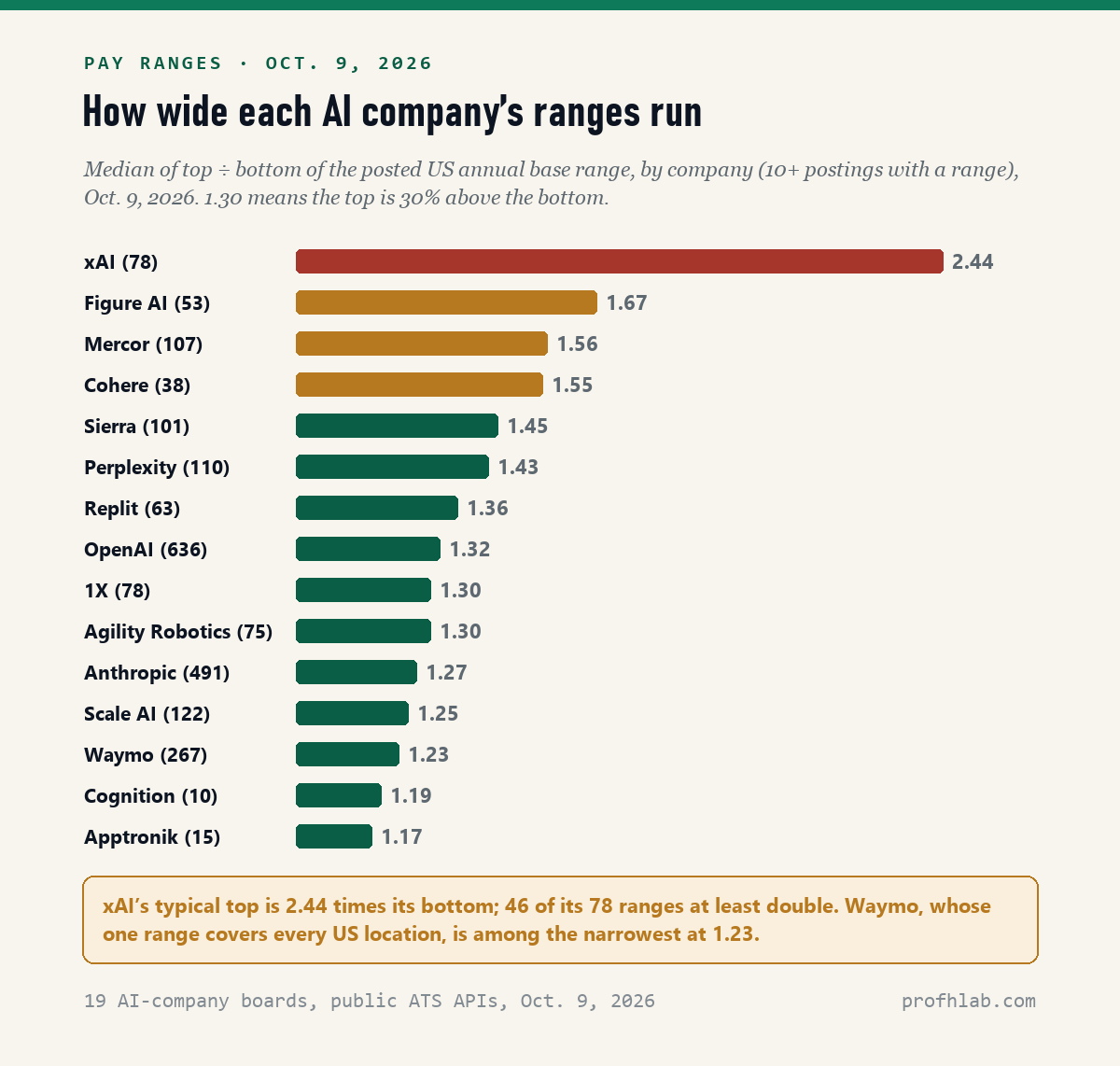
xAI now has the widest ranges by ratio. Its 78 US ranges have a median top 2.44 times the bottom, 46 of them at least double, and 32 print the same $180,000 to $440,000. Mercor reuses one band, $160,000 to $500,000, on 24 postings from Data Scientist to Payments Engineer; the postings do not say why, so calling it one band for many roles is our inference.
Geography explains less than people think, again. 261 of Waymo’s 267 US ranges say they apply “across US locations,” yet Waymo’s median is one of the narrowest at 1.23. Only 49 postings print a separate band per place: 25 at Cohere, 16 at Scale AI and 8 at OpenAI.
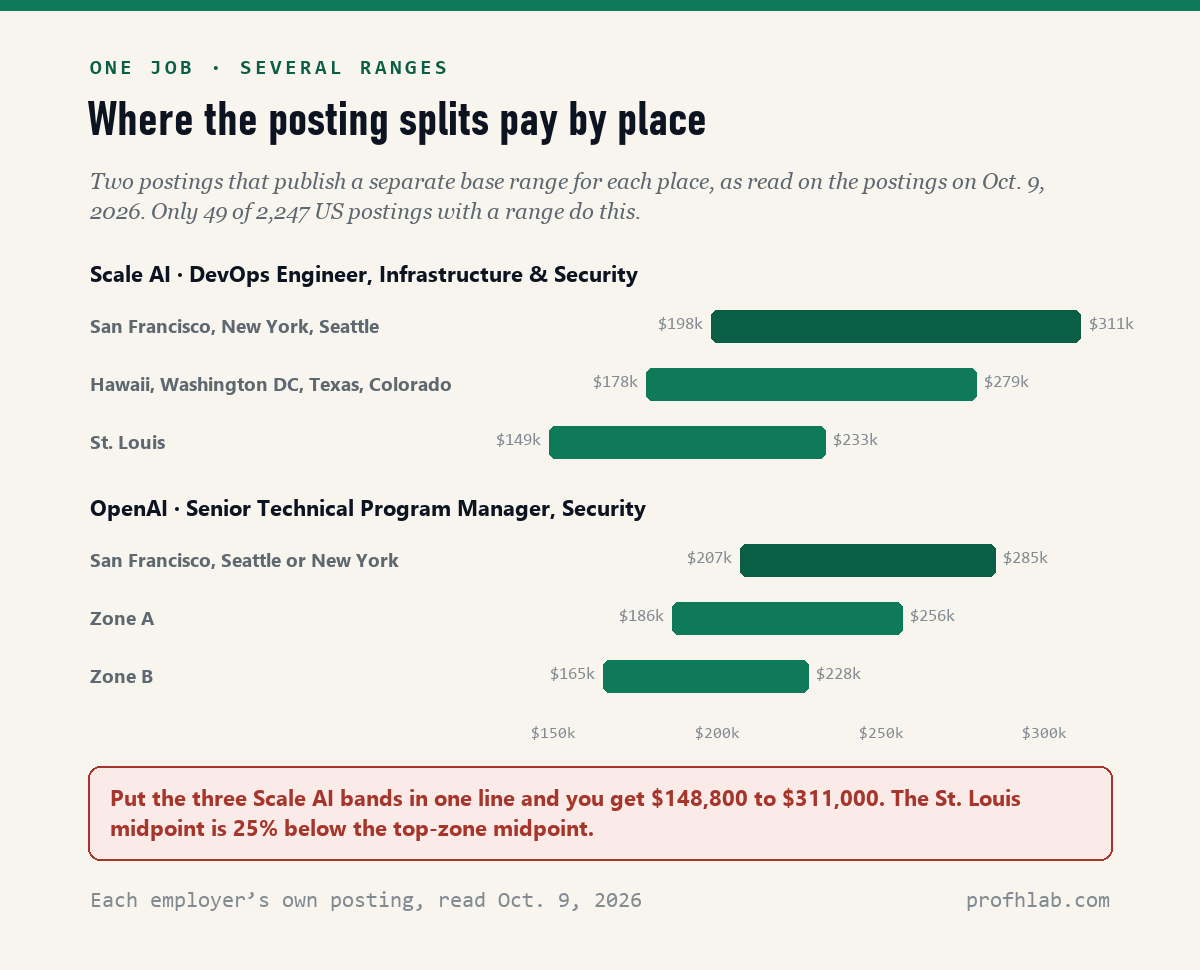

Two employers say it in words. Figure AI’s Senior People Operations Specialist posting, at $110,000 to $200,000, says the range “reflects the two levels at which it may be filled.” Nuro says its range fits “the level at which this job has been scoped.” And one Anthropic Staff+ security posting reads “$32,000 — $485,000”; a floor that low for a staff role looks like a missing digit to us, which is an inference.
Today’s numbers for every board are on the AI jobs tracker, and you can browse every open role and apply on the employer’s site. For the place rules behind zone bands, see why remote jobs have location requirements; for the form field, what to put for desired salary. The September analysis follows unchanged.
So why are salary ranges so wide?
There are three real reasons, and only one of them is about the employer being cagey.
One: the statute asks for a good-faith estimate and stops there. California’s labor regulator defines the posted “pay scale” as “a good faith estimate of the salary or hourly wage range that an employer reasonably expects to pay for a position upon hire.”
Washington asks for the employer’s “most reasonable and genuinely expected compensation range for the job at the time of posting.” New York asks for the range “believed to be accurate at the time of posting.” Every one of those is a sincerity test. None is a width limit. An employer who genuinely would pay anywhere from $280,000 to $850,000 depending on who walks in has complied.
Two: one posting is often several jobs. The $280,000–$850,000 band is not one job with a $570,000 negotiation. It is a ladder — the same posting is used to hire an engineer at three or four different levels, and the band has to cover the bottom of the lowest and the top of the highest. That is why the widest bands cluster on generic engineering titles rather than on specific ones.
Three: a band is a percentage, not a dollar figure. This is the one we can prove with our own count, and it is the section below that we have not seen anywhere else.
How we counted. We read the public job-board feeds of twenty AI, robotics and autonomous-driving companies (Greenhouse and Ashby) on September 4, 2026 and kept every US posting that published both a floor and a ceiling. Postings with a single fixed number, or no number, are excluded from the width statistics and counted separately. “Spread” is ceiling minus floor; “ratio” is ceiling divided by floor. The daily counts and the per-company table live on our AI Jobs Tracker, which we refresh every morning.
Most bands are ordinary. The tail is what you remember
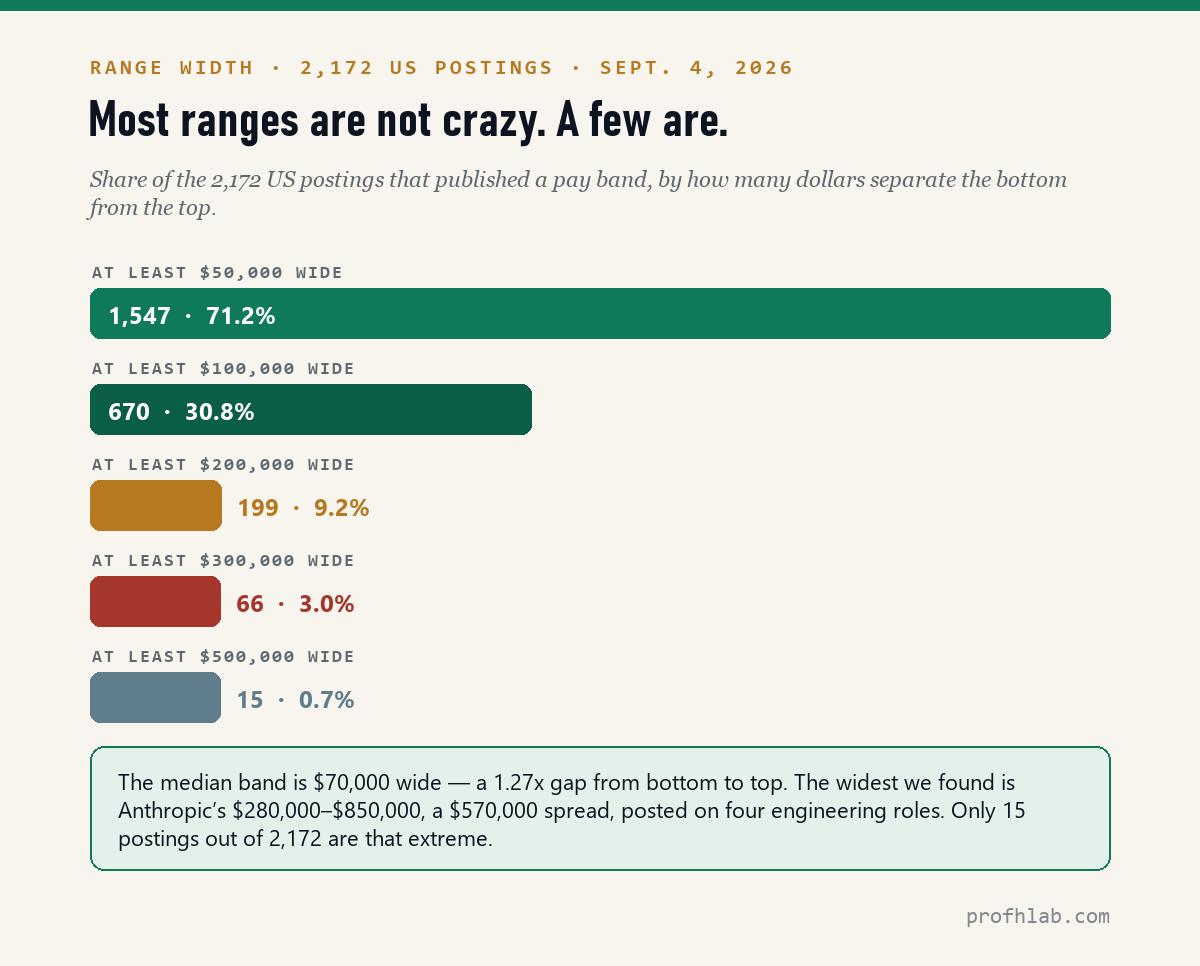
Read the bottom two bars first. Ranges of $300,000 or more — the ones that get screenshotted and posted with a caption about how meaningless job listings have become — are 66 postings, three percent of the sample. The $500,000-plus ranges are 15. Meanwhile 1,502 postings sit under $100,000 of width, which for a job paying north of $200,000 is a fairly ordinary band.
The extremes are worth naming precisely, because they are not random. By dollars, the widest is Anthropic’s $280,000–$850,000, which appears on four engineering postings. A $850,000 ceiling shows up on 30 postings in total, split between Anthropic and OpenAI. By ratio, the widest are elsewhere entirely: Mercor lists a Payments Engineer at $100,000–$500,000 and Cognition lists a Paid Media Marketer at $50,000–$250,000 — both exactly 5.00x. Those are not ladders. Those are a company that has not decided what the job is.
The percentage never moves — only the dollars
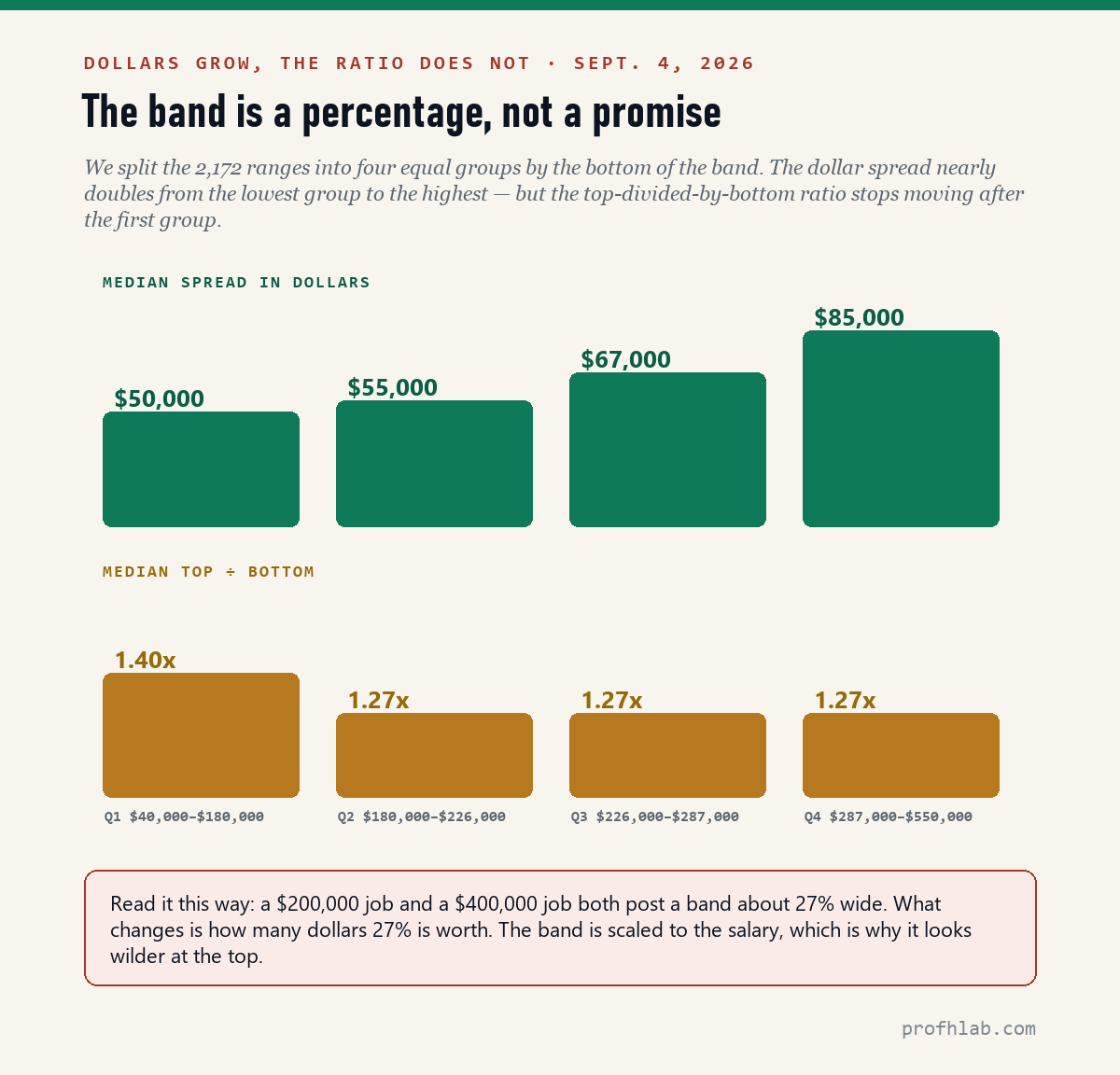
We sorted every band by its floor and cut the list into quarters. The median spread climbs steadily — $50,000, $55,000, $67,000, $85,000. The median ratio does not: 1.40x, then 1.27x, 1.27x, 1.27x, flat across three-quarters of the market.
That is the shape of a compensation band, and once you see it the wide numbers stop being mysterious. Somebody set the band at roughly plus-or-minus thirteen percent around a midpoint, and then applied it to salaries of every size. A $200,000 job and a $400,000 job both get a band about 27% wide; the second one just looks twice as outrageous because 27% of $400,000 is a lot of money. The width you are angry about is mostly a multiplication result.
The lowest quartile is the interesting exception at 1.40x. Those are the postings under $180,000 — the ones where an employer is genuinely less sure what the role is, and where a single band gets stretched across a technician job and a specialist job. If you are early in your career, that is the quartile you are shopping in, and it is the one place where a wide band really does signal an undecided employer rather than a pay ladder.
What the advice columns get backwards about geography

Nearly every explainer on this topic gives the same reason for wide bands: the posting covers several cities, so it has to stretch from Austin money to San Francisco money. It sounds obviously right. In our data it is backwards.
We split the 2,172 bands by whether the posting named one location or several. Single-location postings have a median spread of $75,000 and a ratio of 1.31x. Multi-location postings — the ones that supposedly have to stretch — come in narrower, at $65,000 and 1.25x. There were 1,587 of the first and 585 of the second, so this is not a small-sample fluke.
The likely explanation is that a company posting one job across New York, San Francisco and Seattle has already given up on geographic pay tiers and quotes a single national band. The company hiring for one office is the one still stretching a band across several levels. We are describing what we measured, not proving the mechanism — but if geography were the main driver of width, the multi-city numbers would have to be bigger, and they are smaller.
Junior postings have the tightest bands on the board
If wide bands are a ladder, then jobs with no ladder should have narrow ones. They do. We sorted postings by title into junior-sounding (intern, apprentice, associate, junior, new grad, fellow, technician, coordinator, assistant), senior-sounding (senior, staff, principal, lead, head, director, manager) and everything in between:
| Title level | Postings | Median band width | Median ratio | Median floor |
|---|---|---|---|---|
| Junior-titled | 31 | $30,600 | 1.30x | $135,000 |
| Neither word in the title | 972 | $85,500 | 1.35x | $230,000 |
| Senior-titled | 1,169 | $60,000 | 1.25x | $226,000 |
US postings with a published floor and ceiling, September 4, 2026. Title-word classification, so a “Senior” in the title is taken at face value.
Two things fall out of that table. The junior band is less than half the width of the middle group — if you are applying to entry-level roles, the wide-range problem largely is not yours. And there are only 31 of them among 2,172 priced postings, which is the harsher finding and matches what we keep seeing: the shortage at the bottom of this market is openings, not information.
We have written separately about the data centre technician route, what robotics technician postings actually require and the national laboratory route, which are the three doors that reliably open without a degree.
Note the median junior floor: $135,000. That is not a beginner wage anywhere else in the economy, and it is a reminder that “entry-level” on an AI company board usually means entry-level for an experienced engineer. If you are asking whether you need a PhD or whether a certificate helps, those postings are the evidence to read.
The 812 postings that say nothing at all
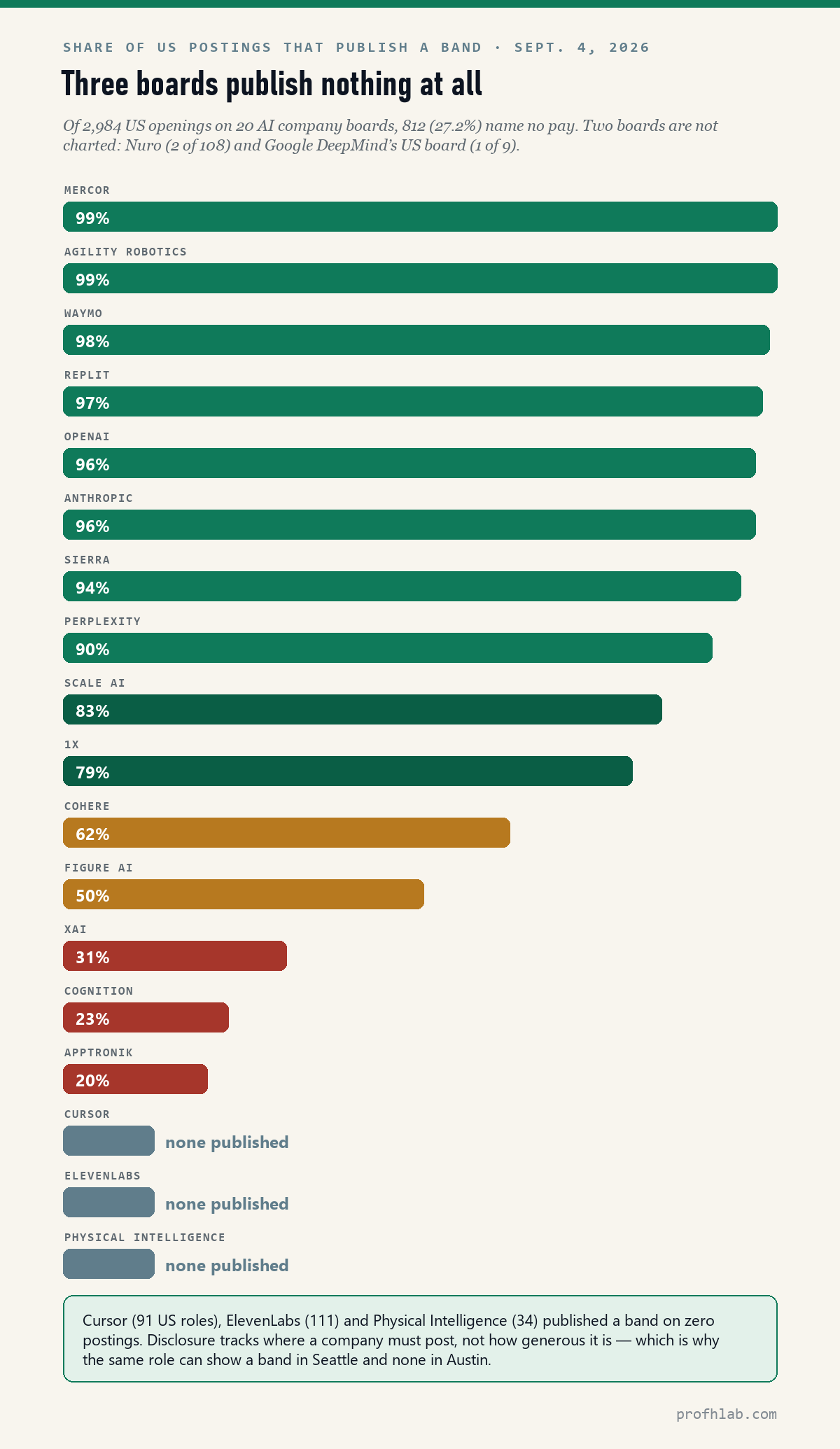
A wide band is still information. 812 US postings — 27.2% — give you none, and the distribution is not gradual. Mercor, Agility Robotics, Waymo, Replit, OpenAI and Anthropic publish a band on 96–99% of their US roles.
Cursor (91 US roles), ElevenLabs (111) and Physical Intelligence (34) publish one on zero. xAI sits oddly in the middle at 31%, and the bands it does publish are by far the widest of any board: a median spread of $225,000 and a median ratio of 2.44x, roughly double everyone else. We looked at that board in detail in August and the pattern has held.
| Company board | US roles | Publish a band | Median width | Widest band posted |
|---|---|---|---|---|
| OpenAI | 637 | 96% | $92,000 | $380,000–$850,000 |
| Anthropic | 462 | 96% | $80,000 | $280,000–$850,000 |
| Waymo | 299 | 98% | $50,000 | $250,000–$334,530 |
| xAI | 238 | 31% | $225,000 | $180,000–$600,000 |
| Scale AI | 165 | 83% | $52,000 | $198,400–$342,000 |
| Sierra | 123 | 94% | $77,500 | $180,000–$390,000 |
| ElevenLabs | 111 | 0% | — | none published |
| Nuro | 108 | 2% | $59,600 | $176,400–$264,600 |
| Perplexity | 104 | 90% | $100,000 | $220,000–$485,000 |
| Figure AI | 100 | 50% | $100,000 | $150,000–$400,000 |
| Mercor | 92 | 99% | $120,000 | $100,000–$500,000 |
| Cursor | 91 | 0% | — | none published |
| 1X | 87 | 79% | $50,000 | $110,000–$240,000 |
| Apptronik | 83 | 20% | $33,000 | $165,000–$235,000 |
| Agility Robotics | 70 | 99% | $60,000 | $257,000–$402,000 |
| Replit | 62 | 97% | $75,000 | $130,000–$300,000 |
| Cohere | 56 | 62% | $135,000 | $270,000–$539,750 |
| Cognition | 53 | 23% | $40,000 | $50,000–$250,000 |
| Physical Intelligence | 34 | 0% | — | none published |
| Google DeepMind (US board) | 9 | 11% | $61,000 | $141,000–$202,000 |
All twenty boards, US postings only, read September 4, 2026. Counts move daily — the live version is on the AI Jobs Tracker.
Where the requirement actually comes from

There is no federal law requiring a salary range on a private-sector job posting. Every requirement you have encountered is a state or city one, which is why the same company can post a band in Seattle and nothing in Austin. Four whose text we read directly:
- Colorado — the Equal Pay for Equal Work Act (C.R.S. § 8-5-101 et seq.) requires employers to disclose compensation in all job postings and notices, internal and public, along with benefits and how to apply.
- California — an employer with 15 or more employees must include the pay scale in any job posting, where pay scale means “a good faith estimate of the salary or hourly wage range that an employer reasonably expects to pay for a position upon hire.”
- Washington — also 15 or more employees; Labor & Industries asks for the “most reasonable and genuinely expected compensation range for the job at the time of posting,” plus a description of benefits and other compensation.
- New York — Labor Law § 194-B applies at just four or more employees and covers promotions and transfers as well as new openings.
Then there is the sentence that explains more about wide bands than any commentary we read. Washington’s guidance tells employers: “Employers may include a more specific hiring wage scale or salary range if they do not intend to hire within the full range.” The regulator anticipated that employers would post bands they never meant to hire across, and invited them to post a tighter one instead. Most do not take the invitation. That is a choice, not a legal requirement — which is the fair version of the complaint, and worth separating from the parts that are just arithmetic.

What we found that page one did not have
Before writing this we pulled the top results for “why are salary ranges so wide” and read them. Seven had enough text to score (one returned an error, one blocked us, one is a discussion thread). Every one of the seven tells you what to do about a wide range. Zero of the seven counted anything. Not one measured a set of real postings; the numbers that do appear are borrowed or hypothetical. One of the seven separates entry-level from senior. Two mention the “good faith” standard that is the actual legal reason the bands are allowed to be wide.
We say that not to dunk on them — several are well written — but to explain why our numbers disagree with the received wisdom on geography, and why the phrase “salary ranges are meaningless now” survives. It is a claim nobody has been checking against postings.
What to do with a band that is too wide to read
- Work out the midpoint and treat it as the real number. If the band is a percentage around a midpoint — and at 1.27x it usually is — then the midpoint is the job as posted. A $280,000–$850,000 band has a midpoint of $565,000, and if that number is implausible for the role you are reading, the posting is covering several levels.
- Check the ratio, not the dollars. Divide the top by the bottom. Under about 1.4x is a normal band. Over 2x means the posting is a ladder or the employer has not scoped the job — both are worth asking about, and neither is an insult.
- Ask which level this requisition is open at. This is the single most useful question, and it is answerable by a recruiter in one sentence without anyone negotiating anything.
- In California, you can ask for the pay scale. Labor Code § 432.3 requires an employer to give an applicant the pay scale for the position on reasonable request, and to give a current employee the pay scale for their own position.
- Do not volunteer your salary history. California, Colorado and a number of other states bar employers from asking — but the ban generally does not apply to information you offer unprompted.
- If there is no band at all, check the company’s other postings. The same employer often publishes a band on a role in a state that requires it. That gives you a comparable the unposted role does not.
None of this is negotiation advice and none of it is legal advice — for a dispute about your own pay, your state labor department is the free and correct first stop. It is just how to read the number in front of you.
Rank employers by midpoint, not by the $850,000 ceiling
“Which of these companies actually pays the most?” Midpoints, not ceilings, are the way to rank them — we did that across 2,144 bands in this piece, and the order is not the one the $850,000 headlines suggest.
“Fine, but who is hiring at all?” The daily count across all twenty boards is on the AI Jobs Tracker (3,772 roles today, up 18 from yesterday), with the standing overview in which AI companies are hiring right now and a single-employer deep dive in is Anthropic hiring right now.
“Is any of this open to me without a decade of experience?” Start with the federal route, then part-time and remote work and whether AI training jobs are legitimate. If you are aiming at the labs themselves, how to get a job at OpenAI or Anthropic and what to put on your resume are the two we get asked about most. And the background worry behind all of it is whether AI takes your job.
“Is an algorithm setting my pay the way it sets prices?” Different question, same machinery, and the FTC has started naming it — see is it illegal to charge different prices for the same product.
Does posting a pay band help, and how to negotiate inside one
The questions that follow a wide range
Why are salary ranges so wide?
Three reasons, in order of how much they explain. Pay-transparency laws ask for a good-faith estimate of what the employer would really pay and set no limit on width. One posting is often used to hire at several levels, so the band has to cover all of them. And a band is set as a percentage around a midpoint, so the same 27% looks enormous on a large salary. Across 2,172 US AI postings we measured on September 4, 2026, the median band was $70,000 wide — a 1.27x gap.
Why are salary ranges so big at some companies and not others?
Mostly because of what the posting is for. In our September 4 count, median band width ranged from $33,000 at Apptronik to $225,000 at xAI. The boards with the widest bands also tend to publish the fewest — xAI put a band on 31% of its US roles, Apptronik on 20% — which suggests a company that posts reluctantly also posts loosely.
Do companies have to post salary ranges?
Only where a state or city requires it, and usually only above an employee-count threshold — 15 or more in California and Washington, four or more in New York. There is no federal requirement for private employers. That is why 812 of the 2,984 US postings we read published no pay at all, and why three boards published none on any role.
What states require salary in job postings?
More than a dozen now, and the list keeps changing, so check the labor department of the state you are applying in rather than a third-party tracker. The four whose official text we read for this piece are Colorado (the first, under the Equal Pay for Equal Work Act), California, Washington and New York. A posting is generally covered if the job could be performed in that state, which is why remote roles often carry a band even when the employer is elsewhere.
Why don’t job postings include salary?
Usually because the employer is not required to. Disclosure in our data tracks jurisdiction, not generosity: Cursor, ElevenLabs and Physical Intelligence published a band on zero of their 236 US roles, while boards with heavy West Coast and New York footprints publish on 96–99%. If a role you want has no band, look at the same company’s postings in a state that requires one.
What do salary ranges mean?
Legally, a good-faith estimate of what the employer expects to pay on hire — not a promise, and not the maximum you could ever earn there. Practically, the midpoint is the job as scoped, the floor is what they would pay someone who needs developing, and the ceiling is usually reserved for a level above the one being advertised. Washington’s guidance even allows employers to post a narrower “hiring range” when they do not intend to hire across the full band.
How much do entry level AI jobs pay?
Higher than most people expect, and there are very few of them. Among the 2,172 priced US postings we read on September 4, only 31 carried a junior-sounding title, and their median floor was $135,000 with a median ceiling of $160,000. Their bands were also the tightest in the dataset at $30,600 wide. “Entry-level” on these boards generally means entry-level for an experienced engineer, not for a first job.
What is a good salary range to ask for?
We will not give you a number for your situation, but here is the arithmetic people find useful. If the posted band behaves like the ones we measured, the midpoint is the advertised job. Naming a figure near the ceiling implicitly claims the level above the one posted, so it helps to know which level the requisition is open at before you say anything. And in states with a salary-history ban, you are not obliged to disclose what you earn now — though the protection generally covers what you are asked, not what you volunteer.
Tell us the band you are staring at
If a posting has you stuck — a band you cannot read, a role with no number at all, or a state you are not sure is covered — send it to the Jobs Desk. We check the employer’s own page, say plainly when the market is thin, and publish the answer. We are not recruiters, we take no money from employers, and postings can close at any time — the official page always wins.
One short email a month, if you want the weekly count in your inbox instead.
Cite this: profhlab.com, “Why Are Salary Ranges So Wide? We Measured 2,172 AI Job Postings,” September 4, 2026. Median band width $70,000 (1.27x) across 2,172 US postings publishing pay on twenty AI, robotics and autonomous-driving company boards; 812 of 2,984 US postings published no pay. Daily counts: profhlab.com/ai-jobs-tracker/.
Prof.’s H Newsletter
One short email a month, with the numbers in it
What actually moved in AI hiring, AI prices, and the scams aimed at older Americans. Counted here, dated, and linked to the source. One email a month, and your address goes nowhere else.