Do You Need a PhD to Work in AI? We Read 2,954 Job Postings
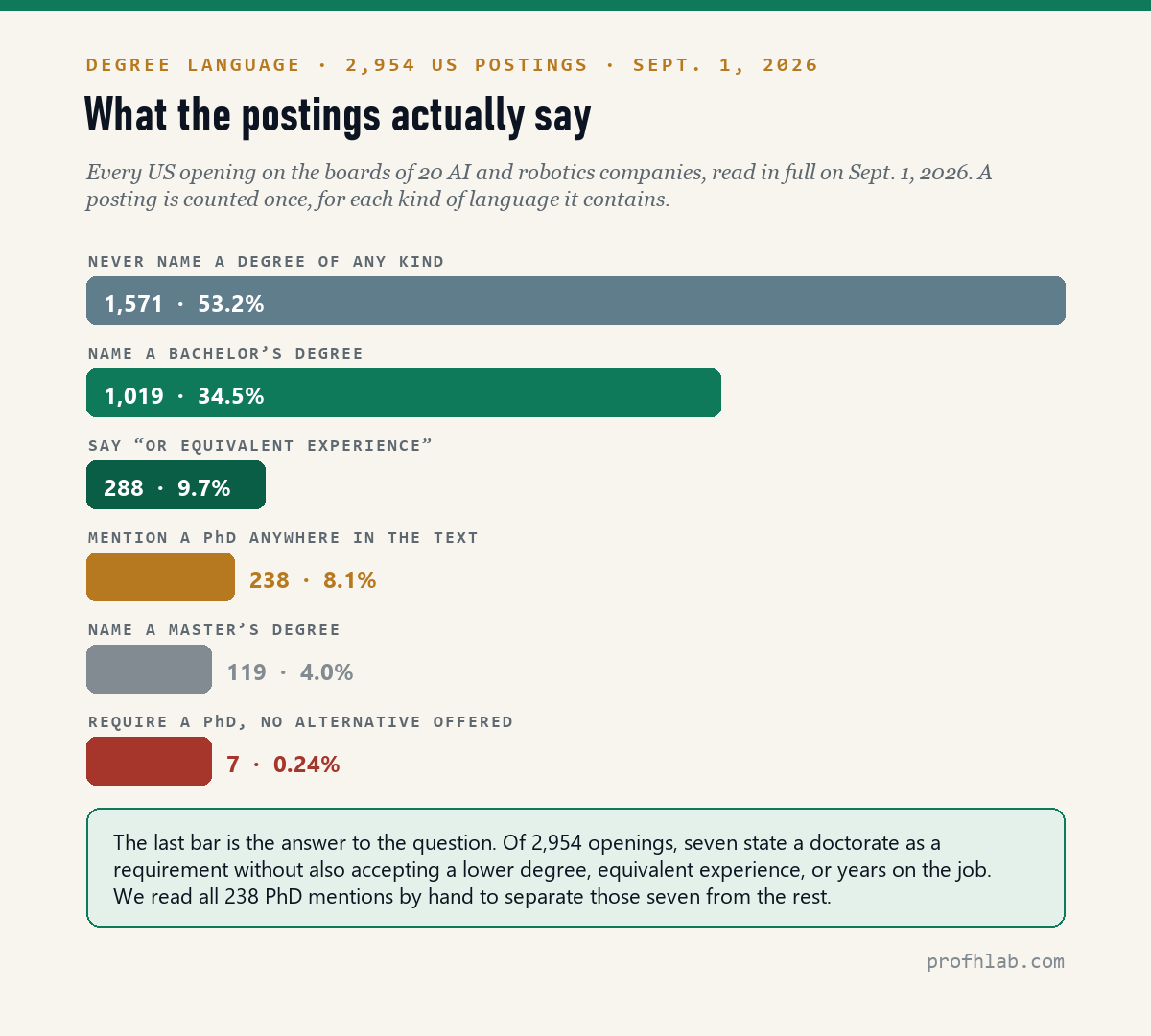
No — and it is not close. On Tuesday, September 1, 2026 we read the full text of every United States job posting on the boards of twenty AI and robotics companies: 2,954 openings. The letters “PhD” appear anywhere in 238 of them. When we read those 238 by hand, the number that state a doctorate as a requirement with no lower degree, no equivalent experience and no years-on-the-job alternative was seven.
Seven out of 2,954 is 0.24%. Meanwhile 1,571 postings — 53.2% — never mention a degree of any kind. The highest-paying opening we found that explicitly accepts a candidate with no bachelor’s degree is an OpenAI technician role in San Francisco advertised at $157,000–$221,000.
At a glance · read September 1, 2026
- 2,954 US openings read in full, from 20 company boards (3,733 worldwide).
- 238 mention a PhD anywhere (8.1%). 7 require one (0.24%).
- 1,571 never name a degree at all — more than half the market.
- 1,019 name a bachelor’s degree; only 119 name a master’s.
- 288 postings contain the phrase “or equivalent experience” in some form.
- All seven doctorate-required roles are research posts at four companies: Google DeepMind, Scale AI, Cohere and 1X.
The short answer, and the number that makes people believe otherwise
If you search this question you will meet a figure very quickly: 23% of AI engineering postings list a PhD or professional degree. It comes from the labour-market analytics firm Lightcast, covering February 2024 to February 2025, and it is quoted on edX’s explainer page among others. Nearly a quarter. That sounds like a wall.
The figure is not wrong. It is answering a different question than the one you are asking, and Lightcast says so plainly in its own methodology note, reproduced on that same page: the percentages can add up to more than 100 because “some job postings may list multiple educational requirements, allowing candidates with any listed degrees to be considered eligible.” Read that twice. A posting that says bachelor’s, master’s, or PhD is counted in all three buckets. It is a posting you can apply to with a bachelor’s, and it still adds one to the PhD column.
That is the gap between listed and required, and it is where our count lives. We did not measure whether a posting contains the string “PhD”. We measured what the sentence around it does to you if you do not have one.
The seven postings that actually require a doctorate
Here they are, all of them, from a market of 2,954 openings. Every one was live on the employer’s own domain when we checked it on September 1, 2026.
| Employer | Role | What the posting says | Published band | Posting |
|---|---|---|---|---|
| Google DeepMind | Research Scientist, Multimodal Alignment, Safety and Fairness | “Requirements: PhD degree in Computer Science, Machine Learning, or a related technical field.” | Not published | Open |
| Google DeepMind | Research Engineer, Human Understanding | “Requirements: PhD degree … with 3+ years of relevant experience.” | Not published | Open |
| Scale AI | Staff/Senior Machine Learning Research Engineer | Under “Requirements”: 5+ years’ experience and “PhD in Computer Science, Electrical Engineering, or a related field”. | $227,200–$284,000 | Open |
| Scale AI | Machine Learning Fellow — Human Frontier Collective | “Who Should Apply — Education: PhD or postdoctoral degree in Computer Science, Computer Engineering, or a related field.” | Not published | Open |
| Cohere | Staff Research Engineer, Model Efficiency | “Qualifications: Have a PhD in Machine Learning or a related field.” | $175,000–$380,000 | Open |
| 1X | Biomechanics Researcher | “Minimum Requirements: PhD in Biomechanics, Biomedical Engineering, Mechanical Engineering … with 5+ years of experience.” | $200,000–$250,000 | Open |
| 1X | Tactile Sensing Research Engineer | “Minimum Requirements: PhD in Robotics, Electrical Engineering, Mechanical Engineering, Materials Science, Bioengineering…” | $200,000–$250,000 | Open |
Every US posting on 20 AI and robotics boards, read in full on September 1, 2026. Wording is quoted from the posting. Postings close without notice — the employer’s page always wins.
Notice what they have in common. All seven are research roles, and four of the seven are at companies most job-seekers are not applying to anyway. Notice also what is missing from the list: OpenAI, Anthropic, xAI, Waymo, Figure AI, Perplexity, Cursor. Between them those seven employers hold more than two thousand of the openings we read, and not one of them makes a doctorate mandatory anywhere on its board today.
One word does all the work, and the word is “or”
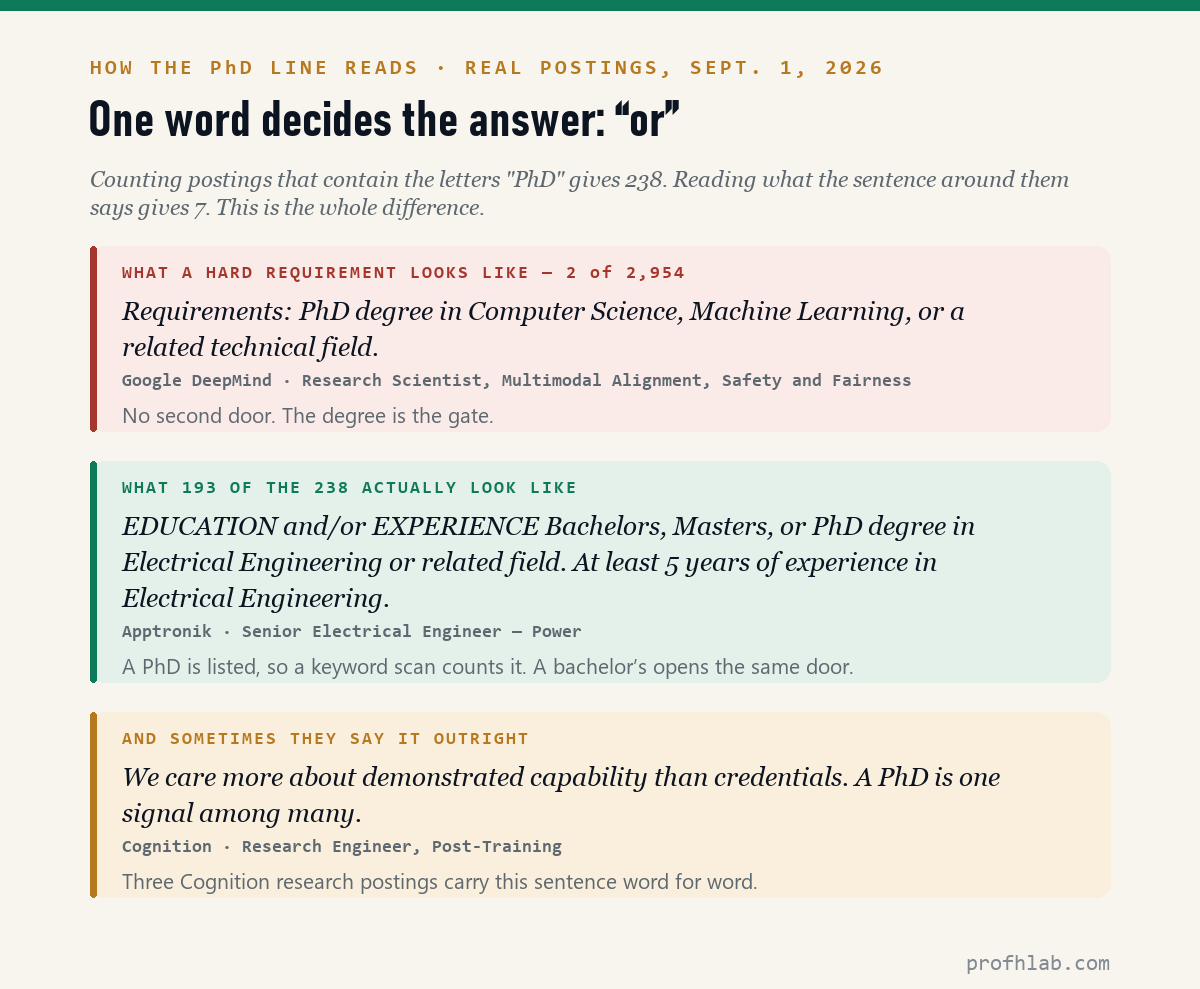
Of the 238 postings that mention a doctorate, 193 attach an escape hatch in the very same sentence. The commonest form is a list: bachelor’s, master’s, or PhD. Apptronik uses that construction across its electrical engineering roles almost verbatim. A machine reading for the word “PhD” scores a hit; a human reading the sentence sees that a bachelor’s degree and five years of work open exactly the same door.
The second commonest form is softer still. Waymo runs the phrase “We prefer: PhD…” through a long list of senior engineering roles — it is a wish, sitting below a hard requirement that is usually a bachelor’s or a number of years. Several of OpenAI’s research postings read “Hold a Ph.D. or other degree in computer science, machine learning, or a related field,” which is a sentence that requires a doctorate of precisely nobody. Physical Intelligence files a PhD under “Bonus Points If You Have”. Perplexity files it under “Nice-to-have”.
And then there is the sentence we did not expect to find on a research posting at all. Cognition prints this, word for word, on three of its research engineering openings:
We care more about demonstrated capability than credentials. A PhD is one signal among many.
Cognition, Research Engineer, Post-Training, read September 1, 2026.
That is a frontier coding-agent company saying the quiet part on its own careers page. It is also, in fairness, easy to say and hard to verify from outside. What we can verify is that the same company’s postings back it up structurally: Cognition names no degree at all in 41 of its 53 US openings.
Where the degree line is hard, and where nobody mentions it
Group the boards by what each company builds and a pattern appears that has nothing to do with how difficult the science is.
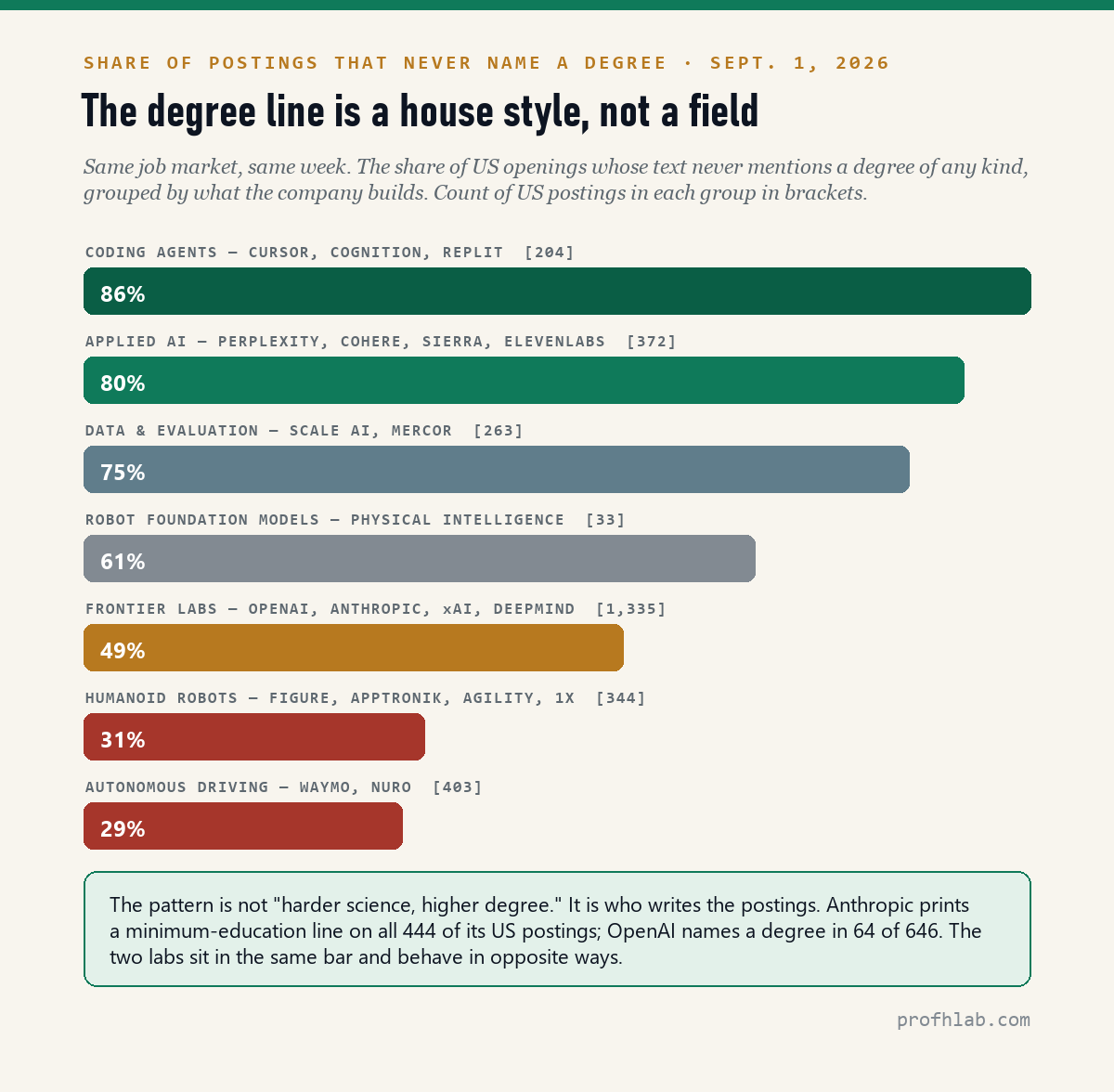
The software-first companies barely raise the subject: 86% of postings at Cursor, Cognition and Replit contain no degree word at all. The hardware-heavy end does the opposite — only 29% of Waymo and Nuro postings stay silent on it, and only 31% at the humanoid-robot firms.
It is tempting to read that as “robotics is more academic.” We do not think that is what it is. Robotics and autonomous driving postings are written by companies that also hire technicians, machinists and service engineers, and postings for those roles name concrete credentials because concrete credentials are what the work uses — a two-year technical degree, a certification, a military electronics background. Agility Robotics’ Senior Service Technician II asks for a “High School diploma or GED; 2-year technical degree or military equivalent preferred.” That is a degree word in our count. It is also the opposite of a barrier.

Anthropic writes a minimum on every posting. OpenAI almost never does.
This is the finding that surprised us most, and it is the cleanest illustration of why “does AI require a degree” has no single answer. Two frontier labs, same city, same week, opposite house styles.
All 444 of Anthropic’s US postings carry an identical block near the bottom: “Minimum education: Bachelor’s degree or an equivalent combination of education, training, and/or experience.” Not most of them. All of them. Anthropic has decided to state a floor in writing on every job it advertises — and then, in the same sentence, to say the floor can be met without the degree.
OpenAI names a degree in 64 of its 646 US postings — under 10%. The other 582 simply do not discuss education. Both approaches are defensible. But if you built your sense of the market by reading Anthropic’s board you would conclude a bachelor’s is the entry ticket, and if you built it from OpenAI’s you would conclude nobody cares. Neither conclusion survives reading both. This is a drafting convention, not a hiring bar, and it is the single biggest reason keyword-based statistics about AI degree requirements disagree with each other.
We took Anthropic’s board apart in more detail yesterday, in is Anthropic hiring right now, and compared published pay across all twenty boards in which AI company pays the most.
What actually pays without a doctorate — or without any degree
Across the 1,571 US postings that never name a degree, 1,121 publish a salary band, and the median of those bands is $218,000–$318,000. That is not a consolation-prize market. It is the middle of this market.
More useful than a median, though, is a short list of openings whose text explicitly accepts something other than a four-year degree. These were live on September 1, 2026.
| Employer | Role | Location | What it asks for instead | Published band | Posting |
|---|---|---|---|---|---|
| OpenAI | Site Operations Technician | San Francisco | “An Associate’s degree, technical certification, military experience, or equivalent practical experience” plus 2+ years. | $157,000–$221,000 | Open |
| OpenAI | Network Operations Engineer, AI Networking | San Francisco | Bachelor’s “or equivalent practical experience”, plus 5+ years running large-scale data-centre networks. | $157,000–$221,000 | Open |
| Anthropic | Repairs Program Lead, Data Center Operations | Remote-friendly | “A bachelor’s degree in relevant domain or equivalent practical experience.” | $320,000–$405,000 | Open |
| Waymo | Early Platforms Operations Program Manager | San Francisco | “BA/BS … or equivalent practical experience in a technical field or role”, 4–6 years. | $159,000–$196,000 | Open |
| xAI | Associate Data Center Operations Technician | Memphis, TN | “High school diploma or equivalency certificate, 0–2 years” — recent graduates encouraged. | Not published | Open |
| Agility Robotics | Senior Service Technician II | Salem, OR | “High School diploma or GED; 2-year technical degree or military equivalent preferred.” | $60,000–$78,000 | Open |
Quoted from the employers’ own postings, read September 1, 2026. Bands are base salary as published and exclude equity.
Put the top and bottom of that table side by side. A San Francisco technician role that accepts a certification or military service pays a published $157,000–$221,000. Three of the seven doctorate-required research roles publish no band at all. Whatever a PhD is worth in this market, the postings are not making the case that it is the price of entry.

What the government’s own numbers say
Job postings are one source. The Bureau of Labor Statistics is another, and it disagrees in an instructive way. We read both relevant Occupational Outlook Handbook entries on September 1, 2026, after its 2025–35 projections went live.
| Occupation | Typical entry-level education | Median pay, May 2025 | Growth 2025–35 | Openings a year |
|---|---|---|---|---|
| Data scientists | Bachelor’s degree | $120,230 | +35% | 24,800 |
| Computer & information research scientists | Master’s degree | $140,300 | +22% | 2,900 |
US Bureau of Labor Statistics, Occupational Outlook Handbook — data scientists and computer and information research scientists, both read September 1, 2026. Median pay is May 2025.
Neither occupation lists a doctorate as the typical way in. BLS does note that for data scientists “some employers require or prefer that applicants have a master’s or doctoral degree” — prefer, again, doing the heavy lifting.
The number in that table worth staring at is the last column. The research-scientist job that BLS says needs a master’s has about 2,900 openings a year in the entire United States. The data-scientist job that needs a bachelor’s has 24,800 — roughly eight and a half times as many. If you are choosing where to aim, the credential question matters far less than which of those two doors is actually open.
Cite this
Prof H Lab read the full text of 2,954 US job postings on 20 AI and robotics job boards on September 1, 2026. A PhD is mentioned in 238 (8.1%) and required, with no alternative offered, in 7 (0.24%); 1,571 postings (53.2%) name no degree of any kind. Source: Prof H Lab AI Jobs Tracker, updated daily. Method: How we count.
Stop filtering yourself out at the degree line
- Stop filtering yourself out at the degree line. If a posting lists “bachelor’s, master’s, or PhD”, the bachelor’s is the requirement and the rest is scenery. Only seven of 2,954 openings today close the door outright, and all seven say so under a heading marked Requirements or Minimum Requirements. Read that heading before you decide.
- If you have no degree, search on the phrase, not the job title. “Or equivalent practical experience” appears in 288 postings; “high school diploma or equivalency certificate” and “associate’s degree” appear in 66 more. Our AI Jobs Tracker lists the current entry-level set with locations and bands.
- If you are mid-career and considering a doctorate for this reason alone — the seven roles above are the entire mandatory-PhD market on these boards today. Weigh three to six years against that number before you commit.
- If you are already in a PhD programme, the value shows up as preference rather than permission: 79 postings name it under “preferred”, “we prefer” or “bonus”. That is a real tiebreaker in senior research hiring, and close to nothing everywhere else.
- Check the date on any posting you found through us. We verify on the day we publish and not after. The employer’s own page always wins.
Technician, federal and lab work: three routes without a degree
“Fine — so what do I need instead?” The three most reliable degree-optional routes we have measured are technician work, federal work and laboratory work. See how to become a data center technician with no experience, how to get a federal job with no experience and national laboratory jobs, no degree. For the robotics side specifically, do you need a degree to be a robotics technician ran the same posting-by-posting count on a smaller sample.
“Which employers should I actually apply to?” Start with which AI companies are hiring right now for the full board count, then how to get a job at OpenAI or Anthropic for the application mechanics, and xAI’s Memphis hiring if you want the largest concentration of entry-level openings in the set.
“What about the jobs advertised to people with no experience at all?” Be careful there — are AI training jobs legit separates the real ones from the rest. When you are ready to apply, should I put ChatGPT on my resume is the question we are asked most, and will AI take my job works through the evidence on the other side of it.
If you are coming to this later in your career, the best AI tools for seniors and how to use ChatGPT for beginners over 50 are the plain-language starting points. Everything the desk publishes lives at the Jobs Desk.
Are graduates ready for AI, and is a degree losing value?

Only seven roles demand a doctorate, all of them in research
Do you need a PhD to work in AI?
No. We read the full text of 2,954 US openings at 20 AI and robotics companies on September 1, 2026. Seven required a doctorate with no alternative offered — 0.24%. A further 231 mentioned one as an option or a preference, and 1,571 postings never named a degree at all.
Which AI jobs actually require a PhD?
All seven we found are research roles: two research posts at Google DeepMind, a staff ML research engineer and a machine learning fellowship at Scale AI, a staff research engineer at Cohere, and a biomechanics researcher and a tactile sensing research engineer at 1X. No posting at OpenAI, Anthropic, xAI, Waymo, Figure AI, Perplexity or Cursor made a doctorate mandatory on the day we checked.
Why do people say 23% of AI jobs require a PhD?
That figure comes from Lightcast data for February 2024 to February 2025 and describes postings that list a PhD, not postings that require one. Lightcast’s own methodology note says the percentages can exceed 100% because a posting may list several degrees, “allowing candidates with any listed degrees to be considered eligible”. A posting reading “bachelor’s, master’s, or PhD” counts in all three columns.
Can you get an AI job without a degree at all?
Yes, and the openings are concrete rather than theoretical. On September 1, 2026 we found 66 US postings naming a high school diploma, GED, associate’s degree or technical certification, and 288 offering “or equivalent experience” against a degree. They cluster in data-centre operations, robotics service and site technician work rather than research.
What is the highest-paying AI job that does not need a bachelor’s degree?
The highest published band we found was OpenAI’s Site Operations Technician in San Francisco at $157,000–$221,000, which asks for “an Associate’s degree, technical certification, military experience, or equivalent practical experience” plus two years in data-centre or industrial operations. Bands are base salary as published and exclude equity.
Do you need a PhD for machine learning engineering specifically?
Not on these boards. Machine learning engineer postings at Waymo and Nuro list a PhD under “We prefer” or as one option beside a master’s and a number of years — Waymo’s Staff Data Scientist posting offers “either a PhD in a quantitative field and 5+ years of industry experience, or 7+ years of industry experience”. One Waymo posting is even titled “(PhD, New Grad)” while its stated requirement is a master’s degree “or equivalent practical experience”.
What degree does the Bureau of Labor Statistics say you need?
A bachelor’s for data scientists and a master’s for computer and information research scientists, as of the handbook read September 1, 2026. Neither lists a doctorate as the typical entry-level education. Data scientists have about 24,800 projected openings a year against 2,900 for research scientists.
How did you count these numbers?
We downloaded every posting from 20 employers’ own public job-board feeds on September 1, 2026, stripped the HTML, and searched the full description of each for degree language. For every posting containing “PhD”, “doctoral” or “doctorate” we then read the surrounding sentence by hand and classified it as required, offered as an option, or preferred. All 238 were read; the classification is ours, and the wording behind each of the seven is quoted in the table above.
Method and limits
Twenty boards: OpenAI, Anthropic, xAI, Google DeepMind (US board), Scale AI, Mercor, Perplexity, Cohere, Sierra, ElevenLabs, Cursor, Cognition, Replit, Figure AI, Apptronik, Agility Robotics, 1X, Physical Intelligence, Waymo and Nuro — read directly from Greenhouse, Ashby or the company careers site, never from an aggregator. 3,733 postings worldwide, of which 2,954 are US roles with a full description.
Three limits worth stating: this is twenty companies, not the whole AI labour market, and it skews toward frontier labs and robotics; a posting’s written requirement is not the same as what a recruiter enforces in practice; and Google DeepMind lists only nine US roles on the board we read, so its share of the seven overstates its share of the market. The full method is on our how we count page, and the daily figures are on the AI Jobs Tracker.
How to read anything we publish about jobs. We are not recruiters. We take no money from any employer named here, and there are no affiliate or sponsored links in this article. Every posting was open on the employer’s own domain on the date given — postings close without notice, and the official page always wins.
We do not give visa, immigration or legal advice, and nothing here is advice about whether to enrol in a degree programme. Never pay to apply for a job, never deposit a cheque and wire money back, and a text-message offer is not an offer. More in our sources and safety notes.
Looking for something specific?
Tell us the city, the field and what you have — degree, certificate, trade, or none of the above — and we will search the boards and answer on the page.
Prof.’s H Newsletter
One short email a month, with the numbers in it
What actually moved in AI hiring, AI prices, and the scams aimed at older Americans. Counted here, dated, and linked to the source. One email a month, and your address goes nowhere else.