Do I Need a Cover Letter? We Opened 475 AI Job Application Forms. 0 Required One.
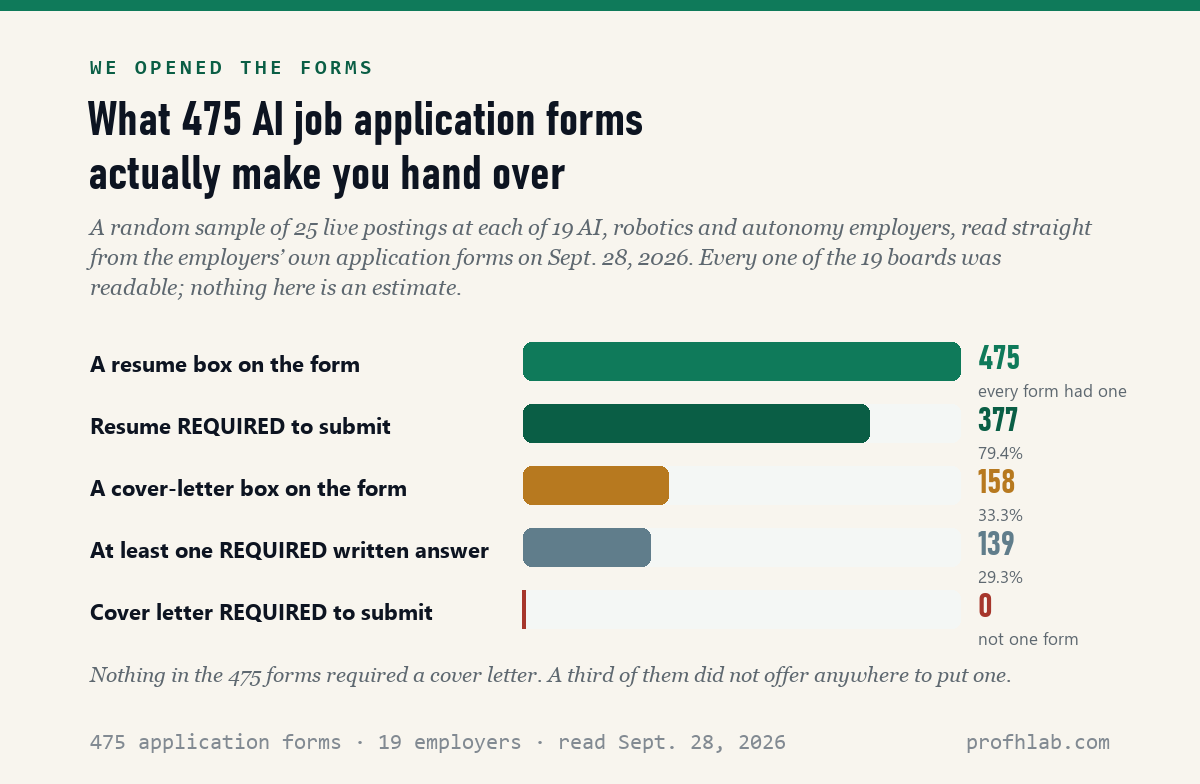
No. On September 28, 2026 we opened 475 live job application forms at 19 AI, robotics and autonomy employers, and 0 of them required a cover letter. Only 158 of the 475 even had a box to put one in, and every one of those boxes was optional. But 139 forms — 29.3 percent — would not submit until you had written an answer to a specific question. The advice you will read everywhere is technically right and practically wrong: the cover letter is dead, and the writing is not.
What we checked on September 28, 2026
We took the 19 employers whose job boards feed our AI & Robotics Jobs Board (3,858 open postings on today’s scan), drew a random sample of 25 live postings from each, and opened the real application form behind every one. That is 475 forms. We read them through the employers’ own application systems, not through a job aggregator.
For each form we recorded every field, its type, and whether it was marked required: resume, cover letter, free-text questions, and any rule or consent about AI. All 19 boards were readable, so there is no “unknown” column here and no estimate anywhere in this piece.
- 0 of 475 forms required a cover letter.
- 158 of 475 (33.3%) had a cover-letter box at all; all optional.
- 377 of 475 (79.4%) required a resume. The other 98 did not.
- 139 of 475 (29.3%) required at least one written answer to a question.
- 74 of 475 carried a rule or consent about AI in hiring.
An AI assistant helped draft this piece and run the page reads; every number was counted from the employers’ own forms, and every quote was read on the source’s own page on the date shown.
So do I need a cover letter, or not?
If the question means “will an application be rejected as incomplete without one,” the answer at these 19 employers is no, and it is not close. Zero of 475.
Two thirds of the forms do not even ask. At 11 of the 19 employers — OpenAI, Perplexity, Sierra, ElevenLabs, Cursor, Cognition, Replit, Mercor, Cohere, 1X and Physical Intelligence — not one sampled form had a cover-letter field anywhere. There is no box. Writing one is not a way to stand out at those companies; it is a file with nowhere to go.
What replaced it is more demanding, not less. A cover letter is one document you can reuse. A required question is specific to that employer, and you cannot submit without answering it.
Which AI employers even give you a box for one?
The split is almost perfectly clean, and it follows the hiring software rather than the industry. The robotics and autonomy employers — Agility Robotics, Apptronik, Nuro, Waymo — had a cover-letter box on all 25 sampled forms. Scale AI had 24, xAI 19, Figure AI 11.
Anthropic had 4. The frontier labs and the applied-AI startups mostly had none.
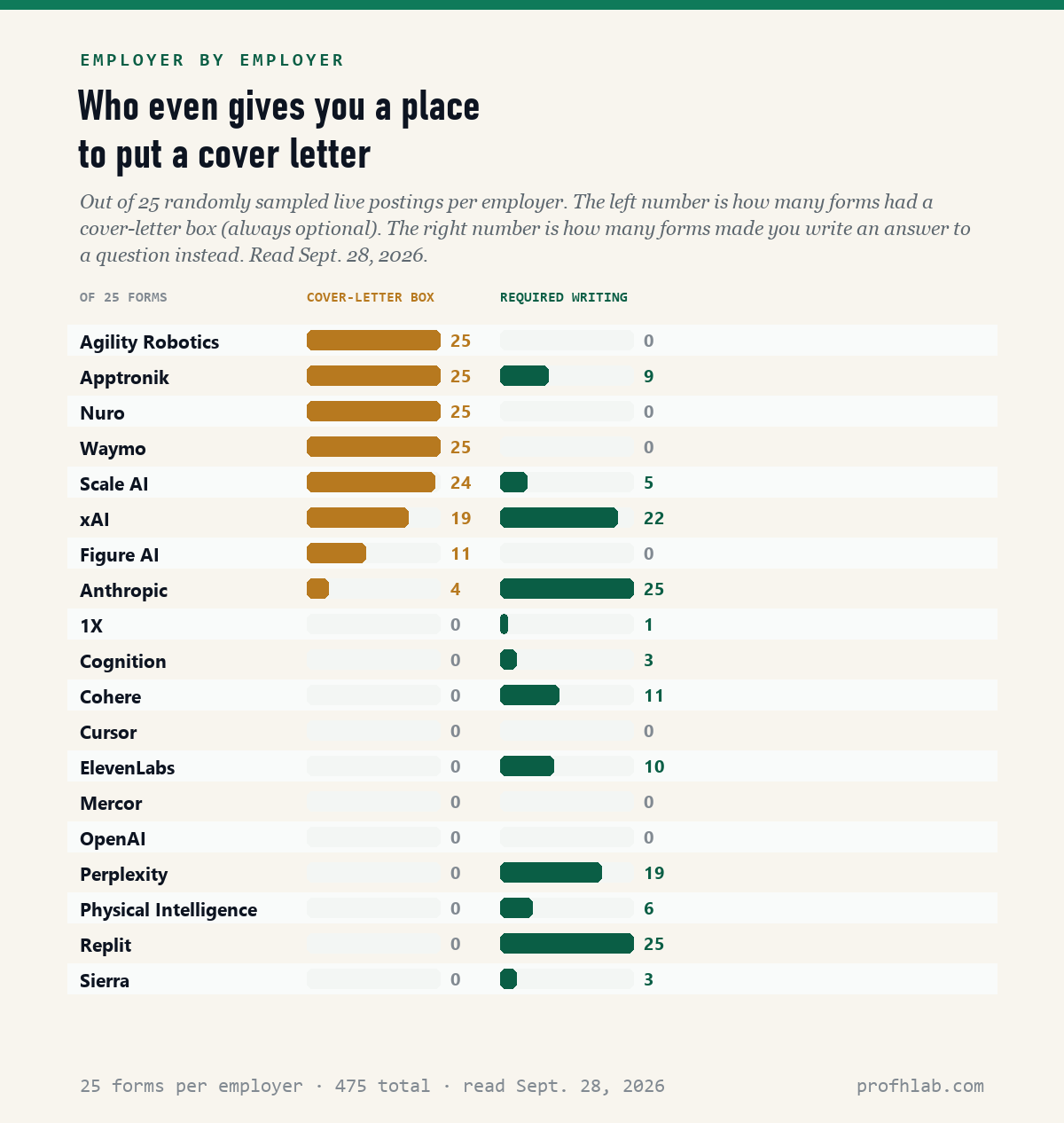
Read the two columns together and the picture inverts. Waymo gives you a cover-letter box on all 25 forms and requires written answers on none. Replit gives you no box at all and requires a written answer on all 25.
If you judged these two employers by whether they “want a cover letter,” you would prepare for exactly the wrong one.

What they ask for instead of a cover letter
These are the questions that actually block the submit button, quoted from the forms, with the number of sampled forms carrying each one.
| Employer | The required question | Forms |
|---|---|---|
| Replit | What excites you about Replit? | 24 of 25 |
| Anthropic | Why Anthropic? | 23 of 25 |
| xAI | What exceptional work have you done? | 22 of 25 |
| Perplexity | How do you use AI in your day-to-day work? What are some of the underappreciated benefits and/or pain points of your favorite AI tools? | 19 of 25 |
| Perplexity | What are the most interesting aspects of Perplexity that you are excited to work on? | 17 of 25 |
| Physical Intelligence | Why do you want to work at pi? | 5 of 25 |
| ElevenLabs | Why ElevenLabs, and why now? | 3 of 25 |
| Sierra | Why are you excited to join us at Sierra? | 3 of 25 |
Physical Intelligence writes its name with the Greek letter pi on the form. Read Sept. 28, 2026.
Look at what these have in common. Every one is the paragraph people traditionally buried in the middle of a cover letter: why this company, why now, what you have done that matters.
The form did not delete that paragraph. It stripped away the date, the address block, the “Dear Hiring Manager,” and the closing, and kept the only part anyone read.
The length limits are real, too. Sierra asked one sampled applicant what qualities make a great Agent Engineer and how their experience fits, in a single required box. Cognition asked sales candidates for their largest deal by annual contract value, who originated it, and how the team coordinated. That is not a cover letter. That is an interview question you answer before anyone has agreed to interview you.

Can I use AI to write it? Three employers, three different rules
This is the question underneath the question, and 74 of the 475 forms now address it directly. They do not agree, and each rule binds only that employer.
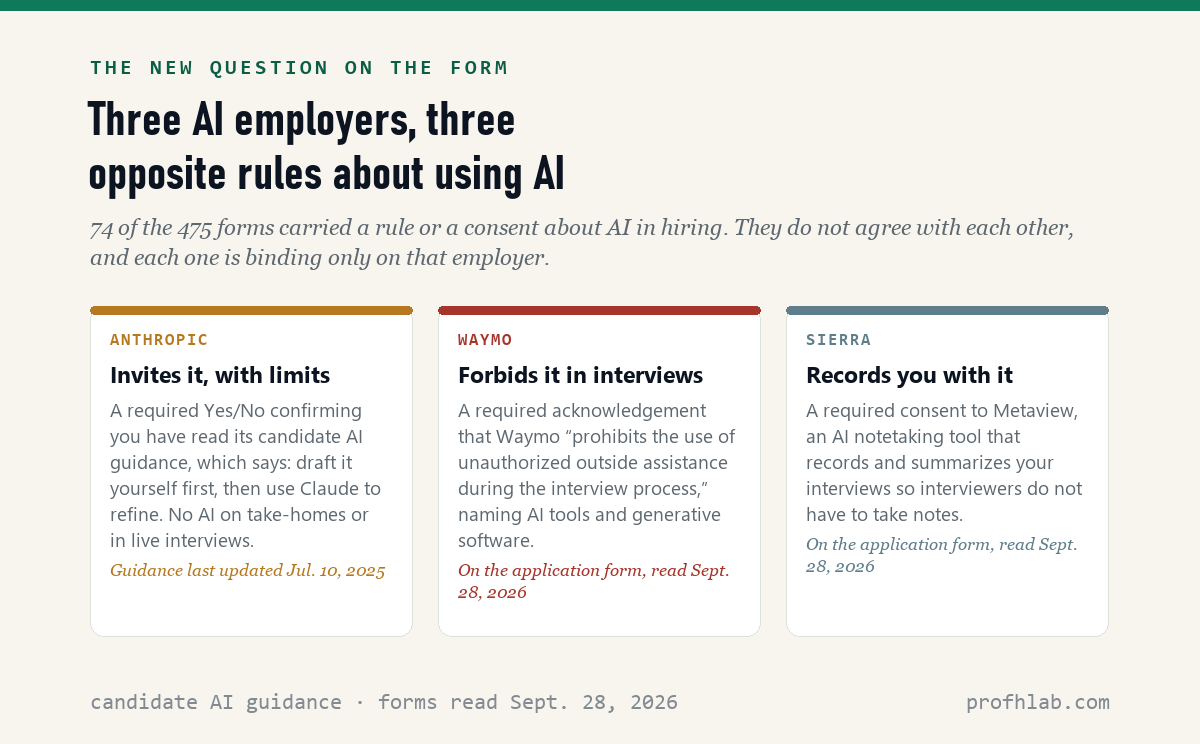
Anthropic invites it, with limits. Its forms carry a required Yes/No item called “AI Policy for Application” that asks you to confirm you have read its candidate guidance. That guidance, last updated Jul. 10, 2025, tells applicants to draft the application themselves first and then use Claude to refine it: “Please create your first draft yourself, then use Claude to refine it.” It also says take-home assessments and live interviews are to be done without AI unless the team says otherwise.
Waymo forbids it during interviews. Its forms carry a required acknowledgement that Waymo “prohibits the use of unauthorized outside assistance during the interview process,” explicitly naming AI tools and generative software. You tick “I acknowledge the above policies” to submit.
Sierra records you with it. Every sampled Sierra form required consent to Metaview, an AI notetaking tool that records and summarises interviews so interviewers do not have to take notes by hand.
So the honest answer to “can I use AI” is: read the form. One of these three employers wants you to, one forbids it at a later stage, and one is using it on you. Guessing gets you the wrong one two times out of three.
Perplexity goes further and makes your AI use the question itself, asking on 19 of 25 sampled forms how you use AI day to day and what the underappreciated pain points of your favourite tools are. There is no way to answer that with a generic letter. We looked at the related question of whether employers screen you with AI in our census of AI resume screening, where 0 of 19 offered an opt-out.
Why the pages above this one get it wrong
We read page one for this question on September 28, 2026 and scored it. Four of the seven results were readable from our machine; Indeed returned 403 and Zety timed out, so we score four and say so rather than pretending we read seven.
Of those four, zero counted anything themselves. Three cite a survey. Two sell a cover-letter or resume builder on the same page. The closest thing to evidence on page one is Jobscan’s survey, published Jul. 8, 2026, which asked 200 newly hired job seekers whether they submitted cover letters — a measure of what applicants did, not of what employers require.
That is the gap. Every page answering this question is asking people about their habits. Nobody opened the form.
What changes when you sit down to apply tonight
Stop writing the letter first. Open the application form before you write anything, because the form tells you whether writing is required, optional or impossible.
Then work in this order.
- Get the resume right first. It is required on 377 of 475 forms. It is the only document that is nearly always mandatory.
- Read every required question before you start. A third of forms have one, and they are employer-specific. Our jobs board links straight to the employer’s own page so you can see the form before committing an evening to it.
- Reuse the argument, never the letter. “Why Anthropic?” and “What excites you about Replit?” want the same two paragraphs you would have buried in a cover letter. Keep those paragraphs; drop the letter around them.
- If there is a box and no question, use it only when you have something the resume cannot carry — a career change, a gap, a relocation, a specific reason for this company. Otherwise the resume is the application.
- Check the AI rule on that specific form. It is now on 74 of 475, and the three we quote above point in three different directions.
One more thing worth knowing before you spend the evening: at these employers the posting you are answering is probably older than it looks. We measured that separately in our piece on old job postings, where most open roles turned out to be more than a month old.

A sample of 475 forms, not a census of 3,858 postings
This is a sample of 475 forms, not a census of all 3,858 open postings we track. We drew 25 postings at random per employer with a fixed seed, so the sample is reproducible but it is still a sample. A rare posting with unusual requirements can be missed.
Application forms are also set per posting, not per company. “Anthropic had a cover-letter box on 4 of 25 forms” means exactly that, and not that Anthropic has a company-wide rule.
These 19 are AI, robotics and autonomy employers hiring largely in the United States. We would not assume a hospital system, a school district or a federal agency behaves this way; federal roles in particular run through USAJOBS, which has its own required documents.
Finally, “not required” is not the same as “never read.” We counted what the form makes you do. We cannot see what a recruiter opens after you submit, and nothing here should be read as a claim about what happens next.
The cover-letter questions applicants actually type into a search box
Do I need a cover letter if it is optional?
At the 158 forms that had a box, it was optional every time. Use it when the resume cannot carry something important: a career change, an employment gap, a relocation, or a specific reason you want this employer. If you would be writing a generic letter, the evidence here does not support spending the hour.
Is a cover letter required for a job application?
Not at any of the 475 AI and robotics forms we opened on Sept. 28, 2026. A resume was required on 377 of them. If an employer truly requires written work, it usually appears as a required question on the form, not as a letter.
Do companies still read cover letters?
We cannot answer that from a form, and neither can the pages that claim to. What we can say is that two thirds of these employers removed the place to put one, which tells you how much weight it carries in their process.
What do AI companies ask for instead of a cover letter?
A specific required question. The most common in our sample were “What excites you about Replit?” (24 of 25 forms), “Why Anthropic?” (23 of 25) and “What exceptional work have you done?” at xAI (22 of 25).
Can I use ChatGPT or Claude to write my application?
It depends on the employer, and 74 of 475 forms now say so explicitly. Anthropic’s candidate guidance, last updated Jul. 10, 2025, asks you to draft it yourself and then use Claude to refine it. Waymo requires you to acknowledge that AI tools are not permitted during its interview process. Read the form you are on.
Does a cover letter help you get past AI screening?
There is no evidence in these forms that it does. When we read employers’ own policy pages on Sept. 27, 2026 for the resume-screening question, none of the 19 offered an opt-out and only one said in a posting that AI may screen applicants.
Do I need a cover letter for an internship or an entry-level role?
The same forms apply. Entry-level roles are a small slice of this market — 152 of 3,058 US postings on today’s scan — and we looked at that ratio in our piece on whether the AI job market is saturated.
Which AI employers never ask for a cover letter?
In our sample, 11 of 19 had no cover-letter field on any of the 25 forms: OpenAI, Perplexity, Sierra, ElevenLabs, Cursor, Cognition, Replit, Mercor, Cohere, 1X and Physical Intelligence.
Reading on either side of this question
If you are working out what to put on the resume that these forms do require, we counted what the postings themselves ask for: whether you need a PhD, whether an AI certificate is worth it (0 of 2,974 postings asked for one), and whether to put ChatGPT on your resume.
If you are choosing where to apply, we have company-by-company counts for OpenAI, Waymo and Figure AI, plus which employers mean it when they say remote and what remote-friendly means at Anthropic.
On pay and timing: why postings hide salary, what forward deployed engineers make, what AI data center electricians make, and which day of the week most jobs appear. If coding is the barrier, 940 open roles do not require it; if you are over 50, we read all 2,985 US openings with that in mind. To be told when a specific employer posts, here is how each of the 20 boards handles alerts, and here is what the xAI tutor listings actually are.
The daily counts behind all of it live on the AI Jobs Tracker and the searchable AI & Robotics Jobs Board, which is rebuilt every morning. If you want us to check something specific for you, ask the desk and we will read the forms.
Cite this
Of 475 live job application forms opened at 19 AI, robotics and autonomy employers on September 28, 2026, none required a cover letter and 158 (33.3%) had an optional cover-letter box, while 139 (29.3%) required a written answer to a specific question. Source: profhlab.com AI Jobs Desk, Do I Need a Cover Letter?
Sources read on September 28, 2026: the Greenhouse and Ashby application forms of the 19 employers listed above, through each employer’s own job board; Anthropic, Guidance on Candidates’ AI Usage (last updated Jul. 10, 2025); page-one search results for this question, scored the same day. Postings close without notice — the employer’s own page wins. We are not recruiters, we take no money from employers, and there are no affiliate links on this page.
Prof.’s H Newsletter
One short email a month, with the numbers in it
What actually moved in AI hiring, AI prices, and the scams aimed at older Americans. Counted here, dated, and linked to the source. One email a month, and your address goes nowhere else.