Why Do Job Postings Not Show Salary? We Checked 3,005 Against the Law — 91.1% vs 15.2%
The short answer · read September 11, 2026
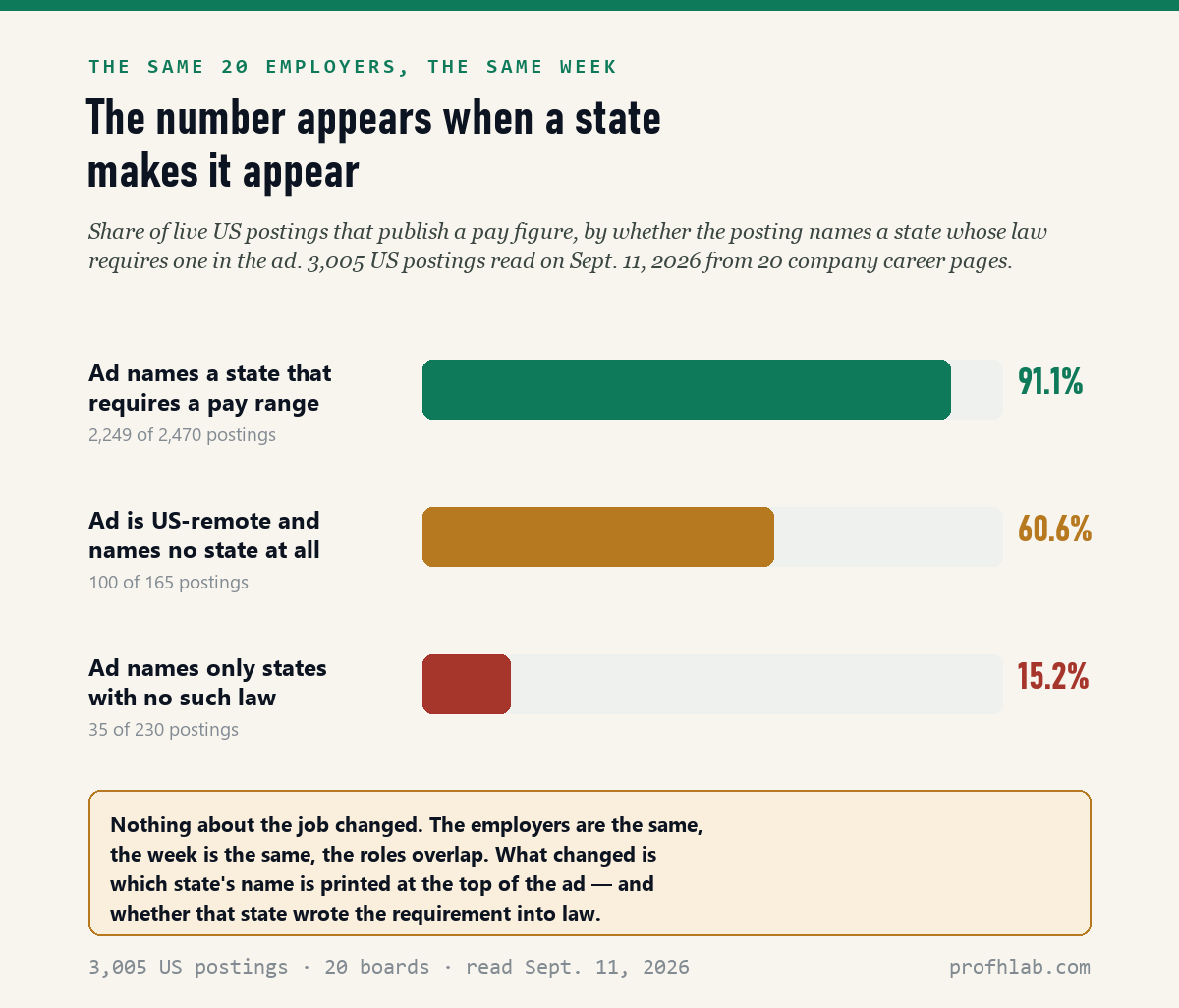
Because in most of the country it is still legal to leave it out — and employers leave it out almost every time they legally can. We read 3,005 live U.S. job postings on the career pages of 20 AI, robotics and self-driving companies on September 11, 2026. Where the ad named a state that requires a pay range in the posting itself, 91.1% published one (2,249 of 2,470). Where the ad named only states with no such law, 15.2% did (35 of 230).
That is a 6.0x gap in the same week, from the same twenty employers. It is not about industry, company size or seniority. The strongest predictor of whether you get to see the number is which state’s name is printed at the top of the ad.
In Robert Koehler’s The Strike, painted in 1886, a crowd of mill workers has come up the road to the owner’s house. He stands on the steps in a top hat with a paper in his hand. They are not asking about ventilation or hours. They have come to find out what the work pays, because the only way to find out was to stand outside a man’s house and ask him.
A hundred and forty years later the paper is a web page, and the question is the same one. You find a job you could do, you read 700 words about mission and impact and a fast-paced environment, you scroll to the bottom, and there is no number. So you do what everyone does: you guess, you apply anyway, and you spend two rounds of interviews hoping the guess was close.
Search this question and you will find a dozen articles explaining the employer’s psychology — they want negotiating room, they don’t want to upset current staff, they haven’t decided yet. Those explanations may all be true. None of them is measured. So we measured it instead, and the answer turned out to be much less psychological than the advice columns suggest.
What we counted, and how
Every weekday we pull the public job feeds of 20 AI, robotics and autonomy companies. On September 11, 2026, nineteen of those boards answered — Google DeepMind’s U.S. feed returned a 404, as it has for several days — giving 3,794 live postings, of which 3,005 are based in the United States.
For each posting we recorded whether it states pay at all: an annual range, an hourly range, or a single fixed figure. Then we read the location line and mapped it to states, and checked each state against the statute that governs pay disclosure in job advertisements.
One methodological note, because it changed our numbers. Our daily scanner had been undercounting: it only recognised annual ranges above $30,000 where the minimum was strictly less than the maximum. That quietly dropped two real categories — hourly rates like Figure AI’s $40–$45/hr, and fixed amounts written as an identical pair, like Anthropic’s Annual Salary: $320,000 – $320,000. We re-derived every figure in this article directly from the same official Greenhouse and Ashby APIs with a parser that accepts all three forms. It moved the count of postings publishing pay from 2,222 to 2,503. We also hand-opened a random sample of postings to confirm the parser’s negatives were real negatives; that check is described at the end, along with what it cannot rule out.
The number appears when a state makes it appear
Twelve U.S. jurisdictions currently require an employer to put a pay range in the job posting itself: California, Colorado, Hawaii, Illinois, Maryland, Massachusetts, Minnesota, New Jersey, New York, Vermont, Washington and the District of Columbia. The exact wording matters. California’s Labor Code § 432.3(c)(3) says an employer with fifteen or more employees “shall include the pay scale for a position in any job posting.” Minnesota’s statute goes further and requires “a general description of all of the benefits and other compensation” alongside the range.
A second group — Connecticut, Nevada and Rhode Island — requires disclosure, but not in the advertisement. There the employer owes you a range on request, or after an interview, or at the offer. This is the distinction most “pay transparency states” listicles blur, and it is the difference between seeing a number while you decide whether to apply and seeing it after you have spent three hours on the process.
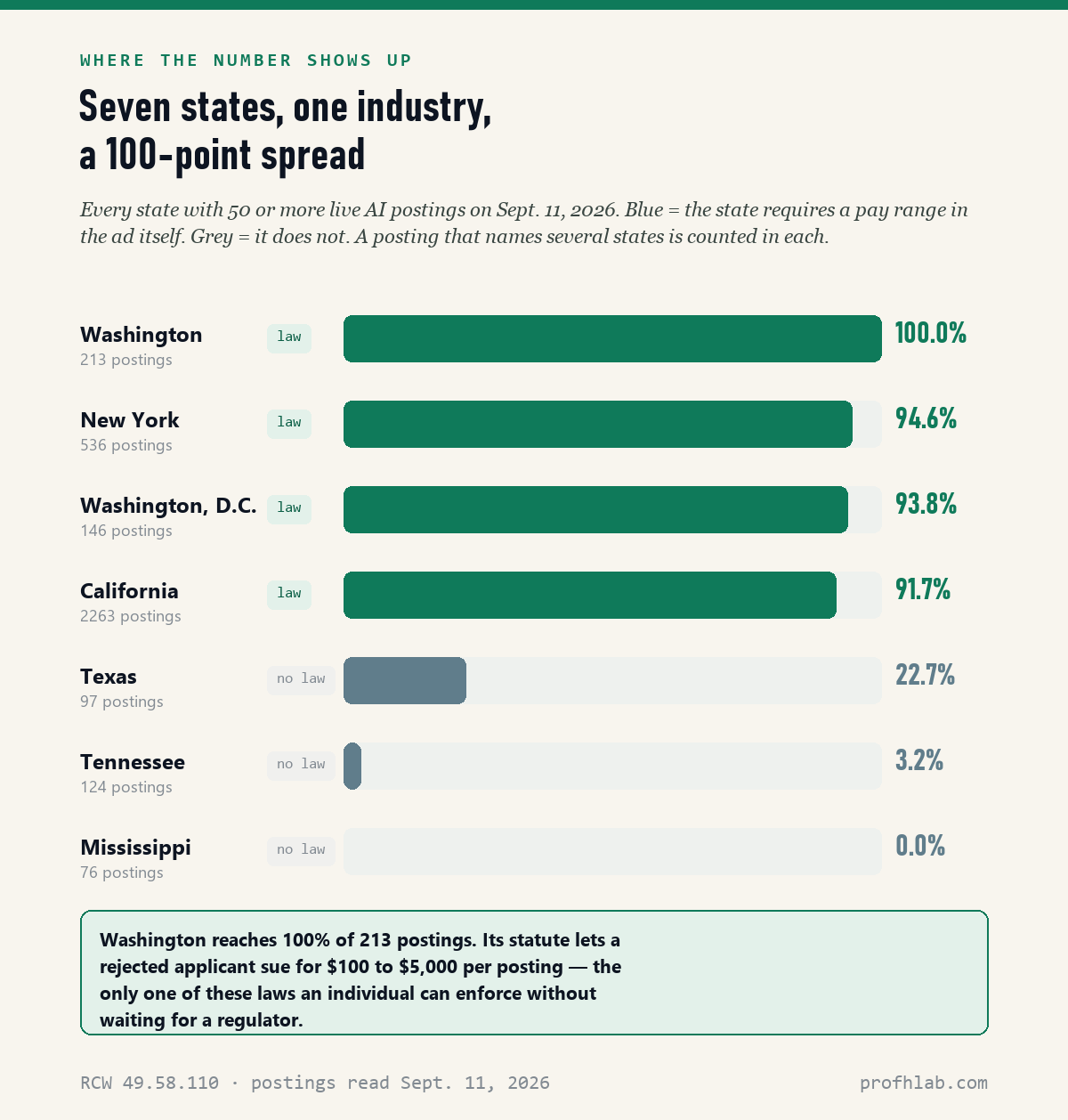
The spread runs the entire length of the scale. Washington: 213 of 213. Mississippi: 0 of 76. These are the same kinds of jobs at overlapping sets of employers in the same seven-day window.
One company, one week, two different answers
The cleanest evidence in the dataset comes from a single employer, which removes almost every competing explanation at once. xAI had 207 live U.S. postings naming at least one state. One recruiting team, one applicant tracking system, one compensation philosophy, one week.
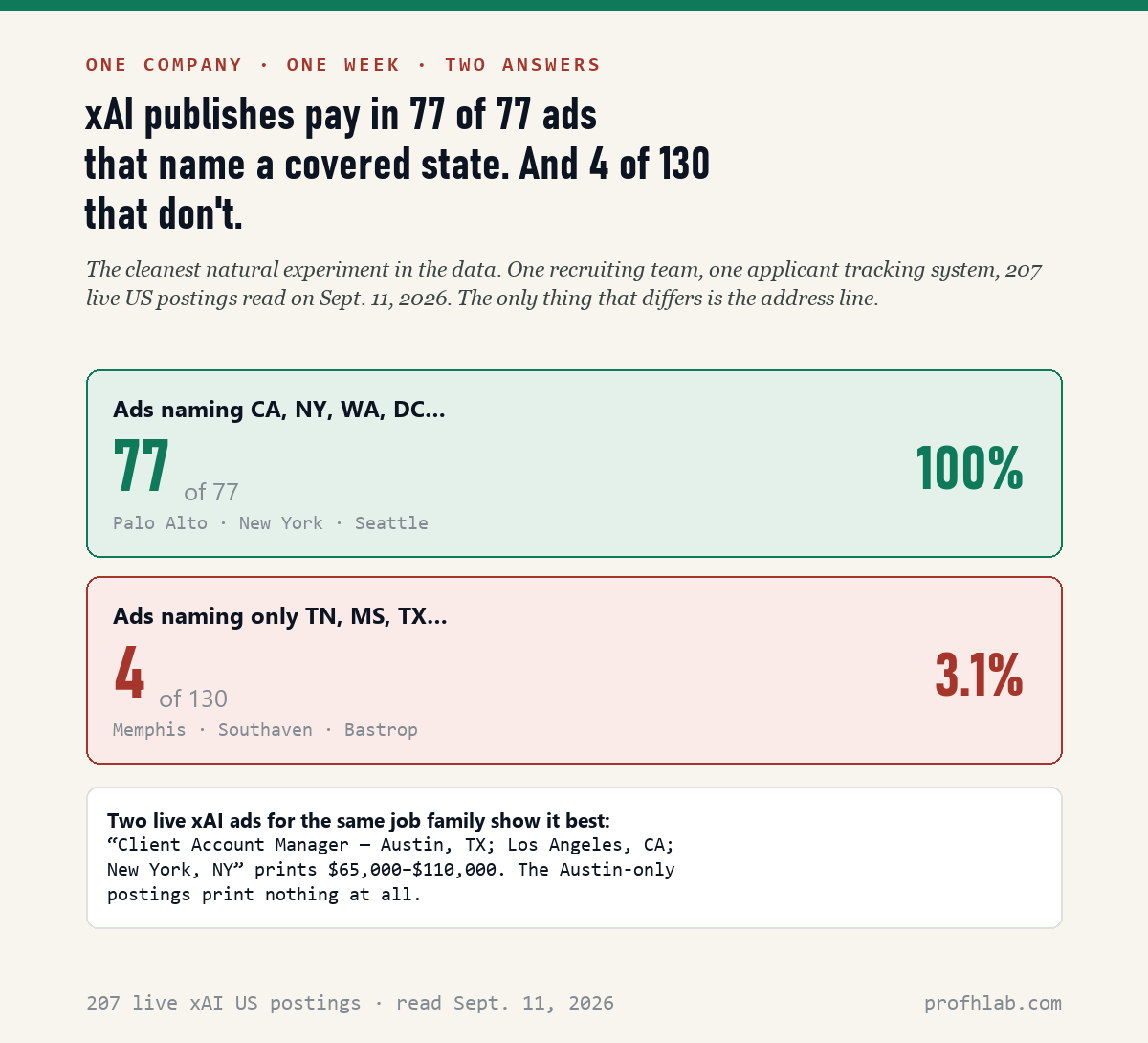
Seventy-seven postings named a covered state. All seventy-seven published pay. One hundred and thirty named only states without a posting requirement — Memphis, Southaven, Bastrop, Austin. Four published pay.
The sharpest version of it is two ads for the same job family. xAI’s Client Account Manager listed in Austin, TX; Los Angeles, CA; New York, NY prints $65,000–$110,000. The Austin-only postings print nothing. A candidate in Austin is shown the number only when a Californian and a New Yorker are invited to apply for the same job.
Eight pairs of the same job, on both sides of the line
The comparison does not stay inside one company. Below are eight pairs of live postings where the same employer is advertising the same role in two places at once — one in a state that requires a pay range in the ad, one in a state that does not. Every link goes to the employer’s own application page, and every one was open and verified on September 11, 2026. There were fourteen such pairs in today’s scan; these are eight.
Read from each employer’s public job feed on September 11, 2026. Postings close without notice — the employer’s own page is authoritative. We are not recruiters and take no money from any employer listed here.
The Apptronik rows are the ones to sit with. Those are not loosely similar jobs; they are the same humanoid-robotics roles posted by the same company in Sunnyvale and in Austin. The Sunnyvale ad tells you it pays $300,000 to $350,000. The Austin ad tells you nothing. And the xAI kitchen roles make the point without any engineering salary to distract from it: a cook in Palo Alto is told $26 to $43 an hour, and a cook in Memphis is told to apply and find out.
The law travels with the posting
That last point generalises, and it is the most useful thing in this article for anyone job-hunting outside the twelve jurisdictions.
Texas has no posting requirement. Across all employers, Texas postings that named only Texas or other uncovered states published pay 10.0% of the time (8 of 80). Texas postings that also named a covered state published pay 82.4% of the time (14 of 17).
Same state. Same employers. Same week. An eight-fold difference, produced entirely by whether a second city was on the address line. Employers do not maintain two versions of an ad, so when a role is open in Seattle and Austin, Washington’s statute effectively writes the number into the Austin listing too. It is why Pennsylvania, Missouri and Arizona — none of which require posting — sit at or near 100% in our data on small numbers: nearly all of their postings are multi-city ads anchored in California or New York.
“Remote — United States” is the gap in the middle
Between the two extremes sits a third category: 165 postings that are U.S. remote and name no state at all. Their disclosure rate is 60.6% — well below the covered-state rate, well above the uncovered-state rate.
This is the honest grey area of pay transparency law. If a job can be performed from anywhere in the country, it can be performed in Denver and Seattle, and the state labor agencies have generally taken the position that their laws reach remote roles that could be filled by someone in the state. Colorado’s division has been the most explicit about it. But an ad that simply says Remote (United States) has not named anyone’s state, and roughly two in five of them print no number.
Worth noticing as you scroll: some employers label a fully remote role Remote (San Francisco), which anchors it to California and, in practice, comes with a number attached. If you are comparing two similar remote listings and only one shows pay, the location label is usually the reason.
Why some ads in covered states still show nothing
The covered-state rate is 91.1%, not 100%. The missing 221 postings are worth being precise about, because this is where it would be easy to overclaim.
Most of them cluster in a handful of companies. On the day we looked, Cursor published pay in 0 of 69 postings naming a covered state, ElevenLabs 0 of 26, Physical Intelligence 1 of 34 and Cognition 10 of 48. At the other end, OpenAI (618), Anthropic (455), Waymo (281), Perplexity and Mercor are at or within a rounding error of 100%.
We are not in a position to say any particular employer is breaking a law, and we are not saying it. These statutes have employee-count thresholds — fifteen in California and Washington, four in New York, twenty-five in Massachusetts — counted in ways that depend on facts we cannot see from outside, and questions about which roles a given state’s law reaches are genuinely contested. What we can report is what the ads did and did not print on a given day.
The enforcement design explains a lot of the variation, though. California’s law is complaint-driven: you file with the Labor Commissioner within a year, penalties run $100 to $10,000 per violation — but the statute also says that for a first violation, “no penalty shall be assessed upon demonstration by the employer that all job postings for open positions have been updated.” A company that has never printed a range faces, in effect, one free correction.
Washington built it differently. There a job applicant can sue directly, with statutory damages of $100 to $5,000 per violation, and that private right of action produced a wave of class actions. Washington is also the state at 213 of 213. Two states is not a proof, and the state legislature has since added a cure period — for postings between July 27, 2025 and July 27, 2027, an employer who fixes a posting within five business days of written notice avoids penalties — but the pattern is consistent with the obvious mechanism: the rule that an individual can enforce is the rule that gets followed.
What this means if you are the one reading the ad
The practical upshot is that a missing salary is usually information about a jurisdiction, not about you or about that particular employer’s character. Three things follow from the data.
- Look for the same role in a covered state before you ask anyone anything. Large employers post the same job family in several cities. If the Austin listing is silent, the New York listing for the same title often is not, and that range is the company’s own good-faith estimate — not a third-party guess.
- A silent ad in a covered state is worth a question, not an assumption. In California you may ask for the pay scale and, under § 432.3(c)(1), an employer must provide it on reasonable request from an applicant. Connecticut, Nevada and Rhode Island have request- or offer-stage rights of their own.
- Treat “competitive salary” as the absence of data. It is not a range, it is not a signal of generosity, and in our 3,005 postings it never appeared alongside a number that would have made it meaningful.
What to do with this today
1. Open our AI & Robotics Jobs Board and sort by pay. Every row links to the employer’s own application page, and 2,222 of today’s rows carry a published range.
2. If a role you want is silent, search the same job title on that company’s board filtered to New York, Seattle or California before you apply.
3. If you believe a posting in a covered state should carry a range, the complaint channels are public: California’s Labor Commissioner, Washington’s L&I Equal Pay and Opportunities Act page, and New York’s Department of Labor.
If you want to go deeper
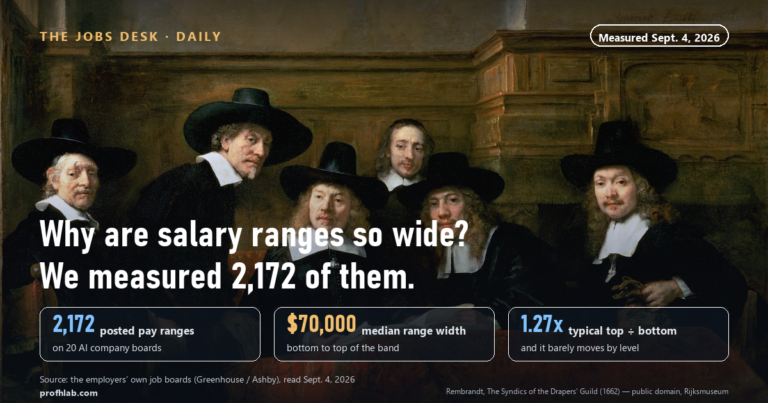
“Fine, but is the posted range even honest?” Often it is very wide. We measured that separately: why AI salary ranges are so wide, across 2,172 postings. A range of $280,000 to $850,000 is technically a disclosure and practically a shrug.
“Which of these companies actually pays the most?” We ranked the posted midpoints in which AI company pays the most. The related case study of a single non-disclosing site is xAI’s Memphis postings, which is where a large share of today’s Tennessee zeros come from.
“I’m earlier in my career than these numbers suggest.” Start with entry-level AI jobs with no experience and part-time AI jobs you can do from home. If a recruiter reaches you by text with an hourly figure and no employer domain, read are AI training jobs legit first — an unsolicited number is not a disclosure.
Questions people actually search
Is it illegal to not post a salary range?
It depends entirely on where the job is. In twelve jurisdictions — California, Colorado, Hawaii, Illinois, Maryland, Massachusetts, Minnesota, New Jersey, New York, Vermont, Washington and Washington, D.C. — a covered employer must include a range in the posting. In most states there is no such requirement and leaving it out is entirely lawful. Coverage also depends on employer size: fifteen or more employees in California and Washington, four or more in New York.
Why do remote jobs not list salary?
Because a posting that says only Remote (United States) has not named a state, and the requirement attaches to a place. In our data, U.S. remote postings with no state named published pay 60.6% of the time, against 91.1% for postings naming a covered state. Remote roles anchored to a city — Remote (San Francisco) — behave like that city’s state.
Can I ask for the salary range before the interview?
In California, yes: § 432.3(c)(1) requires an employer to provide the pay scale to an applicant upon reasonable request. Connecticut, Nevada and Rhode Island create rights that attach at request, interview or offer stage rather than in the ad. Elsewhere you can always ask, but no statute obliges an answer. Asking early is normal and costs you nothing.
What does “competitive salary” mean in a job posting?
Nothing measurable. It is not a range and carries no legal weight, and in a covered state it would not satisfy a posting requirement, which asks for a good-faith minimum and maximum. Treat it as a blank field.
Can a company pay less than the posted range?
The range is defined in these statutes as the employer’s good-faith expectation of what it will pay for the role at the time of posting — California’s wording is “a good faith estimate of the salary or hourly wage range the employer reasonably expects to pay.” An offer below the posted floor is a strong signal that the posting was not made in good faith, and it is the kind of fact a state labor agency will take a complaint about. We are describing how the statutes read, not giving legal advice; a state labor office or an employment lawyer is the right place for your specific situation.
Do employers have to post a salary range in Texas?
No. Texas has no pay-range posting requirement, and it shows: Texas-only postings in our data published pay 10.0% of the time. But Texas postings that also named a covered state did so 82.4% of the time, so it is worth checking whether the same role is cross-listed.
Watch: what happened when the first of these laws landed

Cite this
On September 11, 2026, 91.1% of U.S. AI job postings that named a state requiring a pay range in the advertisement published one (2,249 of 2,470), compared with 15.2% of postings naming only states without such a requirement (35 of 230) — a 6.0x gap across 3,005 live postings on the career pages of 20 AI, robotics and autonomy employers. Source: Prof H Lab, AI Jobs Tracker.
How we counted, and what this cannot tell you
Postings come from the public Greenhouse and Ashby feeds of 20 employers; 19 answered on September 11, 2026. Pay is counted as published if the posting states an annual range, an hourly range, or a fixed figure. Locations are parsed from the employer’s own location line; a posting naming several states counts in each state’s row but only once in the overall test, where it is treated as covered if any named state has a posting requirement. Statute text was read the same day from each state’s own legislature or labor department. Our full method is on How We Count.
Four limits worth stating plainly. This is twenty AI employers, not the U.S. labor market — a sector that pays well, posts on modern applicant systems and skews heavily to California, which alone supplies 2,263 of the 2,700 postings that name a state. The uncovered-state group is small and concentrated: 230 postings, of which xAI’s Memphis, Southaven and Austin sites are a large share, so that 15.2% partly measures one company’s practice. We cannot assess any employer’s legal compliance, for the threshold reasons described above. And we measure the ad, not the offer: a published range is not a promise, and its width is a separate question we handled in a separate piece.
We are not recruiters, we take no money from any employer named here, and postings close without notice — the employer’s own page always wins. Today’s full dataset, refreshed every weekday, is on the AI Jobs Tracker and the searchable Jobs Board. Questions about a specific search go to the Jobs Desk, and we answer them in public.
More from this desk: which AI companies are hiring right now · are AI engineer jobs remote · do you need a PhD to work in AI · is an AI certificate worth it · should I apply to old job postings · AI jobs for people over 50 · how to get a job at OpenAI or Anthropic · should I put ChatGPT on my resume · federal jobs with no experience · national laboratory jobs without a degree · robotics technician without a degree · data center technician with no experience · when summer 2027 internships open · the faculty search tracker · is Anthropic hiring right now.
Prof.’s H Newsletter
One short email a month, with the numbers in it
What actually moved in AI hiring, AI prices, and the scams aimed at older Americans. Counted here, dated, and linked to the source. One email a month, and your address goes nowhere else.