Should I Apply to Old Job Postings? 71% of AI Jobs Are Over 30 Days Old
Short answer: yes, apply — and stop reading the date. On September 26, 2026 we aged every one of the 3,069 open US roles on the AI, robotics and autonomy employer boards we track. 70.8% were already more than 30 days old and the median was 59 days — so a posting you found on day 30 is younger than most of what is open. Pooling 12 seven-day windows, postings closed at 4.0–7.4% a week at every age, with no trend. The one real exception is federal hiring: a USAJOBS announcement stays open a median of 9 days, so there the date is a genuine deadline.
The question shows up in our inbox in one of two shapes. Either “this job was posted three months ago, is it dead?” or the sadder version, “I found it too late.” Both assume the little grey date under the job title means something.
We read those dates for a living. Every morning a script here pulls the public feeds behind 20 employer career pages — OpenAI, Anthropic, Waymo, Figure AI, Scale AI, xAI and the rest — and files what it finds into our jobs tracker and our jobs board. This week we turned the script on the dates themselves. What came back was uncomfortable enough that we changed our own board before publishing this.
The date on the posting is often not the date it was posted
Most of these companies run their hiring on one of two systems, Greenhouse or Ashby, and both publish a job feed that anyone can read. Greenhouse’s own Job Board API documentation lists three date-ish fields on every job: first_published, updated_at, and application_deadline.
The date you see on the careers page is usually the second one. And updated_at moves whenever anyone on the hiring team touches the record — fixes a typo, adds a location, re-syncs the board. Nothing about the job changes. The clock just resets.
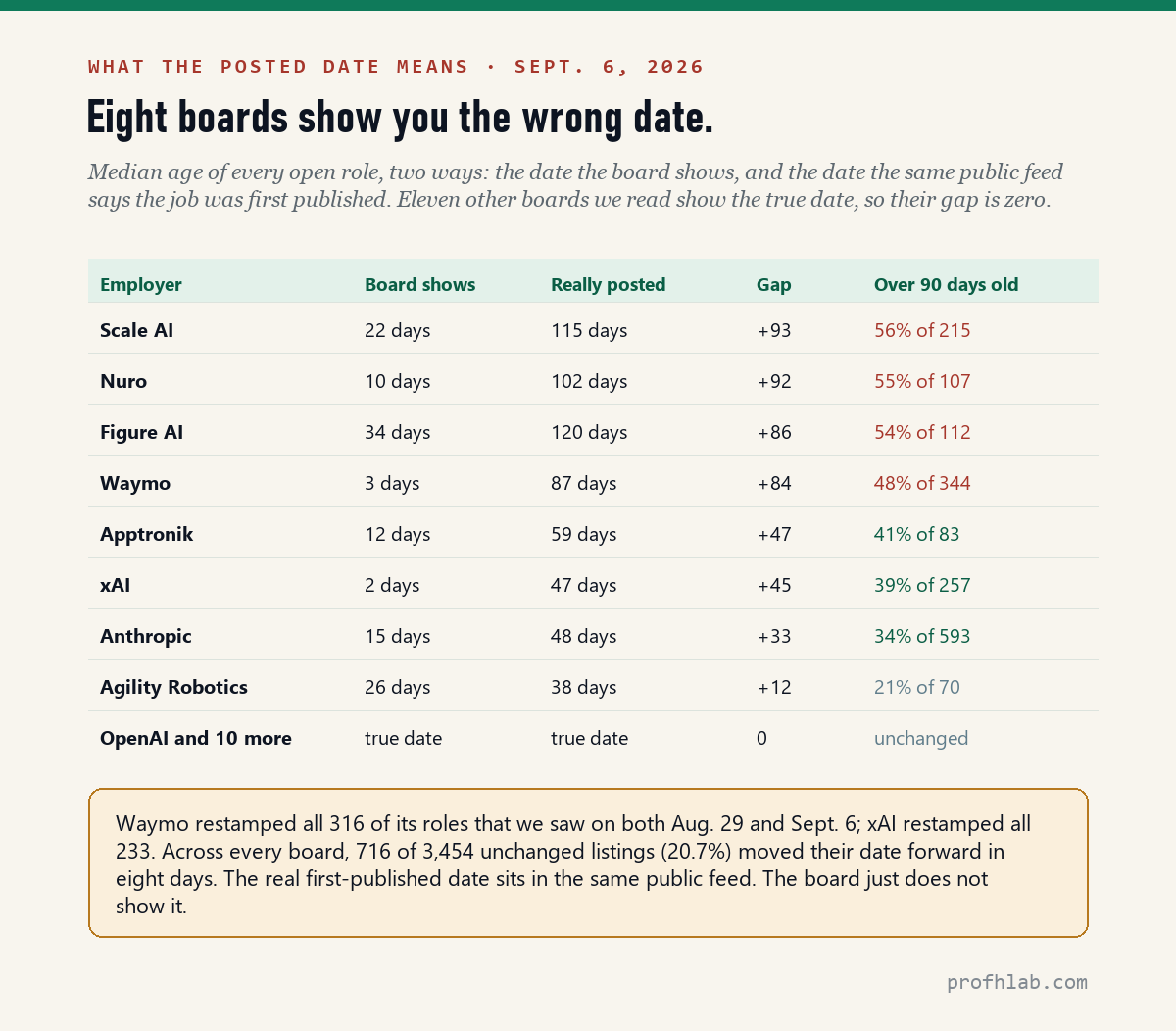
Waymo is the cleanest case. On September 6 every single one of its 344 open roles showed a posted date of three days ago or newer. Read first_published on the same 344 roles and the median is 87 days, with 48% over three months old.
We can prove the restamping rather than infer it, because we scanned the same boards on August 29 and kept the file: of the 316 Waymo listings that appear in both scans, unchanged and at the same URL, 316 had moved their date forward. All of xAI’s 233 did too. Across all boards, 716 of 3,454 surviving listings (20.7%) got a fresher date in eight days without being new.

The practical damage runs in one direction. On September 6, 356 roles looked a week old or newer and were actually more than 90 days old. Across the whole set, 1,570 postings (41.6%) showed a date fresher than the truth, by a median of 73 days. Not one showed a date older than the truth. If the date is wrong, it is wrong in the direction that makes you feel early.
We said Ashby’s date was the honest one. It is not.
A correction to the section above. We told you that updated_at is the field that drifts, and that Greenhouse’s first_published and Ashby’s publishedAt are the real posting dates. That is right about Greenhouse and wrong about Ashby.
We have now read the same boards every morning for five weeks and kept every file: 36 snapshots between August 22 and September 27, 2026, with one gap on September 18. Ashby publishes exactly one date per job. Across the 2,606 Ashby listings that appear in at least one snapshot, 129 of them, 5.0%, moved that date forward. Ashby keeps no second field, so when it moves, the older date is simply gone.
Between them those 129 listings erased 8,477 days of history, a median of 35 days each and 539 at the extreme. Fifty-five of the 129 were present in every one of our 36 snapshots, which rules out the innocent explanation that the job closed and was genuinely reopened. We watched them the whole time. They never left.
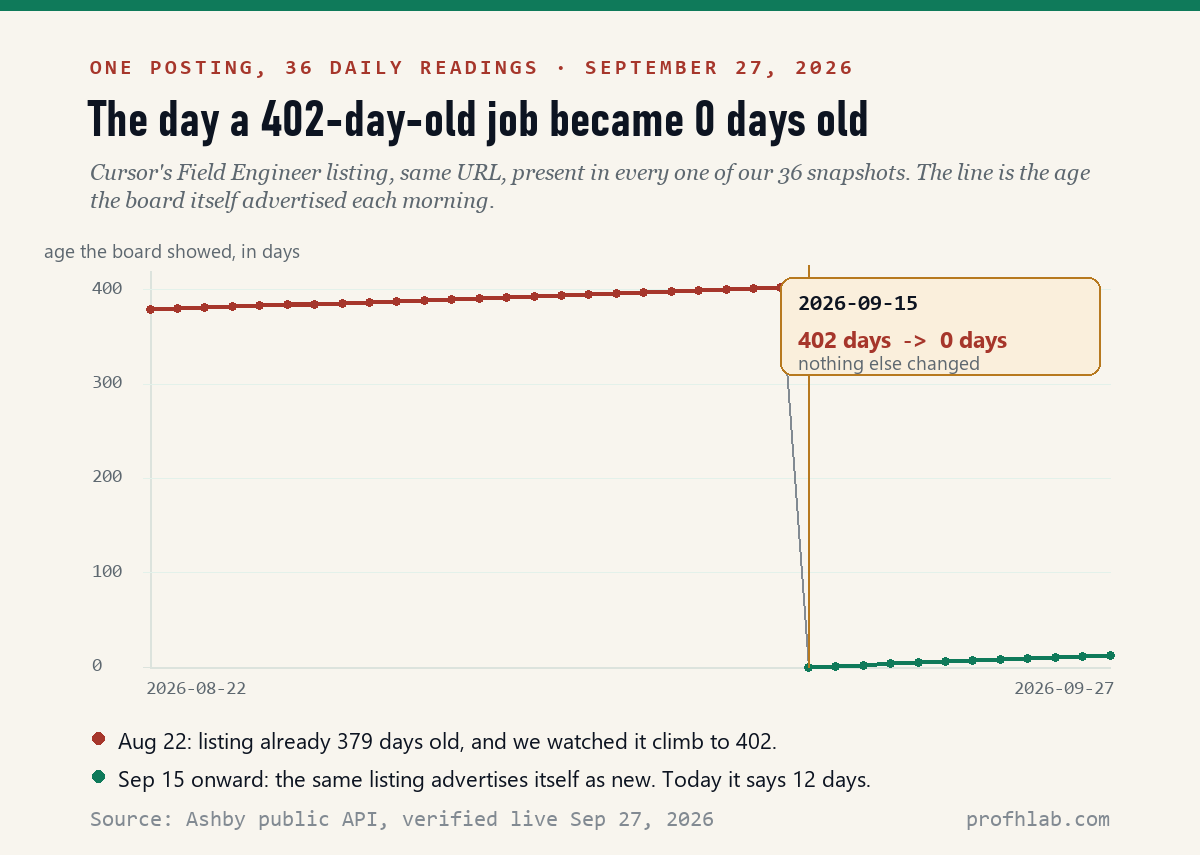
That listing is the one worth looking at twice. When we first recorded it on August 22, 2026 it already carried a published date of August 7, 2025, and we watched that counter climb for 24 more mornings. Then it reset. Checked again on September 27, 2026, the live Ashby feed returns a publishedAt of September 14, 2026 and the role is still listed. A job seeker reading it today sees a posting twelve days old. We have 36 files saying it is 416.
Two more we confirmed on the live feed the same morning. Cohere’s Forward Deployed Engineer, Infrastructure Specialist went from September 11, 2025 to September 1, 2026, erasing 355 days. An OpenAI government role moved from September 18, 2025 to September 1, 2026, erasing 348. Both were in all 36 snapshots. Both are open as we publish this.
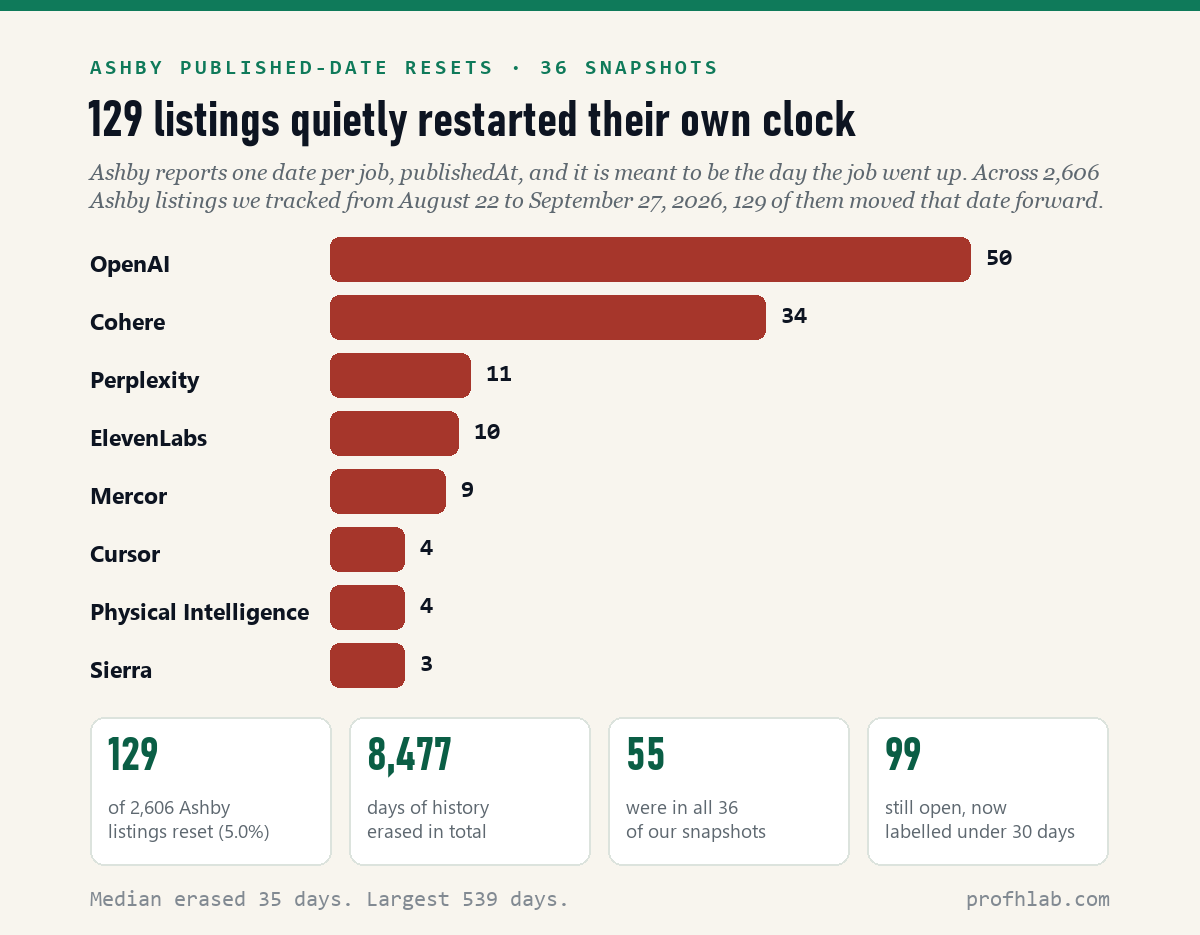
Now the part we cannot tell you. A moved date is not proof of a ghost job. Some of these are genuinely reopened roles. At least one is a rewritten one: the OpenAI listing above was titled AI Deployment Engineer, Gov when we started and reads Applied AI Engineer, Cyber, Government today, same URL. That is a real change, and a fresh date for it is defensible.
What we can say is narrower and still useful. Of the 129, 114 are open right now, and 99 of those advertise an age under 30 days while our own files show them older. So the fix from the last section holds on Ashby boards too, and it is the only fix that works: the date on the page is a claim, not a record. If the age matters to your decision, read the employer’s feed yourself, or find someone who wrote the number down before today.
How old are these jobs really
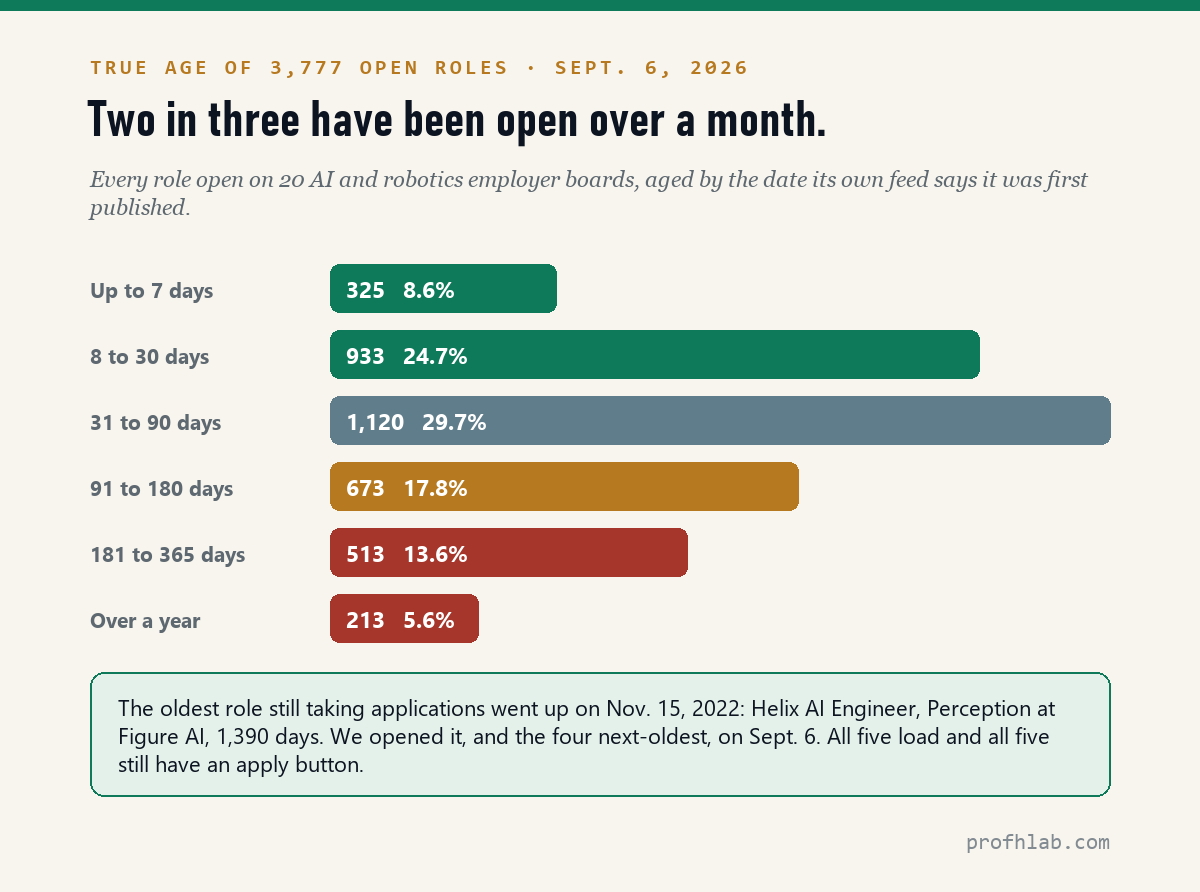
Two thirds of open AI jobs have been open for over a month. One in three is older than a quarter. And 213 of them — 5.6% — have been collecting applications for more than a year.
The oldest is a Helix AI Engineer, Perception role at Figure AI, first published on November 15, 2022. That is 1,390 days. We opened it on September 6, along with the four next-oldest at OpenAI, Scale AI and Nuro. All five load, and all five still have an apply button.
So is 30 days old actually old?
That is the version of this question people actually type, so here is the direct answer from this morning’s scan. Of the 3,069 US roles open across the boards we track on September 26, 2026, 2,173 (70.8%) had already been posted for more than 30 days. Only 896 — 29.2% — were newer than that.
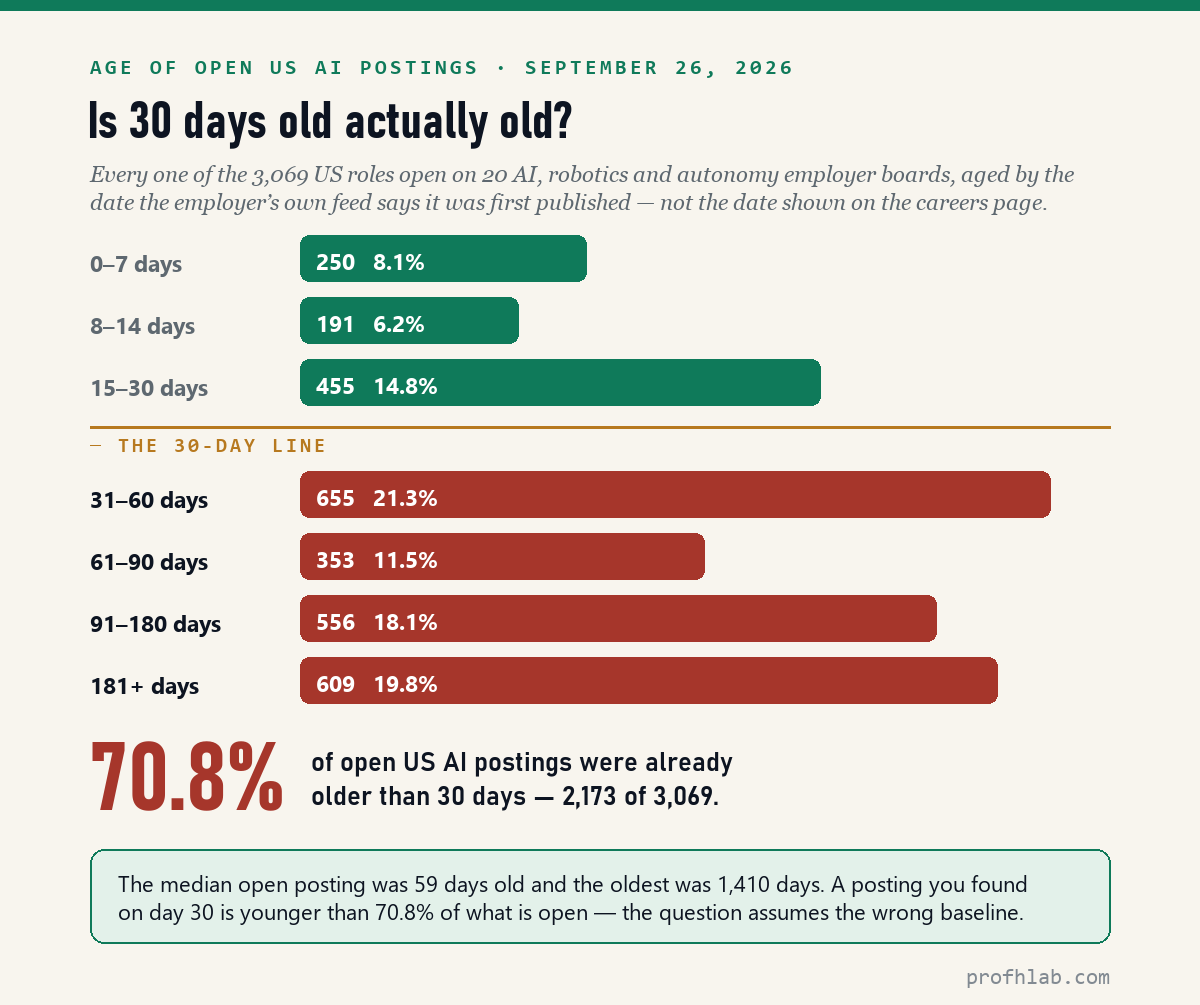
The median open posting was 59 days old. So a listing you found on day 30 is not a leftover — it is younger than roughly seven out of ten things currently open, and younger than the typical role by a month. 49.5% of the board is past 60 days and 38.0% is past 90.
The question contains a hidden assumption — that postings have a natural shelf life and 30 days is most of it. On these boards there is no shelf life to be most of. The number that would justify the worry does not exist. You can sort the same roles by pay or filter them to entry-level on our jobs board, where every row links straight to the employer’s own application page.
Do old postings close sooner? We checked
Age is only worth worrying about if it predicts something. So we ran the obvious test on the eleven boards that publish a true posting date: take every role open on August 29, sort by how old it was that day, and see which ones were gone by September 6.
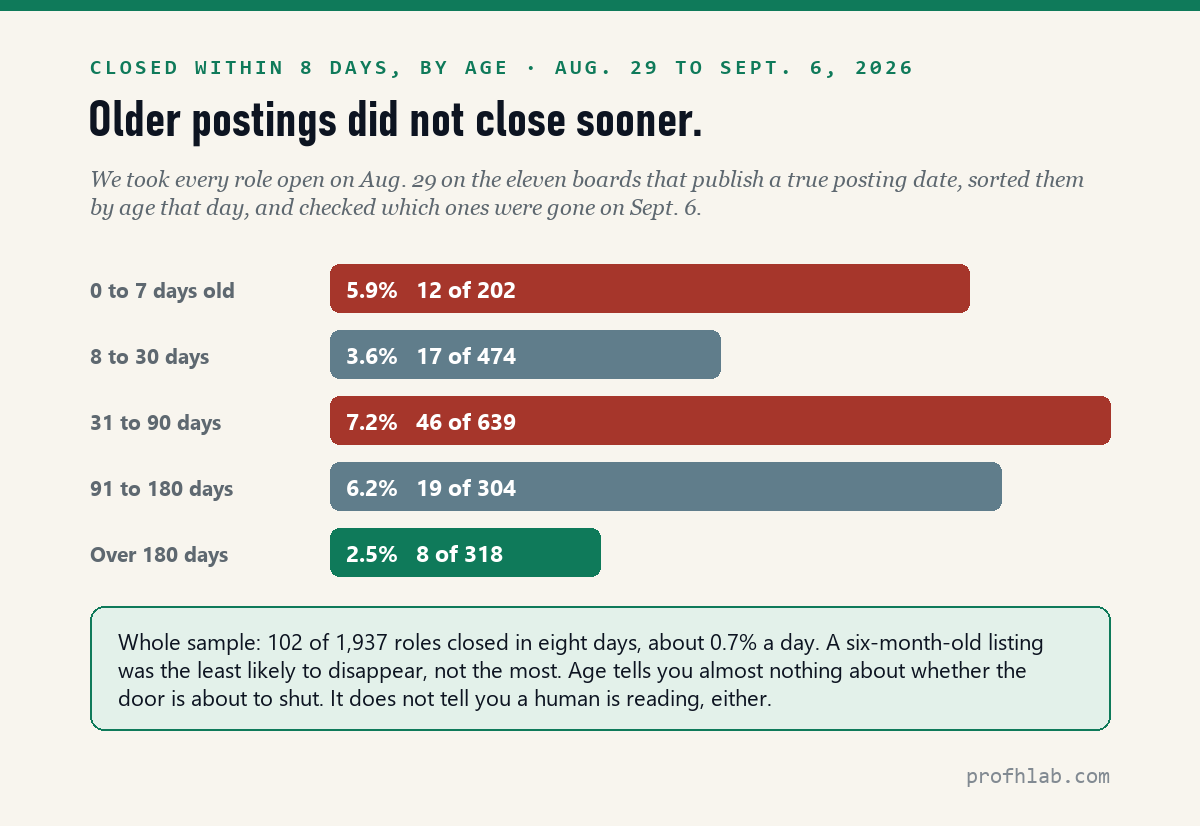
The pattern people expect — old listing, about to vanish — is not there. Postings over six months old closed at 2.5% over the eight days. Postings under a week old closed at 5.9%, more than double. The middle buckets sit between 3.6% and 7.2% with no trend. Across the whole sample, 102 of 1,937 roles closed, roughly 0.7% a day.
That daily rate is the only clock that actually exists here, and it ticks at the same speed for a role posted yesterday and a role posted last winter. Waiting a week costs you about five percent of the doors. Waiting because a posting looks old costs you nothing you were going to get anyway.
We re-ran that test on twelve weeks, not one
The check above used a single eight-day window, which is thin evidence for a claim this load-bearing. Our archive now holds daily scans back to 2026-08-22, so we repeated it properly: every pair of scans exactly seven days apart — 12 usable weeks — sorting the roles open on day one by age and counting which were gone by day seven.
| Age on day one | Roles watched | Gone in 7 days | Closing rate |
|---|---|---|---|
| 0–14 days | 5,460 | 260 | 4.8% |
| 15–30 days | 5,687 | 286 | 5.0% |
| 31–60 days | 7,142 | 530 | 7.4% |
| 61–180 days | 10,624 | 737 | 6.9% |
| 181+ days | 7,142 | 285 | 4.0% |
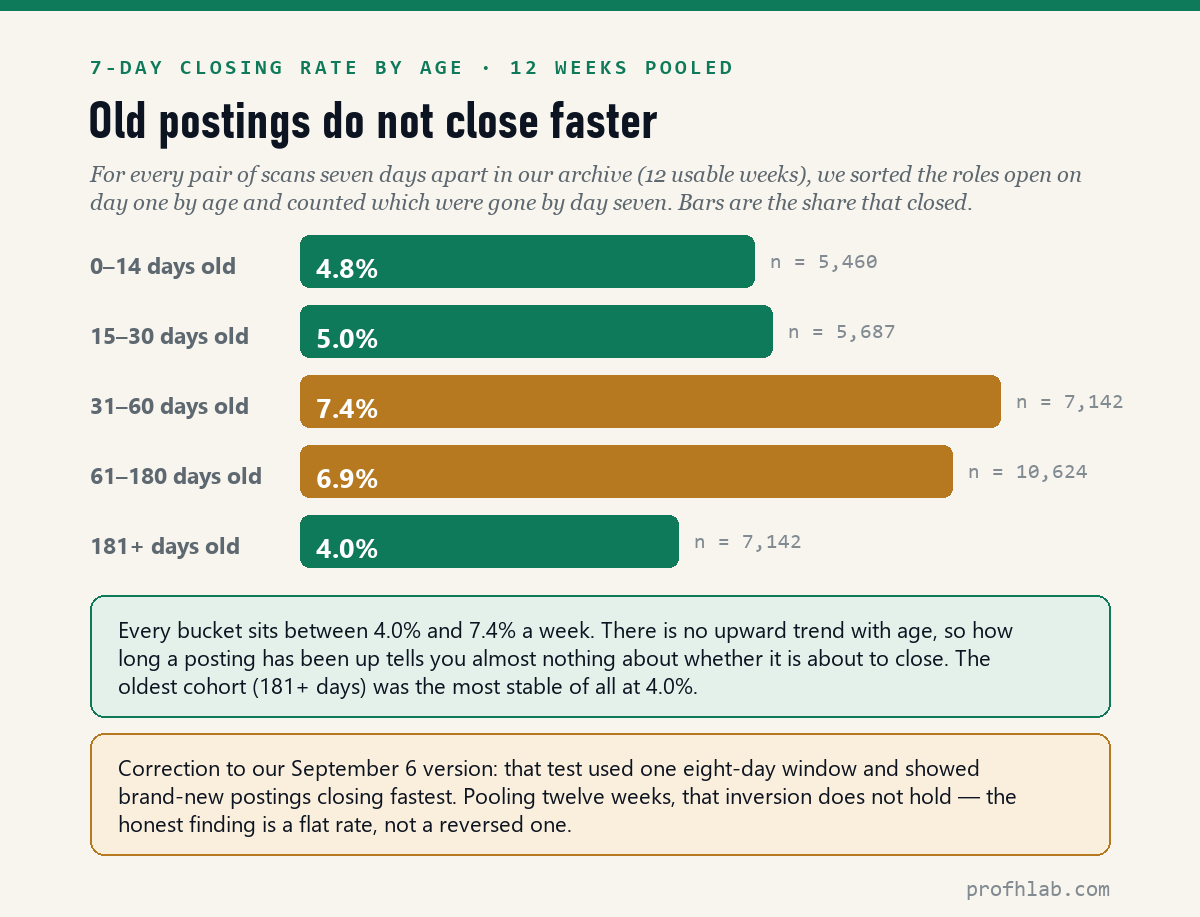
Every bucket lands between 4.0% and 7.4% a week, and the oldest cohort is still the most stable of the five at 4.0%. The conclusion survives the bigger sample: how old a posting is tells you essentially nothing about whether it is about to close. How the scans are built and what they can and cannot see is set out in our methodology.
A correction to the September 6 version of this article. That single window showed brand-new postings closing faster than old ones (5.9% against 2.5%), and we wrote it up as a reversal. Pooled over 12 weeks the reversal does not hold — the 0–14 day bucket runs at 4.8%, below the 31–60 day bucket’s 7.4%. The honest finding is a flat rate, not an inverted one. It changes none of the advice, but the stronger claim was ours to check and it did not replicate.
There is no closing date, and that is the real answer
Here is the number that reframed this piece for us. Greenhouse gives every employer an application_deadline field. We read all 1,781 postings on the eight Greenhouse boards we track. The number that filled it in: zero. The number carrying an internal requisition ID: 1,780.

Federal jobs are different — a USAJOBS announcement has a real closing date printed on it, which is why the federal process rewards calendar discipline in a way private hiring does not. On a company board there is no bell. A req is open until a hiring manager closes it, and it closes when they fill it, freeze it, or forget it. “Am I too late?” has no answer because there is no schedule to be late against. The only meaningful question is whether the posting is still in the employer’s feed today, and you can check that in ten seconds.
What “30 days” means depends on who posted it
A single median hides the most useful thing in this data. Split the same roles by employer and the typical age swings by a factor of 6.7.
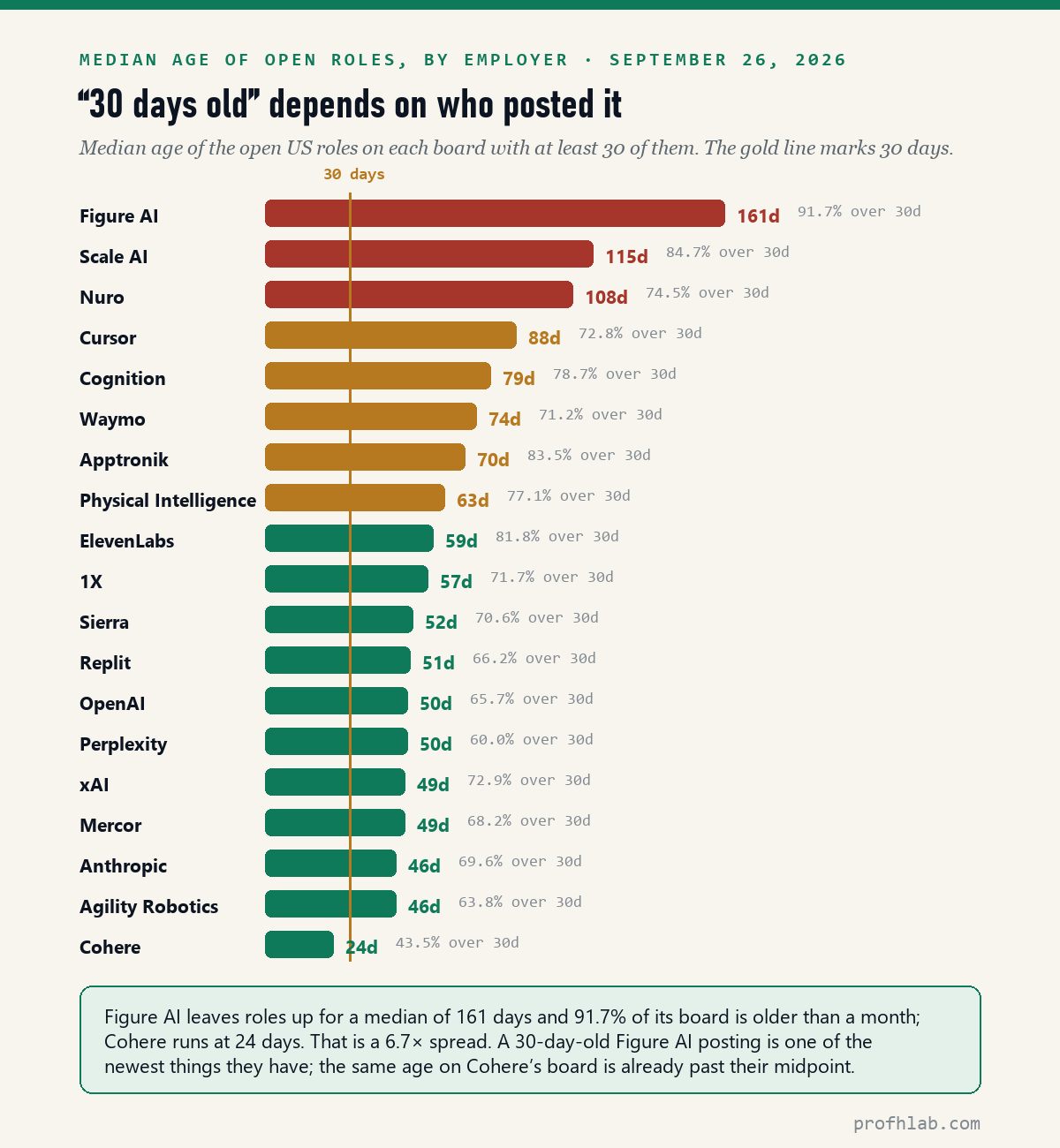
Figure AI runs a median of 161 days with 91.7% of its board past a month; Cohere runs at 24 days with 43.5%. The same “30 days ago” label therefore means opposite things: on Figure AI’s board it marks one of the newest openings they have, and on Cohere’s it is already past the midpoint. Before you read anything into a date, check what normal looks like for that employer — the chart above is that reference. We have taken four of these boards apart one at a time: Figure AI, Waymo, OpenAI and Anthropic.
The one place the date really is a deadline
Everything above describes private employer boards. Federal hiring is the opposite system, and confusing the two is how people actually get burned.
We pulled the 24 AI-related USAJOBS announcements posted in the last seven days and measured how long each one stays open. The median window from opening to closing was 9 days — shortest 4, longest 15, and 23 of 24 ran two weeks or less.
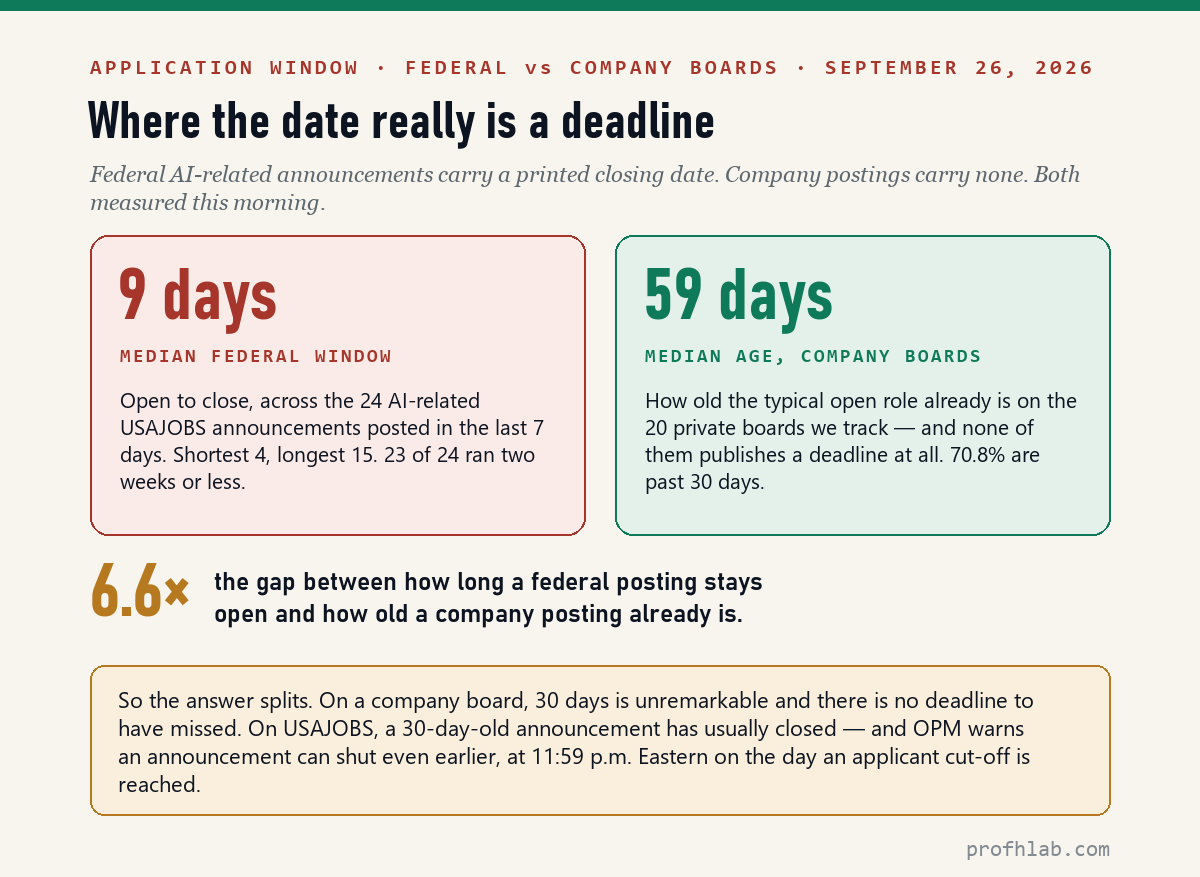
That is a 6.6× gap against the 59-day median age of a company posting. On USAJOBS a 30-day-old announcement has usually closed already, and OPM warns it can close even sooner: some announcements end at 11:59 p.m. Eastern on the day an applicant cut-off is reached, whatever the printed date says. Read the closing date on a federal announcement as a real deadline and the date on a company posting as decoration, and you will be right almost every time.
Federal AI roles closing in the next ten days
Public-eligible announcements only — of the 24 we pulled, 10 are open to candidates outside the federal workforce, and the rest are restricted to current or former federal employees. Every closing date below was re-checked against USAJOBS this morning.
| Announcement | Agency | Grade & salary | Closes |
|---|---|---|---|
| Information Systems Security Engineer – Entry to Mid Level (Maryland) | National Security Agency/Central Security Service | GG 7-12 $87,362–$153,082 | 2026-09-26 closes tonight |
| General Engineer, AST – Engineering Program Management (Direct Hire) | Headquarters, NASA | GS 15-15 $147,945–$197,200 | 2026-09-28 2 days left |
| Public Notice – Engineering (Direct Hire) | Lyndon B. Johnson Space Center | GS 7-11 $50,460–$111,966 | 2026-09-28 2 days left |
| Information Technology Specialist (Artificial Intelligence) | Customs and Border Protection | GS 14-14 $143,913–$187,093 | 2026-09-28 2 days left |
| Program Analyst (Informatics) | Veterans Health Administration | GS 12-12 $89,508–$116,362 | 2026-09-30 4 days left |
| IT Specialist (SYSANALYSIS/APPSW) | Patent and Trademark Office | GS 9-13 $70,623–$158,322 | 2026-10-02 6 days left |
| Program Analyst (Informatics) – Surgical Care | Veterans Health Administration | GS 9-12 $62,223–$117,307 | 2026-10-05 9 days left |
| Software Engineer – Mid to Experienced Level (MD/TX) | National Security Agency/Central Security Service | GG 11-14 $105,262–$192,764 | 2026-10-05 9 days left |
| TECHNICAL ADVISOR ADVANCED CYBER TECHNOLOGY | Department of the Air Force Headquarters | SL 00-00 $151,662–$209,600 | 2026-10-06 10 days left |
What an old posting usually is
Old does not mean fake, and it does not mean live, either. In our data the year-plus roles cluster into three recognizable shapes.
| Shape | Looks like | What it means for you |
|---|---|---|
| Pipeline req | “General Application”, broad titles, no team named | Real, permanently open, low odds per application. Cognition’s general application has been up since March 2024. |
| Always-hiring role | Technician, operator, data center, service | Real and repeatedly filled. Figure AI’s Robot Service Technician has been posted 758 days. |
| Hard-to-fill senior role | Narrow research or infrastructure title, high band | Genuinely unfilled. Age is a signal of difficulty, which can favor a non-obvious candidate. |
Of the 1,399 roles open more than 90 days, 1,124 are in the US, 812 publish a pay range, 333 are remote and 48 are entry-level. The old pile is not junk. It is where a third of the disclosed-pay market lives — and pay disclosure is its own story, which we took apart in why AI salary ranges are so wide.
Four checks that beat looking at the date
- Open it on the employer’s own domain. If the role is still listed at greenhouse.io, ashbyhq.com or the company’s careers page, it is in the live feed today. That is the only freshness signal that means anything. A copy on an aggregator can outlive the original by weeks.
- Ignore “posted 2 days ago” on a company board. Now that you know eight of our twenty boards restamp, treat that line as decoration. Our jobs board now shows the first-published date instead, which is why some listings there suddenly look older than they did last week.
- Read the title for shape, not the date. “General Application” is a pipeline. A named team and a named manager is a live req. A technician role that has been up 400 days is a role they hire for continuously, so today is as good as any day.
- Apply within the week you find it, then move on. Roughly 0.7% of postings vanish per day. That is the actual cost of delay, and it is the same whether the job went up yesterday or in 2023. Nothing here says a human is reading — only that the door has not been shut.
We are not recruiters. We take no money from employers, we never charge to see a posting, and every link above goes to the employer’s own page. Postings can close any hour — the official page always wins over anything we publish. And no posting, of any age, ever asks you to pay, to deposit a check, or to accept an offer that arrived by text message. More on how we count: our methodology.
Ghost jobs, and where this argument stops
There is a fair objection to everything above: a posting can be in the feed and still be going nowhere. That is the “ghost job” complaint, and our data cannot rule it out. We can see the door. We cannot see whether anyone is behind it.
Note what the ghost-job argument actually implies, though. If a listing is a placeholder, it was a placeholder on day one too. Age is not the tell. The tells are the ones in the CBS segment below: no named team, no requisition number, a company that has posted the same role continuously through a hiring freeze, or a “recruiter” who moves the conversation to a messaging app.
If a posting asks you for money at any stage, it is not a stale job. It is a scam, and the age of it is the least of the problem. We keep the four rules in our piece on AI training work.
What actually moved this week
Between last Saturday and this one the headline barely twitched: 3,851 → 3,865 roles, a net change of +14. The churn underneath it did not. 294 postings appeared and 280 disappeared — 7.3% of the board turned over in seven days while the total stood still.
Of the 233 new US roles, the biggest additions were OpenAI 57, Anthropic 41, Waymo 31, xAI 26, Sierra 16. Their median advertised floor was $230,000, 21 are remote and 25 are entry-level. Entry-level openings overall went from 114 to 130, and their median age is just 24 days — the one corner of this market where a posting really is likely to be recent — we keep a standing guide to entry-level AI jobs with no experience. Pay disclosure held at 72.6% of US roles, median floor $225,000; why those bands run so wide is its own story.
That net-versus-churn gap is the practical reason the date on a listing is a bad signal but the feed is a good one. A board that looks frozen from outside replaced one posting in 14 last week. The running totals refresh every morning on the tracker.
Go back to the three jobs you skipped for looking old
- Go back to the three jobs you skipped because they looked old. Check each one on the employer’s domain. If it loads, apply this week.
- Filter our jobs board to entry-level or remote and sort by pay rather than by date — there are 130 entry-level roles open right now, median true age 24 days.
- If you are aiming at one company, start with the two we have taken apart in detail: Anthropic and xAI in Memphis.
- Check the running counts on the tracker before you write a cover letter that guesses at the market.
Hiring, credentials or academia: where to go from here
- “Which of these companies is actually growing?” — who is hiring right now and which one pays the most.
- “Do I have the credentials?” — whether you need a PhD, whether a certificate is worth it, and what a robotics technician job actually requires.
- “What about academia?” — university postings run on real deadlines and a real season: when faculty jobs get posted, the faculty search tracker, and labs recruiting for next fall.
- “Where do I start?” — the application walk-through, the data center route, and what to say about AI on your resume. New here? Start here or browse the resources shelf.
Ask the desk
Tell us the role, the city and the constraint — part-time, no degree, over 50, night shift — and we will go through the boards for you and post what we find. It is free and there is no catch. Post your request on the Jobs Desk, or ask us anything else. One short email a month, no more.
Reposted dates, deadlines and year-old listings
Should I apply to old job postings?
Yes. Pooling 12 seven-day windows through September 26, 2026, postings closed at between 4.0% and 7.4% a week at every age, and the oldest cohort (181+ days) was the most stable at 4.0%. Age did not predict closing. Check that the role is still on the employer’s own site, then apply.
How long do job postings stay open?
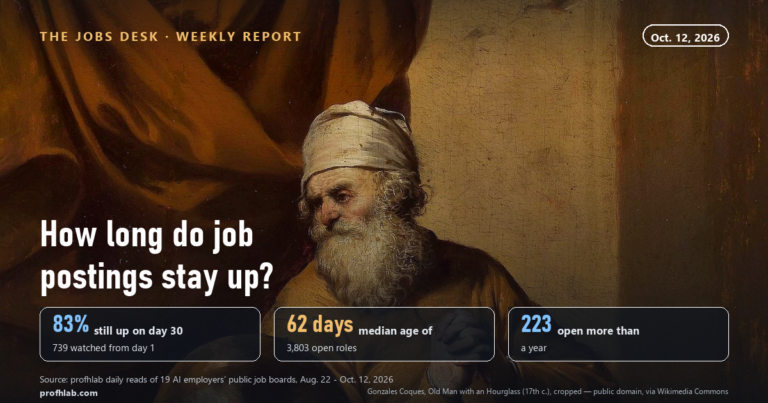
Longer than most people assume. In our September 6 count the median open AI job had been posted 57 days, two thirds were older than a month, 37% were older than 90 days and 213 had been open more than a year. The oldest still accepting applications went up in November 2022.
Why does a job say posted 2 days ago when it has been up for months?
Because the date shown is usually the last-updated timestamp, not the original posting date. Both fields sit in the same public feed. On September 6 we found 356 roles that looked a week old or newer but were really more than 90 days old, and 1,570 in total whose shown date was fresher than the truth, by a median of 73 days.
Is a job posting from three months ago already filled?
Sometimes, and there is no way to tell from the outside. What we can say is that the posting being three months old does not make it likelier to close than a fresh one. If it has been filled, the req usually disappears from the employer’s feed — 262 of the 3,716 roles we saw on August 29 were gone eight days later.
Do job postings have a deadline?
Private ones generally do not. Greenhouse gives employers an application-deadline field, and on September 6 not one of the 1,781 postings we read had filled it in. Federal announcements on USAJOBS are the exception: those carry a real closing date and you should treat it literally.
Is it too late to apply if the posting is a year old?
No, but adjust what you expect. Year-old postings tend to be pipeline reqs, continuously hired technician roles, or genuinely hard-to-fill senior positions. All three accept applications. The first gives you the lowest odds per application, the third can favor an unusual candidate.
How can I tell if an old job posting is still real?
Open it on the employer’s own domain rather than an aggregator, and look for a named team and a requisition number. If the page loads on greenhouse.io, ashbyhq.com or the company careers site today, the req is in their live feed today. Aggregator copies routinely outlive the original.
Should I apply to a job posted on the same day it goes up?
Applying early is fine, and it costs nothing, but our numbers give no reason to panic-apply. Across 12 weeks of scans the closing rate sat near 4.8–7.4% a week at every age, so waiting a week costs you a few percent of your options whether the posting went up yesterday or last year.
Should I apply to a job posted 30 days ago?
Yes, and on a company career page the premise is backwards. On September 26, 2026 we aged 3,069 open US AI and robotics roles: 70.8% of them were already more than 30 days old and the median was 59 days. A 30-day-old posting is younger than most of what is open. Federal announcements on USAJOBS are the exception — those carry a real closing date, median 9 days, so a 30-day-old one has usually closed.
How long after a job is posted is too late to apply?
On private employer boards there is no such cut-off, because the postings carry no deadline at all. Pooling 12 seven-day windows, postings closed at between 4.0% and 7.4% a week regardless of age, and the oldest cohort was the most stable. The only real deadline is on federal announcements, which print one and can also close early once an applicant cut-off is reached.
Is it worth applying to a job posted 30+ days ago?
It is worth the same as applying on day one, which is the point. We could find no age effect on closing rates across 12 weeks of scans. What does vary is the employer: median open-role age ranges from 24 days at Cohere to 161 days at Figure AI, a 6.7x spread, so judge a posting against its own board rather than against a calendar.
Cite this: profhlab Jobs Desk, “Should I apply to old job postings?” updated September 26, 2026. Of 3,069 open US AI and robotics roles, 70.8% were more than 30 days old and the median age was 59 days; across 12 seven-day windows the closing rate was 4.0–7.4% at every age; the median federal application window was 9 days. profhlab.com/ai-jobs-tracker
Method and limits. We read the public Greenhouse and Ashby feeds of 20 AI and robotics employers on September 6, 2026; 19 answered (the Google DeepMind board returned 404). True age uses first_published on Greenhouse and publishedAt on Ashby, with the caveat added on September 27, 2026 that publishedAt is itself moved forward on about 5% of Ashby listings; the “board shows” figure uses updated_at.
Closure rates compare the same feeds against our own August 29 scan and cover eight days and one cohort, not a full life table. Survival is measured only on the eleven boards whose dates are stable, because a restamped date cannot be aged. Being in the feed is not evidence that anyone is reading applications. No federal USAJOBS records are included in this count.
Written by Prof. H, who has spent the week arguing with timestamps. The Jobs Desk publishes daily; the underlying counts refresh every morning on the tracker and the board. Next: what the eight-day disappearance rate looks like company by company, and whether the roles that vanish are the ones that pay.
Prof.’s H Newsletter
One short email a month, with the numbers in it
What actually moved in AI hiring, AI prices, and the scams aimed at older Americans. Counted here, dated, and linked to the source. One email a month, and your address goes nowhere else.