Do I Have to Pay for Apple Intelligence? Apple’s Own Page Never Says the Word Free
Four days from now, on Wednesday, September 9, Apple will spend ninety minutes telling America what its new Siri can do. Apple’s own events page has the invitation up right now: “Surprise and shine. Watch a special Apple Event on 9/9 at 10 a.m. PT.” Nobody at that event will say a number for Apple Intelligence, because there isn’t one. And that is exactly why people are typing this question into Google in the days before a keynote.
So here is the short version, before the marketing starts.
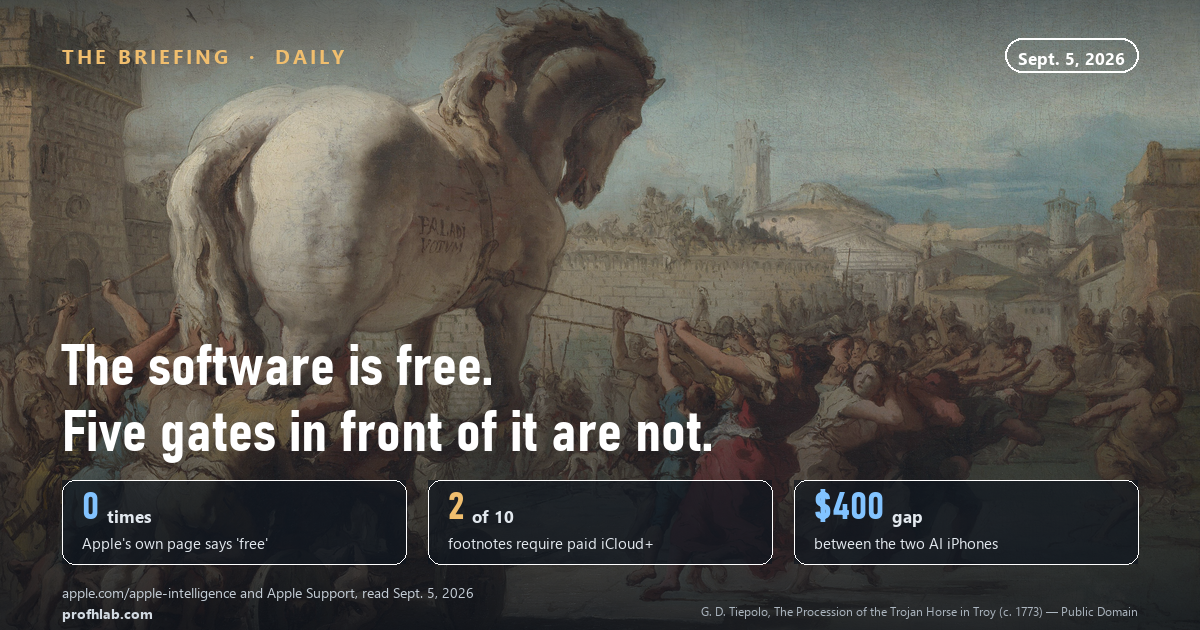
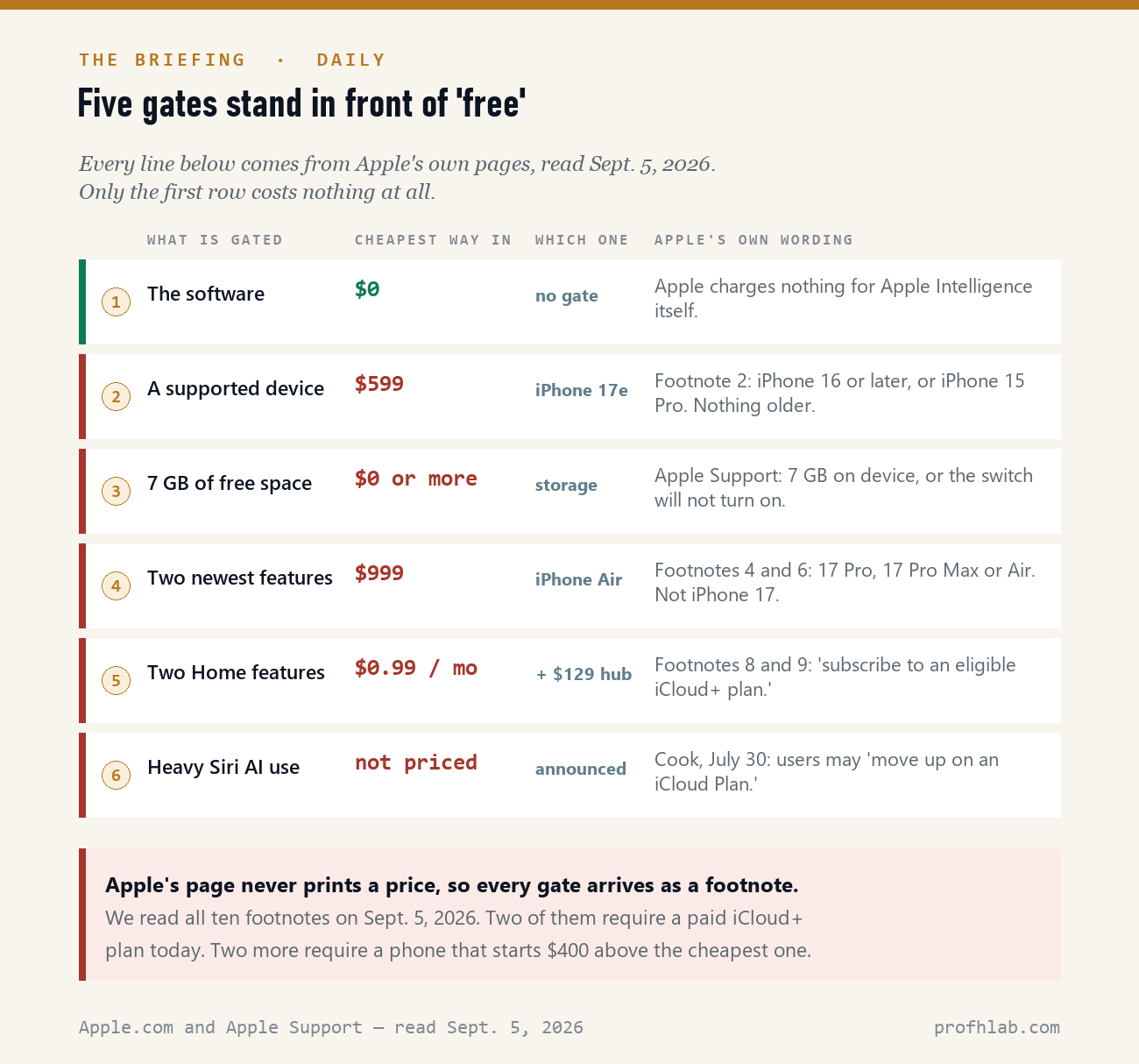
No, you do not pay for Apple Intelligence. You pay for five things standing in front of it. On September 5, 2026 we read Apple’s own Apple Intelligence page from top to bottom, including all ten footnotes. The word “free” appears zero times. A dollar sign appears zero times.
The word “subscription” appears twice — both times in footnotes, both times attached to a paid iCloud+ plan. The cheapest new iPhone that runs Apple Intelligence at all is $599; the cheapest one that runs the two newest features is $999. And the software will not switch on until it has 7 GB of free space on your device.
Apple’s own page never says the word “free”
This is the finding that started the piece, and anyone can repeat it in ninety seconds.
Open apple.com/apple-intelligence and press Command-F. Search “free.” You will get nothing in the visible text. Search for a dollar sign. Nothing. Search “subscription” and you get two hits, both buried in the footnote block at the bottom, both about iCloud+.
Search “cost” and you get exactly one hit. Here it is, in full: “Any app can tap into the on-device models that power Apple Intelligence, and the features you build work offline. And it’s all at no cost per request.”
Read who that sentence is addressed to. It is a promise to app developers that Apple will not bill them per query. It is the only cost promise on the page, and it is not made to you.
None of this is a scandal. Apple is not obliged to print a price for something it does not charge for. But it explains why the question keeps getting asked and never quite answered: the page that would settle it declines to use the vocabulary of money at all, and every actual gate arrives later, in six-point type.
Gate one is a phone, and there are two price floors, not one
Everybody knows about the first floor. Six of the nine page-one results we could read repeat it: Apple Intelligence needs an iPhone 15 Pro or newer. Apple’s footnote 2 spells out the whole list — all iPhone 16 models and later, iPhone 15 Pro and 15 Pro Max, iPad mini (A17 Pro), iPads and Macs with M1 or later, Apple Vision Pro with M2 or later, and Apple Watch Series 9 and later when paired with a supported iPhone.
Almost nobody mentions the second floor, and it is the one that costs real money.
Two features on that same page carry a different footnote. Customizing how Siri sounds (footnote 4) and the improved on-device Dictation model (footnote 6) are “Available on iPhone 17 Pro, iPhone 17 Pro Max, iPhone Air, iPad models with M4 and later and at least 12GB of unified memory, and Mac models with M3 and later and at least 12GB of unified memory.”
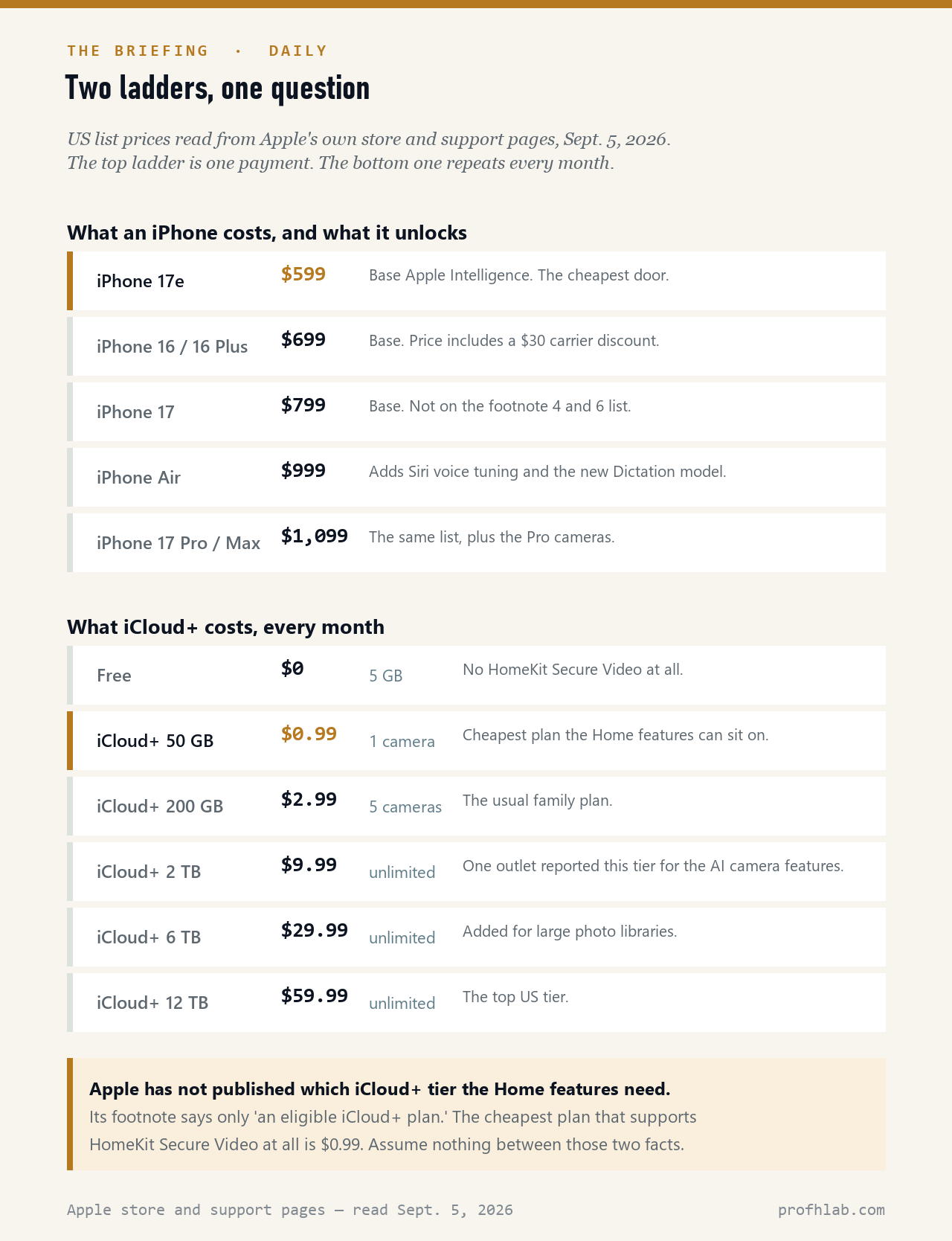
Notice what is missing from that list: the regular iPhone 17. A phone Apple is selling new today, on the same web page, for $799, is not eligible for two features on the Apple Intelligence page.
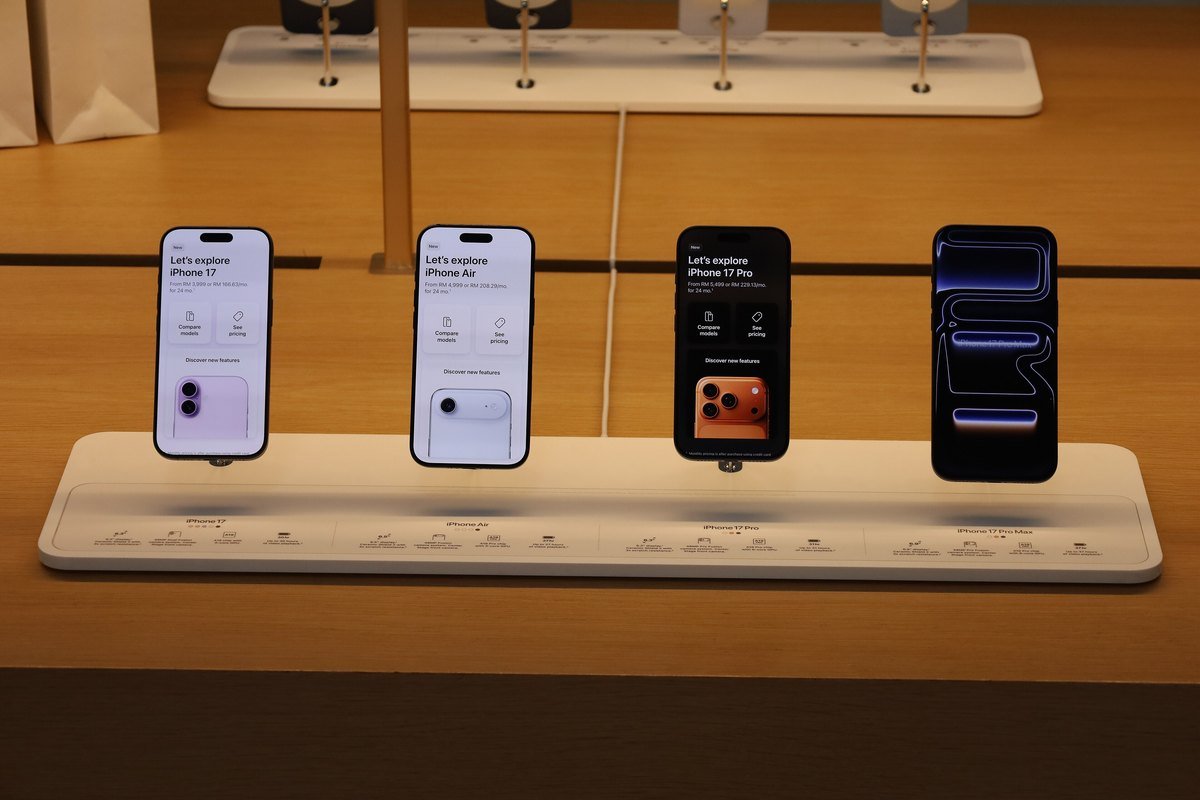
Put US list prices against those two floors, read from Apple’s own store on September 5:
- Runs Apple Intelligence: iPhone 17e from $599.
- Runs the two newest features: iPhone Air from $999.
That is a $400 gap inside the word “free.” It is not a subscription and it will never show up on a statement, which is precisely why it does not feel like a price.
One more thing worth knowing before you compare those numbers to an ad. Apple’s own footnote says the $799 iPhone 17 price “includes a $30 connectivity discount that requires activation,” and the $699 iPhone 16 price “includes a $30 T-Mobile or Verizon discount.” The sticker already assumes you are bringing a carrier with you. If you are the kind of buyer who has been burned by a carrier perk before, we walked through how those work in Is Google AI Pro free with Verizon?
Gate two: seven gigabytes, before anything turns on
Apple’s support document “How to get Apple Intelligence” lists the system requirements plainly, and one line is a cost that most people never associate with AI: 7 GB of storage on device. Not in the cloud. On the phone in your pocket.
If you have a 256 GB iPhone with room to spare, this costs you nothing and you will never notice it. If you are one of the many people living permanently at 98 percent full, it is the difference between the switch working and the switch refusing, and the fix is either deleting things or buying a bigger phone next time.
Two of the nine pages we scored mentioned the 7 GB figure. It is the least glamorous requirement on the list and probably the one that stops the most people.
Gate three: two features on Apple’s page already require a paid subscription
Here is the part not one page-one result mentioned.
Scroll to the footnotes on Apple’s Apple Intelligence page and read numbers 8 and 9. Both describe the new Apple Intelligence features in the Home app — the ones that summarize what happened in your security camera footage before you watch it, and let you search clips by describing what happened. Both footnotes end the same way:
“The owner of the home must have an Apple Intelligence-enabled iPhone, have Apple Intelligence enabled in the Home app, and subscribe to an eligible iCloud+ plan.”
— Apple, apple.com/apple-intelligence, footnotes 8 and 9, read September 5, 2026
That is not a rumor about next year. That is Apple, today, on its own marketing page, putting two Apple Intelligence features behind a monthly payment. Those two footnotes are the only two places the word “subscription” appears on the entire page.
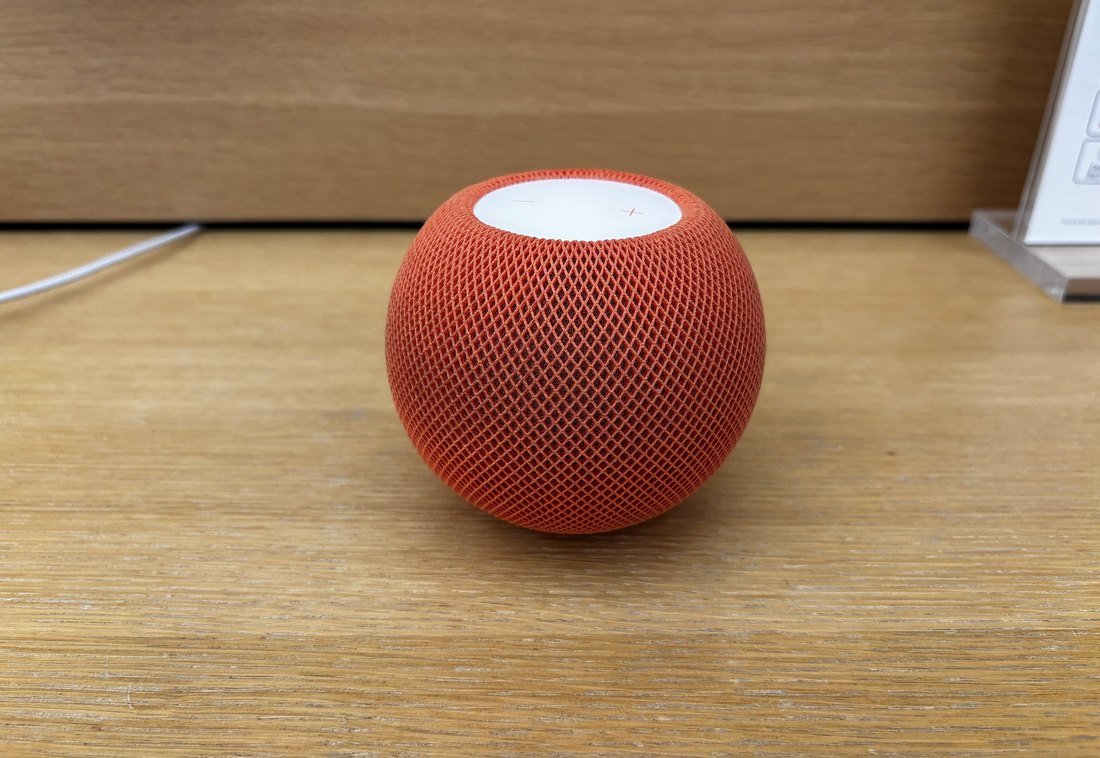
Apple does not say which iCloud+ tier counts as “eligible,” and we are not going to guess. What we can tell you is the shape of the ladder from Apple’s own pricing page. The cheapest iCloud+ plan that supports HomeKit Secure Video at all is 50 GB at $0.99 a month, and it covers one camera.
The 200 GB plan at $2.99 covers up to five. The 2 TB plan at $9.99 and above covers an unlimited number. One outlet, Gizmodo, reported that the AI camera features specifically require the $9.99 tier; we could not find that tier named in any Apple document, so treat the $0.99 figure as the floor and the $9.99 figure as a reported claim, not a confirmed one.
What Tim Cook actually said, in his own words
On July 30, 2026, on what turned out to be his final earnings call as Apple’s chief executive, Tim Cook was asked about the cost of running Siri AI. Here is the sentence, as quoted by Gizmodo:
“We’ll see what Siri AI does from the cost side of it. There’s also the ability when people use it a lot for them to move up on an iCloud Plan as well. What the balance of that is [is] a bit uncertain at the moment.”
— Tim Cook, Apple Q3 FY2026 earnings call, July 30, 2026
Read it slowly, because the hedging is the news. “We’ll see.” “A bit uncertain.” That is not a company announcing a price. That is a company telling investors that a price exists somewhere in the future and it has not decided where.
Three things follow from that sentence, and none of them are speculation:
- Apple has now publicly said out loud that heavy Siri AI use points toward a paid iCloud plan. It had never said that before.
- The mechanism is iCloud+, not a new “Siri Pro” product. That matters, because iCloud+ is a subscription tens of millions of Americans already pay for something else entirely — photo storage. A price increase delivered through a plan you already have does not feel like a new bill.
- No usage limit has been published. Not by Cook, not on any Apple page we could find. Anyone telling you today how many Siri requests you get before the paywall is making it up.
One footnote to the footnote. The man who said that sentence is no longer running Apple. Apple’s own leadership page today lists John Ternus as CEO and Tim Cook as Executive Chair of the board. Ternus will be onstage on Wednesday. Whether he inherits Cook’s framing, or a number, is the single most interesting money question of the event.

What page one leaves out
We ran the exact search — “do i have to pay for apple intelligence” — fetched all ten results, and scored the nine that returned readable text. One blocked our request, and we left it out rather than guess at it.
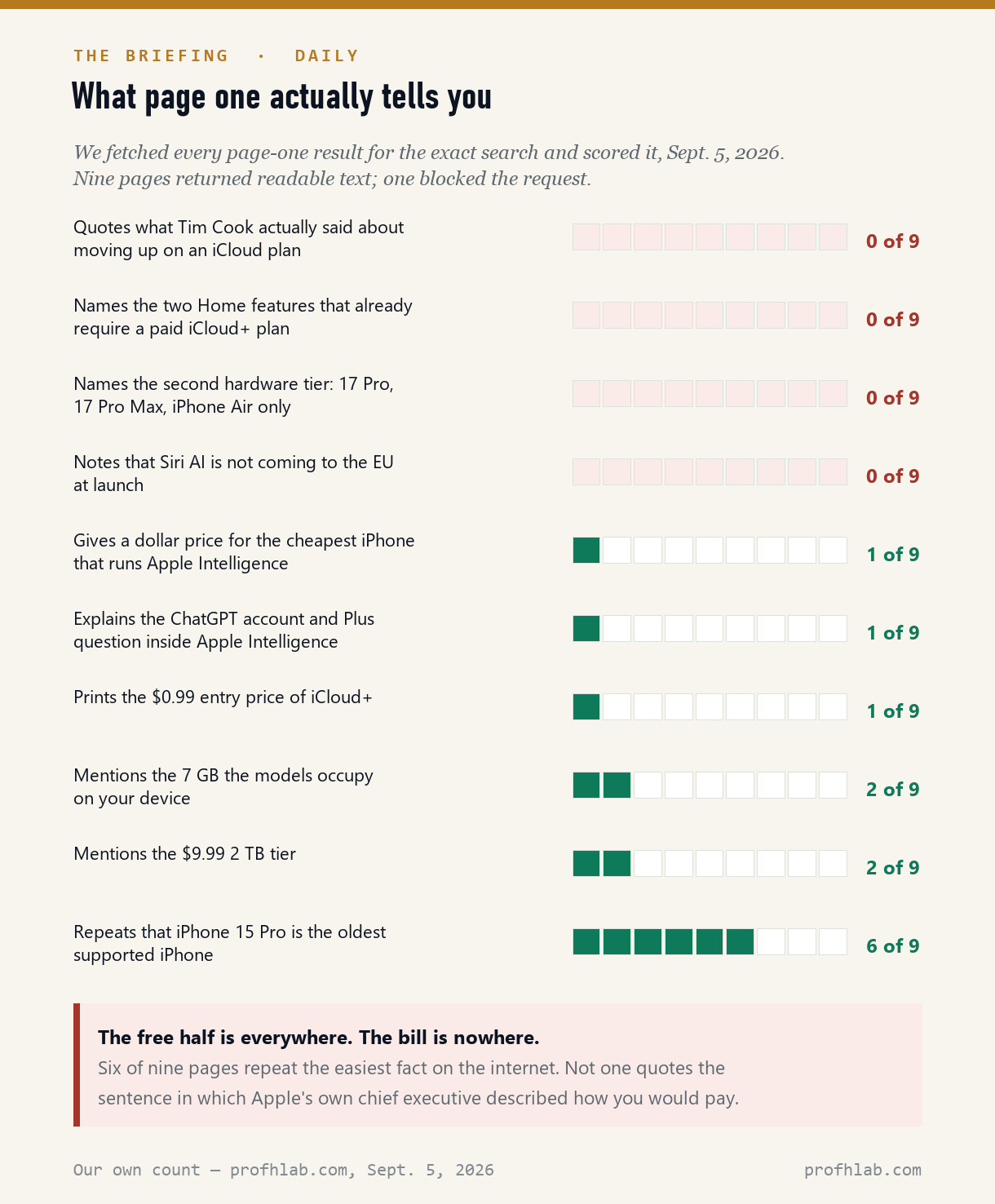
The scoreboard, in one line: six of nine pages repeat that iPhone 15 Pro is the oldest supported iPhone; zero quote what Cook actually said, name the two Home features that already require iCloud+, name the second hardware tier, or mention that Siri AI is not launching in the European Union.
This is not a knock on those writers. It is a structural fact about how a question like this gets answered on the internet. “Apple Intelligence is free” is true, short, and safe. Everything that complicates it lives in footnotes, an earnings call transcript, and a support document about storage requirements — three places nobody visits on the way to filing a 600-word explainer. We found the same shape when we counted what page one said about a Google AI Pro charge and about removing Copilot from Windows 11.
The other subscription hiding inside Apple Intelligence is not Apple’s
When Siri hands a question to ChatGPT, a second company’s pricing enters your phone. Apple’s iPhone user guide is unusually direct about it:
“You don’t need a ChatGPT account, but if you have one — free or paid — you can connect to your account. With a ChatGPT paid account, your iPhone can use advanced ChatGPT capabilities more often.“
— Apple, “Use ChatGPT with Apple Intelligence on iPhone,” read September 5, 2026
“More often” is a rate limit, described politely. You can use the ChatGPT extension for nothing. If you want it to stop saying no, the fix is a $20 subscription paid to OpenAI, not to Apple — and it will appear on your card as an OpenAI charge, which is a small preview of exactly the confusion we mapped last week when a Google AI charge arrived from Verizon. If you are weighing that $20, we did the arithmetic in Is ChatGPT Plus still worth it? and, if you decide against it, in how to cancel and get a refund.
Two more things in the footnotes worth knowing before Wednesday
The new Siri is not finished, and it is not coming everywhere. Footnote 1 says Siri AI “will be available In beta later this year,” in English to start, and that it “will not initially be available in the EU on iOS, iPadOS and watchOS.” If you have European family who are wondering why their phone looks different from yours, that is why.
The hardware list quietly grew a new name. Footnote 2’s device list includes “MacBook Neo (A18 Pro)” — a Mac built on an iPhone-class chip. That is not a pricing fact, but it tells you where the floor is heading: Apple Intelligence eligibility is becoming the thing that defines a current Apple product, and current Apple products are the ones with prices.
What to do with this before Wednesday
- Find out what you already pay Apple every month. On iPhone: Settings, tap your name at the top, then Subscriptions. Then tap iCloud and look at Manage Storage or Storage Plan. If you are on 50 GB, 200 GB or 2 TB, you are already an iCloud+ subscriber and the “eligible iCloud+ plan” footnote may already be satisfied for you. Many people paying $2.99 a month for photo storage do not know they are on a plan with a name.
- Check whether your phone is even eligible before you get excited on Wednesday. Settings, Apple Intelligence & Siri. If that row does not exist, your device is not on the list, and no announcement next week will change that.
- Check your free space now, not after the update. Settings, General, iPhone Storage. Apple wants 7 GB free. If you are under that, the switch will not turn on and the reason will not be obvious.
- Do not buy a phone on Wednesday to get a feature announced on Wednesday. Every Apple Intelligence feature announced at a September event has shipped later than the phone did, some of them much later. Wait for the feature to exist, then buy the phone, in that order.
- If you get a call, text or email about “Apple Intelligence billing,” treat it as a scam until proven otherwise. A pricing announcement is a gift to fraudsters, and one is likely this month. Apple does not call you about subscriptions. Our safe-word method is in AI scams targeting seniors, and the tells for a synthetic voice are in how to tell if a phone call is AI.
Honest limits on everything above. Prices are US list prices read on September 5, 2026 and Apple changes them without warning — we keep a running record on our AI price tracker. Apple has published no usage limits for Siri AI and no iCloud+ tier for the Home features, so anything you read about specific caps is a report, not a fact. This is a consumer-cost explainer, not financial advice, and nothing here is a recommendation about Apple as an investment.
M1 is the cutoff, and any fee would likely ride on iCloud+
“Is my old iPad or Mac eligible?” The line is M1. Any iPad or Mac with an M1 chip or later qualifies for base Apple Intelligence; Intel Macs never will. The newest two features move that line to M4 iPads and M3 Macs, and add a 12 GB memory requirement on top.
“If Apple starts charging, will it be a new app I have to buy?” Based on Cook’s own framing, no — the mechanism he described is moving up an iCloud+ tier, which is a plan most families already have in some form. Watch your existing plan, not the App Store.
“What if I just want it off?” Apple Intelligence can be turned off, and turning it off removes the on-device models and gives you back that 7 GB. We walked every switch on a phone in how do I get rid of AI on my phone, and the specific iPhone call features in how to turn off call screening on iPhone.
“Is this just Apple?” No, and that is the point of this desk. Microsoft raised a subscription price and put Copilot in the box — the workaround is in how to get Microsoft 365 without Copilot. Amazon put Alexa+ on the Echo Show and left the ad settings where they were — we counted the switches, and did the same for Amazon’s shopping AI this morning. The pattern is identical at all four companies: the AI is free, and the thing next to it is not.
Questions people are actually typing about Apple Intelligence and money
Do I have to pay for Apple Intelligence?
No. Apple charges nothing for Apple Intelligence itself, and there is no Apple Intelligence subscription to buy as of September 5, 2026. You may still pay for a supported device, for storage, and — for two Home features — for an iCloud+ plan.
Do you have to pay extra for Apple Intelligence?
Not as a separate line item. The extras are indirect: a phone from the supported list, 7 GB of free space, and an eligible iCloud+ plan for the Home app camera features described in Apple’s footnotes 8 and 9.
Is Apple Intelligence free or paid?
Free as software, on eligible hardware. Apple’s own page uses neither the word “free” nor a dollar sign, which is a fair summary of the situation: nothing to buy, several things you must already own.
Do you have to pay for ChatGPT with Apple Intelligence?
No. Apple’s user guide says you do not need a ChatGPT account at all. It also says that with a paid ChatGPT account “your iPhone can use advanced ChatGPT capabilities more often” — so a $20 OpenAI subscription raises a limit, but it is optional and it is not paid to Apple.
Will Apple charge for Siri AI?
Apple has not announced a price. On July 30, 2026, then-CEO Tim Cook said that when people use Siri AI a lot there is “the ability… for them to move up on an iCloud Plan,” and called the balance “a bit uncertain.” That is the only official statement on the subject.
How much storage does Apple Intelligence take on iPhone?
7 GB of on-device storage, per Apple’s support document. Turning Apple Intelligence off removes the models and returns the space.
What iPhones do not support Apple Intelligence?
Anything older than iPhone 15 Pro, plus the standard iPhone 15 and 15 Plus. Apple’s supported list starts at iPhone 15 Pro and 15 Pro Max, then covers all iPhone 16 models and later. Two of the newest features narrow that further, to iPhone 17 Pro, 17 Pro Max and iPhone Air only.
Is iCloud+ worth it?
As an Apple Intelligence question, only if you want the Home app camera features, which Apple’s footnotes say require an eligible plan. As a storage question it is a different decision entirely, and the entry price is $0.99 a month for 50 GB, not the $9.99 figure most articles quote.
Watch these two, both under ten minutes
Sources
- Apple, “Apple Intelligence and Siri” — the marketing page and all ten footnotes, including footnotes 4, 6, 8 and 9. Read September 5, 2026.
- Apple Support, “How to get Apple Intelligence” — system requirements, 7 GB of storage on device. Read September 5, 2026.
- Apple Support, “iCloud+ plans and pricing” — US tiers and HomeKit Secure Video camera counts. Read September 5, 2026.
- Apple, “Use ChatGPT with Apple Intelligence on iPhone” — account and paid-account wording. Read September 5, 2026.
- Apple, Shop iPhone — US list prices and the carrier-discount footnotes. Read September 5, 2026.
- Apple, Buy HomePod mini and Buy Apple TV 4K — home hub prices. Read September 5, 2026.
- Apple, Apple Events — “Watch a special Apple Event on 9/9 at 10 a.m. PT.” Read September 5, 2026.
- Apple, Apple Leadership — John Ternus, CEO; Tim Cook, Executive Chair. Read September 5, 2026.
- Gizmodo, “On Tim Cook’s Final Earnings Call, He Said Apple May Charge for Siri”, July 30, 2026 — source of the Cook quotation and of the reported $9.99 tier claim.
- National Renewable Energy Laboratory / U.S. Department of Energy, “Data Center Infrastructure in the United States,” May 2025 — public domain map.
- Our own measurements, September 5, 2026: word counts on Apple’s Apple Intelligence page; the footnote audit; and the page-one scorecard across nine readable results.
The same pricing question at Google, and who gives AI away
- Why am I being charged for Google AI Pro? — the same question at the other end of the industry, with nine documented answers.
- What AI really costs you per month — once you claim what you already have.
- Who is giving away AI subscriptions right now — and which deals already expired.
- Is YouTube Premium free with Google AI Pro? — how bundles hide a price.
- Is it cheaper to use the API or the subscription? — for people who use AI a lot.
- The best AI tools for seniors in 2026 — free help for seeing, hearing and remembering.
- How to use ChatGPT: a beginner’s walkthrough for the over-50s.
- Smart speakers in 2026 — the hardware is $99, the assistant is the real bill.
- How do I talk to a real person? — when the AI on the phone line will not let you through.
- The Briefing — every edition of this desk.
About the author. Prof. H teaches robotics and AI and has spent this year reading the fine print on consumer AI products so that readers do not have to. Everything numbered in this article was read from a primary source on September 5, 2026, and the source is named. If a price here is out of date, tell us and we will correct it and say so.
Prof.’s H Newsletter
One short email a month, with the numbers in it
What actually moved in AI hiring, AI prices, and the scams aimed at older Americans. Counted here, dated, and linked to the source. One email a month, and your address goes nowhere else.