Kilauea’s Lava Fountains, Explained: Why It Keeps Erupting in Episodes
This is Explained – a daily companion to The Briefing. Each day we take one thing the world is clicking on and answer the questions people are actually typing about it, in plain English, from primary sources.
On the evening of August 12, a fountain of molten rock rose roughly 500 feet over the summit of Kilauea – about the height of a 45-story building – and kept going for around ten hours. The U.S. Geological Survey’s live camera pointed at the crater has now been watched more than 2.8 million times. This was Episode 53, and if that phrase sounds strange – volcanoes with numbered episodes, like a TV series – this page is for you.
What actually happened
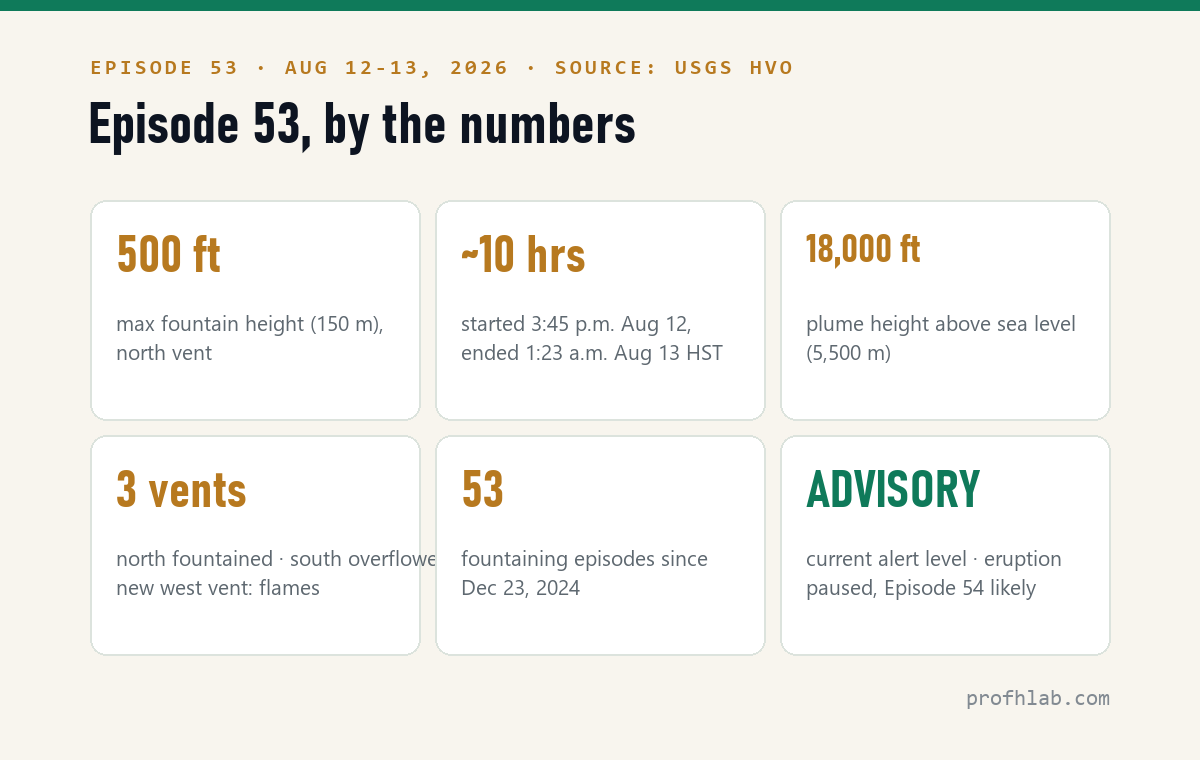
Per the USGS: fountaining began around 3:45 p.m. Hawaii time on August 12 and ended at 1:23 a.m. on August 13. The north vent did the fountaining – up to about 500 feet (150 meters) – while the south vent overflowed with lava and a new west vent produced intermittent flames. The gas-and-ash plume reached about 18,000 feet above sea level. The eruption then paused, which is normal for this volcano right now, and the alert level sits at ADVISORY with aviation code Yellow.
Why does Kilauea keep erupting?
Two reasons, and they are both simple. First, Kilauea sits above a hotspot – a plume of unusually hot rock rising from deep inside the Earth that has been building the Hawaiian islands for millions of years. It supplies fresh magma more or less continuously, which is why Kilauea is one of the most active volcanoes on the planet.
Second, Hawaiian magma is runny. It is basalt – low in silica, so it flows like warm honey rather than exploding like the thick, sticky magma of volcanoes such as Mount St. Helens. Runny magma lets gas escape in dramatic but relatively predictable fountains instead of catastrophic blasts.
Why fountains – and why numbered episodes?
The current eruption began on the night of December 23, 2024, and it has settled into a remarkable rhythm: short bursts of fountaining separated by quiet pauses. Each burst gets a number. August’s was the 53rd.
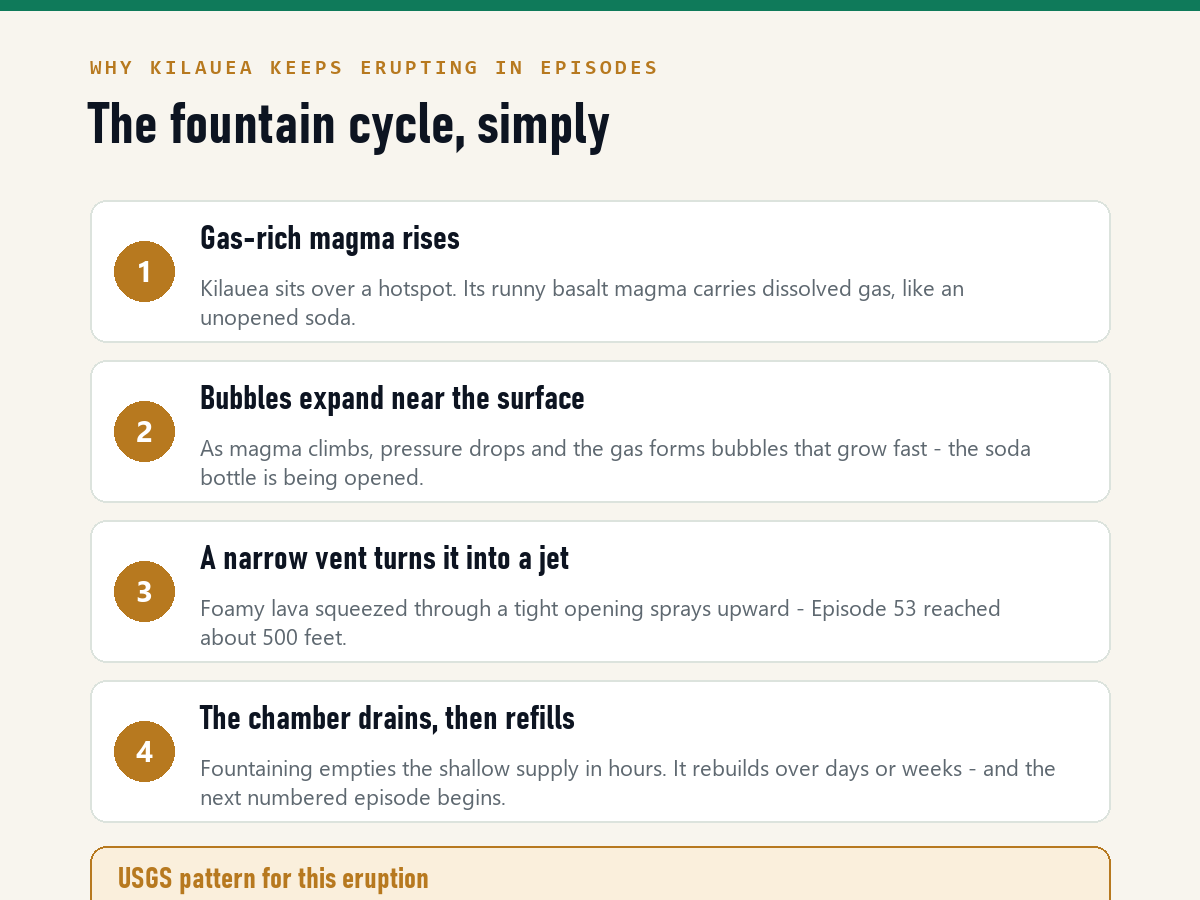
The everyday analogy really is a soda bottle. Magma rises carrying dissolved gas under pressure. Near the surface the pressure drops, the gas turns to fast-growing bubbles, and foamy lava gets squeezed through a narrow vent – a jet, like putting your thumb over a garden hose. A few hours of that empties the shallow supply; days or weeks refill it; the next episode begins. Same vents, same crater, new number.
Is it safe to visit Hawaii right now?
It is also worth saying what this is not: it is not a repeat of 2018, when lava broke out of the volcano’s flank into neighborhoods and destroyed hundreds of homes. That event happened on the lower East Rift Zone, far from the summit. What is happening now is summit fountaining inside a crater with no one living in it – which is exactly why it is such good television.
How to watch (the best seat is free)
The USGS points a public camera straight at the vents, around the clock. When Episode 54 starts, this is where it will appear first:
Is the park open, and how high do Kilauea’s fountains reach?
Why does Kilauea keep erupting?
It sits over a hotspot that keeps supplying magma, and its runny basalt lets that magma erupt often and relatively gently. The current episodic eruption has been running since December 23, 2024.
How high are the lava fountains?
Episode 53 reached about 500 feet (150 meters) from the north vent, per USGS. Some earlier episodes in this sequence have gone higher; each episode is different.
Is it safe to visit Hawaiʻi Volcanoes National Park right now?
The eruption is confined to a closed area inside the park, and the park has remained open around it. Check the National Park Service alerts and the USGS daily update before you go – vog and Pele’s hair travel downwind during episodes.
When is Episode 54?
USGS says another episode is likely but that more data are needed for a forecast. Pauses in this eruption have lasted from days to over two weeks. The USGS livestream is the earliest place you will see it begin.
Is this like the 2018 eruption?
No. In 2018, lava erupted from the volcano’s lower flank into residential areas and destroyed hundreds of homes. The current activity is fountaining at the summit, inside a closed crater, with an alert level of Advisory.
Sources
- USGS Hawaiian Volcano Observatory – Kilauea Volcano Updates (August 16, 2026)
- USGS – Kilauea eruption information (episodic eruption onset December 23, 2024)
- Smithsonian Institution / USGS Weekly Volcanic Activity Report (August 6-12, 2026)
- YouTube view counts verified August 17, 2026
Three more explainers, from Social Security math to scam defense
- Your 2027 Social Security raise, and what Medicare takes back – the first Briefing, with the per-$1,000 math.
- Physical AI, explained – why a chatbot knows the cup falls but a robot doesn’t.
- AI scams targeting seniors – the safe-word kit and the first-60-minutes plan.
About the author
Prof. H is a professor of AI and robotics, a former Samsung researcher, and the author of dozens of textbooks on AI and automation. He writes hands-on, no-hype guides. More about the author →
Prof.’s H Newsletter
One short email a month, with the numbers in it
What actually moved in AI hiring, AI prices, and the scams aimed at older Americans. Counted here, dated, and linked to the source. One email a month, and your address goes nowhere else.