How to Tell if a Facebook Ad Is Fake: 5 Checks That Take 90 Seconds
You are mid‑swipe when it stops you: the bag you have been quietly wanting, 50% off, today only. It is sitting right there between a cousin’s vacation photos and a birthday reminder, in the same font as everything else you trust, so you tap it.
Two weeks later nothing has arrived. Or something has arrived, and it is not the thing in the picture. And the question that shows up in the search bar at that point—how to tell if a Facebook ad is fake—is the right question asked slightly too late.
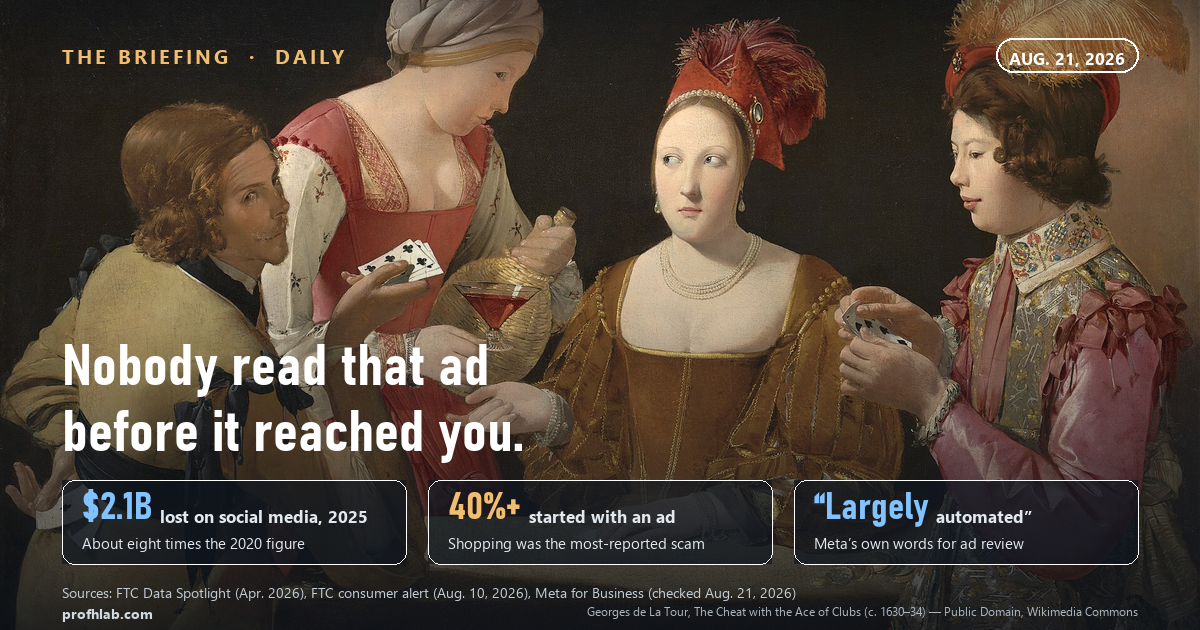
Here is the part that almost nobody says out loud, and that the platform itself will tell you if you read its own documentation: nobody read that ad before it reached you.
Jump to what you need
Was anyone actually checking? · Where the money actually goes · Why the old checklist stopped working · The 90‑second check · The version that costs more · What to do with this
Was anyone actually checking that ad?
On August 10, 2026, the FTC published a consumer alert with a title that reads like a question someone typed into a search bar: “Are ads on social media vetted or checked for scams?” The agency’s answer was careful and, if you sit with it for a second, alarming: “social media platforms don’t always thoroughly vet the ads you see or the advertisers behind them.”
Meta says the same thing about itself, in plainer language. From its own explanation of how ad review works: the system “relies primarily on automated technology to apply our Advertising Policies to the millions of ads that run across our apps. While our review is largely automated, we rely on our teams to build and train these systems, and in some cases, to manually review ads.”
Read that as a supply chain rather than a policy. Generative tools wrote the copy and produced the image. An automated system approved it. An automated system chose you for it, using the same age, interest and shopping-habit targeting a real business would buy. Meta has said it intends to go further — toward campaigns where an advertiser supplies a URL and a budget and the system generates the creative, picks the audience and spends the money.
Every link in that chain has been automated except one. You are the only human on it, and you are the one holding the card.
This is not a claim that the platforms do nothing. Ads do get rejected, advertisers do lose access, and a public Ad Library exists precisely so outsiders can look. It is a claim about what “reviewed” means at the scale of millions of ads a day: a filter, not a reading.
Where the money actually goes (this part surprised us)
The FTC published its social media fraud numbers in April 2026, covering 2025. Nearly 30% of everyone who reported losing money to a scam said it started on social media, with reported losses of $2.1 billion — roughly eight times the 2020 figure, and more than any other way scammers make contact. More money was reported lost to scams that started on Facebook than on any other platform; the FTC notes that Facebook alone accounted for far more than text and email scams did.
Then there are two numbers that are usually quoted in different articles, and belong in the same table.
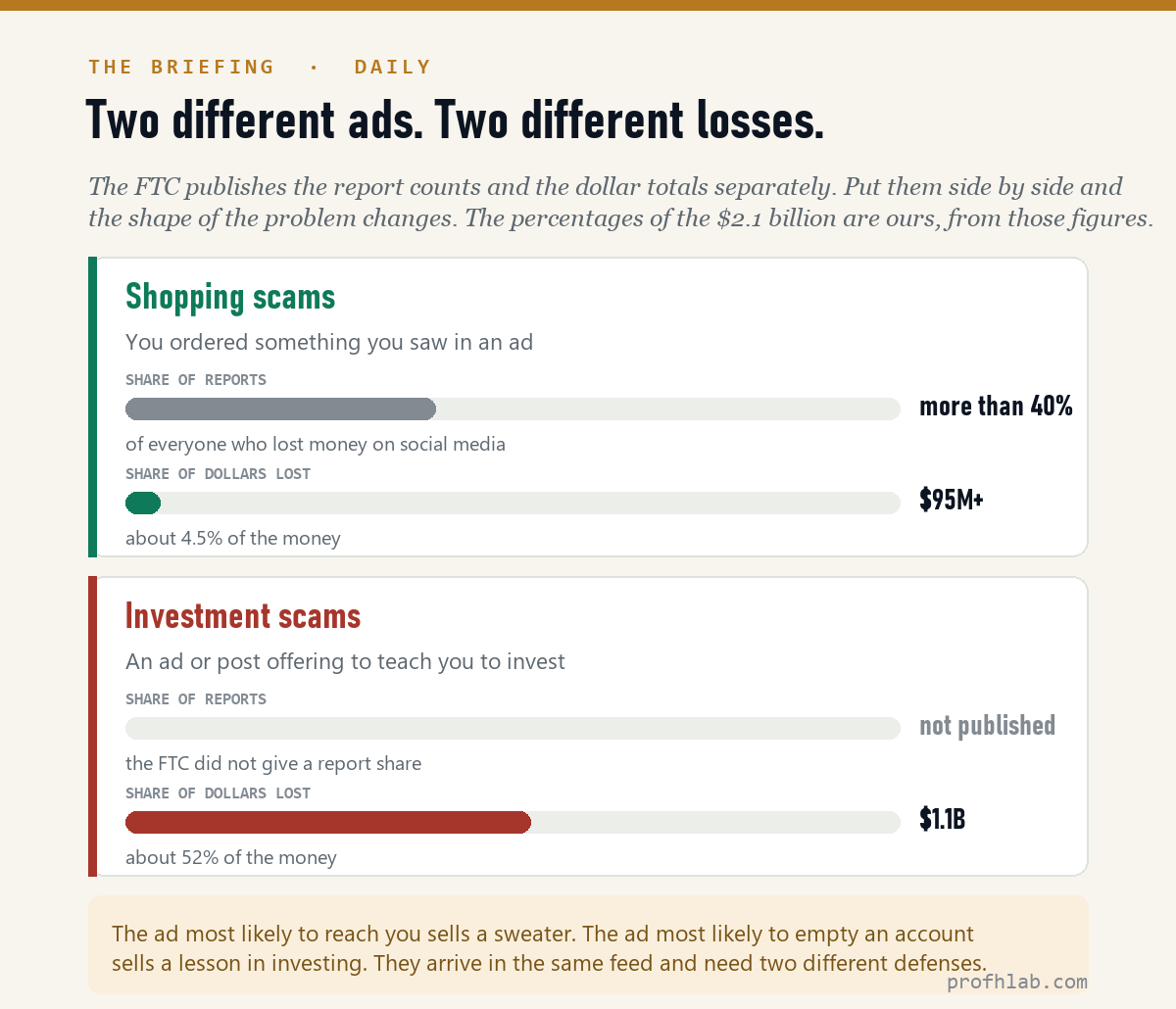
Shopping scams were the most reported social media scam of 2025: more than 40% of people who lost money said it started when they ordered something they had seen in an ad — clothes, makeup, car parts, and, the FTC notes, puppies. But in the August alert, the dollar figure attached to that whole category was more than $95 million. Against a $2.1 billion total, that is about 4.5% of the money.
Investment scams — which usually begin with an ad or post offering to teach you how to invest — accounted for $1.1 billion. About 52% of the money, from a much smaller share of the reports.
So the honest version of “beware of Facebook ads” is really two warnings wearing the same coat. The ad most likely to reach you sells a sweater. The ad most likely to empty an account sells a lesson in investing. They arrive in the same feed, in the same font, and they need two different defenses.
Why the old checklist stopped working
Search this question and you will get the same list from a dozen sites: look for typos, look for pixelated images, look for six fingers, look for awkward English.
That advice was never really about fakery. It was about budget. Those tells existed because the people running the ads could not afford a copywriter or a photographer. That constraint is gone. Producing a clean paragraph and a plausible product photo now costs about as much as producing a bad one, which means the visual tells have been quietly deleted from the evidence pile — and the checklists that still lead with them are training people to feel safe for the wrong reason.
What did not change is provenance. A Page created in June cannot have been selling handbags since 2011. A brand with three hundred followers and four hundred active ads is not a brand. Those facts are boring, checkable, and — unlike the picture — expensive to fake.
How to tell if a Facebook ad is fake: the 90‑second check
Not one of these looks at the ad. All of them look at who is behind it.
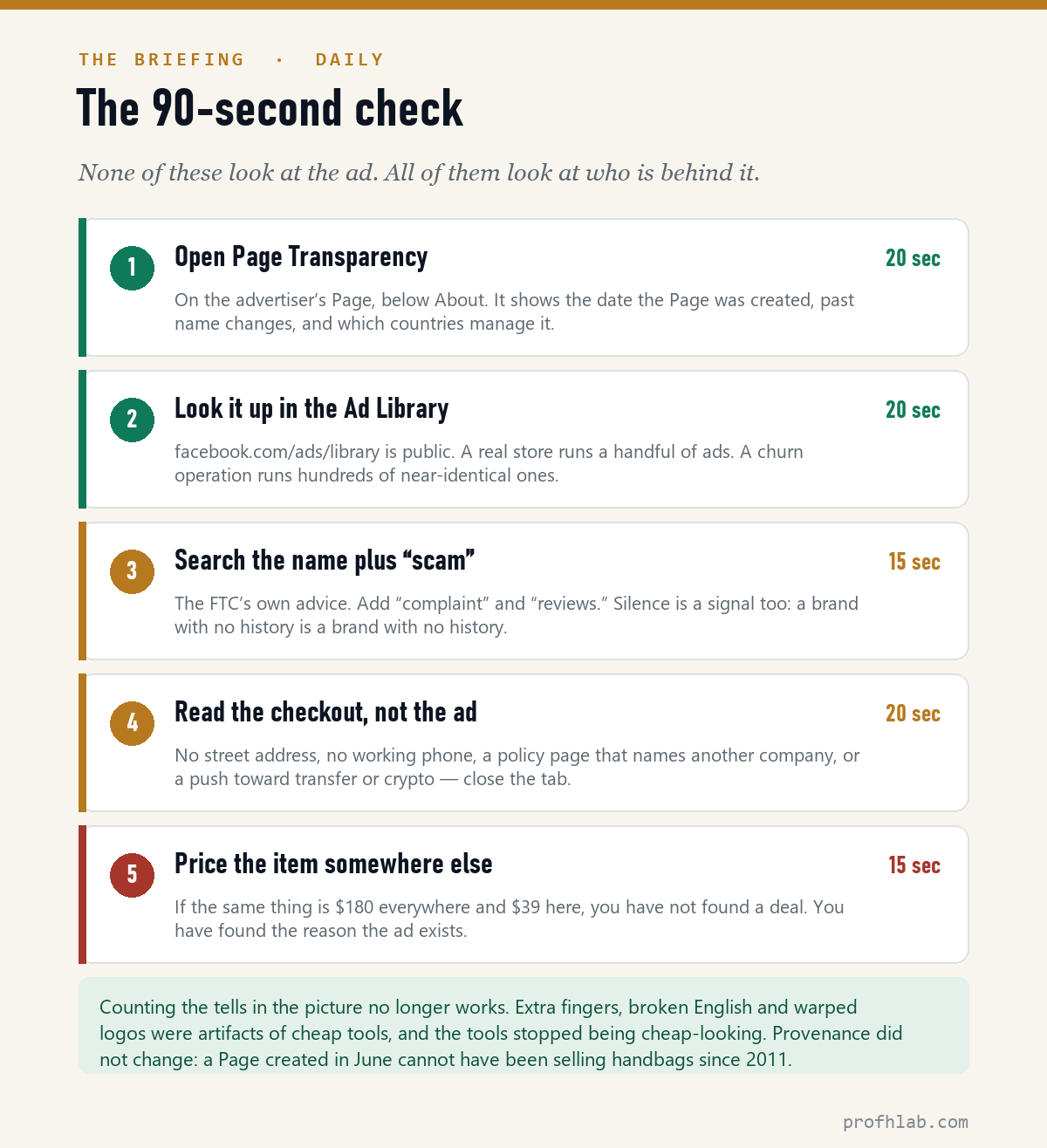
1. Open Page Transparency (about 20 seconds). On the advertiser’s Facebook Page, scroll to the section below About and open it. It shows the date the Page was created, any previous name changes, and the countries where its managers are located. A jewelry brand whose Page was created seven weeks ago, was previously named something about phone cases, and is run from three countries you did not expect has told you everything you need without you reading a word of its ad.
2. Look it up in the Ad Library (about 20 seconds). facebook.com/ads/library is public and searchable, and Meta points to it itself. Search the advertiser. A real store is running a handful of ads. A churn operation is running dozens of near-identical ones with rotating product photos — which is what a business model built on being gone in six weeks looks like from the outside.
3. Search the name plus “scam” (about 15 seconds). This is the FTC’s own advice, near-verbatim: look online for the company’s name plus “scam” or “complaint.” Add “reviews.” And treat silence as data: a brand with a big ad budget and no online history at all is a brand that was assembled recently.
4. Read the checkout, not the ad (about 20 seconds). Before you type a card number, look for a street address, a phone number that is not a form, and a returns policy that names this company rather than some other one. Then look at how it wants to be paid. A push toward bank transfer, gift cards, or crypto is not a payment preference — it is a preference for a payment you cannot claw back.
5. Price the item somewhere else (about 15 seconds). Open a new tab and find the same product at a retailer you already know. If it is $180 everywhere and $39 here, you have not found a deal. You have found the reason the ad exists.
If you only ever do one: do the Page Transparency check. It is the single field a scam operation cannot backdate, and it takes about as long as reading the ad’s headline twice.

The version of this ad that costs a great deal more
Because more than half the money runs through investment ads, the 90‑second check needs a second gear when the ad is selling a system, a signal group, or a course rather than a sweater.
The FTC’s description of the 2025 pattern is worth reading closely, because it is unusually specific. The ad or post offers to teach you to invest. You end up in a group chat — often WhatsApp — full of “successful investors” posting glowing testimonials. You are directed to a platform that looks entirely real. You open an account, you see profits, and you may even withdraw a small amount successfully. That small successful withdrawal is not evidence. It is the product. It is what the operation sells you before it sells you the loss.
Three checks that fit this case and not the sweater case:
- Look the firm up yourself, not in their screenshot. Type the name into BrokerCheck or investor.gov in your own browser.
- Try a full withdrawal early, not a small one. The small one is designed to succeed. New fees, new taxes, or a new “verification deposit” appearing at the moment you ask for everything is the whole scheme announcing itself.
- Know the sequel. The FTC notes that people who lost money this way then reported second losses to people who offered to trace and recover the money for a fee. If you have been hit once, treat every unsolicited offer of recovery as part of the same event.
None of this is investment advice, and we do not recommend or evaluate any specific investment, platform, or security.
Worth two minutes of watching
Practice on a brand you trust, and pay by credit card
- Run the check once, on an ad you already trust. Pick a brand you have actually bought from and open its Page Transparency. Seeing what a legitimate one looks like — created years ago, one name, one country — is what makes the fake one obvious later.
- Pay with a credit card, not a debit card or a transfer. Credit cards carry dispute rights that transfers and gift cards do not. If the item never arrives or arrives counterfeit, call the number on the back of the card and ask to dispute the charge.
- Report the ad in place. The three dots in the ad’s upper-right corner. Meta says these reports feed the review system and can trigger a re-review — it is the one lever a reader actually holds.
- Report the loss to the FTC at ReportFraud.ftc.gov, regardless of the amount. The FTC is explicit that most scams are never reported and that the real totals are higher than the published ones.
- If you gave up card or bank details rather than money, treat it as an identity issue too: IdentityTheft.gov walks through the steps, and a credit freeze is free.
- Tell one person over 65 about step one. The FTC found social media was the costliest fraud contact method for every age group under 80 — this is not a young-person problem, and the check is short enough to explain over the phone.
Scammers buy the same targeting as honest advertisers
- “Why do I keep getting these ads?” Because targeting is sold to everyone at the same counter. Scammers buy the same age, interest and shopping-habit targeting that legitimate businesses do. Tightening your ad settings reduces the precision of what reaches you; it does not change who is allowed to buy.
- “Does reporting it actually do anything?” Individually, slowly. Meta says reports are a signal to its review systems and may prompt a re-review, and that repeat violators can lose the ability to advertise. Reporting is worth the ten seconds, but it is not a substitute for the ninety.
- “What about the same trick outside my feed?” The FTC covered a close cousin on August 17: bill pay impersonators — paid search ads that catch you when you go looking for a company’s payment page. Same structure, different surface. Type the address you already know rather than clicking the top result.
Does Meta vet ads, and what if you already paid a scammer?
How can I tell if a Facebook ad is fake?
Check the advertiser rather than the ad. Open Page Transparency on their Facebook Page to see when the Page was created, whether it has changed names, and which countries manage it; look the advertiser up in Meta’s public Ad Library; search the company name plus “scam” and “complaint”; read the checkout page for a real address, phone number and returns policy; and price the same item at a retailer you already know. The whole sequence takes about 90 seconds.
Does Facebook check ads before they run?
Partly, and mostly by machine. Meta states its ad review system is designed to review all ads before they go live but “relies primarily on automated technology,” with human reviewers used in some cases and more heavily when an advertiser appeals a rejection. The FTC’s August 10, 2026 alert puts it plainly: social media platforms “don’t always thoroughly vet the ads you see or the advertisers behind them.”
Are ads on social media vetted or checked for scams?
Not reliably. Anyone can pay to place an ad in your feed, including people impersonating real brands or selling counterfeits, and the same interest and shopping-habit targeting available to legitimate businesses is available to them. The FTC’s advice is to check the company yourself before buying from an ad.
How much money do people lose to social media ad scams?
The FTC reported $2.1 billion in losses to scams that started on social media in 2025, about eight times the 2020 figure. Within that, more than $95 million was tied to scams that began when someone ordered something they saw in an ad, while investment scams — often starting with an ad or post about learning to invest — accounted for $1.1 billion.
Are typos and bad images still a reliable sign of a fake ad?
No. Those tells reflected small budgets rather than dishonesty, and generative tools have made clean copy and plausible product photos essentially free to produce. Checks based on provenance — Page creation date, past name changes, advertiser history, ad volume — still work, because they are records rather than appearances.
What should I do if I already paid a scam ad?
Dispute the charge with your card issuer as soon as possible, report the ad through the three-dot menu on the ad itself, and file a report at ReportFraud.ftc.gov whatever the amount. If you handed over personal or bank details rather than a payment, start at IdentityTheft.gov and place a free credit freeze. Be wary of anyone who then contacts you offering to recover the money for a fee — the FTC records that as a common second loss.
Why do I see so many scam ads on Facebook specifically?
Reach and cost. The FTC reported more money lost to scams that started on Facebook in 2025 than on any other social media platform, and noted that Facebook alone accounted for far more than text and email scams. Scammers can reach an enormous audience at very little cost, using the platform’s standard targeting tools.
Sources
- Federal Trade Commission, consumer alert: “Are ads on social media vetted or checked for scams? Here’s what to know” — August 10, 2026.
- Federal Trade Commission, Data Spotlight: “Reported losses to scams on social media eight times higher than in 2020” — April 2026 (2025 Consumer Sentinel data).
- Federal Trade Commission, consumer alert: “Searching online: bill pay impersonators” — August 17, 2026.
- Meta for Business, “Understanding Facebook’s Ad Review Process” — ad review and Ad Library documentation, accessed August 21, 2026.
- U.S. Customs and Border Protection photography (public domain), via Wikimedia Commons.
All figures checked against the primary sources on August 21, 2026. Percentages of the $2.1 billion total are our calculations from the FTC’s published figures. This article is general consumer information, not legal or investment advice.
Beyond Facebook: the safe word, ChatGPT’s ads and expired deals
- AI scams targeting seniors: the first 60 minutes, and the safe word that stops them
- ChatGPT has ads now — where the setting is, and where it isn’t
- Free AI subscription deals in the US — and the expired ones still being recommended
About the author. Prof. H teaches AI and robotics, and writes Prof H Lab to test the tools and read the primary sources so readers don’t have to. Every price and figure here is dated. One short email a month, if you want it.
Prof.’s H Newsletter
One short email a month, with the numbers in it
What actually moved in AI hiring, AI prices, and the scams aimed at older Americans. Counted here, dated, and linked to the source. One email a month, and your address goes nowhere else.