Roman Space Telescope vs. James Webb: What NASA’s Aug. 30 Launch Actually Does
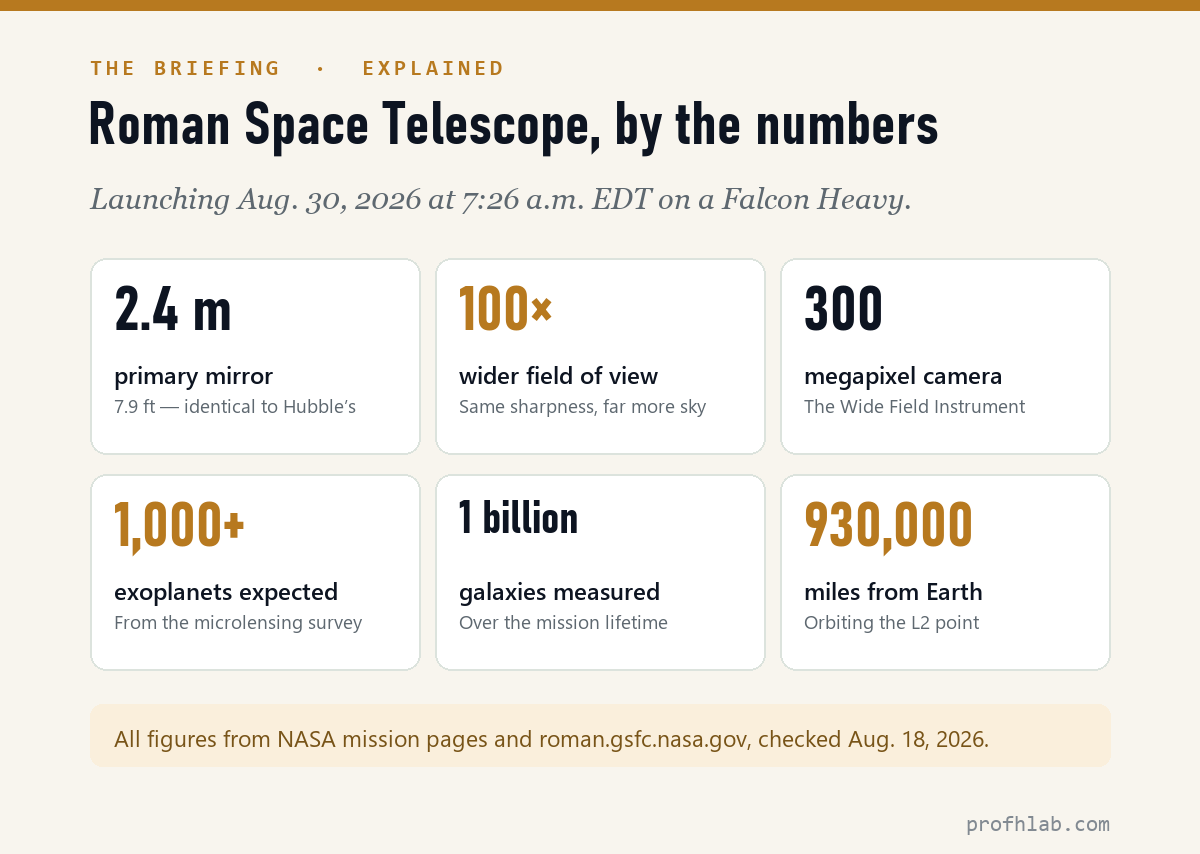
On Aug. 30, 2026, at 7:26 a.m. EDT, a SpaceX Falcon Heavy is scheduled to lift off from Launch Complex 39A at NASA’s Kennedy Space Center carrying a telescope with a mirror 2.4 meters across — exactly the same size as the one inside Hubble, which launched in 1990.
That sounds like a step sideways. It isn’t. NASA’s Nancy Grace Roman Space Telescope keeps Hubble’s sharpness and widens the picture by a factor of 100, and that one change is the entire mission.
People have noticed. In the past three weeks, an explainer from Dr. Becky — an Oxford astrophysicist — passed 190,000 views in four days, NASA Goddard’s own Roman video passed 157,000, and a third-party explainer titled “100x better than Hubble” crossed 422,000. The questions people are typing are narrower than the headlines: Roman vs. James Webb. Is it cancelled? Where does it orbit? Why that name?
Here are the answers, with the source and the date on every number.
What is actually launching
| Item | Detail |
|---|---|
| Launch | Aug. 30, 2026, 7:26 a.m. EDT |
| Rocket / pad | SpaceX Falcon Heavy, Launch Complex 39A, Kennedy Space Center |
| Primary mirror | 7.9 ft (2.4 m) — same diameter as Hubble’s, under one-fourth the weight (410 lb / 186 kg) |
| Main instrument | Wide Field Instrument: a 300-megapixel infrared camera |
| Second instrument | Coronagraph — a technology demonstration that blocks starlight to image planets directly |
| Destination | The L2 point, about 930,000 miles (1.5 million km) from Earth, opposite the Sun |
| Primary mission | 5 years, with a possible 5-year extension |
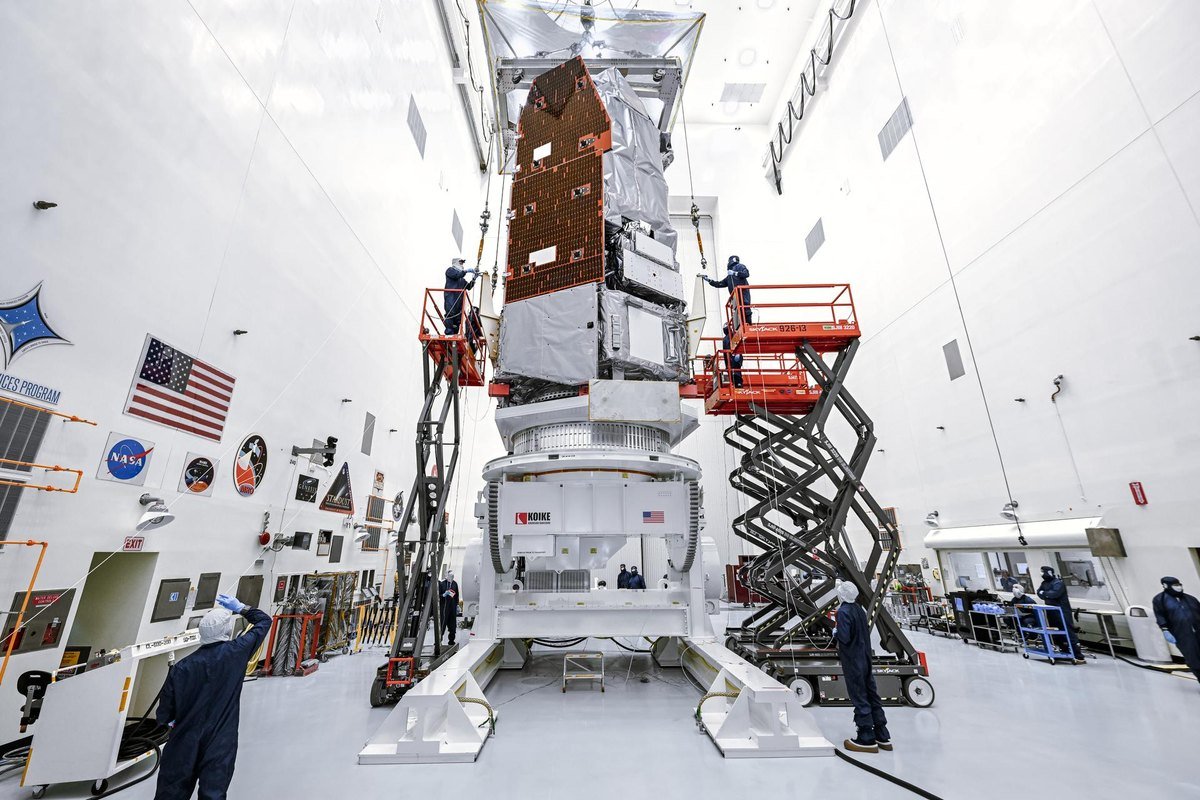
One detail rarely makes the headlines and is worth knowing: Roman’s technical documentation lists the observatory as able to be refueled in flight robotically. Hubble was designed for astronaut servicing; Webb was not designed to be serviced at all. Roman splits the difference.
Why a smaller mirror is the whole point
A telescope mirror does two jobs: it collects light, and it determines how fine a detail you can resolve. A bigger mirror wins at both. So why build one the same size as a 1990 telescope?
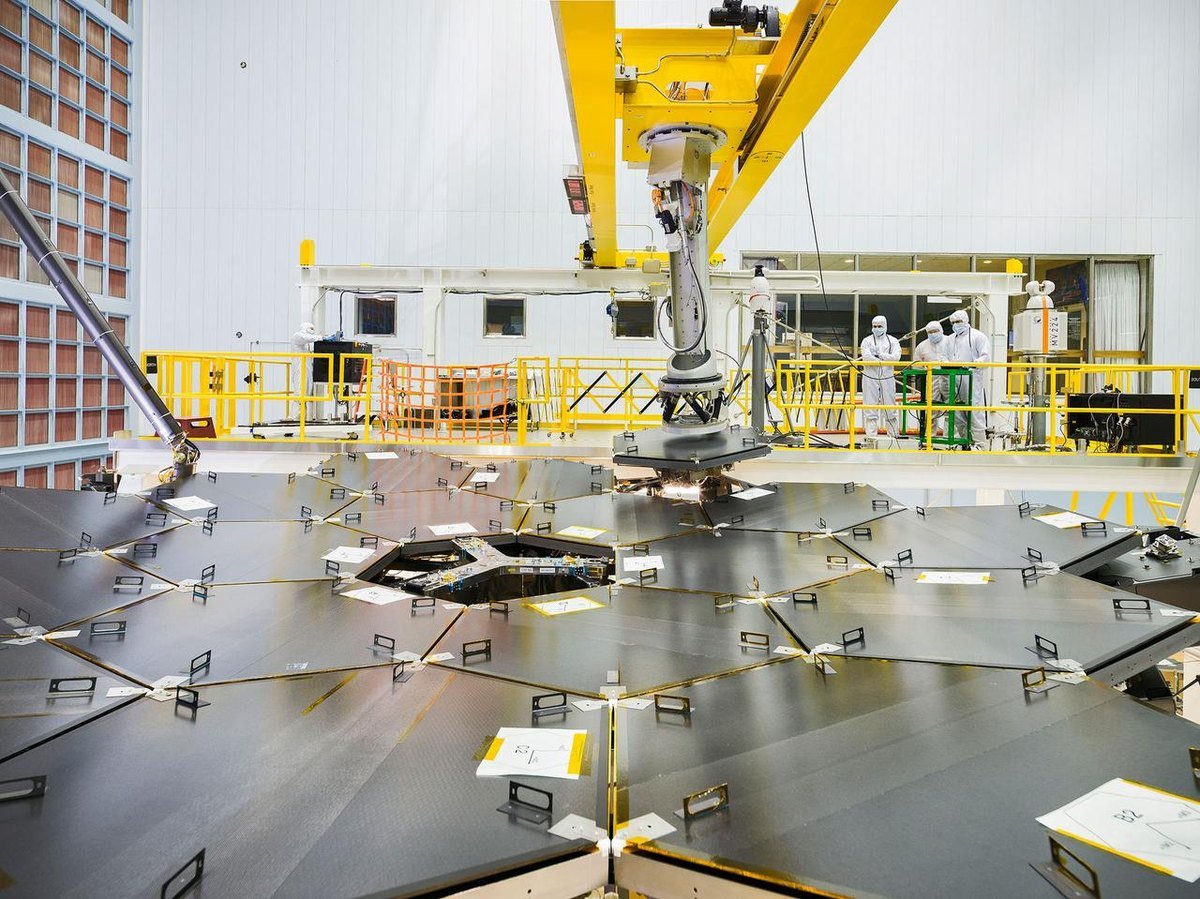
Because the mirror is only half the camera. The other half is how much sky lands on the sensor.
Think of Hubble and Webb as looking through a drinking straw held up to a window. The view through the straw is beautifully sharp — but it is a straw. To see the whole window you have to move the straw a hundred times and stitch the results together, and each move costs telescope time that hundreds of astronomers are competing for.
Roman uses the same quality of glass and points it at the whole window at once. NASA’s public description is a field of view “at least 100 times larger than Hubble’s.” The engineering documentation is more specific: Roman’s detector array produces a 0.4° × 0.8° field of view — 0.281 square degrees excluding the gaps between detectors, which the same document calls roughly 200 times larger than Hubble’s WFC3-IR camera, with better sensitivity and comparable spatial resolution.
How big is 0.281 square degrees, really? The full Moon spans about half a degree across, so it covers roughly 0.21 square degrees of sky. That means Roman photographs about 1.3 full Moons’ worth of sky in a single exposure — at Hubble’s sharpness. At its fastest survey setting, the technical documentation says Roman can cover about 8 square degrees per hour.
Roman vs. James Webb: which one is better?
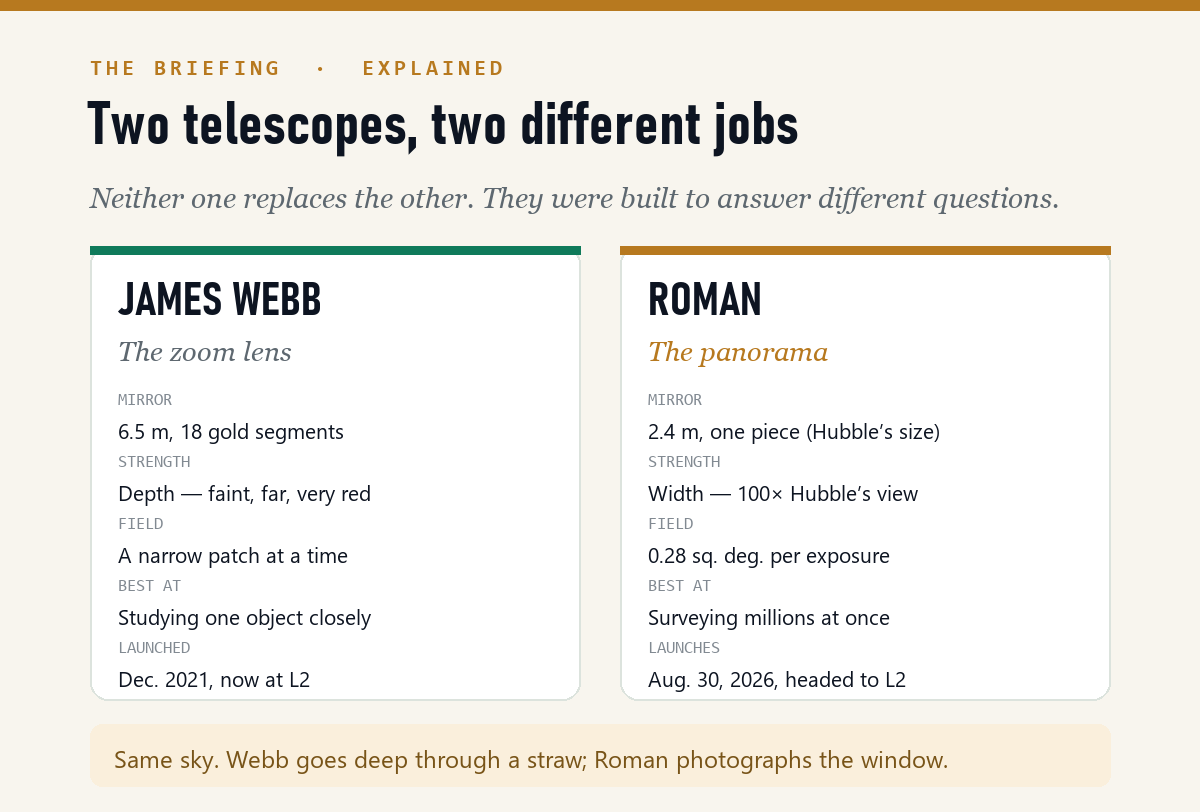
This is the most-searched question about Roman, and the honest answer is that the two telescopes are not competing.
Webb is a zoom lens. Its 6.5-meter mirror — 18 gold-coated segments — collects far more light than Roman’s, and it sees much deeper into the infrared. When astronomers find something strange and want to know what it is made of, Webb is the instrument that answers.
Roman is a panorama. It will not out-resolve Webb on any single object. What it will do is survey enormous stretches of sky at Hubble-class sharpness, fast enough to catch things that change — a star brightening, a supernova going off, a planet bending starlight for a few hours.
The relationship is the one between a census and an interview. Roman finds the interesting objects by the million; Webb interviews the handful that matter most. Both will be parked out at the same L2 point, roughly a million miles from here.
Is the Roman Space Telescope cancelled?
People are searching this, and there is a real reason for the worry — but the short answer is no.
The White House’s fiscal 2026 budget request, released in spring 2025, proposed cancelling Roman along with a long list of other NASA science missions. The proposal drew heavy criticism, in part because the observatory was already nearly finished, on schedule and under budget. Congress did not enact the cancellation; appropriators funded Roman at roughly $300 million — about twice what the request had proposed.
Since then the hardware has been completed at NASA’s Goddard Space Flight Center, shipped to Kennedy Space Center, and scheduled for launch. A budget request is a proposal, not a decision. Roman is on the pad.
What Roman will actually find
The mission has two headline jobs and one bonus.
1. Dark energy. Scientists have concluded that a mysterious pressure called dark energy makes up about 68% of the total energy content of the universe — and beyond that, almost nothing is settled. In 1998, Hubble observations of distant supernovae showed that cosmic expansion is not slowing down under gravity as everyone had assumed; it is speeding up.
Nobody knows why. Either there is a new energy component in the universe, or Einstein’s theory of gravity breaks down at cosmological scales. Roman’s job is to measure enough of the universe — light from a billion galaxies over the mission — to tell those two answers apart.
2. Planets around other stars. Roman will monitor 200 million stars toward the center of our galaxy, watching for the brief brightening that happens when a foreground object’s gravity bends the light of a star behind it. NASA expects this microlensing survey alone to find more than 1,000 exoplanets, including worlds in wide orbits that current methods miss almost entirely. Because Roman is also tracking brightness continuously, astronomers expect it to catch as many as 100,000 additional transiting planets as a by-product.
3. The bonus: the Coronagraph. This instrument is formally a technology demonstration — a set of “starglasses” that blocks a star’s glare so a planet beside it becomes visible. Its purpose is to prove in space the techniques a future mission will need to photograph a rocky, Earth-sized planet in another star’s habitable zone and read its atmosphere. Roman is not that mission. It is the rehearsal.
When do we see the first pictures?
Not on launch day. After liftoff, Roman travels out to L2 and then goes through roughly 90 days of commissioning — cooling down, aligning optics, calibrating detectors — before science operations are expected to begin around the start of 2027.
NASA typically streams major launches live on NASA+ and its official channels, and the agency’s Roman mission blog is where launch timing changes get posted first. Launch dates move; check the mission page the morning of, not a week before.
The part that connects to the rest of this site. A 300-megapixel camera photographing 8 square degrees an hour does not produce pictures — it produces a firehose of measurements no human can page through. Finding 1,000 planets hidden inside 200 million monitored stars is a pattern-recognition problem, and it belongs to the same family as teaching a machine to understand the physical world it is standing in.
If that idea is new to you, start with Physical AI Explained, then Physical AI Foundations for the underlying concepts. Both are written without math.
Launch time, orbit, cost and why neither telescope wins outright
When is the Roman Space Telescope launching?
Aug. 30, 2026, at 7:26 a.m. EDT, on a SpaceX Falcon Heavy from Launch Complex 39A at NASA’s Kennedy Space Center in Florida. Launch dates can slip for weather or technical reasons, so confirm on NASA’s Roman mission page the morning of the launch.
Roman Space Telescope vs. James Webb — which is better?
Neither, because they do different jobs. Webb has a much larger 6.5-meter segmented mirror and sees deeper into the infrared, which makes it the better instrument for studying a single faint object in detail. Roman has a 2.4-meter mirror but a field of view at least 100 times wider than Hubble’s, which makes it the better instrument for surveying huge areas of sky quickly. In practice Roman will find the objects and Webb will examine the most interesting ones.
Is the Roman Space Telescope cancelled?
No. The White House’s fiscal 2026 budget request proposed cancelling it, but Congress instead funded the mission at about $300 million — roughly double the request — and the observatory has since been completed, shipped to Kennedy Space Center, and scheduled to launch Aug. 30, 2026.
Where will the Roman Space Telescope orbit?
Not around Earth. Roman will operate near the second Sun-Earth Lagrange point (L2), about 930,000 miles (1.5 million km) from Earth in the direction opposite the Sun — the same general region where the James Webb Space Telescope operates. At L2, gravitational forces balance so a spacecraft holds a steady position with very little assistance, and the observatory can keep the Sun, Earth, and Moon behind it.
Why is it called the Nancy Grace Roman Space Telescope?
It is named for Dr. Nancy Grace Roman, who earned her Ph.D. in astronomy from the University of Chicago in 1949, worked at the Naval Research Laboratory from 1955 to 1959, and then became NASA’s first Chief of Astronomy and its first female executive. She is known as the “Mother of Hubble” for the work she did to get a large space telescope built and launched at all.
How much does the Roman Space Telescope cost?
NASA’s public mission pages do not publish a single lifetime cost figure. News organizations covering the mission in 2025 and 2026 have reported a number of roughly $4.3 billion, described as covering design, construction, launch, and five years of operations. Treat that as reported rather than officially confirmed. The figure that is directly verifiable is the annual appropriation: about $300 million for fiscal 2026.
Watch
Sources
- NASA, Nancy Grace Roman Space Telescope mission page and About Roman — launch date and time, mirror size, instruments, 100× field of view, one billion galaxies, 1,000+ microlensing exoplanets, five-year primary mission (checked Aug. 18, 2026).
- NASA Goddard, roman.gsfc.nasa.gov — Observatory page (mirror weight, L2 distance, 300-megapixel Wide Field Instrument), Exoplanets page (200 million stars, 100,000 transiting planets), Dark Energy page (68% of the universe’s energy content), and the Observatory and WFI technical pages (0.4° × 0.8° field, 0.281 deg², ~200× WFC3-IR, 0.48–2.3 micron filters, ~8 deg² per hour, robotic refueling).
- NASA, Who is Nancy Grace Roman? — biography, first Chief of Astronomy, “Mother of Hubble.”
- NASA, Webb Observatory — 18 segments spanning 6.5 meters.
- Reporting on the fiscal 2026 budget request and the congressional appropriation (SpaceNews, Sky & Telescope, Scientific American, 2025–2026) — the proposed cancellation and the roughly $300 million enacted figure.
Dates and mission schedules change. Every figure above was checked on Aug. 18, 2026. For launch timing, NASA’s Roman mission page is the authority.
If Roman got you curious: a quiet hurricane season, Kilauea, robots
- Physical AI Explained: Why a Chatbot Knows the Cup Falls but a Robot Doesn’t — how machines learn to model the physical world, no math required.
- Why the Hurricane Season Has Been So Quiet — the El Niño math, and why quiet is not the same as safe.
- Kilauea’s Lava Fountains, Explained — what the USGS data actually says about the eruption everyone is streaming.
Written by Prof. H. Every number in this piece comes from a NASA mission page or NASA technical documentation, listed and dated above. Where a figure could not be verified from a primary source — the mission’s total cost — it is labeled as reported, not confirmed. More from The Briefing.
Prof.’s H Newsletter
One short email a month, with the numbers in it
What actually moved in AI hiring, AI prices, and the scams aimed at older Americans. Counted here, dated, and linked to the source. One email a month, and your address goes nowhere else.