Did the SpaceX Rocket Hit the Moon? Yes — Here Is the Crater NASA Photographed
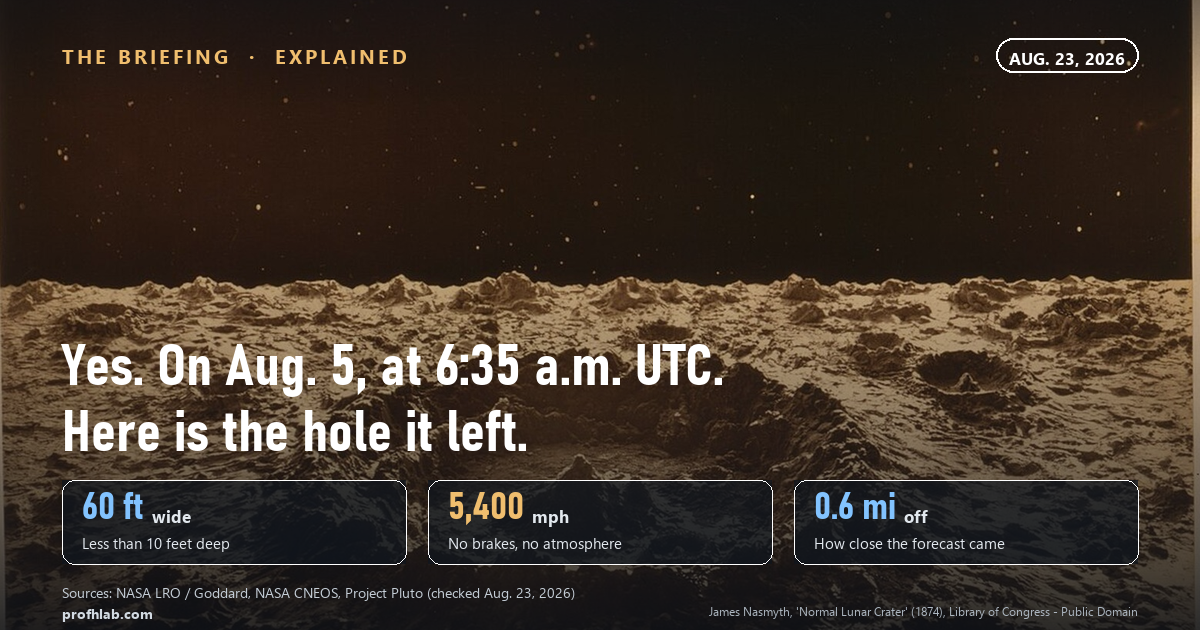
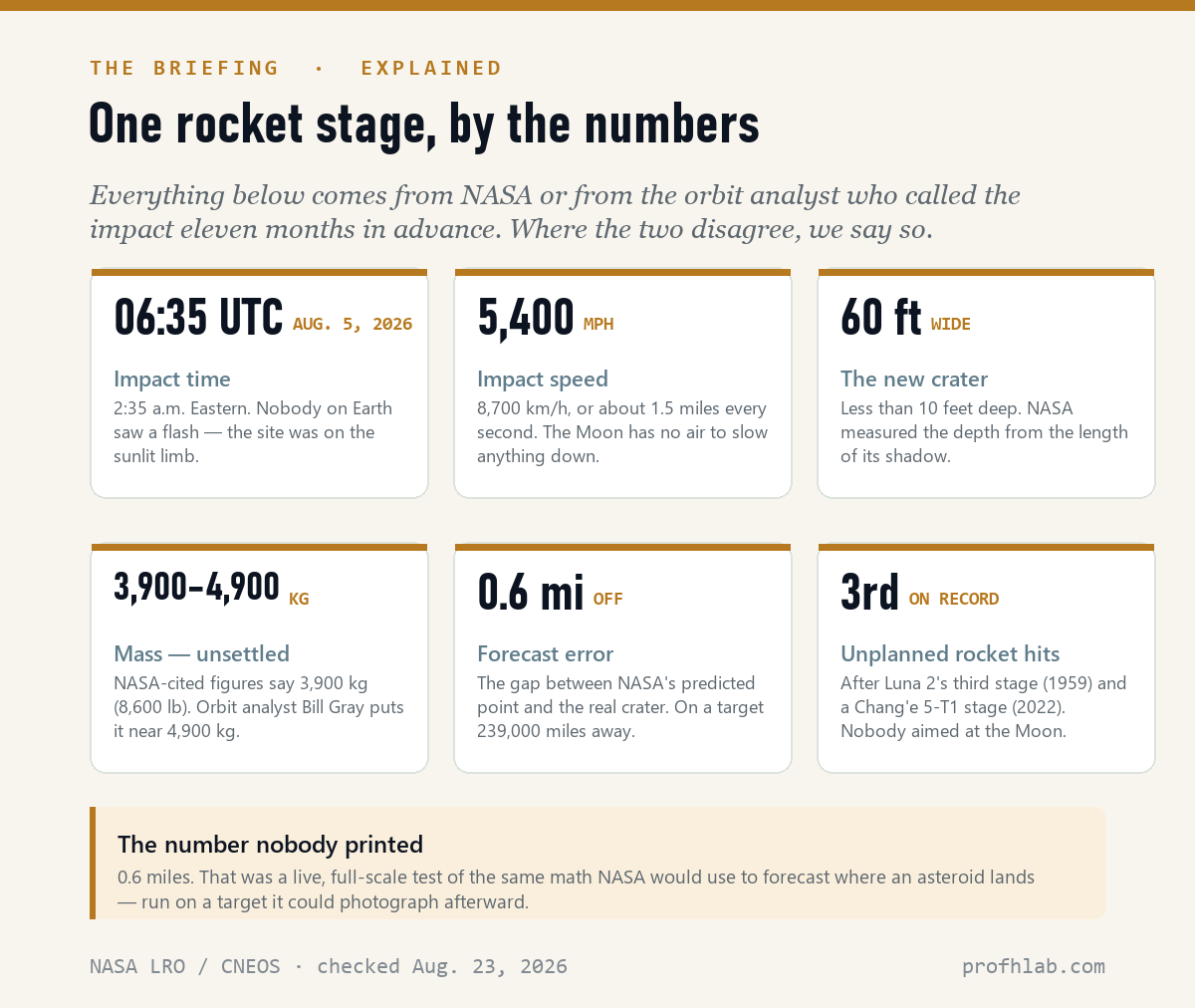
At 6:35 in the morning UTC on August 5, 2026 — 2:35 a.m. in New York, still the night of the 4th in California — about four tons of empty rocket hit the Moon at roughly a mile and a half per second.
Nobody saw a flash. There was no live shot, no camera pointed at the spot. What actually registered the event was a telescope in the Chilean desert that never saw anything at all: the Very Large Telescope picked up the chemical fingerprints of sodium and lithium glowing above the surface for five to ten minutes, then nothing. Sodium from the Moon’s soil. Lithium, most likely, from the rocket.
So if you have typed did the SpaceX rocket hit the moon into a search bar in the last few weeks — and a great many people have, judging by how many of them are still asking whether it has happened yet — the answer is yes, it happened, it happened almost three weeks ago, and as of August 18 we have photographs of the hole.
Jump to what you need
The short answer, with the exact time · The video you saw was fake · What happens when a rocket hits the Moon · Was it on purpose? · How they found a 60-foot hole · The 2022 story that was wrong · What to do with this
Did the SpaceX rocket hit the moon? Yes — here is the exact time
The object was the spent upper stage of a Falcon 9 that launched on January 15, 2025, carrying two lunar landers: Firefly’s Blue Ghost 1 and ispace’s Hakuto‑R Mission 2. Both landers went where they were supposed to go. The stage that carried them did not go anywhere in particular. It was left in a high orbit that crossed the Moon’s path, and it wandered the Earth–Moon system for about nineteen months before the geometry finally caught up with it.
Here is the same moment in every U.S. time zone, because “06:35 UTC” is the sort of thing that sends people back to the search bar:
| Time zone | Local time of impact |
|---|---|
| UTC | 6:35 a.m., Aug. 5 |
| Eastern (EDT) | 2:35 a.m., Aug. 5 |
| Central (CDT) | 1:35 a.m., Aug. 5 |
| Mountain (MDT) | 12:35 a.m., Aug. 5 |
| Pacific (PDT) | 11:35 p.m., Aug. 4 |
Six days later, NASA’s Lunar Reconnaissance Orbiter photographed the site. This is the same patch of ground before and after.
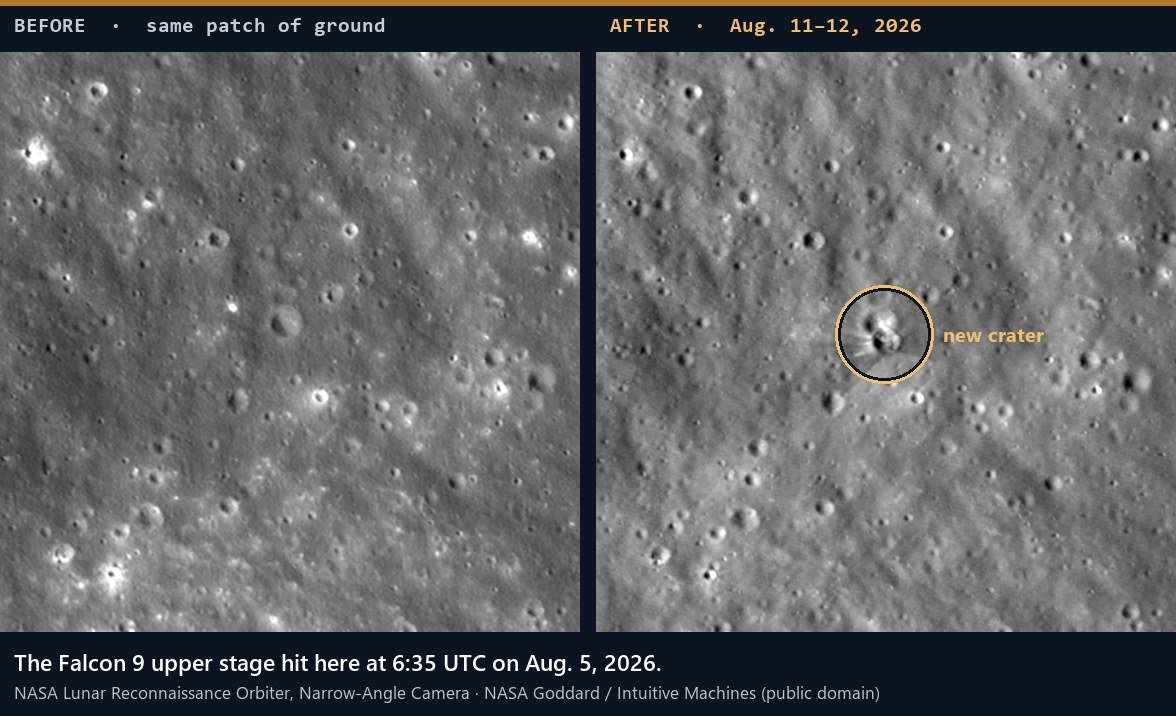
The crater is about 60 feet across and less than 10 feet deep. NASA worked out the depth from the length of the shadow inside it. For scale, that is a hole roughly the footprint of a two-car garage, sitting on a surface where the near side alone covers something like 7.3 million square miles.
Before anything else: the video you probably saw was fake
Within hours of the impact, a clip spread across X, Facebook, Instagram, Threads and TikTok in half a dozen languages. It showed a rocket sailing toward the lunar surface in crisp detail and blooming into a white mushroom cloud. It collected millions of views. Elon Musk reshared it, and later acknowledged it was fake.
It was almost certainly generated by AI, and the tells are worth learning because you will see this pattern again. The fact-checking organisation Full Fact put the clip to four astronomers, and their objections were not subtle:
- You cannot see a rocket that clearly. Dr Matt Bothwell of the University of Cambridge said resolving the incoming stage in that kind of detail would be “literally impossible,” and put his confidence that the video was AI-generated at essentially 100%.
- The terrain is wrong. Carl Schmidt of Boston University was blunt: “It’s certainly a fake. That’s not even the moon!”
- The explosion is far too big. Dr Greg Brown of the Royal Observatory Greenwich said the real impact would not have produced anything close to the blast shown.
- The location does not match. The real crater is near crater Einstein, on the western limb. The video was not.
There is a simpler version of that check that does not require an astronomer. No spacecraft was in position to film the impact. Danuri, the Korean orbiter, was taking still photographs and did not see the strike itself. LRO was on the far side of its orbit. If footage of a thing exists, some instrument had to be pointed at it — and in this case, none was.
The 20-second version of that test
Before you share footage of any event, ask one question: what camera took this, and was it there? A stadium has cameras. A dashcam has a driver. The far limb of the Moon at 2:35 in the morning had nobody. When the answer is “no camera could have been there,” you are looking at an illustration, whatever the caption says. The same instinct is the one that catches a fabricated ad: how to tell if a Facebook ad is fake.
What happens when a rocket hits the Moon?
Almost nothing that your intuition expects, because the two things that make a crash on Earth look like a crash are both missing.
There is no air. On Earth, an object falling from space is slowed and torn apart by the atmosphere; most of the drama you picture — the fireball, the shockwave you can hear — is air being violently compressed. The Moon has none of that. The stage arrived at full speed, roughly 5,400 mph, with nothing to slow it and nothing to carry a sound.
There is nothing to burn. The tanks were empty and there is no oxygen. What looks like an explosion in an impact of this kind is not combustion at all; it is kinetic energy converted, in a fraction of a second, into crushed rock, heat and a spray of dust thrown out on ballistic arcs. That spray has no air to fall through, so instead of a mushroom cloud it makes rays — long straight streaks of material laid down where it landed.
Those rays are the most interesting thing in the pictures, because they come in two colours.
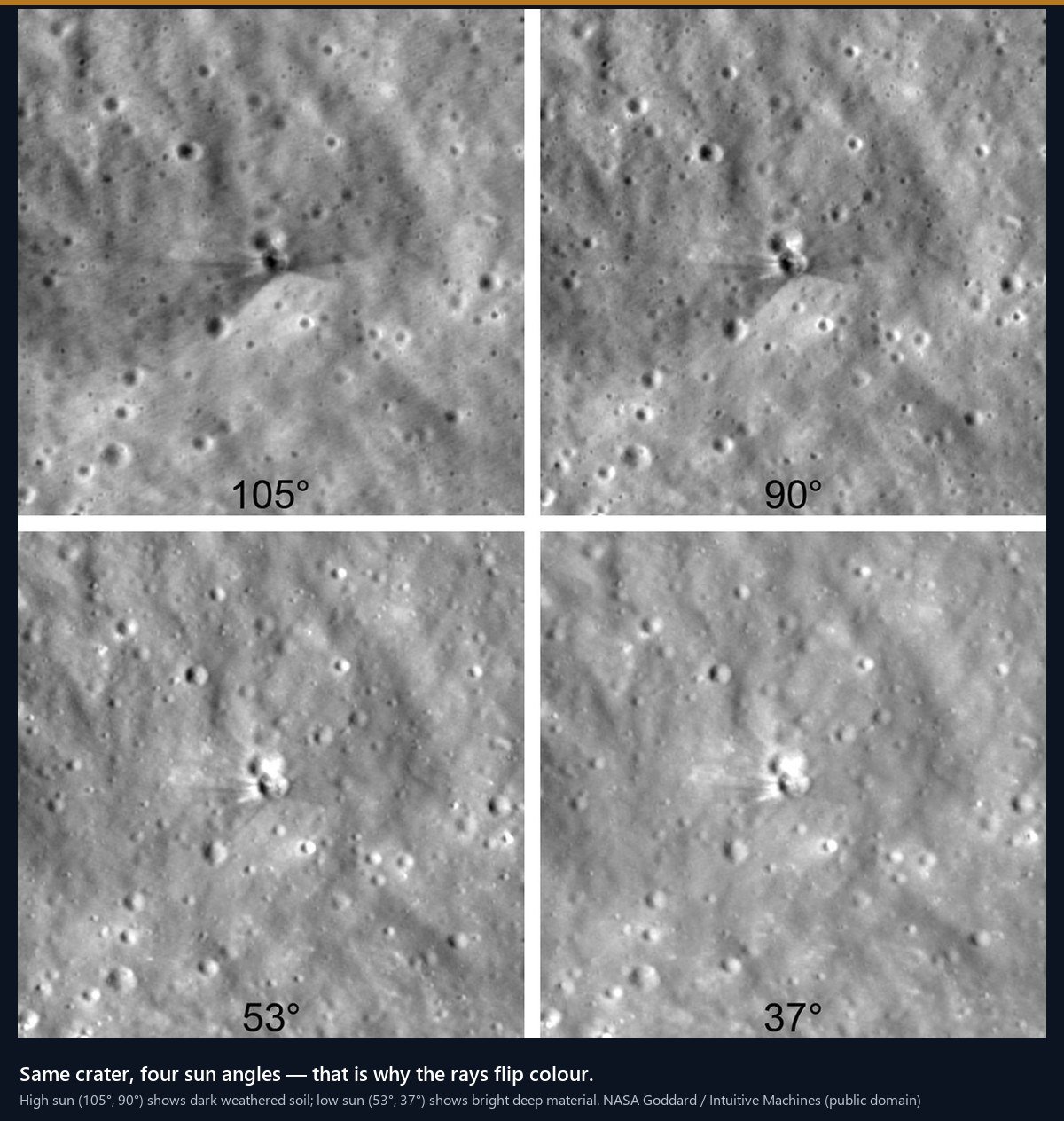
NASA’s explanation is worth reading slowly. The dark fan is soil that had been sitting at the very top of the surface for a long time, chewed on by solar wind, cosmic rays and micrometeorites — a process called space weathering. The impact scooped it out from about a foot and a half down and flung it outward. The bright streaks near the rim are fresher material from deeper still, material that has never been exposed.
So the crater is, in a small way, a core sample taken with a hammer. It exposed a foot and a half of lunar history sideways across the landscape, and the colour of each streak tells you roughly how deep it came from.
Was the crash intentional?
No. This one was not aimed, planned, or wanted. It is the third unplanned rocket impact on the Moon on record, after the third stage of the Soviet Luna 2 in 1959 and a Chinese Chang’e 5‑T1 stage in 2022.
The reason it happened is unglamorous. Once an upper stage has delivered its payload toward the Moon, it is out of fuel and out of the mission plan. Bringing it back for a controlled re-entry costs propellant that was never budgeted; parking it somewhere harmless requires a burn it cannot make. So it is left in a long, unstable orbit, and the Sun and the Moon spend the next few years nudging it around until something intersects.
Deliberate lunar impacts, on the other hand, are an old and respectable scientific technique. Apollo crews left seismometers on the surface and then crashed spent S‑IVB stages into the Moon on purpose, so the seismometers could listen to the ringing and infer what the interior is made of. In 2009 NASA aimed the LCROSS mission at a permanently shadowed crater near the south pole specifically to blow up a plume and look for water in it. It found some.
The difference between those and this one is not the physics. It is that in the deliberate cases, somebody chose the target and had an instrument watching. Here, nobody chose — which is exactly what made the next part interesting.
How five teams found a 60-foot hole
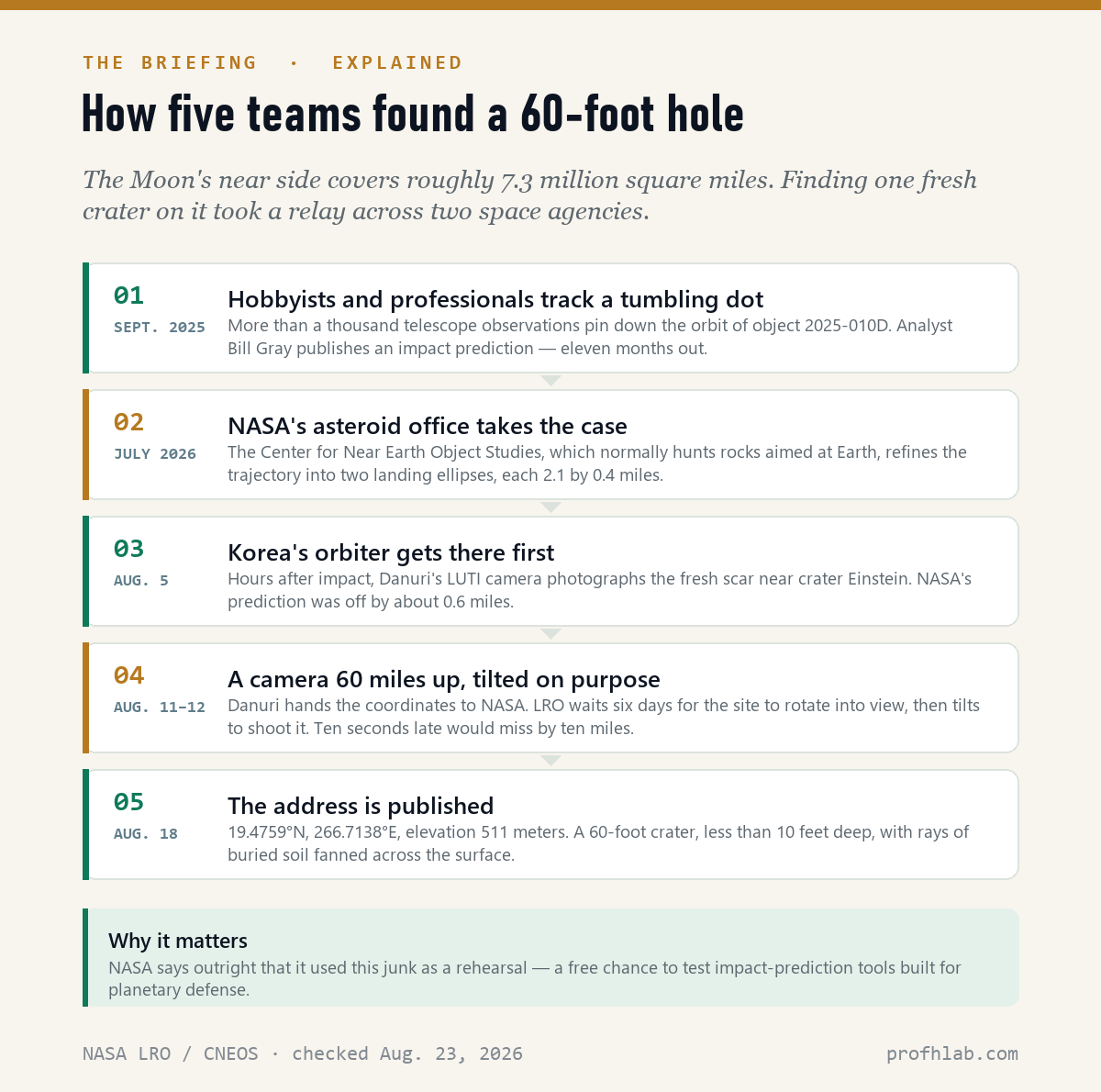
It started with amateurs. More than a thousand telescope observations of a faint tumbling dot were enough for the orbit analyst Bill Gray to publish, in September 2025, a prediction that the object would strike the Moon eleven months later. His final published number was 06:35:37.5 UTC.
Then NASA’s Center for Near Earth Object Studies took over — and this is the detail that most coverage skipped. CNEOS is the office that tracks asteroids that might hit Earth. It does not normally chase rocket debris. It took this case, in NASA’s own words, to test and validate tools and techniques for predicting impacts as part of the agency’s Planetary Defense program.
CNEOS produced two landing ellipses, each 2.1 miles long by 0.4 miles wide — one calculated without lunar terrain, one with it. The terrain-aware version was the good one.
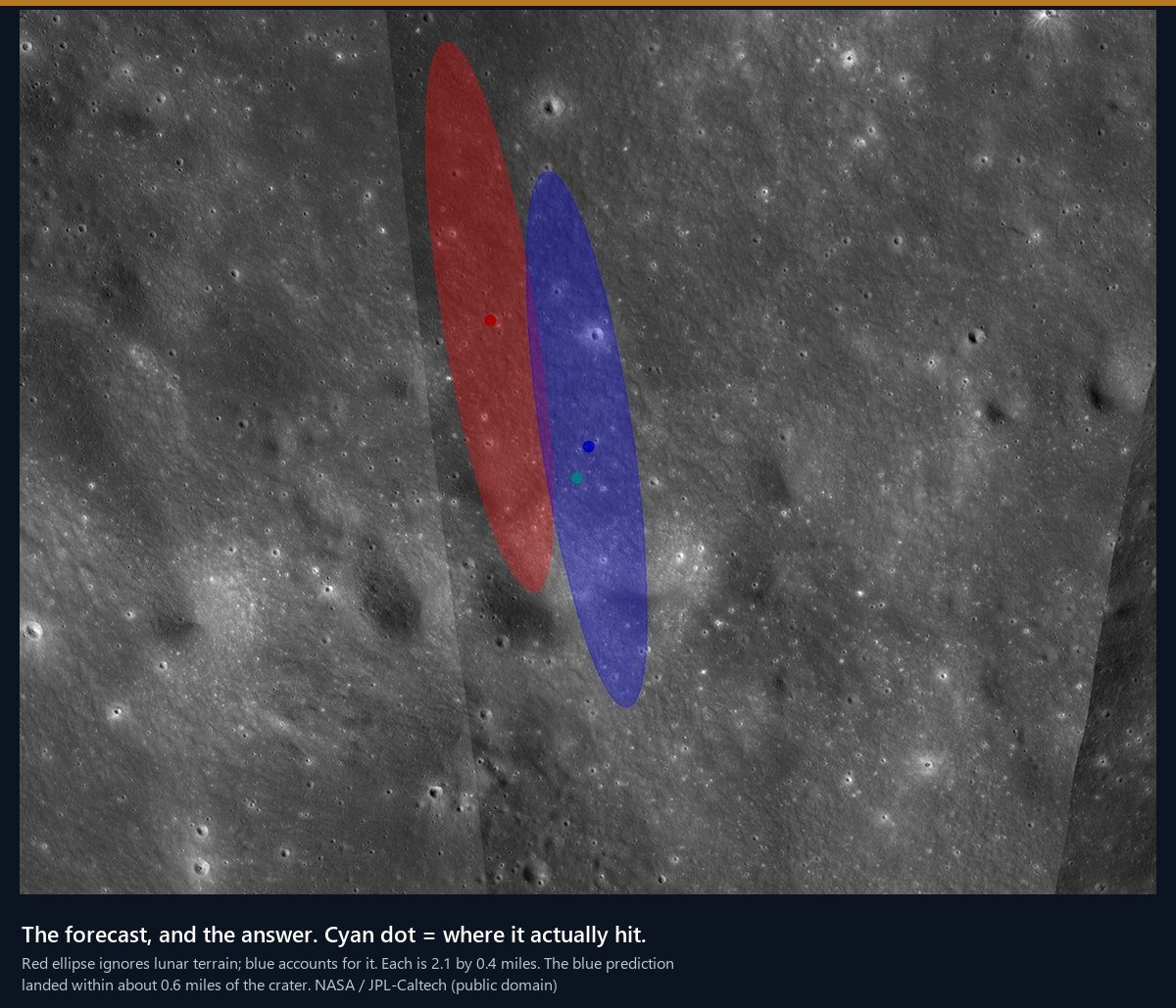
Korea got there first. Within hours of the impact, the Danuri orbiter turned its LUTI camera on the predicted spot and found the fresh scar. NASA’s prediction had been off by about 0.6 miles. Danuri then sent the real coordinates back to the LRO team so they could plan a better imaging pass.
That pass was its own piece of work. LRO orbits pole to pole every two hours while the Moon turns underneath it, so the team had to wait six days for the site to rotate into view. Then they tilted the whole spacecraft to point the camera sideways as it went past at a mile a second, sixty miles up. NASA notes that a shutter ten seconds early or late would have put the target ten miles off centre.
One step deeper: this was a rehearsal, and that is the real story
Predicting where an incoming object will land is the entire problem of planetary defense, and it is normally impossible to grade your own homework — the asteroids you can practice on either miss or you never find the crater.
Here, for once, was a known object on a known trajectory hitting a body we have mapped to three feet, with two orbiters available to check the answer. The forecast came in 0.6 miles off a target 239,000 miles away. That number is not about space junk. It is a report card on how well we can currently say where something will come down.
If you want the wider version of how machines like LRO are taught to see and act in the physical world, that is the subject of our other library: Physical AI, explained.
Why your search results are full of a 2022 story that was wrong
Search for this and you will get articles from 2022 saying a SpaceX rocket was about to hit the Moon. Those articles are not about this event, and they were also incorrect on their own terms. It is worth untangling, because the same person is at the centre of both stories.
In January 2022, Bill Gray identified an object heading for the Moon as a Falcon 9 upper stage from the 2015 launch of NASA’s DSCOVR satellite. The story went everywhere. Then Jon Giorgini, an engineer at NASA’s Jet Propulsion Laboratory, emailed him to point out that JPL’s own trajectory data showed DSCOVR never passed near the Moon. Gray rechecked, found his error, and publicly corrected it: the object was a Long March 3C upper stage from China’s Chang’e 5‑T1 mission, launched in 2014. China denied it.
It struck the far side on March 4, 2022, near crater Hertzsprung. And it left something nobody has fully explained.
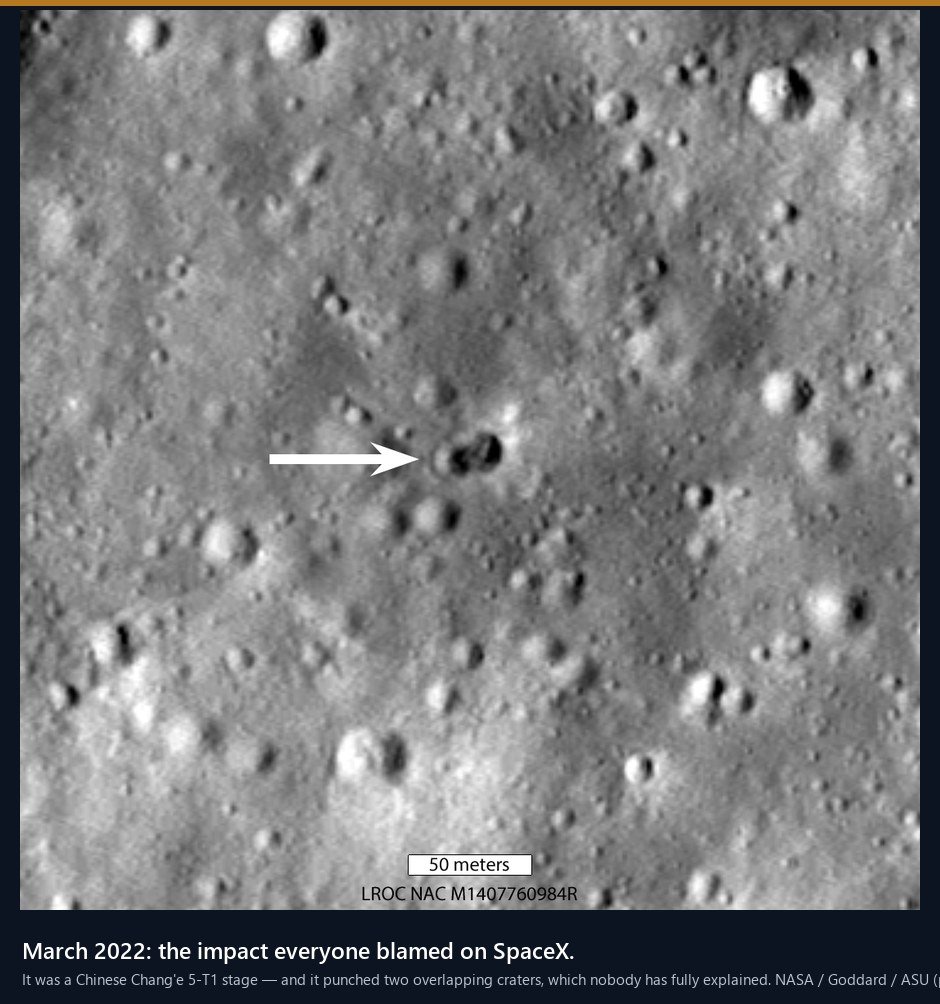
A double crater had never been seen from a rocket impact. The four Apollo S‑IVB stages each made a single irregular crater, and larger ones. NASA’s suggestion is that the 2022 object had substantial mass at both ends, rather than just the engine end — which would mean it was carrying something undeclared. That question is still open.
Two things are worth taking from this. The first is that the 2026 impact was correctly identified from the start, by the same analyst, using better data and a check from JPL. The second is a small lesson in reading science news: Gray’s 2022 correction is the reason to trust his 2026 prediction, not a reason to doubt it. People who publish their errors are the ones whose numbers you can use.
Does this damage the Moon? Can you see it from Earth?
No, and no.
The Moon is struck constantly. Objects large enough to make craters this size arrive on their own without any help from us, and it is covered in hundreds of thousands of them. A 60-foot hole is, in geological terms, a scuff. There is no atmosphere to pollute and no ecosystem to disturb, and the impact was 239,000 miles away on a body with no plate tectonics and no weather.
As for seeing it: a backyard telescope at high magnification resolves lunar features down to roughly a mile across on a very good night. This crater is about a hundredth of that. It sits near crater Einstein on the western limb, an area that is foreshortened almost to an edge from Earth. Only an orbiting camera a few dozen miles up, using an instrument built to resolve three-foot objects, could see it at all — which is precisely why the pictures took two weeks and two space agencies.
The impact day, then the first photos of the lunar crater
Find the crater in NASA’s QuickMap, then test the next viral clip
- Look at the real images yourself. NASA published the before-and-after animation and the four-angle set on its LRO page for this impact, dated Aug. 18, 2026. They are public domain and free to reuse.
- Write down the coordinates. 19.4759°N, 266.7138°E, elevation 511 metres. You can type those into NASA’s LROC QuickMap and fly to the spot in a browser.
- Apply the camera test to the next viral clip. Ask what instrument took it and whether that instrument could have been there. It resolves most fake disaster footage in under a minute.
- If someone in your family shared the fake video, do not make it a fight. Send them the NASA page rather than a fact-check. The real photographs are more interesting than the fake ones, which is usually the fastest way to end the argument.
- If the fake clip arrived attached to a donation link, a “space stock” tip or a login page, treat it as bait. Our guide to AI-era scams and the first 60 minutes that matter covers what to do in that order.
No rule governs spent stages near the Moon, and no agency tracks them
- “Is more of this coming?” Almost certainly. Every mission that sends a payload toward the Moon leaves an upper stage in a similar orbit, and lunar launch traffic is rising. There is no international rule requiring disposal of spent stages in cislunar space, and no agency responsible for tracking them the way orbital debris around Earth is tracked.
- “Why can’t they just clean it up?” Nothing on the Moon is retrievable at any sane cost, and nothing there is in anyone’s way yet. The concern is not litter; it is that a lander or a crewed base eventually shares a neighbourhood with objects nobody is tracking.
- “What did the plume actually tell scientists?” The sodium and lithium lines seen from Chile are a chemistry readout of a lunar impact taken in real time, which is rare. Sodium is native to the lunar surface; lithium most plausibly came from the rocket. Expect papers.
- “How do machines like LRO decide what to look at?” That is the whole subject of Physical AI — systems that perceive and act in the physical world rather than just generate text.
Impact time, the crash video and whether SpaceX meant to do it
Did the SpaceX rocket hit the moon?
Yes. The spent upper stage of a Falcon 9 rocket struck the Moon on August 5, 2026, at 6:35 a.m. UTC — 2:35 a.m. Eastern time. It hit near crater Einstein at about 5,400 mph and left a crater roughly 60 feet wide and less than 10 feet deep. NASA published photographs of the crater on August 18, 2026.
What time did the SpaceX rocket hit the moon?
06:35 UTC on August 5, 2026. That is 2:35 a.m. Eastern, 1:35 a.m. Central, 12:35 a.m. Mountain, and 11:35 p.m. Pacific on August 4. The orbit analyst Bill Gray had predicted 06:35:37.5 UTC eleven months in advance.
Is the video of the SpaceX rocket hitting the moon real?
No. The clip that spread across social media in early August 2026, showing a rocket streaking into the Moon and producing a large white cloud, is almost certainly AI-generated. Elon Musk reshared it and later acknowledged it was fake. Four astronomers consulted by Full Fact identified multiple problems: the incoming rocket could not physically be resolved in that detail, the terrain does not match the Moon, the location does not match crater Einstein, and the blast is far larger than the real impact would produce. No spacecraft was in position to film the impact at all.
What happens when a rocket hits the moon?
There is no fireball and no sound, because the Moon has no atmosphere and there was no fuel left to burn. The kinetic energy goes into crushing rock and throwing dust outward on ballistic arcs, which land as long straight rays instead of a cloud. In this case the impact excavated material from about a foot and a half down, producing dark rays of space-weathered soil and brighter rays of fresher material from deeper below.
Was the SpaceX moon crash intentional?
No. The stage had delivered its payloads — the Blue Ghost 1 and Hakuto-R Mission 2 landers — in January 2025 and was left without fuel in a high orbit that crossed the Moon’s path. Gravity did the rest over about nineteen months. Deliberate lunar impacts do exist for science, such as the Apollo S-IVB stages aimed at the Moon to make seismic readings and the LCROSS mission in 2009, but this was not one of them.
How many rockets have crashed into the moon?
This was the third recorded unintentional rocket impact, after the third stage of the Soviet Luna 2 in 1959 and a Chinese Chang’e 5-T1 upper stage in March 2022. Deliberate impacts are more numerous, including four Apollo S-IVB stages and the LCROSS mission.
Can you see the SpaceX crater on the moon from Earth?
No. At about 60 feet across, it is roughly a hundredth the size of the smallest feature a good backyard telescope can resolve, and it sits near the western limb where the surface is seen almost edge-on. It was photographed by NASA’s Lunar Reconnaissance Orbiter from about 60 miles up, using a camera built to resolve objects three feet across.
Does crashing rockets into the moon damage it?
Not in any meaningful sense. The Moon is struck by natural objects constantly and is covered in hundreds of thousands of craters; there is no atmosphere to pollute and no ecosystem to disturb. The longer-term concern raised by researchers is not damage but bookkeeping — spent stages in lunar orbit are not systematically tracked, and lunar traffic is increasing.
How close was NASA’s prediction of where it would hit?
About 0.6 miles. NASA’s Center for Near Earth Object Studies produced two candidate ellipses, each 2.1 by 0.4 miles; the version that accounted for lunar terrain came within roughly 0.6 miles of the real crater. The final coordinates are 19.4759°N, 266.7138°E, at 511 metres elevation.
Sources
- NASA, “NASA’s LRO Images Falcon 9 Crater on Moon, Learns New Details,” Aug. 18, 2026 (crater dimensions, imaging dates, ejecta rays, coordinates, CNEOS ellipses, Danuri relay, planetary-defense framing).
- Project Pluto (Bill Gray), orbit determination page for object 2025-010D (predicted impact 06:35:37.5 UTC, mass estimate, impact speed).
- European Southern Observatory / Very Large Telescope, sodium and lithium emission detection following the impact, Aug. 5, 2026.
- Full Fact, “Viral video appearing to show SpaceX rocket hitting moon is fake,” with comment from Dr Matt Bothwell (Cambridge), Dr Eamonn Kerins (Jodrell Bank), Carl Schmidt (Boston University) and Dr Greg Brown (Royal Observatory Greenwich).
- NASA / Goddard / Arizona State University, LRO imagery and analysis of the March 4, 2022 double crater near Hertzsprung.
- Impact time-zone conversions and the Moon’s mean distance are ours, calculated from the sources above. All figures checked Aug. 23, 2026.
Keep reading
About the author. Prof. H teaches robotics and AI, and writes Prof H Lab — plain-English explanations built from primary sources. Every figure in this article comes from a space agency publication, a published orbit determination, or a named expert on the record, and each is dated. Where two sources disagree, both are printed. Corrections are published openly.
Prof.’s H Newsletter
One short email a month, with the numbers in it
What actually moved in AI hiring, AI prices, and the scams aimed at older Americans. Counted here, dated, and linked to the source. One email a month, and your address goes nowhere else.