Can I Use AI to Write a Will? Four State Laws Say the Signing Is What Counts
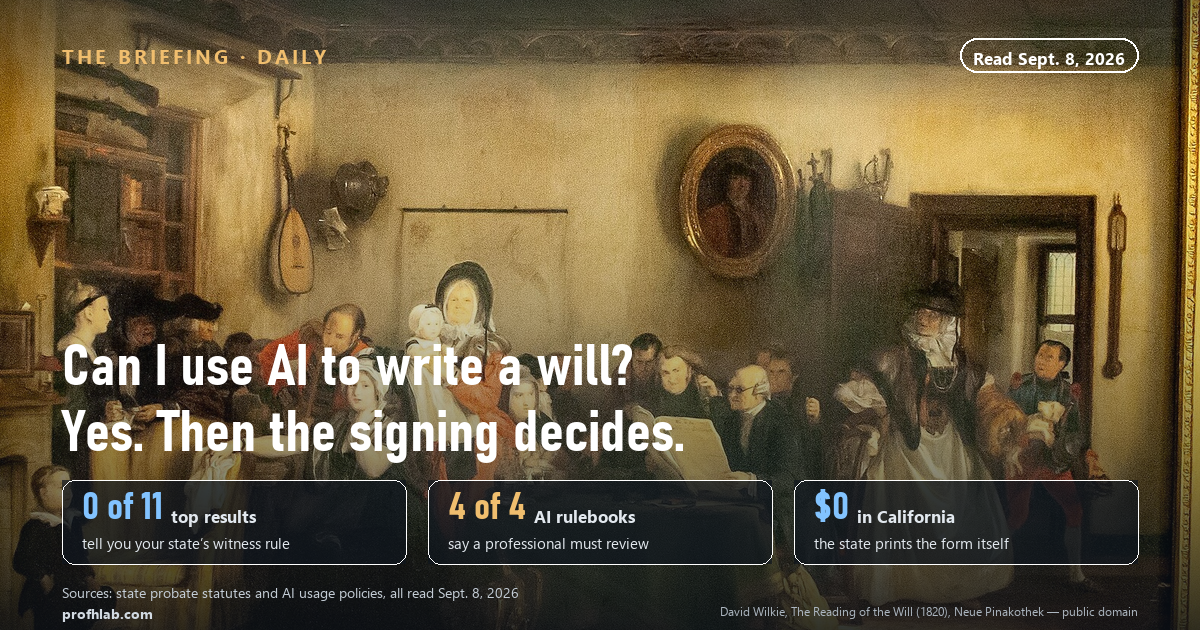
It usually starts after a funeral. Somebody in their sixties comes home from burying a friend, sits down at the kitchen table with the laptop the grandchildren set up, and types a sentence that would have been science fiction three years ago: write my last will and testament. Ninety seconds later there is a document on the screen with their name in it, their children in it, and the house in it. It looks exactly like a will.
Then comes the honest question, and it is the one people actually type into Google: can I use AI to write a will?
Short answer: yes, you can — and the drafting was never the part the law cares about. On September 8, 2026 we read the will-execution statute in four states. California, Florida, New York and Virginia all require the same thing, and none of them says one word about who or what wrote the document: two witnesses, watching you sign.
We also read the usage rules of the four biggest AI assistants: four of four say in writing that legal advice needs a licensed professional in the loop. Then we fetched the pages Google ranks for this question. Of the 11 readable results, three mention witnessing at all, exactly one names a number — and that one is a British firm counting witnesses under an 1837 statute that does not apply to you.
So the useful version of the answer is not “yes” or “no.” It is this: the free part is the writing, and the part that decides whether your family inherits anything happens later, at a table, with two people watching a pen.
So can I use AI to write a will?
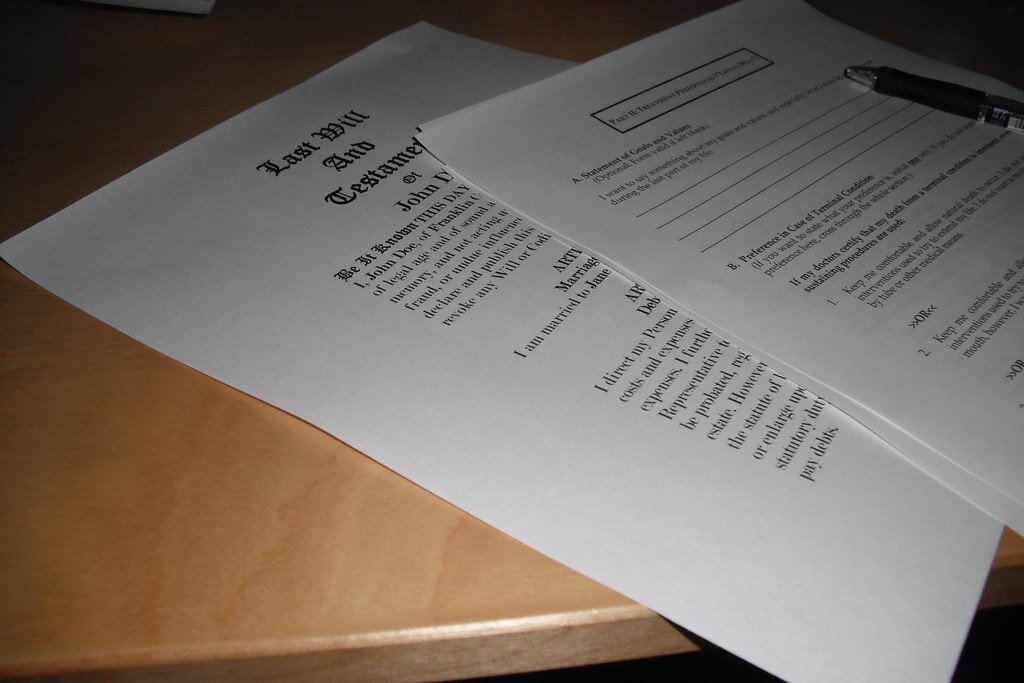
Nothing in any statute we read forbids it. A will does not have to be typed by a lawyer, printed on heavy paper, or written in Latin. What the law regulates is execution — the ceremony — not authorship.
That is genuinely good news for the person at the kitchen table, and it is why the standard scolding you get from page one is only half a story. The realistic risks of an AI draft are worth naming plainly:
- It writes what you asked for, not what you have. A chatbot does not know that the house is held in joint tenancy, that the retirement account already has a named beneficiary that overrides your will, or that one of your children is on benefits an outright gift could wreck.
- It is confident about your state, and it may be wrong. Ask it who can witness and you will get an answer in the same fluent voice whether or not it is right for where you live.
- Whatever you paste in goes somewhere. Names, addresses, account numbers, family grievances. That is a separate question we have written about: what actually happens to a chat after you delete it.
- It cannot witness anything. This is the one nobody says out loud, and it is the whole ballgame.
Four state statutes, one requirement, zero mentions of who wrote it
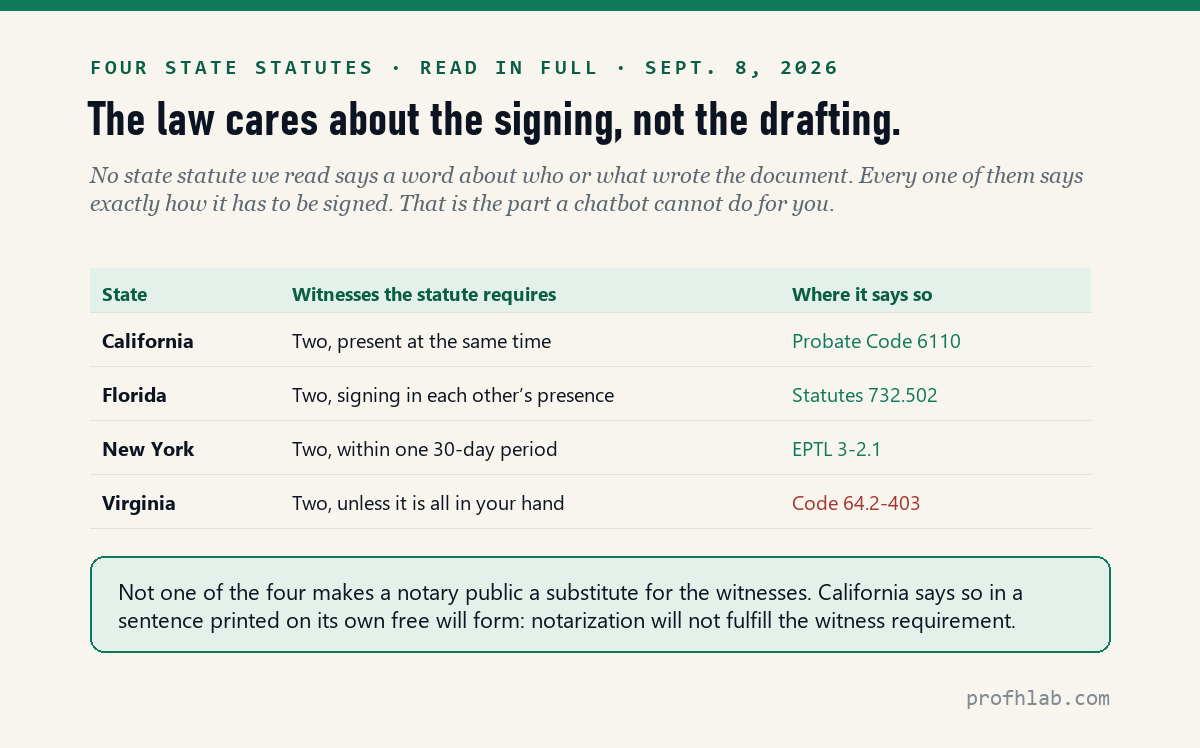
Here is what the law says, in its own words.
California (Probate Code § 6110): the will must be “witnessed by being signed, during the testator’s lifetime, by at least two persons each of whom (A) being present at the same time, witnessed either the signing of the will or the testator’s acknowledgment of the signature or of the will and (B) understand that the instrument they sign is the testator’s will.”
Florida (§ 732.502): you sign “at the end,” in the presence of “at least two attesting witnesses,” and “the attesting witnesses must sign the will in the presence of the testator and in the presence of each other.”
New York (EPTL 3-2.1): “There shall be at least two attesting witnesses,” and they must sign “within one thirty day period.” Notarization is not mentioned anywhere in the section.
Virginia (§ 64.2-403): a will not wholly in your handwriting “is not valid unless” it is signed or acknowledged “in the presence of at least two competent witnesses who are present at the same time and who subscribe the will in the presence of the testator.”
Four states, four different codes, one shared sentence structure: two people, at the same time, watching. That is the legal act. Everything before it — the drafting, the printing, the wording — is preparation.
California does leave a back door open. Section 6110(c)(2) says a will executed the wrong way can still be treated as valid if someone proves “by clear and convincing evidence” that you meant it to be your will. Read that sentence the way a family will experience it: somebody has to go to court and hire a lawyer and prove it. The escape hatch exists, and using it costs more than doing it right would have.
Notarizing it does not make it a will
This is the single most common mistake we can document, and we can document it because the State of California prints the correction on its own form.
California publishes a complete, fill-in-the-blank will inside its statutes — the California Statutory Will, at Probate Code § 6240. It costs nothing. Step three of its instructions reads: “DATE AND SIGN THE WILL AND HAVE TWO WITNESSES SIGN IT.” And then, in the state’s own asterisks:
“You do not need to have this document notarized. Notarization will not fulfill the witness requirement.”
A notary verifies who you are. Witnesses attest that you signed a will. Those are different jobs, and in the states we read only the second one is required.
Where a notary is useful is the step after: the self-proving affidavit. Florida’s § 732.503 prints the form — you and both witnesses swear before an officer that you signed it, and that sworn page travels with the will. It is what keeps your executor from having to track down two witnesses fifteen years later. The notary is notarizing the affidavit, not the will.
Some states now let the whole ceremony happen on video. Florida’s § 732.522 allows an electronic will signed by “audio-video communication technology,” supervised by a notary under the state’s online-notarization chapter, with the witness hearing you acknowledge the signature. Note what has not changed even there: the witnesses. The technology moved. The requirement did not.
What page one told us, and the eight things it never mentioned
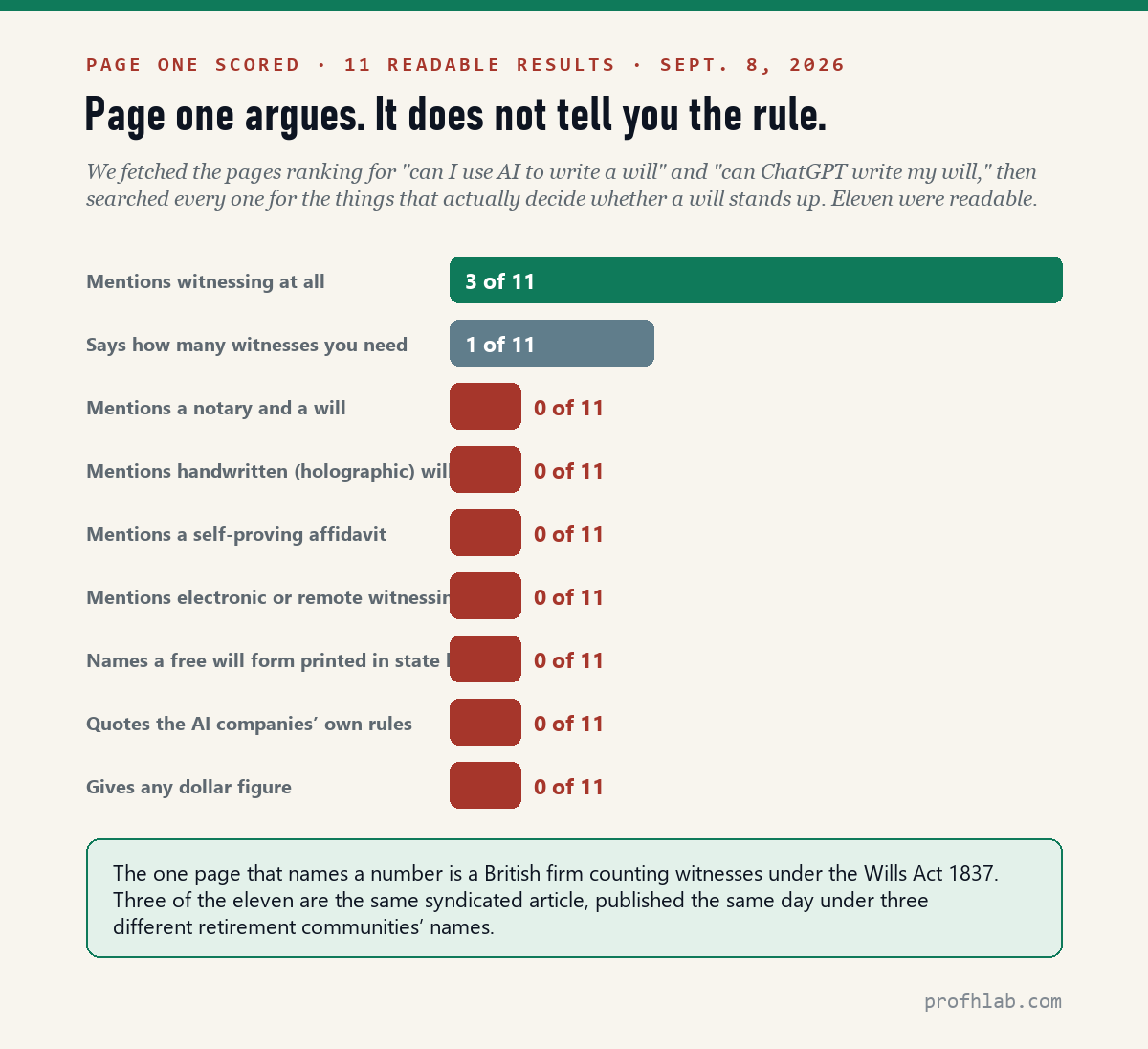
We fetched every result Google returned for “can I use AI to write a will” and “can ChatGPT write my will.” Fourteen pages; eleven loaded for us. Then we searched each one for the parts that decide the outcome.
Three of eleven mention witnessing at all. One of eleven gives a number — a British firm, citing the Wills Act 1837, which is the law in England and Wales and has nothing to do with a will signed in Ohio. Zero mention notarization in connection with a will, holographic wills, self-proving affidavits, electronic-will statutes, a free state-published will form, the AI companies’ own rules, or any dollar figure at all.
And three of the eleven are the same article. Word for word, published the same day — July 3, 2025 — on the blogs of three different retirement communities, each carrying the credit line “Source: IlluminAge AgeWise” at the bottom. The syndicated piece is not bad, exactly. It quotes a law professor on privacy and tells you to visit your state bar’s website. It just never tells you what makes the document legal.
That is what a search result looks like when everyone is answering the emotional question (“should you?”) and nobody is answering the procedural one (“what makes it stand up?”). We have watched this pattern before: when we scored page one on AI scribes in medical exam rooms, the useful right was missing from every result too.
A valid will signing, and a judge sanctioning an AI-written filing
The AI companies’ own rulebooks say the same thing the lawyers do
Nobody quotes these, so we read them today. All four of the biggest assistants tell you, in their own published terms, not to treat the output as legal advice on its own.
- OpenAI lists among prohibited uses the “provision of tailored advice that requires a license, such as legal or medical advice, without appropriate involvement by a licensed professional.” (Usage policies)
- Google: “Don’t rely on the Services for medical, legal, financial, or other professional advice,” and any such content “is not a substitute for advice from a qualified professional.” (Generative AI additional terms)
- Microsoft: “No Professional Advice. AI services are not designed, intended, or to be used as substitutes for professional advice.” (Services Agreement)
- Anthropic classifies “Legal: Use cases related to legal interpretation, legal guidance, or decisions with legal implications” as a high-risk use case, and requires that “a qualified professional in that field must review the content or decision prior to dissemination or finalization.” (Usage policy)
Read them together and a pattern shows up. The companies are not saying the draft is worthless. They are saying a human with a license has to stand between the draft and the consequence. Which, for a will, is exactly what the witness rule already forces you to arrange — two humans, at the table, at the moment it counts.
The one thing a chatbot cannot give you: your own handwriting
Here is the part that no page-one result mentioned, and it is the closest thing to a loophole in this entire subject.
California § 6111: “A will that does not comply with Section 6110 is valid as a holographic will, whether or not witnessed, if the signature and the material provisions are in the handwriting of the testator.” Virginia’s § 64.2-403(B) says a will “wholly in the testator’s handwriting is valid without further requirements,” proved later by two disinterested witnesses who recognize the hand.
Sit with what that means for the question in the title. The one route that skips witnesses entirely is the one route a chatbot is structurally incapable of helping you take. Printed output is not your handwriting. It never will be. You can copy an AI draft out by hand — some people do — but at that point the machine wrote the sentences and your wrist did the legal work.

The most famous do-it-yourself will in America works exactly this way. George Washington signed his on July 9, 1799, twenty-nine pages of it, and wrote in the document itself that “no professional character has been consulted, or has had any Agency in the draught.” He wrote it out by hand, in Virginia, in the summer before he died. Mount Vernon and the Fairfax Circuit Court both describe it as his own hand, and the Clerk of the Circuit Court of Fairfax County still keeps it.

Two honest cautions before anyone reaches for a legal pad. Not every state accepts holographic wills — Florida’s statute is written so that a handwritten will counts only if it was executed with the two witnesses like any other. And a handwritten will still has to be proved by people who can identify your writing, years later, when you are not there to help. Handwriting is a fallback, not a plan.
What this actually costs, from $0 to $26,000
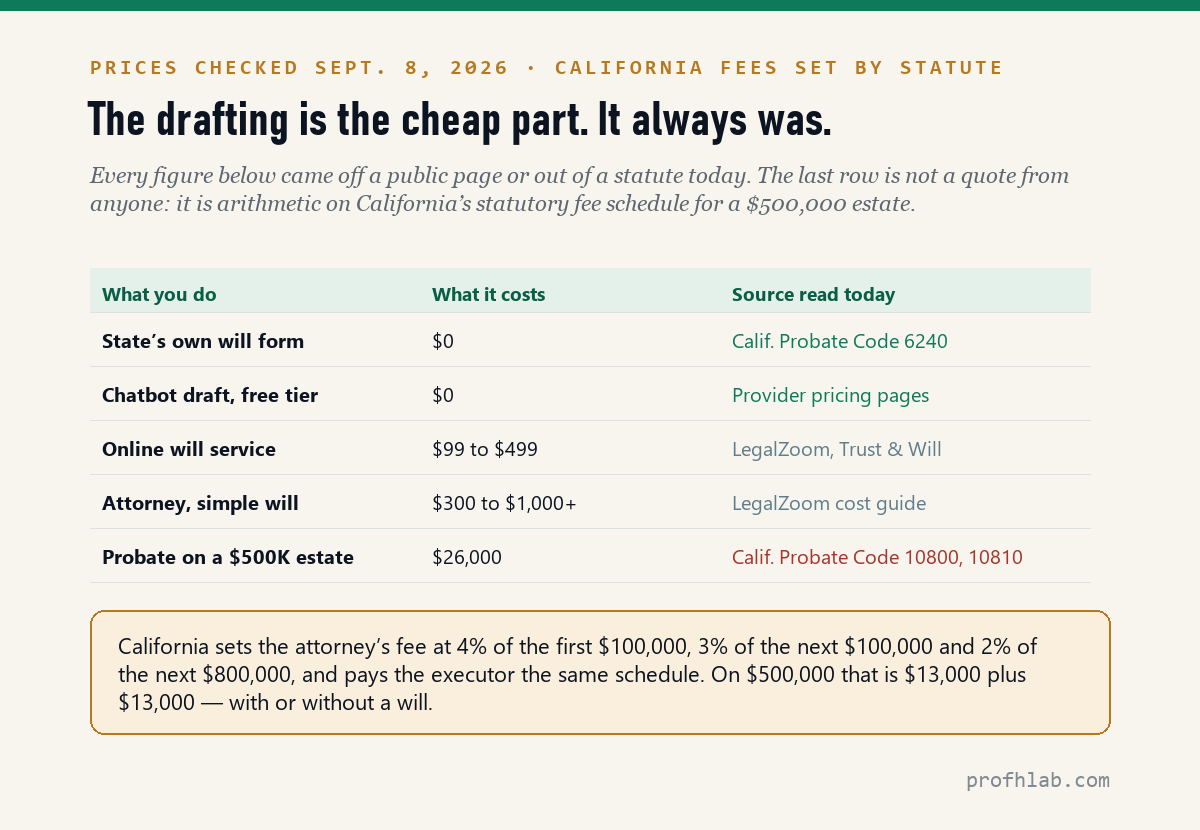
LegalZoom’s own cost guide, read today, puts the range plainly: write it yourself for $0, use an online service for $10 to $250, or hire an attorney for $300 to $1,000 or more — with a simple flat-fee will often $300 to $600 and hourly work $100 to $500. Its own basic packages start at $99 for one person and $199 for two. Trust & Will lists a Will Plan from $199, a Trust Plan from $499, and a $49-a-year membership, with attorney support as a $299 add-on.
Now the number that reframes the whole decision. California sets probate compensation by statute: § 10810 pays the attorney 4% of the first $100,000, 3% of the next $100,000 and 2% of the next $800,000 — and § 10800 pays the executor on the identical schedule. On a $500,000 estate that is $13,000 and $13,000. $26,000, set by law, before anyone argues about anything.
And a will does not avoid that. California’s own statutory form answers the question in its Q&A: “Does a Will avoid probate? No. With or without a Will, assets in your name alone usually go through the court probate process.”
So the real cost comparison is not $0 against $600. It is the price of the document against the price of the fight a defective document starts — in a system where the routine, uncontested fees on a mid-sized estate already run into five figures.
Draft freely, then look up your state’s witness rule
If you are going to do this yourself, do it in this order.
- Draft it however you like. Chatbot, template, or the free form your state may already publish. California’s complete statutory will is at Probate Code § 6240 — and if you use it, follow its own warning: fill in the blanks only, and do not cross anything out.
- Look up your state’s execution rule before you print. Search your state code for “execution of wills.” You are looking for one number: how many witnesses, and whether they must be present at the same time.
- Pick two adults who inherit nothing under the will. Neighbors, coworkers, the couple down the hall. A beneficiary as a witness is the avoidable mistake that turns a will into a lawsuit.
- Sign it in one sitting, everyone in the same room, in each other’s presence. You sign first. They watch. Then they sign. No mailing pages around.
- Add the self-proving affidavit if your state has one (Florida’s form is printed at § 732.503). That is where a notary belongs.
- Tell your executor where the original paper is. This is not sentimental housekeeping: California § 8200 requires whoever holds your will to deliver it to the court clerk within 30 days of learning of your death, and makes them liable for damages if they do not. Nobody can deliver a document they cannot find.
- If anything is complicated, buy one hour of human review. Blended family, a child with a disability, a business, property in two states, an estranged relative. Your state bar’s lawyer-referral service and free legal aid through LawHelp.org or the Legal Services Corporation are the cheapest doors.
This is reporting on public statutes, not legal advice, and we are not your lawyers. Wills are governed by the law of your state, and the four we read are not the fifty.
The ceremony is the law for powers of attorney, too
- “Is what I typed into the chatbot private?” Less than you think, and deletion is not one switch. See where your chats actually live and what we found about uploading medical records.
- “Can I do the rest of my paperwork this way?” Powers of attorney and health-care directives have their own signing rules, and they are frequently the documents that do want a notary. Same principle: the ceremony is the law.
- “Which assistant should I even use?” We keep the running prices on the AI Price Tracker, and a plain-language starting point in our step-by-step guide for beginners over 50.
Witnesses, notaries and handwritten wills in four states
Can I use AI to write a will?
Yes. No statute we read regulates who or what drafts a will. What every one of them regulates is the signing: in California, Florida, New York and Virginia, two witnesses. Use the AI for the draft if you like, then treat the signing as the legal act, because that is what it is.
Does a will need to be notarized to be legal?
In the four states we read, no. California prints the answer on its own free will form: “You do not need to have this document notarized. Notarization will not fulfill the witness requirement.” A notary is useful for the self-proving affidavit that goes with the will, which is a different document doing a different job.
Who can witness a will?
Generally an adult who is competent, who is present when you sign, and — the practical rule — who inherits nothing under the will. Virginia’s statute asks for “two competent witnesses who are present at the same time”; New York requires two attesting witnesses who sign within one 30-day period. Using a beneficiary as a witness is tolerated in some states and disastrous in others, so simply do not.
Is a handwritten will legal?
In some states, yes, and without any witnesses at all. California § 6111 recognizes a holographic will “whether or not witnessed” if the signature and material provisions are in your handwriting; Virginia recognizes a will “wholly in the testator’s handwriting.” Other states do not accept them, and a handwritten will still has to be proved by people who can identify your writing later. It is a fallback, not a plan.
Can I write my own will without a lawyer?
Yes, and the most famous American example is George Washington’s: signed July 9, 1799, with the will itself noting that “no professional character has been consulted.” The question is not permission, it is complexity. Simple estate, simple wishes, careful signing — a self-made will works. Blended family, a business, a disabled beneficiary, or property in two states — buy the hour.
How much does a will cost?
Read today: $0 if you use a state-published form or a chatbot draft, $99 to $499 for the mainstream online services, and $300 to $1,000 or more for an attorney, with simple flat-fee wills often $300 to $600. For scale, California’s statutory probate fees on a $500,000 estate come to $26,000 — with or without a will.
Does a will have to be filed with the court to be valid?
Not while you are alive; it is valid the moment it is properly signed and witnessed. Filing comes after. California § 8200 gives whoever holds the will 30 days after learning of the death to deliver it to the superior court clerk, and makes them liable for damages if they fail. That is why the location of the original matters as much as the wording.
Are will-writing kits legal?
Yes, and so is a form printed by your own legislature — California’s statutory will lives at Probate Code § 6240 and costs nothing. Kits fail for the same reason AI drafts fail: not because the words are wrong, but because people fill in blanks the instructions told them not to, cross things out, or sign without two witnesses in the room.
Sources
- California Probate Code § 6110, § 6111, § 6240, § 8200, § 10800 and § 10810 — read September 8, 2026.
- Florida Statutes § 732.502, § 732.503 and § 732.522.
- New York EPTL 3-2.1; Code of Virginia § 64.2-403.
- Usage rules: OpenAI usage policies, Google generative AI additional terms, Microsoft Services Agreement and Anthropic usage policy — all read September 8, 2026.
- Fairfax County Circuit Court, Washington Wills; Encyclopedia Virginia, George Washington’s Last Will and Testament (July 9, 1799).
- Prices: LegalZoom cost guide and Trust & Will pricing, both read September 8, 2026.
- Page-one scoring: 14 URLs fetched for “can I use AI to write a will” and “can ChatGPT write my will,” 11 readable, scored by full-text search on September 8, 2026.
The rest of the paperwork of getting older, and protecting heirs
- The paperwork of getting older, without the sales pitch: the AI listening in your exam room, what Medicare’s new prior-authorization model actually covers, and what the 2027 raise looks like after Medicare takes its share.
- Protecting the people who would inherit: the safe word that beats AI voice scams, how to tell if a phone call is AI, and five checks on a fake Facebook ad.
- Using the tools without paying twice: what AI really costs per month, whether ChatGPT Plus is still worth it, and how to cancel and get a refund.
- Plain-language starting points: the best AI tools for seniors, writing letters and sympathy notes, prepping for a doctor visit, and getting a chatbot to read a PDF.
- Where your words go: stopping AI from reading your Gmail, how ChatGPT guesses your age, and what your car records about you.
- More from The Briefing, plus our AI Price Tracker and AI Jobs Tracker. If you would rather talk to a human, here is how to reach one.
Written by Prof. H, who teaches robotics and AI and reads the primary documents so you do not have to. Statutes, usage policies and prices in this piece were read on September 8, 2026, and the page-one scoring was done the same day. This is journalism about public law, not legal advice. Last verified: September 8, 2026.
Prof.’s H Newsletter
One short email a month, with the numbers in it
What actually moved in AI hiring, AI prices, and the scams aimed at older Americans. Counted here, dated, and linked to the source. One email a month, and your address goes nowhere else.