Why Is My Doctor Recording My Appointment? We Scored Page One and 0 of 7 Mention AI
Your doctor sat down, put a phone face-up on the desk or tapped something on a laptop, and said a sentence you half-heard. Maybe it was a question. Maybe it sounded like a formality. Then the visit went on, and it was a good visit — better than usual, actually, because nobody was typing.
Afterward you wondered what that was, and you searched for it. And the search results did not tell you.
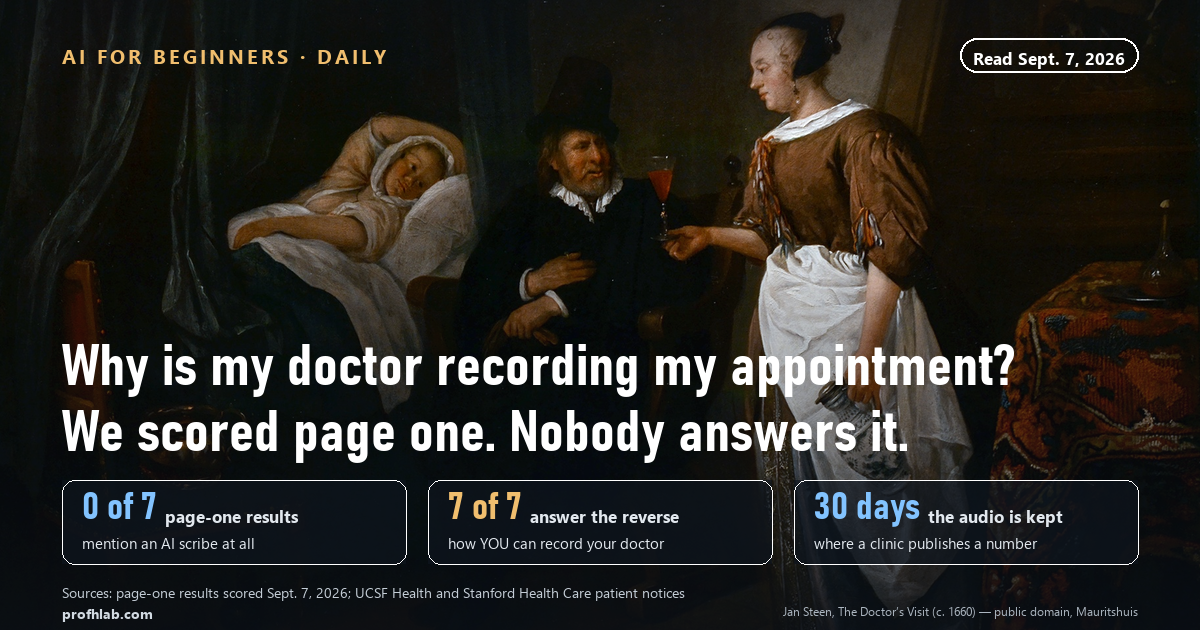
Almost always, the answer is an AI scribe — an app that listens to your visit and writes the first draft of your medical note, which your clinician then edits and signs. On September 7, 2026 we searched that exact question, fetched the nine results that came back, and read the seven that opened. Zero of the seven mention an AI scribe. Seven of the seven are about the opposite situation — how you can record your doctor — and three of them were published before 2020.
The most useful thing on this page is the number your clinic probably has not told you: where a health system publishes one, the audio of your visit is deleted within 30 days, and you cannot have a copy of it.
What is actually happening in the room
An AI scribe is a small program, usually running on the clinician’s phone, that records the conversation between the two of you. When the visit ends, the recording is sent to a company’s computers, and a few seconds later a draft of your visit note comes back — not a word-for-word transcript, but a summary written in the style of a medical note.
Your clinician reads that draft, fixes what is wrong, and signs it. The signed version goes into your medical record. The audio does not.
Think of it as a stenographer who sits in the corner, writes a rough account of the meeting, hands it to your doctor, and then has their notebook shredded a few weeks later. The account your doctor signed is the only thing that survives.
The tools have names you may see on a screen or hear in passing: Abridge, Ambience, DAX Copilot (now part of Microsoft Dragon Copilot), Suki, Nabla. Cleveland Clinic and UCSF Health both use Ambience. Stanford Health Care uses DAX Copilot. You do not need to remember any of them. You need to remember that one of them is probably in the room.
We scored page one. It answers a different question.
Here is the odd part, and it is the reason you could not find an answer.
The phrase “why is my doctor recording my appointment” used to mean something else. Ten years ago, patients asked it because a doctor had objected to them recording a consultation on a phone, and the internet filled up with articles about that — medical malpractice insurers, transcription companies, a bar association blog, an AARP explainer, a 2017 news story from Canada. Those articles are still there. They still rank.
So we measured it. We searched the exact phrase, fetched the nine results, and read the seven that opened. Two blocked our request and were dropped rather than guessed at.
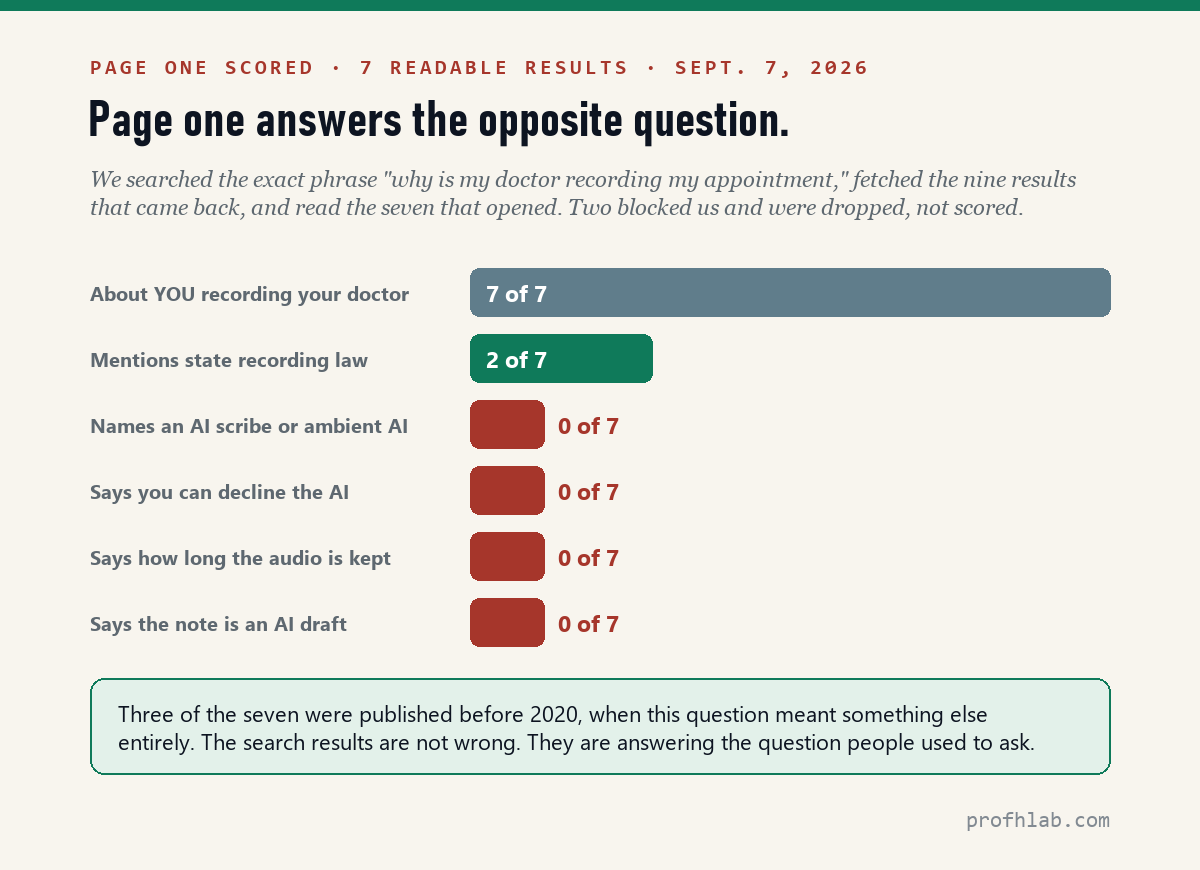
Not one of the seven names an AI scribe. Not one tells you that you can decline. Not one says how long the audio is kept, or that the note in your chart started as a machine draft. Two mention state recording law, and both do it from the other direction — whether you may press record.
That is a genuine gap, and it is why this page exists.
How common is this, really?
Common enough that most American adults will meet it within a year or two.
The American Medical Association surveyed 1,692 physicians in early 2026 and published the results on March 12. Eighty-one percent said they use AI professionally — more than double the share in 2023. Thirty percent use it to create discharge instructions, care plans or progress notes. Twenty-eight percent use it for documentation of charts or visit notes.
At Cleveland Clinic, the numbers are sharper. Of roughly 6,000 eligible physicians and advanced practice providers, more than 4,000 were actively using the ambient scribe within 15 weeks of rollout.
And here is the sentence from that same Cleveland Clinic account that most patients have never read. Explaining why the health system requires verbal consent anyway, a family physician there noted that “there are no formal government regulations regarding patient sign-off.”
Read that again. Cleveland Clinic asks you because Cleveland Clinic decided to. Not because a federal rule says it must.
Five questions a good notice answers
We went looking for what health systems actually tell patients. We read every patient-facing AI note-taking page we could open, and the privacy documents of four scribe vendors, and scored them on the five questions a person in an exam room would want answered.
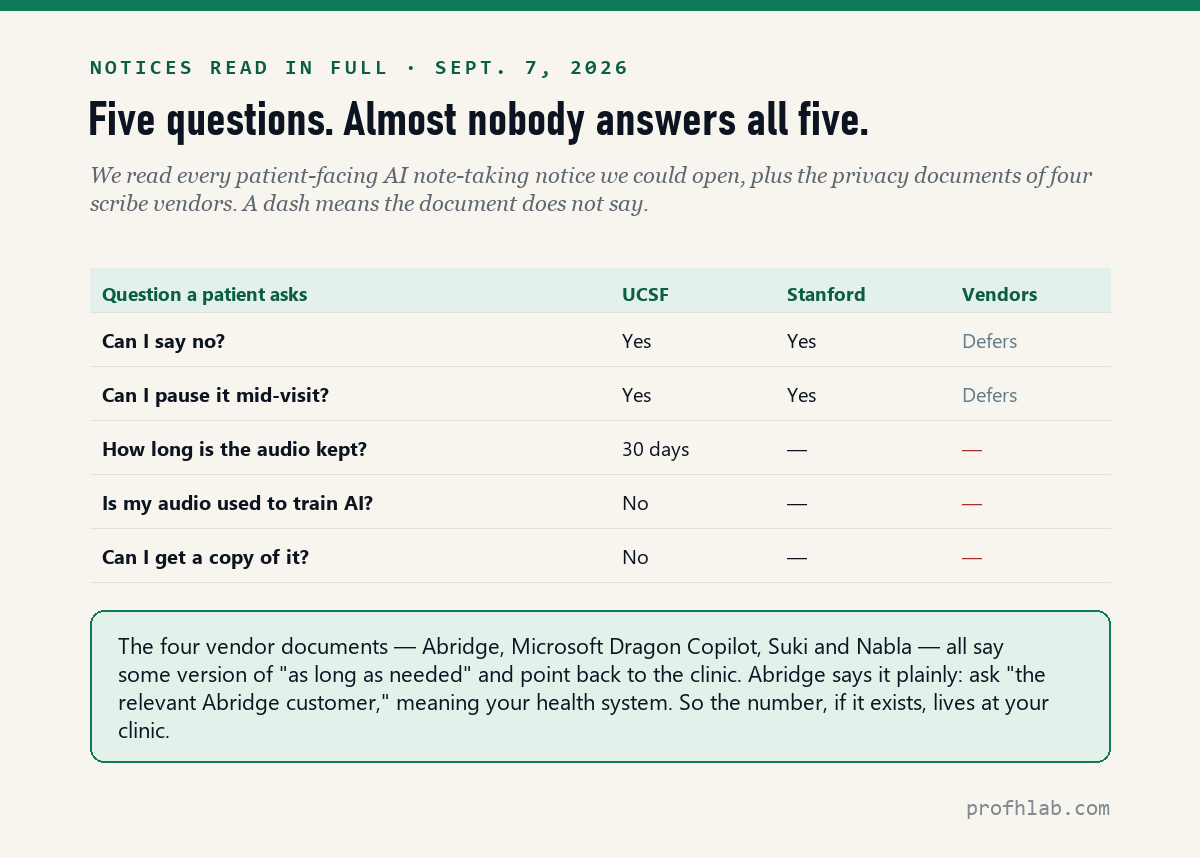
UCSF Health’s page is the best one we found. It says the tool “can only be used with your permission.” It says you can say no, or ask to pause at any point. It says recordings are “permanently deleted within 30 days.” It says the recordings “are used only to write your medical notes — not for research or training.”
Stanford Health Care’s page answers the first two and stops. You will be notified before recording starts; if you would rather not, “simply let your care team know”; you can ask your provider to pause. On storage it says only that the vendor complies with HIPAA. No number of days. No word on training.
The vendors answer none of the five. Abridge, Microsoft, Suki and Nabla all use a version of the same phrase — data is kept “as long as needed” — and then point back at the hospital. Abridge is the most explicit: if you want your data rights honored, “inquire with the relevant Abridge customer directly.” The Abridge customer is your health system. So the answer, if anyone has it, is at your clinic’s front desk, not on a technology company’s website.
What happens to the recording of your visit
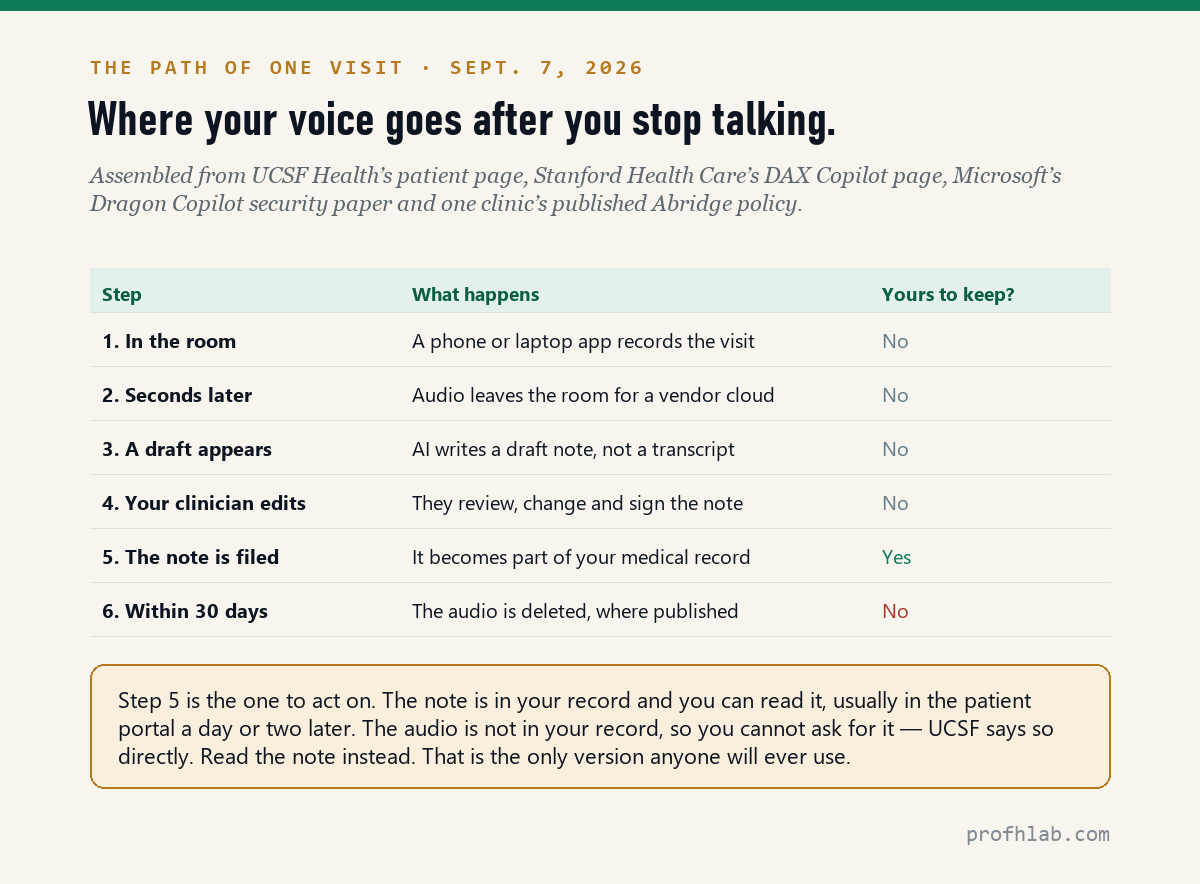
Six steps, and only one of them produces something you can hold.
The note is yours. It lands in your patient portal, usually within a day or two, and you can read it, ask for corrections, and print it.
The audio is not yours. UCSF explains why in plain words: the recording “is not part of your final official medical record or the Designated Record Set,” and so “we are unable to provide patients with a copy of the recording.” One clinic’s Abridge policy gives the same answer with the reasoning attached — transcripts “may contain errors or background conversation,” and keeping them creates risk.
One step deeper: the recording runs one way
This is the part almost nobody notices, and once you see it you cannot unsee it.
On the same page where UCSF Health explains that an AI may record your visit, it also says this about you doing the same thing: “Private recordings are generally not permitted. California law protects staff and clinician privacy.”
So in that exam room, on that page, three rules sit next to each other:
- The clinic’s software may record the conversation, with your permission.
- You may not record the same conversation on your own phone.
- You may not have a copy of the recording the clinic made.
None of those three is scandalous on its own. UCSF’s reasoning is coherent, and the 30-day deletion is genuinely protective. But taken together they describe a room where the audio exists, is useful, and belongs to one side.
That is not an argument for refusing. It is an argument for reading the note, which is the one artifact you are entitled to.
The lawsuit that says the chart lied
In late November 2025, a patient named Jose Saucedo filed a proposed class action in San Diego Superior Court against Sharp HealthCare and three of its affiliated medical groups. The complaint alleges the health system used an ambient AI tool to record clinical conversations “without notice or consent.” The tool named in the complaint is Abridge.
Two details from that filing matter to you no matter where you live.
First, he found out by reading his own chart. The complaint says Saucedo learned of the recording after seeing documentation in the patient portal indicating that he had been “advised” the visit was being recorded and had “consented.” The complaint calls that language false, and alleges Sharp “used boilerplate language” indicating advisement and consent had occurred when, it says, there was no reliable workflow to make sure it had.
Second, deletion was not immediate. When he asked Sharp and the vendor to delete the recording and transcripts, court documents indicate he was told the vendor retains the data for 30 days, so it could not be promptly deleted; the health system offered instead to remove or modify the AI-generated note. A law firm analysis of the case notes the proposed class may exceed 100,000 patients.
These are allegations, and Sharp has not been found liable of anything. But the reading lesson stands on its own: the record of whether you consented is written in your chart, and you can read your chart.

Does the law require them to ask you?
This is where honest answers get shorter than people want.
Under HIPAA, your clinician does not need a separate signed authorization to document your care — documentation is part of treatment. That is why a federal rule requiring a consent form for AI scribes does not exist, and why the Cleveland Clinic physician could say so out loud.
State law is a different matter. Roughly a dozen states generally require everyone in a private conversation to agree before it is recorded. Reading Wikipedia’s list of those states on September 7, 2026, we counted twelve entries, four of them carrying qualifiers: California, Connecticut, Florida, Hawaii, Illinois, Maryland, Massachusetts, Montana, New Hampshire, Oregon, Pennsylvania and Washington. Other published lists name eleven and swap a couple of states in and out. The lists do not fully agree, which is itself worth knowing.
One wrinkle matters especially in an exam room: for some states the rule for an in-person conversation is stricter than the rule for a phone call. Illinois and Oregon are the two commonly cited examples. An exam room is an in-person conversation.
The California statute at issue in the Sharp case is that state’s wiretapping law, which is why the complaint frames a documentation tool as electronic eavesdropping.
We are not your lawyer, and this is not legal advice. If you believe you were recorded without being asked, the practical route is your health system’s Privacy Officer or Patient Relations department — every hospital has one, and the number is on your bill and in your patient portal. You can also file a complaint with the U.S. Department of Health and Human Services Office for Civil Rights through its Complaint Portal, which handles HIPAA privacy and security complaints.
Should I let my doctor use AI to write notes?
People type that exact sentence into Google, so here is a straight answer with both halves.
Reasons to say yes. Your clinician looks at you instead of a screen. Notes get written the same day instead of at eleven at night, which is when tired people make mistakes. Most patients who have experienced it report the visit felt more personal, and that is the whole point of the tool.
Reasons to be careful. AI scribes make things up. In August 2026, Australia’s ABC News reported on an AI scribe that inserted a drug-use accusation into a patient consultation that never happened. Errors and omissions in AI drafts are well documented, which is exactly why every health system requires a human to review and sign the note.
The sensible position is not yes or no. It is yes, and I will read the note. A machine draft that a busy human approved is worth checking, and checking it takes four minutes in your patient portal.
Ask “Is anything recording this visit?” and read the note after
Five things, in the order you will need them.
- At your next visit, ask one question. “Is anything recording this visit?” You are allowed to ask it, and clinics that use these tools train staff to expect it.
- If you would rather not be recorded, say so. Both UCSF and Stanford tell patients in writing that declining is fine and care continues as normal — your clinician will simply take notes the old way. You can also ask to pause for one sensitive part and resume after.
- Read the note. Log in to your patient portal a day or two later and read the visit note and the After Visit Summary. Look for medications, doses, allergies, and any sentence describing you that does not sound like you. This is the four-minute step that catches the AI’s mistakes.
- If something is wrong, ask for an amendment. Contact your care team through the portal or call the office. Under HIPAA you have the right to request an amendment to your record; the clinic must respond in writing. Do it while the visit is fresh.
- If you want the retention number, ask the clinic, not the vendor. The question that gets an answer is: “How long does your AI documentation vendor keep the audio, and is it used to improve their software?” Ask Patient Relations or the Privacy Officer. If they cannot say, that is an answer too.
Your legal record holds the note, not the audio
“Can I get the recording if I want to sue?” Almost certainly not. Health systems classify the audio as outside the Designated Record Set, which is the bundle you have a legal right to access. The note is inside it. Preserve the note.
“Is my visit being used to train an AI?” UCSF says no for its own recordings. Most systems and every vendor document we read are silent, and de-identified data is treated far more permissively under HIPAA than identified data. If it matters to you, ask, and ask in writing through the portal so you have the reply.
“What if my doctor is in a small private practice?” Small practices adopt these tools too, often faster, because the paperwork burden is heaviest there. The same five questions work, and in a small office you can usually ask the doctor directly.
“Is this the same as the AI deciding my coverage?” No, and it is worth keeping them apart. Documentation AI writes the note about your visit. A separate program decides whether Medicare pays — we covered that one in Does Original Medicare require prior authorization?
Can you refuse the AI scribe, and how long is the audio kept?
Why is my doctor recording my appointment?
Almost always because the practice uses an AI scribe: software that records the visit and writes a draft of your medical note, which the clinician then edits and signs. It is a documentation tool, not surveillance and not evidence-gathering. It exists because typing notes during and after visits is the single largest source of administrative burden in American medicine.
What is an AI scribe in healthcare?
A program that listens to a clinical conversation and produces a structured draft note in seconds. It does not usually keep a word-for-word transcript in your chart; it summarizes. Common names include Abridge, Ambience, Microsoft Dragon Copilot (formerly DAX Copilot), Suki and Nabla. A human clinician must review, edit and sign the draft before it becomes part of your record.
Do doctors record conversations without telling you?
They are not supposed to. Health systems that publish patient notices say permission is required and describe verbal consent as the norm. But there is no federal rule requiring a signed form, and a proposed class action filed in San Diego Superior Court in November 2025 alleges one system recorded without notice while the chart said the patient had consented. That case has not been decided.
Can I say no to an AI scribe at my doctor’s office?
Yes. UCSF Health tells patients: “If you prefer not to be recorded, just say so.” Stanford Health Care says the same and adds that if you decline, your provider will spend some of the visit taking notes instead. You can also ask to pause the recording for one part of the conversation and resume afterward.
How long are AI scribe recordings kept?
Where a health system publishes a number, 30 days is the common one — UCSF Health says recordings are “permanently deleted within 30 days,” and one clinic’s published Abridge policy says audio and transcripts are deleted after 30 days. The vendors themselves do not publish a patient-facing number; their privacy policies say data is kept as long as needed and refer you to the health system.
Can I get a copy of the recording of my visit?
No, in almost every case. UCSF explains that the recording is not part of the official medical record or the Designated Record Set, so the health system will not provide a copy. What you can get is the signed note, through your patient portal or a medical records request. That note is the version that will be used for your care, your billing and any future dispute.
Is it legal for my doctor to record me with AI?
HIPAA does not require a separate authorization to document your care. State recording laws are the live question: roughly a dozen states generally require everyone in a private conversation to consent, and in some of them the rule for in-person conversations is stricter than for phone calls. The California case now in court turns on that state’s wiretapping statute. If you are concerned, contact your health system’s Privacy Officer or file a complaint with the HHS Office for Civil Rights.
Should I let my doctor use AI to write notes?
For most people, yes — with one condition. The upside is real: your clinician looks at you instead of a keyboard, and notes get finished while the visit is fresh. The risk is that AI drafts can contain errors, omissions or invented details, which is why every system requires human review. The condition is that you read the note in your portal afterward. Four minutes of reading is what turns a machine draft into a record you trust.
Sources
- UCSF Health, “AI Note-Taking at Your UCSF Health Visits” — read September 7, 2026.
- Stanford Health Care, “DAX Copilot” patient page — read September 7, 2026.
- American Medical Association, “More than 80% of physicians use AI professionally: AMA survey”, March 12, 2026 (1,692 physicians surveyed).
- Cleveland Clinic Consult QD, “Less Typing, More Talking” — 4,000 of 6,000 clinicians in 15 weeks; verbal consent policy.
- Cleveland Clinic Newsroom, rollout of Ambience Healthcare’s AI platform, February 19, 2025.
- Medscape Medical News, “Health System Sued Over AI Scribe Technology, Patient Consent”, January 16, 2026.
- Fisher Phillips, “New Class Action Targets Healthcare AI Recordings” — case details and proposed class size.
- Abridge, Privacy Policy; Microsoft, Dragon Copilot security white paper — read September 7, 2026.
- KFF Health News, “Can I Opt Out of Having My Doctor Take Notes With AI?”, April 7, 2026.
- U.S. Department of Health and Human Services, Office for Civil Rights Complaint Portal — where HIPAA privacy and security complaints are filed.
The other AI in your care: prior authorization and uploaded records
- How to prep for a doctor visit with ChatGPT — the questions to bring, so the note has something worth recording.
- Is it safe to upload medical records to ChatGPT? — the other direction: your data, your choice, your risk.
- How do I talk to a real person? — the phone numbers that still reach a human, including at hospitals.
- Does Original Medicare require prior authorization? — the other AI in your health care, the one that decides payment.
- How do I get rid of AI on my phone? — twelve places, one real off switch.
- The best AI tools for seniors in 2026 — free help for seeing, hearing and reading.
- AI scams targeting seniors — the safe word that beats them all.
- Are deleted ChatGPT chats really deleted? — seven places your data lives, and the one you cannot clear.
- How to use ChatGPT: a beginner’s guide for the over-50s — start here if this is all new.
- What is Gemini on my Android phone? — the other thing that changed without asking.
- How to tell if a phone call is AI — the pause test is dead.
- How to stop AI from reading your Gmail — all five switches.
- How to turn off call screening on iPhone — eight switches, not one.
- How to write letters and emails with ChatGPT — including the appeal that wins.
- Your 2027 Social Security raise, and what Medicare takes back — the honest math.
- AI Scam Watch: September 2026 — what is circulating right now.
- Start Here — the whole beginners’ library in one place.
- Ask Prof. H a question — if your clinic’s answer did not make sense, send it to us.
About the author
Written by Prof. H, who reads the primary documents so you do not have to. Every number on this page was checked against the source named beside it on September 7, 2026. If something here is wrong or has changed, tell us and we will correct it and say so.
Prof.’s H Newsletter
One short email a month, with the numbers in it
What actually moved in AI hiring, AI prices, and the scams aimed at older Americans. Counted here, dated, and linked to the source. One email a month, and your address goes nowhere else.