How to Tell If a Phone Call Is AI: The Pause Test Is Dead
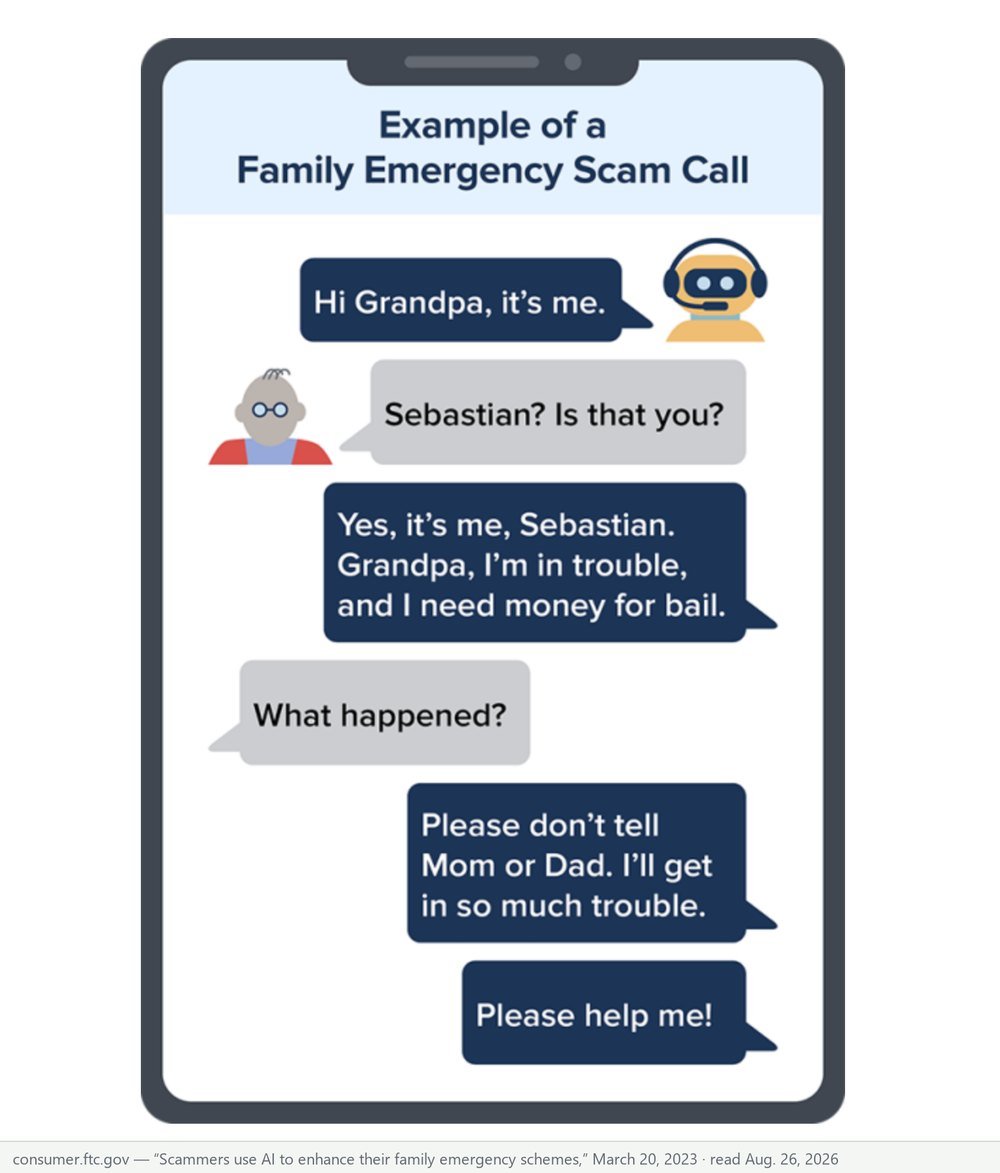
The Federal Trade Commission’s own warning about this opens like a short story. “You get a call. There’s a panicked voice on the line. It’s your grandson. He says he’s in deep trouble — he wrecked the car and landed in jail.” Then the line that made it famous: But darn, it sounds just like him.
That alert went up in March 2023. Underneath it, a reader called Sue left a comment that has aged better than most expert advice: she got two of those calls, told the voice to phone its parents, and hung up.
Three and a half years later the question people type into Google is narrower and more anxious — how to tell if a phone call is ai — and the honest answer has changed. In 2023 you could tell. There was a beat before each reply, a flatness to the vowels, no breath. On August 26, 2026, we went through the seven guides Google puts on page one for that exact phrase, and then went to the specification sheets of the companies that make the voices.
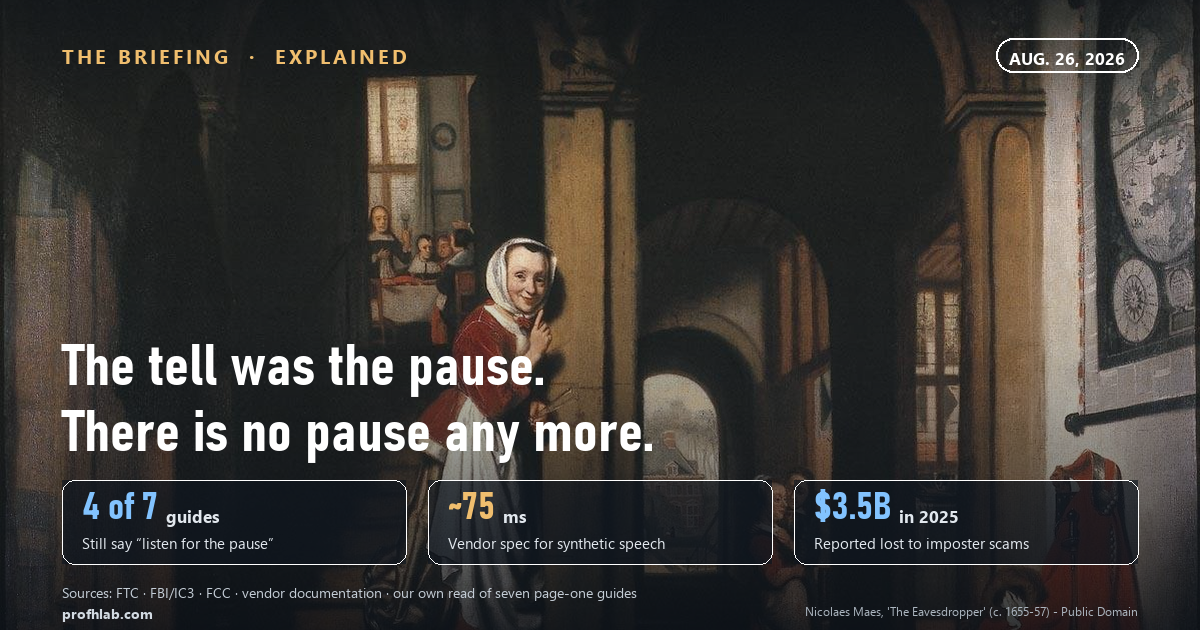
Four of the seven still teach you to listen for a pause. The vendors publish that pause at 75 milliseconds.
The short answer. You cannot reliably tell by listening, and you should stop trying — every second spent evaluating the voice is a second the caller wanted. The test that still works has nothing to do with your ears: hang up, call back on a number you already had, and judge what is being asked for rather than who appears to be asking. The four checks are below.
Why the listening test stopped working
For a century, a voice on a telephone line was treated as proof of identity. It was the only credential the medium had.
The pause advice was a reasonable reading of 2023 technology. Back then a synthetic call was assembled in three separate steps — transcribe what you said, think, then speak — and the seams showed. OpenAI described that older arrangement in its own words when it launched the Realtime API: the pipeline approach “often resulted in loss of emotion, emphasis and accents, plus noticeable latency,” and even a streamlined single-call version “remains slower than human conversation.”
That sentence is the whole story, because it is a statement of the problem the entire industry then went and solved. The same announcement notes that the newer approach “can also handle interruptions automatically” — which quietly retires a second tell that page one still teaches, the idea that AI falls apart when you talk over it.
Here is what the numbers look like when you line them up.
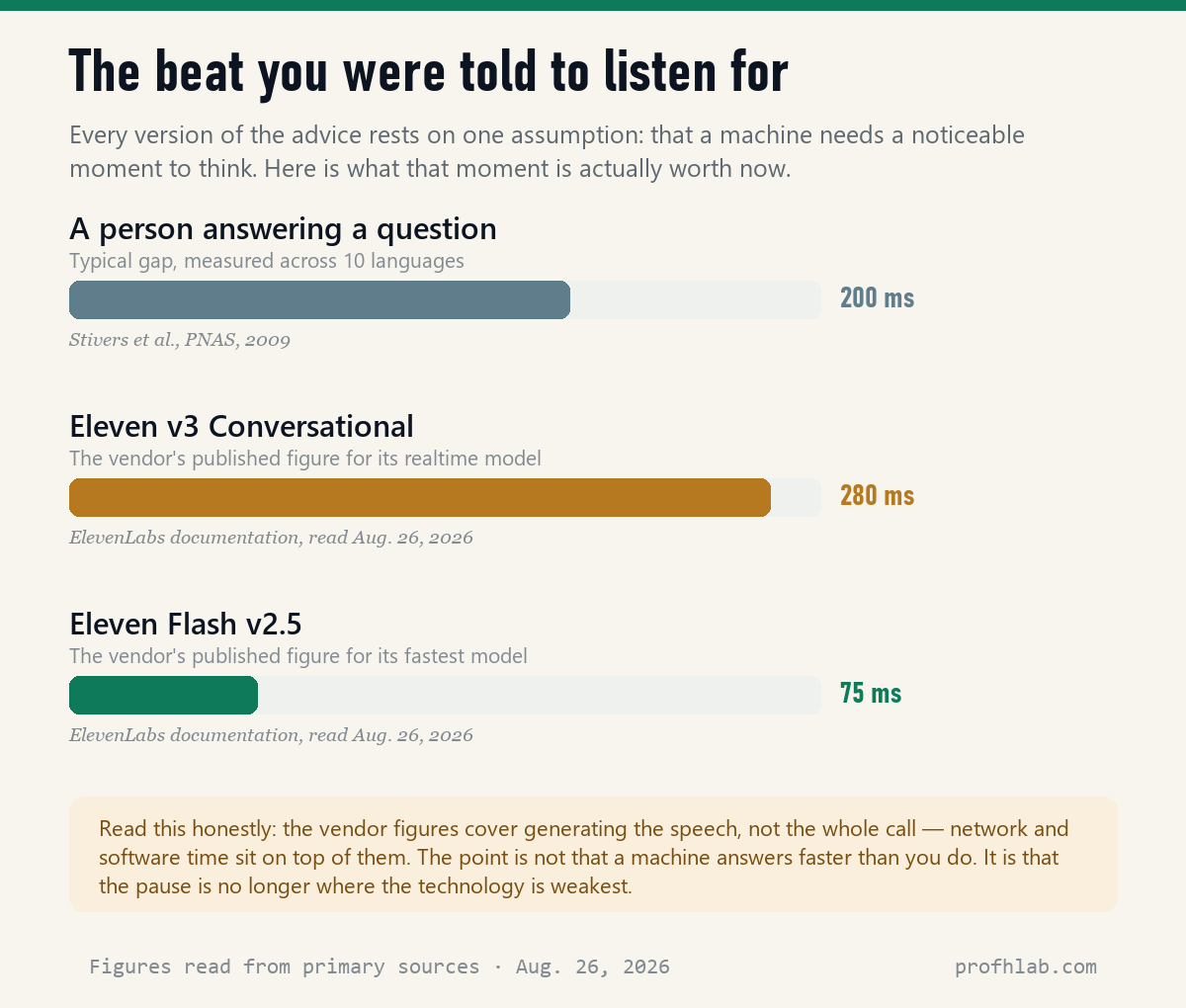
A landmark 2009 study in PNAS recorded conversation in ten languages, from small indigenous communities to major world languages, and found the same pattern everywhere: replies peak within about 200 milliseconds of the question ending. That is the beat you have spent your life calibrating against. It is the beat the advice tells you to notice.
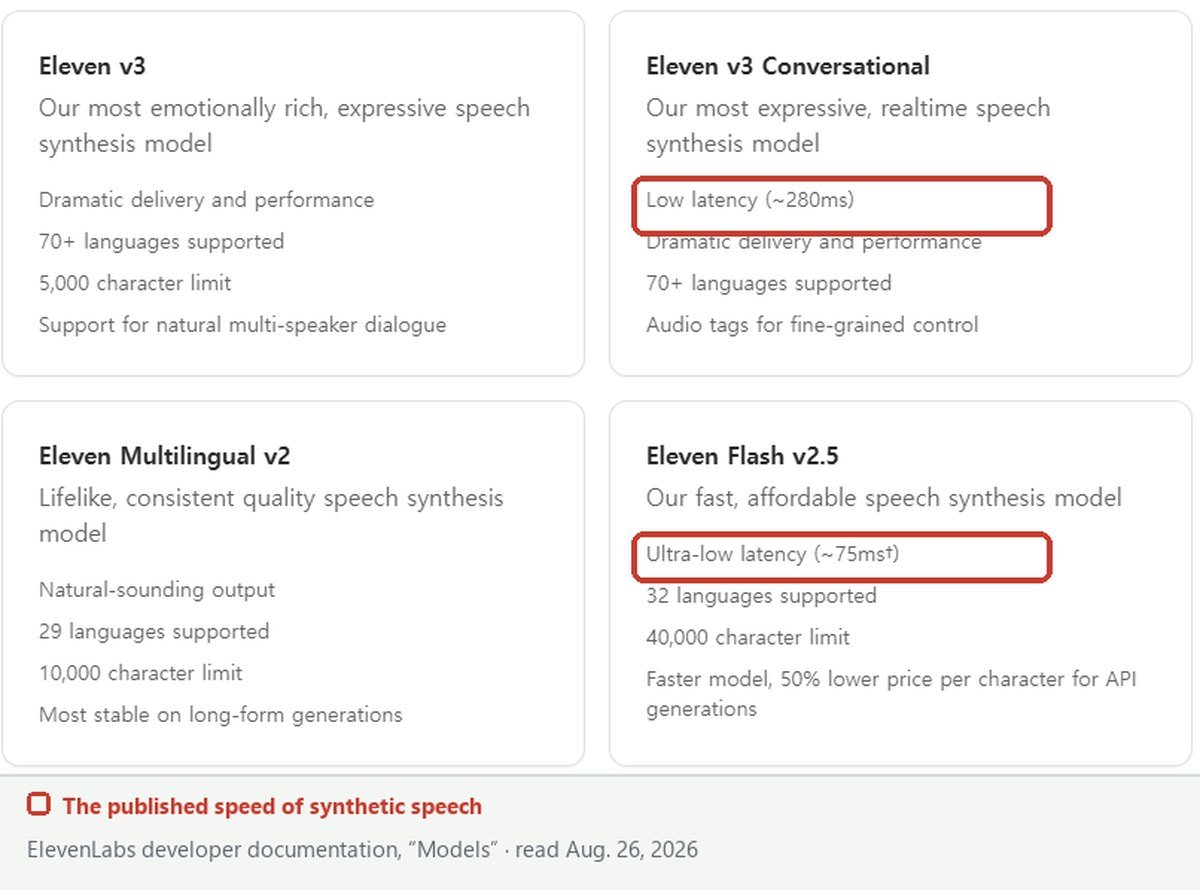
ElevenLabs lists its realtime conversational model at “low latency (~280ms)” and its fastest model at “ultra-low latency (~75ms).” Be precise about what that means: those are generation figures, and the company footnotes that they exclude network and application time. A real call still adds both. The point is not that a machine now answers faster than your daughter does. It is that the delay you were told to listen for is no longer a property of the technology — it is an engineering variable, and the engineering has been pointed at it for two years.
What page one still tells you
So we read them. All seven results Google returned for how to tell if a phone call is ai, in full, on August 26, 2026 — two vendor blogs, two security companies, a credit union, a tech-media piece and CNN.
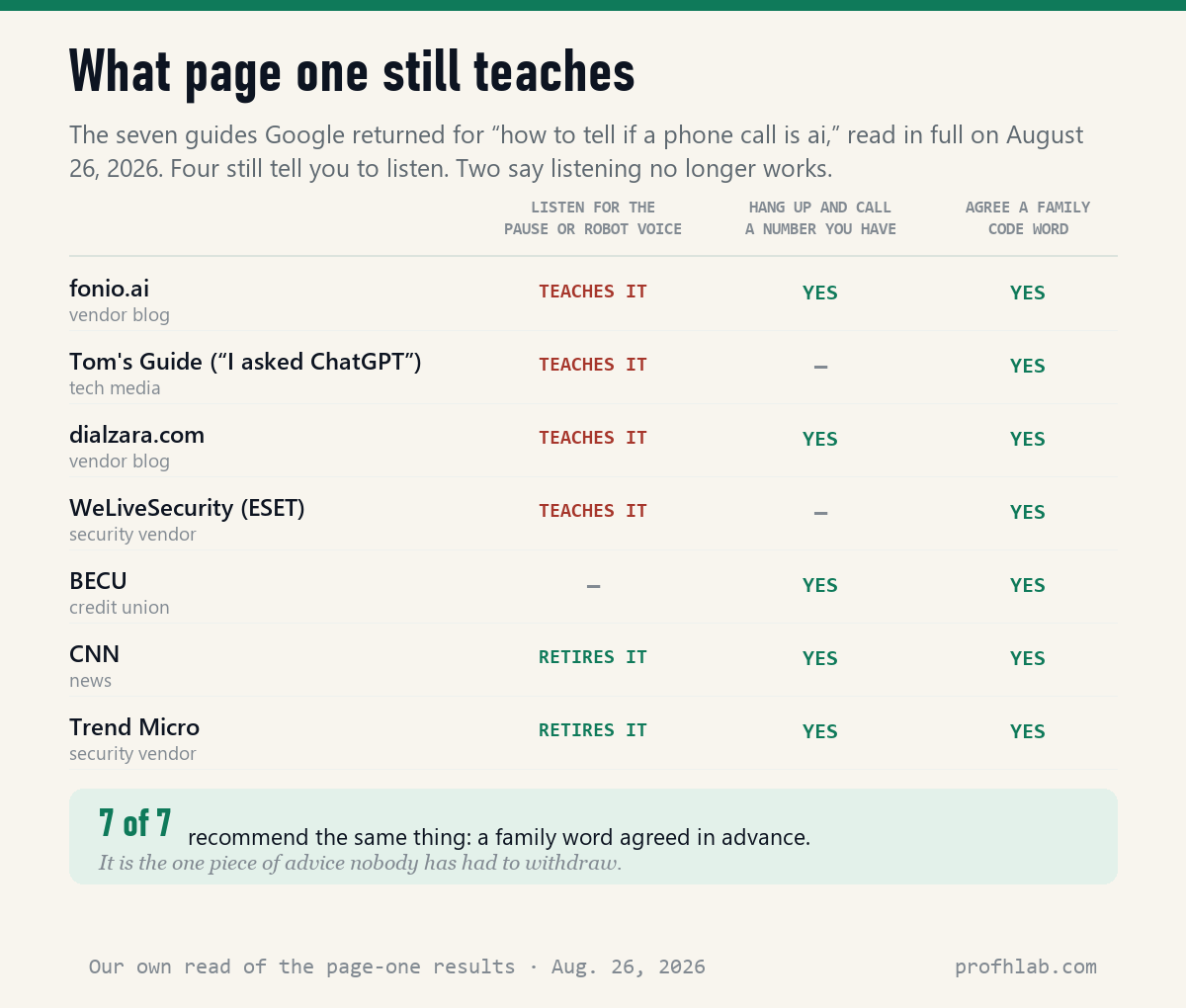
The top result at the time we checked was a tech-media article built on asking ChatGPT the question. Its answer: watch for “odd pacing or timing: slight delays before answering,” an “overly perfect or flat tone,” and that AI “struggles with interruptions.” A security vendor adds “unnatural breathing or even breath-free sentences.” Another tells you to listen for “unusually long pauses.”
Two publishers have already moved. Trend Micro opens a section headed “why the old red flags no longer work.” CNN is blunter, and quotes UC Berkeley’s Hany Farid to make the point: “Strange pauses or vocal fluctuations were previously considered red flags,” the piece says, “but those signals may no longer be present now that AI has advanced.”
There is one thing all seven agree on, and it is the only piece of advice in this field nobody has had to withdraw: agree a family word in advance.
Is it illegal to have AI call people?
Partly — and the gap in that answer is the part worth knowing.
On February 8, 2024, the FCC unanimously adopted a Declaratory Ruling holding that calls made with AI-generated voices are “artificial” under the Telephone Consumer Protection Act. It took effect immediately. “Bad actors are using AI-generated voices in unsolicited robocalls to extort vulnerable family members, imitate celebrities, and misinform voters,” then-Chairwoman Jessica Rosenworcel said. “We’re putting the fraudsters behind these robocalls on notice.”
What that ruling did was fold AI voices into the existing robocall rules, which is what gave state attorneys general something to prosecute. What it did not do is require a lawful AI call to tell you it is one.
The FCC proposed exactly that in September 2024 — a rulemaking (CG Docket No. 23-362) that would define an AI-generated call and “require callers disclose to consumers when they receive an AI-generated call.” Comments closed a month later. We checked the Federal Register on August 26, 2026: it is still a proposed rule. No final rule requiring an AI voice to identify itself has been published.
Why this matters on a real call. Plenty of legitimate businesses now answer their phones with AI, legally, with no obligation to announce it. So “that sounded like a machine” is not evidence of fraud, and “it didn’t announce itself” is not evidence of anything at all. Synthetic and criminal are two different questions, and only the second one costs you money.
How much of my voice does someone actually need?
The FTC’s answer is “a short audio clip — which he could get from content posted online.” The vendors are more specific, because they have to be.
ElevenLabs’ instant voice cloning guide asks users to “record at least 1 minute of audio,” recommends one to two minutes, and warns against supplying more than three, which “will yield little improvement.” Its own support notes add that people have got results from “samples of only 30 seconds.”
Thirty seconds is a voicemail greeting. It is the first half of a eulogy on a church livestream, or the part of a graduation video where somebody says a name. This is worth being calm rather than frightened about: the sample is not the hard part of the crime and never was. Making you act in ninety seconds is the hard part — which is why every countermeasure below is really a way of buying yourself two minutes.
Four checks that still work
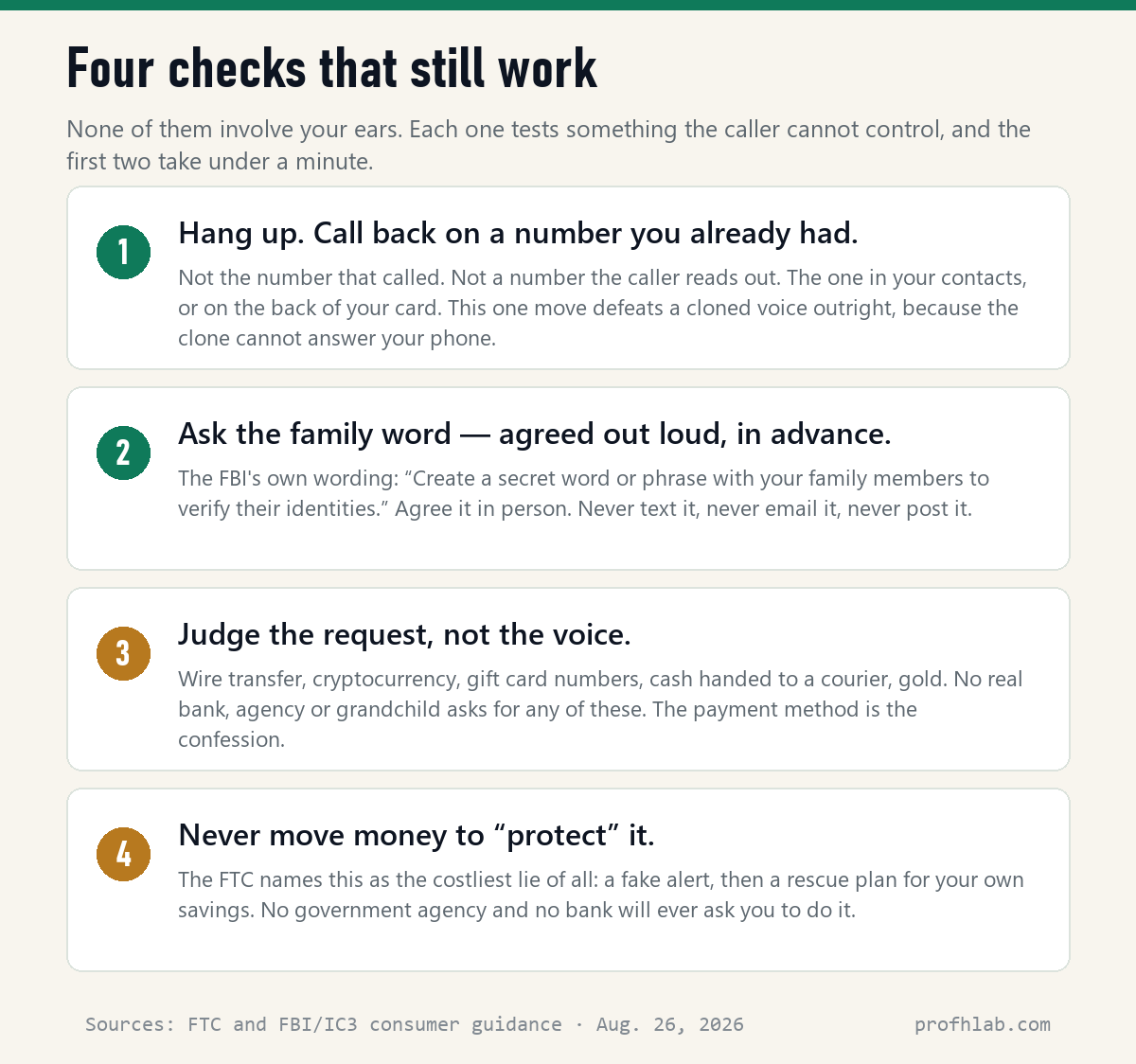
The federal advice is three sentences long and has not changed since 2023, because it did not need to. From that same FTC alert: “Don’t trust the voice. Call the person who supposedly contacted you and verify the story. Use a phone number you know is theirs.”
That works precisely because it does not care whether the voice is real. A cloned voice can call you. It cannot answer your daughter’s phone when you call her.
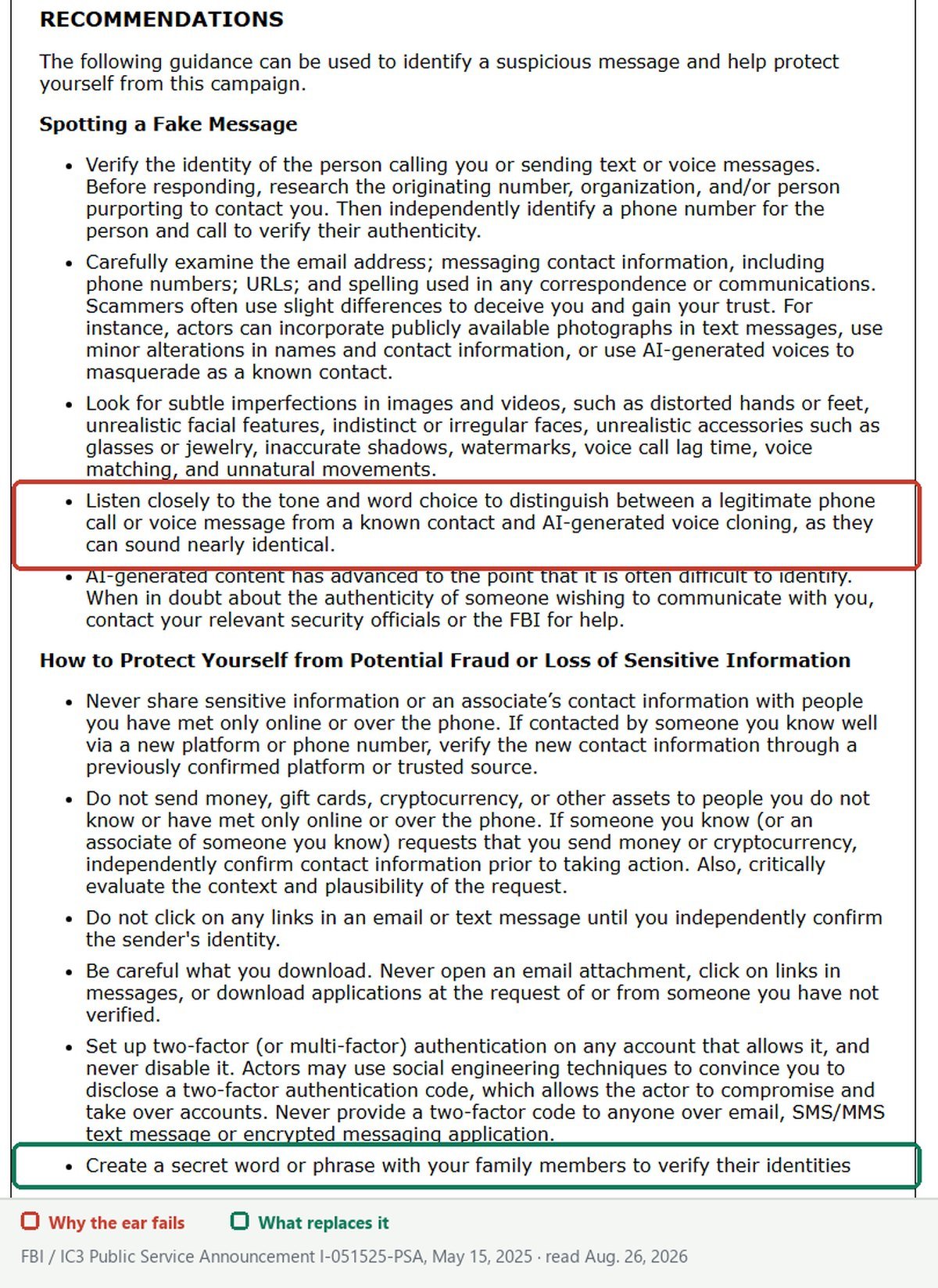
The FBI’s May 2025 announcement is unusually candid about the limits of the ear: legitimate calls and AI-generated voice cloning “can sound nearly identical,” and synthetic content “has advanced to the point that it is often difficult to identify.” Its recommendation is one line: “Create a secret word or phrase with your family members to verify their identities.”
Agree it out loud, in person. Never send it in a text or an email — the whole value of the word is that it exists nowhere a stranger could read it. Choose something concrete and unpostable: not a pet’s name, which is on Facebook, but the thing your father always said about the car.
Pick a family word at dinner and save two numbers
- Today, at dinner: pick the family word. Say it aloud to the people who would call you in an emergency. It takes ninety seconds and it is the single highest-value item on this page.
- Save two numbers in your phone now: your bank’s fraud line, from the back of your card, and your own children’s mobiles under names you will recognise while panicking.
- Write one sentence on a sticky note by the landline: “Hang up. Call back on my number.” It is for the version of you who is frightened, not the version reading this calmly.
- If money already moved: call your bank immediately — same-day reversal is sometimes possible on a wire — then report it at ReportFraud.ftc.gov or on the FTC’s consumer line, 877-382-4357. If a loved one was impersonated, the FBI takes reports at ic3.gov.
- Do not test the caller. Asking clever questions keeps you on a call whose only purpose is to keep you on the call.
Losses over $100,000 for people 60 and up rose eight-fold
Is this actually getting worse, or does it just feel that way? Worse, and the FTC’s numbers are specific about who pays. Imposter scams led every fraud category for the fifth straight year in 2025, with $3.5 billion reported lost and nearly one in three fraud reports falling into the category. Separately, among adults 60 and over, reported losses above $100,000 rose eight-fold in four years — from $55 million in 2020 to $445 million in 2024.
What is the single costliest lie? Not the grandchild. It is the fake security alert, usually from a “bank,” followed by a plan to move your savings somewhere safe. The FTC’s instruction on this is absolute: never move money to protect it.
Where else does this show up? The same displacement — from judging the artefact to judging the source — is happening in video. We ran the equivalent test there: how to tell if a YouTube video is AI generated. And if you are helping a parent through this, our plain-language guide to AI scams targeting seniors covers the same ground without the specifications.
See AI scam calls put to the test, then protect your voice sample
Is AI calling legal, and should you ever say yes on the phone?
How do I tell if a phone call is AI?
In 2026, not by listening. The tells people were taught — a pause before each reply, a flat or robotic tone, no breathing, trouble handling interruptions — describe a generation of technology that vendors have since engineered around; one publishes its speech generation at about 75 milliseconds and its realtime model at about 280. Use structure instead of ears: hang up and call back on a number you already had, ask a family word agreed in advance, and judge what is being requested. Wire transfers, cryptocurrency, gift card numbers or cash to a courier mean fraud regardless of whose voice is asking.
How can you tell if a voice is AI generated?
On a recording you can sometimes still hear it — a room tone that never changes, no breath, no stumble. On a live call you usually cannot, and the FBI says so plainly: a legitimate call and AI voice cloning “can sound nearly identical.” There is no consumer detector that will settle it for you in real time, and none of the ones advertising themselves publish audited error rates.
Is it illegal to have AI call people?
AI-generated voices in robocalls have counted as “artificial” under the Telephone Consumer Protection Act since the FCC’s Declaratory Ruling of February 8, 2024, which made voice-cloning robocall scams directly actionable and gave state attorneys general a tool against them. But there is still no federal rule requiring a lawful AI call to announce itself. The FCC proposed one in September 2024 under CG Docket No. 23-362; as of August 26, 2026 it remains a proposed rule.
What happens if you answer a scam call?
Answering does not itself cost you anything. Two things change: the number is confirmed as live and may be called more often, and you have supplied a sample of your voice. Neither is a catastrophe. The damage happens later, at the moment money moves — which is why the practical rule is not “never answer” but “never act on the same call.” Hang up and call back.
Why should you never say yes on the phone?
This warning has circulated since 2017, and the version usually told — that a recorded “yes” will be spliced in to authorise a charge — is not something we could find a documented case of. The 2026 concern is different and better founded: a clip of your voice is a cloning sample, and one vendor’s documentation says thirty seconds can be enough. Which is an argument for hanging up on unknown callers rather than for avoiding a particular word.
Can AI call your phone?
Yes, and much of it is legitimate. Businesses now run AI receptionists and appointment lines, banks use synthetic voices for notifications, and with a properly obtained consent none of it has to disclose that it is AI. So a machine-sounding call is not proof of fraud, and a human-sounding one is not proof of safety. Test the request, not the speaker.
Sources
- Federal Trade Commission, “Scammers use AI to enhance their family emergency schemes,” consumer alert, March 20, 2023 — “Don’t trust the voice,” the callback instruction, and “a short audio clip” (read August 26, 2026).
- Federal Trade Commission press release, June 15, 2026 — $3.5 billion reported lost to imposter scams in 2025, nearly one in three fraud reports, about $16 billion in total reported fraud losses.
- Federal Trade Commission press release, August 7, 2025 — reported losses over $100,000 among adults 60 and over rose from $55 million in 2020 to $445 million in 2024, and the “don’t move money to protect it” guidance.
- FCC news release, “FCC Makes AI-Generated Voices in Robocalls Illegal,” February 8, 2024 — Declaratory Ruling text and the Rosenworcel quotation.
- Federal Register, “Implications of Artificial Intelligence Technologies on Protecting Consumers From Unwanted Robocalls and Robotexts,” proposed rule, published September 10, 2024, CG Docket No. 23-362 — the proposed AI disclosure requirement; still a proposed rule when checked on August 26, 2026.
- FBI / Internet Crime Complaint Center, Public Service Announcement I-051525-PSA, May 15, 2025 — “can sound nearly identical” and the secret-word recommendation.
- ElevenLabs developer documentation, “Models” and the instant voice cloning guide — published latency figures and sample-length requirements (read August 26, 2026).
- OpenAI, “Introducing the Realtime API” — the description of pipeline latency and automatic interruption handling.
- Stivers et al., “Universals and cultural variation in turn-taking in conversation,” PNAS 106(26), 2009 — the roughly 200 ms response peak across ten languages.
- CNN, “AI ‘voice cloning’ scams are on the rise,” May 29, 2026 — Hany Farid on the retirement of the pause signal.
- Our own read of the seven page-one Google results for “how to tell if a phone call is ai,” August 26, 2026.
The one question that stops a voice scam, and spotting AI video
- AI scams targeting seniors: the voice on the phone, and the one question that stops it
- How to tell if a YouTube video is AI generated
- How to use ChatGPT: a beginner’s guide for people over 50
Written by Prof. H, who read the seven guides and then read the specification sheets, and found them describing different decades. Every figure above was taken from the primary source named beside it on August 26, 2026. This is not legal or financial advice.
Prof.’s H Newsletter
One short email a month, with the numbers in it
What actually moved in AI hiring, AI prices, and the scams aimed at older Americans. Counted here, dated, and linked to the source. One email a month, and your address goes nowhere else.