How to Prep for a Doctor Visit with ChatGPT (Questions to Ask)
By the end of this guide you’ll have one printed page for your next appointment: your symptom timeline, your medication list, and your top three questions. Ten minutes tonight — a calmer, clearer visit tomorrow.
⚠️ First, the ground rule: ChatGPT is not a doctor, and this is not medical advice. Everything below is about preparing for the person who is one. For emergencies — chest pain, stroke signs, trouble breathing — don’t open an app. Call 911.
Why trust this: I’m a professor of AI and robotics and a former Samsung researcher. I write about what AI genuinely does well — and organizing what you want to say, before the eight minutes you actually get with a doctor, is one of those things.
On Reddit, some of the most-upvoted ChatGPT stories aren’t about work at all — they’re people finally understanding a confusing diagnosis letter, or walking into an appointment with their thoughts in order for the first time. That’s the modest, real thing this guide does.
One careful, practical AI guide a month — free, in the Lab Report. Unsubscribe anytime.
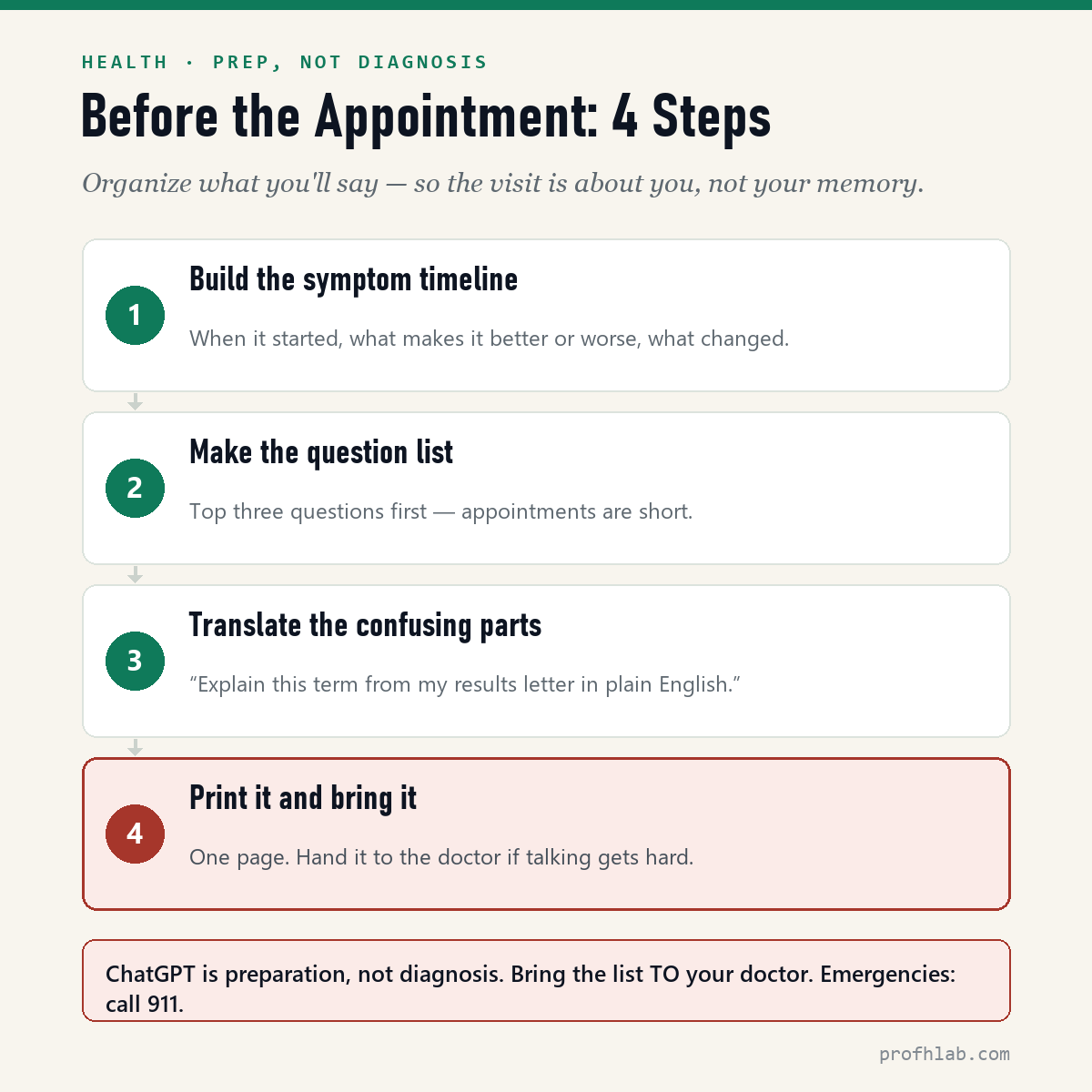
The 4 steps at a glance
Step 1 — Build the symptom timeline
Help me organize this for a doctor visit. For about [three weeks] I've had [knee pain when climbing stairs]. It's worse [in the morning], better [after walking a while]. I've tried [ibuprofen, a knee sleeve]. Organize this into a clear timeline a doctor can read in 30 seconds. Don't diagnose — just organize.
“Don’t diagnose — just organize” keeps the tool in its lane. What you get back is your own story, told in order — which is exactly what a doctor needs and exactly what’s hard to produce from memory in a bright exam room.
⚠️ Privacy habit: describe symptoms generally and leave out your name, birth date, and any ID numbers. For extra caution, delete the conversation afterward.
Step 2 — Make the question list (top three first)
Based on that timeline, suggest 8 questions worth asking my doctor — practical, plain-English questions about causes to explore, tests that might help, and treatment options to discuss. Order them most important first.
Then you pick the top three. Appointments are short; three answered questions beat eight rushed ones.
What does the doctor’s side wish you would ask? Doctor Mike (15M subscribers, a practicing family physician) answers exactly that. 594,607 views as of 13 August 2026.
Step 3 — Translate the confusing parts
Explain this sentence from my test results letter in plain English, at a high-school level, and tell me what a patient would typically want to ask about it: [paste the sentence]
This might be the single best everyday use of AI in healthcare: not replacing the expert — decoding the paperwork so you can talk to the expert as an equal.
Step 4 — Print it and bring it
Combine the timeline, my medication list [list them], and my top 3 questions into one clean page titled "For my appointment on [date]". Large print, short lines, no paragraphs.
Print it, or keep it open on your phone. If nerves take over in the room — and they do, for everyone — you can simply hand the page over. The visit becomes about you, not your memory.
What NOT to use ChatGPT for
- Diagnosis. It can sound confident and be wrong — with your health, that combination is unacceptable. Bring the organized story to a human.
- Medication decisions. Never start, stop, or change doses on an AI’s word. Ask your doctor or pharmacist — bring the question on your page.
- Emergencies. Chest pain, stroke signs, trouble breathing: 911, not an app. Every time.
ChatGPT won’t diagnose you, and shouldn’t see your ID numbers
Can ChatGPT diagnose my symptoms?
No — and that’s not what this guide uses it for. It organizes your symptoms and questions so your doctor, who can diagnose, gets the full picture in the short time you have.
Is my health information private in ChatGPT?
Be careful: describe symptoms generally and leave out names, birth dates, and ID numbers. For extra caution, delete the conversation when you’re done.
Can I prep for someone else’s appointment — a parent or spouse?
Yes — caregivers may find this even more useful. Build the timeline together, keep their name and ID numbers out of the chat, and bring the printed page along. If you’ll be speaking with the doctor on their behalf, ask the office beforehand what permission they need on file.
What should I bring to the appointment?
One printed page: symptom timeline, medication list, top three questions. The four steps above build exactly that page in about ten minutes.
AI does the organizing; your doctor does the medicine
You can’t make appointments longer — but you can arrive as the best-organized eight minutes of your doctor’s day. Ten minutes, four prompts, one printed page. The AI does the organizing; the humans do the medicine. That’s the right division of labor.
More careful guides like this, monthly — join the Lab Report. Unsubscribe anytime.
A Medicare appeal letter, and the same trick for a trip
- Have ChatGPT Write the Letter — including the Medicare appeal, with 2026 win-rate numbers.
- How to Use ChatGPT, for Beginners Over 50 — the gentle five-step start.
- The 2026 Guide to AI Scams — the family safe word and the first-60-minutes plan.
- How to Plan a Trip with ChatGPT — the same organize-first trick, for something joyful.
About the author
Prof. H is a professor of AI and robotics, a former Samsung researcher, and the author of dozens of textbooks on AI and automation. He writes hands-on, no-hype guides to AI tools. More about the author →
Prof.’s H Newsletter
One short email a month, with the numbers in it
What actually moved in AI hiring, AI prices, and the scams aimed at older Americans. Counted here, dated, and linked to the source. One email a month, and your address goes nowhere else.