Is It Safe to Give ChatGPT My Personal Information? 3 of 4 Chatbot Makers Say Leave It Out
It is safe for everyday details, but not for the numbers that unlock your money or your identity: on October 6, 2026 we read the privacy pages of 4 chatbots, and 3 of the 4 makers tell you in writing not to type sensitive or confidential information. OpenAI, the company behind ChatGPT, is one of the three. Its help page says, “Please do not enter sensitive information that you would not want reviewed or used.”
If you have already typed your address or a bill into ChatGPT, you did nothing wrong. A clear question often needs a few real details. Below is what happens to those words, how long they are kept, and the two settings that change it.
What we checked on October 6, 2026
We read 21 privacy and help pages from the four makers of ChatGPT (OpenAI), Gemini (Google), Claude (Anthropic) and Copilot (Microsoft): 8 from OpenAI, 1 from Google, 7 from Anthropic and 5 from Microsoft. Anthropic’s main privacy policy loaded for us only in Korean, so we quote nothing from it. For each one we wrote down what it says about training, human review, private chat modes and deleting a chat. Then we opened the 9 results a web search listed for “is it safe to give chatgpt my personal information.”
We did not test any of these settings on an account of our own. The menu names come from the companies’ own help pages, so your screen may word them a little differently.
Written and checked by Prof. H. An AI assistant helped draft this article and ran the page reads; every quotation below was read on the source’s own page on the date shown.
Is it safe to give ChatGPT my personal information?
Partly: OpenAI’s page “How your data is used to improve model performance,” read October 6, 2026, says that for personal accounts “we may use your content to train our models.” So what you type can be kept, read by staff and used for training unless you change a setting.
Think of a chat box like a postcard, not a sealed letter. Most postcards are never read by anyone but the person they are for. But you would not write your bank PIN on one. The same rule works here.
Everyday facts are fine: your first name, your town, that your knee hurts on stairs. The trouble starts with numbers that let someone pretend to be you. Those are your Social Security number, Medicare number, bank and card numbers, account numbers and passwords.

Does ChatGPT use my chats to train its AI?
Yes, by default for personal accounts, according to OpenAI’s help page read October 6, 2026; you can stop it with one switch. The page says to “turn off Improve the model for everyone under Settings > Data controls.”
- Open ChatGPT and tap your profile icon to open Settings.
- Tap Data controls.
- Turn off Improve the model for everyone.
OpenAI’s “Data controls in ChatGPT” page says that when this is off, “your new conversations won’t be used to train OpenAI models.” Note the word new. Older chats are not covered by the switch. If something private is already in an old chat, delete that chat too.
Can a person read your chat? OpenAI’s page on consumer data says “authorized OpenAI personnel, as well as trusted service providers” may access user content, for listed reasons that include investigating abuse or a security incident and, unless you opted out, improving the model.
How do the other chatbots compare on training, reviewers and deleting?
They differ more than most guides admit: of the 4 chatbots whose pages we read October 6, 2026, only Claude says it trains on your chats only if you choose to allow it. Here is the short version, in each company’s own words.
| Chatbot | Trains on your chats? | Private chat mode | A chat you delete |
|---|---|---|---|
| ChatGPT | Yes, unless you switch it off | Temporary Chat, copy kept up to 30 days | Removed within 30 days |
| Gemini | Yes, while Keep Activity is on | Temporary chats, kept 72 hours | No time given |
| Claude | Only if you allow it | Incognito chats, kept 30 days | Removed within 30 days |
| Copilot (new app) | No, says its page | None found | Not stated |
Google’s Gemini Apps Privacy Hub, last updated September 24, 2026, has the sharpest warning. It says “A subset of chats are reviewed by human reviewers.” Those reviewed chats “are not deleted when you delete your activity” and are kept “for up to three years.”
Microsoft launched a new Copilot app on August 18, 2026. Its page says your prompts and files in that app “aren’t used to train foundation models.” Microsoft’s older Copilot FAQ, which it says covers only the older app, says chats are stored “for 18 months” by default.
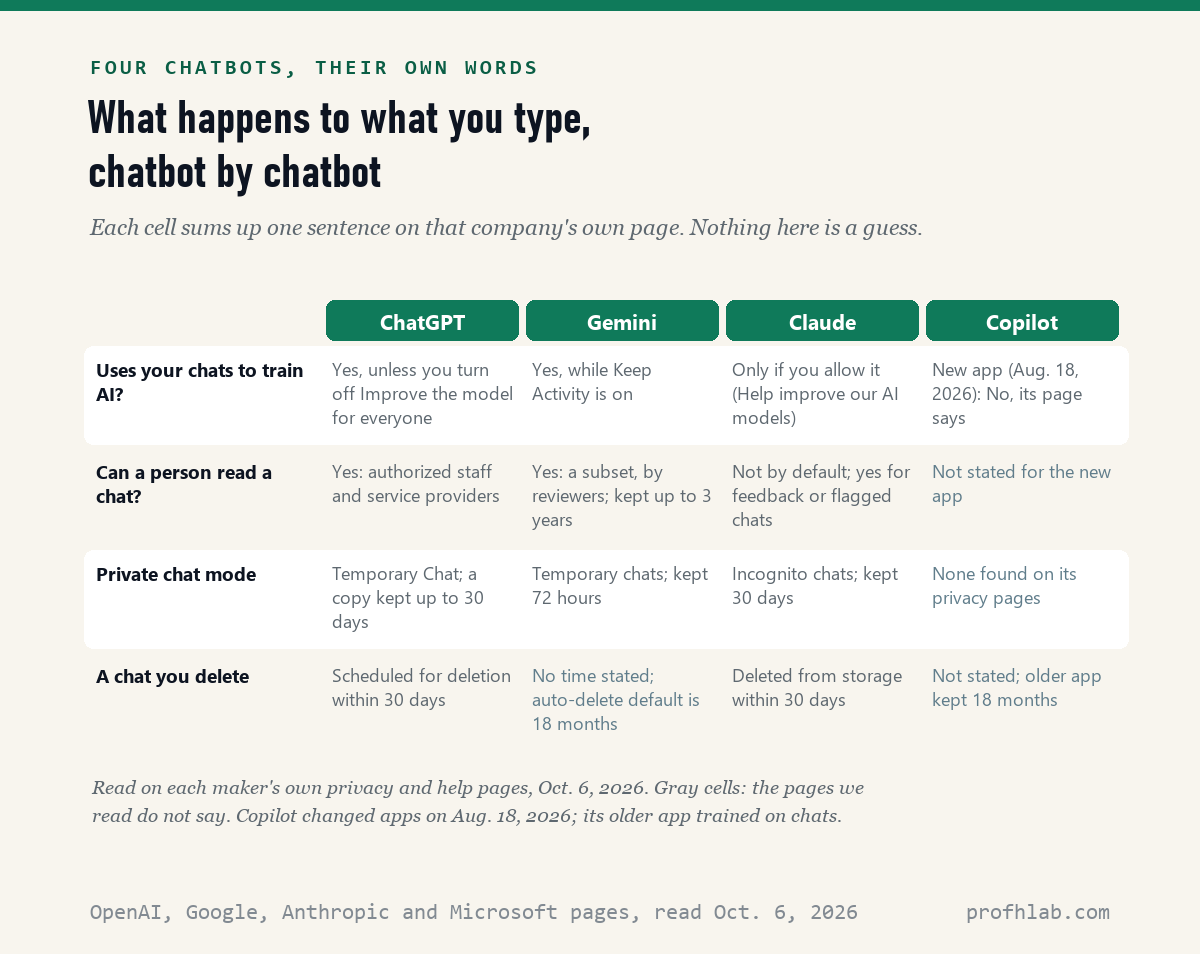
Our count, October 6, 2026: 3 of the 4 makers tell you plainly not to enter sensitive or confidential information: OpenAI, Google, and Microsoft in the FAQ for its older Copilot app. The fourth, Anthropic, says more softly that it encourages users “not to use our products and services to process personal data.”
What should you never type into ChatGPT?
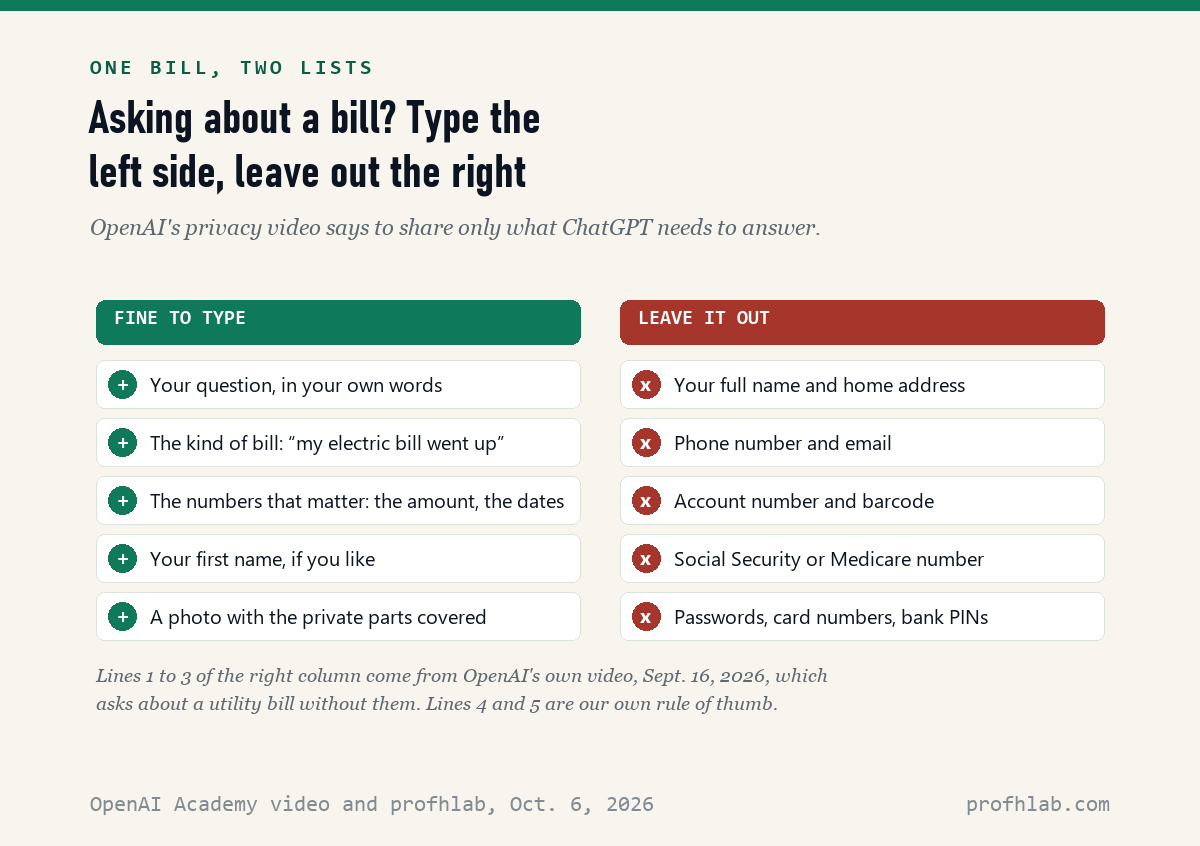
Anything that would let a stranger log in as you, pay as you or prove they are you. OpenAI’s own 101-second video, posted September 16, 2026, shows how to ask about a utility bill without your name, address, phone number, account number or barcode.
- Social Security and Medicare numbers. These are the keys to your benefits.
- Bank, card and account numbers, PINs and passwords. No chatbot needs them to answer a question.
- Your full name with your home address. Together they are what scammers buy.
- Other people’s private details, such as a grandchild’s school or a friend’s diagnosis. It is their story to share.
Asking about a letter or a bill? Copy only the sentence you do not understand. Or take a photo and cover the name, address and account number with your thumb or a sticky note before you upload it.

When should I use Temporary Chat in ChatGPT?
Use it for anything you would rather not keep, like a health worry or a family money question. OpenAI’s Temporary Chat page, read October 6, 2026, says such a chat “stays out of your chat history” and is not used to improve its models while it stays temporary.
- Open a new chat.
- Select Temporary.
- Type your question as usual.
It is not a vanishing act. The same page says “OpenAI may keep a copy of a temporary chat for up to 30 days for safety purposes.” Gemini’s temporary chats are kept for 72 hours, and Claude’s incognito chats for 30 days, according to their own pages read the same day.
One more switch matters. ChatGPT’s Memory can remember details across chats. You can manage it under Settings, then Personalization, then Memory, according to OpenAI’s Memory page read October 6, 2026.
If I delete a chat, is my information really gone?
Usually within a month: OpenAI’s retention page, read October 6, 2026, says a deleted chat is scheduled “for permanent deletion from its systems within 30 days.” Chats you never delete “remain saved to your account until you delete them.”
There are exceptions. OpenAI’s page says the 30 days do not apply if a chat was already de-identified. Google keeps human-reviewed Gemini chats for up to three years even after you delete them. So deleting is good tidying, not an undo button. The safest number is the one you never typed.
We covered the deletion question in more depth in are deleted ChatGPT chats really deleted.

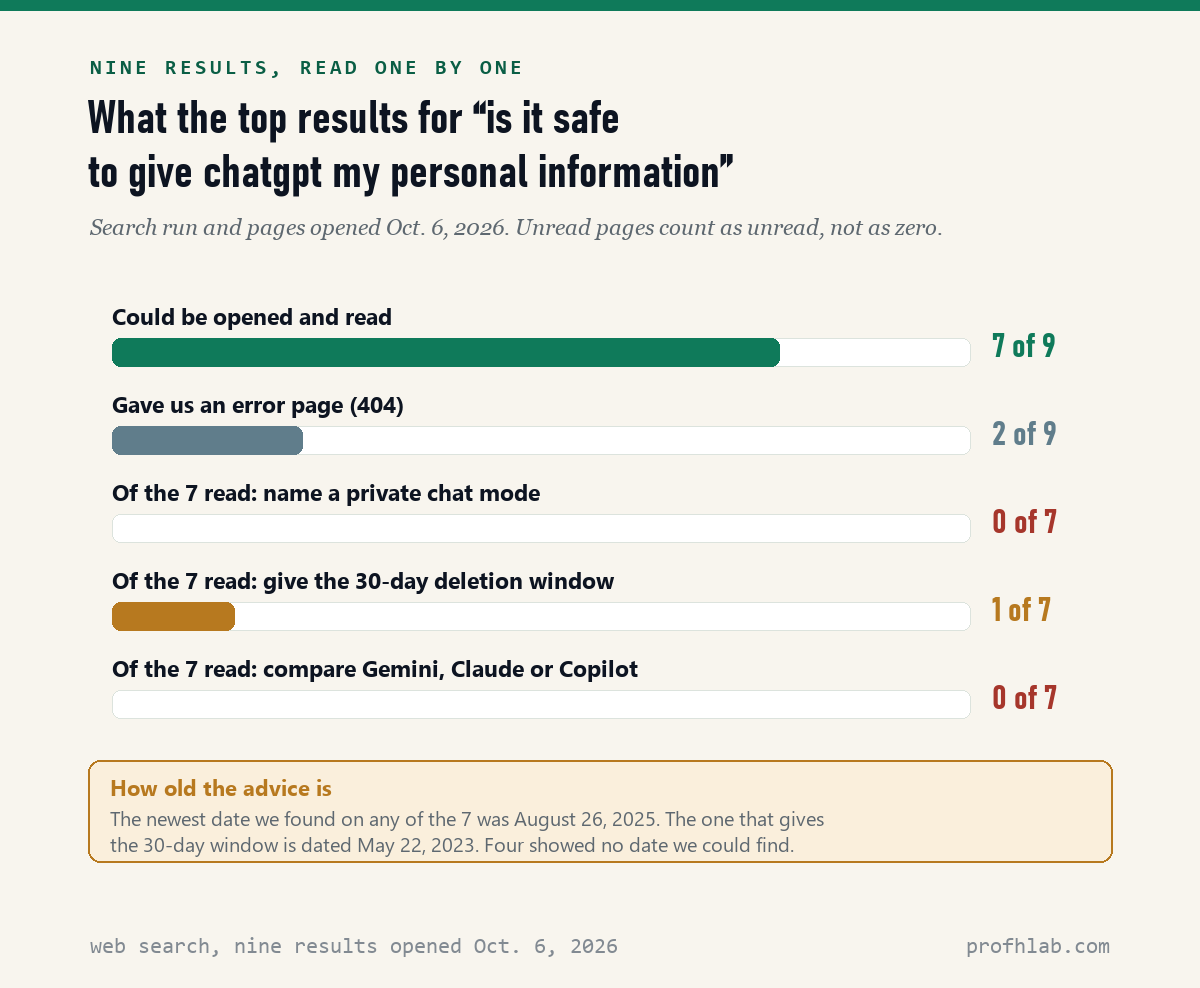
Our read of the 9 search results found no private-mode advice
Of the 9 results our web search listed on October 6, 2026, we could open 7; the other 2 returned an error page. None of the 7 named a private chat mode such as Temporary Chat, and none compared Gemini, Claude or Copilot.
Only 1 of the 7 gave the 30-day deletion window, and that page is dated May 22, 2023. The newest date on any of the 7 was August 26, 2025. Four showed no date we could find. The chatbot rules above have changed since then, which is why we read the companies’ own pages.
A utility bill without the account number, and the switch that stops training
Is ChatGPT safe for health, money and family questions?
Is it safe to tell ChatGPT my name?
Your first name on its own is low risk. The risk grows when a name sits next to an address, a birth date or an account number. OpenAI’s video of September 16, 2026 leaves the name out of its bill example.
Is it safe to give ChatGPT my address?
Leave it out. A town or ZIP code is enough for most questions, such as finding a pharmacy or local help. OpenAI’s privacy video lists the address among details its bill example does not share.
Can I ask ChatGPT about my health?
Yes, without your name or record numbers. Describe the symptom or paste the lab line you do not understand. OpenAI’s own privacy video says ChatGPT “is not a doctor,” so take the answer to yours.
Does ChatGPT share my information with others?
OpenAI’s pages read October 6, 2026 say authorized staff and trusted service providers may access chats. We found no line saying chats are shown to other users. If you made a shared link to a chat, you can manage it under Settings, then Data controls.
Is Temporary Chat completely private?
No. OpenAI says it may keep a copy of a temporary chat for up to 30 days for safety. It is not used to train models while it stays temporary, and it stays out of your history.
Gmail, WhatsApp, Copilot and phone settings that also hold your details
The same habit protects you in other apps. See how to stop AI from reading your Gmail, whether Meta AI reads WhatsApp messages, removing Copilot from Windows 11 and what Gemini is doing on an Android phone.
For ChatGPT itself, read uploading medical records to ChatGPT, giving ChatGPT your credit card, how ChatGPT guesses your age and turning off ads in ChatGPT.
Ready to use it well? Try ChatGPT for the first time after 50, preparing for a doctor visit, writing a letter or email, reading a PDF or talking to it out loud.
Scammers want the same numbers. Set up a family safe word, learn how to tell if a phone call is AI and read AI scams aimed at seniors. New here? Start at Start Here, see the AI tools we rate for seniors, or send a question on the Ask page. Our method is at How We Count.
OpenAI, Google, Anthropic and Microsoft pages behind each claim
- OpenAI Help, How your data is used to improve model performance; Data controls in ChatGPT; Temporary chat in ChatGPT; Chat and file retention in ChatGPT; Memory in ChatGPT; How OpenAI handles data in consumer services; What is ChatGPT. Read October 6, 2026.
- OpenAI, US privacy policy, updated September 10, 2026. Read October 6, 2026.
- Google, Gemini Apps Privacy Hub, last updated September 24, 2026. Read October 6, 2026.
- Anthropic Privacy Center, Is my data used for model training?; How long do you store my data?; How do I change my model improvement privacy settings?; How does Anthropic protect the personal data of Claude users?; How do you use personal data in model training? Read October 6, 2026.
- Claude Help Center, Use incognito chats and chat search and memory. Read October 6, 2026.
- Microsoft Support, Microsoft Copilot for individuals: your activity history, your privacy controls, your data, privacy, and responsible AI, and the older-app Privacy FAQ for Microsoft Copilot. Read October 6, 2026.
- Federal Trade Commission, FTC launches inquiry into AI chatbots acting as companions, September 11, 2025; it asks companies how they use or share personal information from chats. We found no FTC consumer page on this exact question. Read October 6, 2026.
- Web search results for “is it safe to give chatgpt my personal information,” nine listed October 6, 2026: seven opened and read, including Scribbr (May 22, 2023) and Mark Brinker (updated August 26, 2025); two (comparitech.com and docs.kanaries.net) returned an error page and are counted as unread.
This page describes what each company’s own privacy and help pages say; settings and menu names can change after an app update, and some features reach some countries before others. Corrections and questions go to the Ask page.
Prof.’s H Newsletter
One short email a month, with the numbers in it
What actually moved in AI hiring, AI prices, and the scams aimed at older Americans. Counted here, dated, and linked to the source. One email a month, and your address goes nowhere else.