Physical AI Explained: Why a Chatbot Knows the Cup Falls but a Robot Doesn’t
Ask ChatGPT what happens if you push a cup off the edge of a desk and it answers instantly: it falls and breaks.
Now wire that same model to a robot arm. The robot pushes the cup off the desk.
The short version
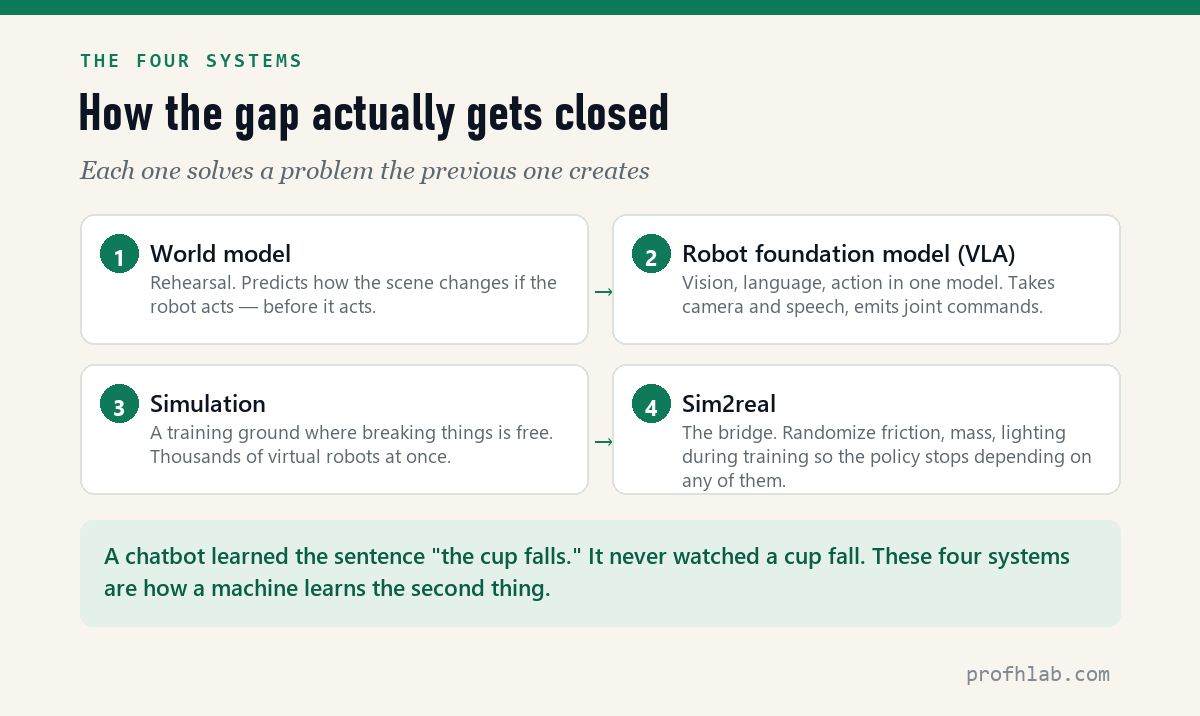
Physical AI is the work of closing the gap between knowing something in words and doing it with a body. Four systems close it, in order: a world model (rehearsal), a robot foundation model (the brain that sees, hears and moves), simulation (a training ground where breaking things is free), and sim2real (the bridge to an actual floor). This piece explains all four without a single equation — and names the real systems, with dates.
Why does this happen? Because a language model learned the sentence “the cup falls.” It never watched a cup fall.
Sentences carry conclusions. Actually picking up that cup requires knowing how wide the hand should open a few centimetres out, and how many milliseconds you have to squeeze harder once it starts to slip. None of that is in the sentence.
Physical AI is the field trying to close that gap: artificial intelligence that works in the physical world rather than only in text. If you want the concepts first, start with Physical AI Foundations. This article is the companion piece — the same four ideas, but with the actual systems, papers and dates attached.
Pillar one — the world model, or running it in your head first
Before you push a cup, you already know what happens. With your eyes closed you can picture it rolling, tipping, dropping. That ability, put into a machine, is a world model.
Google DeepMind describes a world model as technology that lets an AI use its understanding of the world to simulate parts of it. Two predictions matter: how the environment will change, and what effect my own action will have on it.
That stays abstract until you see one. Genie 3, released by DeepMind on August 5, 2025, takes a single line of text and generates a 3D world you can walk around in, on the spot.
Genie 3, measured
720p at 24 frames per second, interactive in real time, holding together for several minutes. Visual memory runs to roughly one minute — it remembers the sign on a street you walked past a minute ago, and loses it after that. Source: Google DeepMind’s own announcement.
One thing worth getting straight: the world a model like this generates is not there to look pretty. It is a prediction engine, so a robot can run “what happens if I reach like this” internally before committing. What people do as mental rehearsal, machines do as video prediction.
Approaches split here. Genie 3 generates visible pixels. Meta’s V-JEPA 2 predicts in a latent space that holds meaning rather than pixels — far lighter to run, with one trade-off: there is nothing for a human to look at.
Pillar two — the robot foundation model: one brain that sees, hears and moves
Prediction is one thing. Something still has to move the arm.
The old way was one program per robot. This arm, on this conveyor, in this factory. Move it to the next line and you rewrote it from scratch.
A robot foundation model inverts that: one large model, shared across many robots. The term you will see everywhere is VLA — Vision, Language, Action. It takes camera images and spoken instructions, and emits joint commands directly.
Two systems define the category. Both are documented in their own papers:
| NVIDIA GR00T N1 | Physical Intelligence π0 | |
|---|---|---|
| Released | March 18, 2025 (arXiv 2503.14734) | October 31, 2024 (company blog) |
| Architecture | Dual system — System 2 (vision-language) interprets the situation, System 1 (a diffusion transformer) generates motion in real time | A 3-billion-parameter vision-language model plus flow matching to output continuous motion |
| Training data | Real robot trajectories + human video + synthetic data | Data from 8 robot types (single-arm, dual-arm, mobile) + public datasets |
| Goal | Generality across robot bodies, from tabletop arms to humanoids | One general policy performing many tasks |
| Availability | Released as an open foundation model | Published as research |
They look similar in a table. The design philosophies are not.
GR00T N1’s two-system split imitates how people think: slow, careful judgement separated from fast reflex. It is the difference between noticing that the light ahead is about to change, and your foot hitting the brake before you have consciously registered the ball that bounced into the road.
π0 asked a different question: robots have different numbers of arms and joints, so can one model really drive all of them? The answer was to feed it data from eight robot types at once. What came out was household-grade dexterity — folding laundry, clearing a table, assembling a box, taking toast out of a toaster.
Folding laundry sounds unimpressive until you consider that a towel is a different shape every time you pick it up. There are no fixed coordinates to send a hand to. The old approach could never solve it.
Pillar three — simulation, a training ground where breaking things is free
Here the practical wall arrives: what do you train that large model on?
Language models scraped the internet. But “a robot picking up a cup” is not on the internet. Someone has to hold the robot and demonstrate it, one repetition at a time. Collecting real robot data tops out at a handful of examples per hour — and when a robot falls, it breaks, and breaking costs money.
Simulation goes straight through that wall by training robots in a virtual space that runs physics. NVIDIA’s Isaac Sim is an open-source robot simulation and synthetic-data framework built on Omniverse; Isaac Lab runs on top of it as a lighter framework aimed at large-scale robot learning.
The point is parallelism: thousands of virtual robots at once. Trial and error that would take years on a real floor compresses into hours on a single GPU.
In practice, labs do not use one simulator. They stack two:
| Stage | Tool | Why |
|---|---|---|
| 1. Bulk training | Isaac Gym / Isaac Lab | GPU parallelism runs thousands of episodes fast |
| 2. Cross-checking (sim-to-sim) | MuJoCo | More precise physics. Slower, but closer to reality |
| 3. Deployment | The actual robot | Only policies that survived both previous stages |
Why run two simulators
A policy trained only in the fast simulator adapts to that simulator’s numerical quirks as well as to the task. Passing it through a simulator with different physics filters out tricks that only work in one virtual world. It is the last safety check before anything touches real hardware.
Pillar four — sim2real, the bridge between the virtual and the actual
Which brings us to the most notorious problem in the field.
A robot that walked flawlessly in simulation falls over on its first real step. This is the sim2real gap.
The cause is not that the simulator lied. It is that reality is filthy. Floor friction changes from one tile to the next. Motors weaken over time. Two identical parts differ by a few grams. Cameras pick up the flicker of fluorescent lights.
A simulator assumes one fixed value for each of those. The robot learns to depend on exactly those values.
The fix is paradoxical: deliberately shake the conditions. This is domain randomization — during training, physical values like friction, gravity and mass, and visual conditions like lighting, texture and colour, are randomized every episode.
In one sentence
A robot that learns “this floor has friction 0.7, so walk like this” falls over on a different floor. Train it at 0.3 and at 0.9 as well, and it learns to stay upright regardless of friction. The more you shake the conditions, the less the robot depends on them.
NVIDIA’s own documentation says the same thing about synthetic data: randomize lighting, reflections, colour and position. Not just the physics — the look of the world too.
And this is where the four pillars join up. The world model predicts, the foundation model decides and acts, simulation supplies the training ground, and sim2real carries the result onto a real floor.
So where is the field, actually? Four dates
Concepts are slippery. Dates are not. Here are four, each checked against the original paper or announcement.
| When | What | Why it mattered |
|---|---|---|
| Oct 31, 2024 | π0 released | Trained on 8 robot types; demonstrated laundry-folding dexterity |
| Mar 18, 2025 | GR00T N1 released (arXiv) | An open foundation model aimed at humanoids |
| Jun 11, 2025 | V-JEPA 2 released (arXiv) | 1M hours of internet video → zero-shot control of a Franka arm |
| Aug 5, 2025 | Genie 3 released | Real-time interactive world generation at 720p, 24fps |
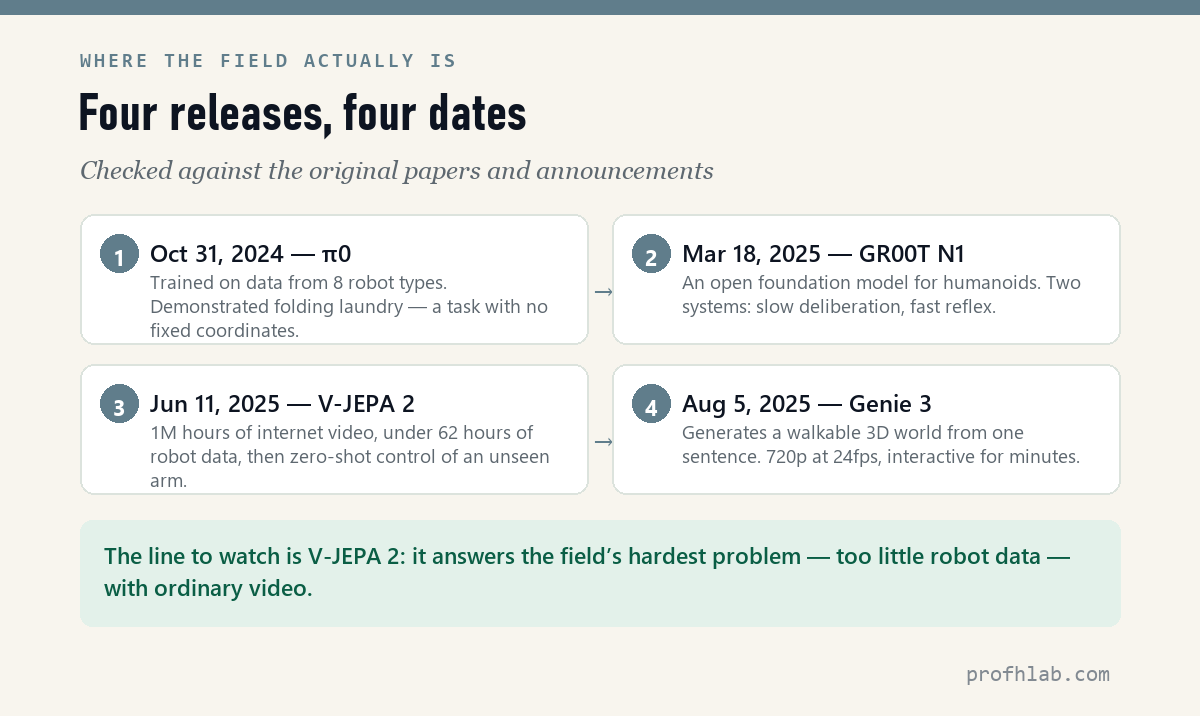
The row to stare at is V-JEPA 2. After watching a million hours of internet video, it needed under 62 hours of additional robot footage — then controlled a Franka arm it had never been trained on, zero-shot, in a lab it had never seen.
To the field’s hardest problem — there is not enough robot data — that is an answer: learn from ordinary video that humans already filmed.
Robotics AI, game engines and world models: how they differ
Q. How is Physical AI different from plain robotics AI?
Robotics AI is closer to repeating a defined task accurately. Physical AI aims at judging and moving in situations it has never seen. All four systems above exist to handle the unfamiliar case.
Q. How is a world model different from game graphics?
A game engine has its physics rules hand-coded by people. A world model learns physical behaviour from video, which is why it can produce a plausible outcome for a situation no programmer ever entered.
Q. How is a VLA model different from GPT?
GPT predicts the next word; a VLA predicts the next action. Both GR00T N1 and π0 start from a pretrained vision-language model and attach a component that emits motion. Same roots, different output.
Q. If it works in simulation, does it work in reality?
No — that gap is the sim2real problem. Which is why training uses domain randomization, and why policies are cross-checked in a second simulator with different physics before anything reaches hardware.
Q. Can a non-specialist try any of this?
Yes. MuJoCo and Isaac Sim are free to download, and GR00T N1 was released as an open model. You will need a GPU. Start by running someone else’s example before writing your own.
Back to the cup
Why does a chatbot know the cup will fall while the robot pushes it off anyway?
Now the answer is concrete. That robot had no head to picture the fall in (world model), no brain to decide how many millimetres to close its fingers (foundation model), no training ground to fail in a few thousand times (simulation), and no bridge to carry a virtual success onto a real desk (sim2real).
A robot with all four folds laundry. That happened in October 2024.
Sources: arXiv 2503.14734 (GR00T N1); arXiv 2506.09985 (V-JEPA 2); Google DeepMind’s official announcement of Genie 3; Physical Intelligence’s official blog on π0; NVIDIA developer documentation for Isaac Sim and Isaac Lab. All checked against the original sources, August 2026. Where a figure is a company’s own claim rather than an independent measurement, the text says so.
Keep reading: Physical AI Foundations covers the same four ideas as concepts, with a glossary and a reading path. From there, the paper explainers in the index below take each system apart one at a time.
Full index
Every guide in the Physical AI library — 27 of them, grouped so you can find the one you need.
Start here
- Physical AI Foundations: World Models, Robot Foundation Models, and Sim2Real — From Zero
- ▸ Physical AI Explained: Why a Chatbot Knows the Cup Falls but a Robot Doesn’t (you are here)
- The Physical AI Toolbox: Six Free Simulators, a $249 Hardware Ladder, and What the 2026 Papers Admit
Research papers, decoded
- RoboVLMs, Explained: What Actually Makes a Robot Foundation Model Work
- Ψ0 (Psi-Zero), Explained: The Humanoid Foundation Model That Learns From Human Video
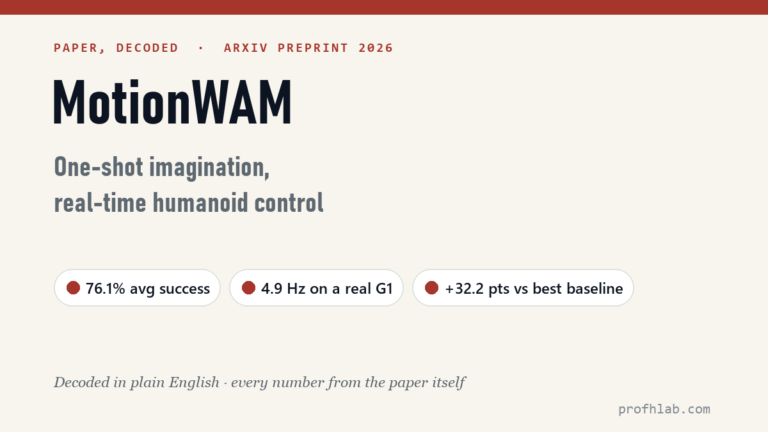
- MotionWAM, Explained: One-Shot Imagination Brings Real-Time Humanoid Loco-Manipulation
- XHugWBC, Explained: One Policy That Drives 12 Different Humanoids
- Vision-Tactile Pretraining, Explained: A Robot Hand Learns Human-Like Dexterity From a Webcam
- TouchWorld, Explained: A Robot Hand That Predicts Touch Before Making Contact
- HOUND and APT-RL, Explained: One Transformer Brain for Walking, Running, and Jumping in the Wild
Machines, priced
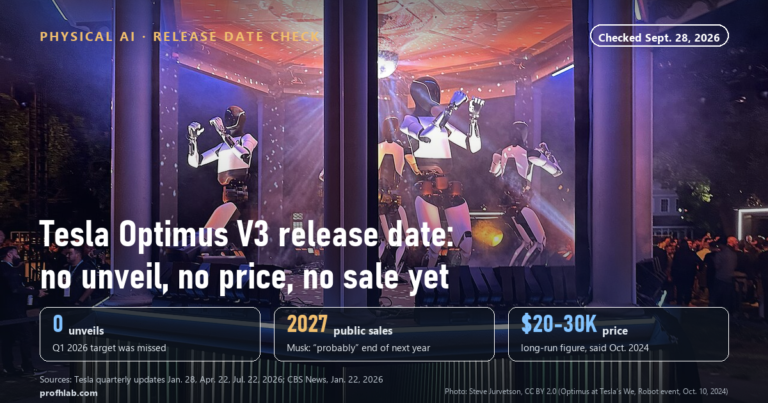
- Tesla Optimus V3 Release Date, Price and Specs: What Tesla Has Confirmed
- Buying a Humanoid Robot in 2026: What a Unitree R1 Really Costs, Retail vs Import
- Robot Dog Prices in 2026: From ≈$2,900 to ≈$71,000 — and Spot Still Has No Price Tag
- Tesla FSD Goes Subscription-Only in Korea — and the ‘5-Year Break-Even’ Everyone Quotes Is Wrong
Home robots, tested
- Narwal Freo Z10 Ultra Review: 18,000Pa, a 75°C Mop Wash, and Three Honest Drawbacks
- 22,000Pa vs 240 Air Watts: Robot Vacuum Suction Numbers, Decoded (2026)
- Robot Vacuum or Stick Vacuum? I Split Housework Into 10 Tasks — Only One Truly Overlaps
- The Sour Smell Isn’t the Mop: Robot Vacuum Odor by Zone, and a 7–9x Consumables Gap
- Drain Height Decides Your Robot Vacuum: Samsung 0.4 m, Roborock 50 cm, LG 1.5 m
- Robot Vacuum Repair Costs 2026: A $140 Fix and a 56.5% Resolution Rate
- Robot Vacuum Subscription vs Buying: What iRobot Select Really Costs
- Are Window-Cleaning Robots Worth It? The Break-Even vs Hiring a Pro
- Smart Speakers in 2026: The Hardware Is $99 — the Assistant Is the Real Price
- Serving Robot Costs in 2026: $399 a Month, and Why 73.3% Saw No Change
Chips & companies
- HBF and zHBM, Explained: Samsung and SK Hynix Give Opposite Answers to the Same Memory Problem
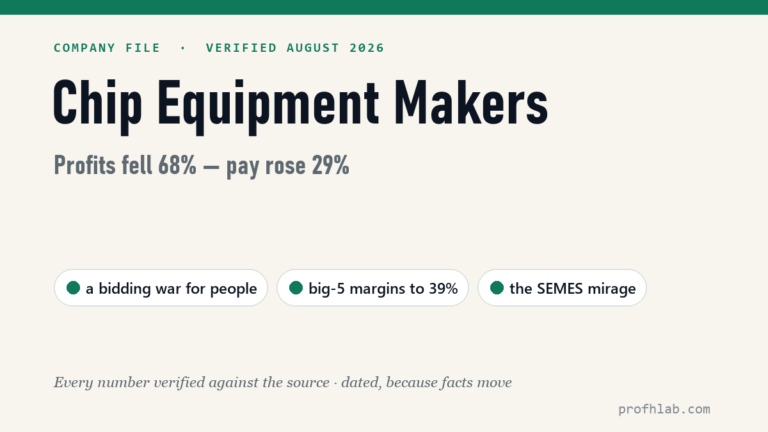
- Korea’s Chip Equipment Makers, Compared: Profits Fell 68% — So Why Did Pay Jump 29%?
- Samsung DS vs DX: One Company, a $450,000 Bonus Gap — and Why the Simple Story Is Wrong
- ASML Korea’s Starting Pay Is $31K — or $46K: Anatomy of a 2.15x Salary-Data Gap
Looking for the other library? Generative AI — tools, tested →
Prof.’s H Newsletter
One short email a month, with the numbers in it
What actually moved in AI hiring, AI prices, and the scams aimed at older Americans. Counted here, dated, and linked to the source. One email a month, and your address goes nowhere else.