RoboVLMs, Explained: What Actually Makes a Robot Foundation Model Work
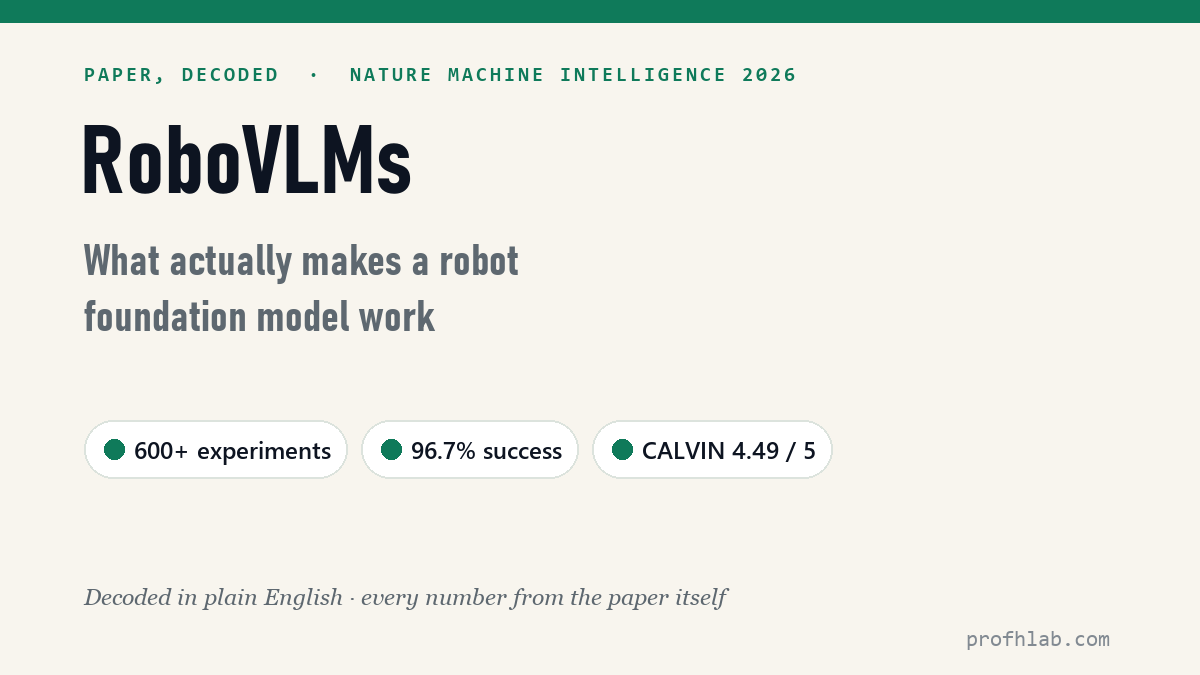
Tell a robot “put that cup away,” and it has to see the cup, understand the sentence, and move its own hands — all in one flow. Handling that entire loop with a single neural network is what a VLA (Vision-Language-Action) model does. This 2026 paper in Nature Machine Intelligence — one of the field’s most authoritative journals — is best read as a design textbook: across more than 600 experiments, it pins down which of the many VLA design choices actually drive performance.
| Original title | What matters in building vision–language–action models for generalist robots |
| Authors / affiliations | Xinghang Li, Peiyan Li, Tao Kong, Hanbo Zhang, Huaping Liu et al. — Tsinghua University, ByteDance Research, BAAI, Shanghai Jiao Tong University, NUS and others |
| Journal | Nature Machine Intelligence, Vol. 8, pp. 158–172 (2026) |
| DOI | 10.1038/s42256-025-01168-7 |
| Preprint / code | arXiv:2412.14058 · robovlms.github.io |
The core idea: a modular test bench
The heart of the paper is RoboVLMs, a “modular experiment bench.” Modern robot AI starts from a vision-language model (VLM) that has already learned from vast image and text data, then bolts on the ability to output actions — turning it into a VLA. The problem: every research team used a different backbone, a different action representation, and different training data, so nobody could say which ingredient deserved the credit.
RoboVLMs standardizes that mess. Like swapping LEGO blocks, you can change only the backbone, or only the action-output scheme, and compare fairly. That let the authors combine 8 different VLM backbones with 4 policy architectures across 600+ experiments — and finally say “this is what actually causes performance.”
What the 600 experiments found
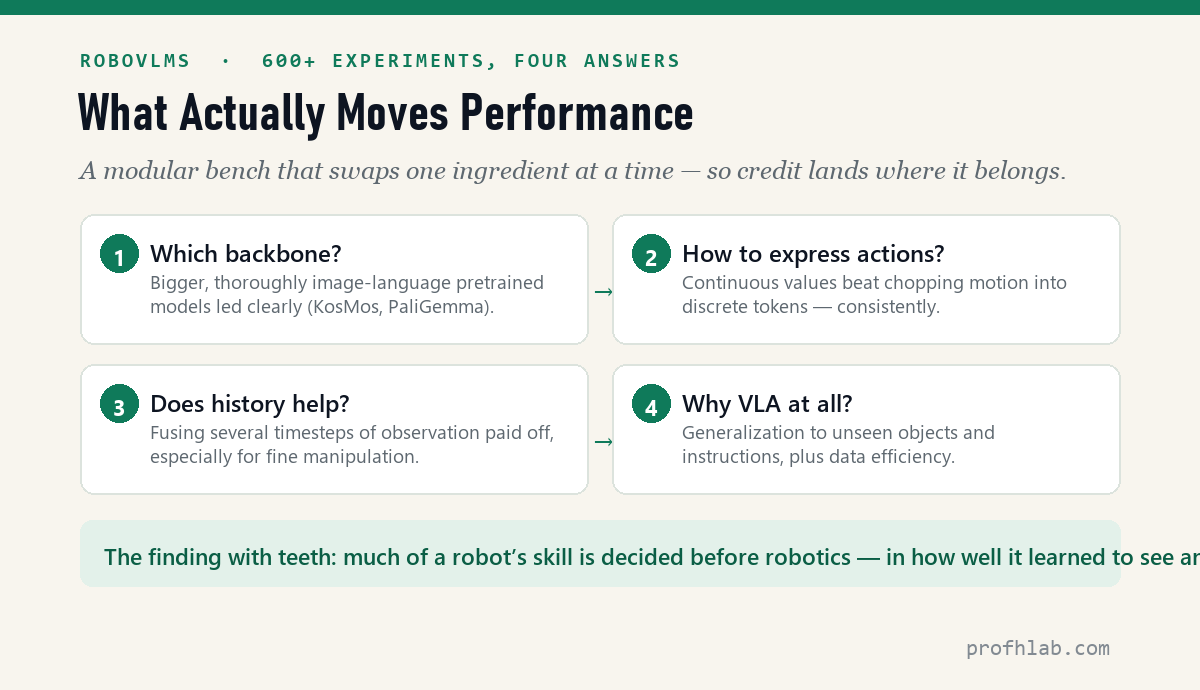
The paper answers four questions:
- Why VLA at all? Because it generalizes — handling unseen objects, backgrounds, and instructions — and learns data-efficiently.
- Which backbone? Bigger backbones with thorough image-language pretraining (KosMos, PaliGemma) clearly led. Much of a robot’s skill is already decided by how well it learned to see and speak.
- How should actions be represented? Outputting continuous action values consistently beat chopping actions into discrete tokens. Robot motion is smooth by nature; forcing it into tokens costs precision.
- Does history help? Fusing several timesteps of observation history into the policy paid off, especially for fine manipulation.
The results, concretely
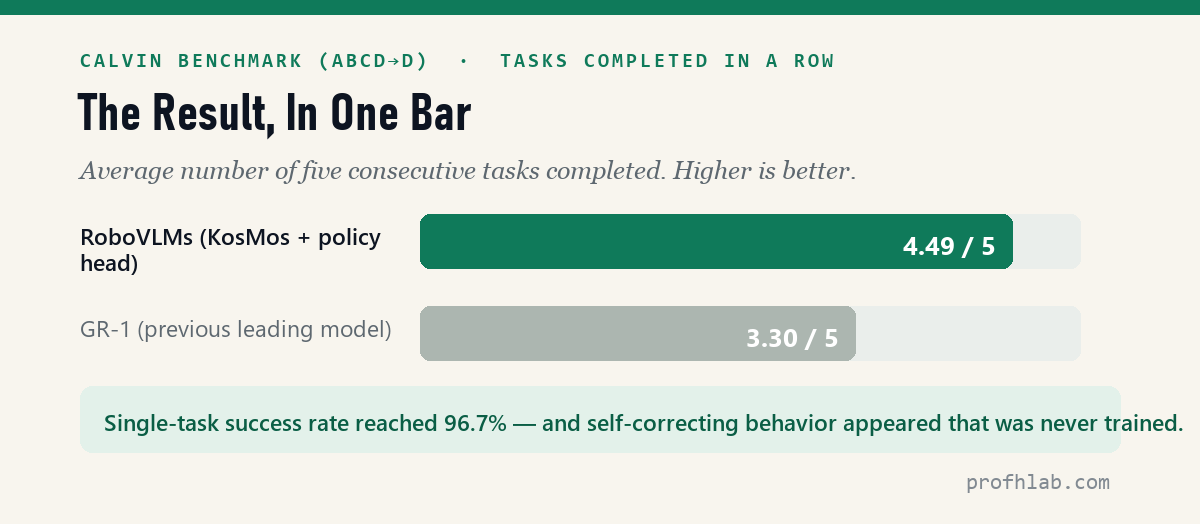
On the standard CALVIN benchmark (ABCD→D), the best configuration (a KosMos backbone with a policy head) completed an average of 4.49 out of 5 consecutive tasks, with a 96.7% single-task success rate — past the previous state of the art, and about 1.19 more tasks per rollout than GR-1, the leading prior model. In real-robot tests (20 tasks × 5 conditions) it beat OpenVLA and Octo on unseen objects, backgrounds, and phrasings — and even showed self-correcting behavior that was never in the training data.
The honest limit: even high-scoring models drop sharply when object positions, instructions, and backgrounds shift far enough — the field-wide “memorization” problem. This paper is less a universal robot brain than a map of how to build one well.
Why it matters
For every team building robot foundation models, the conclusion is a cost-saving recipe: before hoarding giant robot datasets, get a strong VLM backbone, continuous actions, and observation-history fusion in place. One more finding with teeth: pretraining on diverse robot data and then fine-tuning on your own robot lifted performance by +17.2% — a practical weapon for data-poor newcomers. And since backbone quality decides so much, the robot value chain’s upper floor likely belongs to whoever holds strong multimodal foundation models. (Informational only — not advice on any security.)
The 3–5 year view
Robot development is likely to standardize around picking a good foundation model and fine-tuning it — the way phone apps are built on iOS and Android rather than from bare metal. Home, logistics, and factory robots built “like apps” on a few strong robot foundation models is a plausible near future.
From chatbot to VLA, and why continuous actions beat tokens
How is a VLA model different from a chatbot (LLM)?
An LLM answers in text. A VLA looks through a camera, understands the sentence, and then outputs the actual joint and hand movements. The added “A” — action — is the whole difference.
Why are continuous actions better?
Robot motion is inherently smooth and continuous. Squeezing it into a handful of tokens loses precision; emitting continuous values directly preserves fine manipulation — which is exactly what the paper’s experiments showed.
This article reinterprets published research for a general audience; for full details, see the original paper. It is one of a series — the rest of the decoded-papers shelf lives on the Physical AI page.
A 35-minute Welch Labs breakdown of how VLA models work
Full index
Every guide in the Physical AI library — 27 of them, grouped so you can find the one you need.
Start here
- Physical AI Foundations: World Models, Robot Foundation Models, and Sim2Real — From Zero
- Physical AI Explained: Why a Chatbot Knows the Cup Falls but a Robot Doesn’t
- The Physical AI Toolbox: Six Free Simulators, a $249 Hardware Ladder, and What the 2026 Papers Admit
Research papers, decoded
- ▸ RoboVLMs, Explained: What Actually Makes a Robot Foundation Model Work (you are here)
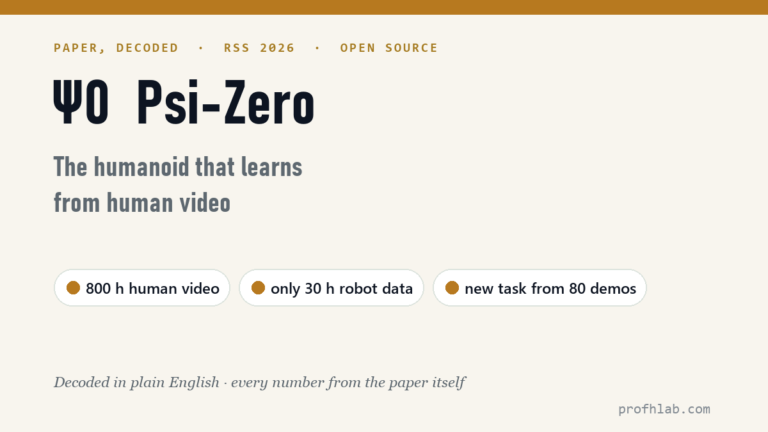
- Ψ0 (Psi-Zero), Explained: The Humanoid Foundation Model That Learns From Human Video
- MotionWAM, Explained: One-Shot Imagination Brings Real-Time Humanoid Loco-Manipulation
- XHugWBC, Explained: One Policy That Drives 12 Different Humanoids
- Vision-Tactile Pretraining, Explained: A Robot Hand Learns Human-Like Dexterity From a Webcam
- TouchWorld, Explained: A Robot Hand That Predicts Touch Before Making Contact
- HOUND and APT-RL, Explained: One Transformer Brain for Walking, Running, and Jumping in the Wild
Machines, priced
- Tesla Optimus V3 Release Date, Price and Specs: What Tesla Has Confirmed
- Buying a Humanoid Robot in 2026: What a Unitree R1 Really Costs, Retail vs Import
- Robot Dog Prices in 2026: From ≈$2,900 to ≈$71,000 — and Spot Still Has No Price Tag
- Tesla FSD Goes Subscription-Only in Korea — and the ‘5-Year Break-Even’ Everyone Quotes Is Wrong
Home robots, tested
- Narwal Freo Z10 Ultra Review: 18,000Pa, a 75°C Mop Wash, and Three Honest Drawbacks
- 22,000Pa vs 240 Air Watts: Robot Vacuum Suction Numbers, Decoded (2026)
- Robot Vacuum or Stick Vacuum? I Split Housework Into 10 Tasks — Only One Truly Overlaps
- The Sour Smell Isn’t the Mop: Robot Vacuum Odor by Zone, and a 7–9x Consumables Gap
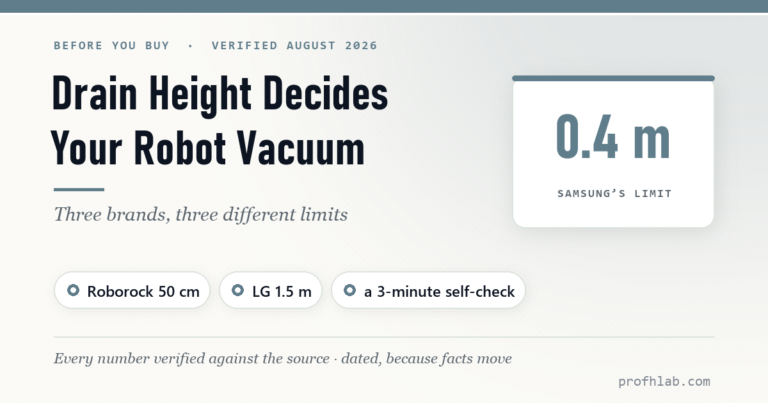
- Drain Height Decides Your Robot Vacuum: Samsung 0.4 m, Roborock 50 cm, LG 1.5 m
- Robot Vacuum Repair Costs 2026: A $140 Fix and a 56.5% Resolution Rate
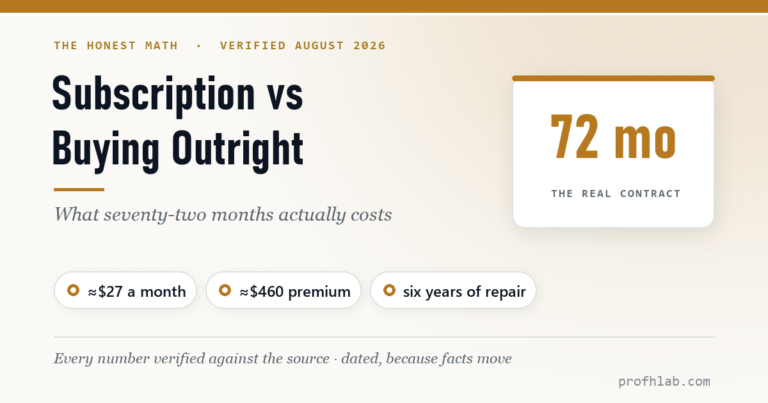
- Robot Vacuum Subscription vs Buying: What iRobot Select Really Costs
- Are Window-Cleaning Robots Worth It? The Break-Even vs Hiring a Pro
- Smart Speakers in 2026: The Hardware Is $99 — the Assistant Is the Real Price
- Serving Robot Costs in 2026: $399 a Month, and Why 73.3% Saw No Change
Chips & companies
- HBF and zHBM, Explained: Samsung and SK Hynix Give Opposite Answers to the Same Memory Problem
- Korea’s Chip Equipment Makers, Compared: Profits Fell 68% — So Why Did Pay Jump 29%?
- Samsung DS vs DX: One Company, a $450,000 Bonus Gap — and Why the Simple Story Is Wrong
- ASML Korea’s Starting Pay Is $31K — or $46K: Anatomy of a 2.15x Salary-Data Gap
Looking for the other library? Generative AI — tools, tested →
Prof.’s H Newsletter
One short email a month, with the numbers in it
What actually moved in AI hiring, AI prices, and the scams aimed at older Americans. Counted here, dated, and linked to the source. One email a month, and your address goes nowhere else.