HOUND and APT-RL, Explained: One Transformer Brain for Walking, Running, and Jumping in the Wild
You are climbing stairs when the ground suddenly turns to dirt; a fallen tree and exposed roots block the way. A person changes stride without a second thought — but for robots, this “wild,” where the terrain shifts moment to moment, has long been a wall too high to clear.
The KAIST team’s paper that took the cover of Science Robotics, the field’s most prestigious journal, on July 16, 2026, gets a quadruped robot to judge terrain on its own and switch smoothly among walking, running, jumping, and ledge-climbing with a single “brain,” sprinting rough ground at up to 6 m/s. The robot is HOUND.
| Item | Details |
| Original title | Agile perceptive multiskill locomotion for quadrupedal robots in the wild |
| Authors / affiliation | Jun-Gill Kang, Seungwoo Hong, Jaehyun Park, Hae-Won Park, et al. — KAIST Dept. of Mechanical Engineering; Korea University |
| Journal / date | Science Robotics, Vol. 11, Issue 116 (July 16, 2026 — cover article) |
| DOI | 10.1126/scirobotics.adz7397 |
Source: science.org/doi/10.1126/scirobotics.adz7397
The core technique
The heart of the paper is a training method called APT-RL — reinforcement learning built on an Action Pretrained Transformer. The name is heavy; an analogy makes it light.
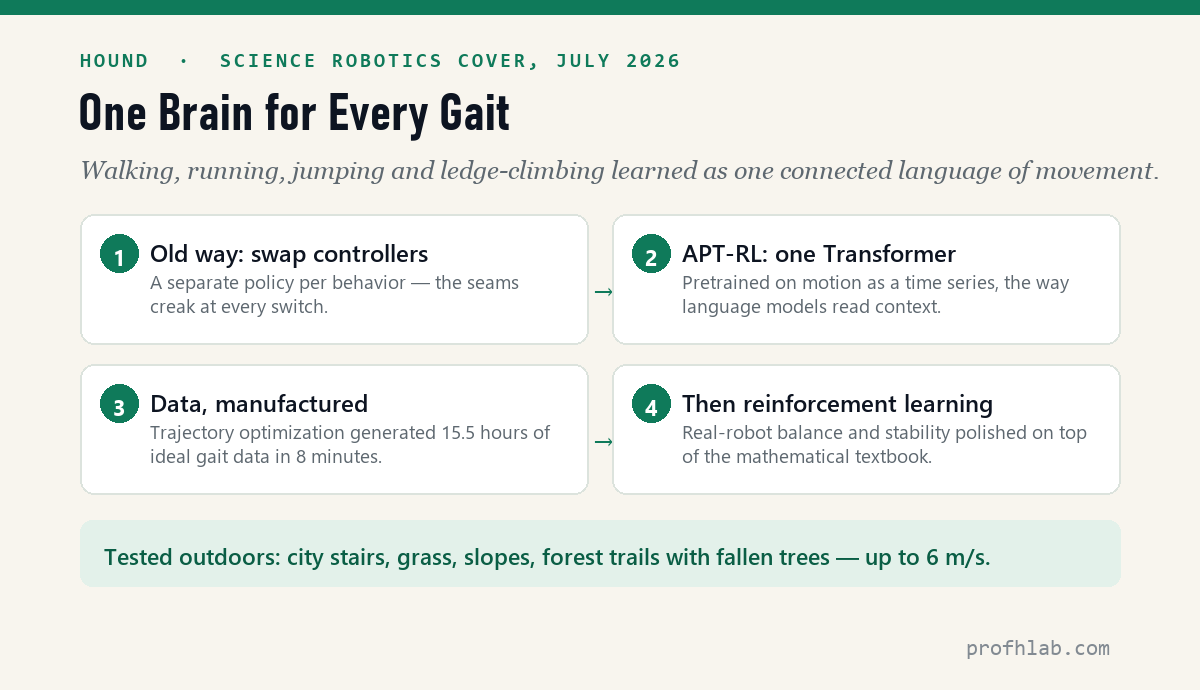
Traditional robot training was close to memorizing “one answer for one situation”: a flat-ground walking controller, a stairs controller, a jump controller — each built separately and swapped in as conditions change. Imagine a person who swaps out their brain for walking, for running, and for climbing stairs. The seams creak at every switch, and unexpected terrain easily brings the whole arrangement down.
APT-RL instead settles all of these abilities into one Transformer neural network in advance. The Transformer — the very architecture behind ChatGPT — is strong at reading context through time: “given this posture, this speed, this terrain, what motion naturally comes next?” So the robot does not learn walking, running, jumping, and ledge-climbing as separate subjects; it learns them whole, as one connected language of movement. When stairs give way to a dirt path, a single controller shifts on its own between a walking gait (trot) and a bounding gait — the way a person naturally adjusts stride.
Source: eurekalert.org/news-releases/1136178
The theory in plain words
APT-RL’s other weapon is the speed at which it manufactures training data. Teaching a robot diverse motions requires a vast library of demonstration data, which used to mean motion-capturing human or animal movement piece by piece — costly in both time and money.
The team moved that entire process into simulation. Using the robot’s physical equations (its dynamics model) and trajectory optimization — a technique that directly computes, by mathematics, the most efficient movement path this robot’s joints and forces can produce — they auto-generated 15.5 hours’ worth of high-quality locomotion data in just 8 minutes. No motion capture: the computer wrote its own textbook of ideal gaits.
That massive textbook pretrains the Transformer, and reinforcement learning then polishes the real robot’s balance and stability. “A mathematically manufactured perfect demonstration” plus “learning by falling down and getting up” — that combination is APT-RL’s skeleton.
Source: science.org/doi/10.1126/scirobotics.adz7397
Real-world results
The robot reads the surrounding 3D terrain in real time with a depth camera and LiDAR. It looks ahead, decides for itself “now is the time to run; now is the time to be careful,” and picks its own target speed and gait. What matters most: the experiments went beyond indoor obstacle courses into real outdoor environments — city stretches mixing stairs, grass, and slopes, plus the KAIST campus and forest trails covered with fallen trees and leaf litter. This is not a lab-only robot that works just inside a simulator.
The paper’s corresponding author expects the work to become a foundational technology that broadens where physical-AI-based legged robots can operate — in harsh settings such as disaster sites, defense missions, and industrial facility inspection. Warehouse stairs and ramps, construction sites, and mountain search-and-rescue are the first candidates. The limits are just as plain: battery endurance, component durability at high speed, and safety validation in complex spaces shared with people are homework still to be done before commercialization.
Source: eurekalert.org/news-releases/1136178
Why it matters
The quadruped field has long been led by Boston Dynamics (Spot) and Unitree. The symbolism here is that a university team took the cover of the field’s top journal on a frontier problem: terrain-adaptive high-speed locomotion.
It should energize industry as well. Rainbow Robotics (whose largest shareholder is Samsung Electronics) has deep ties to KAIST robotics; the robot businesses of Doosan Robotics, LG Electronics, and Samsung Electronics all face the same shared task of autonomous movement across rough, unstructured environments. A method like APT-RL — collapsing data-generation costs and unifying multiple motions into one network — is a key to deploying robots into the field faster and cheaper. In other words, this paper offers not just “a smarter robot” but “a more economical robot-learning pipeline.”
Source: science.org/doi/10.1126/scirobotics.adz7397
Who should care
- If you invest: robot competitiveness splits on “learning efficiency,” not hardware alone. Whoever holds data-and-simulation technology of the “15.5 hours of data in 8 minutes” kind ultimately wins on deployment speed. (An observation of technology trends, not a recommendation of any specific stock.)
- If you study or research: Transformers are powerful not only for language and video but for the time series called “robot motion.” The fusion of reinforcement learning × trajectory optimization × Transformers is the mainstream grammar of robot learning right now.
- If you build products: the era of building a separate controller per behavior is setting. The foundation-model style — “one policy, many skills” — cuts development and maintenance costs sharply.
Source: eurekalert.org/news-releases/1136178
The 3–5 year view
Three to five years out, this trajectory points at the normalization of legged robots that do not care about terrain: stairs, gravel, snow — walking in with no special setup to deliver, inspect, and search. Further on, “perception-driven multiskill integrated control,” proven on four legs, migrates to two-legged humanoids and becomes the lower-body (loco-manipulation) technology of general-purpose robots moving between factory and home. HOUND, which ran a forest trail at 6 m/s today, may be the ancestor of the rescue robot that arrives first at tomorrow’s disaster site.
No motion capture, one controller, and where HOUND could be deployed
What exactly does APT-RL do differently from older methods?
Two things. ① Walking, running, jumping, and ledge-climbing are not learned separately: one Transformer controller integrates them and switches by terrain on its own. ② Instead of motion capture, physics simulation plus trajectory optimization auto-generates 15.5 hours’ worth of training data in 8 minutes, cutting costs dramatically.
Where could HOUND actually be used?
The paper’s authors point first to rough settings that are dangerous or hard for people to reach: disaster response, defense missions, industrial facility inspection. Battery, durability, and safety validation in public spaces remain pre-commercialization homework.
Next on this shelf: following the quadruped, how this “perception-driven integrated control” extends to the whole-body balance control of biped humanoids — through the latest papers.
This article reinterprets published research for a general audience; for full details, see the original paper. The rest of the decoded-papers shelf lives on the Physical AI page.
The KAIST lab’s footage of HOUND’s 100m quadruped world record
Full index
Every guide in the Physical AI library — 27 of them, grouped so you can find the one you need.
Start here
- Physical AI Foundations: World Models, Robot Foundation Models, and Sim2Real — From Zero
- Physical AI Explained: Why a Chatbot Knows the Cup Falls but a Robot Doesn’t
- The Physical AI Toolbox: Six Free Simulators, a $249 Hardware Ladder, and What the 2026 Papers Admit
Research papers, decoded
- RoboVLMs, Explained: What Actually Makes a Robot Foundation Model Work
- Ψ0 (Psi-Zero), Explained: The Humanoid Foundation Model That Learns From Human Video
- MotionWAM, Explained: One-Shot Imagination Brings Real-Time Humanoid Loco-Manipulation
- XHugWBC, Explained: One Policy That Drives 12 Different Humanoids
- Vision-Tactile Pretraining, Explained: A Robot Hand Learns Human-Like Dexterity From a Webcam
- TouchWorld, Explained: A Robot Hand That Predicts Touch Before Making Contact
- ▸ HOUND and APT-RL, Explained: One Transformer Brain for Walking, Running, and Jumping in the Wild (you are here)
Machines, priced
- Tesla Optimus V3 Release Date, Price and Specs: What Tesla Has Confirmed
- Buying a Humanoid Robot in 2026: What a Unitree R1 Really Costs, Retail vs Import
- Robot Dog Prices in 2026: From ≈$2,900 to ≈$71,000 — and Spot Still Has No Price Tag
- Tesla FSD Goes Subscription-Only in Korea — and the ‘5-Year Break-Even’ Everyone Quotes Is Wrong
Home robots, tested
- Narwal Freo Z10 Ultra Review: 18,000Pa, a 75°C Mop Wash, and Three Honest Drawbacks
- 22,000Pa vs 240 Air Watts: Robot Vacuum Suction Numbers, Decoded (2026)
- Robot Vacuum or Stick Vacuum? I Split Housework Into 10 Tasks — Only One Truly Overlaps
- The Sour Smell Isn’t the Mop: Robot Vacuum Odor by Zone, and a 7–9x Consumables Gap
- Drain Height Decides Your Robot Vacuum: Samsung 0.4 m, Roborock 50 cm, LG 1.5 m
- Robot Vacuum Repair Costs 2026: A $140 Fix and a 56.5% Resolution Rate
- Robot Vacuum Subscription vs Buying: What iRobot Select Really Costs
- Are Window-Cleaning Robots Worth It? The Break-Even vs Hiring a Pro
- Smart Speakers in 2026: The Hardware Is $99 — the Assistant Is the Real Price
- Serving Robot Costs in 2026: $399 a Month, and Why 73.3% Saw No Change
Chips & companies
- HBF and zHBM, Explained: Samsung and SK Hynix Give Opposite Answers to the Same Memory Problem
- Korea’s Chip Equipment Makers, Compared: Profits Fell 68% — So Why Did Pay Jump 29%?
- Samsung DS vs DX: One Company, a $450,000 Bonus Gap — and Why the Simple Story Is Wrong
- ASML Korea’s Starting Pay Is $31K — or $46K: Anatomy of a 2.15x Salary-Data Gap
Looking for the other library? Generative AI — tools, tested →
Prof.’s H Newsletter
One short email a month, with the numbers in it
What actually moved in AI hiring, AI prices, and the scams aimed at older Americans. Counted here, dated, and linked to the source. One email a month, and your address goes nowhere else.