Robot Vacuum Subscription vs Buying: What iRobot Select Really Costs
How this was checked
Every plan price and term here is US, read off the published plan pages and verified August 11, 2026. The consumables figures come from manufacturer replacement-part pricing. Subscription terms change more often than hardware does — confirm before you sign.
Robot vacuums are now sold the way phones and cars are: not as a thing you own, but as a monthly line on your statement. In the US there is exactly one that matters, and almost nobody has run the arithmetic on it.
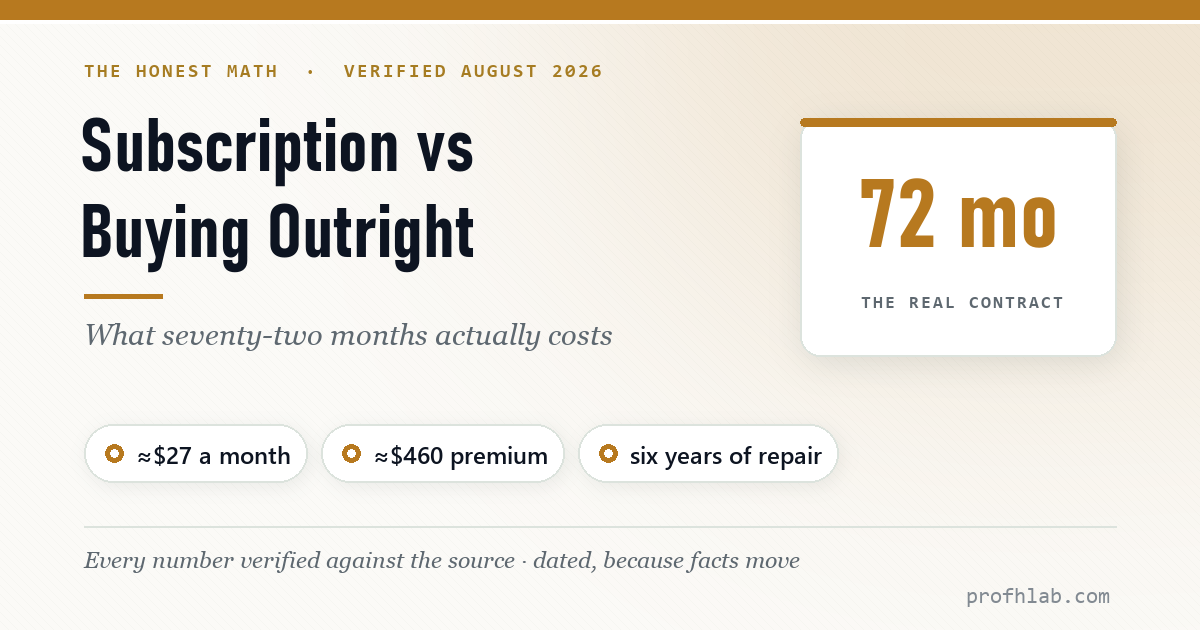
Here is the short version. iRobot Select costs $29.99 a month. Over three years that is $1,079.64 — and at the end of it you own nothing. Cancel and the robot goes back within 30 days. Whether that is a good deal or a bad one depends entirely on three things the marketing does not put side by side, so let us put them side by side.
What you are actually renting
Two plans exist, and they are different products wearing the same name.
| Plan | Monthly | What is included | Do you own it? |
|---|---|---|---|
| iRobot Select (Full) | $29.99 | The robot itself, automatic supply replenishment, extended warranty, priority support, and an upgrade to a newer model every three years | No. Cancel and you return the robot within 30 days |
| iRobot Select (Supplies) | $14.99 | Supply shipments timed to your usage, extended warranty, priority support, 20% off accessories | Yes — you bought the robot separately; this covers parts only |
| ECOVACS Premium | $2.99 ($29.99/year) | Software features: AI video monitoring, better object recognition, longer cleaning history, 3D map view | Not applicable — a software add-on, not a rental |
The multiplication nobody does: $29.99 × 36 months
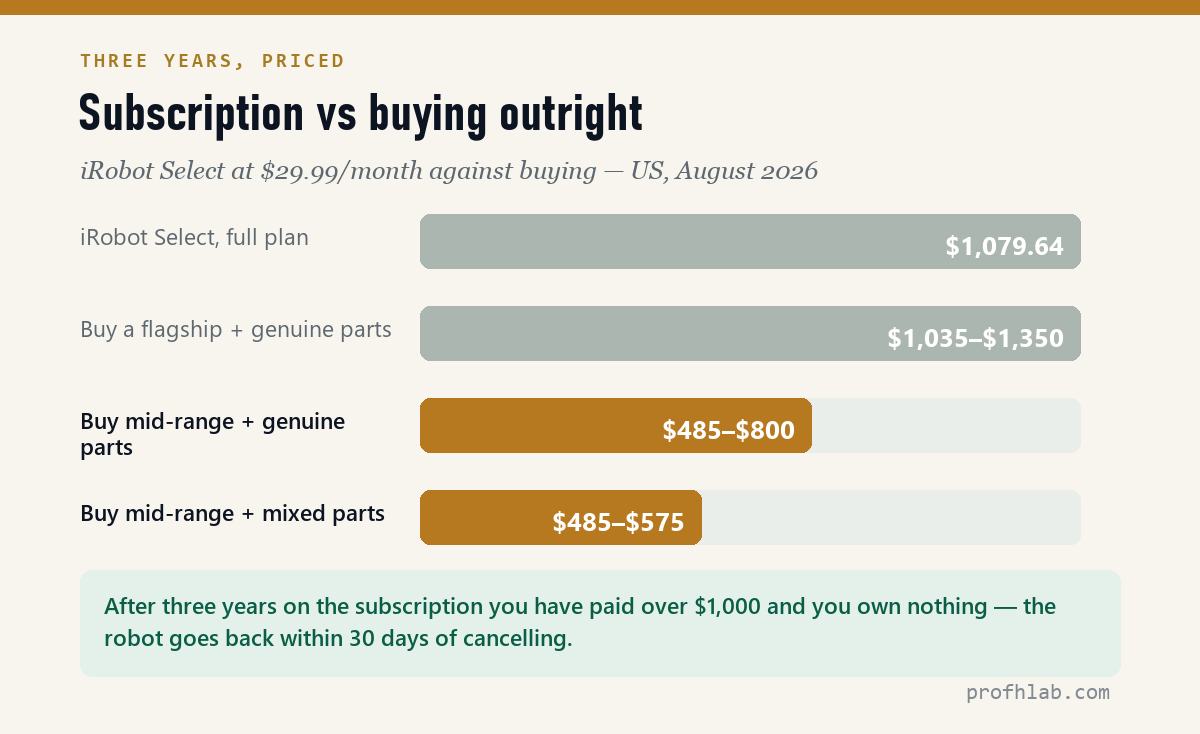
Three years on the full plan comes to $1,079.64. Now price the same three years the ordinary way.
| Route | Three-year total | Where you land |
|---|---|---|
| iRobot Select, full plan | $1,079.64 | Nothing to sell, but a newer machine arriving in year three |
| Buy a mid-range robot (~$350) + genuine consumables | About $485–$800 | You own a three-year-old robot |
| Buy a flagship (~$900) + genuine consumables | About $1,035–$1,350 | You own a three-year-old flagship |
| Buy mid-range + third-party consumables | About $485–$575 | You own it, and you spent the least |
So subscribing costs roughly $280 to $595 more than buying a mid-range robot outright over the same three years — and you end with nothing. Against a flagship purchase it is close to a wash.
That gap is not a scandal. It is the price of three things bundled together: repairs you do not pay for, parts that arrive without you ordering them, and a new machine every three years. The question is simply whether you will use all three.
The $14.99 supplies plan is the one to check twice
This is where the arithmetic gets uncomfortable. The supplies-only plan runs $179.88 a year. Buying the same genuine parts yourself — main brush, side brush, filter, pads, bags — runs about $90 to $150 a year. Mixed genuine and third-party parts run $45 to $75.
In other words, the supplies plan costs more than the supplies. What closes the gap is the extended warranty and priority support riding along with it. If your robot is out of its original warranty and you would otherwise be exposed to a $250 repair, that changes the maths. If it is still under warranty, you are paying a premium for the convenience of not clicking “reorder.”
Worth knowing either way, because that is the plan most owners are offered at checkout.
So who should subscribe, and who should just buy?
Four questions decide it, and none of them is the monthly price.
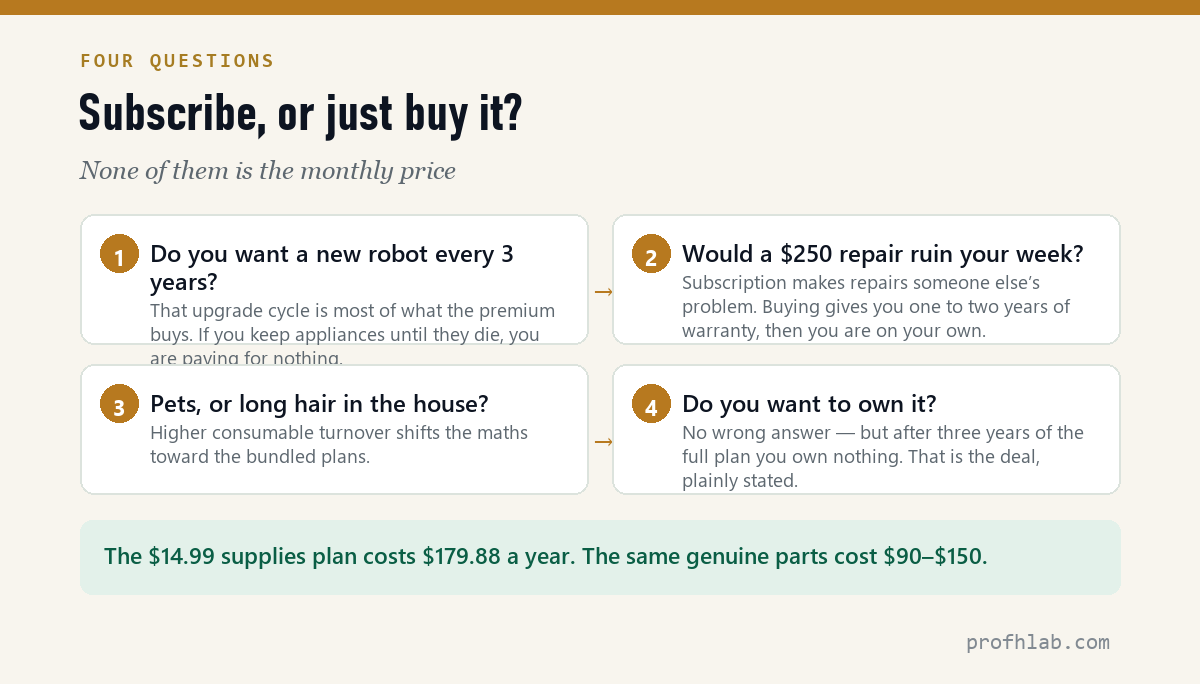
- Do you actually want a new robot every three years? If yes, the upgrade cycle alone justifies most of the premium — three years is roughly two product generations in this category. If you are the sort of person who keeps an appliance until it dies, you are paying for an upgrade you will not take.
- Would a $250 repair bill in year two ruin your week? Subscription makes repairs someone else’s problem. Buying means one year of warranty at most brands, two at iRobot and Roborock, and then you are on your own.
- Do you have pets or long hair in the house? Higher consumable turnover shifts the maths toward the bundled plans, because you will burn through brushes and filters faster than the average owner the pricing assumes.
- Do you want to own it? There is no wrong answer, but be clear-eyed: after three years of the full plan you have paid over a thousand dollars and you own nothing. That is the deal, plainly stated.
My read: buy the robot, skip the full subscription, and consider the supplies plan only once the original warranty has run out. A mid-range robot bought outright with mixed consumables is the cheapest honest route by several hundred dollars, and the money you save covers a repair if one comes.
The exception is real, though. If you genuinely want the newest machine every three years and you never want to think about parts or repairs again, the full plan is not a rip-off — it is a service, priced like one.
Cancel and you send it back: rental, financing and ownership
Q. What happens if I cancel?
On the full plan you return the robot — the published terms give you 30 days to send it back. This is a rental, not a payment plan, and that distinction is the single most misunderstood thing about it.
Q. Is there a rent-to-own robot vacuum in the US?
Not from the major brands. Retail financing exists at checkout — that is a loan, and you own the machine at the end. A subscription is a different arrangement: you never own it. Read which one you are signing.
Q. Does the subscription cover accidental damage?
Plans of this kind cover mechanical and electrical failure. Drops, water damage and pet accidents are usually excluded. Ask specifically before you assume, because it is the difference between a free repair and a $250 one.
Q. Is the ECOVACS $2.99 plan worth it?
It buys software features, not hardware or repairs. If you want AI video monitoring and 3D map history, it is inexpensive. If you were expecting it to cover parts or a broken dock, it does not.
Pay $29.99 for predictability, not to save money
A subscription is not a cheaper way to get a robot vacuum. It is a way to convert an unpredictable cost — repairs, parts, replacement — into a predictable one, and to always have current hardware. Priced that way, $29.99 a month is honest. Priced as “a cheap way in,” it is not, and the $1,079.64 you will have spent by year three says so.
Sources: published US plan pricing and terms for iRobot Select and ECOVACS Premium, and manufacturer replacement-part pricing for the consumables comparison, verified August 11, 2026. Plan terms change — confirm the current ones before you sign.
Vacuum Wars tests whether robot vacuums are worth their price
Full index
Every guide in the Physical AI library — 27 of them, grouped so you can find the one you need.
Start here
- Physical AI Foundations: World Models, Robot Foundation Models, and Sim2Real — From Zero
- Physical AI Explained: Why a Chatbot Knows the Cup Falls but a Robot Doesn’t
- The Physical AI Toolbox: Six Free Simulators, a $249 Hardware Ladder, and What the 2026 Papers Admit
Research papers, decoded
- RoboVLMs, Explained: What Actually Makes a Robot Foundation Model Work
- Ψ0 (Psi-Zero), Explained: The Humanoid Foundation Model That Learns From Human Video
- MotionWAM, Explained: One-Shot Imagination Brings Real-Time Humanoid Loco-Manipulation
- XHugWBC, Explained: One Policy That Drives 12 Different Humanoids
- Vision-Tactile Pretraining, Explained: A Robot Hand Learns Human-Like Dexterity From a Webcam
- TouchWorld, Explained: A Robot Hand That Predicts Touch Before Making Contact
- HOUND and APT-RL, Explained: One Transformer Brain for Walking, Running, and Jumping in the Wild
Machines, priced
- Tesla Optimus V3 Release Date, Price and Specs: What Tesla Has Confirmed
- Buying a Humanoid Robot in 2026: What a Unitree R1 Really Costs, Retail vs Import
- Robot Dog Prices in 2026: From ≈$2,900 to ≈$71,000 — and Spot Still Has No Price Tag
- Tesla FSD Goes Subscription-Only in Korea — and the ‘5-Year Break-Even’ Everyone Quotes Is Wrong
Home robots, tested
- Narwal Freo Z10 Ultra Review: 18,000Pa, a 75°C Mop Wash, and Three Honest Drawbacks
- 22,000Pa vs 240 Air Watts: Robot Vacuum Suction Numbers, Decoded (2026)
- Robot Vacuum or Stick Vacuum? I Split Housework Into 10 Tasks — Only One Truly Overlaps
- The Sour Smell Isn’t the Mop: Robot Vacuum Odor by Zone, and a 7–9x Consumables Gap
- Drain Height Decides Your Robot Vacuum: Samsung 0.4 m, Roborock 50 cm, LG 1.5 m
- Robot Vacuum Repair Costs 2026: A $140 Fix and a 56.5% Resolution Rate
- ▸ Robot Vacuum Subscription vs Buying: What iRobot Select Really Costs (you are here)
- Are Window-Cleaning Robots Worth It? The Break-Even vs Hiring a Pro
- Smart Speakers in 2026: The Hardware Is $99 — the Assistant Is the Real Price
- Serving Robot Costs in 2026: $399 a Month, and Why 73.3% Saw No Change
Chips & companies
- HBF and zHBM, Explained: Samsung and SK Hynix Give Opposite Answers to the Same Memory Problem
- Korea’s Chip Equipment Makers, Compared: Profits Fell 68% — So Why Did Pay Jump 29%?
- Samsung DS vs DX: One Company, a $450,000 Bonus Gap — and Why the Simple Story Is Wrong
- ASML Korea’s Starting Pay Is $31K — or $46K: Anatomy of a 2.15x Salary-Data Gap
Looking for the other library? Generative AI — tools, tested →
Prof.’s H Newsletter
One short email a month, with the numbers in it
What actually moved in AI hiring, AI prices, and the scams aimed at older Americans. Counted here, dated, and linked to the source. One email a month, and your address goes nowhere else.