Tesla FSD Goes Subscription-Only in Korea — and the ‘5-Year Break-Even’ Everyone Quotes Is Wrong
On June 30, 2026, a motoring reporter settled into a Model X and spent six and a half hours driving 300 km (186 miles) around Seoul and its suburbs with one goal: find out whether the Tesla FSD that had just arrived in Korea lives up to the advertising.
Highway lane changes were smooth. Roundabouts went fine. Toll gates, handled. Then, at a section where an unprotected left turn is not allowed, the car cut straight across two solid yellow lines — the centerline — to turn left. In an alley marked one-way only by paint on the road, it ignored the marking and tried to drive in. In a no-cut-in enforcement zone, it crossed a solid line to change lanes. Had enforcement been on site, the reporter noted, those were ticketable moves.
And then the price tag on that feature changed. Through August 9, 2026, FSD in Korea was a one-time purchase: ₩9,043,000 (≈$6,500). From August 10, it became a subscription — ₩150,000 (≈$107) a month — and the one-time option is gone. Figures verified August 10, 2026; dollar figures are approximate, at about ₩1,400 per dollar.
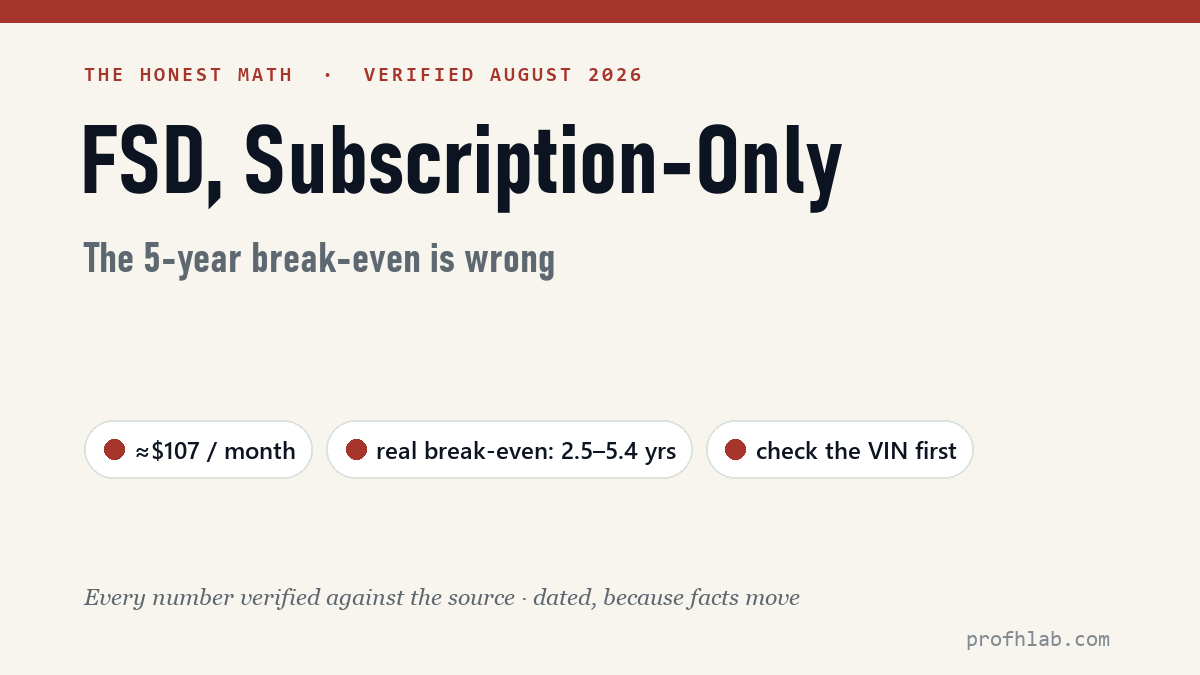
The short version: Tesla Korea switched FSD to a ₩150,000/month subscription on August 10, 2026 and removed the ₩9,043,000 outright purchase. The “60-month (5-year) break-even” circulating online is just ₩9.04M divided by ₩150K, and it misses two things: the opportunity cost of the lump sum (which stretches break-even to 64.3 months) and the resale value FSD adds back to the car (which, at a 50% recovery assumption, cuts break-even to 30.1 months).
Bigger still: every new Model Y sold in Korea is Shanghai-built and not eligible for FSD v14 Lite. From this change onward, the only way to permanently own FSD in Korea is to buy a used U.S.-built Tesla with FSD already active.
What changed on August 10
Tesla Korea announced the sales change on July 11; six outlets (ZDNet Korea, Digital Today, AutoTribune, Green Economy Daily, The Fact, Insight) reported the same numbers.
| Through August 9 | From August 10 | |
|---|---|---|
| FSD purchase | One-time ₩9,043,000 (VAT included) | Subscription ₩150,000/month (VAT included) |
| FSD for EAP owners | One-time upgrade available | ₩75,000/month (≈$54) — a 50% discount |
| New EAP purchase (U.S.-built cars) | Available | Not available |
| New EAP purchase (China-built cars) | Available | Available — ₩4,522,000 (≈$3,200, VAT included) |
| Existing one-time buyers | — | Unaffected; keep using as before |
The most-asked question first: if you already paid the ₩9.04M, nothing changes. Tesla states that customers who bought FSD outright keep using the feature exactly as before. The new terms apply only to new buyers.
Korea is not an outlier here. The U.S. ended one-time FSD sales on February 14, 2026 in favor of the $99/month subscription. Korea was among the last one-time markets — alongside China, Chile, and Colombia — and has now left that list.
The 60-month math everyone is sharing
As the news spread, the same calculation appeared everywhere: ₩9,043,000 ÷ ₩150,000 = 60.29 months. Keep the car for five-plus years and outright wins; sell earlier and the subscription wins. The arithmetic itself is correct. Spread over ownership periods it looks like this:
| Ownership | Subscription total (₩150K/mo) | One-time | Difference |
|---|---|---|---|
| 1 year (12 mo) | ₩1.8M (≈$1,290) | ₩9,043,000 | Subscription cheaper by ₩7.24M (≈$5,200) |
| 2 years | ₩3.6M (≈$2,570) | ₩9,043,000 | Subscription cheaper by ₩5.44M |
| 3 years | ₩5.4M (≈$3,860) | ₩9,043,000 | Subscription cheaper by ₩3.64M |
| 4 years | ₩7.2M (≈$5,140) | ₩9,043,000 | Subscription cheaper by ₩1.84M |
| 5 years (60 mo) | ₩9.0M (≈$6,430) | ₩9,043,000 | Nearly equal (₩43,000) |
| 6 years | ₩10.8M (≈$7,710) | ₩9,043,000 | One-time cheaper by ₩1.76M |
| 7 years | ₩12.6M (≈$9,000) | ₩9,043,000 | One-time cheaper by ₩3.56M |
Clean — and missing two things: what spending ₩9M today costs you, and how much of that ₩9M comes back later. Add them and the answer moves once against the lump sum, and once — much harder — in its favor.
Correction one: a lump sum isn’t free money
Choosing outright means spending ₩9.04M today. Choosing the subscription means that ₩9.04M stays in your account, earning interest. Simple division ignores this.
The honest question is: “If I park ₩9.04M in a deposit and pay the ₩150K subscription out of it each month, how many months does it last?” That duration is the true break-even.
The Bank of Korea’s base rate rose to 2.75% on July 16, 2026. A one-year deposit at 2.8% pre-tax, minus Korea’s 15.4% interest tax, nets about 2.37%. On those terms, the answer is 64.3 months.
| Method | Break-even | vs the folk math |
|---|---|---|
| Simple division (₩9.043M ÷ ₩150K) | 60.3 months (5 yr 0 mo) | Baseline |
| With opportunity cost (2.37% net assumed) | 64.3 months (5 yr 4 mo) | +4.0 months |
Four months. Not dramatic — but “break even in five years” actually means “five years and four months,” and that is worth knowing before deciding. Higher rates widen the gap. This correction hurts the lump sum. The next one swings the other way, and much harder.
Correction two: FSD stays with the car — and comes back as resale value
This is the part the viral math misses entirely. FSD is attached to the vehicle. You cannot move it to your next car — but when you sell, it stays with the car for the next owner. So the ₩9.04M is not money that simply vanishes; part of it returns inside the used-car price. The ₩150K subscription fee, by contrast, is 100% gone the moment it is paid. Recovery rate: zero.
The used market is already showing this is not a theory (Herald Business, two reports in July):
| Observation | Detail |
|---|---|
| Model-year inversion | 2021–2022 Model Ys selling for more than 2024–2025 cars |
| U.S.-built premium | A U.S.-built Model Y listed at ₩70M (≈$50,000) |
| Listed asking prices | 2022 Model Y Long Range AWD at ₩99.99M–₩111.11M (≈$71,000–$79,000) against a ₩66.99M (≈$48,000) new car |
| Depreciation defense | January–June price decline: Tesla 3.0% vs Hyundai 4.1%, Kia 6.7%, Mercedes 9.5%, BMW 9.7% |
A three-year-old used car above new-car money makes no sense — until you add FSD. The used car carries a feature the new car cannot get (next section explains why). Fold a recovery rate into the math and the break-even transforms:
| Assumed resale recovery | Effective one-time cost | Break-even | Read |
|---|---|---|---|
| 0% (the folk math’s silent assumption) | ₩9,043,000 | 60.3 mo (5.0 yr) | Five years to break even |
| 30% | ₩6.33M (≈$4,520) | 42.2 mo (3.5 yr) | Three and a half years |
| 50% | ₩4.52M (≈$3,200) | 30.1 mo (2.5 yr) | Two and a half years |
| 70% | ₩2.71M (≈$1,940) | 18.1 mo (1.5 yr) | Eighteen months |
Assume just 50% recovery and the break-even halves: 60.3 months becomes 30.1. “You need five years to justify outright” can quietly become “two and a half years is enough.” But be clear about what these are: 30% and 50% are scenario assumptions, not measured rates. U.S.-built FSD cars are scarce right now, which inflates the premium; future supply could deflate it.
One honest limitation: I could not confirm in official Tesla documentation that FSD transfers to the next owner on a private sale. Media descriptions blur two different statements — “doesn’t transfer” (to your next car) and “transfers” (to the car’s next owner). The live market premium argues that transfer works; still, if you are buying a used Tesla for the FSD, verify activation in the car and the Tesla app before signing anything.
Your car may not qualify at all — check the first VIN character
Before “fine, I’ll subscribe,” check one thing: your car may not be an FSD v14 Lite target at all.
Tesla Korea’s July 10 rollout of FSD v14 Lite defines eligibility as: U.S.-built Model 3 and Model Y vehicles with the FSD computer installed and FSD (Supervised) activated. The key words are U.S.-built. Where your car was made shows in the first character of the VIN, printed on the registration papers and at the base of the windshield.
| VIN starts with | Built in | FSD v14 Lite |
|---|---|---|
| 5 (5YJ…) | Fremont, USA | Eligible |
| L (LRW…) | Shanghai Gigafactory | Not eligible |
And here is the surprise for many owners: as of 2026, every new Model Y sold in Korea is built at the Shanghai Gigafactory. The Model 3 switched to China-built units from the 2024 model year, the Model Y from 2023. Most people who bought a new Tesla in Korea in recent years cannot receive this feature even if they are willing to pay the monthly fee.
The eligible cars come from the U.S.-import era: Model 3 from 2019, and Model Y mostly 2021 through 2023. Industry estimates put Korea’s HW3 fleet at around 170,000 cars (a secondary-source estimate).
This is also the answer to the model-year inversion in the last section. The older cars are not better cars — they are the only cars that can run FSD.
| Step | What to check | Where |
|---|---|---|
| 1 | VIN first character: 5 or L | Registration papers · base of the windshield |
| 2 | FSD computer (HW3 or later) installed | Car screen → Controls → Software → Additional vehicle information |
| 3 | FSD (Supervised) active | Tesla app → Upgrades |
| 4 | Software version (2026.20.6.11 line or later) | Car screen → Controls → Software |
FSD Lite is not the full v14 — it’s a model distilled to 15%
The “Lite” suffix is earned. HW3 lacks the compute to run the HW4-native v14 neural network as-is, so Tesla distilled the original network down to roughly 15% of its size to fit the older hardware.
| Item | HW3 + FSD v14 Lite | HW4 (AI4) + FSD v14 |
|---|---|---|
| Network size | Compressed to ~15% of the original | Full network |
| Eligible cars | U.S.-built Model 3 (2019–) · Model Y (2021–) | Later AI4-equipped cars |
| Feature set | Similar: lane changes, intersections, curves | Full |
| Frame rate | Lower | Higher |
| Recognition in complex scenes | May trail HW4 | Baseline |
| Hardware swap | Not needed (software update only) | — |
The feature list looks similar, but recognition accuracy and reaction speed in messy situations are not the same. The ₩150K monthly price is identical for HW3 and HW4 cars; the delivered performance is not. Know this before you subscribe.
What 300 km revealed — and what “Supervised” means
Back to the opening test drive (Asia Business Daily, June 30). Across 6.5 hours, four problems were logged:
| Situation | Observed behavior | Risk |
|---|---|---|
| Section where unprotected lefts are prohibited | Cut across the double solid yellow centerline to turn left | Centerline violation |
| Alley with one-way marking painted on the road only | Ignored the marking; attempted wrong-way entry | Wrong-way driving |
| No-cut-in enforcement zone | Crossed a solid line to change lanes | Ticketable behavior |
| Congestion | Bypassed the queue in the next lane, then forced a merge | Provoked hard braking behind |
The reporter’s conclusion: until its safety behavior is tuned to Korean road conditions, this is clearly a driver-assistance system. In fairness, plenty went well — smooth acceleration and braking, competent roundabouts, highway lane changes, and toll-gate passage.
Tesla itself does not dispute the framing. Its official FSD page states that FSD (Supervised) does not make the vehicle autonomous and may not perfectly recognize every obstacle, road condition, or traffic situation — the driver must stay attentive and be ready to take over immediately. The word “Supervised” in the name is an accurate technical description, not marketing modesty.
The legal position is equally clear: in Korea, FSD is classified as an SAE Level 2 driver-assistance feature. If a crash happens while the system is steering, responsibility rests entirely with the driver. Take your hands off and warnings escalate; repeat it and the feature locks out.
The same Tesla page reports 13,236,334,727 cumulative FSD miles and describes the system as “7x safer” than the average U.S. driver (a U.S.-basis estimate). Those miles were banked on American roads — and as the test drive showed, Korea’s narrow alleys and painted-only markings are, so far, a different story.
So what should you do? Four cases
| Your situation | Call | Why |
|---|---|---|
| Already bought FSD outright | Do nothing | Terms unchanged — plus possible resale-premium upside |
| U.S.-built car, no FSD | Subscribe first, then judge | The outright option is gone; experience HW3’s limits before committing further |
| China-built car (most recent buyers) | Wait | Not a v14 Lite target; no reason to pay before regulatory clearance |
| Want to own FSD permanently | Buy a used U.S.-built Tesla with FSD active | The only remaining path — and the market has already priced it |
The last row is the practical conclusion of this whole piece. As of this change, there is no way to buy FSD in Korea. There is only a way to rent it. Owning it means buying a car that already owns it — and the ₩70M U.S.-built Model Y and the above-new-car asking prices are the market saying it has noticed.
For subscribers, one usage pattern deserves a mention: the subscription can be canceled anytime — the one advantage outright never had. Run it only in heavy-driving months and the cost structure changes completely:
| Months used per year | Annual cost | Reaches ₩9.04M in |
|---|---|---|
| 12 (always on) | ₩1.8M | 5.0 years |
| 6 | ₩900K (≈$640) | 10.0 years |
| 4 (holidays and trips) | ₩600K (≈$430) | 15.1 years |
| 2 | ₩300K (≈$210) | 30.1 years |
EAP owners have different math entirely. At ₩75,000 a month, the simple break-even is 120.6 months — ten years. If you already hold Enhanced Autopilot, the subscription is overwhelmingly the rational choice.
Ordered by August 9? Your price, and canceling the subscription
Q. I ordered before the switch and delivery is this week. Do I keep the one-time price?
Tesla says orders placed and purchases made through August 9 keep their original terms — but individual contracts vary, so confirm your order and payment details in the Tesla app. Tesla has also flagged that pricing can be adjusted again after the announcement.
Q. Is there a cancellation penalty?
It is described as a monthly subscription cancelable at will. Check the in-app terms for cutoff dates and re-subscription rules.
Q. Will ₩150,000 stay ₩150,000?
Not guaranteed. Elon Musk has said repeatedly that the U.S. $99 price is not permanent and will rise as FSD performance improves. Every break-even above assumes the price holds; a hike worsens the subscription’s side of the ledger.
Q. When do China-built cars get FSD?
No confirmed schedule exists. It is tied to Korean regulatory approval, so any “soon” is speculation. Start by checking which side of the VIN table your car sits on.
Sources: Tesla Korea’s July 11 sales-change notice as reported by ZDNet Korea, Digital Today, AutoTribune, Green Economy Daily, The Fact, and Insight; Asia Business Daily’s 300 km test drive (June 30, 2026); Herald Business used-market reports (July 2026); Tesla’s official FSD page; Bank of Korea rate decision (July 16, 2026). Figures verified August 10, 2026; prices and policies can change. Informational only — not financial or purchase advice.
Part of the Physical AI library — research decoded and machines compared, in plain English: profhlab.com/physical-ai.
Linus and Luke argue over whether subscription-only FSD adds up
Full index
Every guide in the Physical AI library — 27 of them, grouped so you can find the one you need.
Start here
- Physical AI Foundations: World Models, Robot Foundation Models, and Sim2Real — From Zero
- Physical AI Explained: Why a Chatbot Knows the Cup Falls but a Robot Doesn’t
- The Physical AI Toolbox: Six Free Simulators, a $249 Hardware Ladder, and What the 2026 Papers Admit
Research papers, decoded
- RoboVLMs, Explained: What Actually Makes a Robot Foundation Model Work
- Ψ0 (Psi-Zero), Explained: The Humanoid Foundation Model That Learns From Human Video
- MotionWAM, Explained: One-Shot Imagination Brings Real-Time Humanoid Loco-Manipulation
- XHugWBC, Explained: One Policy That Drives 12 Different Humanoids
- Vision-Tactile Pretraining, Explained: A Robot Hand Learns Human-Like Dexterity From a Webcam
- TouchWorld, Explained: A Robot Hand That Predicts Touch Before Making Contact
- HOUND and APT-RL, Explained: One Transformer Brain for Walking, Running, and Jumping in the Wild
Machines, priced
- Tesla Optimus V3 Release Date, Price and Specs: What Tesla Has Confirmed
- Buying a Humanoid Robot in 2026: What a Unitree R1 Really Costs, Retail vs Import
- Robot Dog Prices in 2026: From ≈$2,900 to ≈$71,000 — and Spot Still Has No Price Tag
- ▸ Tesla FSD Goes Subscription-Only in Korea — and the ‘5-Year Break-Even’ Everyone Quotes Is Wrong (you are here)
Home robots, tested
- Narwal Freo Z10 Ultra Review: 18,000Pa, a 75°C Mop Wash, and Three Honest Drawbacks
- 22,000Pa vs 240 Air Watts: Robot Vacuum Suction Numbers, Decoded (2026)
- Robot Vacuum or Stick Vacuum? I Split Housework Into 10 Tasks — Only One Truly Overlaps
- The Sour Smell Isn’t the Mop: Robot Vacuum Odor by Zone, and a 7–9x Consumables Gap
- Drain Height Decides Your Robot Vacuum: Samsung 0.4 m, Roborock 50 cm, LG 1.5 m
- Robot Vacuum Repair Costs 2026: A $140 Fix and a 56.5% Resolution Rate
- Robot Vacuum Subscription vs Buying: What iRobot Select Really Costs
- Are Window-Cleaning Robots Worth It? The Break-Even vs Hiring a Pro
- Smart Speakers in 2026: The Hardware Is $99 — the Assistant Is the Real Price
- Serving Robot Costs in 2026: $399 a Month, and Why 73.3% Saw No Change
Chips & companies
- HBF and zHBM, Explained: Samsung and SK Hynix Give Opposite Answers to the Same Memory Problem
- Korea’s Chip Equipment Makers, Compared: Profits Fell 68% — So Why Did Pay Jump 29%?
- Samsung DS vs DX: One Company, a $450,000 Bonus Gap — and Why the Simple Story Is Wrong
- ASML Korea’s Starting Pay Is $31K — or $46K: Anatomy of a 2.15x Salary-Data Gap
Looking for the other library? Generative AI — tools, tested →
Prof.’s H Newsletter
One short email a month, with the numbers in it
What actually moved in AI hiring, AI prices, and the scams aimed at older Americans. Counted here, dated, and linked to the source. One email a month, and your address goes nowhere else.