The Physical AI Toolbox: Six Free Simulators, a $249 Hardware Ladder, and What the 2026 Papers Admit
On 1 June 2026, a robot walked onto the GTC Taipei stage: a Unitree H2 Plus body, five-fingered tactile hands from Sharpa Wave, an NVIDIA Jetson Thor where the head should be. About six feet, 150 pounds, 75 degrees of freedom.
NVIDIA said it was not for sale. They called it the GR00T reference humanoid — a standard machine for universities to do research on, with the Allen Institute for AI, ETH Zurich, the Stanford Robotics Center and UC San Diego named as first partners.
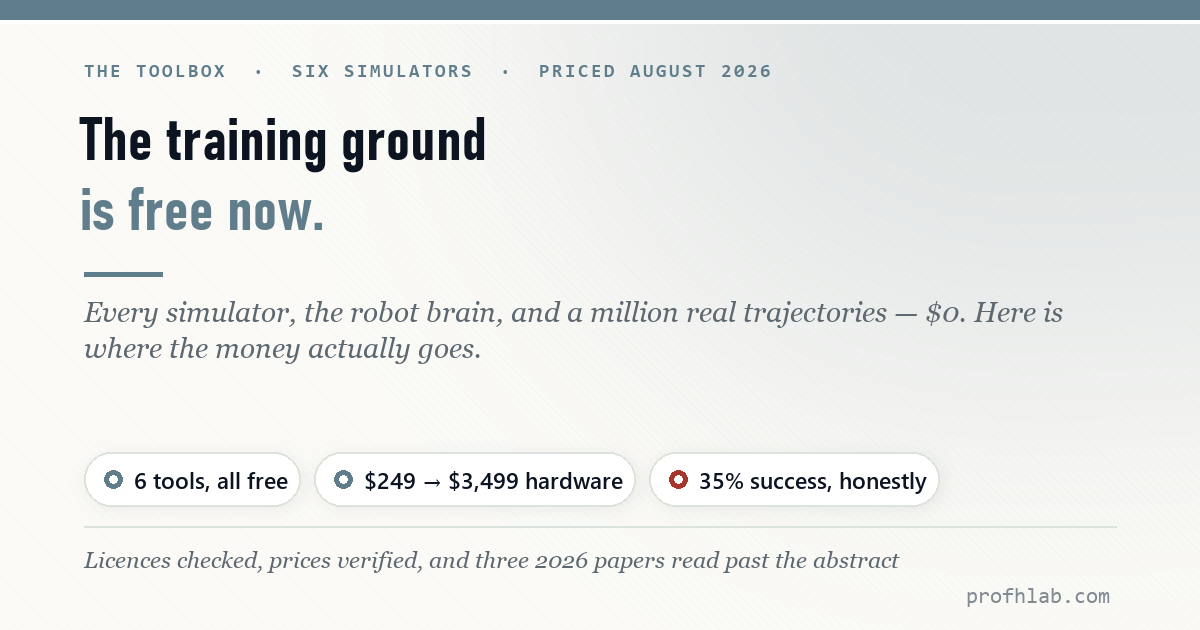
The interesting part was not the body. It was that nearly everything running inside it — the simulator, the training framework, even the foundation-model brain — is something you can download onto a laptop today. The price is zero, and the licences allow commercial use.
Read the first two parts first
This is part three of our Start-here path. Physical AI Foundations explains the five pillars without math; Physical AI Explained connects each pillar to the real system that implements it. This article assumes those ideas and goes straight to the tools.
Where these numbers come from
Every price was checked against the vendor’s page on 12 August 2026, every licence against the official repository, and all three papers were read past the abstract on arXiv the same day. Where a number is a vendor’s benchmark rather than an independent measurement, the text says so.
Six tools, and what each difference actually changes
First, a trap to avoid. Search “robot simulation software” and most results are offline-programming tools for industrial arms — software for previewing the path of a robot that is already programmed. Physical AI simulators are a different species: they run thousands of virtual worlds in parallel so a robot can teach itself.
| Tool | Maker / cost | What it is for | What the difference changes |
|---|---|---|---|
| Isaac Sim / Isaac Lab | NVIDIA / open source | GPU-parallel physics + photoreal RTX rendering; large-scale RL | Practically the only choice when the policy learns from camera pixels. Without an RTX GPU it will not even start |
| MuJoCo | Google DeepMind / Apache 2.0 | Precise contact physics; MJX runs on GPU/TPU | When fine contact decides the task — a hand closing on a cup — this is the accurate one. Renders plainly, so weak for vision learning |
| Genesis | CMU-led research team / open source | Pure-Python ultra-fast physics; 4D scene generation from text | “Months of training in hours” territory — but the 430,000× real-time figure is one specific benchmark scene, not your workload |
| Gazebo (Harmonic) | Open Robotics / open source | ROS 2-native integration, sensor plugins, large outdoor worlds | For validating a whole ROS stack — delivery robots, autonomy. Slower for learning than the three above |
| Open X-Embodiment | 21 institutions / public dataset | 1M+ real robot trajectories, 22 robot types | Removes the cold-start data problem. The finding: other robots’ experience helps even when your robot is not in the list |
| Isaac GR00T N1.7 | NVIDIA / Apache 2.0 | Open VLA foundation model for humanoids | You no longer build the brain from scratch — and commercial use is allowed, so it can ship inside a product |
The question every beginner asks: which one should I pick? The honest answer is that practitioners do not pick one.
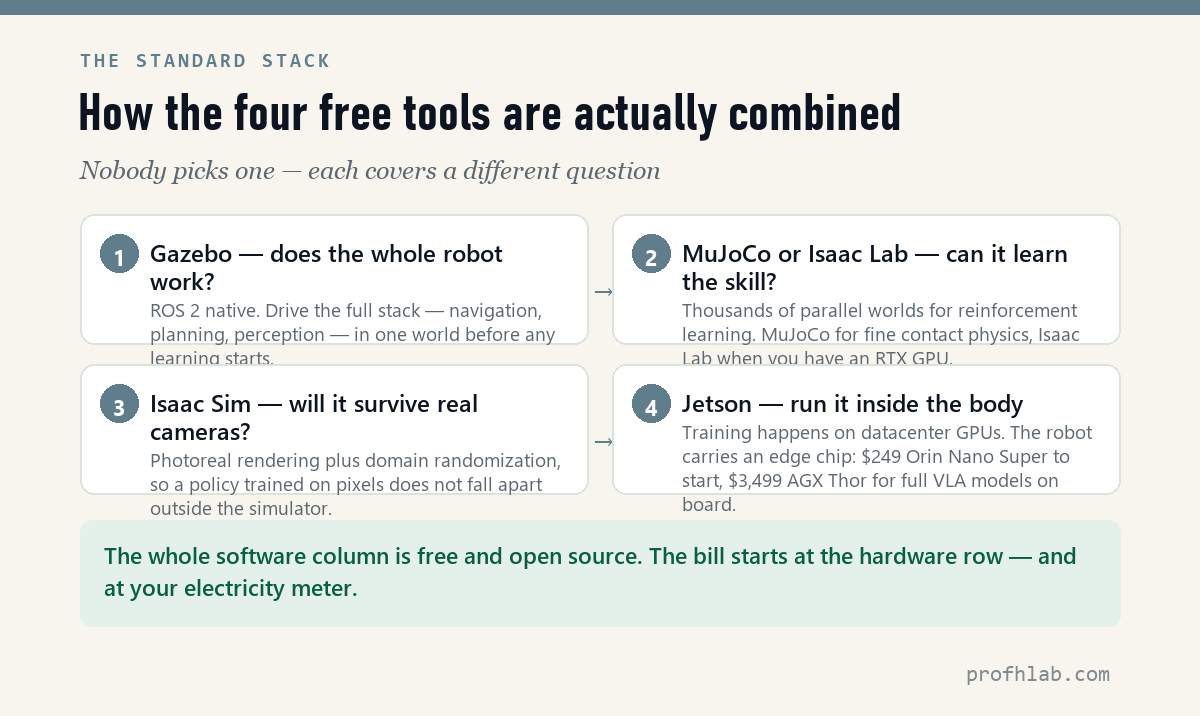
One piece of history worth knowing: MuJoCo began in 2012 as Emo Todorov’s project at the University of Washington, was acquired by Google DeepMind, and went fully Apache 2.0 in 2022. Software that once required a paid licence key is now one pip install.
If the frameworks are free, why did NVIDIA need 105 authors?
Isaac Lab’s official paper (arXiv:2511.04831, November 2025) lists 105 NVIDIA-affiliated authors — it reads like a white paper. What it emphasizes is not speed but integration: actuator models, sensors simulated at different rates, data-collection pipelines and domain-randomization tools in one platform. Translation: until now, researchers burned their time gluing those pieces together themselves. The paper also announces Newton, a differentiable GPU physics engine — when that lands, you will be able to differentiate through the simulation and optimize directly.
Hardware — where the money starts
Free software means the differentiation moved to hardware and data. The hardware sorts into three layers.
1. The chip that rides inside the robot
| Product | What you get | Price (official) | What the difference changes |
|---|---|---|---|
| Jetson AGX Thor dev kit | 2,070 FP4 TFLOPS, 2,560-core Blackwell GPU, 128 GB LPDDR5x, 40–130 W | $3,499 ($3,429 at 10+) | First generation that can run a VLA model inside the body. The 128 GB is the point — the whole model fits on board, so no cloud round-trip |
| Jetson AGX Orin | 1/7.5 the AI performance of Thor | varies by module | The class Boston Dynamics’ Spot actually uses. Plenty for locomotion policies; cramped for large language-vision models |
| Jetson Orin Nano Super | 67 TOPS (1.7× its predecessor) | $249 | The realistic starting point for individuals and classrooms — enough to run small VLMs and vision transformers on-device |
A training GPU and a robot chip are different animals
Jetson chips exist to run already-trained models inside a battery-powered body at 40–130 W. Training happens on datacenter GPUs. So the answer to “if I buy a Thor, can I train robots on it?” is no — Thor is where the finished model lives.
NVIDIA’s official Thor introduction (2.23M subscribers). 400,415 views as of 12 August 2026.
2. The robot itself — entry now starts at $100
The friendliest change is the entry price. The SO-101 arm from Hugging Face and RobotStudio is 3D-printable from public files: roughly $130 if you source the parts yourself, or $220–240 for the SO-ARM101 dual-arm kit. It plugs straight into Hugging Face’s open-source LeRobot library — a camera-equipped arm, a learning framework and public datasets as one set, for hobby money.
An independent build-and-train walkthrough of exactly this arm, from Nikodem Bartnik (245K subscribers). 450,978 views as of 12 August 2026.
At the other end sit the humanoids. The GR00T reference humanoid ships through Unitree late in 2026 — price not yet announced.
3. Sensors — the bottleneck the papers whisper about
Cameras and IMUs are cheap now. Touch is not. Note that the GR00T reference humanoid went out of its way to mount Sharpa Wave’s tactile five-fingered hands — because vision alone cannot tell you “I am holding it, and it is slipping.”
Who verifiably uses this stack
Only cases confirmed by official announcements or engineering blogs:
- Boston Dynamics — trained Spot’s locomotion policy in Isaac Lab and deployed it to the real robot; the pipeline is public on NVIDIA’s technical blog.
- ETH Zurich, the University of Toronto and the AI Institute — co-developed Orbit with NVIDIA, which became today’s Isaac Lab.
- Google DeepMind — maintains MuJoCo and publishes MJX and Playground.
- Allen Institute for AI, Stanford Robotics Center, UC San Diego ARCLab — named first partners for the GR00T reference humanoid.
Meanwhile, the money is betting on the bodies
If the software is free, where does American capital go? Into the machines that will run it.
- Figure AI closed a Series C of more than $1 billion in late 2025 at a valuation reported around $39 billion — total funding above $1.9 billion, with NVIDIA, Intel Capital, LG and Qualcomm Ventures on the list.
- Apptronik added a $520 million extension in February 2026, taking its Series A past $935 million and its valuation to roughly $5.3 billion — backed by Google, Mercedes-Benz and John Deere.
The shape of the market
Billions for the bodies; $0 for the training ground. That asymmetry is the strategy — a free software commons makes the expensive hardware useful, and the companies funding the commons also sell the chips. Understand that, and most physical-AI news makes sense.
Three 2026 papers, read past the abstract
1. The benchmark said 95%. The camera said under 30%.
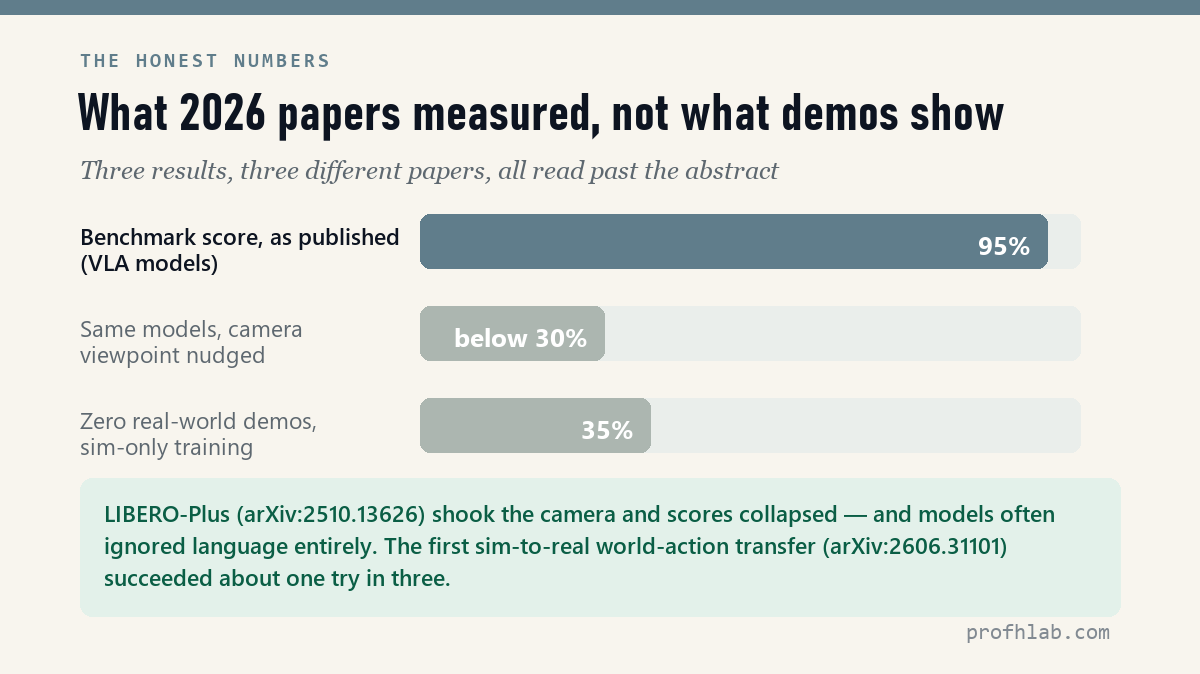
LIBERO-Plus (arXiv:2510.13626) perturbed VLA models seven ways — object placement, camera viewpoint, robot pose, language, lighting, background, sensor noise. Moderate changes to camera viewpoint and initial pose alone dropped success from 95% to below 30%. The stranger finding: changing the language barely moved results — because, follow-up experiments showed, the models largely ignore the instruction. They were not understanding the words. They were not listening.
2. A VLA that fits on a consumer GPU
Rethinking the Practicality of VLA Models (arXiv:2602.22663) starts from a practical complaint: current VLAs are too big, too expensive to pretrain, and break when the robot changes. The team built a new benchmark (CEBench: 14,400 simulated plus 1,600 expert real-world trajectories) and proposes LLaVA-VLA: a compact backbone with multi-view perception and action chunking, trained by two-stage post-training instead of costly pretraining — and claims the first end-to-end VLA for mobile manipulation, navigation and grasping in one action space.
3. Zero real demos — and a 35% success rate
Efficient Sim-to-Real Transfer of World-Action Models (arXiv:2606.31101) asks the question our Foundations article ends on: can a model trained purely on synthetic data drive a real robot zero-shot? Built on Cosmos Policy with about 800 synthetic demos per task and zero real-robot demonstrations, the transferred policies hit 35% average success on a real Franka arm across three tasks. The authors call it the first successful sim-to-real transfer of a world-action model.
The three papers in one sentence
The tools are free and robots now move without any real-world training data — but success is still one try in three, and benchmark scores collapse if you nudge the camera. We are in the gap between “it works” and “it is usable.”
The four-step path, if you start tonight
- Step 1 — pick a simulator ($0). RTX GPU → Isaac Lab. No GPU → MuJoCo:
pip install mujoco, runs on CPU. First milestone: make a hand-built robot model that does not fall over. - Step 2 — borrow data, do not collect it. Open X-Embodiment already holds 1M+ real trajectories across 22 robot types. In the RT-1-X experiments, low-data domains gained about 50% from other robots’ experience versus training alone.
- Step 3 — do not build the brain. GR00T N1.7 is Apache 2.0. Fine-tune it; do not attempt pretraining — the “unaffordable pretraining cost” paper 2 complains about is exactly that trap.
- Step 4 — hardware last, and small. A $249 Orin Nano Super plus a $130–240 SO-101 arm keeps real-world validation under $500. Buy the $3,499 Thor only after your policy is stable in simulation.
The honest limits
- “Free” is narrow. The licence is $0; the GPUs, the electricity and the data-collection labor are not. And Isaac locks you into NVIDIA RTX hardware.
- Marketing numbers are scene-specific. Genesis’s 430,000× real-time figure is 43 million FPS on one Franka arm over a flat plane. Add water, cloth or many contacts and it will not survive.
- Maturity is research-grade. A 35% zero-shot success rate is an academic milestone — and a machine that fails two times in three on a factory floor.
- The camera warning travels. After LIBERO-Plus, watch any humanoid demo video with one question first: is the camera bolted down?
Free simulators, the GPU catch and what $500 can build
Is robot simulation software really free?
All six tools in this guide are. MuJoCo is Apache 2.0, Isaac Sim, Isaac Lab and Genesis are open source, Gazebo has been open source for two decades, and the GR00T N1.7 foundation model is Apache 2.0 — which permits commercial products. The catch is hardware: the Isaac family effectively requires an NVIDIA RTX GPU, and training at scale costs real compute and electricity.
What is the difference between Isaac Sim and Isaac Lab?
Isaac Sim is the simulator itself — GPU physics plus photoreal rendering. Isaac Lab is a robot-learning layer that sits on top: it builds reinforcement- and imitation-learning environments and runs thousands of them in parallel on the GPU. It succeeded Isaac Gym in 2024, and its official paper (arXiv:2511.04831) appeared in November 2025 with 105 NVIDIA-affiliated authors.
How much does the NVIDIA Jetson Thor cost?
The Jetson AGX Thor developer kit lists at $3,499 ($3,429 each for ten or more), verified 12 August 2026. That buys 2,070 FP4 teraflops, 128 GB of memory and a 1 TB SSD, running at 40–130 W. For learning, the $249 Jetson Orin Nano Super is the realistic entry point.
Do I need an NVIDIA GPU to get started?
No. MuJoCo installs with one line — pip install mujoco — and runs on an ordinary CPU, including Apple silicon. You need an RTX GPU only when you move to the Isaac family for camera-based learning, and datacenter GPUs only when you train large policies. Start free, on the laptop you have.
What is a robot foundation model?
A single model that takes camera images and a language instruction and outputs robot actions directly — usually called a VLA (vision-language-action) model. NVIDIA’s GR00T N1 line is the best-known open one; N1.7 is Apache 2.0, so a startup can legally ship it inside a product. Our plain-English explainer covers how these models work.
What can I actually build for under $500?
A complete learn-at-home rig: a $249 Jetson Orin Nano Super for on-device inference, plus the Hugging Face SO-101 arm — about $130 if you source parts and print it yourself, or $220–240 as a dual-arm kit. That pairs with the free LeRobot library and public datasets, so the whole pipeline from teleoperation to a trained policy runs on hobby money.
Full index
Every guide in the Physical AI library — 27 of them, grouped so you can find the one you need.
Start here
- Physical AI Foundations: World Models, Robot Foundation Models, and Sim2Real — From Zero
- Physical AI Explained: Why a Chatbot Knows the Cup Falls but a Robot Doesn’t
- ▸ The Physical AI Toolbox: Six Free Simulators, a $249 Hardware Ladder, and What the 2026 Papers Admit (you are here)
Research papers, decoded
- RoboVLMs, Explained: What Actually Makes a Robot Foundation Model Work
- Ψ0 (Psi-Zero), Explained: The Humanoid Foundation Model That Learns From Human Video
- MotionWAM, Explained: One-Shot Imagination Brings Real-Time Humanoid Loco-Manipulation
- XHugWBC, Explained: One Policy That Drives 12 Different Humanoids
- Vision-Tactile Pretraining, Explained: A Robot Hand Learns Human-Like Dexterity From a Webcam
- TouchWorld, Explained: A Robot Hand That Predicts Touch Before Making Contact
- HOUND and APT-RL, Explained: One Transformer Brain for Walking, Running, and Jumping in the Wild
Machines, priced
- Tesla Optimus V3 Release Date, Price and Specs: What Tesla Has Confirmed
- Buying a Humanoid Robot in 2026: What a Unitree R1 Really Costs, Retail vs Import
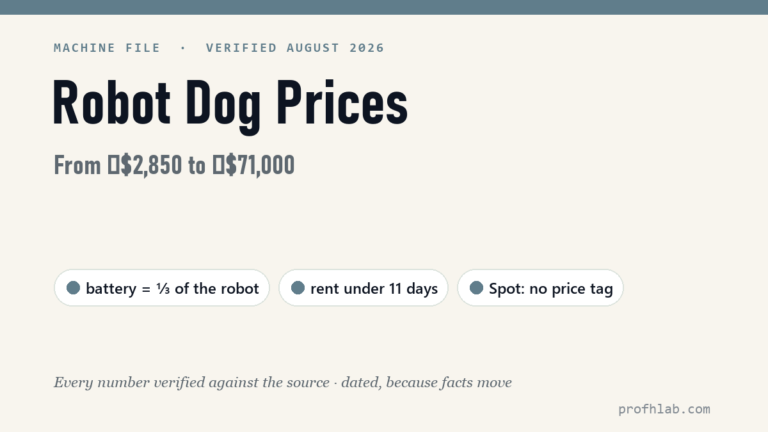
- Robot Dog Prices in 2026: From ≈$2,900 to ≈$71,000 — and Spot Still Has No Price Tag
- Tesla FSD Goes Subscription-Only in Korea — and the ‘5-Year Break-Even’ Everyone Quotes Is Wrong
Home robots, tested
- Narwal Freo Z10 Ultra Review: 18,000Pa, a 75°C Mop Wash, and Three Honest Drawbacks
- 22,000Pa vs 240 Air Watts: Robot Vacuum Suction Numbers, Decoded (2026)
- Robot Vacuum or Stick Vacuum? I Split Housework Into 10 Tasks — Only One Truly Overlaps
- The Sour Smell Isn’t the Mop: Robot Vacuum Odor by Zone, and a 7–9x Consumables Gap
- Drain Height Decides Your Robot Vacuum: Samsung 0.4 m, Roborock 50 cm, LG 1.5 m
- Robot Vacuum Repair Costs 2026: A $140 Fix and a 56.5% Resolution Rate
- Robot Vacuum Subscription vs Buying: What iRobot Select Really Costs
- Are Window-Cleaning Robots Worth It? The Break-Even vs Hiring a Pro
- Smart Speakers in 2026: The Hardware Is $99 — the Assistant Is the Real Price
- Serving Robot Costs in 2026: $399 a Month, and Why 73.3% Saw No Change
Chips & companies
- HBF and zHBM, Explained: Samsung and SK Hynix Give Opposite Answers to the Same Memory Problem
- Korea’s Chip Equipment Makers, Compared: Profits Fell 68% — So Why Did Pay Jump 29%?
- Samsung DS vs DX: One Company, a $450,000 Bonus Gap — and Why the Simple Story Is Wrong
- ASML Korea’s Starting Pay Is $31K — or $46K: Anatomy of a 2.15x Salary-Data Gap
Looking for the other library? Generative AI — tools, tested →
Prof.’s H Newsletter
One short email a month, with the numbers in it
What actually moved in AI hiring, AI prices, and the scams aimed at older Americans. Counted here, dated, and linked to the source. One email a month, and your address goes nowhere else.