22,000Pa vs 240 Air Watts: Robot Vacuum Suction Numbers, Decoded (2026)
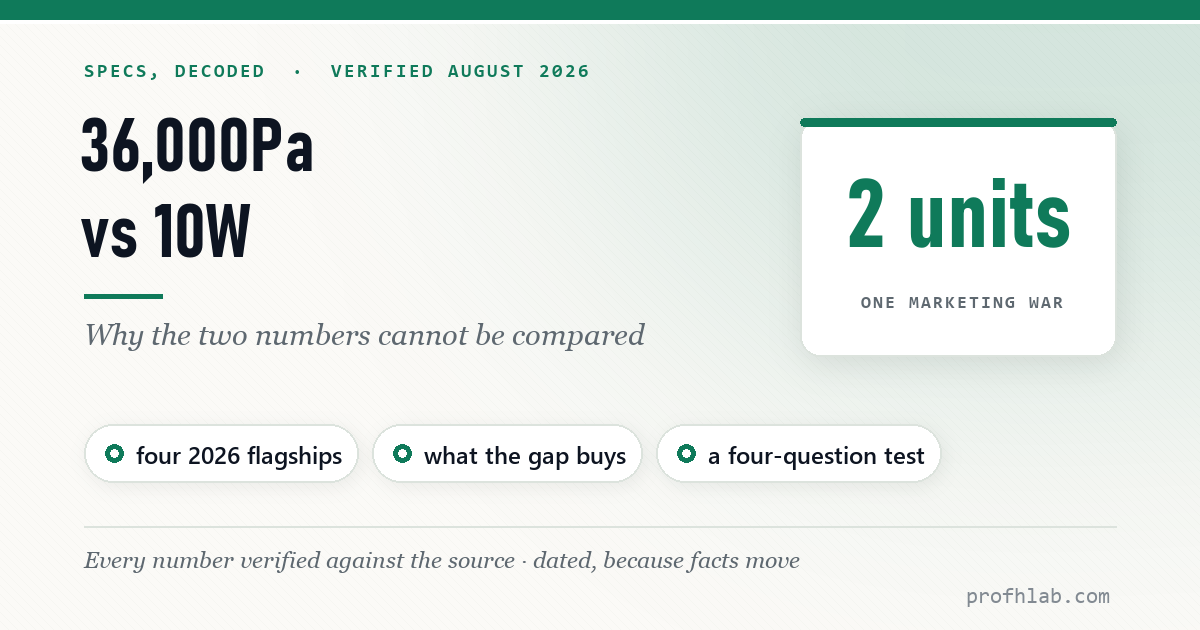
There is a scene that repeats itself in every vacuum aisle in America. One box says 22,000 pascals. Two steps away, a Dyson box says 240 air watts. Both are presented as the suction number, both are printed in the largest font on the package, and a shopper is expected to conclude that the bigger one wins.
Except those two numbers cannot be put on the same scale in the first place. A pascal (Pa) is pressure; an air watt is power. No formula converts one into the other, because they describe different physical quantities. And there is a more damning fact: the two most credible names in the category — Dyson on the stick side, Narwal on its newest robot — have both walked away from the pascal race entirely. One never entered it. The other left after two generations of winning it.
This piece clears the number war out of the way and lays out what actually separates the 2026 flagships you can buy in the US. Prices and specifications verified August 11, 2026.
How this was checked
Every price is US retail, verified August 11, 2026 against manufacturer stores and current listings. Suction figures are each manufacturer’s own published number — that is the point of the article, not an endorsement of them. Where a measurement standard is named, it is named because the manufacturer published it; most do not.
The number war — why W and Pa do not compare
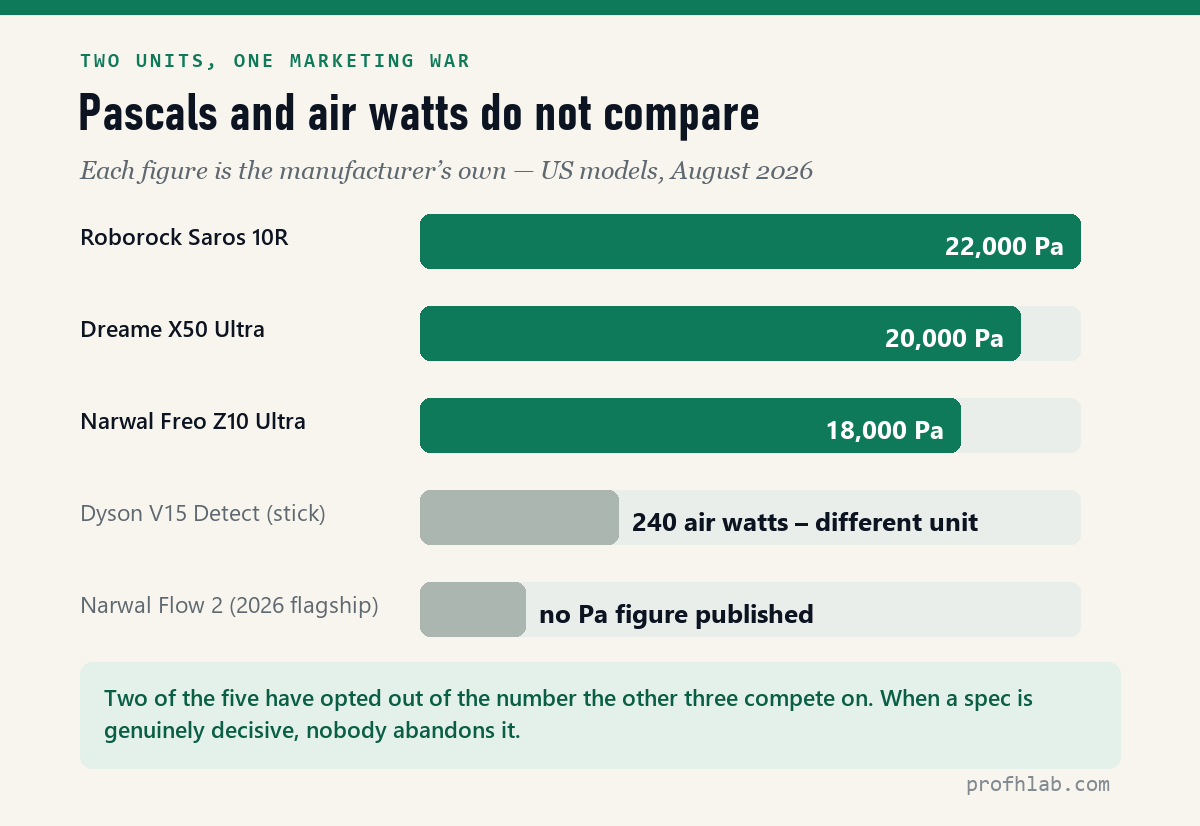
Start with the labels. As of August 2, 2026, this is how the four manufacturers state suction.
- Dyson V15 Detect — up to 240 air watts
- Roborock Saros 10R — 22,000 Pa
- Dreame X50 Ultra — 20,000 Pa
- Narwal Freo Z10 Ultra — 18,000 Pa
Watts describe suction power — closer to “the force actually spent pulling dust in.” Pascals describe the vacuum pressure at the intake when you seal it shut. High pressure with low airflow can still move very little dust, and the reverse holds too. That is why the two values do not convert into each other. Independent tech-media comparisons of the 2026 flagships stops at the same wall, noting that LG and Samsung, which label in watts, cannot be compared directly with Roborock, which labels in pascals.
The problem is that most comparison articles stop at that one line. What a shopper wants to know is not “these are hard to compare.” It is “then what am I supposed to look at?”
Samsung’s two numbers are the useful hint here. On its own product page Samsung spells out the standard test method — KS B 7303:2025, measured in dry cleaning mode with an empty dust bin and a full battery — and writes 10W. It even notes that this is double the 5W of the previous generation. Meanwhile the spec field on the price-comparison listing says 22,000Pa. Korean manufacturers publish the conservative number a standardized test binds them to; retail channels publish the number that looks bigger to a shopper’s eye.
The conclusion is simple. A suction figure means something when you are separating a higher model from a lower one inside the same brand. The moment you cross brands, it struggles to be more than a footnote. So what does decide the cleaning result? Four things. Whether the brush chokes on hair. Whether the mop lifts dried-on stains and not just fresh ones. How much hand labor the station actually removes. And whether the machine clears your thresholds and fits under your furniture.
The 2026 flagship comparison, on one page
Four robots people actually buy in the US, plus one stick vacuum for scale — because the stick vacuum is where the unit problem becomes obvious.
| Model | Stated suction | US price | What the number actually means |
|---|---|---|---|
| Roborock Saros 10R | 22,000 Pa | About $900–$1,000 | Sealed pressure at the nozzle, measured with nothing in the way |
| Dreame X50 Ultra | 20,000 Pa | About $850–$900 | Same test, same caveat |
| Narwal Freo Z10 Ultra | 18,000 Pa | $999.99 official, run-out | Same test |
| Narwal Flow 2 | Not led with Pa | $1,499.99 list, $1,099.99 promo | Narwal now markets navigation instead |
| Dyson V15 Detect (stick) | 240 air watts | $849.99 list | Work done through the machine — a different physical quantity |
Look at the last two rows. Dyson does not publish a pascal figure at all; it publishes air watts. Narwal’s newest flagship has quietly stopped leading with pascals. Two of the five machines on this table have opted out of the number the other three are competing on.
That is your first clue. When a spec is genuinely decisive, nobody abandons it.
Model by model — what the price gap actually buys
Roborock Saros 10R — the highest number, and what it costs you
22,000 Pa is the biggest figure on the table, and it is real in the sense that Roborock measured it. What it does not tell you is how much of that pressure survives a carpet, a brush design and a full dust bin. Roborock’s genuine advantage is elsewhere: obstacle recognition that has been trained on hundreds of object types, and a dock that Roborock explicitly covers under warranty — not every brand does.
Dreame X50 Ultra — 2,000 Pa less, and usually cheaper
20,000 Pa against 22,000 is a 9% difference on paper. No independent test has ever shown a 9% pickup difference between two flagships from that spec alone. What you are really choosing between is dock design, mop mechanism and how each brand handles a repair. Dreame ships one year of warranty, extendable to two if you register within 30 days of purchase — a free upgrade most owners never claim because nobody tells them.
Narwal Freo Z10 Ultra — the lowest number of the three, in run-out
18,000 Pa, $999.99 official, and currently out of stock on Narwal’s own US store as the Flow 2 takes over. If suction numbers decided purchases, this machine would be the obvious loser of the three. It is not, because its hot-water mop wash and drying dock solve a problem owners complain about far more often than pickup: the smell.
Narwal Flow 2 — the flagship that stopped quoting the number
The most expensive robot here, at $1,499.99 list and $1,099.99 on repeated promotion, and it leads its marketing with a vision-language model for obstacle handling rather than a pascal figure. That is a deliberate choice by a company that spent two product generations competing on suction. Read it as an admission: the number stopped selling because buyers stopped believing it.
Dyson V15 Detect — 240 air watts, and why you cannot compare it
A pascal is pressure: force per unit area, measured at a sealed opening. An air watt is power: it accounts for both suction and airflow, which is what actually lifts debris off a floor and carries it to the bin. They are not convertible. Anyone who tells you 240 AW “equals” some pascal figure is guessing.
Which is the whole point. The two most respected vacuum brands in the US market use two different units, and neither one predicts what your floor looks like afterwards.
What the spec sheet cannot tell you — and what does
Market position and spec leadership are different games. In the US, iRobot still holds roughly 35–40% of the market while quoting some of the lowest suction figures in the category, and SharkNinja sells enormous volume at price points where nobody publishes a pascal number at all.
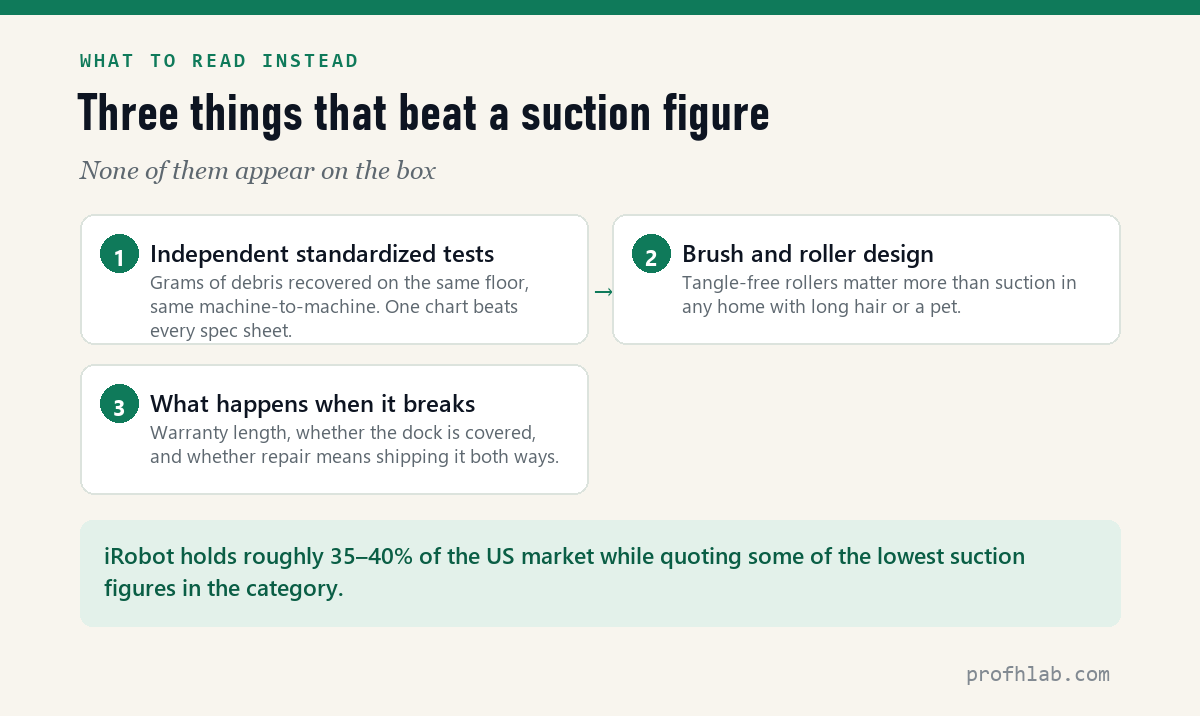
If pressure ratings decided purchases, that could not happen. People buy the machine that finishes the job without needing rescue — which is navigation, brush design and dock reliability, none of which appear on the box.
So what should you read instead? Three things, in order:
- Independent standardized tests. Channels and labs that run every machine over the same debris on the same floor tell you more in one chart than every spec sheet combined. The number to want is grams recovered, not pascals claimed.
- Brush and roller design. Tangle-free rollers matter more than suction in any home with long hair or a pet. This is the single most common reason a robot gets abandoned in a closet.
- What happens when it breaks. Warranty length, whether the dock is covered, and whether there is a repair route that does not involve shipping the machine both ways. That is a real cost; pascals are not.
Which side is your home on? A four-question test
Skip the pascal war. These four questions decide which machine belongs in your house, and none of them appear on a spec sheet.
- How much of your floor is carpet? If it is more than half, no robot on this table is your primary vacuum. Buy a good stick vacuum first and treat the robot as maintenance between real cleanings.
- Does anyone in the house have long hair, or do you have a pet? Then roller design outranks every suction figure here. Look for tangle-free or self-cleaning brush rolls, and read owner reports on hair wrap specifically.
- Do you want to stop touching the mop? That is a dock question, not a suction question. Hot-water washing plus warm-air drying is what keeps a mop from souring — and it is the feature owners say they would not give back.
- Can you plumb the dock, and do you want to? If yes, the auto-fill models become genuinely hands-off. If you rent, or your laundry room is nowhere near your living room, stay with a tank-fill dock and refill it weekly.
Answer those four honestly and the shortlist writes itself — usually down to two machines that are within 10% of each other on every number that matters.
Does a higher Pa number mean stronger suction, and should you wait?
Q. Does a higher Pa number always mean stronger suction?
No. Pa is the vacuum pressure at a sealed intake, so it reflects neither airflow nor brush design. Inside one brand it is a valid way to rank a higher model against a lower one. Across brands it is not evidence. The proof is that Samsung labels the same product 10W in one place and 22,000Pa in another. Real-world differences come far more from anti-tangle brush design, mop pressure, and how much the station automates.
Q. Should I buy now, or wait for the next models?
The 2026 flagship cycle has already landed — Narwal’s Flow 2 shipped in April, and the current Roborock and Dreame flagships are both this year’s machines. That means this is not a “wait” window; it is the window where last year’s flagship goes into run-out. The best value in this category is almost always the previous flagship at a discount, provided its consumables are still stocked.
A tape measure tells you more than the suction number does
Most people who see the number 36,000 for the first time in a store lean toward it. Big numbers are reassuring. But that number was never built to compete with the 10 at the next booth — and the same product wears different numbers depending on which channel is selling it.
Five minutes with a tape measure at your thresholds. Three minutes looking under the sink cabinet. Those eight minutes narrow the answer far more accurately than thirty minutes spent staring at suction figures. Whichever of the four you choose, your floor and your thresholds come first, and the numbers come second.
Sources: manufacturer product pages and US store listings for Roborock, Dreame, Narwal and Dyson, verified August 11, 2026; Narwal’s Flow 2 launch materials; US market-share estimates from published industry surveys. Suction and air-watt figures are the manufacturers’ own. One useful note for anyone who wants to go deeper: Samsung publishes the test standard behind its own suction figure (Korea’s KS B 7303:2025, measured in dry mode with an empty bin and a full battery) — almost no other brand tells you the conditions at all.
Part of the Physical AI library — research decoded and machines compared, in plain English: profhlab.com/physical-ai.
An explainer video on why Pa ratings do not predict cleaning
Full index
Every guide in the Physical AI library — 27 of them, grouped so you can find the one you need.
Start here
- Physical AI Foundations: World Models, Robot Foundation Models, and Sim2Real — From Zero
- Physical AI Explained: Why a Chatbot Knows the Cup Falls but a Robot Doesn’t
- The Physical AI Toolbox: Six Free Simulators, a $249 Hardware Ladder, and What the 2026 Papers Admit
Research papers, decoded
- RoboVLMs, Explained: What Actually Makes a Robot Foundation Model Work
- Ψ0 (Psi-Zero), Explained: The Humanoid Foundation Model That Learns From Human Video
- MotionWAM, Explained: One-Shot Imagination Brings Real-Time Humanoid Loco-Manipulation
- XHugWBC, Explained: One Policy That Drives 12 Different Humanoids
- Vision-Tactile Pretraining, Explained: A Robot Hand Learns Human-Like Dexterity From a Webcam
- TouchWorld, Explained: A Robot Hand That Predicts Touch Before Making Contact
- HOUND and APT-RL, Explained: One Transformer Brain for Walking, Running, and Jumping in the Wild
Machines, priced
- Tesla Optimus V3 Release Date, Price and Specs: What Tesla Has Confirmed
- Buying a Humanoid Robot in 2026: What a Unitree R1 Really Costs, Retail vs Import
- Robot Dog Prices in 2026: From ≈$2,900 to ≈$71,000 — and Spot Still Has No Price Tag
- Tesla FSD Goes Subscription-Only in Korea — and the ‘5-Year Break-Even’ Everyone Quotes Is Wrong
Home robots, tested
- Narwal Freo Z10 Ultra Review: 18,000Pa, a 75°C Mop Wash, and Three Honest Drawbacks
- ▸ 22,000Pa vs 240 Air Watts: Robot Vacuum Suction Numbers, Decoded (2026) (you are here)
- Robot Vacuum or Stick Vacuum? I Split Housework Into 10 Tasks — Only One Truly Overlaps
- The Sour Smell Isn’t the Mop: Robot Vacuum Odor by Zone, and a 7–9x Consumables Gap
- Drain Height Decides Your Robot Vacuum: Samsung 0.4 m, Roborock 50 cm, LG 1.5 m
- Robot Vacuum Repair Costs 2026: A $140 Fix and a 56.5% Resolution Rate
- Robot Vacuum Subscription vs Buying: What iRobot Select Really Costs
- Are Window-Cleaning Robots Worth It? The Break-Even vs Hiring a Pro
- Smart Speakers in 2026: The Hardware Is $99 — the Assistant Is the Real Price
- Serving Robot Costs in 2026: $399 a Month, and Why 73.3% Saw No Change
Chips & companies
- HBF and zHBM, Explained: Samsung and SK Hynix Give Opposite Answers to the Same Memory Problem
- Korea’s Chip Equipment Makers, Compared: Profits Fell 68% — So Why Did Pay Jump 29%?
- Samsung DS vs DX: One Company, a $450,000 Bonus Gap — and Why the Simple Story Is Wrong
- ASML Korea’s Starting Pay Is $31K — or $46K: Anatomy of a 2.15x Salary-Data Gap
Looking for the other library? Generative AI — tools, tested →
Prof.’s H Newsletter
One short email a month, with the numbers in it
What actually moved in AI hiring, AI prices, and the scams aimed at older Americans. Counted here, dated, and linked to the source. One email a month, and your address goes nowhere else.