Smart Speakers in 2026: The Hardware Is $99 — the Assistant Is the Real Price
How this was checked
All prices and subscription terms are US, verified August 11, 2026 against the companies’ own announcements and store listings. Assistant pricing in this category changed twice in the last year — the figures are dated for that reason, and worth re-checking before you buy.
You bought a speaker. What you actually bought, it turns out, was a subscription with a speaker attached.
That is the shift that happened in 2026, and the price tags on the shelf hide it completely. The hardware all costs roughly the same — about a hundred dollars. What separates these devices now is what the assistant inside them costs every month, and whether you are already paying it without realising.
The real price tag: hardware plus assistant
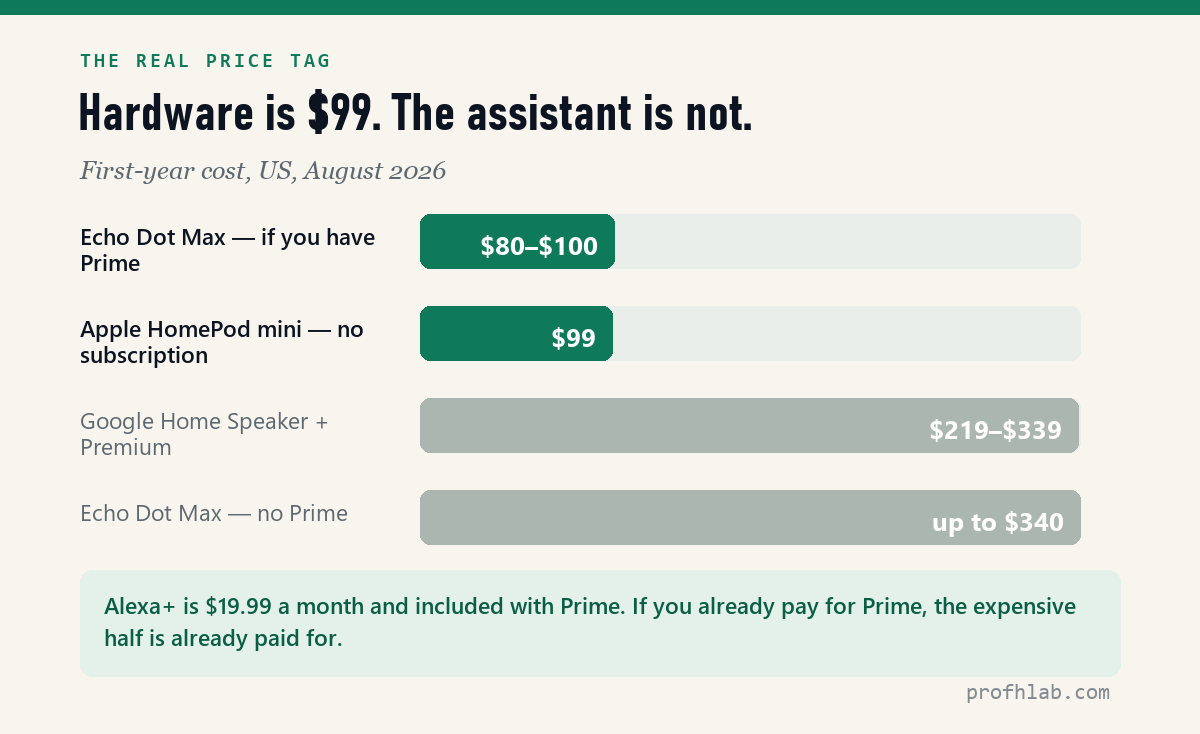
| Device | Hardware | Assistant subscription | Year one, all in |
|---|---|---|---|
| Amazon Echo Dot Max | $99.99 list, seen at $80 | Alexa+ is $19.99/month — free for Prime members | $80–$100 if you have Prime; up to $340 if you do not |
| Google Home Speaker | $99 | Google Home Premium for the advanced Gemini features: $10 or $20/month by tier | $99 basic; $219–$339 with the subscription |
| Apple HomePod mini | $99 | None | $99 |
Read the right-hand column twice. The cheapest device is not the cheapest device. A $99 speaker with a $20 monthly assistant costs more in its first year than a $340 pair of headphones.
If you already pay for Prime, the decision is basically made
This is the single most consequential fact in the category and it gets buried under feature comparisons. Alexa+ is included with Prime. If you are one of the tens of millions of American households already paying for Prime shipping, the most capable version of Amazon’s assistant costs you nothing extra, on every Alexa device in the house, plus the app and the web.
Google’s equivalent capabilities sit behind Google Home Premium at $10 or $20 a month. Apple charges nothing and asks less of Siri in return.
So the honest guidance is unglamorous: check what you already subscribe to before you compare a single feature. For a Prime household, an Echo is effectively subsidised. For a household deep in Google Photos and Gmail who will not pay another monthly fee, the Google speaker still works — you simply get the ordinary assistant rather than the good one.
Brick risk: what happens to the speaker you already own
The uncomfortable part. Every speaker in your house was sold with an assistant that is now being replaced by a different one.
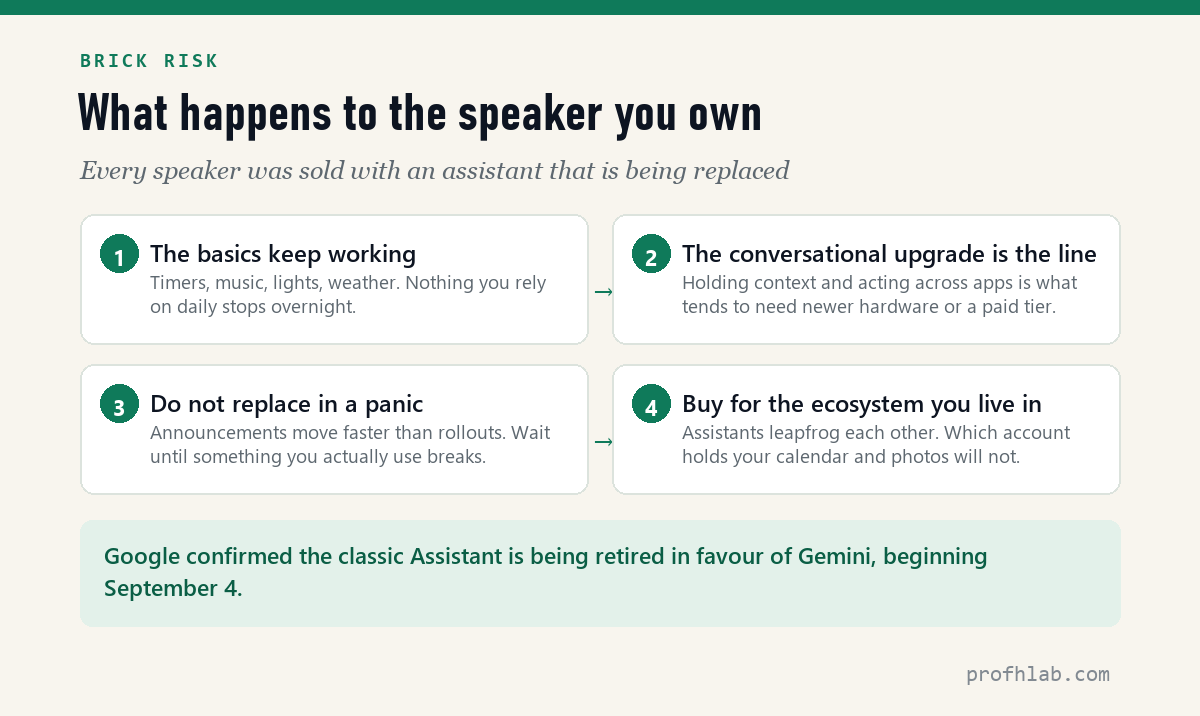
Google has confirmed that the classic Google Assistant is being retired in favour of Gemini, with the transition beginning September 4. Amazon is moving the same way, layering Alexa+ over the older Alexa. Neither company is switching off your speaker — but “still powers on” and “still gets the new features” are very different promises, and only one of them is being made.
What this means in practice:
- Older speakers keep working for basics. Timers, music, lights, weather. Nothing you rely on daily stops overnight.
- The conversational upgrade is where the line falls. The genuinely new capability — following a long request, holding context, acting across apps — is what tends to require newer hardware or a paid tier.
- Do not replace a working speaker in a panic. Wait until something you actually use stops working. Announcements move faster than rollouts, and the rollout is what affects you.
- Buy for the ecosystem you already live in. The assistants will keep leapfrogging each other. Which account holds your calendar, your photos and your shopping list will not change nearly as fast.
Three minutes before you pay
- Do you pay for Prime? If yes, price the Echo first. The best assistant tier is already included, and that is worth more than any spec difference between these three speakers.
- Will you pay a monthly fee for an assistant? If the honest answer is no, cross the paid tiers off and compare what each device does for free. It is a much shorter list than the marketing suggests.
- Does it speak Matter or Thread? Open standards outlive brand assistants. A hub that talks to your lights over an open protocol keeps working even if its voice service is rebranded twice.
- What breaks if the cloud goes away? Ask this of any connected device. If the answer is “everything,” you are renting, not buying — which may be fine, as long as you know it.
Alexa+ with Prime, and what happens to your old Echo or Nest
Q. Is Alexa+ really free with Prime?
Yes. Amazon made Alexa+ available across the US at $19.99 a month and included at no additional cost for Prime members, across Alexa devices, the app and the web. If you already pay for Prime, you are already paying for it.
Q. Will my old Echo or Nest speaker stop working?
Not for the basics. What older hardware tends to lose is access to the newest conversational features, not timers and music. Replace it when something you use daily breaks, not when a press release lands.
Q. Which one is best if I refuse to pay any subscription?
Apple’s HomePod mini at $99 asks for nothing monthly, and a Google speaker without Home Premium still handles the ordinary tasks. You give up the conversational upgrade in both cases.
Q. What about a speaker with no microphone at all?
A reasonable instinct, and a real option: a hub that only coordinates your devices cannot be abandoned when a voice service is discontinued, because it never depended on one. If privacy or longevity is your priority, a Matter or Thread hub is the quiet answer to this whole category.
Have Prime? Buy the Echo. If not, price the monthly assistant
Three speakers, all about a hundred dollars, and the thing that separates them is not sound or microphones. It is whether the assistant inside is already paid for.
If you have Prime, buy the Echo and enjoy the fact that the expensive part is free. If you do not, decide whether a conversational assistant is worth $10 to $20 every month for as long as you own the speaker — because that, not the sticker price, is what you are agreeing to.
Sources: Amazon’s own announcement of Alexa+ availability and pricing; published US pricing for the Echo Dot Max, Google Home Speaker and Apple HomePod mini; Google’s stated timeline for replacing the classic Assistant with Gemini. Verified August 11, 2026.
Google Home speakers upgraded to Gemini, compared with Assistant
Full index
Every guide in the Physical AI library — 27 of them, grouped so you can find the one you need.
Start here
- Physical AI Foundations: World Models, Robot Foundation Models, and Sim2Real — From Zero
- Physical AI Explained: Why a Chatbot Knows the Cup Falls but a Robot Doesn’t
- The Physical AI Toolbox: Six Free Simulators, a $249 Hardware Ladder, and What the 2026 Papers Admit
Research papers, decoded
- RoboVLMs, Explained: What Actually Makes a Robot Foundation Model Work
- Ψ0 (Psi-Zero), Explained: The Humanoid Foundation Model That Learns From Human Video
- MotionWAM, Explained: One-Shot Imagination Brings Real-Time Humanoid Loco-Manipulation
- XHugWBC, Explained: One Policy That Drives 12 Different Humanoids
- Vision-Tactile Pretraining, Explained: A Robot Hand Learns Human-Like Dexterity From a Webcam
- TouchWorld, Explained: A Robot Hand That Predicts Touch Before Making Contact
- HOUND and APT-RL, Explained: One Transformer Brain for Walking, Running, and Jumping in the Wild
Machines, priced
- Tesla Optimus V3 Release Date, Price and Specs: What Tesla Has Confirmed
- Buying a Humanoid Robot in 2026: What a Unitree R1 Really Costs, Retail vs Import
- Robot Dog Prices in 2026: From ≈$2,900 to ≈$71,000 — and Spot Still Has No Price Tag
- Tesla FSD Goes Subscription-Only in Korea — and the ‘5-Year Break-Even’ Everyone Quotes Is Wrong
Home robots, tested
- Narwal Freo Z10 Ultra Review: 18,000Pa, a 75°C Mop Wash, and Three Honest Drawbacks
- 22,000Pa vs 240 Air Watts: Robot Vacuum Suction Numbers, Decoded (2026)
- Robot Vacuum or Stick Vacuum? I Split Housework Into 10 Tasks — Only One Truly Overlaps
- The Sour Smell Isn’t the Mop: Robot Vacuum Odor by Zone, and a 7–9x Consumables Gap
- Drain Height Decides Your Robot Vacuum: Samsung 0.4 m, Roborock 50 cm, LG 1.5 m
- Robot Vacuum Repair Costs 2026: A $140 Fix and a 56.5% Resolution Rate
- Robot Vacuum Subscription vs Buying: What iRobot Select Really Costs
- Are Window-Cleaning Robots Worth It? The Break-Even vs Hiring a Pro
- ▸ Smart Speakers in 2026: The Hardware Is $99 — the Assistant Is the Real Price (you are here)
- Serving Robot Costs in 2026: $399 a Month, and Why 73.3% Saw No Change
Chips & companies
- HBF and zHBM, Explained: Samsung and SK Hynix Give Opposite Answers to the Same Memory Problem
- Korea’s Chip Equipment Makers, Compared: Profits Fell 68% — So Why Did Pay Jump 29%?
- Samsung DS vs DX: One Company, a $450,000 Bonus Gap — and Why the Simple Story Is Wrong
- ASML Korea’s Starting Pay Is $31K — or $46K: Anatomy of a 2.15x Salary-Data Gap
Looking for the other library? Generative AI — tools, tested →
Prof.’s H Newsletter
One short email a month, with the numbers in it
What actually moved in AI hiring, AI prices, and the scams aimed at older Americans. Counted here, dated, and linked to the source. One email a month, and your address goes nowhere else.