Who Is Building the Most AI Data Centers? Big Tech’s $550 Billion Year, the New Rules, and What Comes Next (Oct. 2026)
As of October 2026, the biggest builders of AI data centers are Amazon, Alphabet (Google), Microsoft, Meta and Oracle, with OpenAI, Anthropic and xAI racing alongside through partners; Alphabet, Amazon and Meta alone plan about $545–570 billion of capital spending in 2026, roughly double the $295 billion they spent in 2025. Those totals are our sum of each company’s own figures. Meanwhile Washington is speeding up permits, while states and towns from Texas to New York to Loudoun County, Virginia are pressing pause.
What we read, October 2, 2026
- Company filings: Alphabet, Amazon, Meta, Microsoft and Oracle earnings releases on SEC EDGAR, and their July 2026 earnings calls as transcribed by Investing.com. We re-read the capital spending lines ourselves.
- Government: White House executive orders and the AI Action Plan, Energy Department releases, New York’s Executive Order 62 (via the law firm Foley) and Texas and Virginia actions as reported by the Texas Tribune and NBC Washington.
- Institutions: the IMF, the Bank of England, the International Energy Agency, Lawrence Berkeley National Laboratory and the European Commission.
An AI assistant helped draft this piece and run the page reads; every quote was read on the source’s own page on the date shown. This piece describes what companies and governments said; it is not investment advice.
This is part 6 of our six-part guide to AI data centers.
The complete guide answers 51 questions. The series also covers how they are built, power, chips and water, where they are going, Musk’s space plan and local communities.
Who is building the most AI data centers?
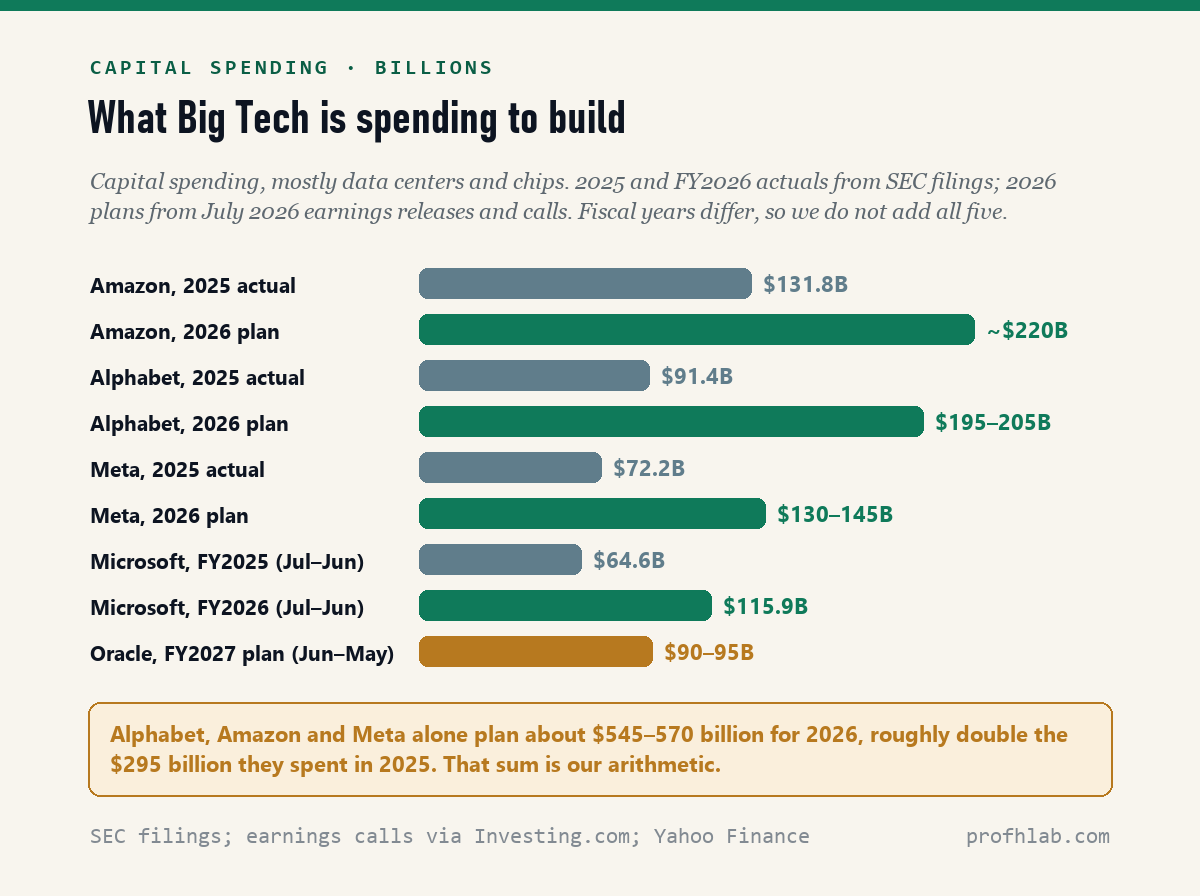
By spending, Amazon leads: it told investors on July 30, 2026 that it now expects “approximately $220 billion in cash CapEx in 2026,” ahead of Alphabet’s raised guidance of $195–205 billion and Meta’s $130–145 billion. Microsoft spent $115.9 billion in its fiscal year ended June 2026, according to its SEC filing, and Oracle guided $90–95 billion for its fiscal 2027.
By what is already running, the picture is similar. Epoch AI’s database, updated October 2, 2026, ranks xAI’s Colossus 2 in Memphis first by estimated power, followed by Amazon’s Indiana campus for Anthropic, Microsoft’s Fairwater Atlanta, and sites run by Google and Meta. Our US map lists them.
All of them say they still cannot build fast enough. Amazon CEO Andy Jassy said on the July call: “Even at that amount, we will still not have enough capacity to meet all the demand we have in 2026.” He blamed part of the increase on “The higher cost of memory,” which pushed Amazon’s estimate up from about $200 billion. Our post on HBM and memory explains why.
How much are Big Tech companies spending on AI data centers?
Roughly twice as much in 2026 as in 2025: Amazon spent $131.8 billion in 2025, Alphabet $91.4 billion and Meta $72.2 billion, according to their year-end SEC filings, against 2026 plans of about $220 billion, $195–205 billion and $130–145 billion. Alphabet’s chief financial officer added on July 22, 2026 that “we continue to expect our CapEx to increase significantly in 2027.”
Oracle is the newest giant builder. In its quarter ending August 2026 it spent $28.5 billion on capital projects, said it “delivered 850MW additional datacenter capacity,” and reported $664 billion in contracted future revenue, much of it tied to AI customers. Its free cash flow in that quarter was negative, about $5.4 billion, according to its SEC filing.
| Company | Last full year | Next year’s plan | Said on the record |
|---|---|---|---|
| Amazon | $131.8B (2025) | ~$220B (2026) | Still short of capacity in 2026 and 2027 |
| Alphabet | $91.4B (2025) | $195–205B (2026) | 2027 to “increase significantly” |
| Meta | $72.2B (2025) | $130–145B (2026) | Louisiana campus raised to 5 GW |
| Microsoft | $115.9B (FY ended June 2026) | Over $50B in the next quarter alone, as reported | “Demand continues to surpass supply” |
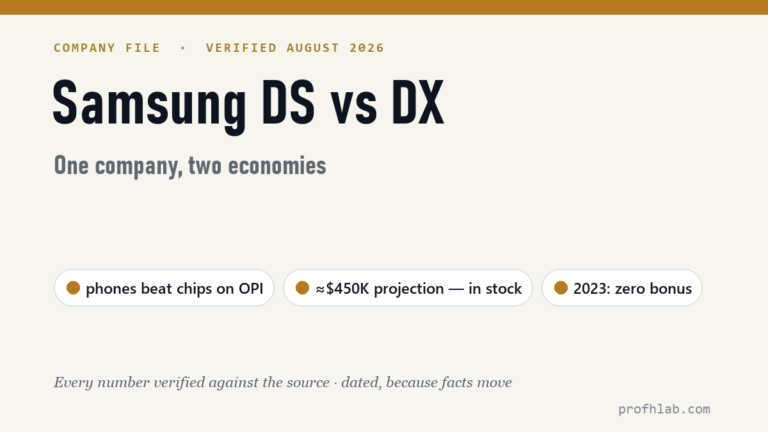
Where does the money go? Alphabet’s call summary put it at roughly 60% servers and 40% data centers and networking. Most of the server money is chips, and most of the chips are NVIDIA’s or custom designs like Google’s TPUs and Amazon’s Trainium. That is why the same boom shows up in chipmakers’ results; see our posts on Samsung’s chip business and chip equipment makers.

What are OpenAI, Anthropic and xAI building?
The AI labs mostly build through partners and long contracts rather than owning everything: OpenAI’s Stargate runs through Oracle, SoftBank and others, Anthropic buys from Amazon, Google and Microsoft, and xAI, now part of SpaceX, builds its own Colossus sites in Memphis. The commitments are enormous, and some have already been trimmed.
- OpenAI: a letter of intent with NVIDIA for at least 10 GW of systems, with NVIDIA intending to invest “up to $100 billion” as each gigawatt is deployed; a deal with AMD to deploy 6 GW of AMD GPUs; 10 GW of custom chips with Broadcom; and contracts with CoreWeave worth about $22.4 billion.
- Anthropic: up to 1 million Google TPUs with well over 1 GW coming online in 2026; a commitment to buy $30 billion of Microsoft Azure computing; and, in April 2026, up to 5 GW with Amazon and a commitment of more than $100 billion to AWS over 10 years.
- xAI: a $20 billion funding round in January 2026, then an acquisition by SpaceX in February 2026, which SpaceX’s SEC filing confirms. Our space data centers post covers that plan.
The numbers are softer than the headlines. NVIDIA’s Jensen Huang said of the $100 billion in February 2026: “It was never a commitment,” Fortune reported. In August 2026, Fortune reported an NVIDIA-backed OpenAI campus in Pike County, Ohio at $105 billion, below the roughly $250 billion first reported. If you follow these companies as an employer, see is OpenAI still hiring and is Anthropic hiring.
Is the AI data center boom a bubble?
Serious institutions say the risk is real but not settled: the IMF warned in January 2026 that a reassessment of AI’s payoff “could lead to a decline in investment and trigger an abrupt financial market correction,” and the Bank of England said in October 2025 that “The risk of sharp corrections in asset prices remained high.” The companies, for their part, say demand still exceeds what they can build.
The worry has a name: circular deals. The IMF described “circular investment and procurement arrangements, in which firms invest in each other while securing future orders,” saying they “create opacity.” A chipmaker investing in an AI lab that then buys its chips is the classic example. Sequoia Capital framed the payoff gap back in June 2024 as “AI’s $600B question”: the revenue AI must eventually earn to justify the spending.
Debt is rising too. The Bank of England noted in December 2025 that “The role of debt financing in this sector is increasing quickly.” Meta financed its Louisiana campus partly through a joint venture in which funds managed by Blue Owl Capital own 80%, valued at about $27 billion, and sold $30 billion of bonds in October 2025, The Register reported.
Our read, not a forecast: both things can be true. Demand for AI computing is real and measurable, as the 900 million weekly ChatGPT users show. Whether today’s spending earns its money back on time is a separate question that nobody can answer yet. This is not investment advice.
What is the federal government doing about AI data centers?
Speeding them up: President Trump’s July 2025 AI Action Plan says “Simply put, we need to ‘Build, Baby, Build!’” and Executive Order 14318, signed July 23, 2025, fast-tracks federal permits for data center projects that commit at least $500 million or add more than 100 MW of load. The order also revoked President Biden’s January 2025 order on AI infrastructure, EO 14141.
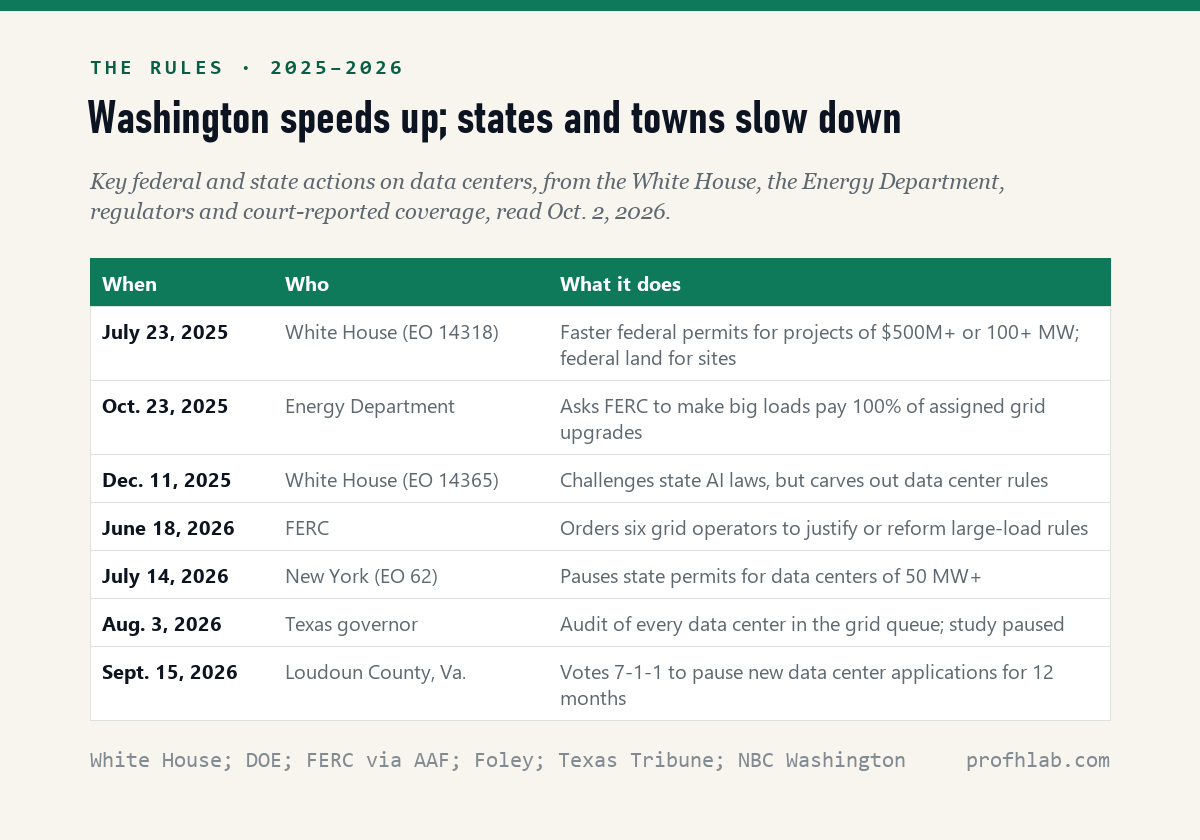
Washington is also offering land and pushing on who pays. The Energy Department picked four federal sites for private AI data centers and power in July 2025: Idaho National Laboratory, the Oak Ridge Reservation, the Paducah site and the Savannah River Site. In October 2025 it asked FERC, the federal grid regulator, to make large loads responsible for “100% of the network upgrades that are assigned through interconnection studies.” In June 2026, FERC ordered six regional grid operators to justify or reform their large-load rules.
On state AI laws, Executive Order 14365 of December 2025 set up a Justice Department task force to challenge state laws the administration considers onerous, but it carves out state rules on “AI compute and data center infrastructure.” In Congress, the House passed the Ratepayer Protection Act in September 2026, aimed at making large users such as data centers pay the full cost of new power and grid upgrades, local outlet FingerLakes1 reported; the Senate has not acted.
Export rules matter too. NVIDIA’s SEC filings say US officials expect the government to receive “15% or more of the revenue” from licensed sales of certain chips to China, and that as of its April 2026 quarter it had earned no revenue under a separate H200 licensing program.
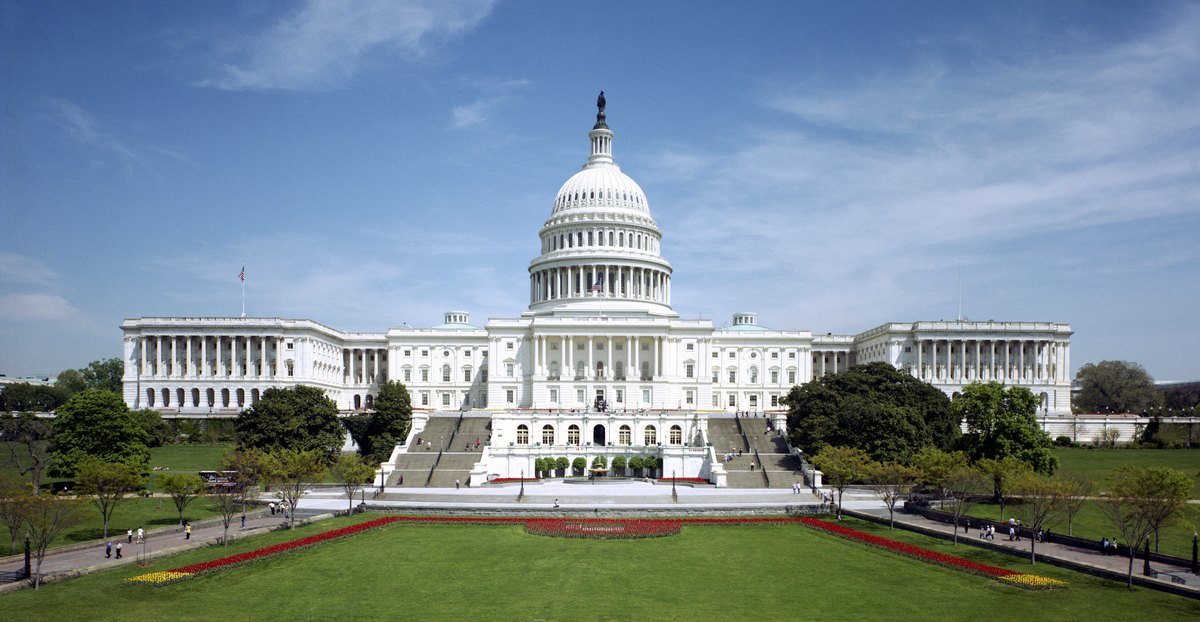
What are states and towns doing about AI data centers?
Adding brakes: New York’s governor paused state environmental permits for data centers of 50 MW or more on July 14, 2026, Texas Gov. Greg Abbott ordered an audit of every data center in the state’s grid queue on August 3, 2026, and Loudoun County, Virginia voted 7–1–1 on September 15, 2026 to pause new data center applications for 12 months.
Texas had already written rules for big loads. Its 2025 law, SB 6, applies to loads of 75 MW or more and lets utilities disconnect eligible new large loads during emergencies, Utility Dive reported. Abbott’s August order went further: “Any project that fails to comply with the requirements set forth by the PUCT and ERCOT, and by state law, must be denied connection to the Texas grid,” the Texas Tribune reported.
New York’s order spells out the cost principle many states share: “the cost of electric system upgrades required to serve large loads should not fall on everyday New Yorkers.” Loudoun’s board chair said the pause is not “a ban or a moratorium,” but time to write new rules; the county hosts 233 data centers. Our local communities post covers the town-level fights.
How are AI data centers changing the rest of the world?
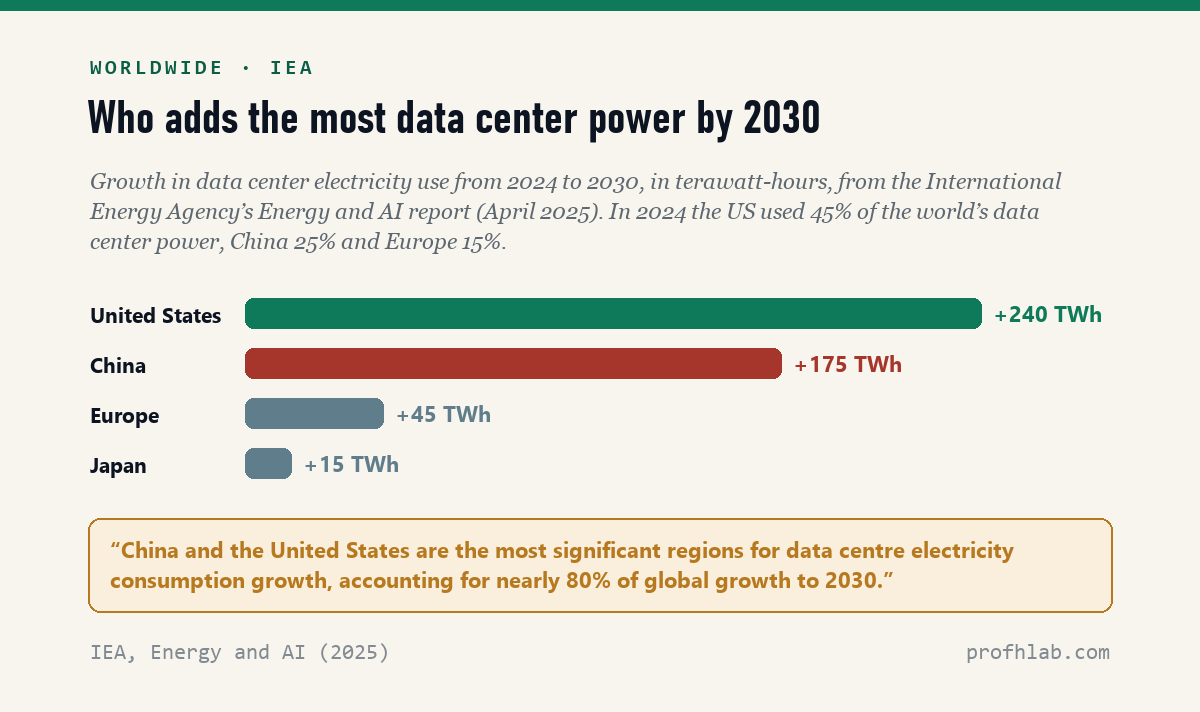
The US is the center of it: in 2024 it used 45% of the world’s data center electricity, China 25% and Europe 15%, according to the International Energy Agency, and the US and China will account for “nearly 80% of global growth to 2030.” The IEA expects worldwide data center use to more than double to about 945 TWh by 2030.
Other regions are building their own. The European Commission announced InvestAI in February 2025, aiming to mobilize €200 billion for AI, including “a new European fund of €20 billion for AI gigafactories,” each planned with over 100,000 advanced AI processors. The EU AI Act is phasing in, with rules for general-purpose AI models in force since August 2, 2025. In the Gulf, Stargate UAE is a 1 GW cluster within a planned 5 GW UAE-US AI campus, announced in May 2025.
Some countries have hit the same walls as US towns. Ireland now requires new data centers to bring their own power generation, and in September 2026 its regulator proposed discounted gas connections that can be interrupted, the Irish Times reported. Supply chains are global too: the IEA notes China controls about 99% of refined gallium supply, a metal used in chips.
What happens next with AI data centers?
Forecasts agree on growth and disagree on size: Berkeley Lab’s reference case has US data centers at 11.8% of electricity by 2030, EPRI’s range is 9% to 17%, and the consulting firm Grid Strategies warned in November 2025 that utility forecasts are “likely overstated by roughly 25 GW.” The binding limits now are power equipment, memory chips and local approval, not money.
| Forecast | What it says | Who and when |
|---|---|---|
| US share of electricity, 2030 | 11.8% (range 9.5–15.3%) | Berkeley Lab, June 2026 |
| US share of generation, 2030 | 9–17% | EPRI, as reported by E&E News, Feb. 2026 |
| New US peak demand in 5 years | 166 GW, about 90 GW from data centers | Grid Strategies, Nov. 2025 |
| US data center capacity, 2035 | 194 GW | BloombergNEF, as reported July 2026 |
| Worldwide spending needed by 2030 | $6.7 trillion | McKinsey, 2025, as reported by DCD |
The equipment queue is the clearest signal. GE Vernova’s gas turbine backlog reached 116 GW in the second quarter of 2026 and it was taking reservations for 2031 delivery, with about 20% of customers data center operators, Utility Dive reported. A new gas plant ordered today may not run until the next decade.
How can AI data centers and communities both win?
By making the data center carry its own load: pay its own grid costs, flex its power use when the grid is tight, bring or buy new power, cool without evaporating water, and share tax money with the people closest to it. A Duke University study found 76 GW of new load could fit on the existing US grid “if those loads could curtail for only 0.25 percent of maximum uptime,” as cited by the American Enterprise Institute.
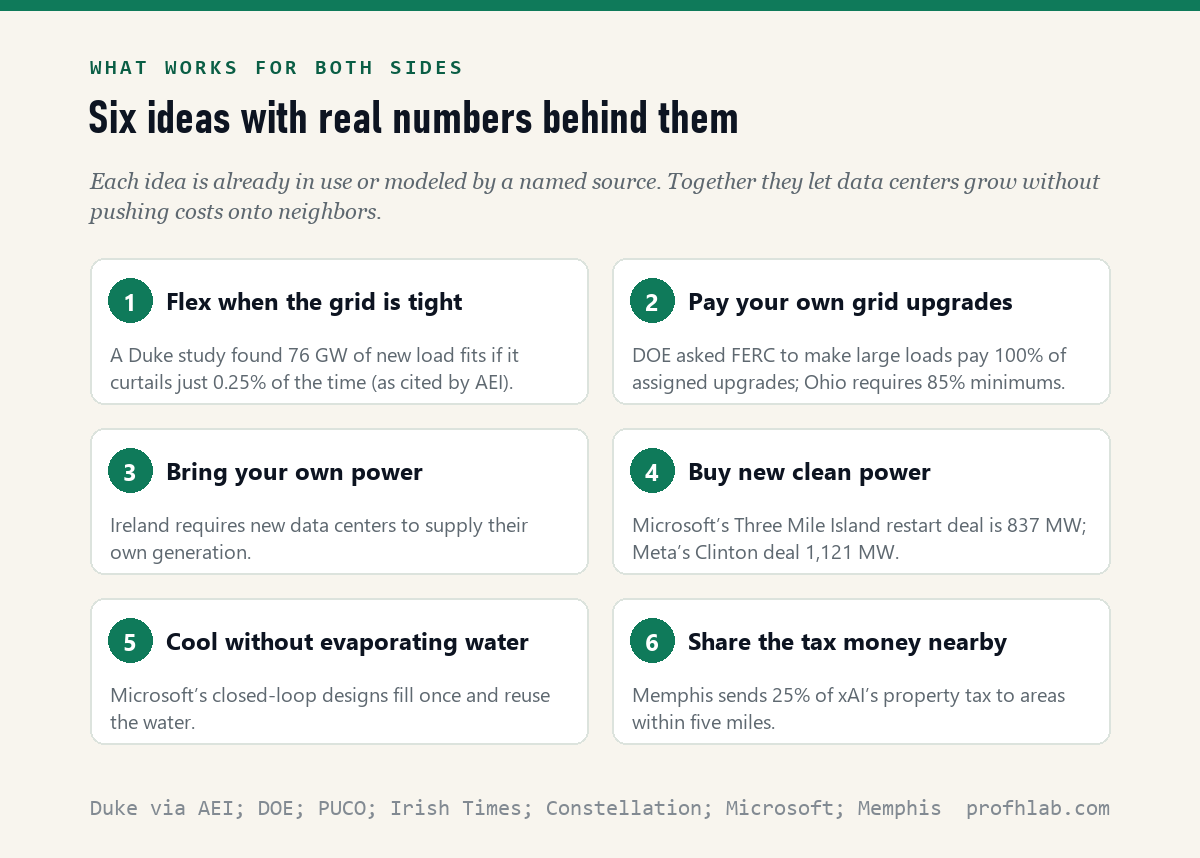
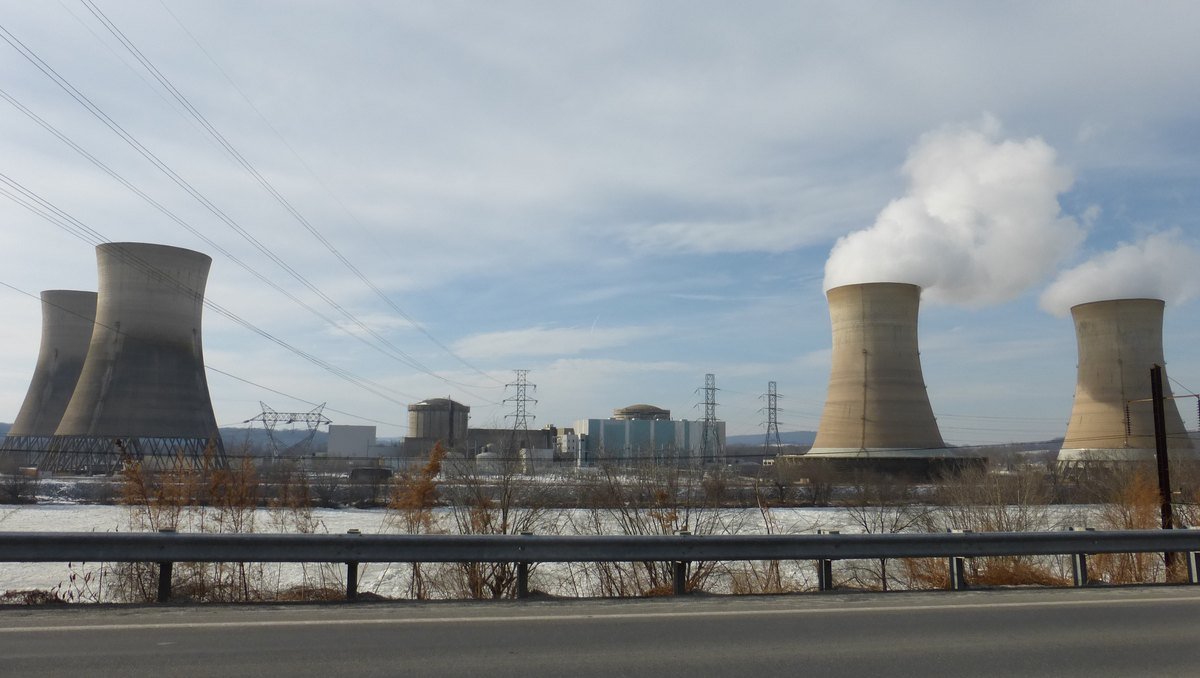
Clean power deals are the most visible version. Besides the Three Mile Island restart, Meta signed a 20-year deal with Constellation for Illinois’ Clinton nuclear plant, 1,121 MW from June 2027; Amazon contracted 1,920 MW from Talen’s Susquehanna plant through 2042; and Google agreed to buy up to 500 MW from Kairos Power small reactors, the first by 2030. Flexibility is the cheapest: consulting firm ICF modeled in June 2026 that PJM could support an extra 30 GW without new generation if loads flex.
Why would companies accept terms like these? Because delays cost them more. Our local communities post tallies the billions in projects blocked or delayed by local opposition. A data center that arrives with its own power, a water cap and a tax-sharing deal is easier to approve.
Power, not money, now limits the build-out
- It is huge and still growing: three companies plan about $545–570 billion of 2026 capital spending, roughly double 2025, by our sum of their guidance.
- Power, not money, is the bottleneck: grid connections in big markets take more than four years (JLL), and gas turbines are booked into 2031 (GE Vernova).
- It is moving inland: to Texas, Louisiana, the Midwest and rural counties (Pew, Synergy, JLL).
- It shows up in your bill and your town: regulators in Ohio, Virginia, Georgia and New York are writing rules on who pays for upgrades.
- Opinion has turned: 60% of Americans told Pew in August 2026 they would be uncomfortable with one nearby.
- Space is not a near-term fix: SpaceX’s own SEC filing says orbital computing starts “as early as 2028.”
- The bubble question is open: the IMF and Bank of England warn of correction risk; the companies say demand exceeds supply.
Is it a bubble, and who pays for the new power lines?
Who is building the most AI data centers?
By 2026 spending plans, Amazon (about $220 billion), Alphabet ($195–205 billion) and Meta ($130–145 billion), with Microsoft ($115.9 billion in its fiscal 2026) and Oracle ($90–95 billion planned for fiscal 2027) close behind.
How much are Big Tech companies spending on AI in 2026?
Alphabet, Amazon and Meta plan about $545–570 billion combined for 2026, roughly double the $295 billion they spent in 2025. That sum is our arithmetic from each company’s figures.
Which company has the largest AI data center?
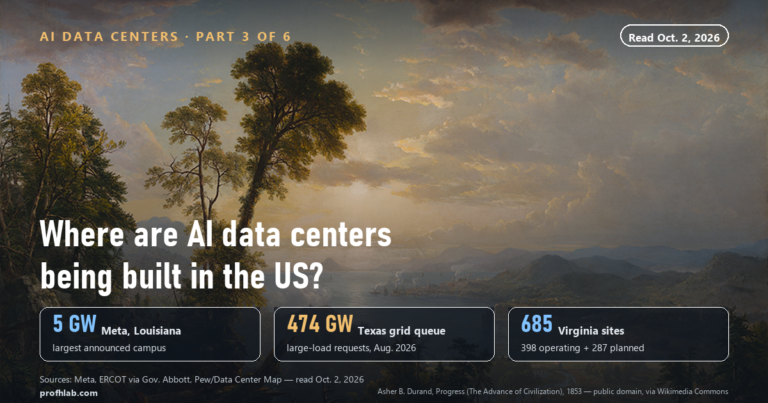
By estimated current power, xAI’s Colossus 2 in Memphis, at about 946 MW of IT power per Epoch AI. By announced size, Meta’s Hyperion in Louisiana, planned at 5 GW.
Is the AI data center boom a bubble?
Not settled. The IMF warned in January 2026 that a reassessment of AI’s payoff could “trigger an abrupt financial market correction,” and the Bank of England said correction risk “remained high.” Amazon and Microsoft say demand still exceeds supply.
What are circular deals in AI?
Arrangements “in which firms invest in each other while securing future orders,” in the IMF’s words, such as a chipmaker investing in an AI lab that buys its chips. The IMF says they “create opacity.”
Did NVIDIA commit $100 billion to OpenAI?
It signed a letter of intent in September 2025 saying it intends to invest up to $100 billion as OpenAI deploys 10 GW of NVIDIA systems. In February 2026, Jensen Huang said “It was never a commitment,” Fortune reported.
What is the government doing about AI data centers?
The federal government is speeding them up: Executive Order 14318 of July 23, 2025 fast-tracks permits for projects of $500 million or more than 100 MW, and the Energy Department offered four federal sites. States and counties are adding limits.
Are there regulations on AI data centers?
Mostly at the state and local level: zoning, environmental permits and utility rate rules. New York paused permits for 50 MW+ data centers in July 2026, Texas law lets utilities disconnect large loads in emergencies, and Ohio, Virginia and Georgia set rules on who pays for grid costs.
Which states have paused data centers?
New York paused state environmental permits for 50 MW+ data centers on July 14, 2026; Texas ordered an audit of its grid queue on August 3, 2026; and Loudoun County, Virginia voted on September 15, 2026 to pause new applications for 12 months.
Who pays for the power lines data centers need?
It is being decided now. The Energy Department asked FERC in October 2025 to make large loads pay 100% of assigned grid upgrades, and the House passed the Ratepayer Protection Act in September 2026 with the same aim; the Senate has not acted.
Why are tech companies buying nuclear power?
For round-the-clock carbon-free power. Microsoft’s 20-year deal restarts Three Mile Island Unit 1 (837 MW), Meta signed for Illinois’ Clinton plant (1,121 MW), and Amazon contracted 1,920 MW from Susquehanna, according to the companies’ announcements.
Which countries use the most data center electricity?
In 2024 the US used 45% of the world’s data center electricity, China 25% and Europe 15%, according to the IEA, which expects the US and China to drive nearly 80% of growth to 2030.
How much will data centers cost by 2030?
McKinsey estimated in 2025 that data centers will need $6.7 trillion of capital worldwide by 2030 to keep up with demand for computing, as reported by DatacenterDynamics.
Can data centers grow without overloading the grid?
Partly, if they are flexible. A Duke study found 76 GW of new load could fit if data centers cut power for just 0.25% of the time, as cited by AEI, and Texas’ SB 6 lets utilities disconnect large loads in emergencies.
Why only three companies’ spending plans are added up
Capital spending figures for 2025 and Microsoft’s fiscal 2026 come from SEC filings we read ourselves. The 2026 plans come from earnings calls as transcribed by Investing.com, and Oracle’s fiscal 2027 guidance from Yahoo Finance’s call summary. Company fiscal years and definitions differ, which is why we add only the three calendar-year companies.
We left out several widely repeated claims we could not confirm on a primary page, including an AMD stock warrant size, a House vote count and some overseas build-out figures. Where a figure is reported by a news outlet rather than the original agency or company, we name the outlet.
Your electric bill, and whether to build a career here
Start with the complete guide to AI data centers, then read is my electric bill going up because of AI. If you are thinking about a career in this build-out, see which AI company pays the most, is the AI job market saturated and our jobs board. The Physical AI library collects the rest.
Cite this
Alphabet, Amazon and Meta plan about $545–570 billion of capital spending in 2026, roughly double the $295 billion they spent in 2025 (profhlab sum of company figures); federal policy speeds data center permits under EO 14318, while New York, Texas and Loudoun County, Virginia paused or audited new projects in July to September 2026. Source: profhlab.com, Who Is Building the Most AI Data Centers?
Sources read on October 2, 2026: Alphabet Q4 2025 release (SEC); Amazon Q4 2025 release (SEC); Meta Q4 2025 release (SEC); Microsoft FY2026 Q4 release (SEC); Alphabet call, July 22, 2026; Amazon call, July 30, 2026; Oracle, September 10, 2026.
Government and institutions: EO 14318, July 23, 2025; America’s AI Action Plan, July 2025; DOE federal sites, July 24, 2025; IMF WEO Update, January 2026; Bank of England FPC, October 2025; IEA Energy and AI; European Commission, February 11, 2025.
Reporting: Foley on New York EO 62; Texas Tribune, August 3, 2026; NBC Washington, September 15, 2026; Fortune, February 2, 2026; Utility Dive, July 23, 2026; Grid Strategies, November 2025; AEI, April 30, 2026; Constellation, June 3, 2025. Photos via Wikimedia Commons under the licenses shown.
Prof.’s H Newsletter
One short email a month, with the numbers in it
What actually moved in AI hiring, AI prices, and the scams aimed at older Americans. Counted here, dated, and linked to the source. One email a month, and your address goes nowhere else.