Are Data Centers Good for Local Communities? Taxes, Jobs, Water and Noise, Town by Town (Oct. 2026)
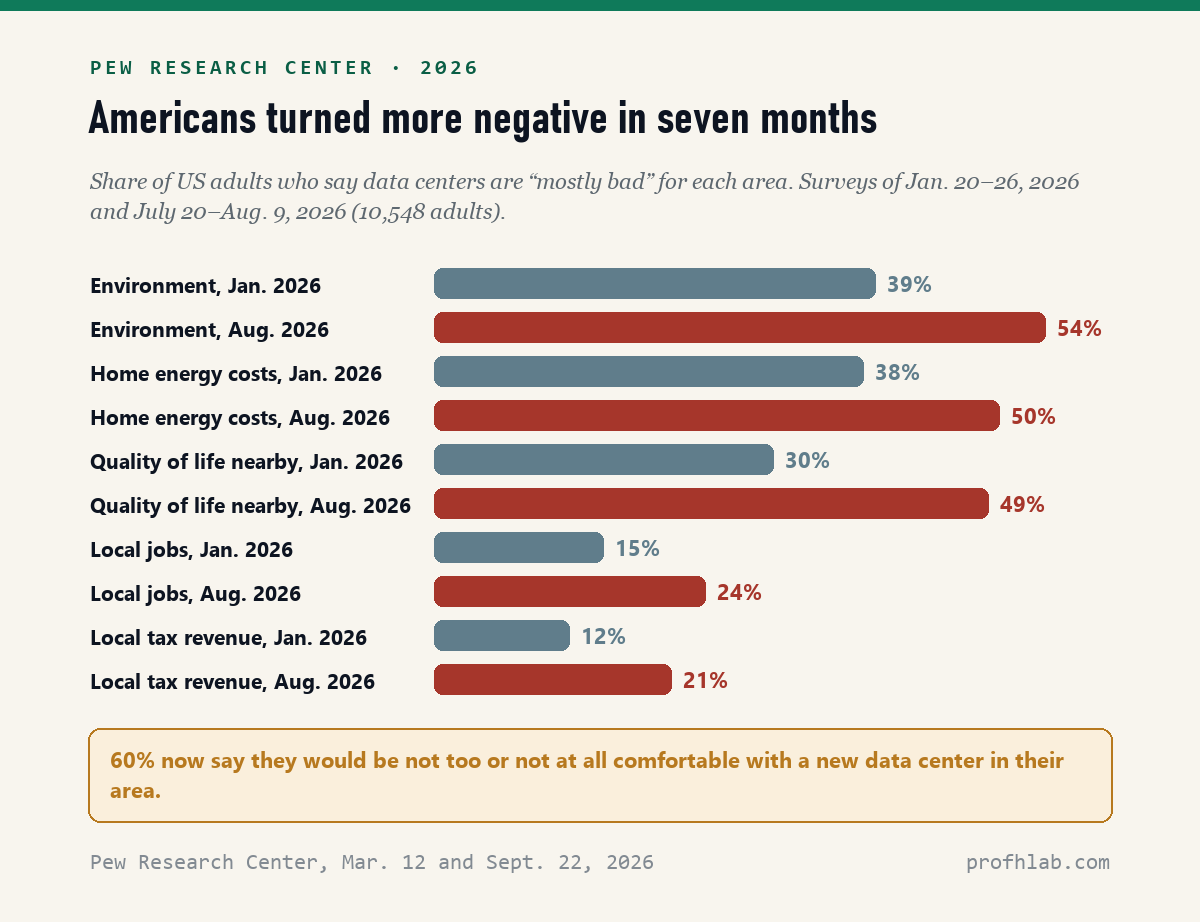
Data centers can be very good for a local budget and much less good for local jobs: Loudoun County, Virginia expects $1.3 billion from them in fiscal 2027, 40% of its budget, while Virginia’s legislative auditor found a typical site needs fewer than 50 people to run once it is built. Whether a town comes out ahead depends on its tax deal, its water, its grid rules and how close the buildings sit to homes. In August 2026, 60% of Americans told Pew Research Center they would be uncomfortable with a new one nearby.
What we read, October 2, 2026
- Government: Loudoun County’s data center page, Virginia’s JLARC report (via Prince William County’s official summary), Georgia’s state audit of its data center tax break, and utility regulators in Ohio, Virginia and Georgia.
- Research and polls: Brookings, Pew Research Center, AP-NORC, PBS News/NPR/Marist and Heatmap.
- Local reporting from Memphis, Tucson, Prince William County, Louisiana, Indiana, Maryland and Texas.
- Advocacy groups, labeled as such each time: Good Jobs First, the Southern Environmental Law Center and an industry-funded PwC study.
An AI assistant helped draft this piece and run the page reads; every quote was read on the source’s own page on the date shown. Electricity bills get only a short section here because our earlier post covers them in depth.
This is part 5 of our six-part guide to AI data centers.
Start with what an AI data center is, then how they are built, how much power and water they need, where they are going, the plan to put them in space and who is building the most, and the rules.
Are data centers good for local communities?
The honest answer from the 2026 evidence is “good for the tax base, small for jobs, and risky for water, noise and power if the deal is weak.” Virginia’s Joint Legislative Audit and Review Commission (JLARC) put it plainly in December 2024: “Data centers provide economic benefits, mostly during their initial construction.” The same report found they bring large local revenue where they cluster.
Public opinion is moving the other way, fast. Pew surveyed 10,548 adults from July 20 to August 9, 2026. The share saying data centers are “mostly bad” for quality of life nearby rose from 30% in January to 49%. For the environment it rose from 39% to 54%, and for home energy costs from 38% to 50%.
Do data centers pay taxes, and how much?
Yes, mostly through local property taxes on buildings and equipment: Loudoun County says data centers generated $1.2 billion in real and personal property tax in fiscal 2026, 39% of its overall budget, and projects $1.3 billion, 40%, for fiscal 2027. As of March 1, 2026, the county had about 233 data center buildings, totaling 56.5 million square feet, built or under construction.
That money changes a county. Loudoun’s real property tax rate fell from $1.145 per $100 of assessed value in 2016 to $0.805 in 2026, Moneywise reported in August 2026. Its fiscal 2027 budget fully funds the school board’s $105 million increase. Even so, Supervisor Juli Briskman told Moneywise: “We’ve become addicted to the data centers for their tax revenues, but at what cost?”
The payoff depends on how many buildings a place has. JLARC found data centers produced $733 million in Loudoun, 31% of local revenue, but $110 million in neighboring Prince William, 7%. Across five mature Virginia markets the share ranged from 1% to 31%. One building does not make a Loudoun.
Some cities now steer the money to the neighbors who live closest. Memphis directs 25% of property tax from xAI’s facility into a fund for areas within five miles. The first $3.2 million, for fiscal 2026, goes to ZIP code 38109, including $1.4 million for home repairs of up to $30,000 per eligible homeowner, the Memphis Flyer reported in July 2026.
Do data centers create jobs for local people?
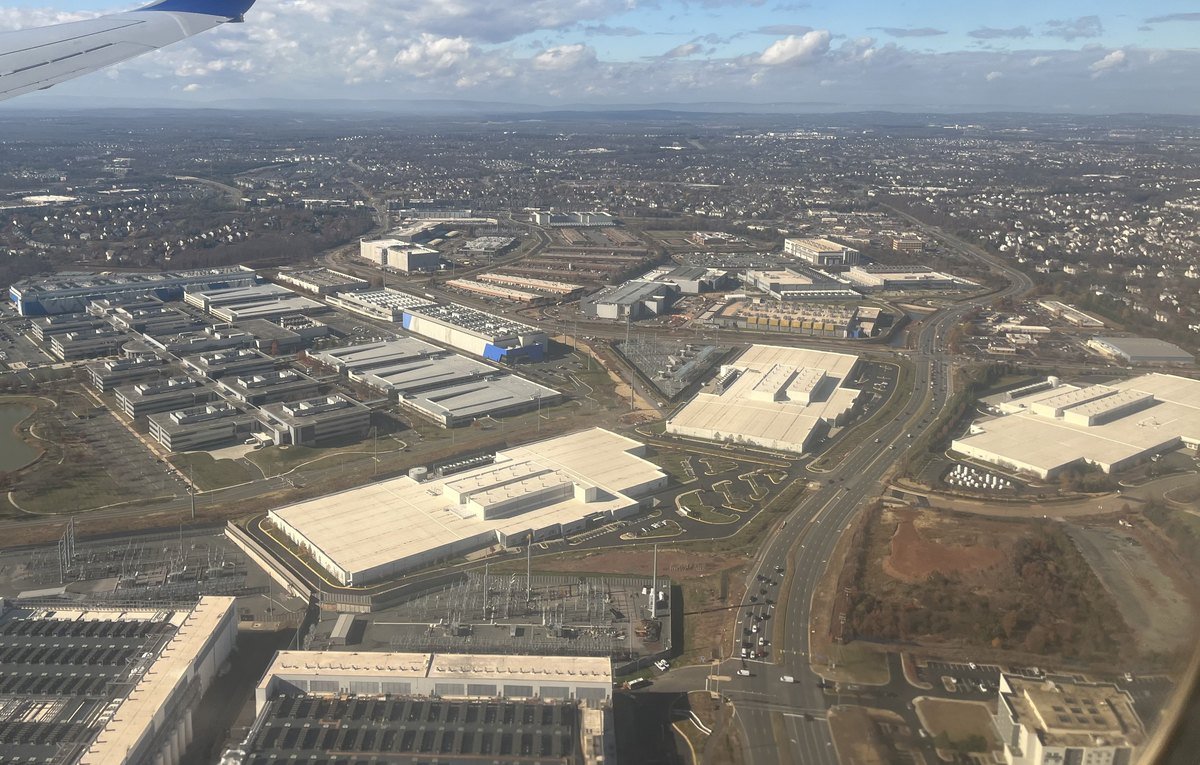
Many during construction and few afterward: JLARC found a Virginia site can employ up to 1,500 construction workers but fewer than 50 people in daily operations per facility. Meta’s Louisiana campus shows the same shape at a larger size. In December 2025 Meta said it expected a peak of 5,000 construction workers and “more than 500 operational jobs like electricians, HVAC specialists, server and network techs.”
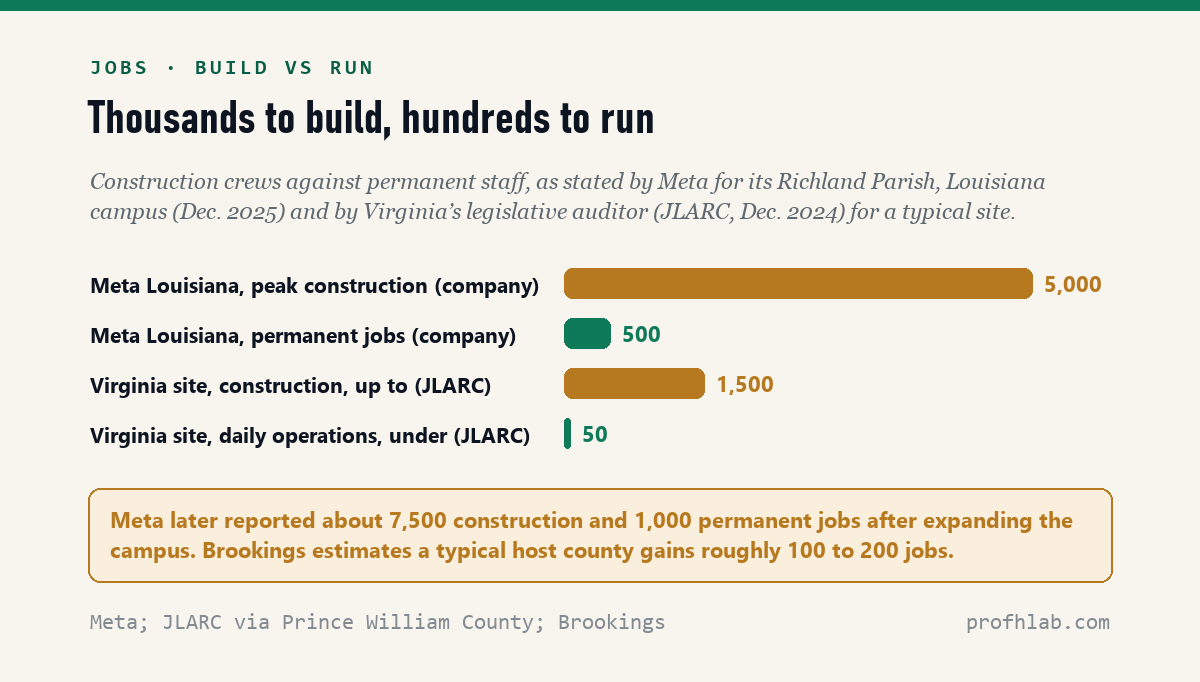
Independent research lands in between. Brookings economists Dany Bahar and Greg Wright estimated in May 2026 that a typical county that gets a data center sees roughly 100 to 200 jobs, depending on the type. Home prices rise 2% to 5%. Wages do not change. They also found that “subsidies may matter more for precisely the facilities that generate the smallest employment benefits.”
The industry’s own number is much bigger, and it measures something different. A PwC study paid for by the Data Center Coalition, the industry trade group, estimated 603,900 direct US data center industry jobs in 2023 and 4.68 million including supply chains. That is a national, modeled total, not jobs at one building. If you want one of these jobs, our guides to becoming a data center technician and AI data center electrician pay cover the path.
Do data center tax breaks pay for themselves?
Not directly, according to Georgia’s own state audit: the state gave up $474.2 million in fiscal 2025 and collected $41.5 million in related taxes, a 4% fiscal return, and found 70% of data centers would have come to Georgia anyway. The same audit found a 289% “economic return,” meaning the wider activity was far larger than the revenue given up.
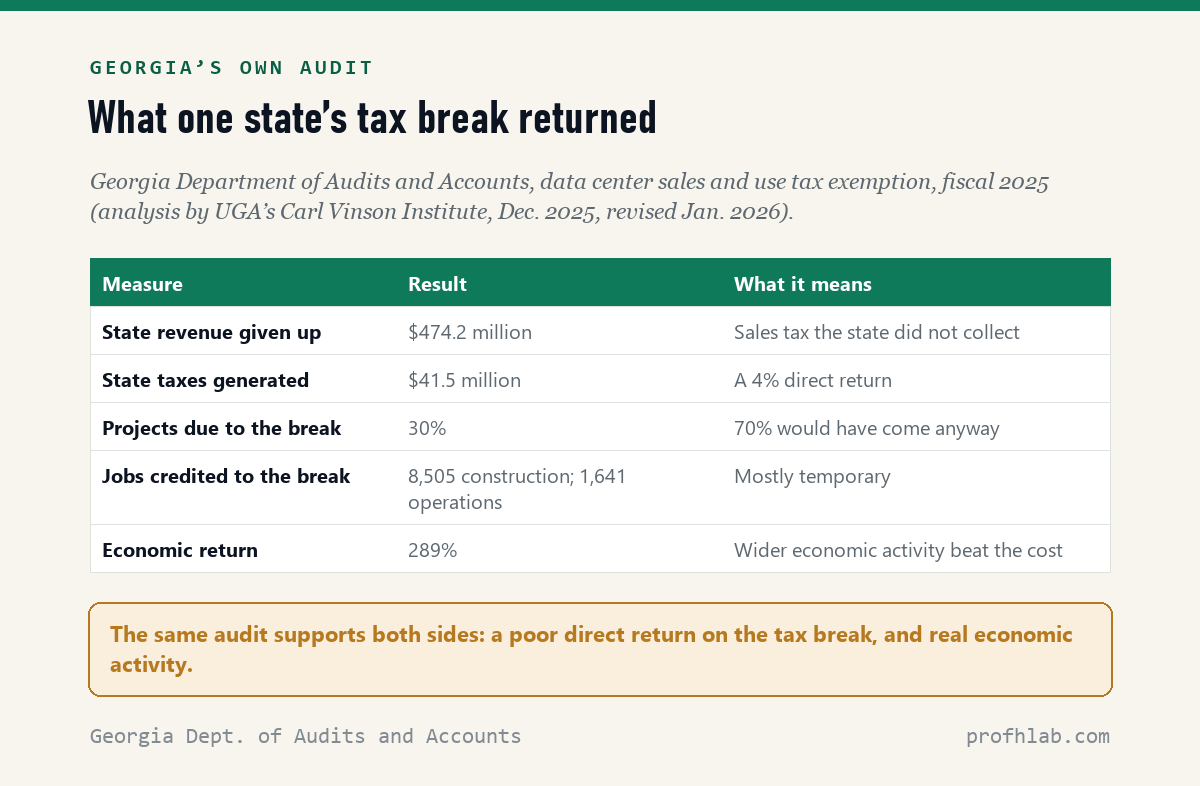
These breaks are now among the most expensive incentives states offer. Virginia’s own annual financial report shows $1.6 billion in sales and use tax revenue lost to data centers in fiscal 2025, according to Good Jobs First, a subsidy watchdog that wants the exemptions repealed. Good Jobs First counted 37 states with such exemptions in June 2026.
One giant project shows the scale. Fortune reported in May 2026 that Meta’s Hyperion campus in Louisiana “will be exempt from state and local sales and use taxes on its data center equipment for the next 20 years,” worth about $3.3 billion by an analysis Fortune cited. Local property taxes are separate, and most of those are still collected: in Georgia’s example, $27.8 million of a $33.6 million property tax bill.
Do data centers use a lot of local water?
It depends on how they are cooled and where they are: Virginia’s JLARC called data center water use there “currently sustainable,” while in Newton County, Georgia, Meta’s campus uses about 10% of the county’s daily water, according to the county water authority as reported by The New York Times in July 2025. Our post on how much power and water an AI data center uses covers the cooling side.
Newton County shows how disputes form. Neighbors near the site said their well failed. Meta says it does “not utilize groundwater” and buys its water from the county authority, and Fortune reported in May 2026 that Meta’s third-party study found no connection between the well and its operations. The county’s supply strain is a separate, documented concern: rates are set to rise 33% over two years.
In Tucson, Arizona, the City Council voted unanimously on August 6, 2025 to end talks on “Project Blue,” a 290-acre data center, over water, power and secrecy. Mayor Regina Romero said: “It is my responsibility to create guardrails to protect Tucson from this industry.” The project then moved forward on county land with air cooling, which uses less water and more electricity.
Texas is the open question. E&E News reported in May 2026 that more than 65% of the state was in drought and that its draft 2027 water plan does not account for data centers. University of Texas researchers estimate data centers could exceed 9% of Texas water use by 2040. Projections vary widely, so treat any single number as a scenario, not a forecast.
Are data centers noisy for people who live nearby?
Sometimes, and it is hard to fix once the buildings are up: JLARC found “In a few cases, noise from data centers has negatively affected nearby residents, and noise impacts can be difficult to resolve.” The usual sources are rooftop cooling fans, chillers and backup generator tests, and the complaint is often a constant low hum.
The best-known case is Great Oak in Prince William County, Virginia, where homes sit about 600 feet from an Amazon Web Services cluster. Residents have complained of low-frequency noise since 2022; AWS cut levels by about 10 decibels after upgrades in 2024, Potomac Local News reported in June 2025. “We’re not anti-data center. We’re anti-living with industrial noise in our homes,” said resident Dale Brown.
Some cities now write rules in advance. Chandler, Arizona’s ordinance, in effect since January 5, 2023, requires a sound study shared with residents before a neighborhood meeting, annual noise studies for five years and limits on generator testing. In College Station, Texas, a developer’s CEO said hyperscale sites run at “about 40 to 50 decibels, which is like a small office”; residents disputed it, and the council rejected the land sale.
Do data centers pollute the air?
Usually only a little, from backup diesel generators during tests or outages: JLARC found Northern Virginia’s backup generators make up under 4% of regional nitrogen oxides and 0.1% of carbon monoxide and particulate matter. On-site gas turbines that run every day are a different story, and Memphis is the example everyone cites.
xAI installed 35 gas turbines at its Colossus site in South Memphis; the Shelby County Health Department permitted 15 of them on July 2, 2025, according to the Southern Environmental Law Center, an environmental law group that is suing xAI on behalf of the NAACP. SELC attorney Patrick Anderson told KAIT: “xAI should not have been allowed to begin operating any of these turbines without first getting an air permit.”
xAI’s side of the ledger is real too. Besides the Memphis tax fund, it has committed to an $80 million wastewater recycling plant meant to treat up to 13 million gallons a day so it draws less from the Memphis Sand Aquifer; the project paused in 2026 with a commitment to restart by early 2027, Water & Wastes Digest reported. Our xAI Memphis jobs post covers the employment side.
What about power lines, farmland and the grid?
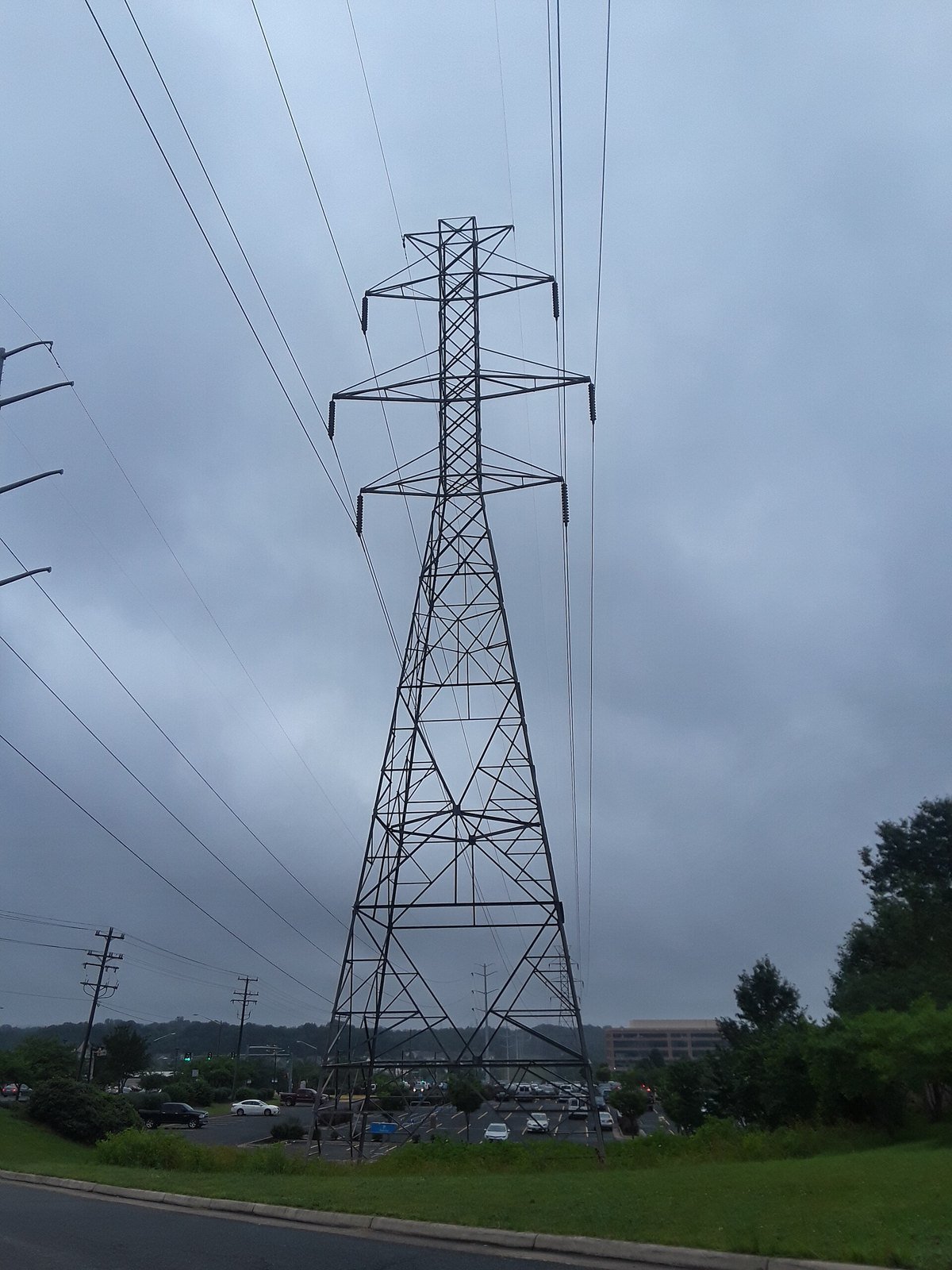
The power has to arrive somehow, and that can put a high-voltage line through land far from the data center: in Maryland, a proposed 67-mile, 500-kilovolt line tied to Northern Virginia’s data center hub would cross farms in Baltimore, Frederick and Carroll counties, NBC News reported in November 2025. Farmer Lisa Gaver told NBC: “It’s going to financially devastate us.”
The grid itself is under strain. The North American Electric Reliability Corporation’s long-term assessment, reported by POWER Magazine in January 2026, found 13 of 23 areas at elevated or high risk of supply shortfalls over five years. NERC’s John Moura: “We must treat large loads as part of system planning, not just demand forecasts.”
Who pays for the upgrades is now set utility by utility. Ohio regulators in July 2025 required new data centers over 25 MW in AEP Ohio’s area to pay for at least 85% of the capacity they reserve for up to 12 years. Virginia created a new rate class for Dominion customers of 25 MW and up. Georgia’s Public Service Commission voted in January 2025 that new customers over 100 MW can be billed for upstream costs. The full bill story is in is my electric bill going up because of AI.
Why do people oppose data centers?
The reasons repeat across towns: higher utility bills, water, noise, property values, lost green space and, often, secrecy about who the developer is. Data Center Watch, a tracker of local opposition, counted about $64 billion of projects blocked or delayed from May 2024 to March 2025, at least $156 billion in 2025 and about $130 billion more in the first quarter of 2026 alone.
National polls show how broad the mood is. A PBS News, NPR and Marist poll of September 14–15, 2026 found 65% of registered voters oppose a data center in their own community. In an AP-NORC poll from July 2026, 84% were concerned about local electricity prices and 73% supported requiring data centers to pay for grid upgrades. Heatmap’s polling swung from 44% support and 42% opposition in August 2025 to 71% opposition by May 2026.
It is not a left-versus-right fight. Data Center Watch found that 55% of politicians who took public positions against projects were Republicans and 45% Democrats. In Indiana, a Franklin Township organizer told WFYI: “This is really just a nonpartisan issue. Everybody wants access to drinking water, everybody wants affordable utility bills.”
Can a town stop a data center?
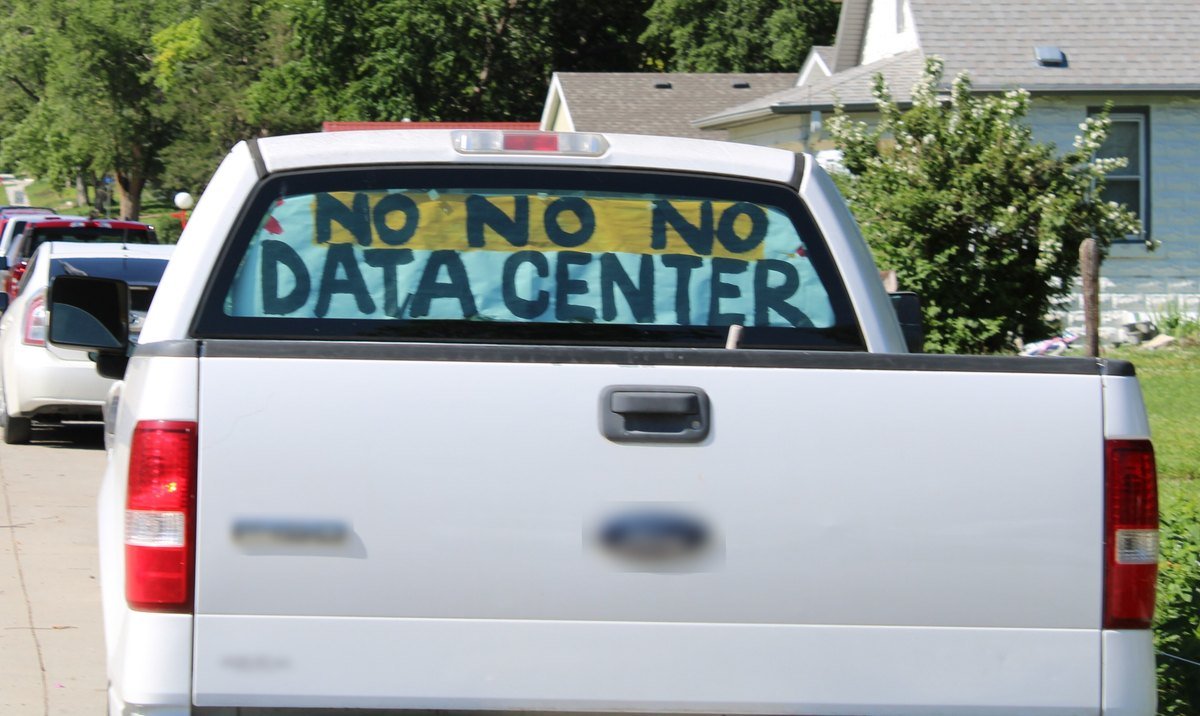
Sometimes: Tucson ended talks on one project, Peculiar, Missouri rewrote its zoning to block another, College Station, Texas refused a land sale, and Google withdrew a nearly 500-acre rezoning in Franklin Township, Indiana in September 2025 before a council vote. At least 100 local moratoria had been adopted by May 2026, according to Columbia Law School’s Sabin Center.
Courts matter too. In Prince William County, Virginia, a judge voided the rezoning for the Digital Gateway, a planned 37-building, 2,100-acre campus, because the county’s public hearing notice was defective. Appeals upheld the ruling, and the last developer withdrew in July 2026. In Indianapolis, the City-County Council voted 23–1 on August 10, 2026 for a pause on new data center approvals through 2027, pending a commission’s sign-off.
But saying no is not always the end. Tucson’s Project Blue went ahead on Pima County land after the city vote, because the county’s earlier approval still stood. Moratoria are usually temporary, often a year, “often the maximum allowed by state legislation,” the Sabin Center notes.
What should residents ask before a data center is approved?
Ask for numbers in writing: water source and a daily cap, noise limits backed by a sound study, generator testing rules, permanent jobs, the net tax the community keeps, and penalties if promises fall short. Those are the terms residents and auditors have actually won or recommended in Virginia, Pennsylvania, Missouri and Arizona.
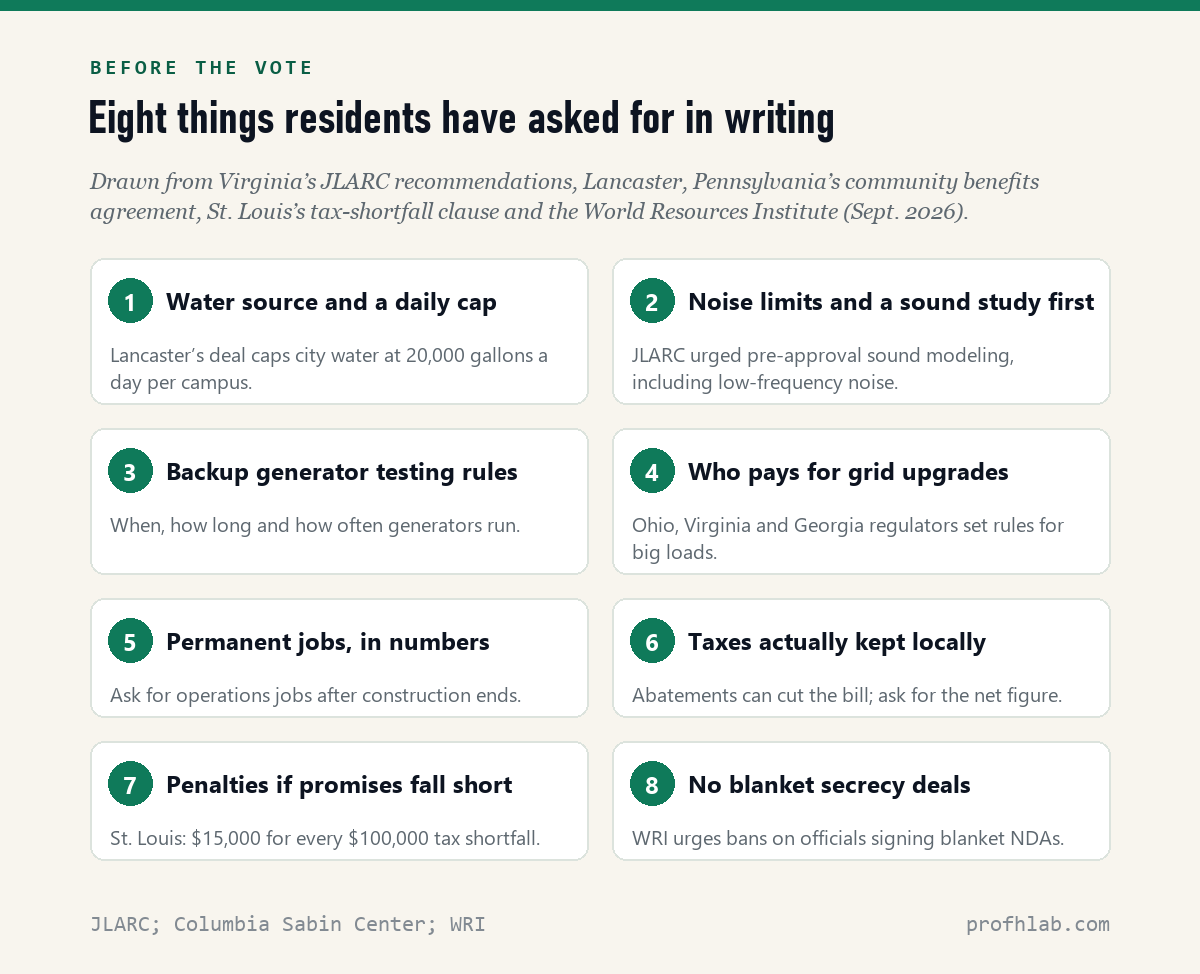
Two real agreements show what “in writing” looks like. Lancaster, Pennsylvania’s community benefits agreement requires $20.25 million in contributions, caps city water at 20,000 gallons a day per campus and sets 100-foot buffers from homes and parks, Columbia’s Sabin Center reported. In St. Louis, if promised local taxes fall short, “the developer will pay the city $15,000 in liquidated damages for every $100,000 shortfall,” according to the World Resources Institute.
Timing matters as much as terms. JLL reported in January 2026 that the industry usually begins community consultation “6 to 18 months into the development process after key decisions are made.” A Lancaster community group said it got the agreement two days before the council vote. Our US build map explains where to look for early signs.
What would a fair deal between a data center and its neighbors look like?
Putting the sources together, a deal that works for both sides has five parts: the data center pays its own grid costs, caps its water, meets a noise limit, shares tax money with the nearest neighborhoods, and accepts penalties if it falls short. That list is our synthesis of the Ohio, Virginia and Georgia rate rules, the Lancaster and St. Louis agreements, Memphis’s neighborhood fund and JLARC’s recommendations, not any one source’s plan.
Each piece already exists somewhere. What is rare is all five in one place, agreed before the vote. The companies have reasons to want this too: Data Center Watch’s billions in blocked or delayed projects are lost time for them. The wider policy picture, including federal moves on permits and grid rules, is in who is building the most AI data centers.
What a data center next door means for jobs, taxes and water
Do data centers create jobs?
Yes, but mostly during construction. JLARC reported up to 1,500 construction workers per Virginia site but fewer than 50 daily operations staff per facility. Brookings estimates roughly 100 to 200 jobs per host county.
Do data centers create jobs long term?
A few hundred at the largest sites. Meta said its Louisiana campus would support “more than 500 operational jobs,” later reported at about 1,000 after expansion. Georgia’s audit credited 1,641 operations jobs, against 8,505 construction jobs, to its tax break.
Do data centers pay taxes?
They pay local property taxes, often a lot: Loudoun County expects $1.3 billion, about 40% of its budget, in fiscal 2027. Many states exempt their equipment from sales tax; Virginia reported losing $1.6 billion that way in fiscal 2025.
Do data centers lower property taxes for residents?
They can. Loudoun’s real property tax rate fell from $1.145 per $100 in 2016 to $0.805 in 2026 as data center revenue grew. Results depend on local abatements and how many buildings a place has.
Do data center tax breaks pay off?
Not directly in Georgia: the state gave up $474.2 million in fiscal 2025 and collected $41.5 million in related taxes, and found 70% of projects would have come anyway. The same audit found a 289% economic return from wider activity.
Do data centers raise home prices?
Slightly, by one estimate. Brookings researchers found home prices in host counties rise 2% to 5%, with no change in wages.
Do data centers use a lot of local water?
It depends on cooling and location. Meta’s Georgia campus uses about 10% of Newton County’s daily water, per the county water authority as reported by The New York Times, while Virginia’s JLARC called current use there sustainable.
Are data centers loud?
Some are, for close neighbors. Homes in Prince William County’s Great Oak neighborhood sit about 600 feet from an AWS cluster; residents have complained since 2022, and AWS cut levels by about 10 decibels. JLARC found harm “in a few cases.”
Do data centers pollute the air?
Backup diesel generators are a small share: under 4% of Northern Virginia’s nitrogen oxides, per JLARC. Daily-running gas turbines are different: xAI installed 35 in Memphis before 15 were permitted, which led to legal action by the NAACP and SELC.
Why do people oppose data centers in their town?
Data Center Watch lists “higher utility bills, water consumption, noise, impact on property value, and green space preservation.” Secrecy recurs too: non-disclosure agreements in Tucson and rushed votes elsewhere.
How many Americans oppose a data center near them?
Most, in 2026 polls. Pew found 60% would be uncomfortable with a new one in their area in August 2026, and a PBS News/NPR/Marist poll in September found 65% of registered voters oppose one in their own community.
Is data center opposition a left or right issue?
Neither cleanly. Data Center Watch found 55% of politicians opposing projects were Republicans and 45% Democrats, and AP-NORC found broad support across parties for making data centers pay for grid upgrades.
Can a town block a data center?
Sometimes. Tucson, Peculiar, College Station and Franklin Township said no or saw withdrawals, and at least 100 local moratoria exist. But Tucson’s project continued on county land, and most moratoria last about a year.
What is a community benefits agreement for a data center?
A signed deal between the developer and the community. Lancaster, Pennsylvania’s requires $20.25 million in contributions, a 20,000-gallon daily cap on city water per campus and noise kept to pre-construction levels.
JLARC refused our connection; the county summary stood in
Government figures come from the agencies’ own pages, except JLARC, whose site refused our connection; we used Prince William County’s official summary of the JLARC report instead. The New York Times page on Newton County blocked our reader, so those facts come from coverage of the Times story, and we say “as reported.” Advocacy and industry sources are labeled each time they appear.
We left out several widely repeated numbers we could not confirm on a primary page, including some project values and dates in Missouri and Texas. Local stories change quickly. If your town is in one of these fights, the county’s own agenda and minutes are the record that counts.
Power bills first, then jobs at the site next door
Start with whether AI is raising your power bill, then the complete guide to AI data centers and how they are built. For the bigger trend, see where AI data centers are going and the Physical AI library.
If you would rather work at one, browse openings on our jobs board, check today’s counts on the AI jobs tracker, or read AI jobs that don’t require coding.
Cite this
Loudoun County, Virginia projects $1.3 billion, 40% of its fiscal 2027 budget, from data centers, while Virginia’s JLARC found a typical site needs fewer than 50 daily operations staff; Georgia’s audit found a 4% direct return on its data center tax break; and 60% of Americans told Pew in August 2026 they would be uncomfortable with one nearby. Source: profhlab.com, Are Data Centers Good for Local Communities?
Sources read on October 2, 2026: Loudoun County, Data Centers: The Loudoun Story; Prince William County summary of JLARC Report 598, December 2024; Georgia Department of Audits and Accounts, revised January 2026; Brookings, May 4, 2026; Pew Research Center, September 22, 2026; AP-NORC/EPIC, September 16, 2026.
Also read on October 2, 2026: PBS News, September 23, 2026; Heatmap, June 2, 2026; Memphis Flyer, July 21, 2026; SELC (advocacy), May 8, 2026; AZ Luminaria, August 6, 2025; Potomac Local News, June 11, 2025; NBC News, November 1, 2025; Columbia Sabin Center, May 28, 2026; World Resources Institute, September 8, 2026; Fortune, May 14, 2026. Photos via Wikimedia Commons under the licenses shown.
Prof.’s H Newsletter
One short email a month, with the numbers in it
What actually moved in AI hiring, AI prices, and the scams aimed at older Americans. Counted here, dated, and linked to the source. One email a month, and your address goes nowhere else.