How to Become a Data Center Technician With No Experience: What 50 Live AI Job Postings Require (August 2026)
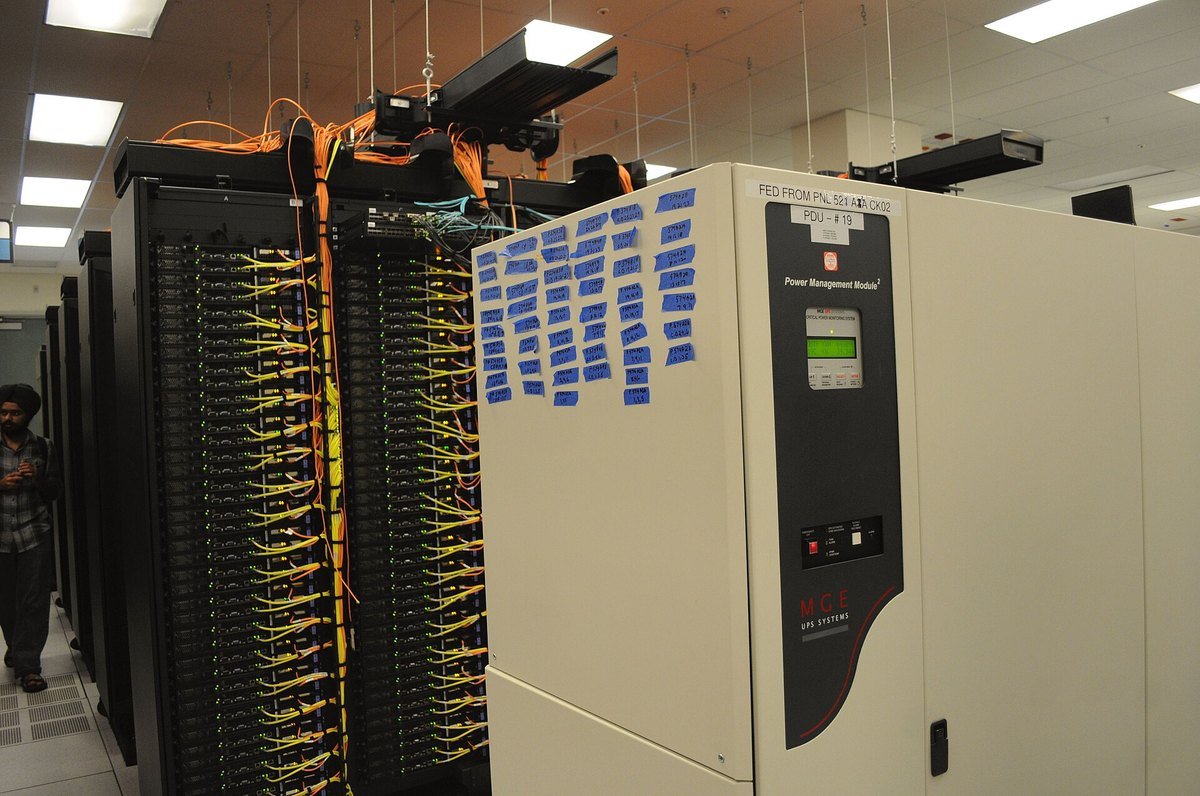
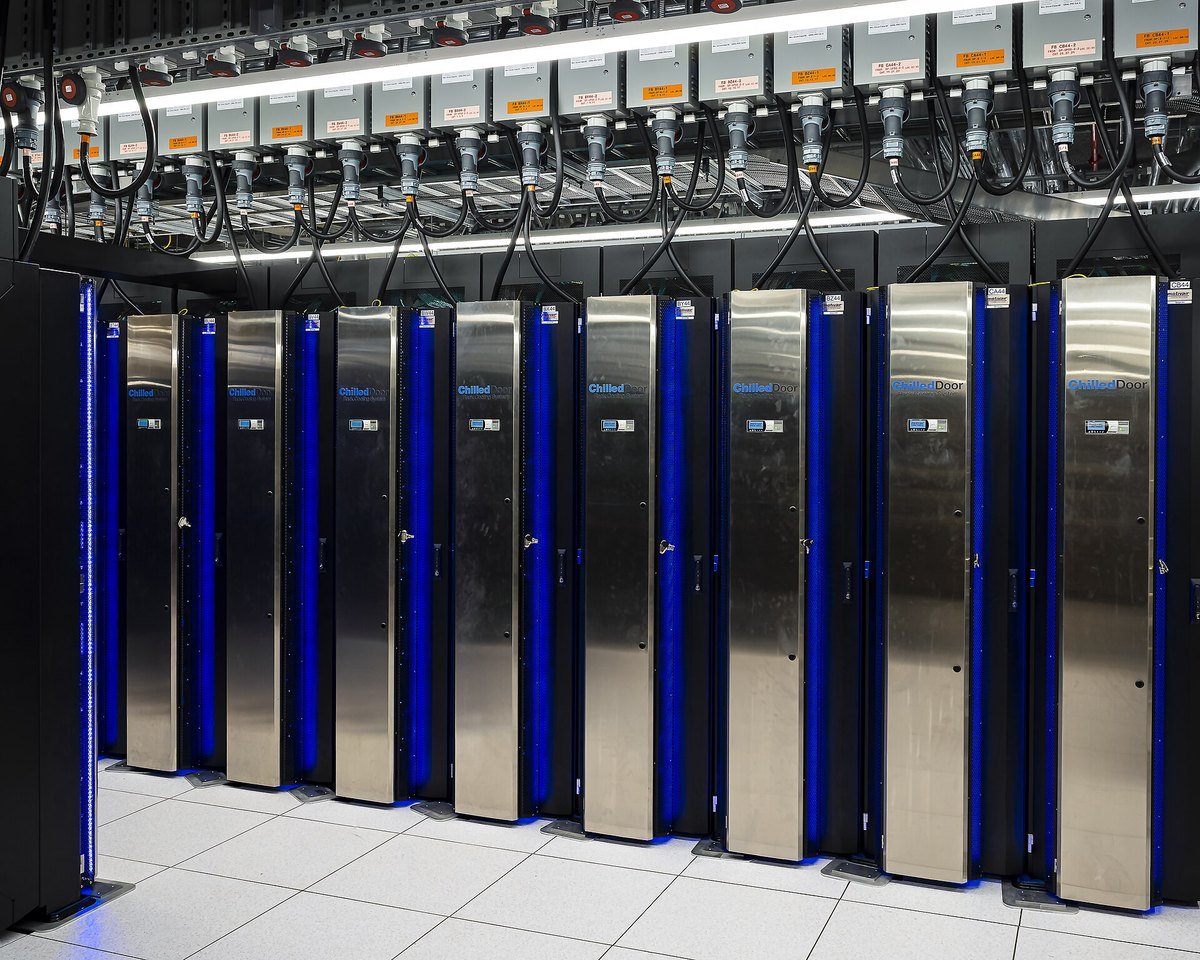
In the photograph below, the most important object in the room is a strip of blue painter’s tape. Somebody wrote circuit numbers on it by hand and stuck it to the front of a power distribution unit, because the machine that costs more than a house does not come with a label maker that survives a shift change.
That is the job. Not the servers — the power, the cooling, the labels, and the person who walks the aisle at 3 a.m. to find out why row B is warm.
Search how to become a data center technician with no experience and you will get a dozen guides that say the same four things: get a CompTIA A+, write a good résumé, apply widely, be persistent. None of them tell you what the postings actually say. So on August 24, 2026 we read all fifty technician roles open at eight AI and robotics companies — not the summaries, the requirements sections — and counted the words.
The honest headline: the door is real, and it is narrower than the guides suggest. Ten of the fifty postings accept a high school diploma or a GED. Exactly one asks for zero to two years of experience.
How we counted
Fifty technician postings live on August 24, 2026 on the public job boards of OpenAI, xAI, Figure AI, 1X, Physical Intelligence, Nuro, Agility Robotics and Scale AI — read straight from the feeds those employers publish, then parsed for the education, experience, certification and physical-requirement lines. Pay figures are only quoted where the employer printed a range in the posting itself. Labour-market figures come from the US Bureau of Labor Statistics, read the same day. This is eight AI-native employers, not the whole market — see the scope note near the end.
What the job is, what it pays and the 75-pound lift
- What a data center technician actually does all day
- Do you need a degree? What the postings say
- The years-of-experience number nobody prints
- The doors that are open today, with pay
- The part that surprised us: the growing door is the trades door
- Which certifications the postings actually name
- The night shift and the 75 pounds
- What to do this week
- Questions people actually search
What a data center technician actually does all day
There is no single job behind the title, and that is the first thing worth knowing. Sorting the fifty postings by what the work touches gives three families:
- Facilities, electrical and mechanical (13 postings). Switchgear, transformers, UPS systems, generators, chillers, cooling towers, CRAC and CRAH units, pumps. xAI’s Mechanical Commissioning Technician posting lists exactly that hardware, by name, in one sentence.
- IT, network and server (10 postings). Racking, cabling, fibre, hardware swaps, break-fix. This is what most people picture when they hear the title.
- Robotics and manufacturing (27 postings). Assembly, test, harnesses, service calls on humanoid robots and autonomous vehicles. Same word — technician — different building.
The distinction matters because it decides which door you knock on. If the picture in your head is a computer lab, you are aiming at the smallest of the three groups.
Do you need a degree to be a data center technician?
No — and the postings are unusually blunt about it.
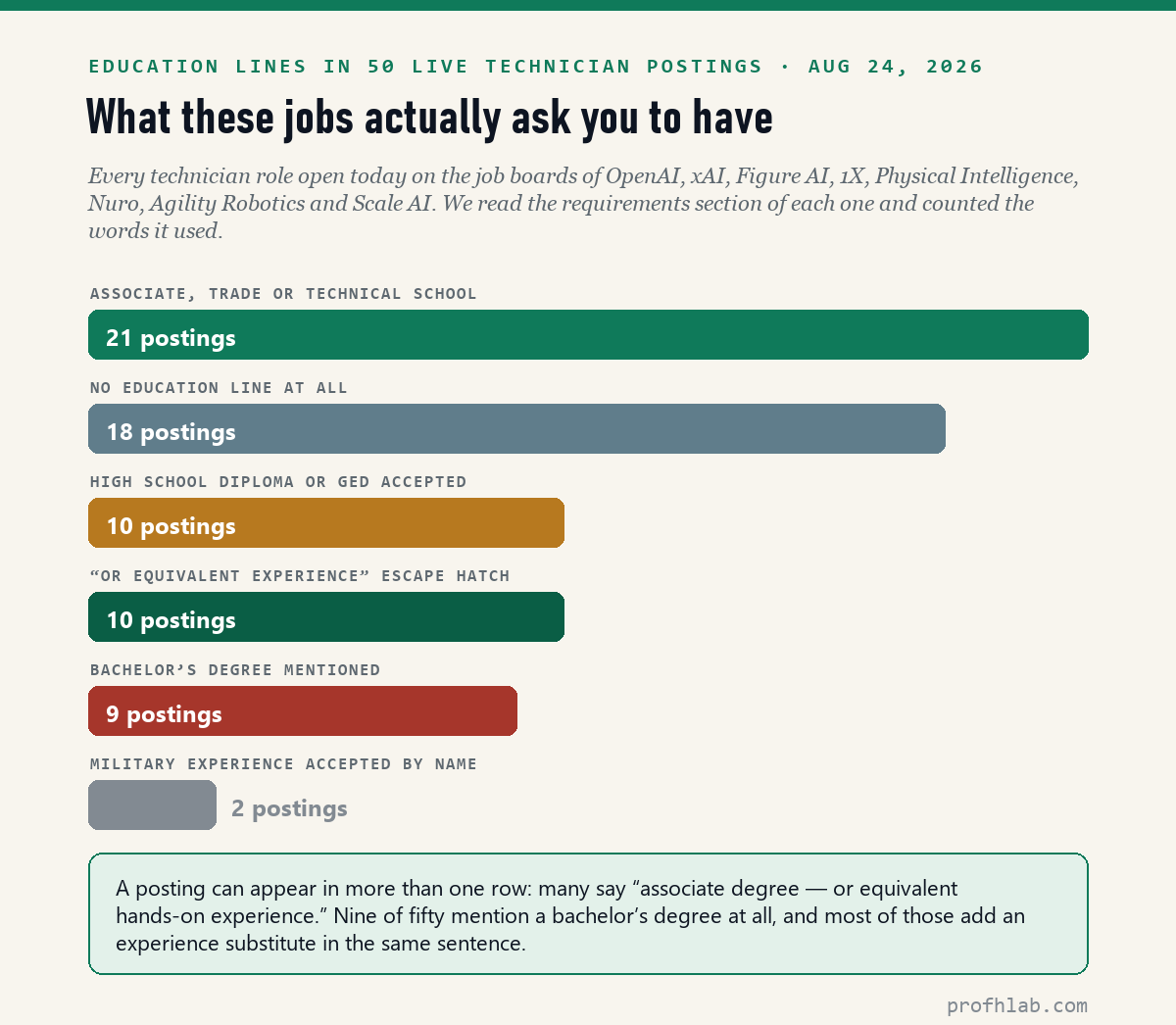
Twenty-one of the fifty ask for an associate degree, a trade school certificate or a technical school qualification. Eighteen name no education requirement at all. Ten explicitly accept a “high school diploma or equivalency certificate” — that phrase, verbatim, appears across xAI’s Memphis and Southaven postings. Only nine mention a bachelor’s degree, and most of those hand you an escape route in the same sentence.
The escape routes are worth memorising, because they are the actual entry mechanism:
- OpenAI’s Site Operations Technician asks you to “have an Associate’s degree, technical certification, military experience, or equivalent practical experience.” Four doors, one sentence — and one of them is the service.
- xAI’s Facilities Operations Technician wants a “Bachelor’s Degree in Mechanical or Electrical or 2+ years of hands-on operations/facilities work experience in lieu of degree.”
- Agility Robotics’ Engineering Support Technician says “typically AS degree … and/or 3 years equivalent work experience.”
Two postings name military experience as a qualification on its own. If you turned wrenches, ran power or fixed radios in uniform, you are the candidate that sentence was written for.
The years-of-experience number nobody prints
Here is where the cheerful guides go quiet. We searched every posting for a sentence of the form “N years of experience.”
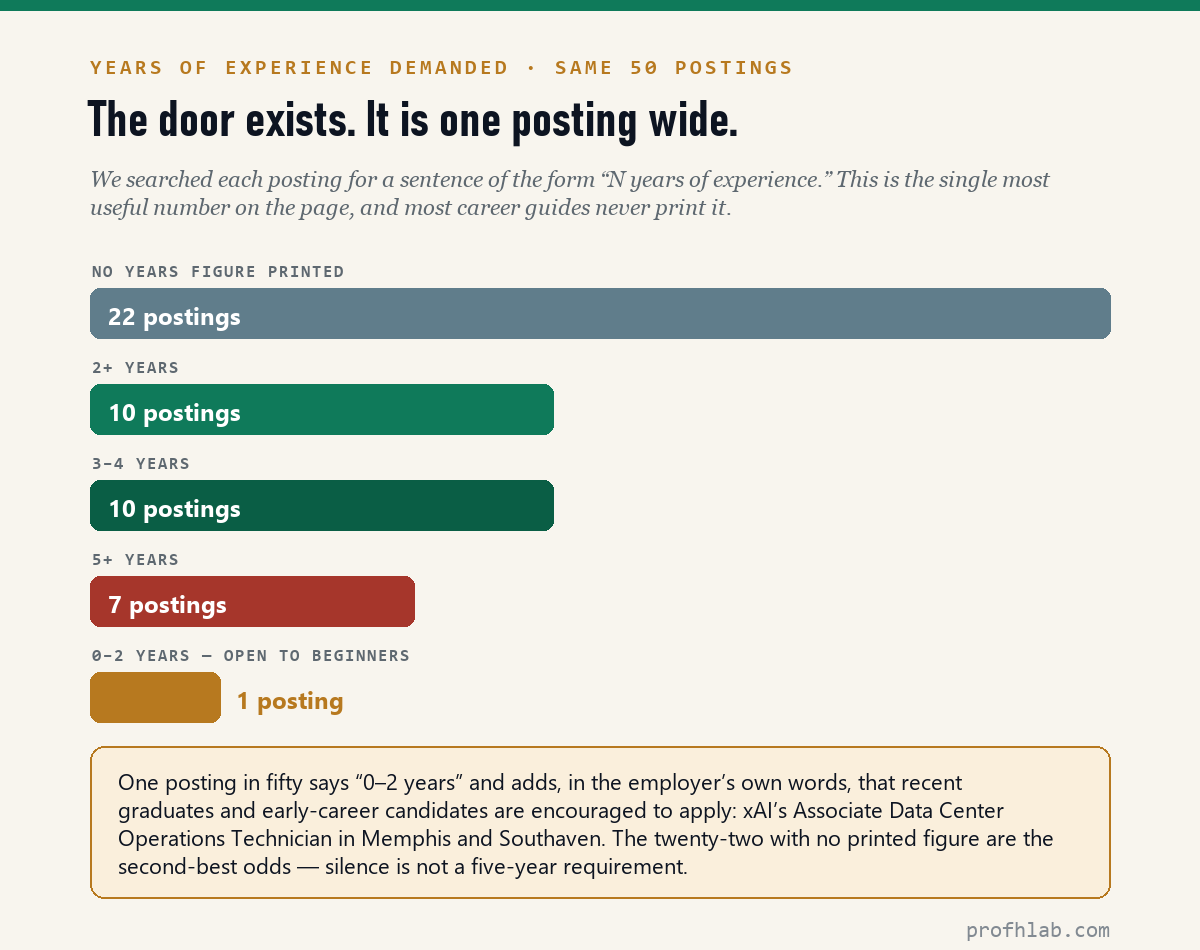
Seven ask for five years or more. Twenty ask for two to four. Twenty-two print no figure at all — which is not the same as a five-year requirement, and is where a determined beginner should spend their applications.
And one posting, out of fifty, says this:
“High school diploma or equivalency certificate … 0–2 years of experience working with server, storage, compute, or network hardware (recent graduates or early-career candidates encouraged to apply).”
That is xAI’s Associate Data Center Operations Technician, posted for Memphis, Tennessee and Southaven, Mississippi, and refreshed on August 21, 2026. It is, as far as our count goes, the literal answer to the search query that brought you here. It does not publish a pay range, and it asks you to lift 35 pounds unassisted and work evenings and weekends. We will come back to both.
The doors that are open today, with pay where it is published
Ordered by how little they ask of a beginner. Every link goes to the employer’s own board.
| Role | Employer | Where | What it asks for | Published pay |
|---|---|---|---|---|
| Associate Data Center Operations Technician | xAI | Memphis, TN · Southaven, MS | High school diploma or GED; 0–2 years; beginners invited by name | No range published |
| Apprentice Robot Service Technician | Figure AI | San Jose, CA | Apprenticeship: robot operator duties blended with entry-level service work | No range published |
| Associate Fleet Technician | Nuro | Santa Clara & SF, CA | Academic program, vocational training or professional role; ASE or CompTIA named as examples | No range published |
| Site Operations Technician | OpenAI | San Francisco, CA | Associate degree, technical certification, military experience or equivalent practical experience | $157,000–$221,000 |
| Engineering Support Technician | Agility Robotics | Fremont, CA | AS in electronics or engineering technology and/or 3 years equivalent experience | $74,000–$95,000 |
| Facilities Technician | xAI | Memphis, TN | High school diploma or GED; 2+ years; plumbing, HVAC, basic electrical, carpentry | No range published |
| IT Services Technician | xAI | Memphis, TN | Associate or bachelor preferred, equivalent experience considered; 2–4 years; A+ or Network+ preferred | $61,200–$91,800 |
| IT Services Technician | xAI | Seattle, WA | Same posting text as Memphis, different pay band for the same work | $68,400–$102,600 |
All eight were live on August 24, 2026. Postings close without notice — the employer’s page is always the authority.
Read the last two rows again
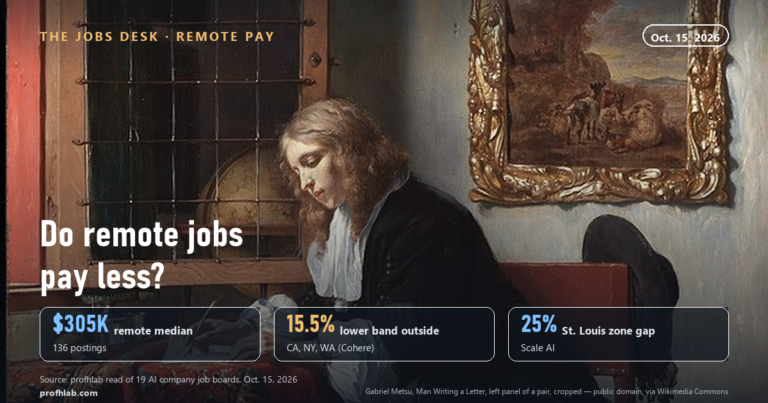
The same posting text, the same title, the same employer — and Seattle pays a band that starts $7,200 higher than Memphis. Neither number is a secret: both are printed because Washington and California pay-transparency law obliges employers to print them. Only 7 of the 50 technician postings we read published any range at all, and the ones that did were nearly all in states that require it. A missing range is a legal artefact, not a warning — but it is a fair thing to ask about on the first call.
The part that surprised us: the growing door is the trades door
We expected the AI build-out to be hiring computer people. Sort xAI’s nineteen technician postings by what they touch and it is almost an even split — nine on the IT and network side, ten on electrical, mechanical, controls, commissioning and facilities. A gigawatt of compute is a heavy industrial site that happens to contain servers.
Now put that next to the federal projections. The US Bureau of Labor Statistics has no occupation called “data center technician,” which is exactly why the salary figures quoted online swing so wildly. The work is filed under four other occupations — and they are not moving in the same direction.
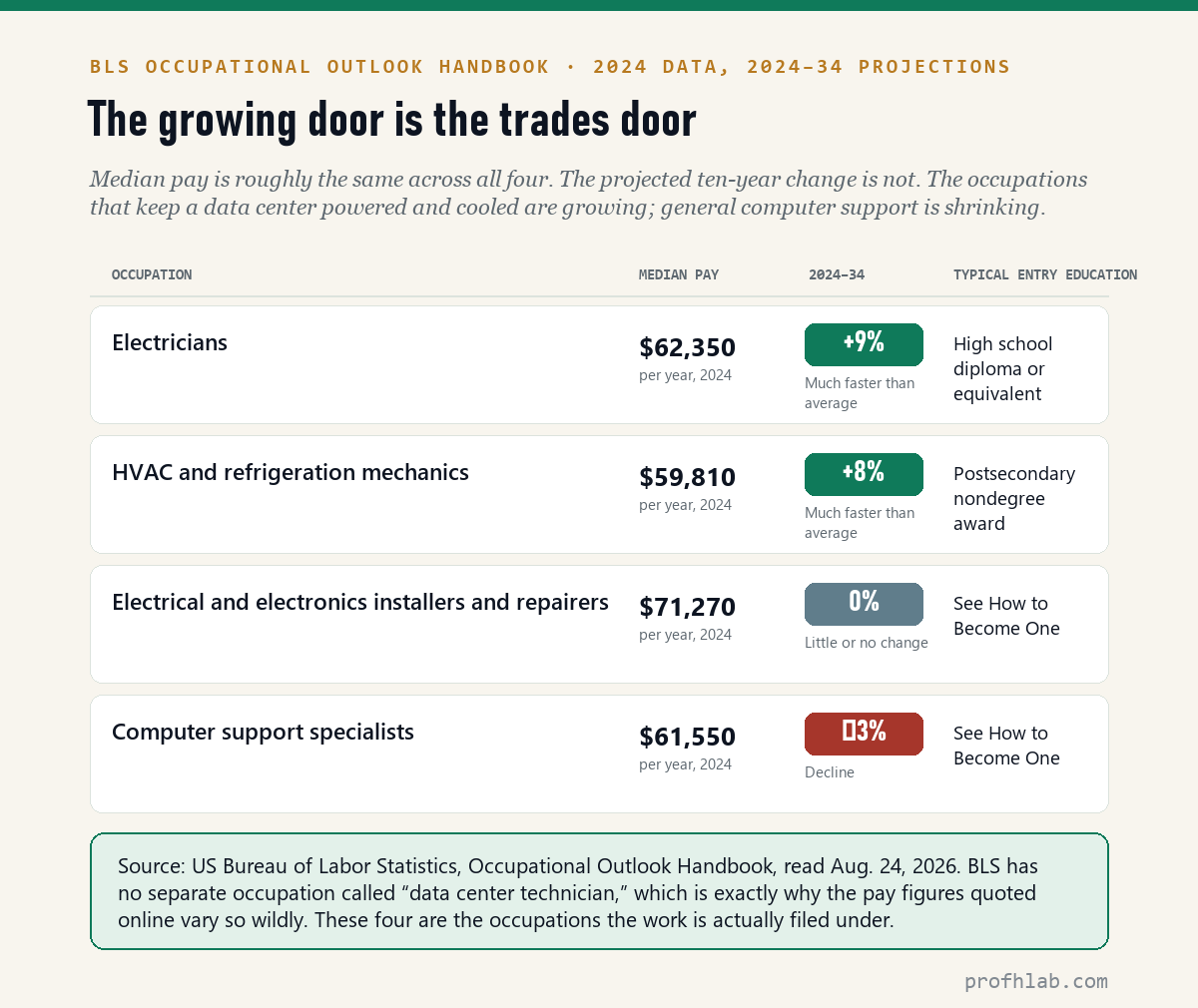
Electricians: +9% through 2034, typical entry education a high school diploma, trained through apprenticeship. HVAC and refrigeration mechanics: +8%. General computer support specialists, the occupation most people mean when they say “get into IT”: −3%, a projected loss of 24,200 jobs from a base of 882,300.
So the honest version of the advice is not “learn IT.” It is: the door that is opening is the one you get through with a licence and a toolbag, and it opens without a degree.
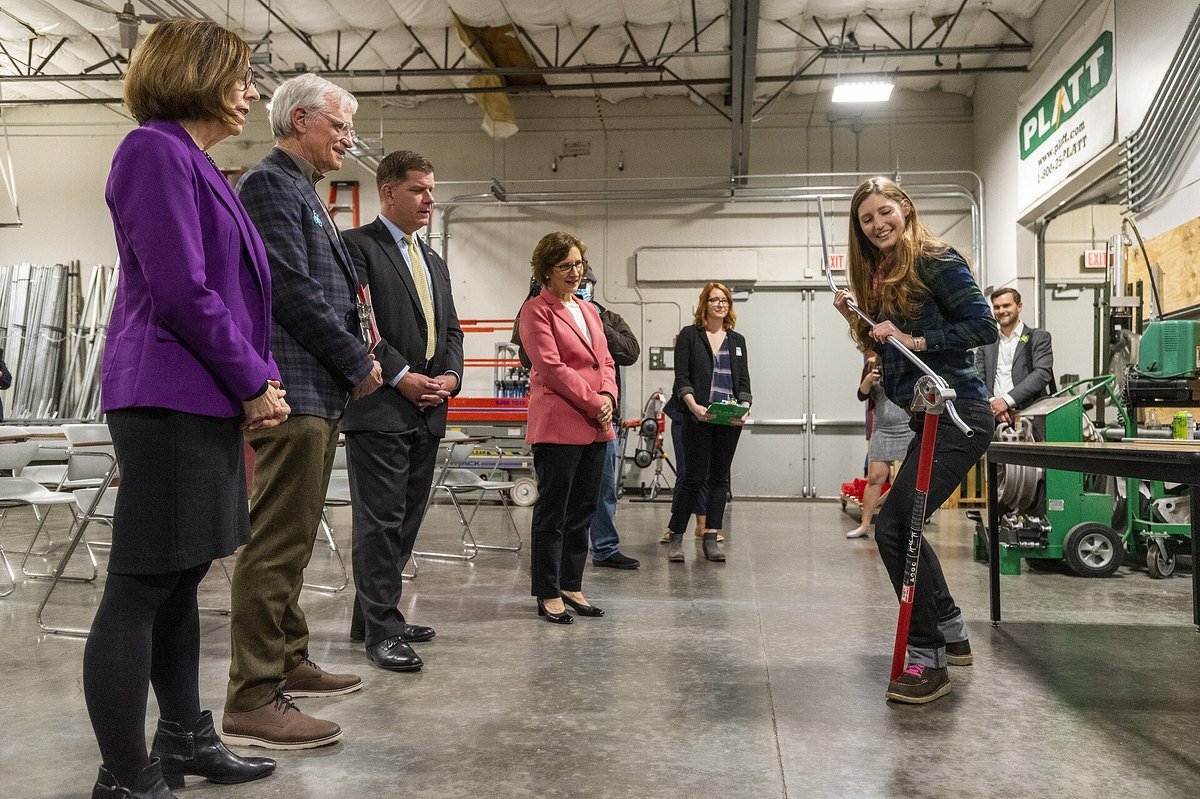
If you want the trades door specifically, the federal apprenticeship finder at apprenticeship.gov lists registered programs by trade and ZIP code. Registered apprenticeships are paid from the first day and end with a credential, which is a materially different proposition from paying for a bootcamp.
Which certifications the postings actually name
Counting certification mentions across the fifty postings puts the usual advice in an awkward light. HVAC appears in eight. ASE — the automotive credential — in six. OSHA safety training in four. CompTIA in four. NFPA 70E (electrical safety) in three, journeyman status in three, forklift in three. A+ and Network+ appear in two each; CCNA and BICSI in one each; EPA 608 refrigerant handling in one.
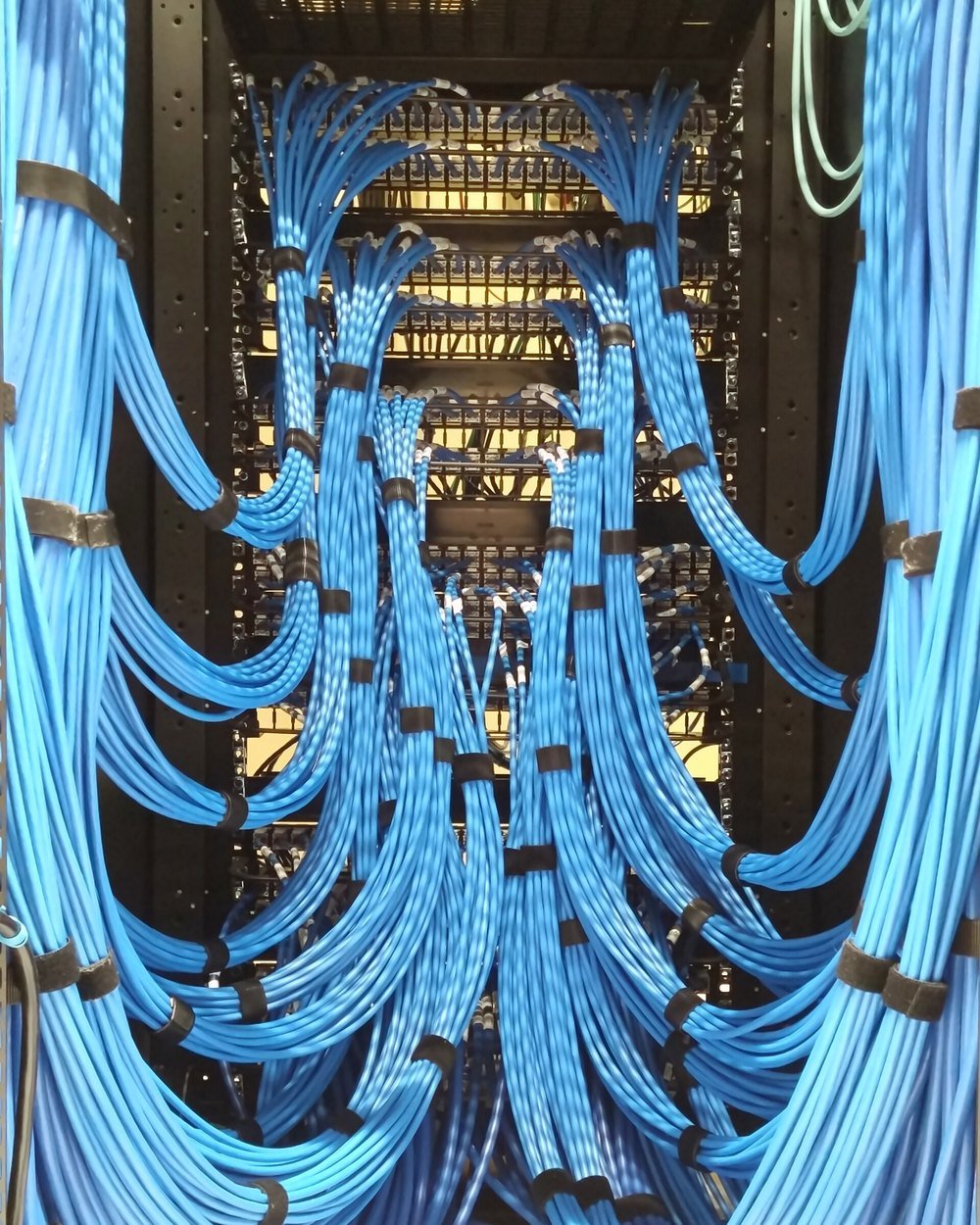
The A+ is not useless — xAI names it as preferred on both IT Services Technician postings. But if you were choosing one credential to fund yourself through, the postings point at OSHA 10 or 30 and at an HVAC or electrical qualification more often than at any IT certificate. And OpenAI lists OSHA and First Aid as a plus on the Site Operations role rather than any computing certificate at all.
The night shift and the 75 pounds
Every posting that is honest about the job says the same two things somewhere near the bottom, and they are easy to scroll past.
The hours. Twenty of the fifty carry an explicit shift or on-call clause. xAI’s Data Center Operations Technician (Night Shift) names the shift outright: “6:00 PM – 6:00 AM.” Others say “24/7 facility will require day and night shift work,” or ask for “flexible shifts providing 24×7 coverage … including evenings, weekends, and holidays.” The commissioning roles want “extended hours, nights, and weekends during critical commissioning windows.”
The body. The lifting requirements printed in these postings run from 10–15 pounds up to 75 pounds on two of the xAI data centre operations roles; 35 pounds unassisted and 50 pounds are the most common figures. Nuro adds “bend, stand, and/or stoop for long periods.”
None of that is a reason not to do it. It is a reason to know it before you take a $95 certification exam on the strength of a blog post — including this one.
Scope: what this count does and does not cover
These fifty postings come from eight AI-native employers. They are not the whole data centre labour market — the hyperscalers (Amazon, Microsoft, Google, Meta), the colocation operators (Equinix, Digital Realty, Vantage) and the electrical and mechanical contractors who build the shells all hire far more technicians than these eight combined, and they run their own boards which we did not scan today. What this count is good for is the shape of the requirement — the education lines, the years, the certifications, the shifts — read from primary sources rather than repeated from another article.
What to do this week
- Today: open the xAI Associate Data Center Operations Technician posting and read the requirements section end to end. Whether or not you apply, it is a free specification of what an entry-level hire is expected to be.
- This week: search apprenticeship.gov for electrical and HVAC programs within commuting distance. Paid from day one, credential at the end.
- If you already have a trade: stop applying to “data center technician” and start applying to facilities, controls, commissioning and O&M technician. Same building, thirteen of our fifty postings, far less competition from career-changers.
- If you served: put the words “military experience” against OpenAI’s Site Operations posting and read that sentence again. It is written for you.
- Before any exam fee: check that the certificate you are about to buy appears in postings you would actually apply to. Ours found HVAC and OSHA more often than CompTIA.
- Track the count: our AI Jobs Tracker re-reads all twenty boards daily, with entry-level counts and published pay bands.
Memphis has 105 openings, but it is a one-employer town
“Is Memphis really where these jobs are?” Of the roles we scanned across all twenty boards, Memphis is the fourth-largest US location — 105 open roles — behind San Francisco, remote and Mountain View, and ahead of San Jose and New York. That concentration is one employer’s build-out, which is both the opportunity and the risk: it is a single-company town for this work.
“What if I want the office job instead?” The same scan covers 3,659 open roles across twenty companies; we broke down who is hiring and for what in which AI companies are hiring right now, and the frontier-lab process specifically in how to get a job at OpenAI or Anthropic.
“What about the national labs?” They hire technicians without degrees too, on a different clock and with different rules about who may apply — we went through those postings in national laboratory jobs with no degree.
What we are and what we are not
We are not recruiters. We take no money from any employer, and there are no affiliate links in this article. Every posting linked here goes to the employer’s own board or applicant system and was live on August 24, 2026 — postings close without notice, and the official page always wins. Nobody legitimate will ever ask you to pay to apply, deposit a cheque and wire part of it back, or accept an offer that arrived by text message.
Degree, certifications, night shifts: what 50 postings ask for
Do you need a degree to be a data center technician?
No. Of fifty technician postings open at eight AI companies on August 24, 2026, ten explicitly accept a high school diploma or equivalency certificate, eighteen name no education requirement at all, and twenty-one ask for an associate degree or a trade or technical school qualification. Only nine mention a bachelor’s degree, and most of those add “or equivalent practical experience” in the same sentence. Two accept military experience by name.
What does a data center technician do?
Three different jobs share the title. Facilities, electrical and mechanical technicians maintain switchgear, transformers, UPS systems, generators, chillers and cooling units. IT and network technicians rack hardware, run and terminate cabling, and handle break-fix. In robotics companies the same word covers assembly, test and field service on machines rather than servers. Of the fifty postings we read, 13 were facilities and mechanical, 10 IT and network, and 27 robotics and manufacturing.
How hard is it to get a data center technician job with no experience?
Harder than most guides admit, but not closed. Across fifty live postings, exactly one asked for 0–2 years and invited recent graduates and early-career candidates by name: xAI’s Associate Data Center Operations Technician in Memphis and Southaven. Twenty-two printed no experience figure at all, which is the second-best place to aim. Seven asked for five years or more.
What certifications do I need to work in a data center?
None are universally required. Counting mentions across fifty postings: HVAC in eight, ASE in six, OSHA in four, CompTIA in four, NFPA 70E in three, journeyman status in three, forklift in three, A+ and Network+ in two each, CCNA and BICSI in one each, EPA 608 in one. Safety and trade credentials are named more often than IT certificates. Check that a credential appears in postings you would actually apply to before you pay the exam fee.
Is data center technician a good job, and is it blue collar?
It is largely blue-collar work, and the postings do not hide it: twenty of fifty carry explicit shift or on-call clauses, and lifting requirements run up to 75 pounds. On pay and prospects, BLS 2024 medians for the occupations this work is filed under are $62,350 for electricians (+9% through 2034), $59,810 for HVAC and refrigeration mechanics (+8%), $71,270 for electrical and electronics installers (0%) and $61,550 for computer support specialists (−3%). The trades side is the growing side.
What are data center technician night shift hours?
Where employers print them, twelve-hour rotations are standard. xAI’s Data Center Operations Technician (Night Shift) posting in Hillsboro, Oregon names 6:00 PM to 6:00 AM. Other postings in the same family say the 24/7 facility requires both day and night shift work, or ask for flexible coverage including evenings, weekends and holidays. Commissioning roles ask for extended hours during commissioning windows rather than a fixed night rotation.
How much do entry-level data center technician jobs pay?
Only 7 of the 50 postings published a range, almost all of them in states with pay-transparency laws. Among those: xAI’s IT Services Technician pays $61,200–$91,800 in Memphis and $68,400–$102,600 in Seattle for the same posting text; Agility Robotics’ Engineering Support Technician pays $74,000–$95,000 in Fremont; OpenAI’s Site Operations Technician pays $157,000–$221,000 in San Francisco. The true entry-level xAI posting in Memphis publishes no range at all.
What is the career path from data center technician?
The postings themselves sketch it. The same employers list Senior Data Center Operations Technician (5+ years), Lead Controls Technician (5+ years including 2 in a lead role) and Senior Facilities Operations Technician, each with an experience figure that reads as a rung on a ladder. In other words, the years-of-experience lines that block you at the start are the same lines that describe your next three jobs.
Ask the desk
Want this run for your city, your trade, or your shift pattern — or for the hyperscaler boards we did not scan today? Tell us and we will go read the postings for you and publish the answer.
Next check: we re-read all twenty boards daily for the tracker. The specific number to watch is whether xAI posts a second Associate-level technician role — one opening for a whole build-out is a thin door, and a second one would say the entry tier is becoming a real tier.
Sources: public job-board feeds of OpenAI, xAI, Figure AI, 1X, Physical Intelligence, Nuro, Agility Robotics and Scale AI (50 technician postings, read Aug. 24, 2026); US Bureau of Labor Statistics, Occupational Outlook Handbook — Electricians, HVACR Mechanics, Electrical and Electronics Installers, Computer Support Specialists (2024 data, read Aug. 24, 2026); Apprenticeship.gov Job Finder. Photographs credited in each caption.
Prof.’s H Newsletter
One short email a month, with the numbers in it
What actually moved in AI hiring, AI prices, and the scams aimed at older Americans. Counted here, dated, and linked to the source. One email a month, and your address goes nowhere else.