Do Remote Jobs Pay Less? We Read 2,197 AI Pay Ranges on Oct. 15, 2026, and Location Did Most of the Cutting
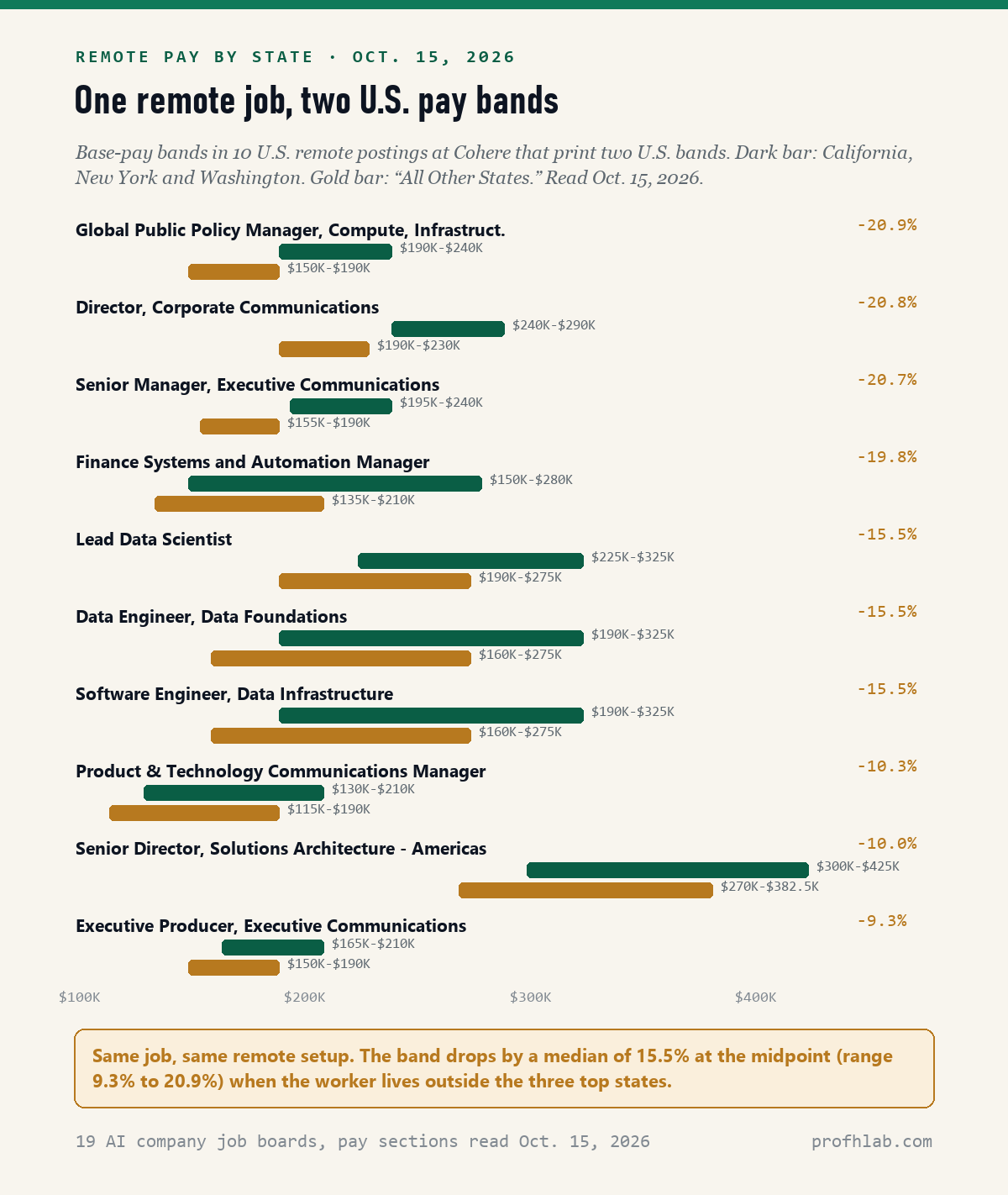
On October 15, 2026, the 136 remote U.S. postings with published pay on 19 AI company job boards had a median range midpoint of $305,000, above the $277,500 median for 2,061 on-site and hybrid postings, so the remote label alone did not mean less money. What did cut pay was where the worker lives. At Cohere, 10 of 19 U.S. remote postings print a second, lower band for “All Other States,” a median 15.5% below the California, New York and Washington band.
So the honest answer to “do remote jobs pay less” is: not for being remote, but often for being somewhere cheaper. The rest of this piece shows the postings that prove each half of that sentence.
What we checked on October 15, 2026
- All 3,796 open postings on the 19 AI, robotics and self-driving company boards we track for the AI jobs tracker, read through the public Greenhouse and Ashby job feeds. A 20th board, Google DeepMind’s U.S. board, returned “not found” and is not counted.
- We kept the 3,059 postings located in the United States, then the 2,197 that publish a pay range. A posting counts as remote when its location field says remote (for example “Remote, USA” or Anthropic’s “Remote-Friendly”); Ashby postings count only when the employer set the workplace type to Remote.
- For every one of the 2,197 we re-read the full pay section and pulled every dollar range it prints, so postings with more than one range by location show up. We read the location-tier sentences by eye.
- Midpoint means the middle of a posted base range, for example $150,000 for a $120,000 to $180,000 range. It is not what anyone was actually paid. We did not apply to any job or contact any employer.
Written and checked by Prof. H. An AI assistant helped draft this piece and run the page reads; every quote was read on the source’s own page on October 15, 2026.
Do remote jobs pay less than in-person jobs at AI companies?
Not on the posted ranges we read on October 15, 2026: 136 remote U.S. postings had a median midpoint of $305,000 and 2,061 on-site or hybrid ones had $277,500. That gap is not a remote bonus, though. The two groups hold different jobs at different companies, so the raw medians compare different mixes.
Anthropic alone supplied 51 of the 136 remote postings, and its pay runs high. That pulls the remote median up. To get a fairer read, we compared remote and on-site postings inside the same company, then looked for the same job title posted both ways.
Only one exact title showed up both ways with pay: Anthropic’s Research Engineer, Machine Learning listed “Remote-Friendly (Travel-Required)” and the same title in San Francisco and New York. Both print $500,000 to $850,000.
Which AI companies post remote roles at the same pay as office roles?
Inside the six companies that posted pay for both kinds of U.S. role on October 15, 2026, remote medians were within 4% of on-site at OpenAI, Anthropic and Agility Robotics, higher at Sierra and Cohere, and lower at Waymo. The table shows the counts behind each median.
| Company | Remote postings, median midpoint | On-site or hybrid, median midpoint |
|---|---|---|
| OpenAI | 19 · $304,000 | 597 · $307,500 |
| Anthropic | 51 · $362,500 | 444 · $348,750 |
| Agility Robotics | 20 · $202,750 | 52 · $195,500 |
| Sierra | 16 · $328,750 | 81 · $245,000 |
| Cohere | 19 · $242,500 | 8 · $222,500 |
| Waymo | 10 · $177,500 | 250 · $238,000 |
Waymo is the one company where remote looked cheaper, and the job mix explains at least part of it. Its 10 remote U.S. postings are program, policy and quality operations roles, while its on-site list is full of engineering jobs. That reading is an inference from the titles, not something Waymo says.
Waymo also shows the opposite case. It posted Software Quality Operations Specialist as “Remote, USA” and the same title for Mountain View, San Francisco or remote. Both print $130,000 to $160,000.
Sierra’s remote median is high because many of its 16 remote postings are sales leadership roles. Mix again, not a remote premium we can prove.

Why does a remote job show two different pay ranges?
Because some employers price the job by the worker’s state: on October 15, 2026, 10 of Cohere’s 19 U.S. remote postings listed one base band for California, New York and Washington and a lower one for “All Other States.” The job, duties and remote setup are identical; only the address changes the band.
Cohere’s Lead Data Scientist, listed “Remote (United States),” reads: “USA – California, New York and Washington: Base Salary $225K – $325K” and “USA – All Other States: Base Salary $190K – $275K.” At the midpoint that is $275,000 against $232,500, a 15.5% step down.
Across the 10 two-band postings the step ranged from 9.3% to 20.9%, with a median of 15.5%. One of them, the Global Public Policy Manager role, also puts Washington, D.C. in the top band.
The other 9 Cohere remote postings did not split. Four print the same band for every U.S. tier, such as the Senior Sales Operations Specialist at $135,000 to $250,000 everywhere. Five sales roles give one U.S. on-target-earnings range with no state tiers.
Is pay set by remote status or by where you live?
Mostly by where you live: on October 15, 2026, Cohere, Scale AI and Agility Robotics tied pay to states or cities, and only OpenAI printed a separate “Remote” band, in 6 postings for 5 roles. Most tiers name places, not work arrangements.
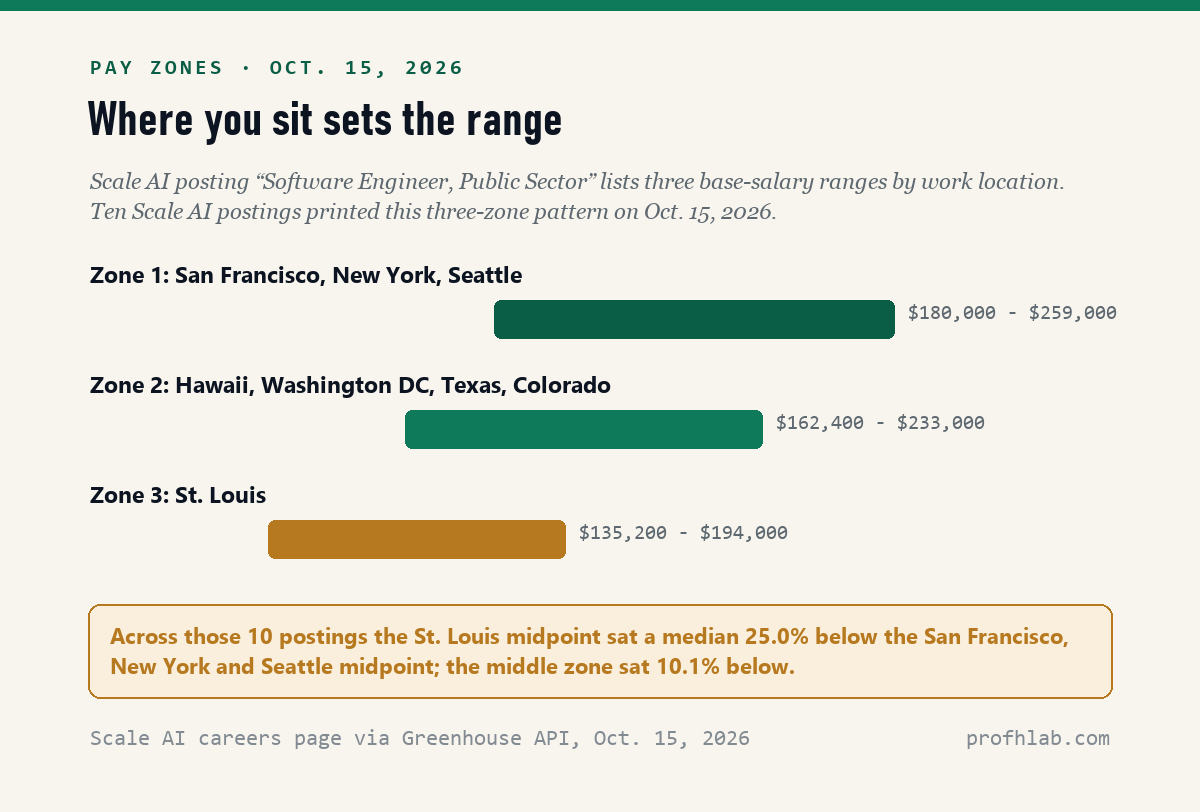
Scale AI shows this without any remote role at all. Its Software Engineer, Public Sector posting says the base range “in the locations of San Francisco, New York, Seattle is: $180,000 — $259,000 USD,” with $162,400 to $233,000 for Hawaii, Washington, D.C., Texas and Colorado, and $135,200 to $194,000 for St. Louis.
Ten Scale AI postings printed that three-zone pattern. Across them the St. Louis midpoint sat a median 25.0% below the San Francisco, New York and Seattle midpoint, and the middle zone sat 10.1% below. Same office job, different city, different number.
Agility Robotics takes a softer route. All 20 of its remote U.S. postings print one range and add that “this range may change based on geographical location.” That sentence tells you a lower offer is possible outside its main hubs, but not by how much.

Does OpenAI pay remote workers less than office staff?
For 4 of the 5 OpenAI roles that printed a separate remote band on October 15, 2026, the remote band was lower, by 10.0% to 25.7% at the midpoint. These roles are listed in San Francisco or New York with “US – Remote” as a second location, so our remote count above did not include them.
OpenAI attaches a reason to some of these bands. Its Account Director, Digital Native Enterprise posting says the remote base pay “may vary depending on multiple individualized factors, including market location.” So even the remote label points back to place.
| OpenAI role | Office band | Remote band | Midpoint change |
|---|---|---|---|
| Account Director, Digital Native New Business | $261K–$290K | $189K–$220.5K | −25.7% |
| Applied AI Architect (posted twice) | $174K–$276K | $156.6K–$220.5K | −16.2% |
| Technical Sourcer, Research SWE | $171K–$240K | $136.8K–$216K | −14.2% |
| Account Director, Digital Native Enterprise | $261K–$290K | $234.9K–$261K | −10.0% |
| Account Director, Digital Native Large Enterprise | $189K–$252K | $176K–$350K | +19.3% |
The last row runs the other way: its remote band starts lower but reaches higher, so the midpoint rises. We could not tell from the posting why. Most of OpenAI’s other 600-plus U.S. postings with pay print one band with no location or remote split.
How much less do remote workers in cheaper states get offered?
On the posted bands we read on October 15, 2026, the step down for a lower-cost location was 9.3% to 20.9% at Cohere and about 10% or 25% at Scale AI, depending on the zone; OpenAI’s lower remote bands fell 10.0% to 25.7%. Those are gaps between two posted bands, not a cut anyone took from a paycheck they already had.
Here is what that looks like in dollars, using the midpoints. A Cohere Lead Data Scientist band drops from $275,000 to $232,500. A Scale AI public-sector engineer band drops from $219,500 in San Francisco to $164,600 in St. Louis.
Researchers have measured the other side of the trade. The National Bureau of Economic Research paper “Why Working from Home Will Stick,” by Barrero, Bloom and Davis (revised October 2026), cites an estimate by Mas and Pallais of “an average willingness to pay equal to 8% of earnings” for working from home.
The same paper cites Cullen and co-authors, who found from job offer data that U.S. tech workers “will accept 25% lower pay for hybrid or fully remote jobs.” Those are studies of what workers accept, not rules employers post. Our count measures the rules, so the two are not the same number.
Government pay works the same way as the tiered employers. The U.S. Office of Personnel Management says that for a remote federal worker, “the employee’s official worksite for location-based pay purposes is the alternative work location under the remote work agreement,” meaning locality pay follows the home address. We read that page on October 15, 2026; it shows no date.
Some companies drop city tiers but still price by country. GitLab’s compensation handbook page, last modified September 13, 2026, says it “pays local market rates based on cost of labor, not cost of living.” Its older calculator page now asks for a sign-in, so we quote nothing from it.
What should you check before taking a remote offer?
Five checks cover what the October 15, 2026 postings revealed, and each one takes less than a minute on the employer’s own page.
- Look for more than one range. Words like “All Other States,” “in the locations of” or “may change based on geographical location” mean your state picks the band.
- Find your own row. If you live outside the named top states, the lower band is the one that applies to you.
- Ask what happens if you move. A tiered company may re-band you after a move. Ask in writing before you accept.
- Compare midpoints, not top numbers. The top of a wide band is rarely the offer. Our piece on why salary ranges are so wide shows how far apart the ends sit.
- Apply only on the employer’s site. Remote listings are a favorite costume for scams. Every role in this piece links to the company’s own board.
If a range is missing entirely, our explainer on why job postings do not show salary covers the state laws that force a number and the ways companies avoid one.
We are not recruiters. We take no money from employers, and postings can close at any time. The official page always wins over anything here. Never pay to apply, never deposit a check and send money back, and treat a text-message offer as not an offer. Our Jobs Desk sources box lists the scam rules in full.
When did big employers start cutting pay for moving away?
The topic hit national news in August 2021, when NBC News reported companies telling work-from-home employees to expect pay cuts and Reuters reported that Google staff working from home could see one; both clips were still playable on October 15, 2026. They are five years old, so treat them as background on how location pay began, not as current company policy.
Where do remote AI jobs actually sit today?
On October 15, 2026, 272 of 3,059 U.S. postings on our 19 boards were remote, about 9%, and only 136 of those published pay. The rest were on-site or hybrid, with San Francisco alone holding 1,610.
You can filter the full list by company and location on our jobs board, where you can browse every open role and apply on the employer’s site. The daily AI jobs tracker shows how the totals move each day.
For the companies with the most remote work, start with AI companies hiring remote workers and whether AI engineer jobs are remote. Anthropic’s wording has its own explainer: what remote-friendly means at Anthropic.
Remote postings often carry a second catch besides pay: a list of states you must live in. We counted those rules in why remote jobs have location requirements, and the hybrid version in what hybrid means in a job posting.

Is a lower remote band still the better deal?
Sometimes, and the arithmetic is yours to run: the posted bands on October 15, 2026 show the size of the step down, not the costs you skip by staying home. Commuting, rent and child care differ too much by person for us to put one number on them.
What we can say from the postings is narrower. A lower band in a cheaper state is a pricing rule the employer wrote down in advance. At Cohere, the tiers apply to office and remote postings alike, so a remote worker in New York sits in the same top band as the San Francisco office.
If pay at the very top is the goal, our comparison of which AI company pays the most and the breakdown of forward deployed engineer pay use the same board data.
Looking for flexible hours rather than a full-time remote seat? See part-time AI jobs you can do from home, and check any training-gig platform with our legitimacy test for AI training jobs and the Mercor count. Older readers may want AI jobs for people over 50.
Postings move fast; our study of how long job postings stay up found most last weeks, not days. We will re-read these pay sections in the second week of November and note any company that adds or drops a state tier. Have a question about a specific offer? Ask the Jobs Desk, and browse the Jobs Desk hub for the rest of the series.
Do remote workers get paid less than office workers at the same company?
Usually not on the AI boards we read on October 15, 2026. At OpenAI, Anthropic and Agility Robotics the remote median midpoint was within 4% of on-site. The exception was 4 OpenAI roles with a separate remote band 10.0% to 25.7% lower.
Why do remote jobs pay less in some states?
Because some employers set pay by the worker’s location. On October 15, 2026, 10 of Cohere’s 19 U.S. remote postings printed a lower band for all states outside California, New York and Washington, a median 15.5% lower at the midpoint.
Do fully remote jobs pay less than hybrid jobs?
Not by label in our count. The 136 remote U.S. postings with pay had a median midpoint of $305,000 and the 2,061 on-site or hybrid ones $277,500 on October 15, 2026, but the two groups hold different jobs, so that gap is not a remote bonus.
Can a company lower your pay if you move to a cheaper state?
Postings with state tiers suggest it can apply the band for the new location, but none of the pay sections we read on October 15, 2026 said what happens after a move. Ask the employer in writing before you accept or relocate.
How do you know if a remote job has location-based pay?
Read the pay section for more than one range or for words like All Other States, in the locations of, or may change based on geographical location. On October 15, 2026, Cohere, Scale AI and Agility Robotics used that kind of wording.
Where every pay figure in this piece came from
- Greenhouse job board API and Ashby posting API for 19 company boards (OpenAI, Anthropic, xAI, Scale AI, Mercor, Perplexity, Cohere, Sierra, ElevenLabs, Cursor, Cognition, Replit, Figure AI, Apptronik, Agility Robotics, 1X, Physical Intelligence, Waymo, Nuro), read October 15, 2026. Google DeepMind’s U.S. board returned 404.
- Cohere, Lead Data Scientist, Global Public Policy Manager and Senior Sales Operations Specialist, read October 15, 2026.
- Scale AI, Software Engineer, Public Sector, read October 15, 2026.
- Anthropic, Research Engineer, Machine Learning (remote-friendly) and the San Francisco and New York listing; Waymo, Software Quality Operations Specialist (two listings), read October 15, 2026.
- OpenAI, Account Director, Digital Native New Business, Account Director, Digital Native Enterprise and Technical Sourcer, Research SWE, read October 15, 2026.
- Barrero, Bloom and Davis, “Why Working from Home Will Stick,” NBER Working Paper 28731, April 2021, revised October 2026, read October 15, 2026.
- U.S. Office of Personnel Management, telework FAQ on the official worksite for locality pay, undated, read October 15, 2026.
- GitLab Handbook, Compensation, last modified September 13, 2026, read October 15, 2026.
Prof.’s H Newsletter
One short email a month, with the numbers in it
What actually moved in AI hiring, AI prices, and the scams aimed at older Americans. Counted here, dated, and linked to the source. One email a month, and your address goes nowhere else.