Why Am I Getting So Many Medicare Calls? 13 Official Pages, 1 Cold-Call Ban
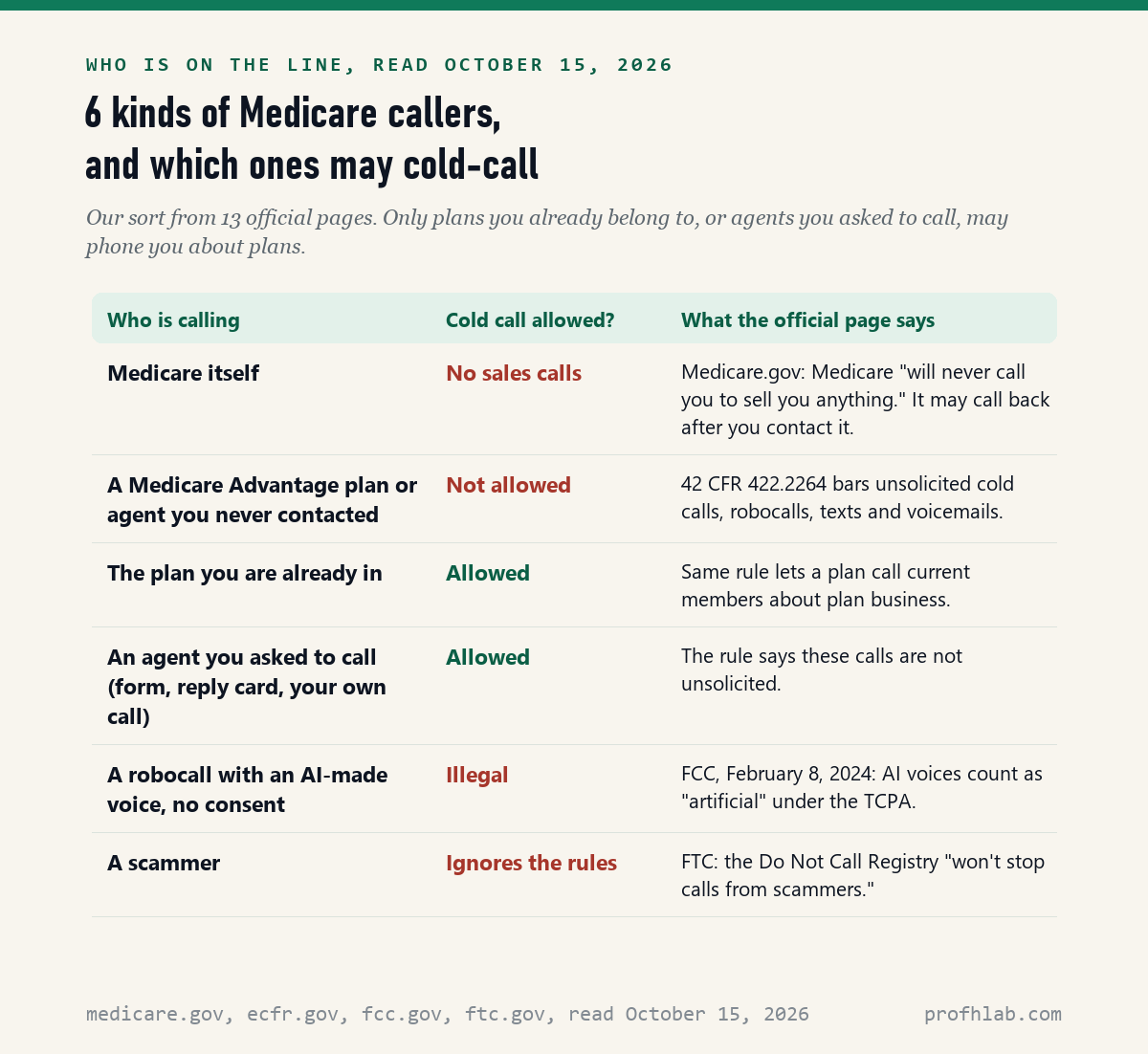
If a caller is trying to sell you a Medicare plan, it is not Medicare: on October 15, 2026, the first day of Medicare Open Enrollment, we read 13 official pages, and Medicare.gov says Medicare “will never call you to sell you anything.” Most of the calls come from private plan sellers and from scammers, and a federal rule already bars Medicare Advantage plans and agents from cold calling you.
Below is who is calling, why October gets so loud, which calls are legal, and 5 things to do the next time the phone rings. Nothing here costs money or needs a new app. And if you have picked up one of these calls, you did nothing wrong. They are built to sound official.
What we checked on October 15, 2026
We read 13 official pages: 3 on Medicare.gov, 2 sections of the federal Medicare marketing rule on eCFR (42 CFR 422.2264 and 422.2267), 1 FCC release, 3 FTC consumer pages, 1 Senior Medicare Patrol page, 2 HHS Office of Inspector General fraud alerts and the State Health Insurance Assistance Program home page. We also read the FTC’s December 1, 2025 report on older consumers.
Our own count: only 2 of the 13 pages say in plain words that Medicare will not call you uninvited (Medicare.gov and an FTC alert). One more, the eCFR rule, is the binding ban on plan and agent cold calls. Between them, the pages give 7 different voice phone numbers, plus TTY lines. Some FCC web pages returned an error, so we quote only the FCC release we could open.
Written and checked by Prof. H. An AI assistant helped draft this article and ran the page reads; every quote was read on the source’s own page on the date shown. This is not legal or insurance advice. For plan choices, use the free counselors named below.
Does Medicare call you on the phone?
Rarely, and never to sell: Medicare.gov, read October 15, 2026, says Medicare “will never call you to sell you anything or visit you at your home,” and only calls for personal information in “limited situations.”
Medicare.gov names those situations. They are an agent or representative “returning your call after you’ve joined a plan, reported fraud, or left a message for Medicare.” In each case, you made the first move.
The FTC says the same thing in its own words. Its consumer alert dated September 30, 2025 says “Medicare will only ask you to verify information if you contact them first.” The same alert warns that “caller ID can be faked.” So a screen that says Medicare proves nothing.
Think of it like your bank. A real bank does not call to ask for your PIN. When a caller asks you to prove who you are, the safe move is to hang up and call the number you already trust.
Why am I getting so many Medicare calls right now?
Because Open Enrollment runs October 15 to December 7, the Medicare.gov joining-a-plan page says, and that is the window when people can switch Medicare Advantage and drug plans for coverage starting January 1.
Private companies sell those plans, and some pay sales agents and marketing firms to find new members. That is why the calls cluster in the fall. This part is our reading of the rules and the calendar, not a count of calls. We found no official page that counts Medicare sales calls by month.
The federal rule has a name for these firms: third-party marketing organizations, or TPMOs. If one sells plans from more than one company, the rule makes it read a set sentence on sales calls before talking about benefits. It starts: “We do not offer every plan available in your area.”
If you hear that sentence, you are on a sales call, not a call from Medicare. That is a clue you can use today.
Is it legal for Medicare plans to cold call me?
No: the Medicare marketing rule, 42 CFR 422.2264, current on eCFR as of October 1, 2026, says Medicare Advantage plans may not use unsolicited “telephone solicitation (that is, cold calling), robocalls, text messages, or voicemail messages.”
The rule even lists examples that are banned. Calls “based on referrals” are out. So are calls to people who went to a sales event, unless they gave “express permission” to be called.
There are exceptions, and they matter. The rule says a call is not unsolicited “if the beneficiary provides consent or initiates contact with the plan.” Returning your call counts. So does calling after you mailed a reply card asking for contact. And a plan may call its own current members about plan business.
Plans may still reach you without asking first in two ways: regular mail, and email that carries an opt-out. So a pile of mailers in October is allowed. A stranger calling to sell you a plan is not. We read this rule for Medicare Advantage plans; we did not check the separate rule pages for drug-only plans or Medigap.
How did they get my phone number?
We could not confirm where any one caller got your number, and none of the 13 official pages we read on October 15, 2026 explains how marketers build their call lists.
What the rule does tell us is when a call is allowed. If you filled out an online form, mailed a reply card, or asked a website to have an agent call, that can count as consent. Those forms are often small print on ads for free Medicare help.
Our advice, as an inference from the rule: before you type your phone number into any Medicare ad or quote form, read the line under the button. If it says an agent will call, expect calls. Medicare.gov and the free SHIP counselors give help without that trade.
Can a Medicare robocall use an AI voice?
It can be made, but it is illegal without your consent: on February 8, 2024 the FCC announced a unanimous ruling that calls made with AI-generated voices are “artificial” under the Telephone Consumer Protection Act.
That law already limits robocalls that use artificial or prerecorded voices. The FCC release says the ruling took effect immediately and gives state attorneys general “new tools” against voice-cloning scams.
What we could not verify: how many Medicare robocalls today use AI voices. No page we read gives that number. So treat every recorded or oddly smooth voice the same way. Do not press 1, do not say your Medicare Number, and hang up.
If you worry about a voice that sounds like a family member, a family safe word helps. We wrote safe word examples families actually use, and how AI scams target people over 60.

Will the Do Not Call Registry stop Medicare calls?
Only the legal ones: the FTC’s Do Not Call FAQ, dated September 2023 and read October 15, 2026, says the registry is meant to stop “unwanted sales calls from real companies that follow the law” and “won’t stop calls from scammers.”
It is still worth doing. The FTC page says your registration “will never expire,” and you can sign up by calling 1-888-382-1222 from the phone you want to list, or at DoNotCall.gov.
The same page lists calls that stay allowed: political calls, charities, debt collectors, purely informational calls and surveys. Its rule for those is simple: they “can’t also include a sales pitch.” Companies you recently did business with may also call.
So if a caller says it is a survey about your Medicare benefits and then offers you a plan, the FTC page says that call has crossed the line. You can report it at DoNotCall.gov.
What should I say when a Medicare caller asks for my number?
Say nothing about your number and hang up: the FTC’s September 30, 2025 alert says “true Medicare representatives won’t call, text, or email you out of the blue to ask for your numbers or a payment.”
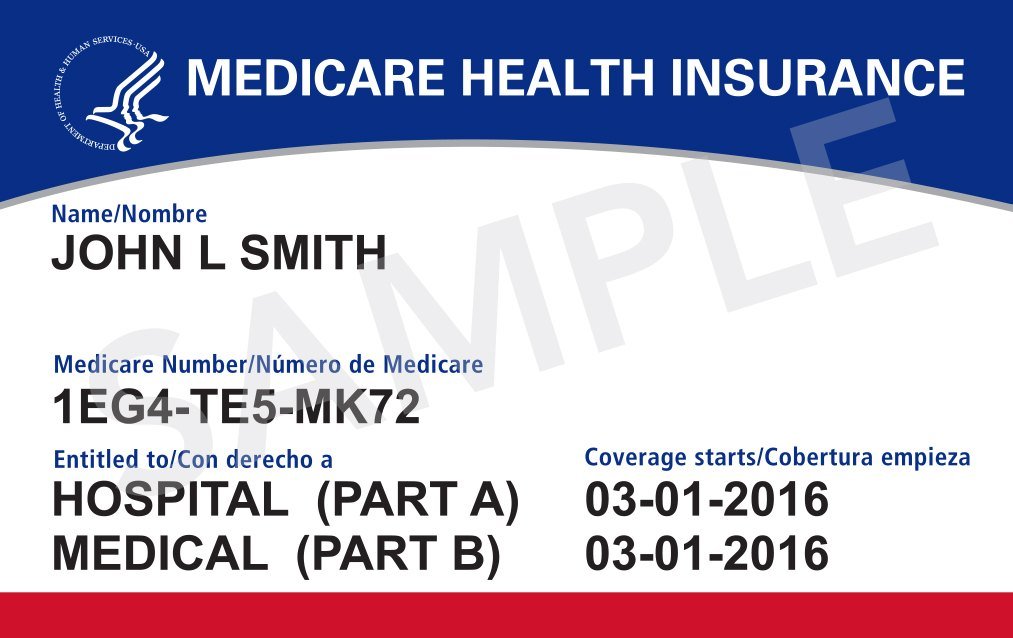
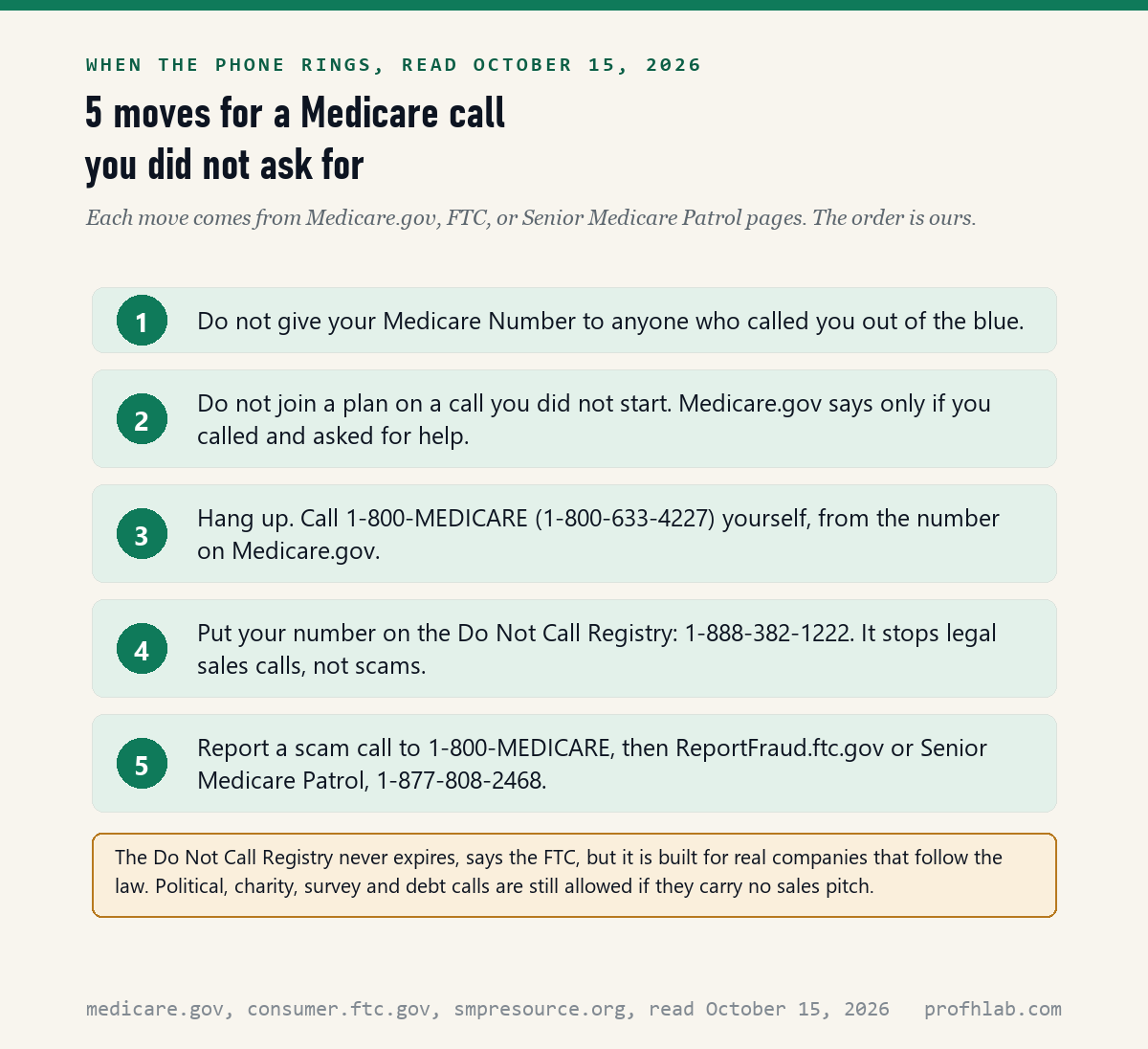
You do not need a speech. “No thank you” and hanging up is enough. If you want to check the call, call 1-800-MEDICARE (1-800-633-4227) yourself. Medicare.gov says real people answer 24 hours a day, 7 days a week, except some federal holidays. TTY users can call 1-877-486-2048.
Medicare.gov adds a second rule: do not join a Medicare health or drug plan over the phone, “unless you called and asked for help.” That one sentence stops most plan-switch tricks.
How much do older adults lose to phone scams?
More than on social media, per person: the FTC’s December 1, 2025 report on older consumers says median reported losses were $2,210 for phone fraud, compared to $650 for fraud that started on social media.
The same report says older adults’ reported losses rose “from about $600 million in 2020 to $2.4 billion in 2024.” These are reports people filed with the FTC, so the real totals are not known. They are not Medicare-only numbers either.
HHS’s Office of Inspector General has warned about Medicare-themed calls for years. Its alert on catheter scams, dated April 30, 2024, says scammers reach Medicare enrollees “through phone calls, internet ads, and text messages” with offers of free services, equipment or gift cards. Its genetic testing alert, last updated September 27, 2019, names “telemarketing calls” first.

Where do I report a fake Medicare call?
Start with 1-800-MEDICARE (1-800-633-4227): Medicare.gov, read October 15, 2026, says to call that number if you suspect fraud, and the FTC says to report there first and then at ReportFraud.ftc.gov.
- Medicare fraud: 1-800-MEDICARE (1-800-633-4227), or Medicare.gov’s online fraud report.
- A Medicare Advantage or drug plan problem: Medicare.gov lists I-MEDIC at 1-877-7SAFERX (1-877-772-3379).
- Help from a person near you: Senior Medicare Patrol, toll free 877-808-2468.
- The scam call itself: ReportFraud.ftc.gov, and unwanted sales calls at DoNotCall.gov.
- Fraud against HHS programs: the HHS-OIG hotline, 1-800-HHS-TIPS (1-800-447-8477).
If you want honest help choosing a plan this fall, use your State Health Insurance Assistance Program. SHIPhelp.org says it offers “one-on-one Medicare counseling” from your local SHIP “at no cost to you.” Its national line is 877-839-2675.
The FTC and CMS each made a short video about these calls
The FTC posted a 47-second video on avoiding Medicare scams on November 26, 2025; it had 765 views when we checked on October 15, 2026. FTCvideos had 38.5 thousand subscribers that day.
The second is a 30-second spot from CMSHHSgov, the channel of the agency that runs Medicare. It was posted September 9, 2020 and had 22,002 views when we checked.
Hanging up, cell phones and daily calls: five more worries
Does Medicare call you to update your information?
Not out of the blue. Medicare.gov says Medicare only calls for personal information in limited situations, such as returning a call after you joined a plan, reported fraud or left a message. If a caller wants to update your profile, hang up and call 1-800-633-4227.
Are calls about Medicare Part A and B scams?
Many are sales or scam calls. Medicare.gov says Medicare will never call you to sell you anything. Senior Medicare Patrol lists a request for your Medicare number in an unsolicited phone call as a sign of fraud.
How do I stop Medicare calls on my cell phone?
Register your number free at DoNotCall.gov or 1-888-382-1222, which the FTC says stops legal sales calls. Do not answer unknown numbers, and check the call-blocking tools from your phone company. Scammers ignore the registry, so hang up on them.
Why is Medicare calling me every day?
It is very unlikely to be Medicare. The federal rule bars Medicare Advantage plans and agents from cold calling, and the FTC says caller ID can be faked. Our reading: daily calls in October and November line up with Open Enrollment, October 15 to December 7.
Can I get in trouble for hanging up on Medicare?
No official page we read says so. Medicare.gov and the FTC both tell you to hang up on suspicious callers and call 1-800-MEDICARE yourself. Your benefits do not depend on answering a call you did not expect.
More from our desk on calls, scams and Medicare money
- How to stop AI calls on a landline, with what 5 phone companies offer.
- What happens if you say yes on a scam call, and the evidence behind the warning.
- iPhone call screening: how it works before you turn it off.
- How to reach a real person when a phone tree blocks you.
- The 2027 COLA after Medicare premiums, worked out in dollars.
- Does Original Medicare require prior authorization?
- Do health insurers use AI to deny claims?
- AI scam watch, September 2026.
- Why scam ads keep showing up on YouTube.
- Is it safe to give ChatGPT your personal information?
- Using ChatGPT to prepare for a doctor visit.
- How to use ChatGPT if you are over 50.
- Start here: every AI for Beginners guide in one place.
Our working-life desk tracks something different: the AI jobs tracker counts real job posts that mention AI, updated from employer boards.
Thirteen official pages and one FTC report, with dates
- Medicare.gov, Reporting Medicare fraud and abuse (no date shown), read October 15, 2026.
- Medicare.gov, Joining a plan (no date shown), read October 15, 2026.
- Medicare.gov, Talk to someone (no date shown), read October 15, 2026.
- eCFR, 42 CFR 422.2264, contact with beneficiaries, current as of October 1, 2026, read October 15, 2026.
- eCFR, 42 CFR 422.2267(e)(41), TPMO disclaimer, current as of October 1, 2026, read October 15, 2026.
- FCC, FCC makes AI-generated voices in robocalls illegal, February 8, 2024, read October 15, 2026.
- FTC, Medicare Open Enrollment season: learn how to protect yourself from scams, September 30, 2025, read October 15, 2026.
- FTC, What to know ahead of Open Enrollment to avoid health insurance scams, September 28, 2026, read October 15, 2026.
- FTC, National Do Not Call Registry FAQs, September 2023, read October 15, 2026.
- FTC, Protecting Older Consumers 2024-2025, December 1, 2025, read October 15, 2026.
- Senior Medicare Patrol, Medicare fraud (no date shown), read October 15, 2026.
- HHS-OIG, Consumer alert: catheter scam, April 30, 2024, read October 15, 2026.
- HHS-OIG, Fraud alert: genetic testing scam, last updated September 27, 2019, read October 15, 2026.
- SHIP National Technical Assistance Center, SHIPhelp.org (no date shown), read October 15, 2026.
Featured image: James Carroll Beckwith, The Telephone and the Ticker, study for the Manufactures Building, 1891-92, public domain, via Wikimedia Commons, cropped.
About the author. Prof. H writes profhlab’s AI for Beginners guides for readers who are new to AI or over 50. Each guide is built from the official pages it quotes, read on the date shown. Spot an error? Use the Ask page and we will fix it with a dated correction.
Prof.’s H Newsletter
One short email a month, with the numbers in it
What actually moved in AI hiring, AI prices, and the scams aimed at older Americans. Counted here, dated, and linked to the source. One email a month, and your address goes nowhere else.