What Happens If You Say Yes on a Scam Call? The Evidence, After 9 Years
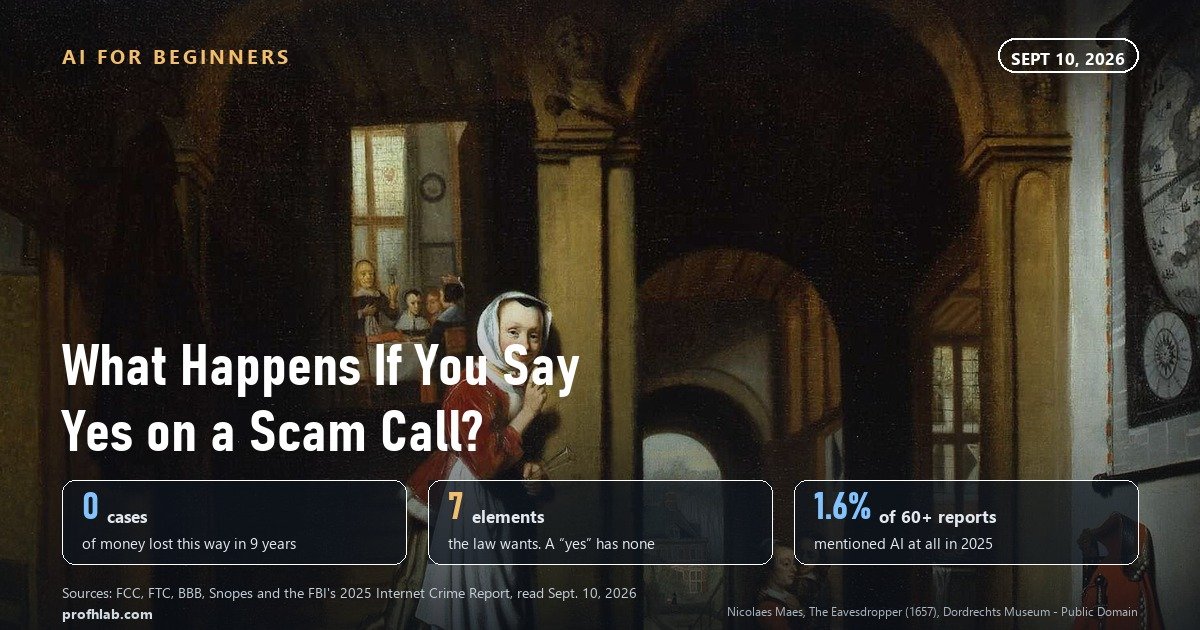
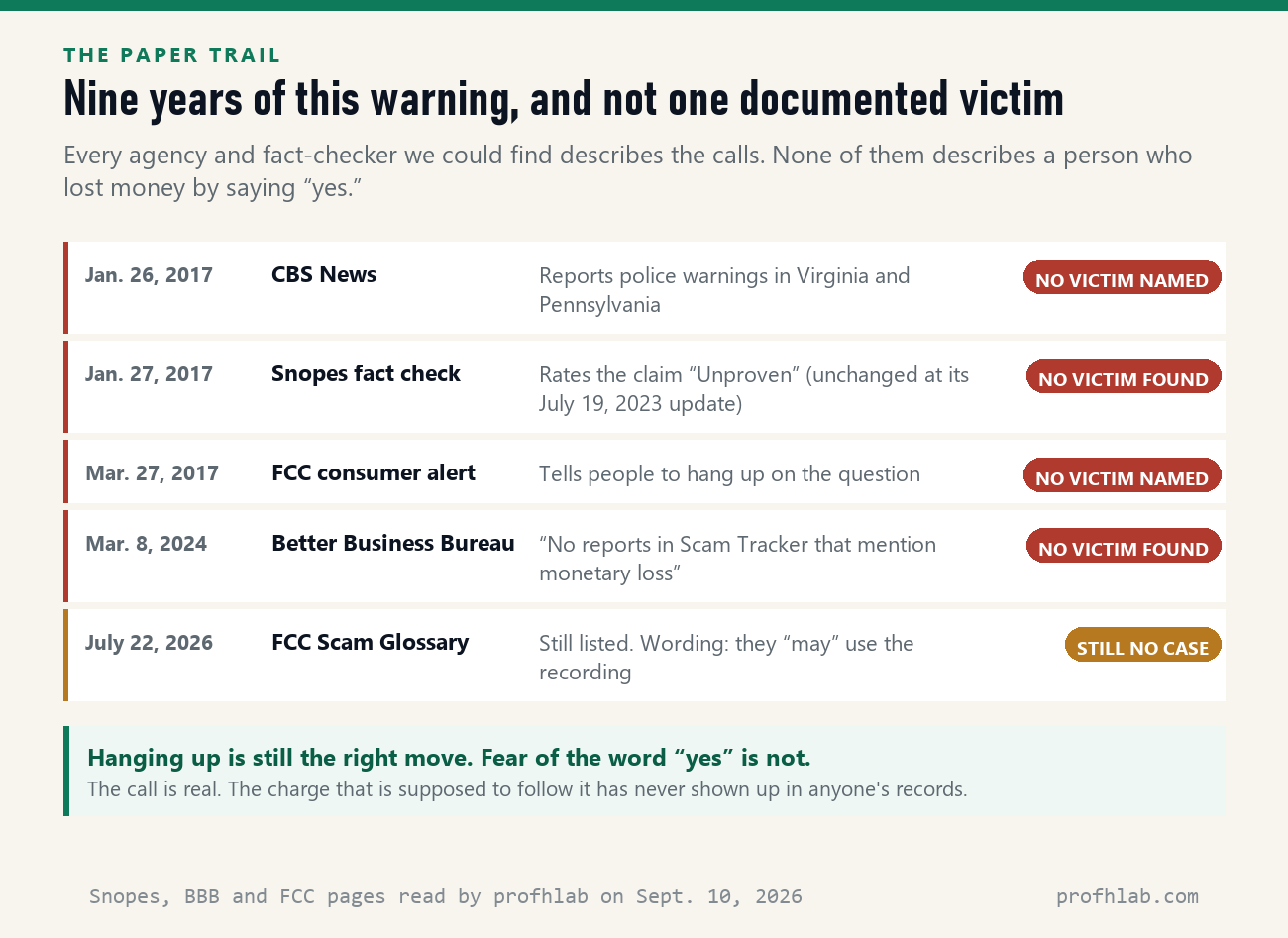
In almost every case, nothing happens. After nine years of this warning circulating in the United States, no federal agency, no state attorney general, and no consumer group has produced a single documented case of an American losing money because they said “yes” to a stranger on the phone. Snopes rated the claim Unproven on January 27, 2017 and had not changed that rating at its July 19, 2023 update. The Better Business Bureau, revisiting the scam on March 8, 2024, wrote that it still had “no reports in Scam Tracker that mention monetary loss.”
You should still hang up. But you should hang up for the right reason, and stop losing sleep over the wrong one.
This matters more than it sounds. Fear is a finite resource. Every hour spent worrying about a word you already said is an hour not spent on the scams that are emptying accounts right now — and those scams do not begin with “can you hear me?” They begin with a fake investment app, or a pop-up warning about your computer, or a voice that sounds like your grandson.
The short version. Saying “yes” does not authorize a charge, because federal law requires a recorded phone authorization to contain seven specific things and a one-word answer contains none of them. What answering does do is confirm your number is live. That is worth something to a caller — just not what you have been told.
Where this warning came from, and what each source actually documented
The story arrived almost fully formed in the last week of January 2017. CBS News reported on January 26 that police in Virginia were warning about it, following earlier warnings from Pennsylvania authorities. Within days it was on national television, in local newspapers, and in police department Facebook posts across the country. The Federal Communications Commission issued its own consumer alert on March 27, 2017.
Snopes went looking for the victim the next day and could not find one. Its writers made two observations that nobody has answered in the nine years since.
The first is about mechanics: they could not identify “any scenario under which a scammer could authorize charges in another person’s name simply by possessing a voice recording of that person saying ‘yes,’ without also already possessing a good deal of personal and account information for that person.”
The second is about motive, and it is the one that ends the argument: “it’s hard to imagine why scammers would need to utilize an actual audio recording of the victim’s repeating the word ‘yes’ rather than simply providing that response themselves.”
Think about that for a second. If a criminal is willing to forge your authorization, he does not need your voice. He can say “yes” himself, in his own voice, and the recording is exactly as good — because no phone company, utility or card issuer keeps a voiceprint of you on file to compare it against.
What the FCC says today — and the one word in it worth noticing
The FCC has not withdrawn the warning. The agency’s Scam Glossary, last updated July 22, 2026, still carries an entry that reads:
“Scammers open by asking a yes-or-no question, such as: ‘Can you hear me?’ or ‘Is this X?’ Their goal is to record you saying ‘yes’ in response. They then may use that recording to authorize charges over the phone.”
Federal Communications Commission, Scam Glossary, updated July 22, 2026
Read that last sentence twice. It says may. It does not say this has happened, to whom, or when. Government consumer alerts are written on a better-safe-than-sorry basis, which is a defensible way to run a public warning system — but it is not the same as evidence, and it is worth being able to tell the difference.
Why a recorded “yes” cannot legally authorize anything
Here is the part almost nobody writing about this scam mentions, and it is the part that should let you exhale.
When a company takes payment over the phone using a method that is not a credit card — a bank debit, a check by phone, a charge to your utility bill — the FTC’s Telemarketing Sales Rule requires what it calls “express verifiable authorization.” One of the three permitted forms is an oral authorization that is audio-recorded. And the rule, at 16 CFR 310.3(a)(3)(ii), spells out exactly what that recording has to contain.
Seven things. Not one of them is a person saying “yes.”
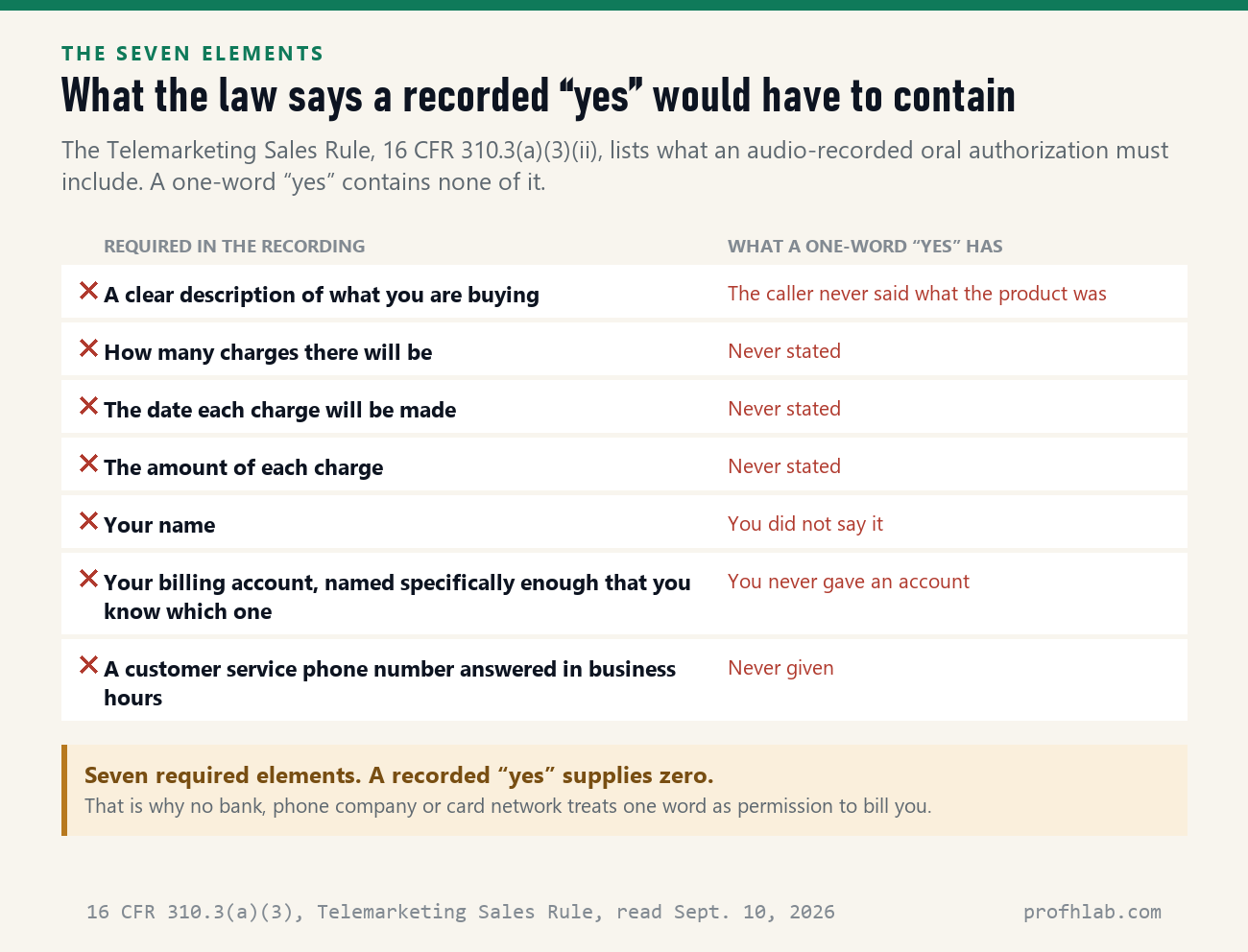
The recording must show that you received an accurate description of what you were buying, how many charges there would be, the dates they would hit, the amounts, your own name, which of your accounts would be used, and a customer service number answered during business hours.
A criminal who had all seven of those things about you would not need your voice. He would already have your account.
And for credit cards, you have a second, entirely separate protection: the Fair Credit Billing Act gives you the right to dispute charges you did not authorize, and no card network in the country resolves those disputes by playing back a one-second audio clip.
So what is the “yes” actually worth to the caller?
Something real, just something smaller.
The most likely explanation, and the one security researchers offered back in 2017, is mundane: many of these calls are automated dialers checking whether a number reaches a live human. A number that answers is worth more on a list than a number that rings out. Say anything — “yes,” “hello,” “who is this” — and you have confirmed you exist.
That is why the FTC’s advice about robocalls is worded the way it is: do not press any numbers to reach an operator or to be removed from the list, because it “might lead to more robocalls.” Same logic, same mechanism. Every interaction is a signal.
The version of this trick that is documented — against businesses
There is a real, prosecuted version of the recording trick, and it is a useful thing to understand because it shows what the fear got half right.
It targets small businesses, not households. In July 2014, the FTC announced it had shut down a group of office supply sellers — Midway Industries, Commercial Industries, Standard Industries and about ten related companies — that shipped goods nobody ordered and then invoiced for them. When recipients objected, according to the FTC, they were “pressured into paying by the defendants’ claiming that they had audio recordings verifying the order (which they failed to produce).” Refunds in that matter eventually exceeded $11.6 million.
A related case is even more direct. In a fake online Yellow Pages scheme the FTC brought in 2014, the agency alleged that when recipients disputed the $479.95 invoices, the defendants “used deceptive collection tactics, such as playing altered or incomplete audio recordings to give the false impression that an employee of the organization had authorized a directory listing.” The court entered a judgment of $3,081,969.
So the truth sits in an unexpected place. A recording is not a legal instrument that lets someone bill you. It is a bluffing prop — something a fraudulent biller waves at you to make you pay an invoice you never agreed to. And in the documented cases, the recordings were either never produced at all, or were doctored.
The practical lesson. If anyone ever tells you “we have a recording of you agreeing to this,” your answer is one sentence: “Send me the recording and the written contract, and I will look at it.” Then hang up. In every FTC case on record, that request is where the bluff collapsed.
But in 2026, can they clone my voice from that “yes”?
This is the modern form of the question, and it deserves a straight answer rather than either a shrug or a scare.
A single word is thin material. But we are not going to hand you a number of seconds to memorize, because the honest position — the one we take in our guide to AI scams targeting seniors — is that the threshold depends on the tool and the audio quality, and it keeps falling. Assume any recording of your voice could eventually be enough: your voicemail greeting, a birthday video, a “hello?” to an unknown caller. Then stop counting seconds and use a defense that does not care about seconds, which is a family safe word.
Now the scale, because scale is what fear gets wrong.
Voice cloning in family emergency calls is real and it is prosecuted. The FBI’s 2025 Internet Crime Report puts losses from confidence and romance complaints with an AI connection — the category that includes grandparent and “distress” calls using cloned voices — at more than $5 million for the year. Across every crime type and every age, complaints flagged as AI-related numbered more than 22,000, with adjusted losses above $893 million.
Those are big numbers in isolation. Put them next to the whole picture and they change shape.
What actually took the money from Americans 60 and older
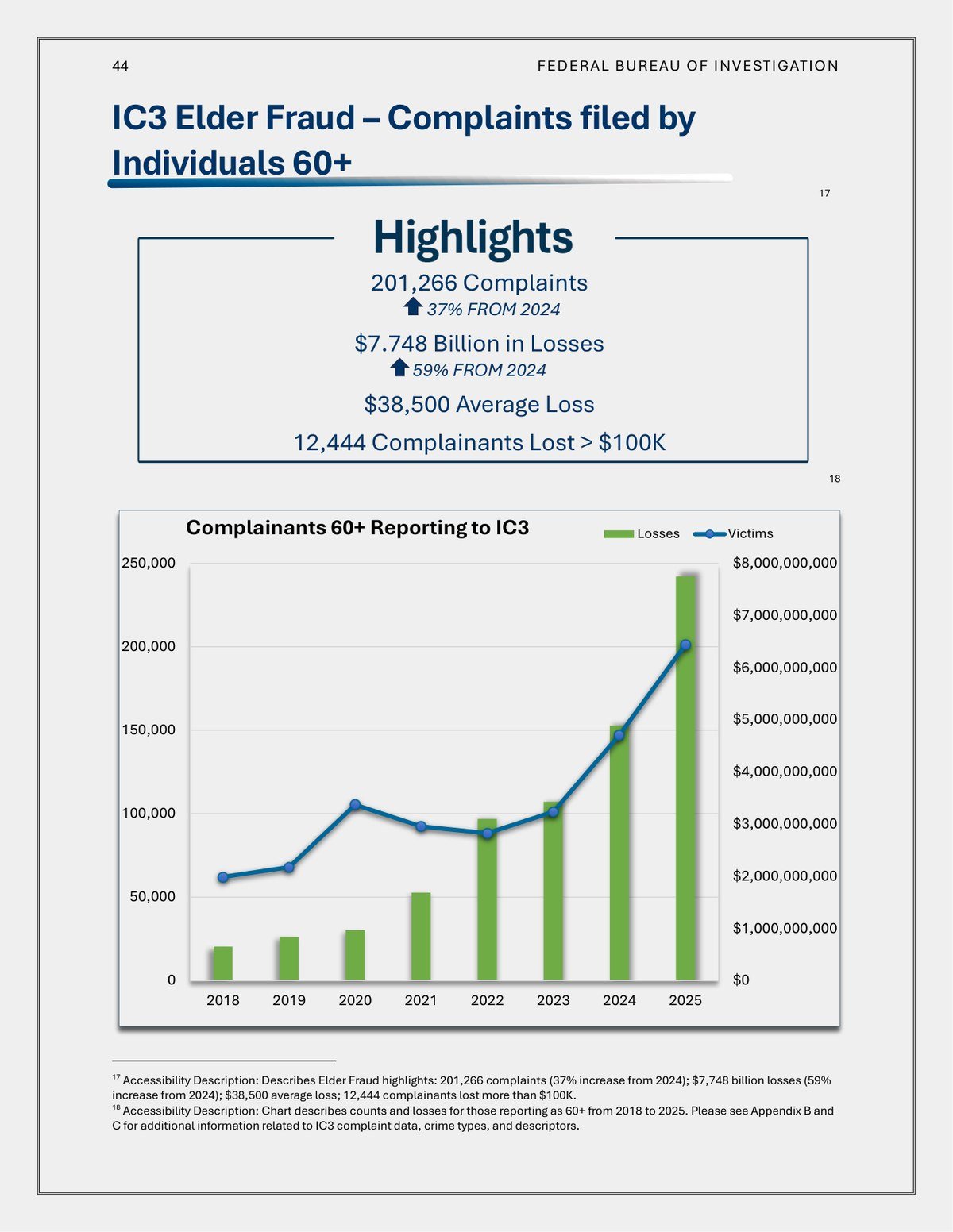
We read the FBI’s 2025 Internet Crime Report line by line on September 10, 2026. Americans aged 60 and older filed 201,266 complaints last year and reported $7.748 billion in losses — complaints up 37% over 2024, losses up 59%, an average loss of $38,500, and 12,444 people who each lost more than $100,000.
Of those 201,266 complaints, the number that mentioned AI at all was 3,143. We worked that out to 1.6%.
And here is where the money went. Two categories — investment schemes at $3,519,296,354 and tech or customer support fraud at $1,040,730,043 — account for $4.56 billion, just under 59 cents of every dollar Americans over 60 reported losing.
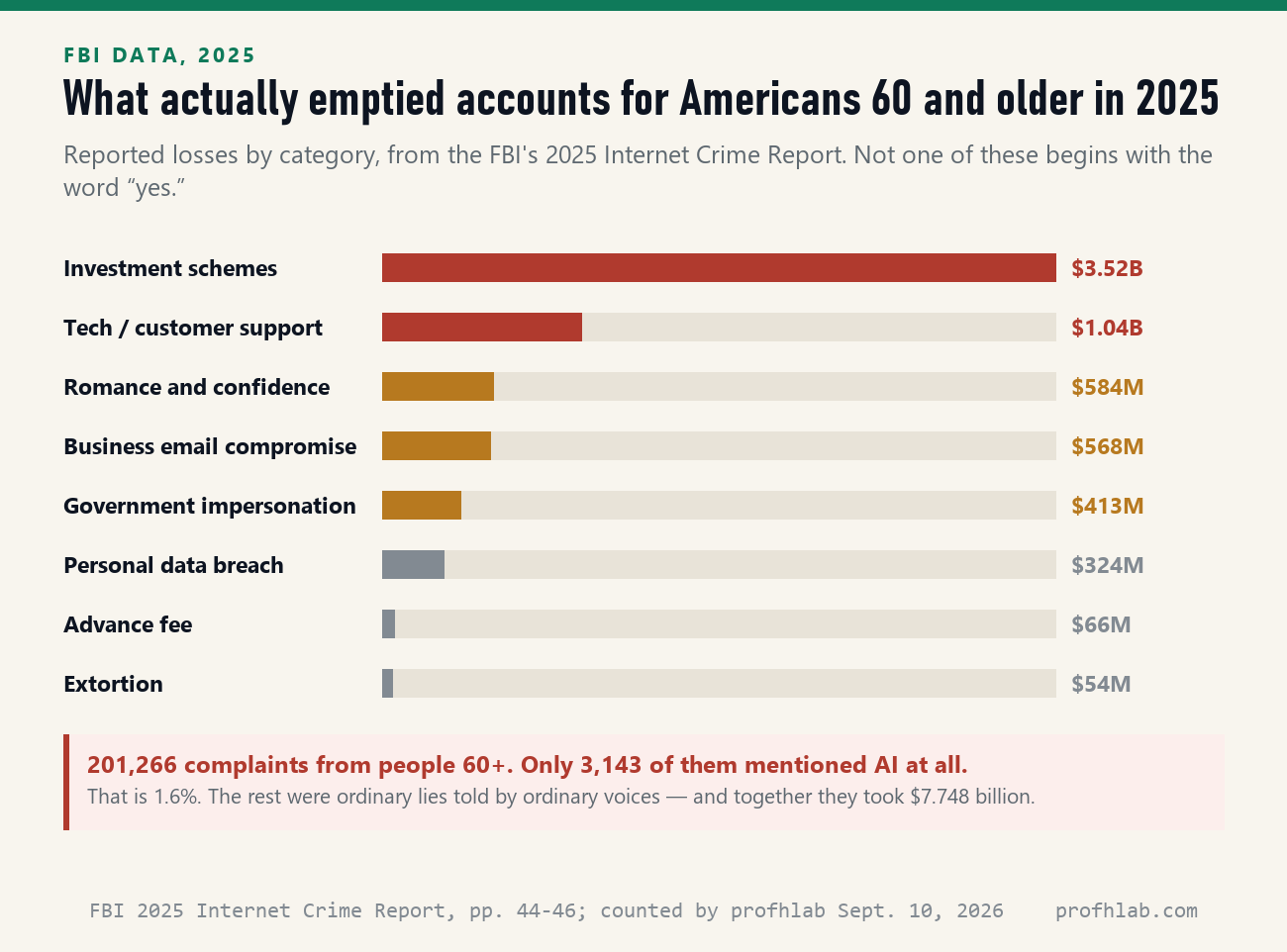
The most common complaint from this age group was phishing and spoofing, at 48,064 reports — the fake texts and calls that pretend to be your bank or a delivery company. Tech support fraud came second at 21,333.
Not one of those categories starts with the word “yes.” They start with a link you tapped, a number you called back, an app you were talked into installing, a person you came to trust over six weeks.
That is the redistribution of worry this article is asking you to make. If you want the other end of the same lesson — the AI features quietly switched on around you, which are a privacy question rather than a fraud one — start with stopping AI from reading your Gmail and turning off AI on Amazon.
What to do with this
If you already said “yes” to a stranger on the phone. Nothing needs to happen tonight. Do these three things over the next month and you have covered it completely:
- Read your next two statements — card, bank, and phone bill — line by line, including the small ones. Unauthorized charges slipped onto a phone bill have a name, cramming, and the FCC warns they often appear as $1, $2 or $3 items labelled “service fee,” “membership,” “voicemail” or “calling plan.” Small is the point; small does not get read.
- If you find something, call the company that billed you and ask them to remove it. If they refuse, file with the FCC at consumercomplaints.fcc.gov for interstate telephone charges, or with your state public service commission for in-state ones.
- Report the call itself. The channel depends on whether you lost money: if you did, use ReportFraud.ftc.gov; if you did not, the short form at DoNotCall.gov is the right one. The FTC releases reported numbers to carriers each business day to feed call-blocking tools, so a 60-second report is not a wasted 60 seconds.
If you want fewer of these calls in the first place, the settings that actually cut the volume — Silence Unknown Callers on iPhone, spam filtering on Android, your carrier’s free blocking app — are laid out step by step in our guide to AI scams targeting seniors, along with how to choose and rehearse a family safe word. If your iPhone has started answering calls for you, that is a different feature with its own switches: see how to turn off call screening on iPhone.
If you want to go deeper
“Why does the warning survive if it was never proven?” Because it is cheap to repeat and expensive to check. A police department can post it in two minutes; verifying it takes reading a federal rule. The advice attached to it — hang up on unknown callers — happens to be good, so nobody has an incentive to correct the reasoning underneath.
“Is my bank using my voice to identify me?” Some institutions do offer voice authentication, and if yours does, you opted in and enrolled deliberately by repeating a set phrase several times. That is a different thing from a stray “yes,” and if you are uneasy about it, you can call your bank and ask to have voice ID removed from your profile.
“Are AI robocalls illegal?” Yes. On February 8, 2024 the FCC ruled unanimously that AI-generated voices in robocalls count as “artificial” voices under the Telephone Consumer Protection Act — which means calling you with one, without your prior express consent, is unlawful and state attorneys general can prosecute it. The ruling followed AI-generated calls impersonating President Biden ahead of the New Hampshire primary.
“How do I judge an AI-generated image or video I get sent?” The same instinct that makes you suspicious of a voice should apply to pictures. We wrote up the three checks that beat guessing in how to tell if a picture is AI generated.
Two videos worth your time on this call
The first is the warning as America received it, from a national network. Watch it with one question in mind — what evidence is actually offered? “What the ‘can you hear me’ scam is and how it works,” ABC News (19.8 million subscribers; about 18,100 views, checked September 10, 2026).
The second is what we would rather you spend your attention on: AARP’s Fraud Wars episode on how the scams that actually take money get inside people’s lives (AARP, 415,000 subscribers; about 62,800 views, published October 17, 2025, checked September 10, 2026).
The questions people type after one of these calls
What happens if you say yes on a scam call?
Almost certainly nothing to your money. A recorded “yes” cannot function as a payment authorization, because federal rules require a recorded authorization to include seven specific disclosures and one word supplies none of them. What you have done is confirm your number reaches a live person, which can mean more calls. Hang up, and read your next two statements.
What to do if you say yes on a scam call
Hang up without saying anything else. Do not call the number back. Check your card, bank and phone bills over the next two billing cycles for charges you do not recognise, including tiny ones. Report the call at DoNotCall.gov, or at ReportFraud.ftc.gov if any money actually moved. You do not need to cancel cards or freeze anything on the strength of a “yes” alone.
What happens if you answer a scam call and they hang up?
That is a strong sign it was an automated dialer confirming your number is live, which is exactly what the researchers who examined these calls in 2017 concluded. Expect more calls, not a charge. Turning on Silence Unknown Callers or your carrier’s free blocking app is the fix.
Is it dangerous to answer a spam call?
Answering by itself does not install anything, charge anything or give anything away. The danger begins with what happens after — a number you call back, a code you read aloud, a link you tap, an app someone talks you into installing. The FBI’s 2025 figures for people over 60 bear this out: the losses cluster in investment fraud and tech support fraud, both of which require you to keep going.
Why do spam callers try to get you to say yes?
Two plausible reasons, and only one of them is sinister. The mundane one is number validation: a live answer makes your number more valuable on a call list. The other is psychological — an early “yes” makes the next question easier to say yes to. Neither requires a recording to work.
Can someone steal my voice from a phone call?
One word is thin material, but do not anchor on a number of seconds — the amount of audio these tools need keeps falling. Assume any recording of your voice could be enough eventually, and protect yourself with something that does not depend on the audio: a family safe word that anyone claiming to be a relative in trouble has to produce.
Can a scammer charge my phone bill without my permission?
Unauthorized charges on phone bills are real enough to have their own name — cramming — and the FCC estimates it has affected tens of millions of American households. But it happens through third-party billing arrangements, not through a voice clip. The defense is the same either way: read the bill, including the small line items, and dispute anything you did not order.
Has anyone actually lost money to the “can you hear me” scam?
No case has been documented publicly. Snopes rated it Unproven in 2017; the BBB said in March 2024 it had no Scam Tracker reports mentioning monetary loss; and the FCC’s current glossary entry says a recording “may” be used, without citing an instance. The calls are real. The loss has never been shown.
Sources
- Federal Communications Commission, Scam Glossary — “Can You Hear Me” Scam entry, updated July 22, 2026 (read September 10, 2026).
- Federal Trade Commission, Telemarketing Sales Rule, 16 CFR 310.3(a)(3) — express verifiable authorization (read September 10, 2026).
- FBI Internet Crime Complaint Center, 2025 Internet Crime Report — elder fraud highlights p. 44, crime types reported by 60+ pp. 45–46, AI in cybercrime pp. 39–41.
- Snopes, “Can You Hear Me?” Scam Warning — rating Unproven; published January 27, 2017, updated July 19, 2023.
- Better Business Bureau, BBB Scam Alert on the “Can you hear me?” phone scam, March 8, 2024.
- Federal Trade Commission, FTC Stops Deceptive Office Supply Scam, July 31, 2014.
- Federal Trade Commission, FTC Halts Online ‘Yellow Pages’ Scammers, March 2015.
- Federal Communications Commission, FCC Makes AI-Generated Voices in Robocalls Illegal, February 8, 2024.
- Federal Communications Commission, Cramming and Understanding Your Telephone Bill.
- Federal Trade Commission, Phone Scams — robocall guidance and reporting channels.
- Federal Trade Commission, People Reported Losing $3.5 Billion to Imposter Scams in 2025, June 15, 2026.
Keep reading
- AI Scams Targeting Seniors in 2026: The Safe Word That Beats Them All — the six schemes that take the most money, and the four-word script that stops them.
- How to Turn Off Call Screening on iPhone — if your phone has started answering calls before you do.
- How to Tell if a Picture Is AI Generated — three checks that beat guessing.
- Is Meta AI Reading My WhatsApp Messages? — what Meta actually gets, and the three settings worth four minutes.
- How to Use ChatGPT: A Step-by-Step Guide for Beginners Over 50 — start here if this is all new.
- The Best AI Tools for Seniors in 2026 — free help for seeing, hearing and remembering.
- Start Here — the whole beginners library in reading order.
- FAQ — 132 plain answers to the questions people actually ask about AI.
- AI Jobs Tracker — our own weekly count of who is hiring for AI work.
- How to Prep for a Doctor Visit with ChatGPT — the questions to ask, written out for you.
- Ask Prof H — send us the call you got and we will look at it.
- How We Count — the method behind every number we publish, including the ones above.
About the author. Prof. H writes profhlab.com, where AI tools are tested rather than hyped. Every figure in this article was read from a primary source on September 10, 2026 and is linked above. If a number here is wrong, tell us and we will correct it in public.
Prof.’s H Newsletter
One short email a month, with the numbers in it
What actually moved in AI hiring, AI prices, and the scams aimed at older Americans. Counted here, dated, and linked to the source. One email a month, and your address goes nowhere else.