Can AI Read Cursive? We Tested 5 Old Letters and 95% of Words Matched
Yes, mostly: on November 8, 2026 we had one AI read 5 old handwritten pages, and 95.3% of the 1,056 words matched the volunteer transcriptions. The catch is that some of its 7 clear mistakes read perfectly well, so you still need to check names, dates and any sentence that matters against the original page.
If you have a shoebox of letters from a grandmother, this guide shows what happened when we scored an AI word by word. It also gives the exact instruction to paste into a chatbot, and the 3 kinds of mistakes to look for.
What we tested on November 8, 2026
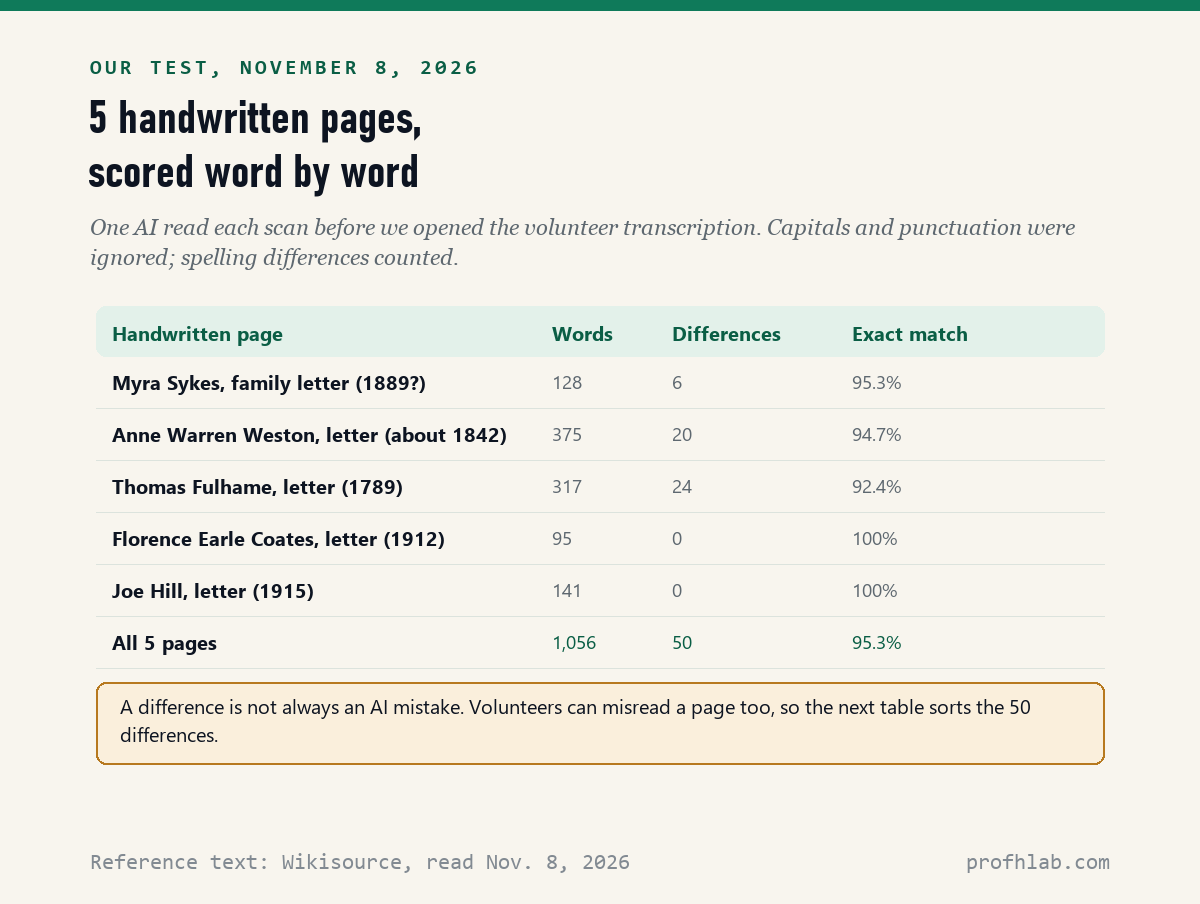
We took 5 handwritten pages by 5 writers, dated 1789 to 1915, from Wikisource, where volunteers type up scanned documents. The AI was Claude Opus 5.5, made by Anthropic. It copied each page first. Only after all 5 readings were saved did we open the volunteer text and compare the two with a word-matching script.
We ignored capitals and punctuation. Spelling differences counted. The score is 1 minus the differences divided by the words in the volunteer text. A sixth page, listed as a World War I diary, turned out to be typed, so we dropped it. This is one small test of one AI, read once. We did not test ChatGPT, Gemini or Copilot, and the AI we tested also helped write this article, so weigh the result with that in mind.
An AI assistant helped draft this article and ran the page reads and the handwriting test; every quote was read on the source’s own page on the date shown, except where we say otherwise.
Can AI read cursive well enough to trust?
It can read most of it: in our November 8, 2026 test we found 50 differences across 1,056 words on pages written between 1789 and 1915, an exact match rate of 95.3%.
Think of it as a friend who is good at finishing your sentences. Most of the time the friend is right. Now and then the friend says what you were probably going to say, not what you did say. You will not notice unless you check.
The two cleanest pages were from 1912 and 1915, and both matched every word. The two hardest were letters from 1842 and 1789, at 94.7% and 92.4%. One caution about the 1915 page: it is a well-known letter by the labor organizer Joe Hill, so the AI may have met it in training. We cannot rule that out, and it could flatter the score.

Which AI mistakes should worry you most?
The ones that read naturally: of the 7 words we judged the AI got wrong on November 8, 2026, 4 carried no warning at all, and 3 of those changed a person, a pronoun or a phrase.
- A common word replaced an unusual one. In an 1842 letter, the writer says “we lark about.” The AI wrote “we look about.” It reads fine. It is also wrong.
- A small word was swapped. On the same page, “their time” became “his time,” which changes who is busy.
- A guess overruled the ink. The page shows “Mrs Jonathan Phillips.” The AI wrote “Mr,” apparently because Jonathan is usually a man’s name. That last part is our inference, not something the AI reported.

Researchers have seen the same pattern. Lucian Li’s 2024 study of Gemini, read November 8, 2026, says its errors “generally resulted from text generation, rather than letterform recognition.” In plain words, the AI often sees the letters well enough and then writes what sounds right.
One rule helped. We told the AI to put [?] after any word it doubted. It flagged 4 words, and 3 of them were among the 7 mistakes. So the mark is useful, but it caught fewer than half.
Were the volunteers right every time?
No: when we enlarged the 50 places where the two texts differed on November 8, 2026, the page appeared to back the AI in 40, the AI was clearly wrong in 7, and 3 stayed unsettled.
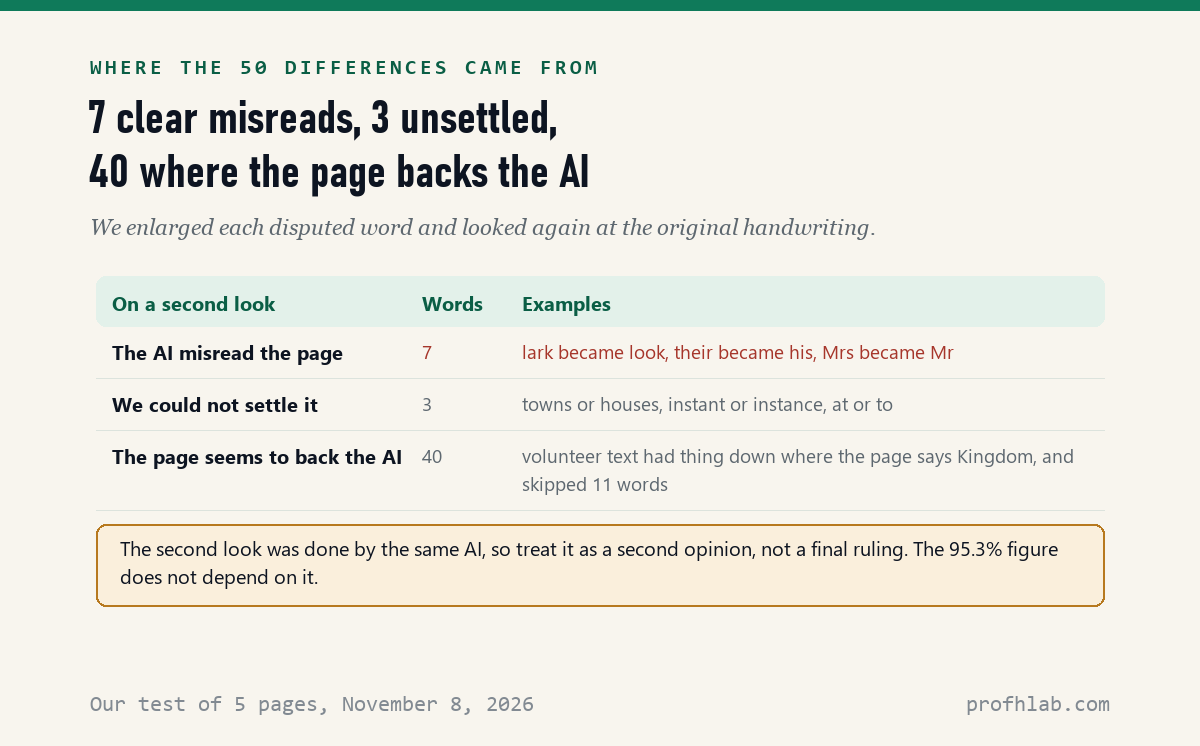
This is not a complaint about volunteers. Old handwriting is hard for everyone, and they did the work for free. The 1789 page shows how easy it is to slip. Its Wikisource version is marked as validated, yet it says “thing down” where the writer put “Kingdom,” and it leaves out 11 words from the middle of a sentence.

Two things follow. A typed copy made by anyone, person or machine, can be wrong. And a score against a human transcription is a fair yardstick, but not a perfect one. FamilySearch says much the same of its own AI text: its October 18, 2025 blog post warns, “Because the transcripts are AI-generated, you may see some transcription errors.”
How do you get AI to read a cursive letter on your phone?
Take one clear photo of one page, add it to the chat and paste a strict instruction; Google’s Gemini help page, read November 8, 2026, lists the steps as Add files, then Photos or Camera, then Submit.
- Photograph one page at a time. Lay it flat near a window. Fill the screen with the page.
- Open your AI app. In Gemini, tap Add files, then choose Photos or Camera. In ChatGPT, OpenAI’s help text says to select the plus sign, then Add photos & files. We saw that wording in search results, because the help page blocked our direct read.
- Paste the instruction in the box below. This is the rule we used in our test.
- Read the result with the letter beside you. Check every name, date and number first.
- Look up every [?]. Then re-read any sentence that seems a little too ordinary.
Copy and paste this
Copy this page of handwriting word for word. Keep the original spelling and line breaks. Do not correct anything. If you are not sure of a word, put [?] right after it.
Do not ask the AI to fix its own work and stop there. A 2025 benchmark by Crosilla, Klic and Colavizza, read November 8, 2026, found these models “do not possess a significant capability for self-correction.” Your eyes are the check. Before you upload anything, cover or leave out Social Security numbers, account numbers and medical details. Our guide on what is safe to tell a chatbot explains why.
Is a chatbot or a specialist tool better for old handwriting?
Neither wins every time: the same 2025 benchmark, read November 8, 2026, found chatbots strongest on modern English handwriting, while on historical documents their comparison with the specialist tool Transkribus “is not consistent.”
On one modern English test set, that study reports GPT-4o-mini got about 3.34% of words wrong. Those are different pages and older models, so do not compare that number with our 95.3%. For most people, the practical choice comes down to cost and effort:
| Tool | Free allowance we found | Best for |
|---|---|---|
| Gemini app | Up to 10 files in one prompt, depending on availability (Google help, November 8, 2026) | A quick first read on your phone |
| ChatGPT app | 3 file uploads a day on the free plan, per OpenAI help text seen in search results November 8, 2026. OpenAI says limits can drop at busy times | One or two pages at a sitting |
| Transkribus | 50 free credits a month, 1 credit per page, no credit card (Transkribus pricing page, November 8, 2026) | A whole diary or a box of letters |
Scanning a stack of old pages first? Our guide to getting ChatGPT to read a PDF covers files with many pages. If you want the people named in a letter traced, stop and read what ChatGPT can and cannot do for genealogy. Reading a page is one job. Finding records is another, and chatbots can invent them.
Four chatbots try an 1853 will, and a second channel runs Gemini on real documents
We picked 2 videos on November 8, 2026, going by their descriptions and channel focus. The first compares ChatGPT, Claude, Gemini and Copilot on a handwritten will from 1853, which covers the models we did not test. The second shows Gemini pulling text from printed and handwritten documents.
Five habits that keep a misread out of the family story
- Keep the original. Save the photo beside the typed copy, so anyone can check it later.
- Label the typed copy. Write “AI reading, not yet checked” at the top until someone has compared it.
- Check names and dates twice. A wrong letter in a surname can send a family search the wrong way.
- Keep odd spellings. Myra Sykes wrote “granfartha.” That word tells you something about her that a corrected copy would lose.
- Ask a relative about anything strange. An older cousin may know who “Alfred” was, and no AI will.
If you turn the letters into something new, these may help: writing a memoir with ChatGPT, restoring old photos with AI, whether AI should write an obituary and using AI for a eulogy.
Other AI guides for anyone with a box of family papers
- Talking instead of typing: how to talk to ChatGPT and have it talk back.
- Writing back to relatives: using ChatGPT to write a letter or email and making a Christmas card.
- Pictures of plants, places and things: using Google Lens and telling whether a picture is AI-generated.
- Your family photos and privacy: turning off AI in Google Photos and sharing one ChatGPT account.
- New to all of this? Start from the Start Here page, our ChatGPT guide for beginners over 50 or our AI tools for seniors.
- Staying safe: AI scams that target seniors. Curious where AI work is hiring? Our AI jobs tracker counts openings every week.
Can ChatGPT, Gemini and Claude read handwriting too?
Can AI read cursive?
Yes, most of it. On November 8, 2026 we scored one AI, Claude Opus 5.5, on 5 handwritten pages from 1789 to 1915. It matched 95.3% of 1,056 words against volunteer transcriptions. It still made mistakes that read naturally, so check names, dates and key sentences.
Can ChatGPT read cursive?
Likely yes, but we did not test it. A 2025 benchmark found GPT-4o-mini got about 3.34% of words wrong on one modern English handwriting test. Results on older handwriting were less steady, so compare its reading with the original page.
Can Gemini read cursive?
We did not test it. A 2024 study by Lucian Li found mixed results: Gemini misread 34% of characters on one English test, but it was comparable to tuned specialist models on manuscripts by Jeremy Bentham. Google lets you add a photo through Add files.
Can Claude read handwriting?
Yes. Claude Opus 5.5 is the model we tested, and it matched 95.3% of words on 5 old pages. That is one model version and one reading of each page. Other Claude versions may do better or worse.
Can AI read old German handwriting?
We did not test German. The 2025 benchmark found chatbots weaker on languages other than English. For old German scripts, try a specialist tool such as Transkribus as well, and ask a person who reads the script to check it.
Can ChatGPT read doctor handwriting?
We did not test this, and we would not rely on it. A misread drug name or dose can hurt you. Ask the pharmacy or the office that wrote the prescription to confirm it.
The letters, studies and help pages behind this test, by date
- Wikisource, letter from Myra Sykes, page 1, read November 8, 2026.
- Wikisource, letter from Anne Warren Weston, page 1, read November 8, 2026.
- Wikisource, letter from Thomas Fulhame to Joseph Black, page 2, read November 8, 2026.
- Wikisource, letter from Florence Earle Coates, last page, read November 8, 2026.
- Wikisource, Joe Hill farewell letter, read November 8, 2026.
- Crosilla, Klic and Colavizza, Benchmarking Large Language Models for Handwritten Text Recognition, arXiv, first submitted March 19, 2025, read November 8, 2026.
- Lucian Li, Handwriting Recognition in Historical Documents with Multimodal LLM, arXiv, submitted October 31, 2024, read November 8, 2026.
- FamilySearch, Full-Text Search: A Powerful Tool for Making Genealogy Discoveries, published October 18, 2025, read November 8, 2026.
- Google, Upload & analyze files in Gemini Apps, read November 8, 2026.
- OpenAI, Uploading files and audio to ChatGPT, seen in search results November 8, 2026; the page blocked our direct read.
- Transkribus, pricing, read November 8, 2026.
- YouTube, Gen-AI and Genealogy Made Simple, Can Gen-AI transcribe old handwriting?, May 27, 2025, and Gwulo, How to use AI for free OCR of printed or handwritten text, September 1, 2025, both checked November 8, 2026.
Prof.’s H Newsletter
One short email a month, with the numbers in it
What actually moved in AI hiring, AI prices, and the scams aimed at older Americans. Counted here, dated, and linked to the source. One email a month, and your address goes nowhere else.