How to Use ChatGPT for Genealogy Research: 6 Jobs It Does, 4 It Invents
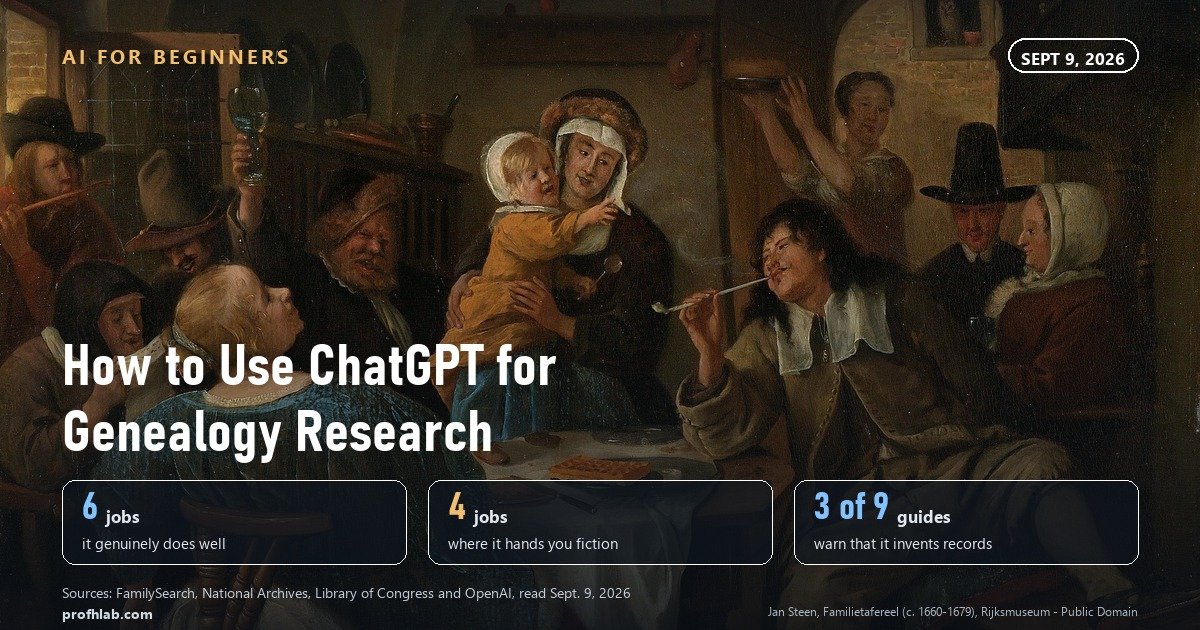
Use ChatGPT to plan the search, read the handwriting, and organize what you already have — never to find a record or produce a citation. It cannot open FamilySearch, whose 16.93 billion indexed names sit behind a file that tells crawlers to stay out of the search pages. And when it does not know something, it does not stop — it guesses. OpenAI’s own researchers asked a chatbot for one real person’s birthday and got three different dates, all wrong.
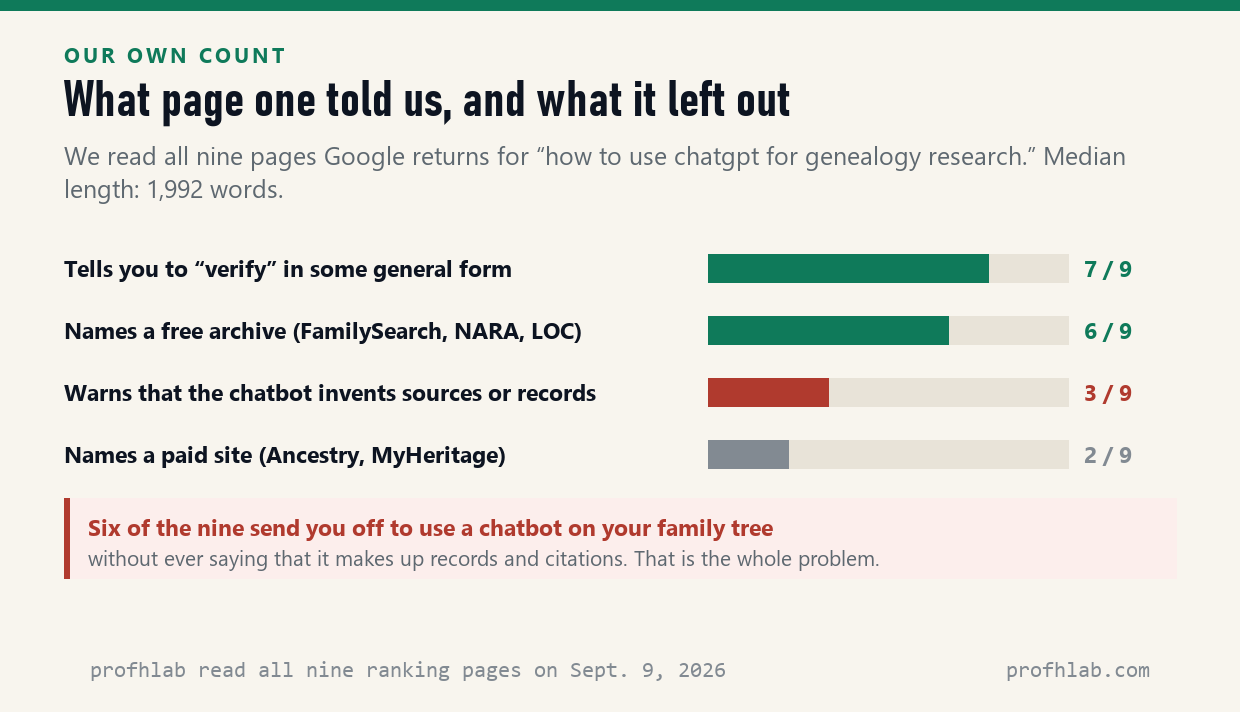
That is the honest version, and it is not the version page one gives you. On September 9, 2026 we read all nine pages Google returns for “how to use chatgpt for genealogy research.” Seven tell you to “verify.” Six name a free archive. But only three of the nine say the thing that actually matters: that the chatbot manufactures records and citations out of nothing, in complete sentences, with confidence.
So six of nine hand a beginner a tool that invents ancestors and never mention it. This article is the missing warning, plus the six jobs where the tool is genuinely excellent.
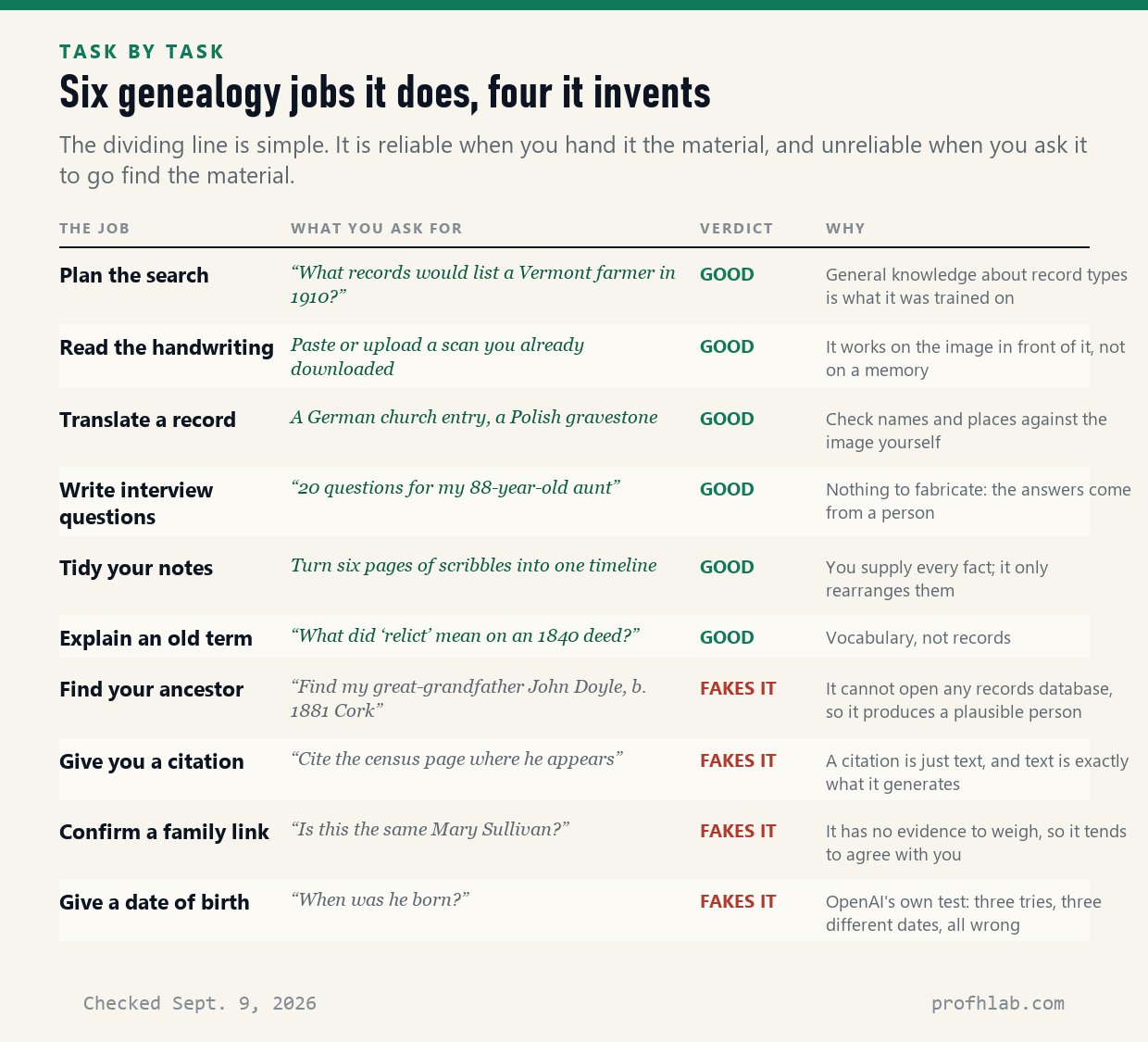
The rule, in one line. It is reliable when you hand it the material. It is unreliable when you ask it to go find the material. Everything below is a footnote to that sentence.
Why it cannot find your great-grandfather
Most people picture ChatGPT as a very fast librarian — someone who runs off to the archive, pulls the right box, and comes back with the page. That picture is wrong in a way that matters enormously for family history.
It has no library card.
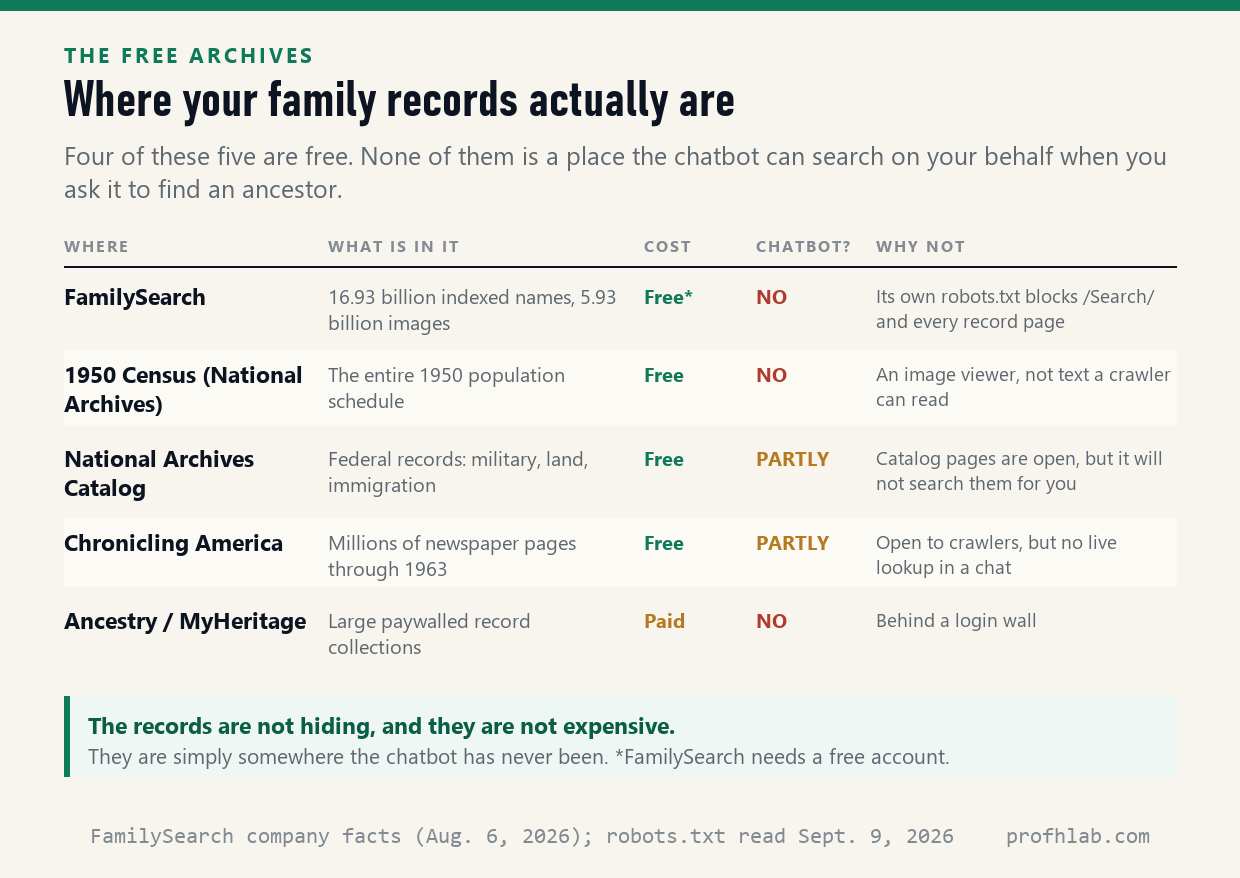
The genealogy record sets live in specific places. FamilySearch holds 16.93 billion searchable names and 5.93 billion digital images, according to its own company facts page updated August 6, 2026. Ancestry and MyHeritage sit behind paywalls. The National Archives runs its own catalog. None of these is a place a chatbot goes when you type a name into a chat window.
We checked the most concrete case. FamilySearch publishes a robots.txt file — the standard note every website leaves for automated crawlers, saying where they may and may not go. Read on September 9, 2026, it disallows /Search/, it disallows /search/all-collections/results/, and it disallows the individual record pages themselves (/ark:/61903/1:). It also blocks /tree/person and /tree/find.
A robots file is a request, not a locked door. But the well-behaved crawlers that feed AI search obey it, and the practical effect is exactly what you would expect: when you ask a chatbot to look up your great-grandfather, it is not looking him up in there. It is doing something else entirely.
What it does instead: it writes something that looks right
A language model is a machine for producing text that fits the shape of the request. Ask for a census citation and you will get something with the correct shape of a census citation — a year, a state, a county, an enumeration district, a sheet number, a line number. Every part will look plausible. Some of it may even be right by accident.
This is not a rumor from critics. OpenAI published a research note on September 5, 2025 titled “Why language models hallucinate,” and it is unusually blunt: “ChatGPT also hallucinates.” The company’s explanation is that standard training and evaluation reward guessing over admitting uncertainty. A model that guesses a birthday has a one-in-365 chance of scoring a point. A model that says “I don’t know” scores zero, every time. So the guessing gets trained in.
The example OpenAI chose to illustrate this could have been written for genealogists. Researchers asked a widely used chatbot for the title of one author’s PhD dissertation and got three different answers, none correct. Then they asked for his birthday and got three different dates, all wrong.
Now transfer that to your family tree. A wrong birth date for a living computer scientist is embarrassing. A wrong birth date for your great-grandmother gets copied into an online tree, then into someone else’s tree, then into a third, and in five years it is “what everybody knows.” Bad genealogy does not decay. It compounds.
Six jobs it genuinely does well
None of this makes the tool useless. It makes it a specific kind of useful. Every job below has one thing in common: you supply the material, and the machine works on what is in front of it.
1. Plan the search. This is the best use and almost nobody starts here. Try: “My great-grandfather was a farmer in Chittenden County, Vermont, born around 1878. List every type of U.S. record that might name him between 1900 and 1940, and tell me which agency holds each one.” Record types are general knowledge, and general knowledge is exactly what it was trained on.
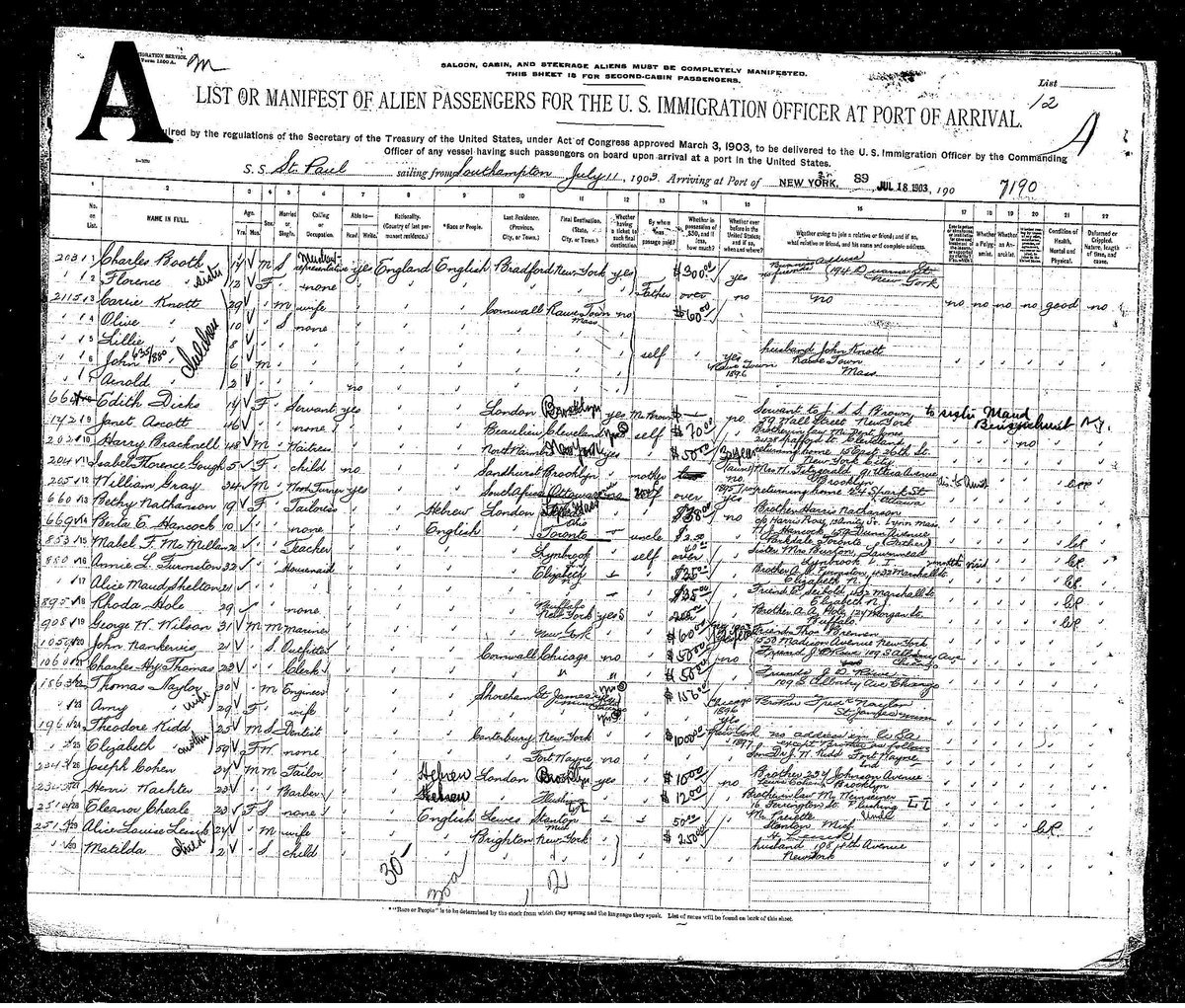
2. Read the handwriting. Download the scan yourself, then upload it and ask what it says. It is working on the image in front of it, not recalling a memory. Read our guide on how to get ChatGPT to read a PDF if the download comes as a PDF rather than a picture. Always check the names and dates against the image with your own eyes.
3. Translate a record. A German parish entry, a Polish gravestone, an Italian birth act. Same rule: give it the image or the transcription, check the proper nouns yourself.
4. Write interview questions. “Give me 20 questions to ask my 88-year-old aunt about her childhood in Brooklyn in the 1940s, starting with easy ones.” There is nothing here to fabricate, because the answers come from a living person. This is the job with the shortest deadline in all of genealogy.
5. Tidy your notes. Paste six pages of scattered notes and ask for a chronological timeline, or a list of contradictions between two accounts. You supplied every fact; it only rearranges them.
6. Explain an old word. “What did ‘relict’ mean on an 1840 deed?” Vocabulary, not records.
Can ChatGPT do my family tree?
It can draw one. It cannot build one.
If you give it forty verified facts, it will lay them out as a clean tree, spot that two dates contradict each other, and suggest where the gaps are. That is real help. If you give it a name and a country and ask it to fill in the tree, you will get a family that never existed, arranged in a very tidy diagram.
The same goes for the “AI family tree generator” tools people search for. Some are genuine record-matching services attached to actual databases. Others are a chat window with a logo. The test is simple: if it will not show you the image of the record, it does not have the record.
Where the records actually are, and what they cost
Here is the part that gets buried. Most American genealogy records are free, and three of the best collections are run by the federal government.
The 1950 census is free at 1950census.archives.gov, with no account, no trial, no card. The National Archives released it on April 1, 2022 and put the whole population schedule online.
Chronicling America, at the Library of Congress, holds millions of digitized newspaper pages published through 1963 from nearly every state and territory. Free, no account. Obituaries, marriage notices, the small-town column that mentions who visited whom. It is the most underused resource in American family history.
The National Archives Catalog holds federal records — military service, land, immigration, pensions. Free.
FamilySearch is free with a free account, and it is the largest of them all.
Why does the census stop at 1950? Because of the 72-year rule. The Census Bureau states it plainly: the government will not release personally identifiable information about an individual to anyone until 72 years after it was collected. By our arithmetic on that rule, the 1960 schedules are due on April 1, 2032.
One step deeper: the National Archives already used AI on your family
This is the detail we did not expect to find, and it changes how you should read every search result you get.
When the National Archives put the 1950 census online, someone had to turn 150 million handwritten names into a searchable index. They did not do it by hand. They used, in their own words, “Amazon Web Services’ artificial intelligence / optical character recognition (AI/OCR) Textract tool to extract the handwritten names.”
And then they said the honest thing, on the same page: “Because the initial name index is built on optical character recognition (OCR) technology, it is not 100-percent accurate.” They built a public transcription tool and asked citizens to submit corrections.
The practical lesson: if you cannot find an ancestor in the 1950 index, that is not evidence they were missing. It may simply mean a machine misread the enumerator’s cursive. Search by location and browse the enumeration district by eye. This is the single most useful thing in this article and it is in none of the nine guides we read.
It also puts the whole subject in proportion. AI is not arriving in genealogy. It has been quietly transcribing your ancestors for years, with a documented error rate, and the institution doing it published the caveat itself. That is what responsible use looks like.
A four-step routine that uses both safely
- Ask the chatbot what records should exist. Give it the place, the decade, and the occupation. Get a list of record types and the agency that holds each.
- Go to the archive yourself and search for those records. Start free: FamilySearch, the National Archives Catalog, Chronicling America, the 1950 census site.
- Download the image. Not the index entry, not the summary — the picture of the page.
- Bring the image back to the chatbot for transcription, translation, or explanation. Then check every name, date and place against the image before it goes anywhere near your tree.
Step 3 is the one people skip, and it is the one that protects you. An index entry is somebody’s reading of a page. The page is the evidence.
FamilySearch’s AI rules and a genealogist on keeping it accurate
Search the 1950 census today, then old newspapers through 1963
- Today, free, no account: open 1950census.archives.gov and search for a relative who was alive in 1950. If nothing comes back, search by address or browse the enumeration district — remember the index is machine-read.
- Then: open the Library of Congress’s Chronicling America guide, follow its link into the collection, and search the same name for obituaries and local mentions through 1963.
- Free account, ten minutes: FamilySearch. It is a nonprofit, and there is no upsell to a paid tier.
- Before you type a name into any chatbot: decide whether you are asking it to work on something or to go get something. Only the first one is safe.
- This week, no computer required: call the oldest person in your family and ask them five questions. No archive will ever hold what is in their memory. The chatbot is genuinely good at writing the question list.
- Never paste a living relative’s Social Security number, full date of birth, or medical history into a chatbot. Related: is it safe to upload medical records to ChatGPT? and are deleted ChatGPT chats really deleted?
Try the free archives before paying for Ancestry
- “Can I just pay for Ancestry and skip all this?” You can, and its record set is real. But start with the free archives first — you will learn what exists before you pay for access to it, and you may not need to. On subscription arithmetic generally, see is ChatGPT Plus still worth it? and how to cancel and get a refund.
- “What about the old family photos in the shoebox?” That is a different job with different tools, and the results are much better. See restoring old photos with AI and making AI photos with grandparents who have died.
- “How do I know a family photo someone sent me is real?” Three checks that beat your eyes: how to tell if a picture is AI generated. For video, we checked 17 of them.
- “Someone called claiming to be a long-lost relative.” Family history research makes you a target, because it puts names and relationships in public. Read AI scams targeting seniors, how to tell if a phone call is AI, and this month’s AI Scam Watch.
- New to all of this? Begin at Start Here, or with how to use ChatGPT if you are over 50 and the best AI tools for seniors. To write to a distant cousin you just found, have it draft the letter.
Can ChatGPT build your family tree, or will it invent sources?
How do I use ChatGPT for genealogy research?
Use it for the parts where you supply the material: planning which records to look for, transcribing handwriting from a scan you downloaded, translating a foreign-language record, writing questions for a family interview, organizing your notes, and explaining archaic terms. Do not use it to find records, produce citations, or confirm relationships. Find the records yourself in the free archives, then bring the images back to it.
Can ChatGPT do my family tree?
It can arrange facts you give it into a tree and point out contradictions. It cannot research one. Given only a name and a country it will generate a plausible family that never existed, laid out as a convincing diagram.
Is ChatGPT accurate for genealogy?
It is accurate on general knowledge about record types and terminology, and unreliable on specific people, dates and citations. OpenAI published research on September 5, 2025 stating that “ChatGPT also hallucinates,” and its own example was a chatbot giving three different, all wrong, birthdays for one real person.
Can AI find my ancestors?
A chatbot cannot. Record-matching features built into an actual database — FamilySearch’s research assistant, for example — work against real records and are a different thing. The test: if a tool will not show you an image of the source document, it does not have the document.
Does ChatGPT make up sources and citations?
Yes, routinely, and this is the single most important thing to know. A citation is a piece of text with a recognizable shape, and generating text with a recognizable shape is precisely what the model does. Assume every citation it gives you is fiction until you have seen the record image.
What is the best free genealogy site?
For most Americans, FamilySearch (free with a free account, 16.93 billion indexed names). Add the 1950 census at the National Archives and Chronicling America at the Library of Congress, both free with no account at all.
How far back can genealogy be traced?
In U.S. federal records, to the 1790 census. Beyond that it depends on church registers, land records and probate files in the country your family came from. There is no general answer, and any chatbot that gives you a confident one about your family specifically is inventing it.
Why does the census stop at 1950?
The 72-year rule. The Census Bureau will not release personally identifiable information about an individual until 72 years after it was collected. The 1950 census was released April 1, 2022; by that arithmetic the 1960 schedules are due April 1, 2032.
Sources
- OpenAI, Why language models hallucinate, September 5, 2025 — “ChatGPT also hallucinates”; the three-wrong-birthdays example; why evaluation rewards guessing.
- FamilySearch Newsroom, FamilySearch.org Facts, updated August 6, 2026 — 16.93 billion searchable names, 5.93 billion digital images, 1.94 billion people in the Family Tree.
- FamilySearch, robots.txt — the disallowed search and record paths. Read September 9, 2026.
- National Archives, 1950 Census Records — free access, the AWS Textract AI/OCR index, and the statement that it “is not 100-percent accurate.”
- U.S. Census Bureau, The 72-Year Rule — the release restriction and the fact that individual records 1790–1950 are held by the National Archives.
- Library of Congress, Chronicling America: A Guide for Researchers, last updated August 17, 2026 — freely accessible, newspaper pages through 1963, an NEH and Library of Congress partnership.
- Our own count: all nine results Google returned for “how to use chatgpt for genealogy research” on September 9, 2026, read in full and scored for four properties. Median length 1,992 words. Method notes: How we count.
For old scans and photos: restoration, PDFs and fake detection
- How to get ChatGPT to read a PDF
- How to restore old family photos with AI
- How to tell if a picture is AI generated: 3 checks that beat your eyes
- How to use ChatGPT: a beginner’s guide for people over 50
- How to prepare for a doctor’s visit with ChatGPT
- How does ChatGPT know my age?
Looking for something else? Resources collects the free tools and official pages we keep coming back to, and our AI Jobs Tracker is where we count things for a living. Have a question about your own research? Send it through Ask, and the FAQ collects the ones that come up most.
About the author. Prof. H writes Prof. H Lab’s AI for Beginners series for readers who did not ask for any of this and now have to live with it. Every figure in this article comes from the organization that published it, on the date shown, and every number we call ours was counted by us — including the nine ranking pages we read one by one. Where a claim is our arithmetic rather than a published figure, such as the April 2032 release date, we say so. See our editorial and review policy.
Prof.’s H Newsletter
One short email a month, with the numbers in it
What actually moved in AI hiring, AI prices, and the scams aimed at older Americans. Counted here, dated, and linked to the source. One email a month, and your address goes nowhere else.