What Does Remote-Friendly Mean at Anthropic? 56 Roles Say It, None Skip the Office (Sept. 15, 2026)
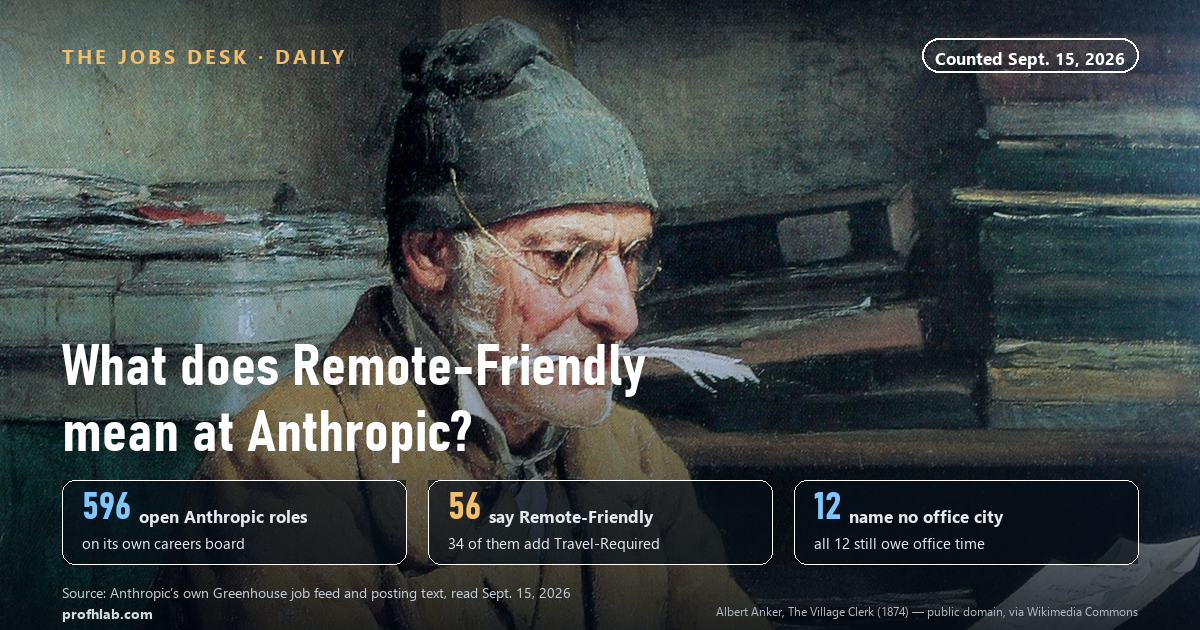
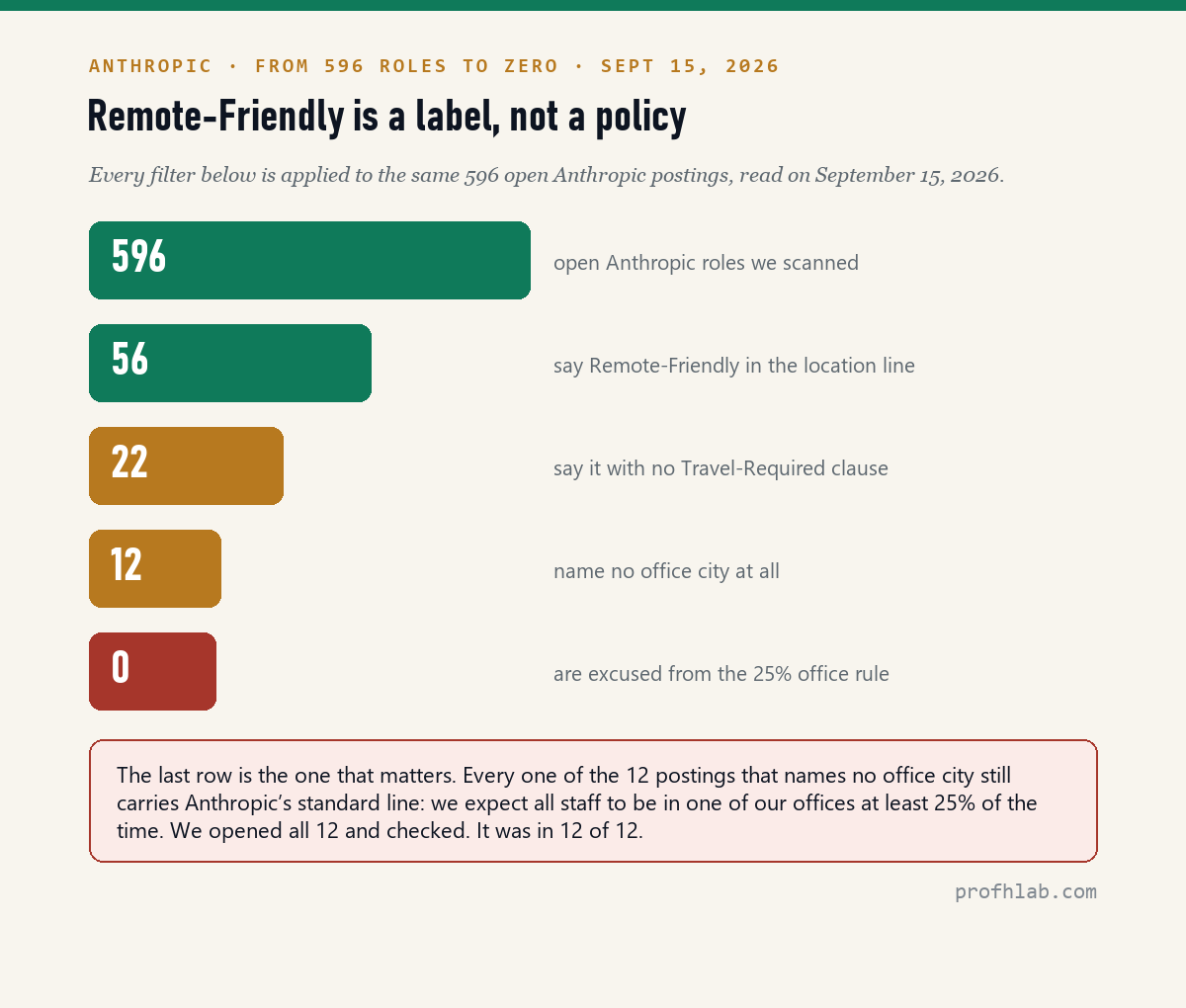
At Anthropic, “Remote-Friendly” is a category in a location box, not a promise that you can work from anywhere. We read all 596 open roles on Anthropic’s own careers board on September 15, 2026. Fifty-six of them use the phrase, 34 of those add (Travel-Required), and only 12 — two percent of the board — say “Remote-Friendly, United States” with no office city attached. We opened all 12. Every one still carries Anthropic’s standard sentence: “we expect all staff to be in one of our offices at least 25% of the time.”
Somebody types that question into Google often enough that it now finishes itself. Type what does remote friendly mean and Google offers …at anthropic as the next words. That is a very specific confusion, and it has an unusually specific cause: Anthropic is one of the few large AI employers that invented its own word for this.
Not remote. Not hybrid. Remote-Friendly. It appears nowhere else on the nineteen AI and robotics career pages we read every morning. So there is no industry convention to fall back on, and the applicant is left to guess.
Here is what it actually means, counted rather than guessed.
What we counted on Anthropic’s board
Anthropic publishes its openings through a Greenhouse feed. We pulled the whole thing on the morning of September 15, 2026 and sorted every posting by what its location line says.
| What the location line says | Roles | What it means in practice |
|---|---|---|
| No mention of remote | 540 | A named office, or several. |
| Remote-Friendly (Travel-Required) | 34 | Office time plus travel, disclosed in the location line itself. |
| Remote-Friendly + a city | 10 | Flexible, but anchored to that office. |
| Remote-Friendly, United States | 12 | No office named — and still 25% office time. |
Fifty-six roles, then, out of 596. That is 9.4% of the board. If you stopped there you would conclude that roughly one Anthropic job in ten is remote, which is more or less what the aggregator sites currently say. It is also wrong.
The sentence that settles it is not in the location line
We opened all twelve of the “Remote-Friendly, United States” postings and read them end to end. Each one carries the same block of boilerplate near the bottom, under the heading Logistics:
“Location-based hybrid policy: Currently, we expect all staff to be in one of our offices at least 25% of the time. However, some roles may require more time in our offices.”
Anthropic, on every one of the twelve postings we checked, read September 15, 2026
Twelve of twelve. Not a sample — the whole set. The phrase “Remote-Friendly” sits in the location box; the rule that binds sits four screens down in the body text, and the two say different things.
Twenty-five percent of a five-day week is one day. One day a week, in one of Anthropic’s offices — San Francisco, New York, Seattle, Washington, Boston, or its non-US sites. That is the floor, not the ceiling: the same sentence adds that some roles require more.
So the honest answer to the question is this. Remote-Friendly means you do not have to live walking distance from a desk. It does not mean you never have to sit at one. If you are in Denver and the nearest Anthropic office is San Francisco, “at least 25% of the time” is a flight, roughly fifty times a year, and you should price that in before you apply.

The twelve roles, and the pattern nobody mentions
Here is the part we did not expect. The twelve most-remote roles at Anthropic are not engineering jobs, and they are not research jobs. Eleven of the twelve are about building and running data centers.
| Role | Published range |
|---|---|
| Data Center Architect, CSA | $320,000–$405,000 |
| Data Center Electrical Engineer | $320,000–$405,000 |
| Data Center Mechanical Engineer | $320,000–$405,000 |
| Data Center Supply Planning Lead | $320,000–$405,000 |
| Energy Scheduling & Portfolio Lead | $320,000–$405,000 |
| Manufacturing Engineer – Data Center Hardware | $320,000–$405,000 |
| New Product Introduction (NPI) Sourcing Manager, Data Center Power & Cooling | $320,000–$405,000 |
| Product Engineer – Manufacturing Operations | $320,000–$405,000 |
| Reporting and Controls Lead, Data Center Capacity Delivery | $320,000–$405,000 |
| Senior Recruiting Coordinator [fixed-term contract] | none published |
| Supply Chain Delivery Manager, Data Center Power & Cooling OFE | $320,000–$405,000 |
| Transaction Manager | $320,000–$405,000 |
Eleven of the twelve print the identical band: $320,000–$405,000. The twelfth, a fixed-term recruiting coordinator contract, publishes no range at all. We checked the posting text rather than trusting our own parser, and the figure is printed there in full, described as on-target earnings.
Once you see it, the logic is obvious. A data center electrical engineer cannot do the job from an office in San Francisco, because the work is at a substation in some county you have never heard of. So the location box says United States, because the answer genuinely is United States. These roles are not remote because Anthropic is relaxed about remote work. They are remote because the concrete is somewhere else.
That is worth knowing if you are searching for a remote job at an AI lab. The remote openings are real, they pay extremely well, and they are almost entirely in power, cooling, supply chain and construction — not in model training. If your background is in industrial engineering, utilities or datacenter operations, this is the least crowded door into a frontier AI company we have found. If your background is in software, this list is not for you, and you should be reading our count of remote AI engineer openings instead.
Why Anthropic’s board cannot simply tell you
There is a structural reason this question is confusing, and it is not Anthropic’s fault so much as its software’s.
Of the 3,800 postings we track across nineteen companies, 2,036 sit on boards where the employer picks a workplace type from a menu: Remote, Hybrid or On-site. Those are a field. You can filter them, count them and trust them. The other 1,764 — Anthropic’s included — sit on boards with no such field at all. There is only a free-text location box, and whatever a person typed into it.
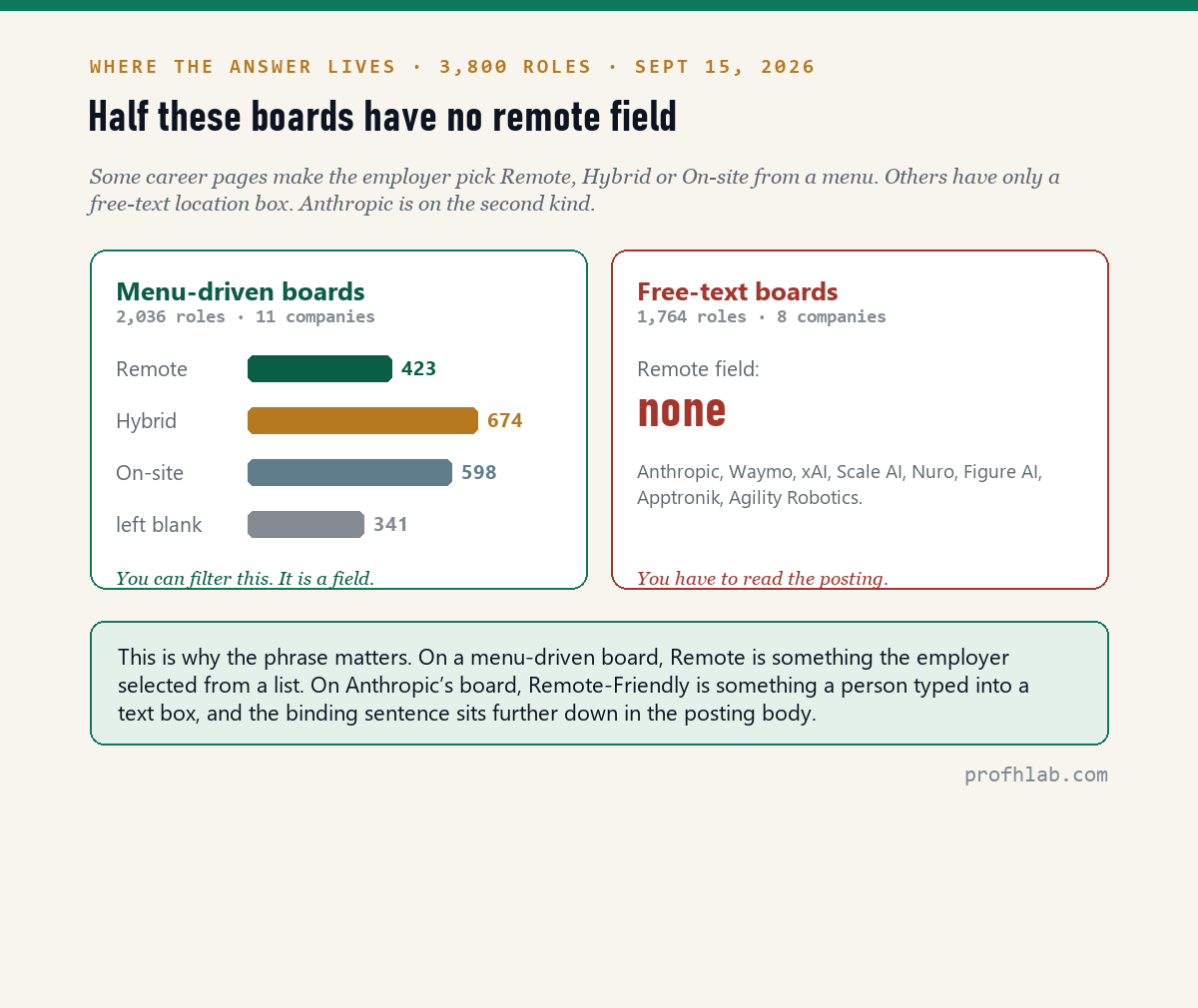
This is why aggregator sites disagree so wildly about Anthropic. They are reading a text box and guessing. So, for that matter, were we — more on that below.
One thing worth saying plainly, because it cuts in Anthropic’s favour: it is the only company on our nineteen boards that puts travel requirements into the location line itself. All 34 “(Travel-Required)” tags in our entire scan are Anthropic’s. Every other employer that expects heavy travel buries it in the body text, if it says so at all. The label is confusing, but it is not evasive.
Six ways AI boards say “remote,” and what each one costs you
Since you are probably applying to more than one company, here is the wider decoder. These are the six phrasings we see most across all nineteen boards, counted on the same morning.
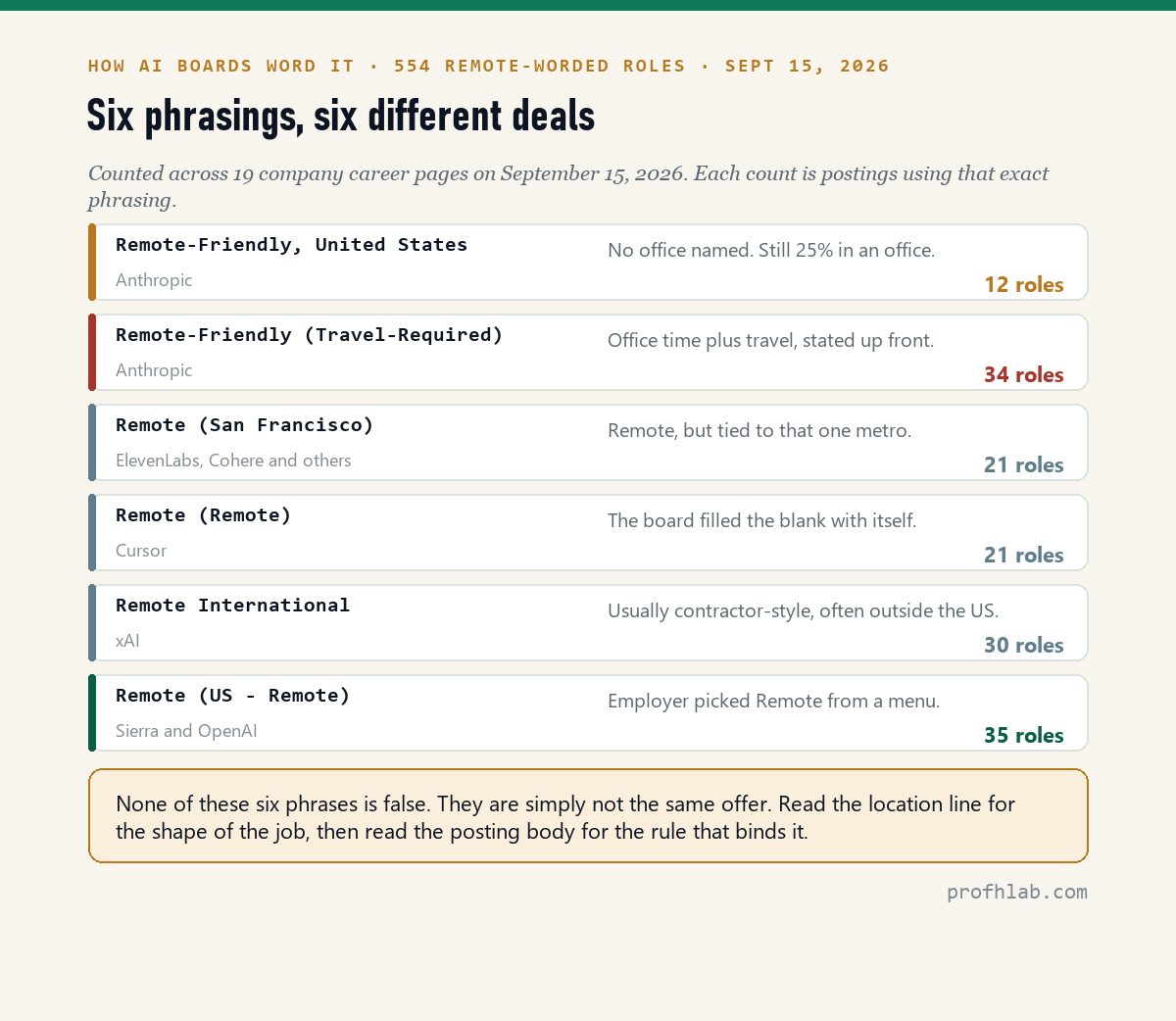
Two of those deserve a note. “Remote (San Francisco)” catches people out constantly: it reads like a remote job with a nice detail attached, and it is in fact a remote job that expects you to be reachable from that metro. Twenty-one postings currently say it.
And then there is Cursor’s, which we enjoyed more than we should have: twenty-one postings whose location reads “Remote (Remote).” That is not a policy. That is a form where somebody selected Remote from the menu and then typed Remote into the box underneath. It is, at least, unambiguous.
How to read any location line in ninety seconds
The method that works on every board, not just this one:
- Search the posting for the word “office.” Not “remote” — “office.” The location line is marketing; the office sentence is policy. On Anthropic’s postings it is under Logistics, near the bottom.
- Then search for “travel.” Two of the twelve roles above quietly add up to 50% travel to partner factories, on top of the office minimum.
- Check whether a city is named anywhere. If one is, assume you need to be able to reach it on a normal week, whatever the headline says.
- Ask in the first screening call, and ask for a number. “How many days a month would I be expected on site, and which office?” is a neutral logistics question that recruiters answer readily. Vague answers this early rarely get sharper later.
- Apply on the employer’s own domain. The aggregator copy is often weeks stale and strips exactly the boilerplate that matters here.

What we had wrong until this morning
An honest note, because it is the same mistake the aggregators are making.
Our own scanner flags a posting as remote when the word “remote” appears in its location line. For the menu-driven boards we fixed this last week and now read the employer’s own classification instead. For Anthropic there is no field to read, so the keyword test is still what we have — and it counts all 56 of these as remote, including the 34 that say Travel-Required in the very same sentence.
That number is not wrong so much as it is answering a narrower question than it appears to: how many Anthropic postings mention remote work. The answer to how many are remote, in the sense a job seeker means, is twelve — and even those come with one day a week in an office. We have noted the limitation on the tracker’s methodology section rather than quietly restating the number.
What to do with this
- If you want a genuinely remote AI job today: filter for infrastructure, not software. Open our jobs board, filter by remote, and look at the data-center and supply-chain titles first.
- If you are applying to Anthropic specifically: read the Logistics block before you write the cover letter, and work out which office you would be commuting to four or five times a month.
- If you are comparing employers: OpenAI’s board uses a menu and marks 30 roles Remote against 493 Hybrid — a much lower remote share than its raw flag suggests, for the same underlying reason.
- If a posting will not say: that is itself information. Ask on the first call.
If you want to go deeper
Is Anthropic even hiring at my level? The board is large but top-heavy; we counted the whole thing in our Anthropic headcount piece, and entry-level roles are scarce across the industry — see entry-level AI jobs with no experience.
Why do the salary ranges look so strange? The identical $320,000–$405,000 band across eleven roles is not a coincidence — it is how levelled pay bands work. We explain the mechanics in why salary ranges are so wide and why some postings show none at all.
I want remote work that is actually part-time. Be careful here, because this is where the scams cluster. Start with part-time AI jobs from home and whether AI training jobs are legitimate.
Where these numbers come from
We read the employers’ own career feeds every morning and publish the raw counts on the AI jobs tracker; every individual posting, with a link that applies on the employer’s own site, is on the jobs board. We are not recruiters, we take no money from employers, and postings close without notice — the official page always wins.
Watch: what the 25% rule looks like in practice
When a company sets an attendance minimum rather than a schedule, employees optimise against the minimum. CNBC reported on the habit that produces — showing up, being seen, and leaving — which is worth understanding before you accept a role with a percentage in the contract.
Frequently asked questions
What does remote friendly mean at Anthropic?
It means the role is not tied to one office, but it is not exempt from office attendance. Anthropic’s postings state that the company expects all staff to be in one of its offices at least 25% of the time, and that some roles require more. On September 15, 2026, 56 of its 596 open roles used the phrase and 12 used it without naming any city.
Is Remote-Friendly the same as fully remote?
No. We found no Anthropic posting that waives the 25% in-office expectation. Every one of the twelve roles with no office city attached still carried that sentence. Fully remote, in the sense of never appearing in person, is not on offer on this board.
How many Anthropic jobs are actually remote?
Twelve, as of September 15, 2026, out of 596 open roles — about 2%. A further 34 say Remote-Friendly but add “(Travel-Required),” and 10 pair the phrase with a named office. Counts that report roughly 9% are counting every posting that mentions remote work at all.
What does 25% of the time mean in days?
One day in a five-day week, or roughly four to five days a month. Anthropic states this as a floor and adds that some roles require more time in its offices. The postings do not specify whether the days must be consecutive or how travel to a distant office is treated, so ask.
Which Anthropic roles are the most remote?
Data center and infrastructure roles. Eleven of the twelve postings listed as “Remote-Friendly, United States” concern data center power, cooling, supply chain, manufacturing or capacity delivery, and eleven publish the same range of $320,000–$405,000. The twelfth is a fixed-term recruiting coordinator contract.
Does Anthropic sponsor visas for remote-friendly roles?
The postings we read state that the company does sponsor visas, but that it cannot sponsor every role for every candidate, and that it will make reasonable efforts where it extends an offer. That is the employer’s own wording and it is role-specific; immigration questions should go to the recruiter and to a licensed immigration attorney, not to a job board.
Why do job sites disagree about Anthropic’s remote jobs?
Because Anthropic’s board has no structured remote field for them to read. Of the 3,800 AI roles we track, 2,036 sit on boards where the employer selects Remote, Hybrid or On-site from a menu; the remaining 1,764, Anthropic’s among them, offer only a free-text location box. Aggregators pattern-match on that text and reach different answers.
Cite this
On September 15, 2026, 56 of Anthropic’s 596 open roles were labelled “Remote-Friendly,” 34 of those also said “Travel-Required,” and 12 named no office city — but all 12 carried the company’s stated expectation that staff be in an office at least 25% of the time. Source: The Jobs Desk, profhlab.com, reading Anthropic’s own Greenhouse feed and posting text.
Sources
- Anthropic careers board, Greenhouse feed and individual posting text, read September 15, 2026 — anthropic.com/careers
- Nineteen AI, robotics and autonomy career feeds read the same morning; counts and methodology on the AI jobs tracker and every posting on the jobs board
- CNBC, “How Employees Are Coffee Badging To Avoid Full Days At The Office,” December 17, 2024
- Google Search autocomplete, US English, queried September 15, 2026
Have a question about a specific posting or company? Ask the desk — we answer on the page, for free, and we never ask for money or personal details. More on who is hiring right now, who pays the most, roles that need no coding, AI jobs after 50, how to get hired at a frontier lab, whether old postings are worth applying to and which day most jobs appear. One short email a month.
Prof.’s H Newsletter
One short email a month, with the numbers in it
What actually moved in AI hiring, AI prices, and the scams aimed at older Americans. Counted here, dated, and linked to the source. One email a month, and your address goes nowhere else.