How Much Do Robotics Technicians Make? Robot Makers’ Own Postings Say About $30 to $50 an Hour (Oct. 2, 2026)
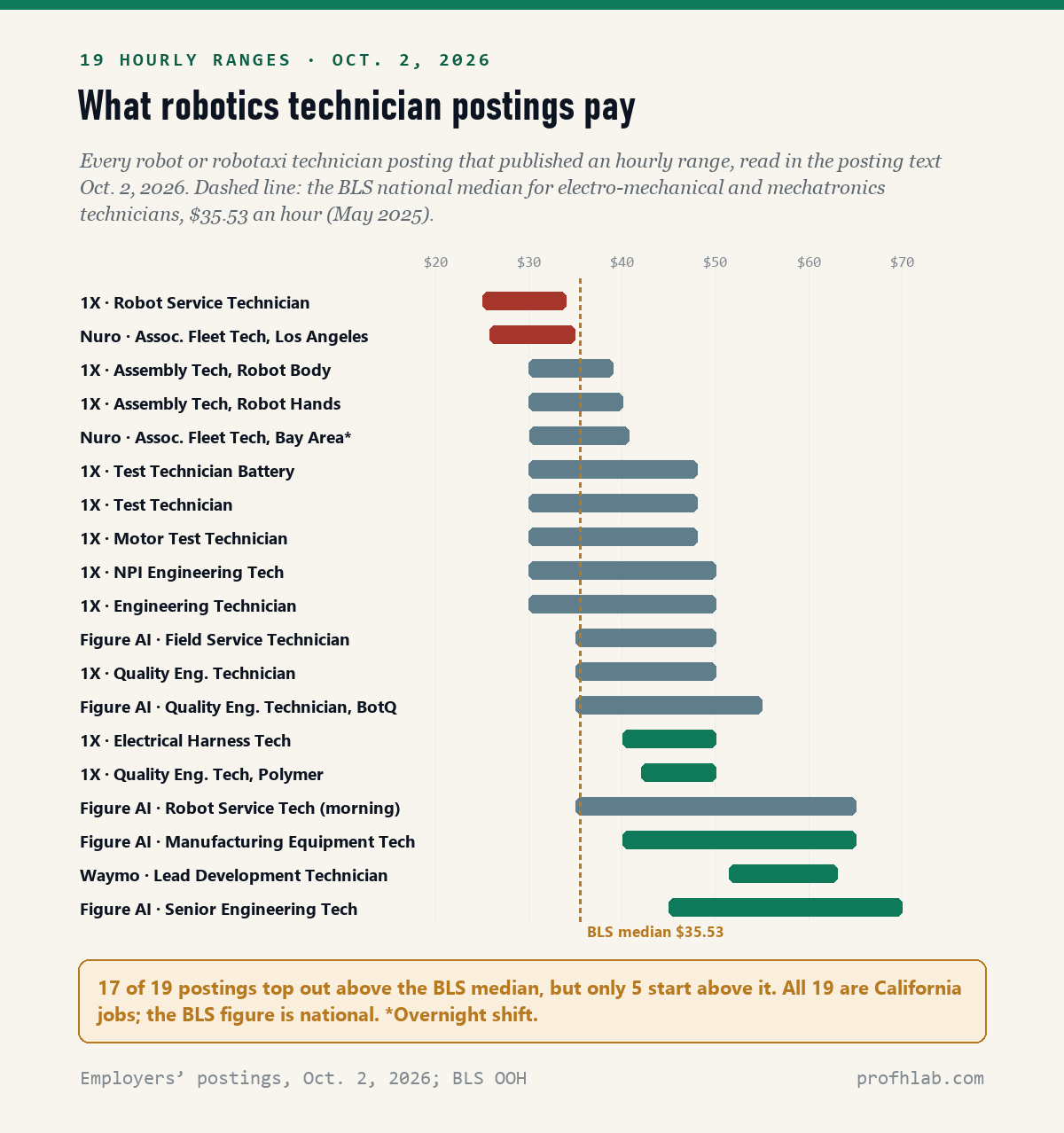
On October 2, 2026, the 19 robotics technician postings that listed hourly pay at humanoid-robot and robotaxi companies had a median range of $30.10 to $50 an hour, or about $62,600 to $104,000 a year at 40 hours a week. The national median for the closest government category, electro-mechanical and mechatronics technicians, is $35.53 an hour. So these postings start a little below the national median and top out well above it. Two OpenAI robotics technician jobs start at $225,000 a year, which is far outside that range.
What we read on October 2, 2026
We pulled the full text of every technician posting on the public job boards of nine robot, robotaxi and AI employers we track on our AI jobs tracker. We kept the 27 jobs where the technician builds, tests or services robots or self-driving vehicles. Then we read the pay line in each one.
- 27 robot and robotaxi technician postings at 7 employers; 23 publish a pay range.
- 19 give an hourly range. All 19 are in California.
- Median hourly range: $30.10 to $50. Lowest floor: $25. Highest top: $70.
- 17 of 19 top out above the BLS median of $35.53 an hour; only 5 start above it.
- 3 1X postings show two different ranges on the same page. 4 Physical Intelligence postings show none.
An AI assistant helped draft this piece and run the page reads; every quote was read on the source’s own page on the date shown.
How much do robotics technicians make at robot companies right now?
At the seven robot and robotaxi employers we read on October 2, 2026, technician postings paid from $25 an hour at the bottom of 1X’s Robot Service Technician range to $70 an hour at the top of Figure AI’s Senior Engineering Technician range. The middle of the pack sits around $40 an hour. These are the employers’ own published ranges, not survey estimates.
| Employer | Postings read | With pay | Posted range, lowest to highest |
|---|---|---|---|
| Figure AI | 5 | 5 | $35 to $70 an hour |
| 1X | 11 | 11 | $25 to $50 an hour, plus equity |
| Waymo | 1 | 1 | $51.45 to $62.99 an hour |
| Nuro | 2 | 2 | $25.80 to $40.73 an hour |
| Agility Robotics | 2 | 2 | $74,000 to $95,000 a year; $29 to $38 with no unit printed |
| OpenAI | 2 | 2 | $225,000 to $318,000 a year, plus equity |
| Physical Intelligence | 4 | 0 | No range in the posting |
Figure AI writes the pay in one plain sentence. Its Robot Service Technician posting, read on October 2, 2026, says: “The US base salary range for this full-time position is between $35 – $65/hr.” That posting is for a morning shift, “6:30am to 3pm,” at its San Jose site.
1X posted the most technician jobs: 11 robot roles in San Carlos and Hayward, California. Every one gives an hourly range and adds equity. Assembly jobs on the robot body and hands pay $30 to $39 or $40 an hour. Test and engineering technicians reach $48 to $50.
The Agility Robotics Senior Assembly Technician posting in Salem, Oregon shows “$29 — $38 USD” with no unit next to it. We read that as hourly because of its size, but that is our inference, not the posting’s wording. We left it out of the hourly median for that reason.
How does that compare with the BLS median for robotics technicians?
The Bureau of Labor Statistics puts the median wage for electro-mechanical and mechatronics technologists and technicians at $73,900 a year, or $35.53 an hour, in May 2025, according to its Occupational Outlook Handbook read on October 2, 2026. BLS has no separate category called robotics technician. This is the group it describes as people who “operate, test, and maintain electromechanical or robotic equipment.”
Against that line, the robot-company postings look generous at the top and ordinary at the bottom. Seventeen of the 19 hourly ranges top out above $35.53. Only five start above it. In plain terms, a new hire at the low end of these ranges earns a bit below the national middle; the upside is in the top half of the range.
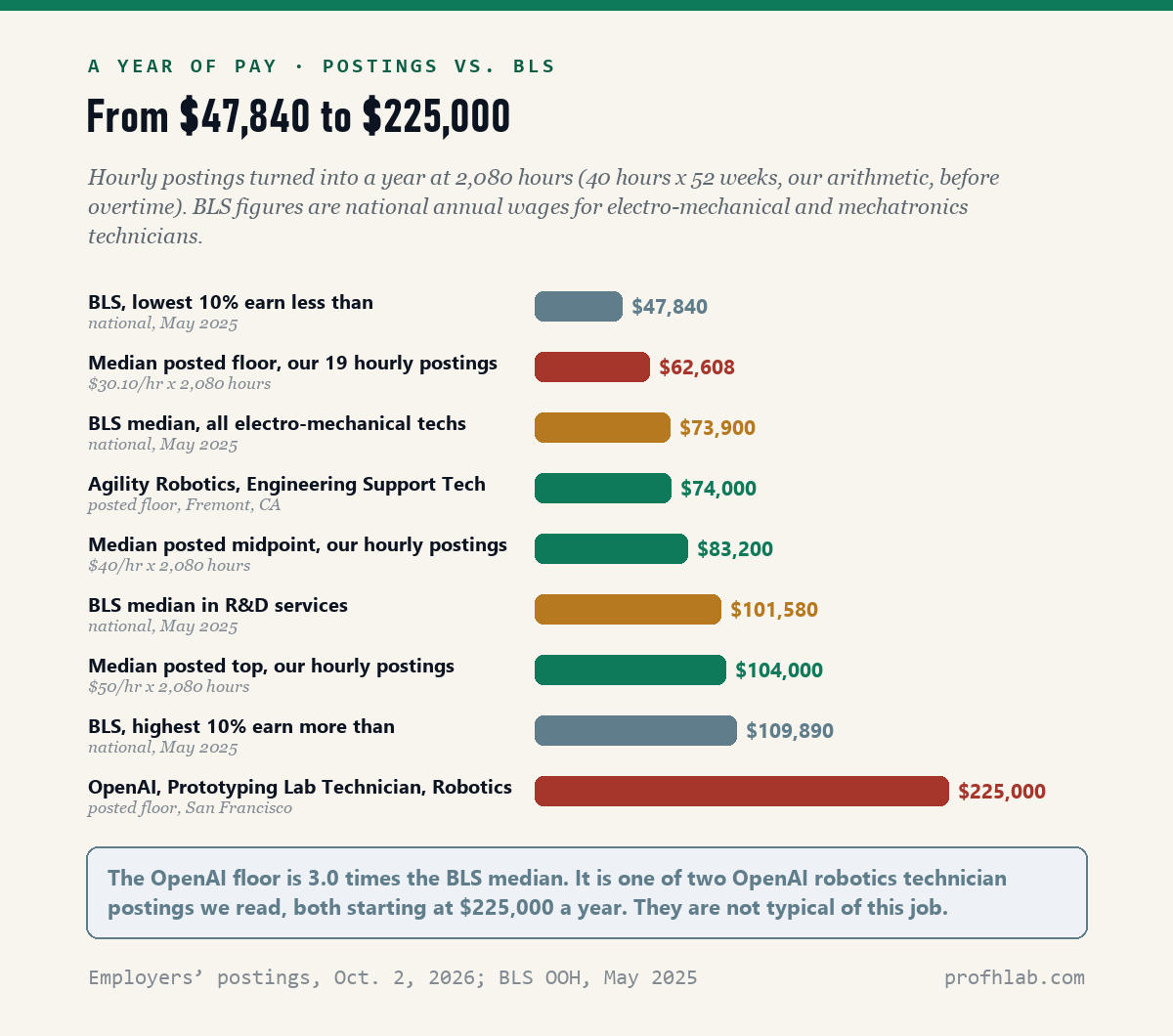
Two cautions about that comparison. First, the BLS figure is national, and every hourly posting here is in California, where wages and rent both run high. Second, BLS reports a different number for one industry: in scientific research and development services, the median was $101,580.
What does a robotics technician’s hourly pay come to in a year?
At 40 hours a week for 52 weeks, or 2,080 hours, $30 an hour comes to $62,400 a year, $40 comes to $83,200, and $50 comes to $104,000, before taxes and before any overtime. That conversion is ours; none of the postings print an annual figure for hourly jobs. It is a simple way to put an hourly and a salaried offer side by side.
| Hourly rate | A year at 2,080 hours | Where we saw it on October 2, 2026 |
|---|---|---|
| $25.00 | $52,000 | Floor, 1X Robot Service Technician |
| $30.10 | $62,608 | Median floor of 19 hourly postings |
| $35.53 | $73,900 (BLS figure) | BLS national median, May 2025 |
| $40.00 | $83,200 | Median midpoint of 19 hourly postings |
| $50.00 | $104,000 | Median top of 19 hourly postings |
| $70.00 | $145,600 | Top, Figure AI Senior Engineering Technician |
Read the gap between floor and top with care. The difference between $30 and $50 an hour is $41,600 a year at 2,080 hours. That is the width of the range, not a raise anyone is promised. Seven postings, all at Figure AI and Agility Robotics, say pay depends on “job-related knowledge, skills, and experience.” That is what sets where you land inside the range.
Why do two OpenAI robotics technician jobs start at $225,000?
OpenAI’s Prototyping Lab Technician, Robotics posting lists $225K to $295K a year and its Engineering Technician, Actuators posting lists $225K to $318K, both read on October 2, 2026, and both offer equity. Their floors are about three times the BLS median. Neither posting explains its pay level, so any reason we give would be a guess.
What the postings do say is useful. The prototyping role wants “versatile, hands-on generalists” who work across “mechanical, electrical, fabrication, and experimental domains.” Both are in San Francisco, and both are in person five days a week. Our read, not OpenAI’s wording: these are senior lab roles that happen to carry the technician title.
So treat these two as the outer edge, not the target. For how OpenAI pays across all roles, see our read of which AI company pays the most and whether OpenAI is still hiring.
Do you need a degree to become a robotics technician?
Not always: of the 27 postings we read on October 2, 2026, several accept a high school diploma plus experience, and most ask for an associate degree or “equivalent hands-on experience” rather than a bachelor’s. BLS lists an associate’s degree as the typical entry-level education for this work.
Here is how the employers word it, quoted from the postings:
- Agility Robotics, Senior Assembly Technician I: “High school diploma or GED; 2-year technical degree or military experience a plus.”
- 1X, Electrical Harness Technician: “High school diploma or equivalent, with 2–3+ years of direct experience in wire harness fabrication and assembly.”
- Physical Intelligence, Robotics Technician: an associate degree in a related field “(bachelor’s a plus), or equivalent hands-on experience.”
- Agility Robotics, Engineering Support Technician: “Typically AS degree in Electronics Technology, Engineering Technology and/or 3 years equivalent work experience in an engineering development environment.”
Experience is the harder bar. Most 1X postings ask for 2 or 3 years of hands-on work. Figure AI’s Senior Engineering Technician asks for 5+ years, and Waymo’s Lead Development Technician asks for 5+ years in an advanced automotive role. Our list of AI jobs that don’t require coding covers more of these hands-on paths.
What is the entry-level way into robotics technician work?
Nuro calls its Associate Fleet Technician “a critical, entry-level technical role,” and the Los Angeles posting, read on October 2, 2026, pays $25.80 to $34.91 an hour. The Bay Area version pays $30.10 to $40.73 for the overnight shift. They are the only two postings in our count that call themselves entry-level.
The Nuro postings ask for training, not a degree: “Automotive, Robotics, IT, or Technical training/certification” such as ASE, CompTIA or a vocational certificate. They also name high-voltage training, IPC certification and EPA 609 refrigerant certification. The job is physical; it asks you to “safely lift up to 50 lbs.”
The 1X Robot Service Technician is the other low-floor role, at $25 to $34 an hour in its description. It asks for 2+ years in “robotics, manufacturing, aerospace, automotive, electronics, or another hands-on technical field.” If you are starting from zero, see entry-level AI jobs with no experience and humanoid robot operator jobs.
Why does one 1X posting show two different pay ranges?
On October 2, 2026, three of 1X’s 11 robot technician postings showed one range in the job board’s compensation box and a different one in the job description. The Robot Service Technician box says $25 to $43 an hour; the description says “$25.00 – $34.00 per hour.” That is a $9 difference at the top.
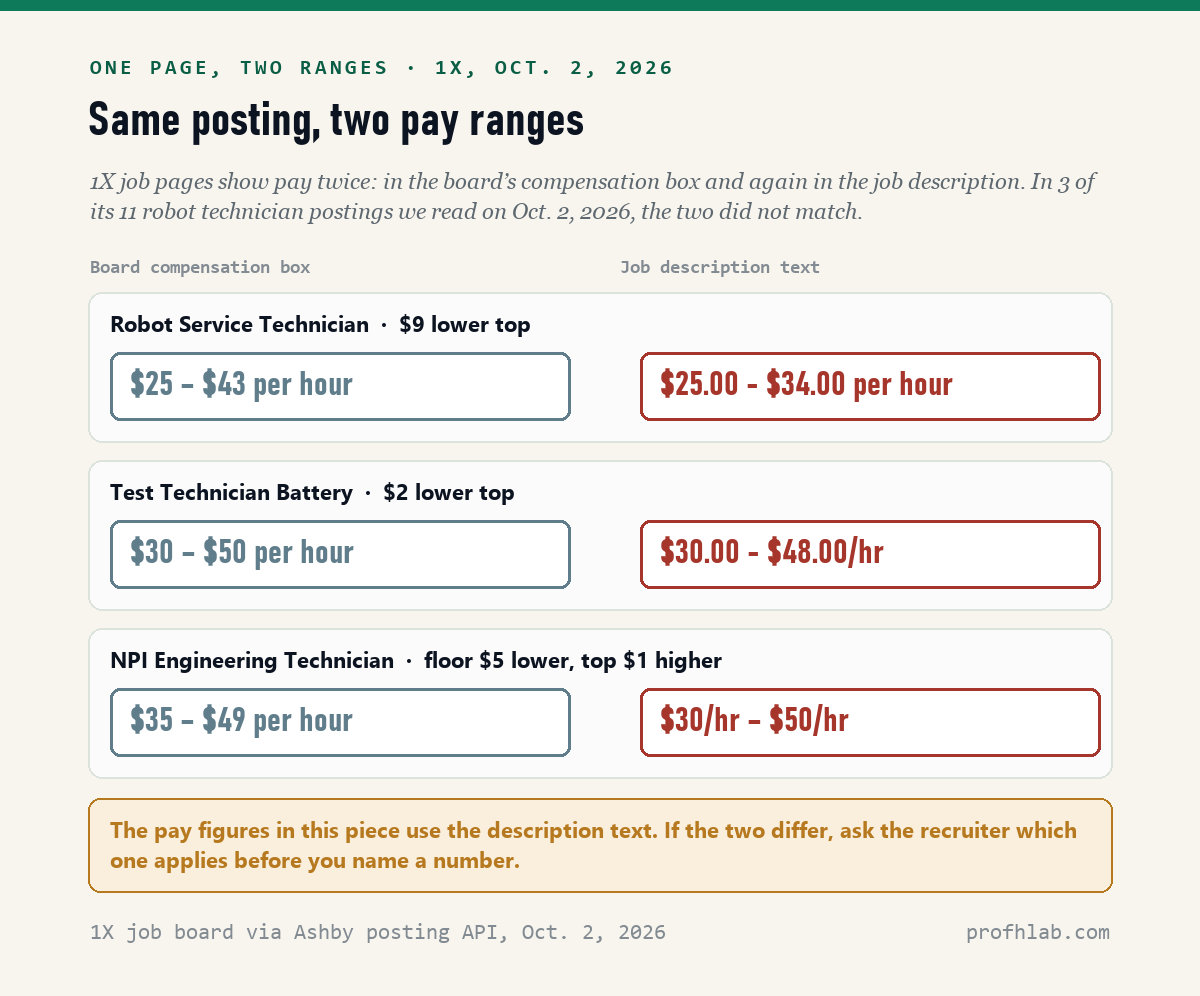
The other two are smaller gaps. Test Technician Battery shows $30 to $50 in the box and $30 to $48 in the text. NPI Engineering Technician shows $35 to $49 in the box and $30 to $50 in the text. We cannot tell from the outside which number is current, and we have not asked 1X.
If you apply to one of these, ask the recruiter which range applies before you name a number. Our explainer on why salary ranges are so wide covers how to use a range in that conversation.
Which robotics technician postings don’t show pay at all?
All four Physical Intelligence technician postings we read on October 2, 2026, in San Francisco and Fremont, showed no pay range in the description and none in the board’s compensation field. They are Robot Build, Robot Prototype, Robot Integration and Test, and Robotics Technician. That makes four of 27, or about one in seven.
That does not mean the jobs pay less. It means you cannot compare them from the posting. Our piece on why job postings don’t show salary explains what to ask instead. The other 23 postings, at six employers, did publish a range.
How do you check the pay on a technician posting before you apply?
Find the pay line, note whether it is hourly or yearly, check for a second range on the same page, and convert it at 2,080 hours; that is the order we used on the 27 postings in this count. It takes about two minutes per posting.
- Press Ctrl+F (Command+F on a Mac) and search for “$”. Figure AI and Nuro write the pay into a sentence; Agility and Waymo show a bare range.
- Check the unit. Look for “/hr,” “per hour” or “a year.” If none is printed, ask.
- Look for a second range. On Ashby boards such as 1X’s, compare the compensation box with the description.
- Read the shift line. Nuro’s Bay Area range is for the overnight shift; 1X lists day and swing shifts.
- Convert it. Multiply the hourly rate by 2,080 to compare with a salaried job.
The posting shows two pay ranges. Which one applies to this role,
and is the rate different for day, swing or overnight shifts?
One question about the range, one about the shift. To catch new technician postings when they open, set up job alerts for specific companies.
Nine employers’ job boards, minus facilities technicians
We read the public Greenhouse and Ashby job-board APIs of Figure AI, Apptronik, Agility Robotics, 1X, Physical Intelligence, Waymo, Nuro, OpenAI and xAI on October 2, 2026. We kept every posting with technician in the title whose work is building, testing or servicing robots or self-driving vehicles. Apptronik had no technician postings that day.
We left out facilities technicians at Figure AI and 1X, a Waymo proving-ground manager, a Waymo posting in Munich, OpenAI’s data center and site operations technicians, and xAI’s 32 data center and power plant technician postings. Those are real jobs, but not robot work. Our xAI Memphis pay read covers that side.
Our daily scanner only catches yearly ranges, so it showed no pay for most of these jobs. So we pulled each posting’s full text and read every dollar line in it. Postings change daily; the employer’s own page wins. BLS figures come from its handbook page for electro-mechanical and mechatronics technicians.
Before you apply anywhere
We are not recruiters, we take no money from employers, and postings can close at any time: the official page wins. A real employer never asks you to pay to apply, deposit a check and send money back, or accept an offer by text. Apply only on the employer’s own domain. More on spotting job scams.
Data center electricians and technicians: two more hands-on paths
Browse every open role on our jobs board and apply on the employer’s site, or see today’s counts on the AI jobs tracker. For the robot makers in this count, read is Figure AI hiring and is Waymo hiring. For the wider market, start with which AI companies are hiring right now.
Weighing a different hands-on path? Compare what AI data center electricians make and how to become a data center technician. Changing careers later in life? See AI jobs for people over 50. Want us to read a posting for you? Ask the desk, or visit the Jobs Desk.
Cite this
On October 2, 2026, 19 robotics technician postings with hourly pay at humanoid-robot and robotaxi employers had a median range of $30.10 to $50 an hour; 17 topped out above the BLS median of $35.53 for electro-mechanical and mechatronics technicians, and 5 started above it. Source: profhlab.com AI Jobs Desk, How Much Do Robotics Technicians Make?
Sources read on October 2, 2026: the public Greenhouse and Ashby job boards of Figure AI, Apptronik, Agility Robotics, 1X, Physical Intelligence, Waymo, Nuro, OpenAI and xAI, with the full text of every technician posting; Figure AI, Robot Service Technician; 1X, Robot Service Technician; Nuro, Associate Fleet Technician, Bay Area; OpenAI, Engineering Technician, Actuators; BLS Occupational Outlook Handbook, Electro-mechanical and Mechatronics Technologists and Technicians. Photos via Wikimedia Commons under the licenses shown.
Prof.’s H Newsletter
One short email a month, with the numbers in it
What actually moved in AI hiring, AI prices, and the scams aimed at older Americans. Counted here, dated, and linked to the source. One email a month, and your address goes nowhere else.