Is the AI Job Market Saturated? 3,870 Openings, 1 in 27 for Beginners (Sept. 25, 2026)
No, the AI job market is not saturated at the top, but it is crowded at the door. On September 25, 2026, we counted 3,870 open jobs on 20 AI company boards, 218 more than five weeks ago. Only 115 of the 3,075 US openings, about 1 in 27, were written for students, new graduates or beginner technicians. Senior-titled postings outnumber them 13 to 1.
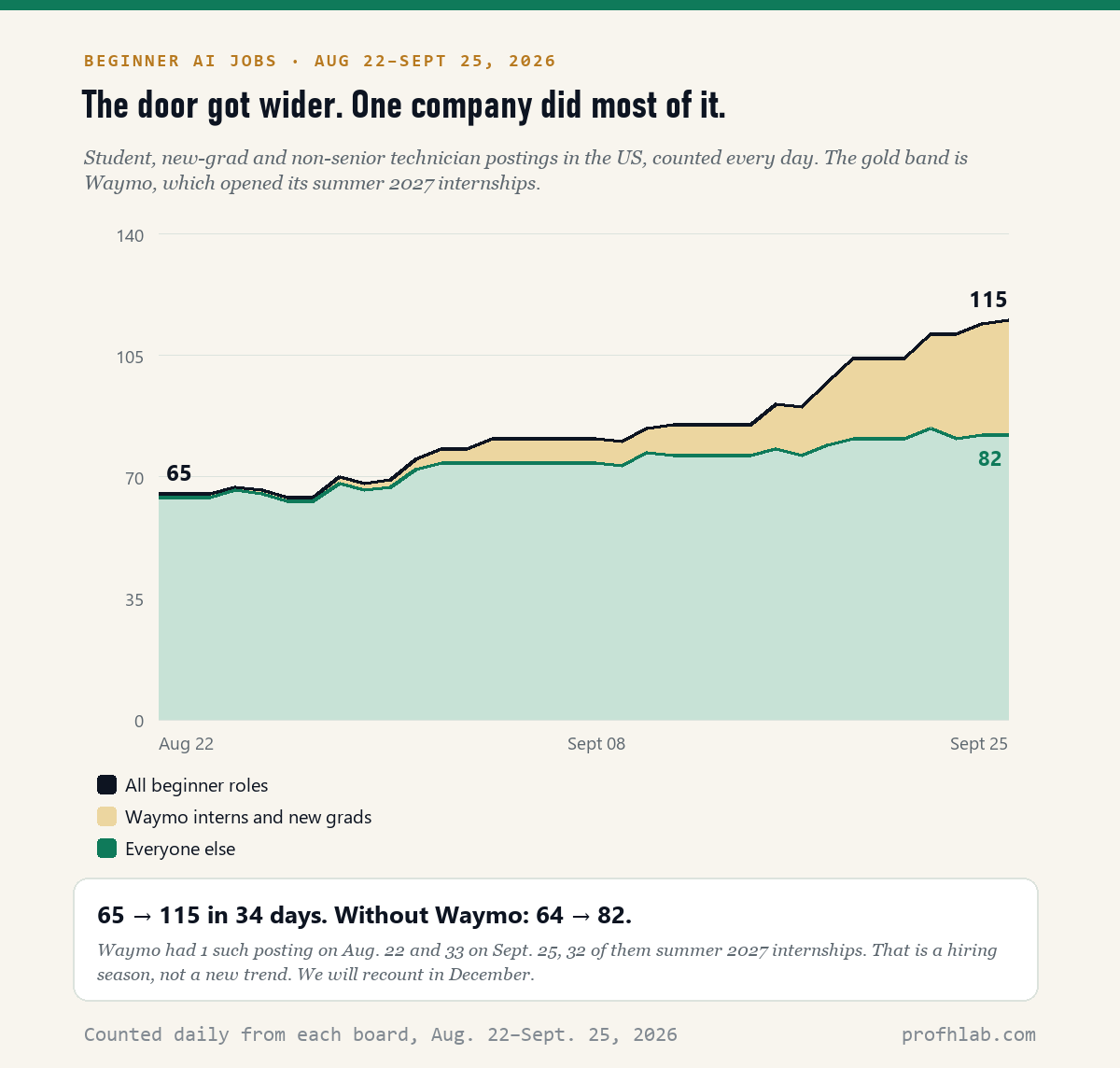
On August 22, Waymo’s careers board listed one job a college student could apply for. This morning it listed 33, most of them posted in the last three weeks. One of the newest is a summer 2027 PhD internship in simulation software. If you only watched Waymo, you would think the door to AI jobs just swung open. If you watched everyone else, you would see it barely moved.
People ask whether the AI job market is “saturated” because it feels that way from the outside: hundreds of applicants per opening, auto-rejections at 2 a.m., friends with master’s degrees still looking. We cannot count applicants. Nobody outside the companies can. What we can count, every day, is the other side of the ledger: the jobs. We have read these 20 boards daily since August 22. Here is what 34 days of counts say.
The short version, as of September 25, 2026
- 3,870 AI, robotics and self-driving jobs open on 20 company boards (3,075 in the US).
- +218 since August 22: 1,173 postings appeared, 955 disappeared.
- 1,501 US postings carry a senior title. 115 are for beginners.
- Beginner roles grew from 65 to 115, but 32 of the 50 new ones are Waymo internships.
Are AI companies still hiring, or has it stalled?
Still hiring. The total has drifted up almost every week: 3,652 postings on August 22, 3,799 on September 10, 3,870 today. That gain came even though Google DeepMind’s US board, which had 10 postings in August, has returned an error since September 6 and counts as zero.
Underneath the net number, the churn is large. Comparing each day’s posting links, 1,173 postings appeared and 955 disappeared over the 34 days. About 74% of the jobs that were open on August 22 are still open. A saturated market, where companies had more good candidates than they could use, would look different: postings would fill and vanish fast, and the total would fall.
The growth is not spread evenly. Anthropic added 106 postings and OpenAI 74. Perplexity (+23), Mercor (+26), Cognition (+19) and xAI (+19) also grew. ElevenLabs lost 46, Figure AI 27 and Waymo 11 (Waymo lost senior roles while adding interns). Daily company counts are on the AI jobs tracker, and the ranking of who is hiring most is in which AI companies are hiring right now.

Who the 3,075 US openings are actually for
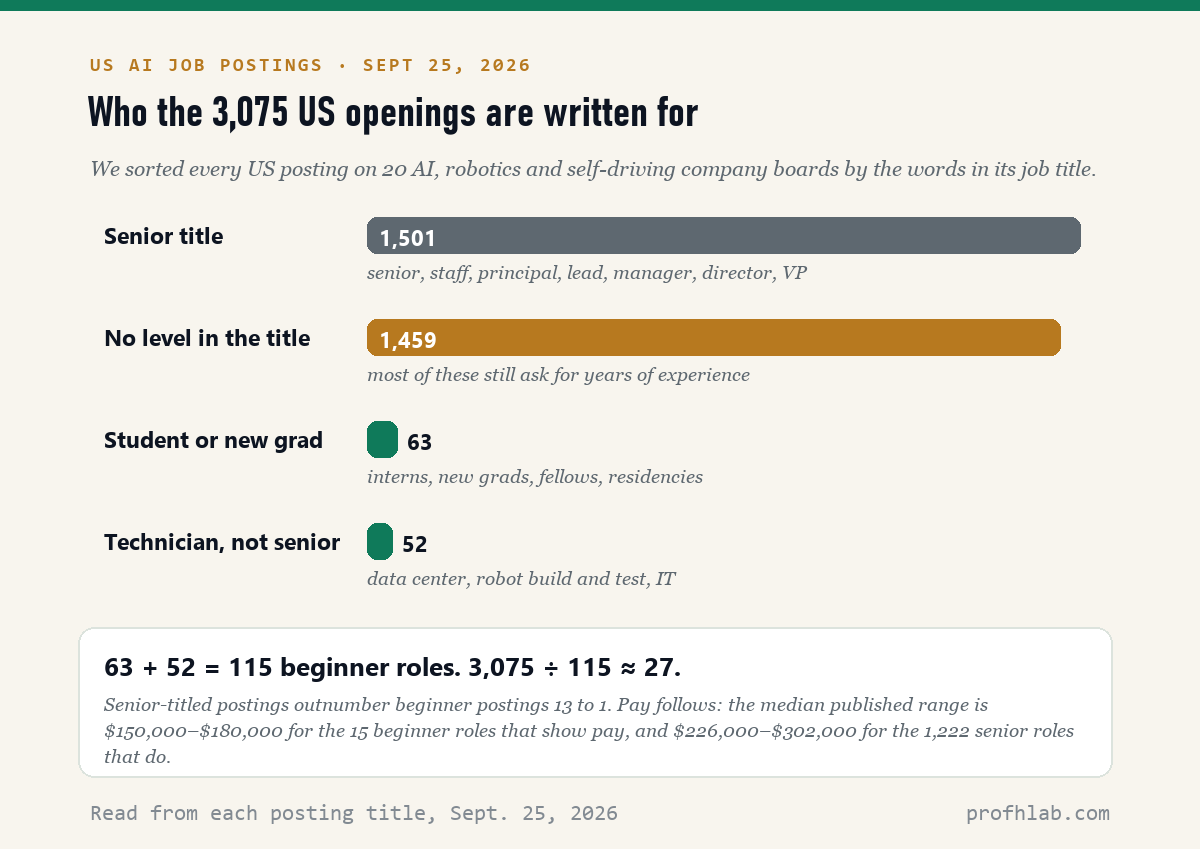
We sorted every US posting by the words in its job title. Nearly half, 1,501, say senior, staff, principal, lead, manager, director, VP or something above. Another 1,459 have no level in the title at all, and most of those still ask for years of experience once you open them.
That leaves the door. 63 postings are internships, new-grad roles, fellowships or residencies. 52 are technician jobs without a senior or lead title: data center, robot assembly and test, IT. Together, 115. Divide 3,075 by 115 and you get about 27.
What we found that the headlines miss: the beginner door did widen, from 65 postings on August 22 to 115 today. But Waymo alone added 32 of the 50, almost all summer 2027 internships. Take Waymo out and the rest of the industry went from 64 to 82. That is internship season arriving, not a change in how AI companies hire.
If you are a student, that timing matters more than the saturation question. Big internship programs open in late summer and fall and close on a rolling basis. We tracked when each company opens in when summer 2027 internships open, and what Waymo is posting in is Waymo hiring.
Why it feels saturated when you are starting out
Because for people starting out, the evidence says it is harder. In August, Stanford economists Erik Brynjolfsson, Bharat Chandar and Ruyu Chen updated their study of ADP payroll data. Employment among workers ages 22 to 25 in highly AI-exposed jobs now stands about 19% below where it would be if it had kept pace with similar young workers in less-exposed jobs. A year earlier the gap was 15%. Experienced workers show no comparable gap (Stanford Digital Economy Lab, Aug. 12, 2026).
Our counts line up with that from the job side. When 1 posting in 27 is written for a beginner, every one of those postings draws the applicants who could not get the other 26. The market is not full. The entrance is narrow.
The picture outside AI companies is steadier. The Bureau of Labor Statistics projects data scientist jobs to grow 34% from 2024 to 2034, far above the 3% average, with a median pay of $112,590 in 2024 (BLS Occupational Outlook Handbook). Those jobs sit in hospitals, banks, insurers and government, not just labs in San Francisco. If you are wondering what this means for your current job instead, we looked at that in will AI take my job.

What beginner AI jobs pay, from the postings themselves
Only 15 of the 115 beginner postings publish a pay range. Their median range is $150,000 to $180,000, pulled up by new-grad software engineering jobs in the Bay Area. For comparison, the 1,222 senior-titled postings that show pay have a median range of $226,000 to $302,000. We explain why these ranges are so wide in why salary ranges are so wide.
| Posting | Location, as written | Base pay |
|---|---|---|
| Mercor · Research Fellowship (APEX) | Remote (San Francisco) | $40,000–$80,000 |
| xAI · IT Services Technician | Memphis, TN | $61,200–$91,800 |
| xAI · IT Services Technician | Seattle, WA | $68,400–$102,600 |
| Agility Robotics · Engineering Support Technician | Fremont, CA (on site) | $74,000–$95,000 |
| Scale AI · Software Engineer, New Grad | San Francisco, CA | $124,000–$162,000 |
| Replit · Software Engineer, New Grad (2027) | Foster City, CA | $140,000–$180,000 |
| Sierra · Software Engineer, Agent (New Grad 2027) | San Francisco, CA | $150,000–$180,000 |
| Nuro · Software Engineer, AI Platform, New Grad | Mountain View, CA | $153,000–$176,000 |
| OpenAI · Site Operations Technician | San Francisco | $157,000–$221,000 |
| Perplexity · Research Fellowship | San Francisco | $180,000–$220,000 |
| OpenAI · Prototyping Lab Technician, Robotics | San Francisco | $225,000–$295,000 |
Eleven of the 15 beginner postings that publish a pay range, lowest first. All read on the employer’s own board on September 25, 2026. The titles link to the postings. The other 100 beginner postings, including every Waymo internship and every Figure AI and 1X technician role, show no range.
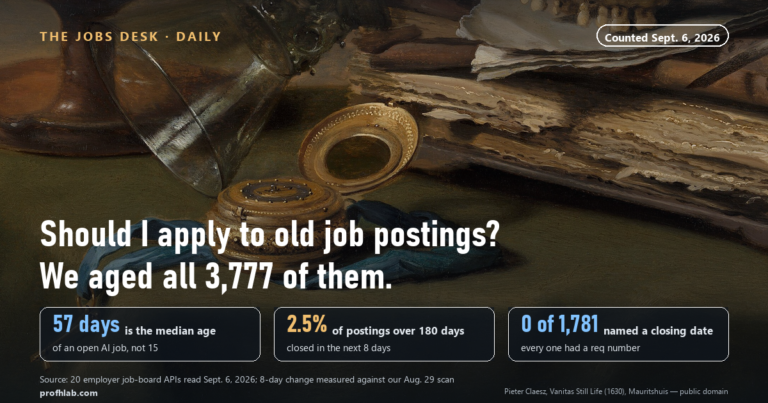
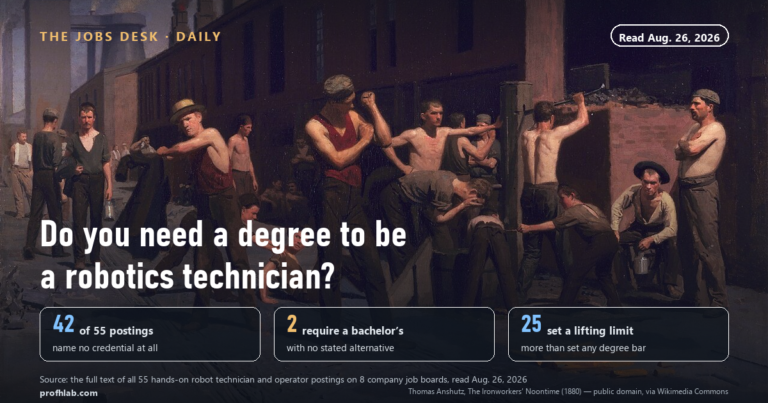
The technician rows are the ones to look at if you do not have a computer science degree. We read what those postings ask for in do you need a degree to be a robotics technician and how to become a data center technician with no experience. One more pattern: about 38% of US postings have been up for 90 days or more. Some are real jobs that are hard to fill; some are evergreen ads. We sorted which is which in should I apply to old job postings.

We are not recruiters. We take no money from any employer named here, and we do not handle applications. Postings can close without notice, and the official page wins. Apply only on the employer’s own site: the links in the table go there. A real employer will not charge you a fee, ask you to deposit a check and send money back, or offer you a job by text. More in our sources and scam rules.
Filter for beginner roles and apply in the first week
- Go where the door is. Filter for beginner roles on our jobs board, or browse every open role and apply on the employer’s site.
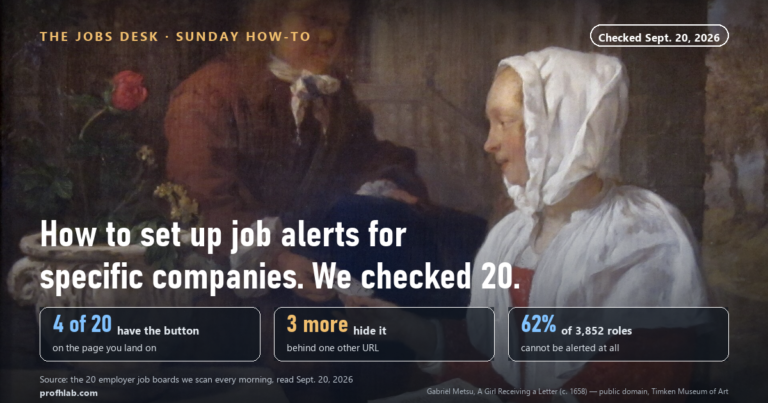
- Apply in the first week. With 1 beginner posting for every 27, early applications get read. Set up job alerts for specific companies.
- Look beyond engineering. Technician, operations and support roles are real entrances: AI jobs that don’t require coding.
- Do not buy your way in. Before paying for a course, read is an AI certificate worth it.
The Stanford gap hits young workers, not experienced ones
Do I need a PhD? For research roles, often. For most of the 3,870, no: do you need a PhD to work in AI. Starting from zero? Try entry-level AI jobs with no experience.
What if I am changing careers later in life? The Stanford gap is about young workers; experienced workers show none. That is part of why we wrote AI jobs for people over 50. Which company pays the most? Which AI company pays the most compares every published range.
How we read the boards is in how we count. You can ask the Jobs Desk a question; we answer in public and never charge.
Questions people ask about the AI job market
Is the AI job market saturated?
Not for experienced people. On September 25, 2026, we counted 3,870 open jobs on 20 AI, robotics and self-driving company boards, 218 more than on August 22. But only 115 of the 3,075 US postings, about 1 in 27, were written for students, new graduates or non-senior technicians. The crowd is at that door.
Is it hard to get an entry-level AI job right now?
Yes, mainly because there are so few of them. Senior-titled postings outnumber beginner postings 13 to 1 on the boards we read. Stanford researchers found employment for 22- to 25-year-olds in the most AI-exposed jobs is about 19% below where it would be if it had kept pace with less-exposed jobs.
Are AI companies still hiring in 2026?
Yes. Over 34 days of daily counts, 1,173 postings appeared and 955 disappeared, a net gain of 218. Anthropic (+106) and OpenAI (+74) added the most; ElevenLabs (−46) and Figure AI (−27) shrank the most.
Do entry-level AI jobs still pay well?
The ones that publish pay mostly do. The median range for the 15 beginner postings with a range was $150,000 to $180,000. The lowest was a Mercor research fellowship at $40,000 to $80,000, and IT technician roles at xAI start at $61,200.
Is the data science job market saturated?
The government does not think so. The Bureau of Labor Statistics projects data scientist jobs to grow 34% from 2024 to 2034, with a median pay of $112,590 in 2024. That is growth across the whole economy, not just AI companies.
What should I do if I am just starting out?
Apply where the beginner roles are: internships and new-grad programs that open in the fall, and technician jobs at data centers and robot makers. Set alerts on those companies, apply within the first week a posting is up, and read the whole posting for the experience line.
Cite this
On September 25, 2026, Prof H Lab counted 3,870 open jobs on 20 AI, robotics and self-driving company boards, up 218 since August 22. Of 3,075 US postings, 115 (about 1 in 27) were for students, new graduates or non-senior technicians, and 1,501 carried a senior title. Source: AI Jobs Tracker, Prof H Lab.
We’ll run this count again on December 4, after most fall internship programs have closed. Two things to watch: whether the beginner count falls back toward 80 without Waymo’s internships, and whether Stanford’s next update shows the 19% gap still widening.
Sources
- Job counts, titles, pay ranges and posting links: our daily read of each employer’s own board (Greenhouse and Ashby public feeds) from August 22 to September 25, 2026. “Beginner” means a title with intern, new grad, early career, fellow, fellowship, residency or apprentice, or a technician title without senior, lead, manager or a level number. Google DeepMind’s board returned an error from September 6 and is counted as zero. Method: how we count.
- Stanford Digital Economy Lab, “No Widespread Displacement, but the AI Employment Gap for Young Workers Has Widened to 19%,” Aug. 12, 2026 and the August 2026 paper (PDF).
- U.S. Bureau of Labor Statistics, Occupational Outlook Handbook: Data Scientists.
- Videos: Nicholas Thompson with Erik Brynjolfsson; CNBC, “How AI Is Killing The Value Of A College Degree”.
- Featured image: Ford Madox Brown, Work (1852–65), public domain, via Wikimedia Commons.
Prof.’s H Newsletter
One short email a month, with the numbers in it
What actually moved in AI hiring, AI prices, and the scams aimed at older Americans. Counted here, dated, and linked to the source. One email a month, and your address goes nowhere else.