Should I Answer Voluntary Self-Identification on a Job Application? What 3,828 Forms Show (Oct. 18, 2026)
It is your choice on every form we read: on October 18, 2026, 2,170 of 3,828 application forms on 19 AI company job boards had a voluntary self-identification section, and every one of its questions offered a way to decline. The section asks about gender, race, veteran status and, on a shrinking number of forms, disability. Six boards ask none of it.
The disability question is the one that changed. A Labor Department rule removed the federal requirement behind it on September 21, 2026, yet 30 forms still carry it. Below are the counts by company, what each employer says it does with your answers, what declining looks like on screen, and where the law now stands.
What we opened on October 18, 2026
- Every open application form on the 19 boards behind our AI jobs tracker: 3,828 forms, 3,093 of them for U.S. jobs. We read each one through the employer’s public Greenhouse or Ashby application feed, the same form an applicant sees. 32 forms were rate-limited on the first pass; we re-read them one at a time, so none is unread. Google DeepMind’s U.S. board, a 20th board we track, returned “not found” and is not counted.
- We counted gender, race, veteran and disability questions and read every match by eye. Three false matches, such as “How do you pronounce your name?”, were removed.
- We read the Labor Department’s final rules in the Federal Register and the current text of 41 CFR in the eCFR. We did not apply to any job or contact any employer, and this is not legal advice.
Written and checked by Prof. H. An AI assistant helped draft this piece and run the form reads; every quote was read on the source’s own page on October 18, 2026.
Should I answer voluntary self-identification on a job application?
On the 3,828 AI company application forms we read on October 18, 2026, answering was optional in practice: 0 self-identification questions lacked a decline answer. At most companies the questions are not even marked required.
The decline wording varies. OpenAI, Cursor, Cognition and Replit use “Decline to self-identify.” Anthropic and six other Greenhouse boards use “Decline To Self Identify” for gender and race and “I don’t wish to answer” for veteran status. Waymo uses “I don’t wish to answer” throughout, and Sierra uses “I prefer not to answer.” Each is a normal choice in the list.
So the honest answer to “should I” is that it depends on what you are comfortable sharing. The forms are built to accept either. What they say happens to your answer is in the next sections, along with the parts nobody outside the company can check.
Which AI companies put a self-ID section on their forms?
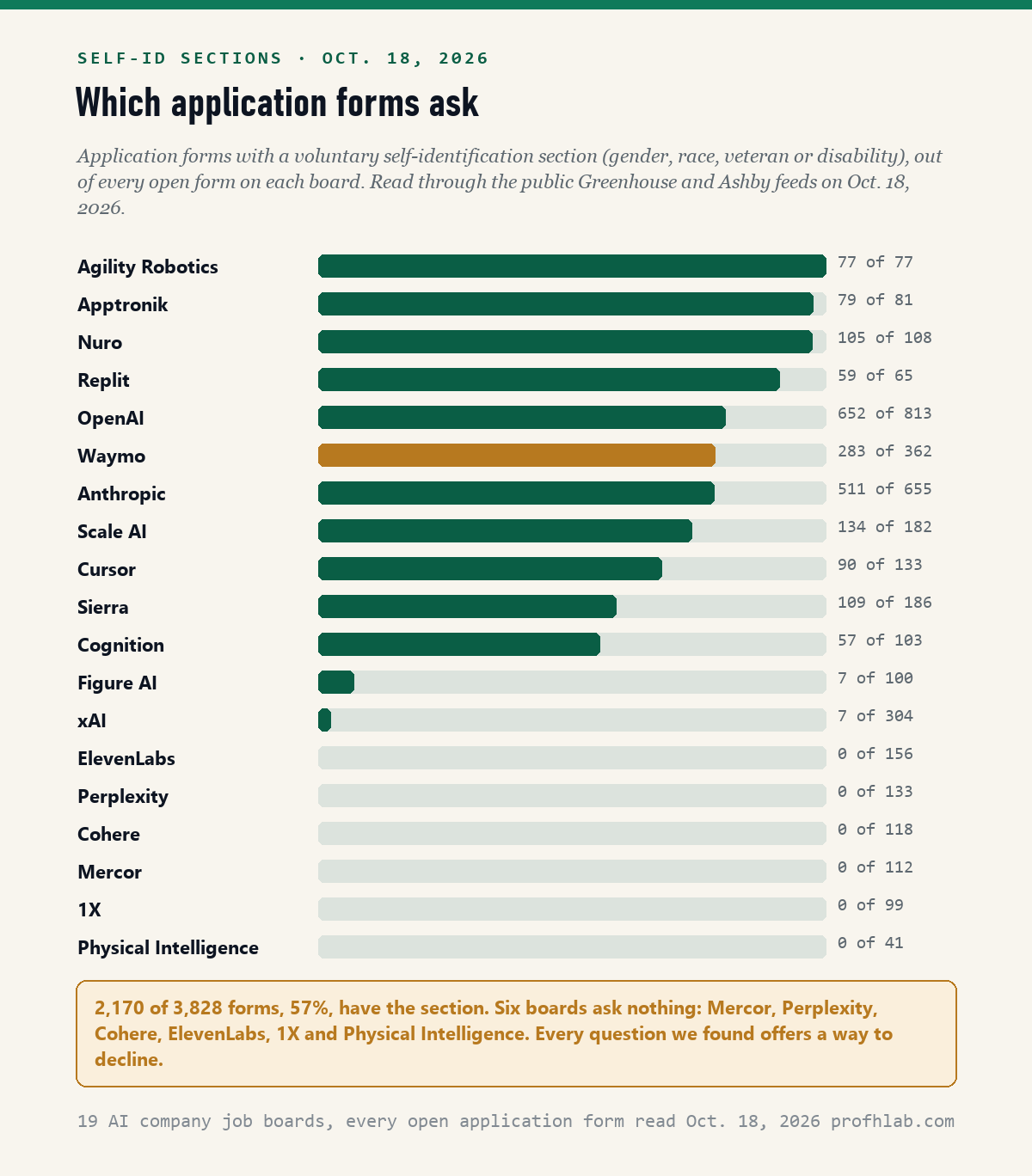
Thirteen of the 19 boards had a self-identification section on at least one form on October 18, 2026, and six had none on any form. The six with none were Mercor, Perplexity, Cohere, ElevenLabs, 1X and Physical Intelligence.
| Board | Forms with the section | What it asks |
|---|---|---|
| OpenAI | 652 of 813 | Gender, race, veteran |
| Anthropic | 511 of 655 | Gender, race, veteran; disability on 25 |
| Waymo | 283 of 362 | Gender, race, veteran, marked required |
| Sierra | 109 of 186 | Gender, race, sexual orientation; disability on 5 |
| 9 other boards | 615 of 1,153 | Gender, race, veteran |
| 6 boards with none | 0 of 659 | Nothing |
Location matters more than company. Of the 3,093 forms for U.S. jobs, 2,087 had the section, or 67%. Of the 735 forms for jobs outside the U.S., only 83 did. Two boards barely use it at all: xAI had it on 7 of 304 forms and Figure AI on 7 of 100.
Sierra stands out for asking a question the others do not. All 109 of its forms with a survey ask “How do you identify your sexual orientation?”, with “I prefer not to answer” as the last choice. No other board asked about orientation.
Why do 30 forms still ask about disability after September 21, 2026?
The federal rule that told contractors to ask applicants about disability, 41 CFR 60-741.42, was removed effective September 21, 2026, but 30 of the 3,828 forms we read on October 18, 2026 still ask. Twenty-five are Anthropic’s and five are Sierra’s.
The Labor Department published the change on August 21, 2026, as a final rule at 91 FR 54482. Its regulatory text reads, in full for that section, “Remove and reserve Sec. 60-741.42.” The eCFR version dated October 15, 2026 now shows the section as “[Reserved].” The department’s own forms page says the self-identification form “is discontinued, effective September 21, 2026.”
Its reason is worth reading in the department’s own words. The rule argues that the Americans with Disabilities Act bars most disability questions before a job offer, and that calling the answer voluntary does not change that. In the rule’s words, “Describing the applicant’s response as voluntary does not alter the legal character of these requirements.”
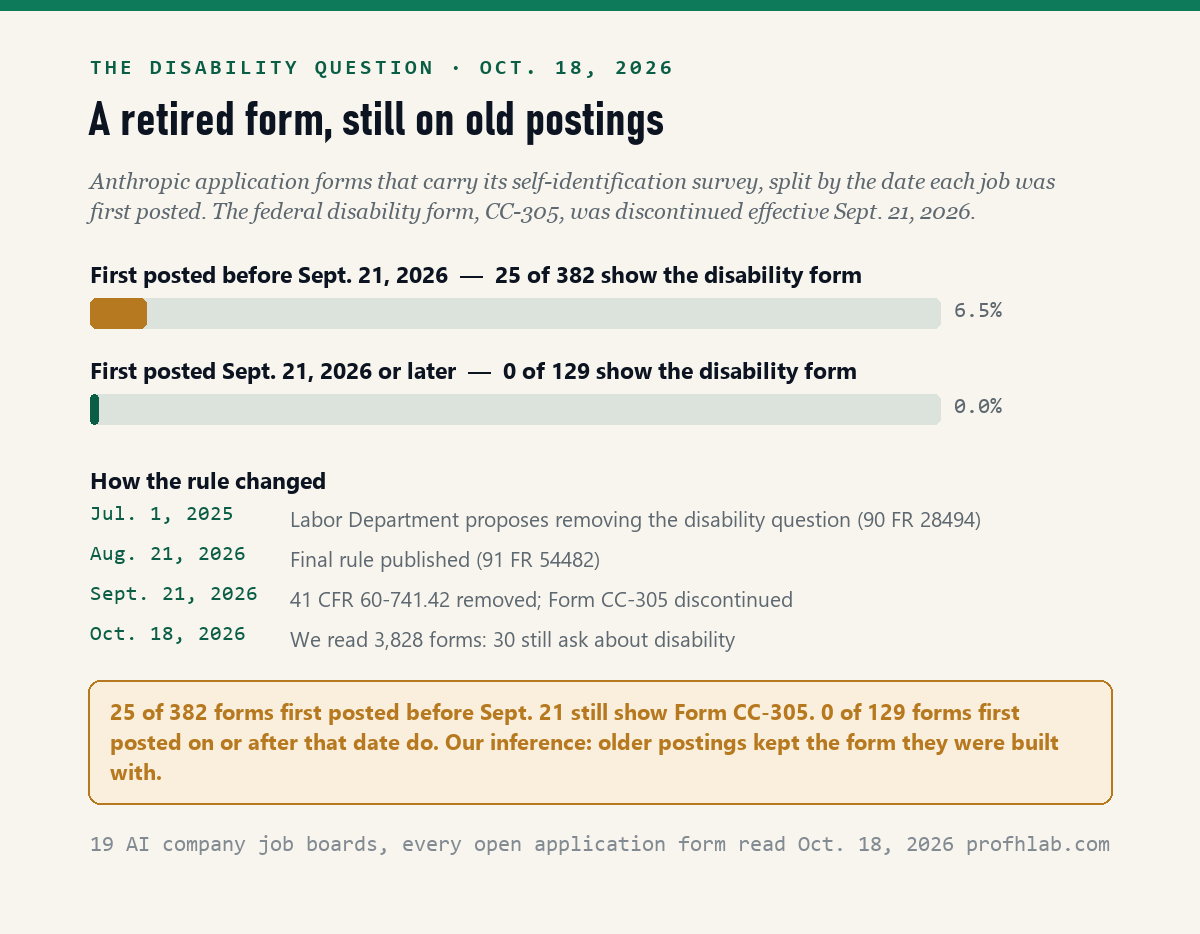
The dates tell a clear story at Anthropic. All 25 forms that still show Form CC-305 belong to jobs first posted before September 21; the newest was posted September 19. None of the 129 Anthropic forms first posted on or after September 21 includes it. Our inference is that older postings kept the form they were built with. We did not ask Anthropic, so that is an estimate, not its stated reason.
The old form even carries its own stale label: “OMB Control Number 1250-0005 Expires 07/31/2029.” It also still says “Completing this form is voluntary.” Sierra’s five forms use different wording, “Do you identify as a person with disability?”, and all five jobs were first posted between March and July 2026.
Is the protected veteran question still on job applications?
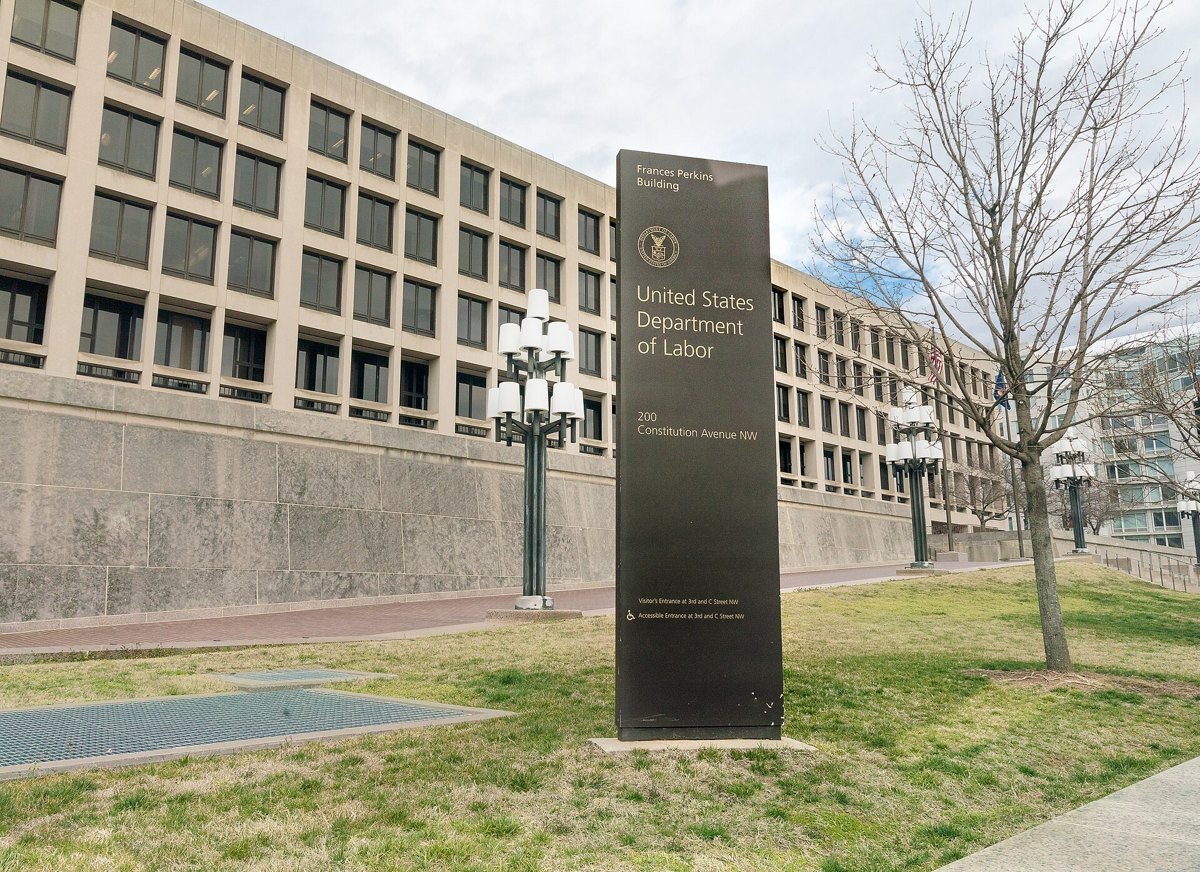
Yes: 2,061 of the 3,828 forms we read on October 18, 2026 ask about veteran status, and the federal rule behind the most common version still stands. The eCFR text of 41 CFR 60-300.42, dated October 15, 2026, says contractors “shall invite applicants” to say whether they are a protected veteran.
The Labor Department changed its veteran rules on the same day as its disability rules. That final rule, 91 FR 54234, also took effect September 21, 2026. We searched its full text for section 60-300.42 and found no mention, so the invitation was left as it was.
The usual question has three answers. OpenAI’s version reads “I identify as one or more of the classifications of protected veteran listed above,” “I am not a protected veteran,” or “I decline to self-identify for protected veteran status.” Waymo asks a plainer question about whether you are “a veteran or active member” of the U.S. Armed Forces.
What does a required self-ID question mean at Waymo?
On October 18, 2026, Waymo was the only one of the 19 boards that marked its self-identification questions required, on all 283 of its forms with the survey, and every one of them includes “I don’t wish to answer.” Required, there, means you must pick something, and declining counts.
Waymo’s survey is headed “Candidate Demographic Survey.” Its note says “Completion of this self-identification form is voluntary,” and that responses, “including choosing not respond,” will not be linked to the application. That is Waymo’s wording, typo included.
The practical step is small. If a form will not let you submit until a self-ID box is filled, look for the decline choice at the bottom of the list. On every required question we found, it was there.
Does choosing “decline to self-identify” hurt your application?
Every employer that explains its survey says your answer will not be used in hiring, but that is a promise we cannot test from outside: on October 18, 2026, 8 of the 13 asking boards put that statement on the form. The other five, all on Ashby, showed no explanation in the application feed.
Seven boards, Anthropic, Scale AI, Nuro, Apptronik, Agility Robotics, xAI and Figure AI, use the same standard text, which says “Completion of the form is entirely voluntary.” It goes on: “Whatever your decision, it will not be considered in the hiring process or thereafter.” Waymo, the eighth, uses its own note quoted above.
For OpenAI, Cursor, Cognition, Replit and Sierra, the Ashby feed carried the questions but no explanation. Their job pages may show text the feed does not, which we did not check. Either way, how a company stores and uses these answers is not visible to an applicant, so read every promise here as the employer’s own statement.
The Job Accommodation Network’s role-play on whether to disclose a disability in an interview had 20,083 views when we checked on October 18, 2026. Its companion video covers disclosing to get an accommodation, the step the new rule leaves in place.
How do you fill in, or skip, the self-ID section?
On the forms we read on October 18, 2026, the section was a separate block from the job questions, and it took four choices at most: gender, race, veteran status and, on 30 forms, disability. Here is what that looks like, step by step.
- Finish the job questions first. In the Greenhouse and Ashby feeds we read, the survey is its own block, apart from the resume and job questions.
- Read the note above the questions. It tells you who asks and why, for example “For government reporting purposes.” If there is no note, that is worth knowing too.
- For each drop-down, pick an answer or the decline choice. Look for “Decline to self-identify,” “I don’t wish to answer” or “I prefer not to answer,” usually last in the list.
- Check the veteran wording carefully. “Protected veteran” is a legal category with listed classes. The form lists them above the question; read them before choosing.
- Keep accommodations separate. If you need a change to the hiring process, the rule says you can still raise it yourself; the survey is not that request.
We are not recruiters and not lawyers. We take no money from employers, and postings can close at any time; the employer’s official page wins. Never pay to apply, never deposit a check and send money back, a text message is not a job offer, and apply only on the employer’s own site. More at the Jobs Desk sources.
More screening questions we have counted on these 19 boards
The same 3,828 open roles are listed on our AI jobs board, where you can browse every open role and apply on the employer’s site, and the daily AI jobs tracker counts them by company. Each listing links to the employer’s own form.
Other parts of the application have their own counts: whether you need a cover letter, what to put for desired salary, the “why do you want to work here” box and opting out of AI resume screening.
Screening after the form gets the same treatment in drug tests in tech postings, degree or equivalent experience and applying without every requirement. Applying twice? See several jobs at one company.
Company reads cover Anthropic, Waymo and OpenAI. Veterans leaving service may want federal jobs with no experience, and career changers AI jobs for people over 50.
We will re-read these forms in mid-November and report whether the 30 disability questions are gone. Stuck on a form? Ask the Jobs Desk, or start at the Jobs Desk hub.
Is voluntary self-identification required?
Not in practice on the forms we read. On October 18, 2026, 0 self-identification questions on 3,828 AI company forms lacked a decline answer. Waymo marks its questions required, but each includes I do not wish to answer.
What happens if I do not answer voluntary self identification?
The forms accept a decline answer. Eight of the 13 boards that ask say on the form that your choice will not be used in hiring; Anthropic, Scale AI and Nuro say it will not be considered in the hiring process or thereafter.
Should I say I am a protected veteran?
Only you can decide that. The question appears on 2,061 of 3,828 forms we read on October 18, 2026, and federal rule 41 CFR 60-300.42 still tells contractors to invite the answer. Every version had a decline choice.
Do employers still use Form CC-305?
Some old postings do. The Labor Department discontinued it effective September 21, 2026, but 25 Anthropic forms, all for jobs first posted before that date, still showed it on October 18, 2026.
Should I disclose a disability on a job application?
It is your choice, and fewer forms now ask. On October 18, 2026, 30 of 3,828 forms had a disability question, each with a decline answer. The new federal rule says applicants may still raise accommodation needs themselves.
Sources
- Greenhouse job board API (questions view) and Ashby application form feed for 19 company boards: OpenAI, Anthropic, xAI, Scale AI, Mercor, Perplexity, Cohere, Sierra, ElevenLabs, Cursor, Cognition, Replit, Figure AI, Apptronik, Agility Robotics, 1X, Physical Intelligence, Waymo, Nuro; every open application form read October 18, 2026. Google DeepMind’s U.S. board returned 404.
- Sample forms read October 18, 2026: Anthropic, Finance & Strategy, Deal Velocity (shows Form CC-305); Waymo, 2027 Summer Intern, BS, Depot Automation; OpenAI, Software Engineer, Scaled Abuse; Sierra, Enterprise Sales Engineer.
- U.S. Department of Labor, Modifications to the Regulations Implementing Section 503 of the Rehabilitation Act, 91 FR 54482, published August 21, 2026, effective September 21, 2026; read October 18, 2026.
- U.S. Department of Labor, Modifications to the Regulations Implementing VEVRAA, 91 FR 54234, published August 21, 2026, effective September 21, 2026; read October 18, 2026.
- eCFR, 41 CFR 60-300.42 and 41 CFR 60-741.42, version dated October 15, 2026; read October 18, 2026.
- OFCCP, Voluntary Self-Identification of Disability Form page; read October 18, 2026.
Prof.’s H Newsletter
One short email a month, with the numbers in it
What actually moved in AI hiring, AI prices, and the scams aimed at older Americans. Counted here, dated, and linked to the source. One email a month, and your address goes nowhere else.