Does Claude Max Include API Credits? Yes, $100 or $200 a Month Since Oct. 7
Yes. Since October 7, 2026, Claude Max includes $100 a month in Claude API credits on Max 5x and $200 a month on Max 20x. Team plans get $20 per Standard seat and $100 per Premium seat, pooled and capped at $500 a month, and Anthropic’s help centre says Pro, Free and Enterprise get nothing. The credit is real money for building your own apps, but it does not pay for the Claude Code sessions most Max subscribers bought the plan for.
Picture this: you pay $100 for Max, open your billing page, and find a new button that says “Link organization.” Click the wrong one and the credit goes somewhere you cannot move it yourself. Ignore it and $100 quietly expires at the end of the month. This page is the short version of Anthropic’s rules, read on its own pages, with the three places people will trip.
What we read on October 17, 2026
- Claude Help Center, “Monthly API credits for Max and Team plans” and “Claude Team plan for scientists”; the Claude release notes entry dated October 7, 2026; the Claude Platform docs page “API credits for Max and Team plans”; Anthropic’s API pricing docs; claude.com/pricing.
- Written and checked by Prof. H. An AI assistant helped draft this page and run the page reads; every price and quote below was read on Anthropic’s own pages on the date shown. We take no commission from Anthropic and there are no affiliate links here.
How much API credit does each Claude plan get?
The release notes put it in one line on October 7: “Max and Team plans now include monthly API credits for running your own apps and agents on the Claude Platform.” The help article, checked October 17, 2026, gives the amounts.
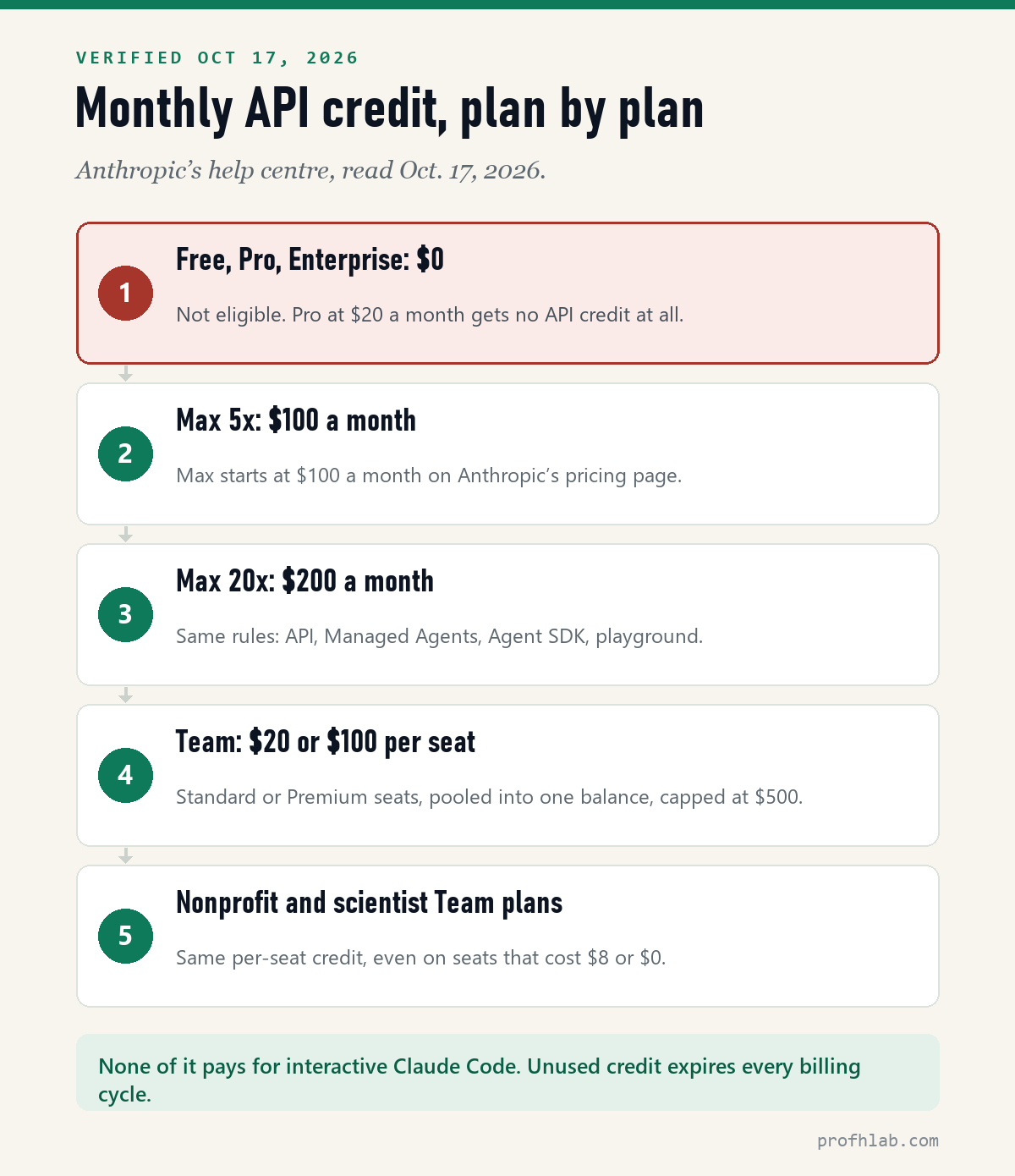
| Plan | Monthly API credit | What to know |
|---|---|---|
| Free, Pro, Enterprise | $0 | “Free, Pro, and Enterprise plans aren’t eligible.” |
| Max 5x | $100 | Max starts at $100 a month on Anthropic’s pricing page |
| Max 20x | $200 | Upgrading from 5x gives a prorated credit right away |
| Team | $20 per Standard seat, $100 per Premium seat | Pooled into one balance, capped at $500 |
| Nonprofit and scientist Team plans | Same per-seat amounts | Same $500 cap |
Anthropic’s own worked example: a team with three Standard seats and two Premium seats gets $260 a month. Add one more Premium seat and the next cycle pays $360. The pool is counted from the seats on the plan when the credit lands, not from the seats you had last month.
One gap in what we could read: the static version of claude.com/pricing shows “From $100” for Max and lists the API credit row as $100 and $200, but it did not show us the Max 20x subscription price. We are not printing a number we did not read.
Where can the credit be spent, and where does it stop?
This is the part most coverage skims. The credit lives in a Claude Console organization, not in your chat account. It covers four things, per the help article:
- The Claude API (the Messages API and Message Batches API).
- The Playground in the Claude Console.
- Claude Managed Agents.
- The Claude Agent SDK.
And it does not cover three things, in Anthropic’s words: “Interactive Claude Code in the terminal, IDE, desktop, or web,” “Extra usage in Claude, Claude Code, or Claude Cowork,” and Claude on Amazon Bedrock, Google Cloud Vertex AI or Microsoft Foundry.
So if you hit your Max limit in Claude Code on a Thursday, this credit does not top you up. Anthropic says it plainly: the credits “don’t change your usage limits in Claude, Claude Code, or Claude Cowork.” It is a second, separate wallet.

How do you claim it without linking the wrong organization?
The claim takes a few minutes, but one step cannot be undone by you. Here is the order Anthropic gives, with the trap marked.
- Wait seven days. New subscribers can claim “once they’ve been on an eligible plan for seven days.” The offer also rolled out over a few days after October 7, so it may simply not be showing yet.
- Use a web browser. Plans bought in the iOS or Android app are eligible, but you claim on claude.ai in a browser.
- Check your role. On Max you must be the subscriber; on Team, a Primary Owner or Owner. In the Console organization you need Owner, Admin or Billing.
- Open billing. Settings > Billing on Max, or Organization settings > Billing on Team. Find “API credits” and choose “Link organization.”
- Pick the organization you will actually build in. This is the trap. “You can link only one Console organization,” and “you can’t change the linked organization yourself.” Changing it later means a support ticket.
- Read the Supplemental Credit Terms, then link. No card is needed on the Console side to claim or use the credit.
Anthropic’s tip is worth following: sign in to the Console with the same email you use on claude.ai. If the linking flow throws an error, the help article says to try again in a few hours.
What does $100 of API credit actually buy?
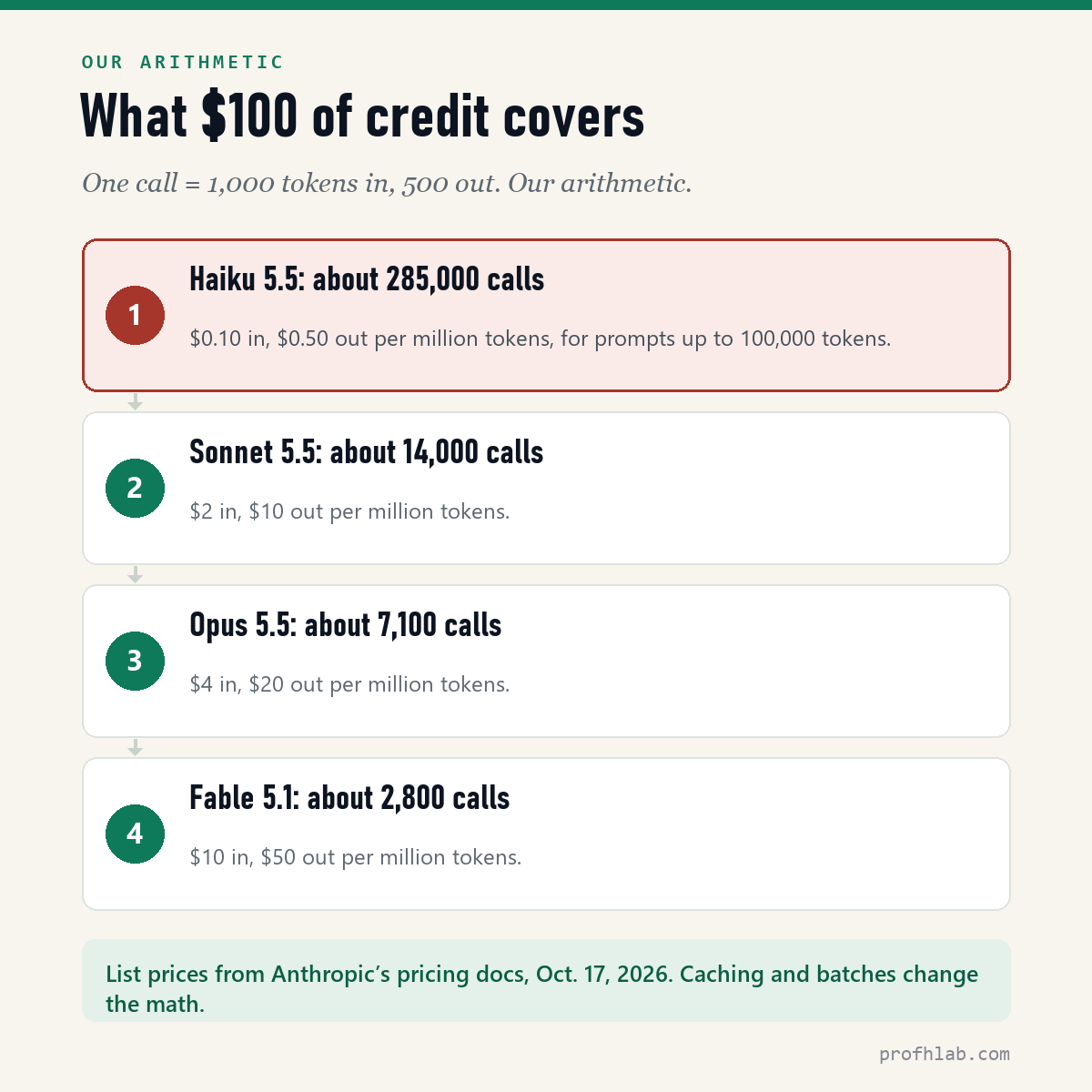
It depends on the model. We took one ordinary request — a 1,000-token prompt and a 500-token reply, roughly a page in and half a page out — and priced it at the list rates on Anthropic’s pricing docs, as of October 17, 2026. The counts are our arithmetic, not Anthropic’s.
| Model | Price per million tokens (in / out) | Cost of one call | Calls per $100 |
|---|---|---|---|
| Haiku 5.5 | $0.10 / $0.50 (prompts up to 100,000 tokens) | $0.00035 | about 285,000 |
| Sonnet 5.5 | $2 / $10 | $0.007 | about 14,000 |
| Opus 5.5 | $4 / $20 | $0.014 | about 7,100 |
| Fable 5.1 | $10 / $50 | $0.035 | about 2,800 |
The spread is the story: the same $100 is about 100 times more calls on Haiku than on Fable. Prompt caching and the Batches API lower these costs further; long prompts over 100,000 tokens raise Haiku’s rate fivefold. And Anthropic’s docs note that newer models use a tokenizer that produces about 30% more tokens for the same text, so a “page” costs a little more than it used to.
Why a free lab seat now comes with $20 of API credit
Here is where the numbers flip. The credit applies to Anthropic’s discounted Team plans too, at the same per-seat amounts. On the Claude Team plan for scientists, Standard seats cost $0 for the first 12 months. Each one still carries $20 of monthly API credit.
Run it to the edge. A lab with 25 Standard seats — the plan’s maximum — pays $0 for seats and would receive the full $500 monthly pool. That is our arithmetic from Anthropic’s figures, and it comes with the plan’s own conditions: it is offered to “a limited number of groups,” seats renew at the then-current price after 12 months, and a group idle for 90 days may be moved back to standard pricing.
Nonprofits see a smaller version of the same flip. A Claude for Nonprofits Team seat is $8 a month and carries a $20 credit. That does not mean the seat pays you: the credit only buys API calls, it expires each cycle, and Team needs at least two seats. But a small nonprofit already building on the API should claim it. Our side-by-side of the two nonprofit programmes is in ChatGPT nonprofit discount vs Claude for Nonprofits, and the lab offers are in free AI for researchers.
Should a Pro subscriber upgrade to Max for the credit?
Usually not. Pro is $20 a month billed monthly, or $17 a month billed annually, on Anthropic’s pricing page. Max starts at $100. The step up costs $80 a month more than monthly Pro, and Pro gets no API credit at all.
The $100 credit only offsets that gap if you would otherwise buy about that much API usage every month. If you have never opened the Claude Console, the credit is worth nothing to you, because unused credit “expire[s] at the end of each billing cycle.” Upgrade for the higher chat and Claude Code limits if you need them; treat the credit as a bonus, not the reason.
Three more rules decide how much the credit is worth to you:
- No rollover. A quiet month is $100 gone.
- Used first. Monthly credit is spent before any credit you bought, so purchased credit lasts longer.
- When it runs out, API calls stop unless you have bought credit or turned on auto-reload. Anthropic says usage is “never charged to your Claude plan.” That makes it a safe sandbox for a first project: there is no surprise bill unless you add one.
If you cancel or downgrade, new credits stop, but credit you already have stays usable until it expires. For a fuller comparison of paying per token against paying a flat subscription, see API vs subscription cost.
Anthropic’s own launch video for the model at the top of the price list
The most expensive model the credit can reach is Fable 5.1, the one that turns $100 into about 2,800 calls in our example. Anthropic’s launch video shows what it is for.
If you are deciding between models before you spend the credit, Anthropic’s explainer on how Claude “thinks” at different levels is the clearest short guide to why the bigger models cost more per token.
What else moved in AI perks this week
We re-read every offer on our AI perks and deals page on October 17, 2026. Four other changes are worth a minute:
- ChatGPT for Academic Researchers is now a lottery. OpenAI’s program page carries an update dated August 10, 2026: new applicants join a waitlist, and an initial 10,000-seat cohort is picked “through a lottery among eligible applicants,” with applications to “reopen later this fall.” Our hub row had missed it; it is corrected.
- Free Google AI Pro trials skip YouTube Premium Lite. Google One Help says the benefit “is unavailable until trials of Google AI Pro conclude and you convert to a paid subscription.” That covers the student, Pixel, Samsung and Googlebook trials.
- Two Oct. 31 deadlines. Pixel 10 Pro owners must redeem their 12 months of Google AI Pro by then, and US college students must claim OpenAI’s four free months of ChatGPT Plus by the same date.
- Verizon’s legacy Disney+ add-ons rise on Oct. 21. Verizon’s perk FAQ lists Basic from $11.99 to $12.49 a month and Premium from $18.99 to $21.49.
Pro, Claude Code, expiry and the card: the Claude credit fine print
Does Claude Pro include API credits?
No. Anthropic’s help centre says Free, Pro and Enterprise plans are not eligible. The monthly credit is only on Max 5x ($100), Max 20x ($200) and Team plans, including the discounted nonprofit and scientist Team plans.
Can I use Claude Max API credits for Claude Code?
Not for interactive Claude Code in the terminal, IDE, desktop or web, and not for extra usage after you hit your plan’s limits. The credit covers the Claude API, the Console playground, Claude Managed Agents and the Claude Agent SDK.
Do Claude API credits expire?
Yes. Unused monthly credit expires at the end of each billing cycle, with no rollover. On annual plans the credit still arrives monthly. Credit you buy yourself is separate and is spent after the monthly credit.
Why don’t I see the API credit offer in my account?
Anthropic gives three reasons: the rollout took a few days after October 7, 2026; new subscribers must be on an eligible plan for seven days; and you need the right role (the Max subscriber, or a Team Owner or Primary Owner). Claim it on claude.ai in a web browser, not in the mobile app.
Do I need a credit card on the Claude Console to use the credit?
No. Anthropic says you do not need to add a payment method on the Claude Platform to claim or use the credit. When it runs out, API requests stop until the next month’s credit arrives, unless you buy credit or turn on auto-reload.
For what every major AI subscription costs this month, see our AI price tracker and the real monthly cost of AI. Google’s side of the price list changed last week too: is Gemini still free?
Sources, read October 17, 2026: Claude Help Center, “Monthly API credits for Max and Team plans” and “Claude Team plan for scientists”; Claude release notes, October 7, 2026; Claude Platform docs, “API credits for Max and Team plans” and the model pricing page; claude.com/pricing; OpenAI, “Accelerating scientific discovery with ChatGPT for Academic Researchers” (update of August 10, 2026); Google One Help, “Use Google AI Pro benefits”; Pixel Phone Help, Google One offers for Pixel devices; chatgpt.com/college-students; Verizon, Disney perk FAQ.
Call counts are our own arithmetic at Anthropic’s list prices. Terms change without notice; the dates are there so you know how stale this is. We take no commission from any company named here and there are no affiliate links on this page. Featured image: after Marinus van Reymerswaele, Tax Collectors (1600–1649), National Museum in Warsaw, public domain.
Prof.’s H Newsletter
One short email a month, with the numbers in it
What actually moved in AI hiring, AI prices, and the scams aimed at older Americans. Counted here, dated, and linked to the source. One email a month, and your address goes nowhere else.