Free AI for Researchers in 2026: 4 Programs, 4 Different Gates
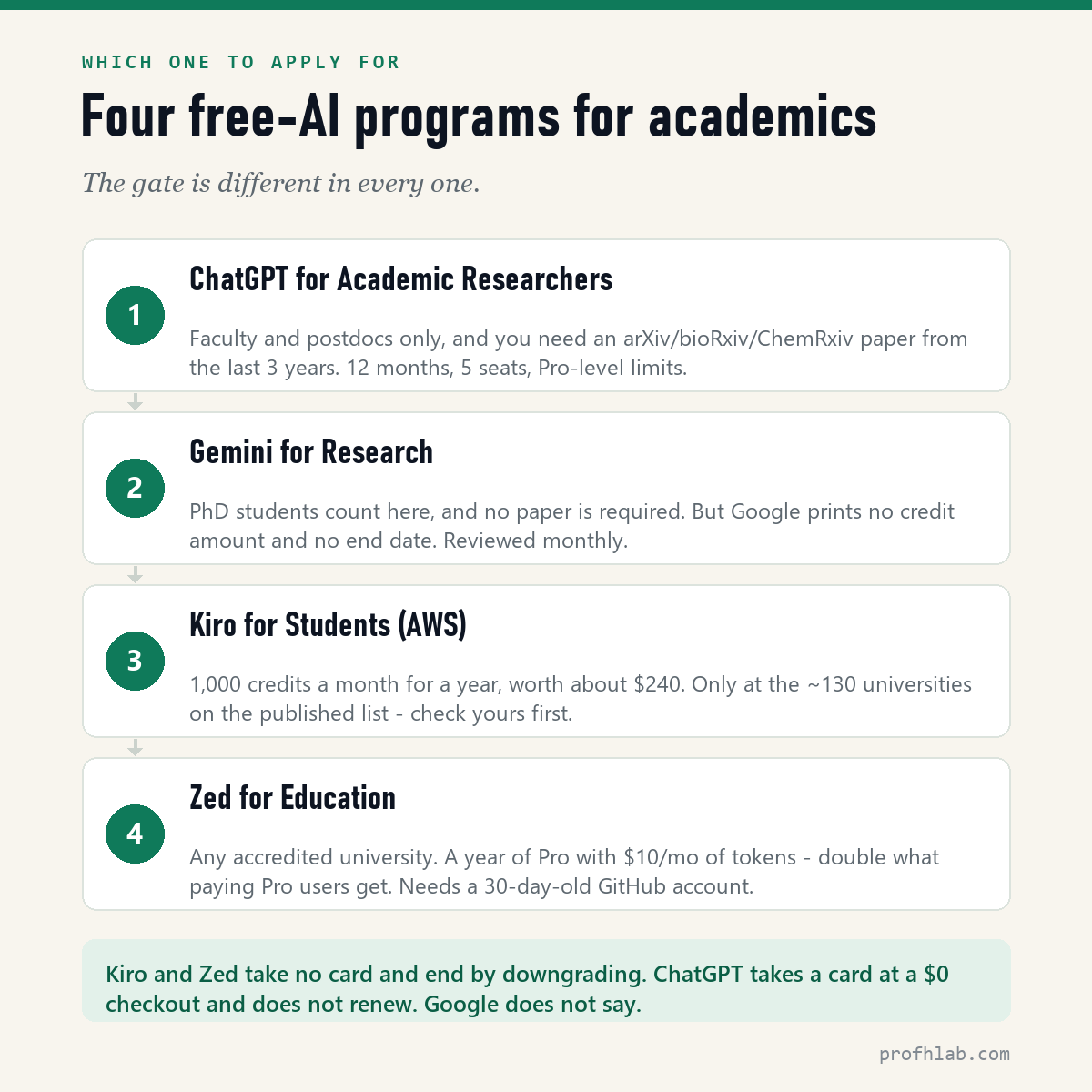
As of September 28, 2026, four programs give academics free access to paid AI tools, from OpenAI, Google, AWS and Zed. Two of them, Kiro and Zed, never ask for a card; OpenAI takes one at a $0 checkout and says the workspace will not renew, and Google’s page does not address payment at all.
The gates are completely different, so the one you qualify for is probably not the one you have heard of. OpenAI wants a paper you authored in the last three years, Google will take PhD students but will not say how much it is giving you, AWS only counts you if your university is on a published list, and Zed takes anyone at an accredited university but wants a GitHub account older than 30 days.
On the terms as published, none of the four rolls into a paid plan when it ends, which makes this a rare corner of the free-AI market where the trap is not the billing.
What we checked on September 28, 2026
We read each provider’s own page and terms, not the roundups, and added all four to our AI perks and deals page the same day.
- None of these four is the student ChatGPT Plus offer or the K–12 teacher offer. Those are separate, and we cover them separately.
- Every figure below comes from the provider. Where a provider does not publish a number — and one of them does not — we say so instead of repeating one we found elsewhere.
- We are not paid by any provider here. There are no affiliate links on this page.
- Written and checked by Prof. H. An AI assistant helped draft this page and run the page reads; every figure was read on the provider’s own page on the date shown.
Correction, October 5, 2026: This page first said three of the four programmes take no card. Only Kiro and Zed say so. Google’s page, as we read it on September 28, 2026, does not address payment, and OpenAI takes a card at a $0 checkout. We corrected the headline, the opening and both images.
The four, and what each one actually hands you
| Program | Who gets in | What you get | Card? |
|---|---|---|---|
| ChatGPT for Academic Researchers OpenAI |
Research faculty and postdocs at listed institutions, with a recent paper | 12 months, 5 seats, ChatGPT Pro-level rate limits, business data protections | Yes, at $0 — does not renew |
| Gemini for Research |
Faculty, staff and PhD students at a valid institution, supported countries | Gemini API credits and higher rate limits — amount not published | Not stated |
| Kiro for Students AWS |
Students 18+ at a university on AWS’s published list | 1,000 credits/month for 12 months, premium models, Kiro Web — about $240 of value | No |
| Zed for Education Zed |
Students 18+ at any accredited university, worldwide | Zed Pro for 12 months with $10/month in tokens and unlimited edit predictions | No |
Read on each provider’s own pages and terms, Sept. 26–28, 2026.
OpenAI wants a paper, not a job title
ChatGPT for Academic Researchers is the largest of the four by what it hands over: a dedicated workspace running at ChatGPT Pro-level rate limits with business-grade data protections, for up to five people — one workspace owner and four verified collaborators — free for twelve months.
The eligibility is where people will bounce, and it is unusual. Being faculty is not enough on its own. OpenAI asks you to be a research faculty member or postdoctoral researcher at an institution on its eligibility list and to point at a paper on arXiv, bioRxiv or ChemRxiv that was posted within the last three years, lists you as an author, and sits in one of seven fields: Biological Sciences, Chemistry and Materials, Computer Science, Earth and Planetary Sciences, Engineering, Mathematics or Physics.
Two consequences follow that nobody warns you about. A researcher in the humanities or the social sciences is out, whatever their seniority. And a productive lab whose recent output went to journals without a preprint has nothing to submit — the requirement is a preprint server, not a publication record.
The failure mode OpenAI documents, and it is an easy one to hit. The email you verify with through SheerID has to match the email on the ChatGPT account you are signed into. If your institutional address is on one account and you are signed into a personal one, verification fails. Sign out, sign back in with the institutional account — or create one on that address — before starting. OpenAI also says to turn off any VPN, because SheerID may not resolve your affiliation through it.
Plan for the calendar, not just the form. OpenAI says review typically takes one to two weeks, and meeting the criteria lets you apply without guaranteeing approval. Checkout asks for a card but the total is $0, and this is the part worth reading twice: OpenAI states the workspace will not renew automatically. At the end of twelve months it is deactivated after a grace period, and OpenAI says it will share continuation options before that. There is no renewal date to defuse.
Three limits shape how you use it. Collaborators must be at the same institution, so a cross-institution collaboration cannot share one workspace. A verified email can belong to only one researcher workspace at a time. And the offer covers ChatGPT access only — it does not include API credits, which is exactly the gap the Google programme fills.
Google takes PhD students, but will not name a number
Gemini for Research is the one to apply for if your work runs through API calls rather than a chat window. It offers Gemini API credits plus higher rate limits for a research project, and its door is wider in the way that matters most to a lab: it is open to faculty, staff and PhD students affiliated with a valid academic institution or research organisation in supported countries. No paper required.
That breadth is the reason to know it exists. A doctoral student is categorically excluded from OpenAI’s researcher programme and categorically included in Google’s.
The trade is transparency. Google publishes no credit amount, no rate-limit figure and no duration, and states plainly that API access and credits are “granted and removed at Google’s discretion.” Applications are reviewed monthly. There is no deadline to race, and equally nothing to hold Google to. We list it because it is real and first-party; we are not going to print a credit figure Google has not printed, and you should be sceptical of any page that does.

AWS gives more, to fewer people, and the list is the catch
Kiro is AWS’s agentic coding tool, and its student programme hands over 1,000 credits a month for twelve months, with full access to paid features including premium models and Kiro Web. That is precisely the allowance Kiro Pro sells for $20 a month, so the year is worth roughly $240 at list price.
Then the catch, and it is the one every roundup omits: this is not open to all .edu addresses. AWS publishes a named roster of participating universities, and your Kiro account has to use an email from a school on it. When we read the page on September 28, 2026 it listed roughly 130 institutions, about 50 of them in the US. AWS’s own weekly roundup of September 14, 2026 describes the expansion as going “from 11 universities to 121 new schools across 16 countries.”
So the first move is not to sign up. It is to open the eligible-schools list and look for your institution. If it is missing there is a form on the same page to nominate it, and AWS says it may get in touch if the offer is extended there. Check before you spend an afternoon on it.
Two limits in the terms bite in ordinary use. Unused credits do not roll over month to month, and you may not buy add-on credits during the free year. A heavy month is simply a short month — there is no way to pay your way out of it until the year ends. On the upside there is no credit card required, and when the twelve months finish you drop to Kiro’s 50-credit free tier rather than being billed. The agreement, worth knowing, is with Amazon Web Services rather than with Kiro.
Zed gives students double what it gives paying customers
Zed is a collaborative code editor, and its student plan is the only offer in this group — or on our whole deals page — where the free tier is more generous on the thing that costs money than the paid one.
Read these two lines together. Zed’s pricing page lists Pro at $10/month including $5 of tokens, with usage-based billing after that. Zed’s education page lists the student plan as $10/month in AI token credits. The student is getting twice the token budget of the customer paying $10 a month, plus the same unlimited edit predictions. Both figures were read on Sept. 28, 2026, on zed.dev.
Eligibility is the loosest of the four: currently enrolled at any accredited university worldwide, and at least 18. Verification is the quirk. Zed wants a GitHub account older than 30 days alongside a current university email, and it checks the domain against JetBrains’ open-source list of university domains. If your institution is not in that list you can add it yourself, which also clears the path for the next person from your department.
The exclusions are the expensive models — Claude Fable, Claude Opus and the GPT Pro tier are not included, though you can point Zed at your own API key or an external agent when the credits run out. Two small mercies in the terms: no card is taken, so after twelve months the plan downgrades to the free tier instead of billing you; and if you graduate mid-year, the plan still runs a full year from your application date.
Which one should you apply for first?
These do not compete with each other. Nothing in any of the four terms prevents you holding all the ones you qualify for, and they cover different things — a chat workspace, API credits, and two code editors. The useful question is the order, because one of them costs you one to two weeks of waiting.
- Faculty or postdoc with a preprint from the last three years? Start the OpenAI application today, because of the review window, and because five Pro-level seats is the largest single thing on offer here. Then do the others while you wait.
- PhD student? OpenAI’s researcher programme will turn you away. Gemini for Research is the one that counts you, and the separate four free months of ChatGPT Plus for students is open to graduate students until Oct. 31, 2026.
- Writing code either way? Check the Kiro school list first, since that is a yes-or-no you can settle in ten seconds. Zed takes you regardless, so it is the fallback that always works.
- Running API calls? Gemini for Research is the only one of the four that gives you API credits at all. The OpenAI workspace explicitly does not.
OpenAI published its own short video about the researcher programme, below. The eligibility rules above come from OpenAI’s help article, not from the video.
The one calendar entry you still need
On most of the free AI offers we track, the single most valuable thing a reader can do is set a reminder two days before the renewal date, because a card is on file and the offer rolls into full price. That is not the risk here. Kiro and Zed take no card and end by downgrading; OpenAI takes a card at a $0 total and states the workspace does not renew; Google’s programme is applied for rather than subscribed to.
The risk runs the other way: these expire quietly and you lose the tool mid-project. So the reminder to set is not a cancellation reminder but a migration one — about four weeks out, while there is still time to export what matters, decide whether to pay, or move the work. For the OpenAI workspace in particular, a five-person team losing a shared workspace at the end of a grace period is a disruption worth seeing coming.
One genuine billing trap does sit next door to these, and it catches academics who also hold a consumer plan. If you are a student who claimed the twelve free months of Google AI Pro, that one does take a card and does renew at $19.99 a month, and eligibility has to be re-verified yearly. We keep the renewal dates for all of them on the deals page.
What Google, OpenAI and AWS leave off their pages
- How much Gemini for Research actually grants. Google names no credit amount, no rate-limit number and no duration. We asked the page for it and it is not there.
- Which institutions are on OpenAI’s eligibility list. OpenAI tells applicants to check the current list before applying, but the list is not something we can reproduce or date here; check it against your own institution at the point of applying.
- The exact size of the Kiro roster. We counted roughly 130 entries on the page on Sept. 28, 2026, and the list carries a “see more” control, so treat our count as a close approximation rather than an audited figure. AWS’s own 11-plus-121 description is the number to quote.
- Whether Gemini for Research requires a payment method. The page does not address it either way.
Preprints, PhD students, collaborators and ChatGPT Edu
Can a PhD student get ChatGPT for Academic Researchers?
No. OpenAI limits it to research faculty members and postdoctoral researchers. PhD students should look at Gemini for Research, which explicitly includes them, and at the separate student ChatGPT Plus offer, which is open to graduate students until Oct. 31, 2026.
Do I need a published paper, or is a preprint enough?
A preprint is what is actually being asked for. OpenAI wants a paper on arXiv, bioRxiv or ChemRxiv posted within the last three years that lists you as an author and sits in one of seven eligible fields. A journal publication with no preprint on one of those three servers does not satisfy it as written.
Will any of these charge my card when the free period ends?
Not on the terms as published. Kiro and Zed take no card and downgrade to their free tiers. OpenAI takes a card for verification at a $0 checkout total and states the researcher workspace does not renew automatically. Google’s programme is an application rather than a subscription. This is unusual — most consumer AI offers we track do roll into full price.
My university is not on the Kiro list. Can I still apply?
Not right now. Your Kiro account has to use an email from a participating university, and AWS may ask for proof of enrolment there. The page carries a form to submit your school and your student email so AWS can contact you if the offer is extended. In the meantime Zed takes students at any accredited university.
Can I hold more than one of these at once?
Nothing in the four sets of terms prevents it, and they cover different products. The restrictions that do exist are internal to each programme: one ChatGPT researcher workspace per verified email, one Kiro benefit per person, and Kiro collaborators and OpenAI collaborators both have to sit at the same institution as the owner.
Can my collaborators at another university join my ChatGPT workspace?
No. OpenAI limits a researcher workspace to verified collaborators at the same institution, and every invitee has to clear SheerID separately. A cross-institution project needs a workspace on each side.
Is ChatGPT for Academic Researchers the same as ChatGPT Edu?
No, but they interact. If your account already belongs to an active ChatGPT Edu or Enterprise workspace, OpenAI says you still apply, and if approved your researcher workspace is set up inside your institution’s existing Edu organisation through an institution-managed process rather than the self-service one.
We re-check these offers weekly and keep the expired ones
We re-verify every offer on this beat weekly and keep the expired ones on the page, marked expired, because most guides do not. The running list is the AI perks and deals page, with the date we last read each provider’s terms. List prices for the paid versions of all of these sit on the AI price tracker, which also logs what changed and when.
If you are in the academic job market as well as the tooling market, the faculty search tracker counts open AI and robotics faculty positions by board, and labs recruiting lists groups taking PhD students and postdocs. If you know of a US programme we have missed, tell us on the Ask page and we will verify it and add it with a date.
Sources, read Sept. 26–28, 2026: OpenAI Help Center, “ChatGPT for Academic Researchers” and “ChatGPT Back to School offer for students”; Google AI for Developers, “Accelerate discovery with Gemini for Research”; kiro.dev/students, the Kiro for Students Terms & Conditions (last updated Sept. 8, 2026) and kiro.dev/pricing, with the AWS Weekly Roundup of Sept. 14, 2026 for the university expansion; zed.dev/education, zed.dev/pricing and Zed’s “Introducing Zed for Education” post. Terms change without notice; the dates are there so you know how stale this is. We take no commission from any provider named here and there are no affiliate links on this page.
Prof.’s H Newsletter
One short email a month, with the numbers in it
What actually moved in AI hiring, AI prices, and the scams aimed at older Americans. Counted here, dated, and linked to the source. One email a month, and your address goes nowhere else.