Is It Illegal to Charge Different Prices for the Same Product? The FTC Just Named Seven Cases
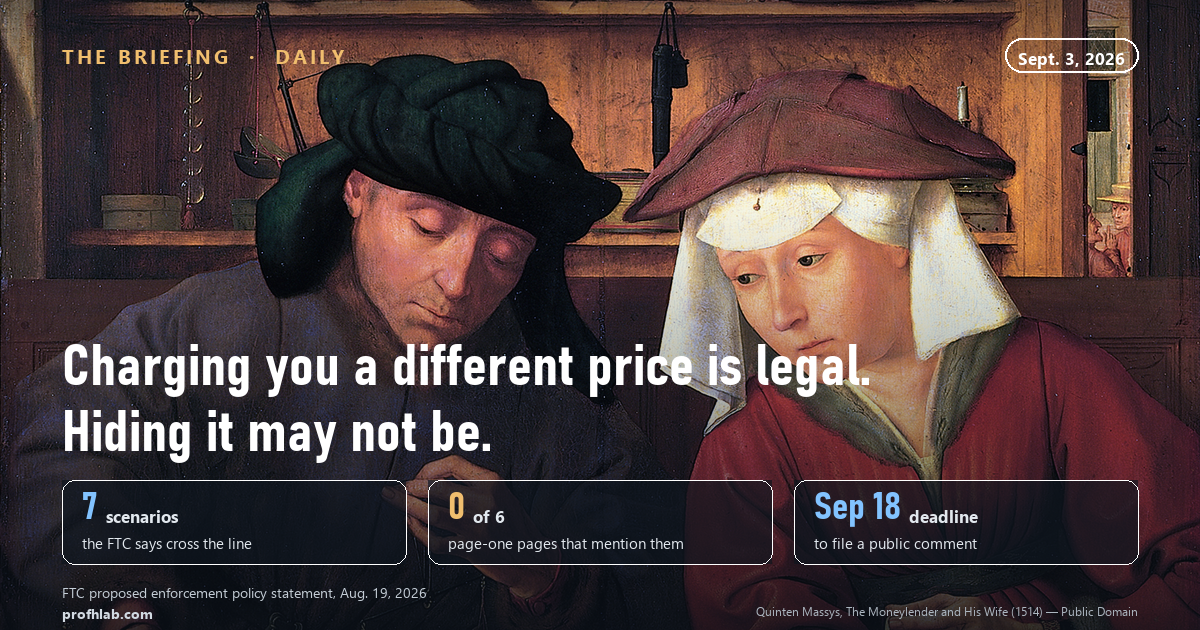
Short answer: no, and yes. Charging you a different retail price than the shopper beside you is generally not illegal — the 1936 law everyone reaches for, the Robinson-Patman Act, governs a seller’s dealings with competing businesses that resell its goods, not you at a checkout. What may be illegal is not telling you. On August 19, 2026 the Federal Trade Commission proposed an enforcement policy statement listing seven personalized-pricing scenarios it considers likely violations of Section 5 of the FTC Act, and it is taking public comment until September 18, 2026.
Somebody types this into a search box roughly the way you would ask a friend: is it illegal to charge different prices for the same product? Usually there is a story behind it. A neighbor paid $12 less for the same detergent. A hotel room cost more on the phone than on the laptop. A flight got more expensive after the third look.
And the first page of Google answers the question — the 1936 version of it. We read every reachable result on September 3, 2026. Not one mentioned the rule the FTC proposed six weeks ago.
The law everyone cites is about stores, not shoppers
The Robinson-Patman Act is real, it is enforced, and it is almost certainly not about you.
The FTC’s own guidance describes it as a ban on “discriminatory prices, services, and allowances in dealings between merchants.” The injury it recognizes is competitive: a supplier gives one retailer a better deal than a competing retailer, and the disfavored retailer is harmed. The agency also notes two limits that quietly rule out most consumer complaints — the Act “applies to commodities, but not to services, and to purchases, but not to leases.”
What this means at the register. If a grocery wholesaler charges a big chain less per case than the corner store, that is the statute’s home ground. If a website charges you $4 more than it charges your neighbor, Robinson-Patman is not the law that helps you. That is not a loophole — it is what the statute was written to do.
Other laws still apply. A price that varies by race, color, religion, national origin, or sex can run into civil rights and public accommodation statutes. Prices that are fixed by agreement among competitors are an antitrust problem regardless of the technology. And a price that is advertised at one number and charged at another is ordinary deception.
What did not exist, until recently, was a clear federal statement about a price built from your own data. That is what changed this summer.
What actually changed on August 19, 2026
The Commission published a proposed enforcement policy statement on personalized pricing. It is eight pages. We read all of it.
The framing is deliberately narrow, and the FTC says so in the first section: “Congress has not given the Commission the authority to prohibit personalized pricing in all circumstances.” Chairman Andrew Ferguson put the consumer-facing version in the press release: “When consumers see a listed price, they expect it to be same price that everyone else sees, not the retailer’s estimate of how much they are willing to pay based on their personal data.”
So the theory is not you cannot do this. The theory is you cannot do this quietly. Where shoppers reasonably expect a price not to vary by person, the statement says, a business “should clearly and conspicuously disclose not just that the price is personalized, but also the basis for that personalization and the types of data on which the personalization is based.” Failing to do that “is likely to constitute an unfair or deceptive act or practice in violation of Section 5.”
The document is careful about what it does not cover. Prices that move with supply and demand are fine, including local surges. Insurance premiums and credit offers necessarily turn on individual characteristics, and the statement says so explicitly. Rideshare pricing that reflects supply and demand in a neighborhood is named as a legitimate variation.
The seven scenarios the FTC put in writing
The most useful part of the statement is a bulleted list near the end. These are the agency’s own illustrations, not ours. We counted seven.
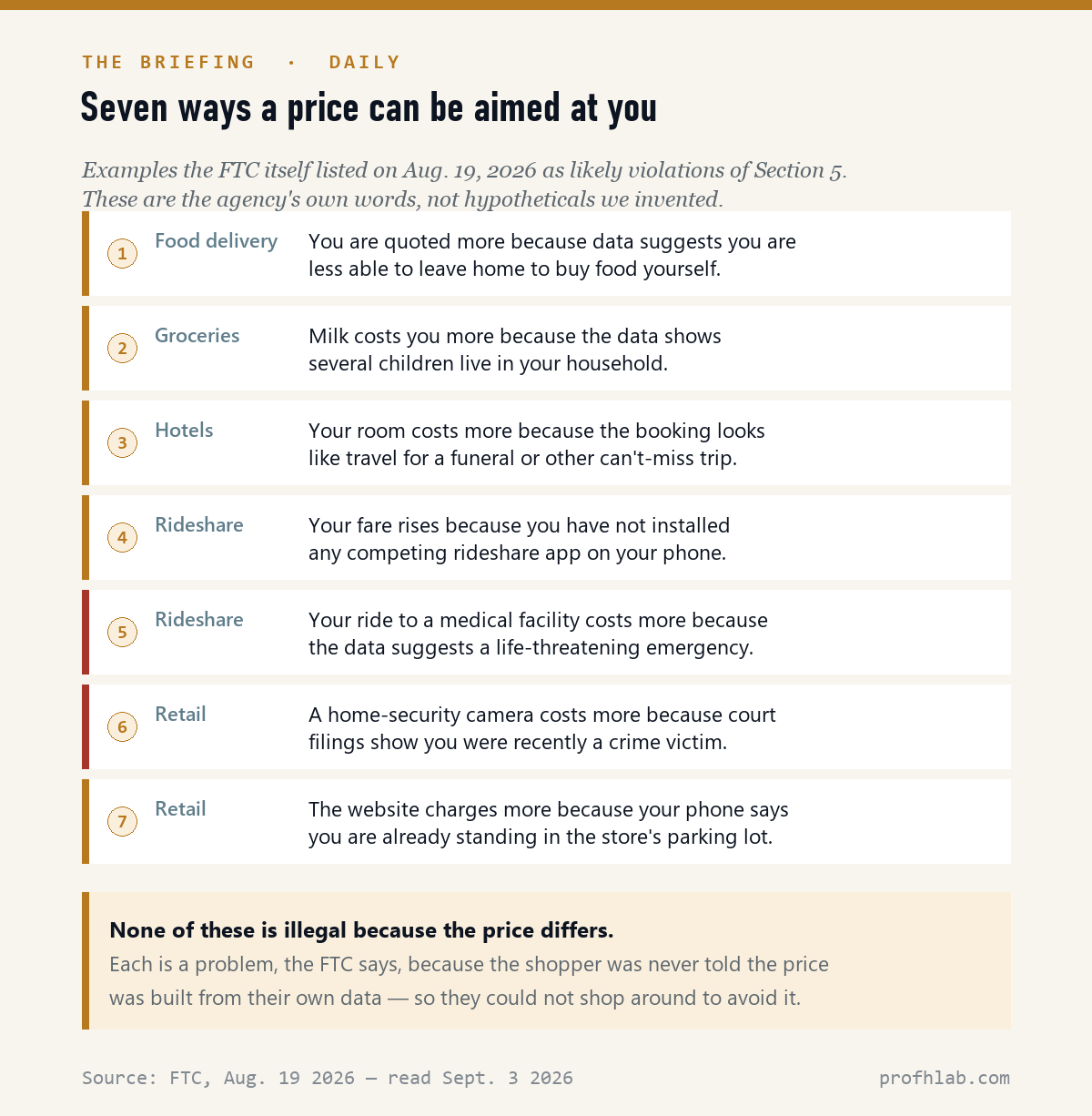
Read as a group, they have a pattern. Every one of them prices your constraint. Not your appetite — your inability to walk away.
The food delivery example charges more to someone the data says cannot easily leave home. The hotel example charges more when the trip looks like a funeral. The rideshare example charges more for a trip to a medical facility when the data suggests an emergency. The home-security camera costs more because court filings show the shopper was recently the victim of a crime.
The uncomfortable version. A pricing model that is good at its job will find the moment you are least able to shop around. Grief, an emergency, a house you are afraid to sleep in. The FTC did not pick those examples to be lurid; it picked them because willingness to pay and desperation are the same signal to a model that cannot tell the difference.
One more, easy to miss, is the seventh: a retailer’s website charging more because your phone shows you are already standing in its parking lot. Nothing about you changed. Only your options did.
We scored page one. Four of six questions got zero answers.
Here is our own measurement, run on September 3, 2026.
We took the exact search — is it illegal to charge different prices for the same product — pulled the page-one results, and fetched each one. Seven were listed; one (a pricing consultancy) returned a dead link, leaving six pages that actually loaded. We scored each against six things a shopper asking that question in 2026 would want to know.
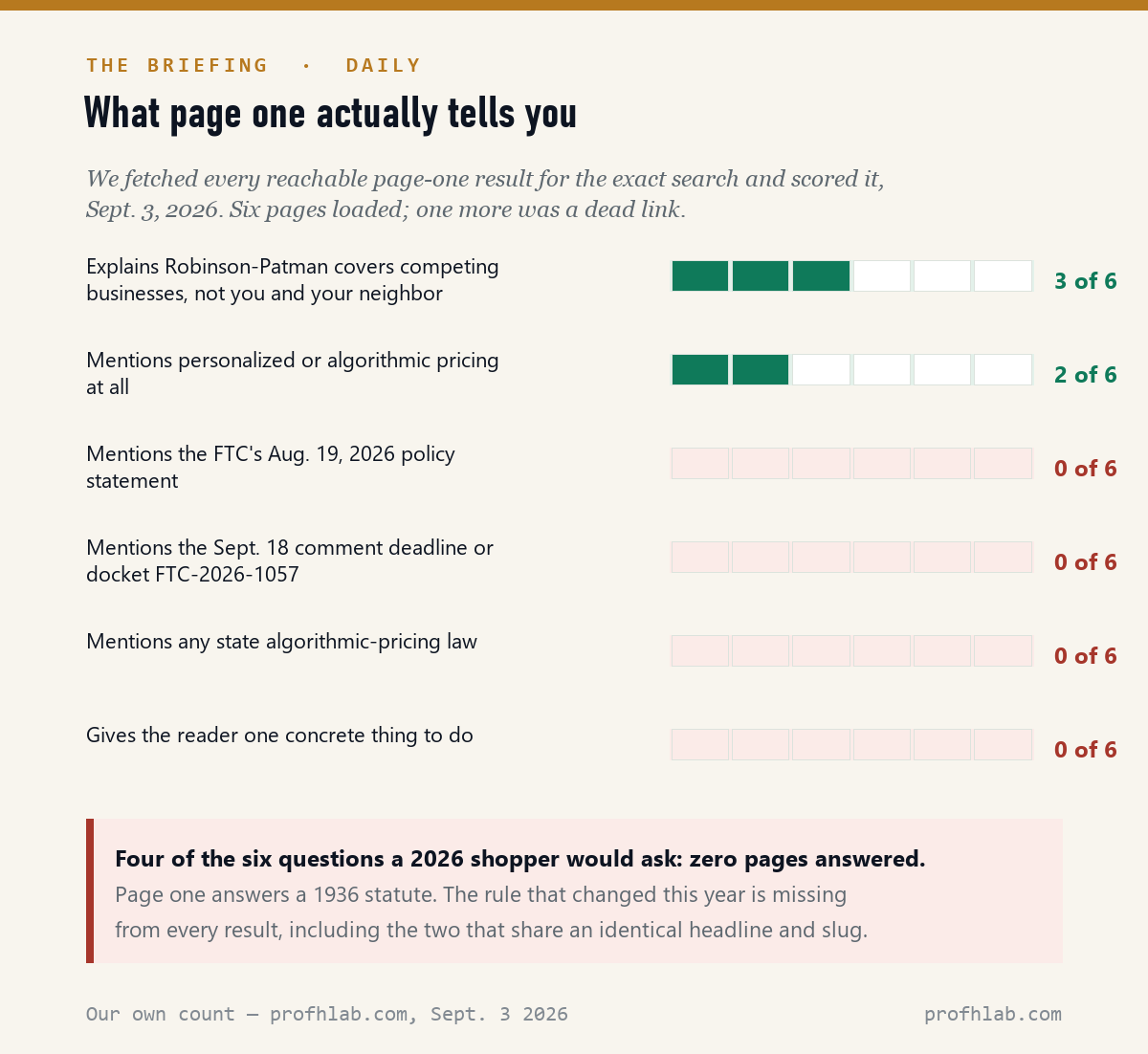
Three of six correctly explained that Robinson-Patman is about competing businesses. Two mentioned algorithmic or personalized pricing at all. Zero mentioned the FTC’s August 2026 policy statement. Zero mentioned the September 18 comment deadline or the docket number. Zero mentioned any state algorithmic-pricing law. Zero gave the reader a single concrete thing to do.
A detail worth recording: two of the six results carry an identical headline and an identical URL slug on two different domains. We compared them sentence by sentence and found zero identical sentences longer than sixty characters. Same outline, same title, same slug, different words. Make of that what you will; we only note it because both occupy space on the page where the current rule should be.
The posted price is a 1916 invention
It is worth remembering that a single price for everyone is not ancient. It is a business decision, roughly a century old, and it can be un-made.
Before self-service groceries, a clerk stood between you and the goods and quoted a number. Piggly Wiggly opened in Memphis in 1916 with a turnstile, a fixed route through the aisles, and a price tag on every item. The tag was the innovation. It meant the number did not depend on the clerk’s read of you.

The tag is now a screen. Electronic shelf labels let a retailer change a price centrally, without anyone walking the aisle. That is not sinister by itself — it is also how a store fixes a mispriced item in ninety seconds instead of a morning.
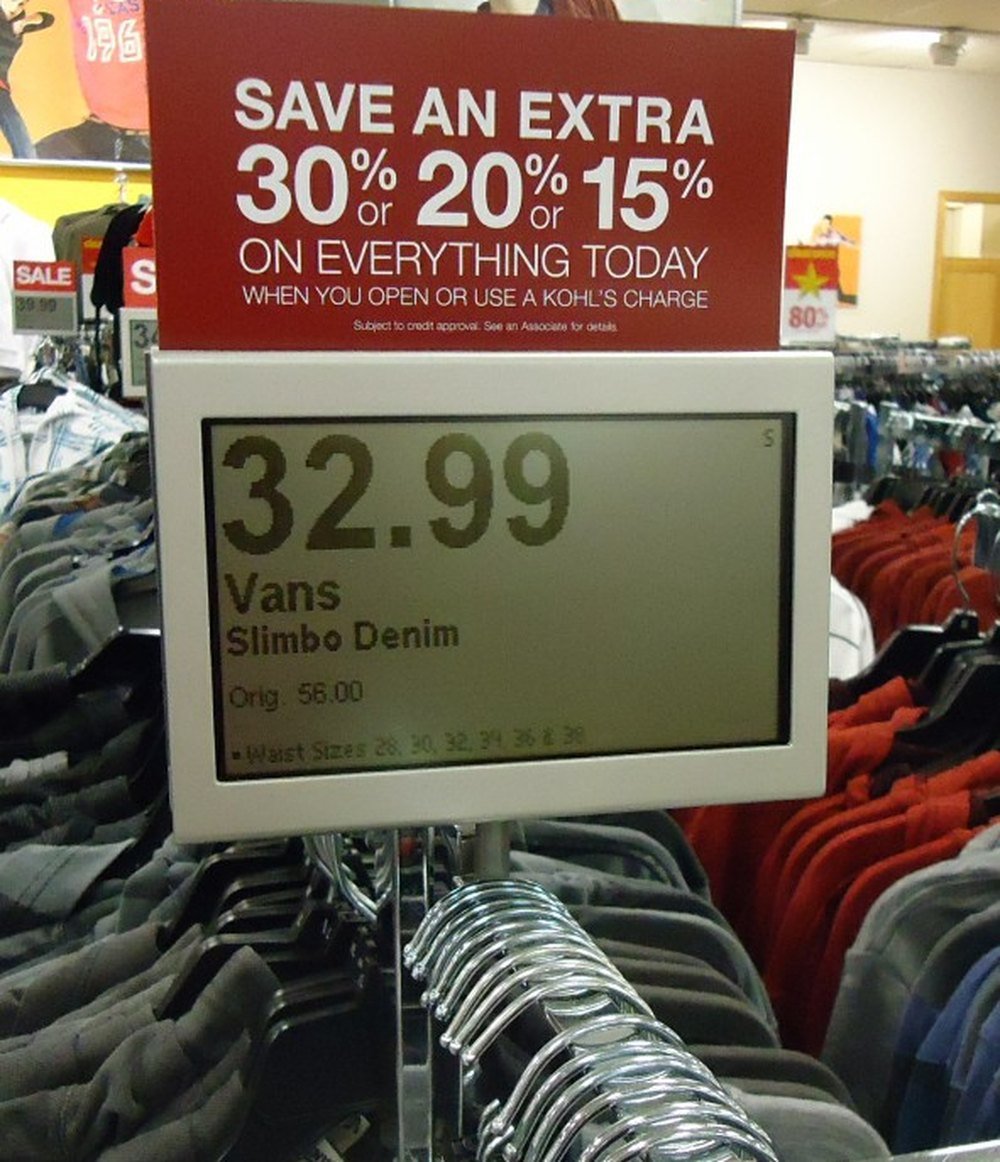
That photograph is a useful control case. Tiered discounts, senior discounts, student pricing, loyalty prices and coupons all charge different people different amounts, and none of them is the problem the FTC is describing. They are posted. You can see the rule, and you can decide whether to meet it.
New York already forces them to say the sentence
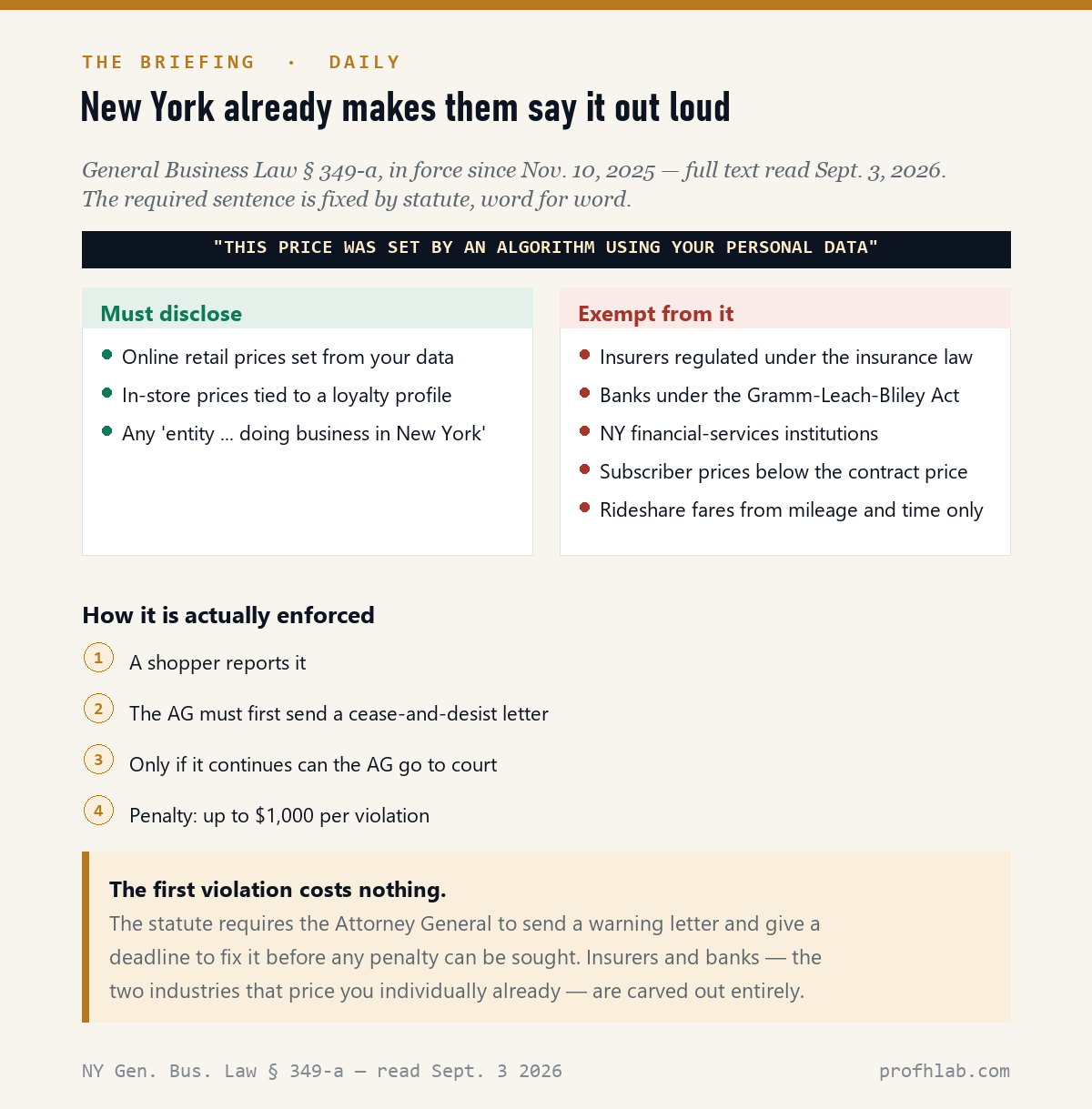
While the federal rule is still a proposal, one state has had a disclosure requirement in force since November 10, 2025. We read the full statutory text of New York General Business Law § 349-a on September 3, 2026.
It does not ask for a vague notice. It specifies the sentence, in capital letters: “THIS PRICE WAS SET BY AN ALGORITHM USING YOUR PERSONAL DATA.”
Two things in that statute rarely survive the summaries.
The first is that the first violation costs nothing. The law directs the Attorney General, on reason to believe there is a violation, to “dispatch a cease and desist letter” specifying the violation and a timeline to cure it. Only if the entity keeps going may the AG seek an injunction. The $1,000-per-violation penalty sits at the end of that sequence, not the start.
The second is who is carved out. The exemptions cover insurers, financial institutions under the Gramm-Leach-Bliley Act, New York financial-services institutions, and subscription prices offered below a contract price. Location data used by a rideshare or for-hire vehicle purely to compute fare from mileage and trip time is excluded from “personal data” altogether.
In other words, the two industries that have priced individuals individually for a century — insurance and credit — are outside the law. That is not an oversight. Those industries already carry their own disclosure duties, and the FTC’s statement cites them approvingly as the model: the Fair Credit Reporting Act requires an adverse action notice telling you the specific basis when a consumer report leads to a worse offer.
The commissioner who voted no, and now runs the agency
There is a genuine arc here, and it is more interesting than a reversal.
In July 2024, the FTC issued 6(b) orders to eight intermediary firms to study surveillance pricing. On January 17, 2025 it released interim staff findings based on documents from six of them — Mastercard, Accenture, PROS, Bloomreach, Revionics and McKinsey & Co. Staff reported that mouse movements on a page and items abandoned in a cart could feed individualized pricing, and that those intermediaries worked with at least 250 clients, from grocery chains to apparel retailers.
The vote to release was 3-2. Commissioner Andrew Ferguson, joined by Commissioner Melissa Holyoak, dissented from the release of those research summaries — though he had concurred in issuing the study orders in the first place.
Nineteen months later, Ferguson is Chairman, and the personalized-pricing policy statement went out under his name on a 2-0 vote. Its footnotes cite his own earlier separate statements. Whatever one thinks of the 2025 dispute, it was about how interim findings were published, not about whether the practice deserved scrutiny — and the agency’s position now is on the record in a form retailers’ lawyers have to read.
But is Delta doing it?
This is the version of the question most people are actually searching, so it deserves a straight answer with a source.
In July 2025, Senators Ruben Gallego, Richard Blumenthal and Mark Warner wrote to Delta about its work with the AI pricing firm Fetcherr. Delta’s response, published on its own newsroom over the signature of EVP Peter Carter, is unambiguous: “There is no fare product Delta has ever used, is testing or plans to use that targets customers with individualized prices based on personal data.” On the vendor specifically: “We do not share any personal information with Fetcherr and as noted above, our ticket pricing never takes into account personal data.”
Delta describes the tool as a decision-support system for its revenue analysts working from aggregated data, and notes that fares are filed publicly through ATPCO multiple times a day.
The line in Delta’s letter that is actually useful to you: “customers are not required to sign in on delta.com or the app to shop and compare prices.” Whether or not a given airline personalizes anything, shopping signed out is a free test you can run on any site. If the number moves when you log in, you have learned something.
Airline pricing has varied by seat, day and fare class for decades, and that is the supply-and-demand variation the FTC explicitly does not treat as a problem. The distinction that matters is not does the price change. It is does the price change because of what the seller knows about you.
Two short explainers: the ordinary kind, and the personal kind
These two videos cover the two halves of the distinction above.
File an FTC comment before September 18, then shop signed out
1. File a comment before September 18, 2026. The FTC is asking, in public, on the record. The docket is FTC-2026-1057 at regulations.gov. Comments do not need to be legal briefs; agencies read plain accounts of what happened to real people, and a short description of a price you could not explain is exactly the kind of thing a rulemaking record is for.
2. Shop signed out, then signed in. The FTC’s own statement names the avoidance measures an informed shopper might take: “using a virtual private network or private browsing functionality, choosing a different retailer whose prices are static or widely offered, rather than personalized, or simply declining to complete the transaction.” A private window costs nothing and takes ten seconds.
3. Check the same item on a second device. Phone versus laptop, on your own home network, is the simplest comparison there is. Screenshot both with the time visible.
4. If you are in New York, look for the sentence. The disclosure is fixed by statute and has to be near the price. If a price is personalized and you cannot find it, the complaint route is the Attorney General’s office, which is required to send a cease-and-desist letter before any penalty.
5. Report deception to the FTC. ReportFraud.ftc.gov takes consumer reports directly, and consumer reports are named in the New York statute as one of the triggers for AG action.
6. Do not assume a higher price means you were profiled. Sales end, inventory moves, and regional prices differ for dull reasons. The signal worth acting on is a price that changes with who you are logged in as, not with the day.
Not legal advice. This is a general explanation of published federal and state materials, not advice about your situation. Consumer protection law varies by state, and whether any particular price is lawful depends on facts we cannot see. For a specific dispute, your state Attorney General’s consumer division is the free place to start.
Why a posted member price usually is not personalized pricing
Is a loyalty-card price personalized pricing? Usually not in the sense the FTC means. A posted member price available to anyone who joins is a disclosed rule. It edges closer to the line when the discount itself is computed per person from your data and never stated.
Does this cover insurance and credit? No. Both are excluded from the New York statute, and the FTC statement treats them as the long-established example of individually priced markets that already carry disclosure duties, such as the FCRA adverse action notice.
What happens after September 18? The Commission reviews comments and decides whether to finalize the statement. A policy statement is not a rule; it tells the market how the agency intends to deploy enforcement, and the document says plainly that it “does not confer any rights on any person and does not operate to bind the FTC or the public.”
Delta, New York’s disclosure law and cash-versus-card prices
Is it illegal to charge different prices for the same product?
Between retail customers, generally no. The Robinson-Patman Act addresses a seller’s dealings with competing businesses that buy its goods, and the FTC notes it applies to commodities rather than services and to purchases rather than leases. What may be illegal, under the FTC’s August 19, 2026 proposed policy statement, is personalizing a price from your data without clearly disclosing that fact, the basis, and the data types used.
Is it illegal to charge different prices to different customers?
Not by itself. Senior discounts, student rates, loyalty prices, coupons and regional pricing are all lawful differences. The problems arise when the difference is based on a protected characteristic, when it results from an agreement among competitors, or when a personalized price is presented as though it were the standard price for everyone.
Is it illegal to charge different prices for the same service?
Robinson-Patman does not reach services at all — the FTC’s guidance says the Act “applies to commodities, but not to services.” Services can still be covered by Section 5 of the FTC Act, by state consumer protection law, and by civil rights statutes covering public accommodations.
Is Delta using AI to set prices?
Delta says it uses AI as a decision-support tool for analysts working from aggregated data, and denies personalization. In its published letter to three US senators it states: “There is no fare product Delta has ever used, is testing or plans to use that targets customers with individualized prices based on personal data,” and that it shares no personal information with its vendor Fetcherr.
What is the New York Algorithmic Pricing Disclosure Act?
It is New York General Business Law § 349-a, in force since November 10, 2025. An entity that sets a price using personalized algorithmic pricing and advertises that price to a New York consumer must include the disclosure “THIS PRICE WAS SET BY AN ALGORITHM USING YOUR PERSONAL DATA.” Insurers, GLBA financial institutions, New York financial-services institutions and certain subscription prices are exempt, and penalties run up to $1,000 per violation after a required cease-and-desist letter.
Surveillance pricing: who uses it?
The FTC’s January 2025 interim findings did not name retailers. They described the intermediaries that build the tools — the staff analysis drew on documents from Mastercard, Accenture, PROS, Bloomreach, Revionics and McKinsey & Co. — and reported that those intermediaries worked with at least 250 clients selling everything from groceries to apparel. Client names were not disclosed because 6(b) material is released only in aggregated or anonymized form.
Is it legal to charge different prices for cash and card?
In most of the United States yes, and it is regulated separately from anything discussed here. A cash discount or a disclosed card surcharge is governed by state law and card network rules, and the amount and the disclosure are what matter. It is not personalized pricing, because the rule applies to everyone who pays that way.
Does personalized pricing happen in grocery stores?
The FTC’s proposed statement uses a grocery example directly: a chain charging a delivery customer more for milk based on data showing several children in the household. Whether and how widely that occurs in practice is not established — the statement itself says “the extent to which businesses currently use personalized pricing is not well understood.” Electronic shelf labels make a price easy to change centrally, but changing a price for everyone is not the same as changing it for you.
Sources
- Federal Trade Commission, Proposed Enforcement Policy Statement Regarding Personalized Pricing, August 19, 2026 (8 pp.).
- Federal Trade Commission, FTC Seeks Comment on Enforcement Policy Statement Regarding Personalized Pricing — comment deadline September 18, 2026; docket FTC-2026-1057; Commission vote 2-0.
- Federal Trade Commission, FTC Surveillance Pricing Study Indicates Wide Range of Personal Data Used to Set Individualized Consumer Prices, January 17, 2025.
- Federal Trade Commission, Price Discrimination: Robinson-Patman Violations.
- New York State Senate, General Business Law § 349-a (Pricing), full statutory text.
- Delta Air Lines, Delta responds to misinformation around AI pricing — letter from EVP Peter Carter to Senators Gallego, Blumenthal and Warner.
- Federal Trade Commission, ReportFraud.ftc.gov.
Other places AI reaches your wallet, and how to dispute a charge
- Is My Electric Bill Going Up Because of AI? — the other place AI reaches your wallet without appearing on the bill.
- AI Scams Targeting Seniors in 2026 and this month’s AI Scam Watch.
- How Do I Talk to a Real Person? — when you need to dispute a charge with a human.
- Are Deleted ChatGPT Chats Really Deleted? and How Does ChatGPT Know My Age? — how much a system infers from small signals.
- How to Stop AI From Reading Your Gmail, How to Stop Meta AI From Using My Photos, and How Do I Get Rid of AI on My Phone?
- What AI Really Costs You per Month, Is ChatGPT Plus Still Worth It?, API vs Subscription, and How to Cancel ChatGPT Plus and Get a Refund.
- Robot Vacuum Subscription vs Buying and Tesla FSD Subscription Math — two more places the sticker is not the price.
- Does Original Medicare Require Prior Authorization? and Your 2027 Social Security Raise — algorithms and arithmetic on the benefits side.
- How to Tell if a Facebook Ad Is Fake, How to Tell If a Phone Call Is AI, and How to Turn Off Call Screening on iPhone.
- How to Turn Off Alexa+ Ads on Echo Show and Smart Speakers in 2026 — the device is cheap because you are the product.
- How to Use ChatGPT: A Guide for Beginners Over 50.
- More in The Briefing.
About the author. Prof. H is a robotics and AI professor who writes profhlab.com. Every figure in this piece was read from a primary document on September 3, 2026 — the FTC’s eight-page statement, the New York statute, and Delta’s published letter — or is our own count of one, and the page-one scorecard is our own measurement. Corrections are welcome.
Prof.’s H Newsletter
One short email a month, with the numbers in it
What actually moved in AI hiring, AI prices, and the scams aimed at older Americans. Counted here, dated, and linked to the source. One email a month, and your address goes nowhere else.