ASML Korea’s Starting Pay Is $31K — or $46K: Anatomy of a 2.15x Salary-Data Gap
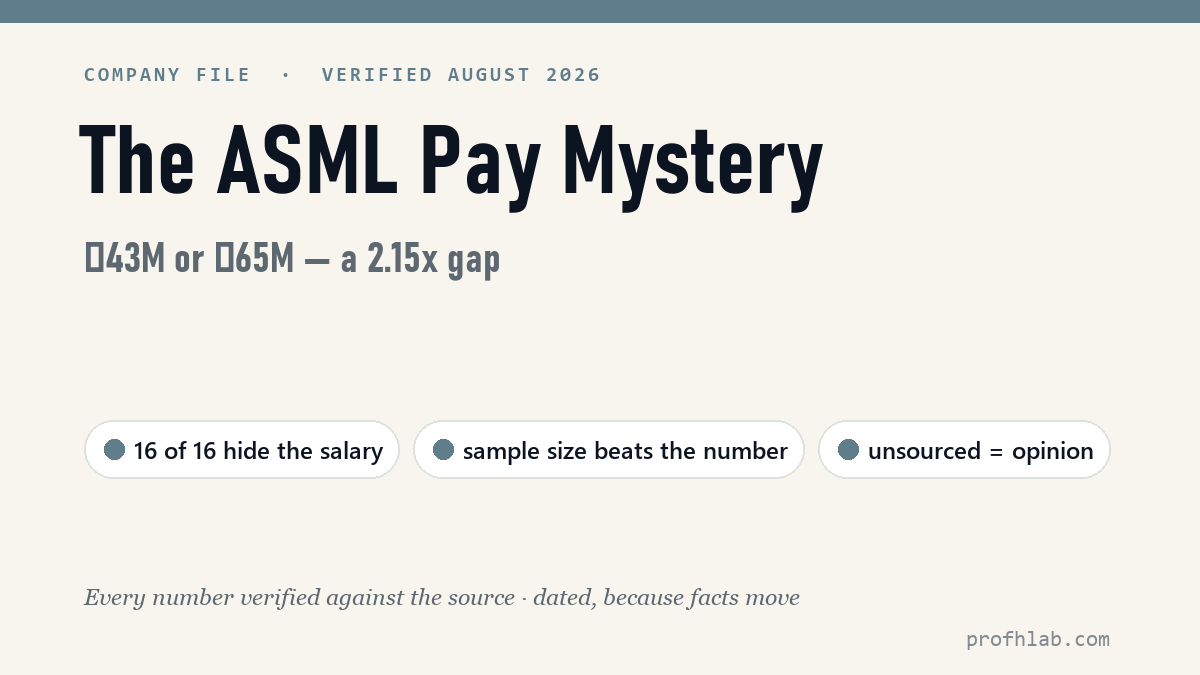
A question keeps resurfacing on Korean career forums: what does ASML Korea pay a new hire? The replies always split in two. One camp says ₩43,000,000 (≈$31,000). The other says ₩65,000,000 (≈$46,000). Both camps attach screenshots. Both screenshots are real.
On the morning of August 8, 2026, I opened the sources behind both numbers. The ₩43M sits on JobKorea’s salary page for ASML Korea — with fine print reading “as of 2022.” The ₩65M sits in a blog post that tops the search results for foreign-company salary rankings — with no source, no survey date, no sample size, no method. One number is stale; the other is unaccountable. Between them: ₩22M (≈$16,000) a year.
This is an anatomy of that gap — what it reveals about how the foreign chip-equipment giants’ Korean units handle pay, and how to read salary data anywhere. Figures verified August 8, 2026; dollar figures are approximate, at about ₩1,400 per dollar.
The short version: ① Published averages for the single company ASML Korea span ₩62.88M to ₩135M (≈$45,000–$96,000) — a 2.15x spread — and the highest figure cites nothing. The same pattern holds at Applied Materials Korea (2.41x) and Lam Research Korea (2.50x). ② The root cause: in a survey of 16 live openings at foreign equipment makers’ Korean units, the salary field read “decided after interview” in 16 of 16.
The companies publish nothing, so crowd data fills the vacuum — and the crowd disagrees. ③ What the openings do disclose: 5 of 16 (31%) accept candidates without a four-year degree. ④ The fine print: 3 of 12 direct-hire roles were fixed-term contracts, and 3 listings never named the employer at all.
One company, a 2.15x spread
Start with what actually happened when I opened four sources on the same company, the same morning:
| Source | ASML Korea average pay | New-hire starting pay | Sample and basis disclosed? |
|---|---|---|---|
| JobKorea salary page | ₩69.12M (≈$49,000) | ₩43M | “As of 2022” noted; sample size not shown |
| Catch (catch.co.kr) | ₩62.88M (≈$45,000) | Not shown | Labeled as 2025 company data |
| Top-ranked blog (“Top 30 foreign salaries”) | ₩135M (≈$96,000) | ₩65M | No source, date, or sample |
| Live job listings (2, same day) | — | — | Salary: “decided after interview” |
Low to high, that is ₩72.12M (≈$52,000) of daylight — a factor of 2.15 — all describing one employer. And ASML is not special:
| Company | JobPlanet (sample disclosed) | JobKorea | Top-ranked blog | Max spread |
|---|---|---|---|---|
| Applied Materials Korea | ₩50.69M (≈$36,000; 559 reports) | ₩70.08M (≈$50,000) | ₩122M (≈$87,000) | 2.41x |
| Lam Research Korea | ₩48.06M (≈$34,000; 230 reports) | ₩60.36M (≈$43,000) | ₩120M (≈$86,000) | 2.50x |
Notice the pattern: the sources that disclose their sample sizes report the lowest numbers. JobPlanet shows its receipts — 559 salary reports for Applied Materials Korea, 230 for Lam Research Korea — and lands lowest. The six-figure blog shows nothing and lands highest.
Read the sample size and the base year before the number. Crowd-sourced salary averages are made of whoever bothered to enter data: heavy on long-tenured staff, they inflate; heavy on new hires and contractors, they deflate. The composition is the number. When a disclosed-sample source and an unsourced source disagree, suspicion belongs on the unsourced high one.
Why the field is blank: 16 openings, 16 “decided after interview”
Open the actual hiring notices and the mystery dissolves. Across a 16-listing survey — ASML Korea, Lam Research Manufacturing Korea, Applied Materials Korea, Axcelis Korea, Versum Materials units (Merck), SUSS MicroTec Korea, EV Group Korea, plus several unnamed-employer listings — every single salary field read “decided after interview.” Zero exceptions.
This is the exact opposite of Korea’s domestic equipment makers. In our companion piece on the domestic sector, mid-tier firms printed pay to the won in the notice itself — ₩35M/₩38M bases, level allowances, travel stipends, housing support. Domestic mid-tiers publish; foreign giants don’t.
The reason is structural. The foreign units tie pay to global grade/band systems: the same role spans a wide range depending on experience and negotiation, so no single number can honestly go in a notice. But the consequence rolls downhill to the reader. The company’s silence gets filled by whoever is willing to name a number — and the loudest number on the internet is an unsourced one that currently outranks the accountable ones in search.
The degree myth: 31% of openings don’t require a bachelor’s
The stereotype says the foreign equipment makers demand a four-year engineering degree plus English test scores. Tallying the 16 openings’ actual education requirements:
| Education requirement | Count | Share | Examples |
|---|---|---|---|
| No requirement | 1 | 6% | Install/relocation engineer, first-timers welcome (agency listing) |
| High school + | 2 | 13% | Axcelis Korea plant logistics; Versum (Merck) field service |
| 2–3-year college + | 2 | 13% | ASML Korea repair associate; SUSS MicroTec field service |
| 4-year degree + | 11 | 69% | Lam Research, Applied Materials, Axcelis engineering roles |
A four-year degree dominates — but 5 of 16, or 31%, sit below it. And counted by experience requirement, exactly half the openings (8 of 16) were open to people with none.
English works as a job condition, not an entry test. Not one listing demanded a test score. But the job titles themselves are English — Configuration Engineer, Global Software Support Engineer, UIR Engineer — and so are the manuals and the escalation calls to headquarters. The real bar is reading technical documents and explaining a situation to HQ: a different skill from a test score, and a harder one to fake.
Do the foreign firms actually out-pay Samsung and SK? At entry, no evidence
Here is the most misunderstood point, with starting pay laid side by side:
| Tier | Company | New-hire starting pay | Source and basis |
|---|---|---|---|
| Domestic chipmaker | Samsung Electronics · SK Hynix | ~₩54M (≈$39,000) | Linkareer 2026 compilation (company disclosures) |
| Domestic equipment | SEMES | ~₩50.87M (≈$36,000) | Jasoseol company data, 2026 |
| Domestic equipment | Hanmi Semiconductor | ~₩41.61M (≈$30,000) | Catch · Jasoseol, 2026 |
| Foreign equipment | ASML Korea | ₩43M | JobKorea (2022 basis) |
| Foreign equipment | ASML Korea | ₩65M | Top-ranked blog (unsourced) |
Believe JobKorea, and ASML Korea’s starting pay trails Samsung and SK by ₩11M (≈$7,900). Believe the blog, and it leads by the same amount. The direction itself flips with the source.
How much rides on that flip? Hold raises at zero, pre-tax, bonuses excluded:
| Item | If ₩43M | If ₩65M | Gap |
|---|---|---|---|
| Annual, pre-tax | ₩43M | ₩65M | ₩22M (≈$16,000) |
| Monthly (÷12) | ≈₩3.58M (≈$2,600) | ≈₩5.42M (≈$3,900) | ≈₩1.83M (≈$1,300) |
| 3-year total | ₩129M (≈$92,000) | ₩195M (≈$139,000) | ₩66M (≈$47,000) |
| 5-year total | ₩215M (≈$154,000) | ₩325M (≈$232,000) | ₩110M (≈$79,000) |
Five years compounds the uncertainty to ₩110M (≈$79,000) — too much money to stake on one unsourced blog post. Which is, at this writing, the top search result.
The defensible read: the foreign equipment makers’ case was never first-year cash. It is the slope and the doors — a global band system to climb, mobility across overseas sites, and a well-worn path into chipmaker facility roles later. Judged on the first year’s paycheck alone, there is no evidence they beat Samsung or SK.
The fine print: contracts and unnamed employers
Two structural details from the survey that no average captures.
First, 3 of the 12 direct-hire listings — 25% — were fixed-term contracts, including a one-year repair-associate role at ASML Korea and two Axcelis Korea listings. A contract role is not inherently bad; an unexamined one is.
Second, 3 listings named no employer at all — just “a foreign semiconductor-equipment company,” posted by search firms, with a fourth from a staffing company. That is normal practice for experienced roles, but it means the listing itself tells you nothing about the entity you would sign with.
Three facts determine what such an offer is actually worth: ① the legal name of the entity on the employment contract ② permanent or fixed-term — and if fixed, the conversion terms ③ whether pay follows the named firm’s band or a subcontractor’s rate card. Two people in the same cleanroom servicing the same machine can differ on all three. Same room, different economies.
The job behind the listings: what field service actually is
The roles that dominate the survey are Field Service Engineer and Customer Support Engineer — the people who keep the machines alive inside customers’ fabs. Practitioner accounts converge on four realities. Call-outs ignore clocks: when a tool goes down, a production line stops, and fabs run 24/7 — nights, weekends, holidays included. The workplace is a cleanroom: full protective suit, fixed walking routes, hours at a stretch — a shock for anyone picturing a desk. The career lattice has walls: moves into tool R&D are consistently described as rare, and application-engineering tracks typically expect advanced degrees. And the well-trodden exit is sideways: master the machines, then move to the customer — chipmaker facility organizations hire exactly this experience. That last path is the most-cited trajectory in practitioner communities, though it depends on hiring cycles and no public statistics verify the rate.
Three rules for reading salary data — any salary data
1. The sample size and base year outrank the number. A figure labeled “559 reports, 2025” beats a bigger figure labeled nothing.
2. When sourced and unsourced figures disagree, the unsourced high one is the suspect. Flattering numbers travel further on the internet; accountable ones travel slower.
3. One average hides the base-versus-variable split. Foreign units often run lower base pay with larger variable components, plus shift and on-call allowances that may or may not sit inside the quoted figure. An annual average cannot predict a monthly paycheck without the composition behind it.
Band systems, a data vacuum and the unsourced 135M won average
Q. Why don’t the foreign equipment makers publish salaries in Korea?
Their pay rides global grade/band systems that are wide by design — one honest number cannot represent a band. The result is a data vacuum, and the vacuum, not any single bad actor, is what lets unsourced rankings dominate search.
Q. Is the ₩135M ASML Korea average real?
It is a real number on a real page — with no source, date, or sample attached. Treat it as opinion until someone shows the receipts. The disclosed-sample sources cluster at roughly half that level.
Q. Do people really move from these firms to Samsung or SK Hynix?
It is the most-cited path in practitioner communities: field engineers live inside the customers’ fabs, and the experience maps directly onto chipmaker facility roles. It is not automatic — it depends on the customer’s hiring cycles — and the reverse move, into tool development or research, is consistently described as hard.
The closing rule
What this survey really documented is a vacuum. The number people most want is the one the companies won’t print. The void gets filled by whoever will print one, sourced or not — and search ranks the confident above the accountable. The distance between ₩43M and ₩65M is ₩110M over five years. So before trusting a salary figure — in this industry or any other — check whether a sample size and a base year sit underneath it. If they don’t, it isn’t information. It’s an opinion.
Sources: JobKorea, Catch, and JobPlanet company salary pages (sample counts as shown); a 16-listing survey of live foreign-equipment-sector openings; Linkareer and Jasoseol company-data pages; the companies’ official careers sites. All accessed August 8, 2026. Pay figures are third-party estimates unless a company disclosure is cited; listings and terms change constantly.
Part of the Physical AI library — research decoded and machines compared, in plain English: profhlab.com/physical-ai.
A 55-minute film on ASML’s EUV lithography machine
Full index
Every guide in the Physical AI library — 27 of them, grouped so you can find the one you need.
Start here
- Physical AI Foundations: World Models, Robot Foundation Models, and Sim2Real — From Zero
- Physical AI Explained: Why a Chatbot Knows the Cup Falls but a Robot Doesn’t
- The Physical AI Toolbox: Six Free Simulators, a $249 Hardware Ladder, and What the 2026 Papers Admit
Research papers, decoded
- RoboVLMs, Explained: What Actually Makes a Robot Foundation Model Work
- Ψ0 (Psi-Zero), Explained: The Humanoid Foundation Model That Learns From Human Video
- MotionWAM, Explained: One-Shot Imagination Brings Real-Time Humanoid Loco-Manipulation
- XHugWBC, Explained: One Policy That Drives 12 Different Humanoids
- Vision-Tactile Pretraining, Explained: A Robot Hand Learns Human-Like Dexterity From a Webcam
- TouchWorld, Explained: A Robot Hand That Predicts Touch Before Making Contact
- HOUND and APT-RL, Explained: One Transformer Brain for Walking, Running, and Jumping in the Wild
Machines, priced
- Tesla Optimus V3 Release Date, Price and Specs: What Tesla Has Confirmed
- Buying a Humanoid Robot in 2026: What a Unitree R1 Really Costs, Retail vs Import
- Robot Dog Prices in 2026: From ≈$2,900 to ≈$71,000 — and Spot Still Has No Price Tag
- Tesla FSD Goes Subscription-Only in Korea — and the ‘5-Year Break-Even’ Everyone Quotes Is Wrong
Home robots, tested
- Narwal Freo Z10 Ultra Review: 18,000Pa, a 75°C Mop Wash, and Three Honest Drawbacks
- 22,000Pa vs 240 Air Watts: Robot Vacuum Suction Numbers, Decoded (2026)
- Robot Vacuum or Stick Vacuum? I Split Housework Into 10 Tasks — Only One Truly Overlaps
- The Sour Smell Isn’t the Mop: Robot Vacuum Odor by Zone, and a 7–9x Consumables Gap
- Drain Height Decides Your Robot Vacuum: Samsung 0.4 m, Roborock 50 cm, LG 1.5 m
- Robot Vacuum Repair Costs 2026: A $140 Fix and a 56.5% Resolution Rate
- Robot Vacuum Subscription vs Buying: What iRobot Select Really Costs
- Are Window-Cleaning Robots Worth It? The Break-Even vs Hiring a Pro
- Smart Speakers in 2026: The Hardware Is $99 — the Assistant Is the Real Price
- Serving Robot Costs in 2026: $399 a Month, and Why 73.3% Saw No Change
Chips & companies
- HBF and zHBM, Explained: Samsung and SK Hynix Give Opposite Answers to the Same Memory Problem
- Korea’s Chip Equipment Makers, Compared: Profits Fell 68% — So Why Did Pay Jump 29%?
- Samsung DS vs DX: One Company, a $450,000 Bonus Gap — and Why the Simple Story Is Wrong
- ▸ ASML Korea’s Starting Pay Is $31K — or $46K: Anatomy of a 2.15x Salary-Data Gap (you are here)
Looking for the other library? Generative AI — tools, tested →
Prof.’s H Newsletter
One short email a month, with the numbers in it
What actually moved in AI hiring, AI prices, and the scams aimed at older Americans. Counted here, dated, and linked to the source. One email a month, and your address goes nowhere else.