TouchWorld, Explained: A Robot Hand That Predicts Touch Before Making Contact
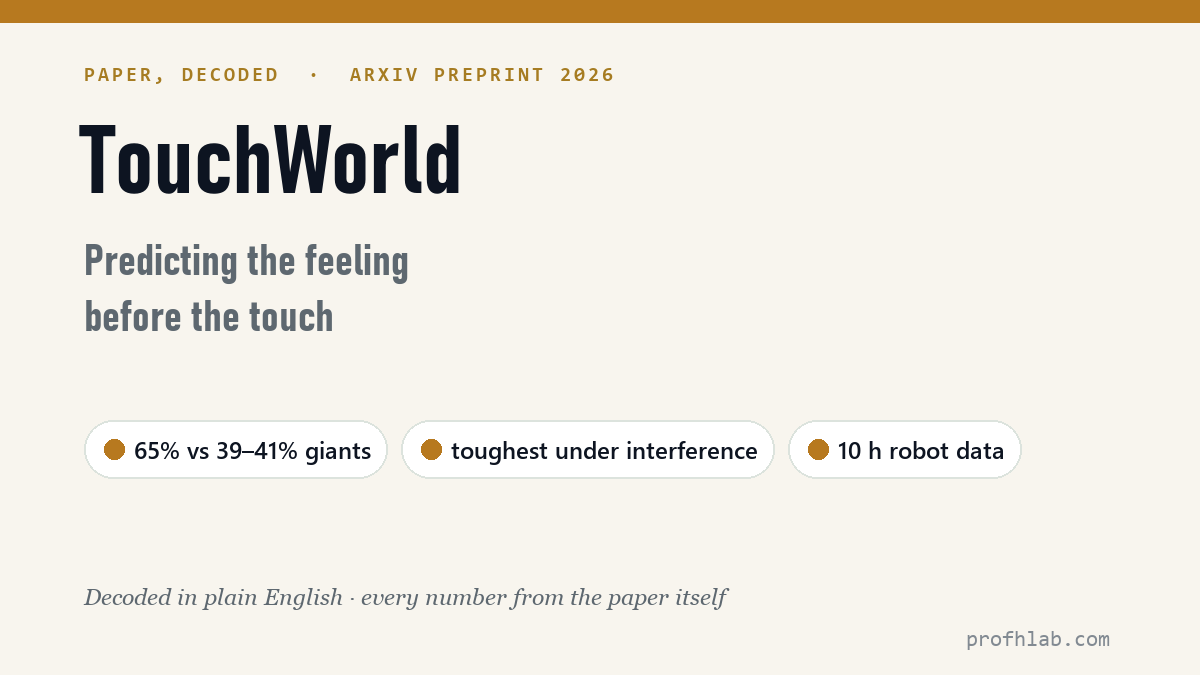
A person knows what a cup will feel like before their fingers close around it. Robots do not — they notice a slip only after contact, and by then it is too late. The paper in this edition plants in robots the ability to sketch the contact in advance — to picture the feeling before touching. If the vision-tactile dexterity paper we decoded in the previous edition was about weaving the senses together well, today’s paper goes one step further: learning to predict the senses.
| Original title | TouchWorld: A Predictive and Reactive Tactile Foundation Model for Dexterous Manipulation |
| Authors | Jianyi Zhou, Feiyang Hong, Yunhao Li, Yicheng Zhao, and 12 others |
| Affiliations | Harbin Institute of Technology, Shenzhen · PHANES AI |
| Released | Submitted July 8, 2026 (v1); revised July 9, 2026 (v2) |
| Paper | arXiv:2607.07287 |
Note: this paper is an arXiv preprint (before peer review). It is not a journal-published version, so its numbers may be adjusted during review.
Source: arxiv.org/abs/2607.07287
The core technique
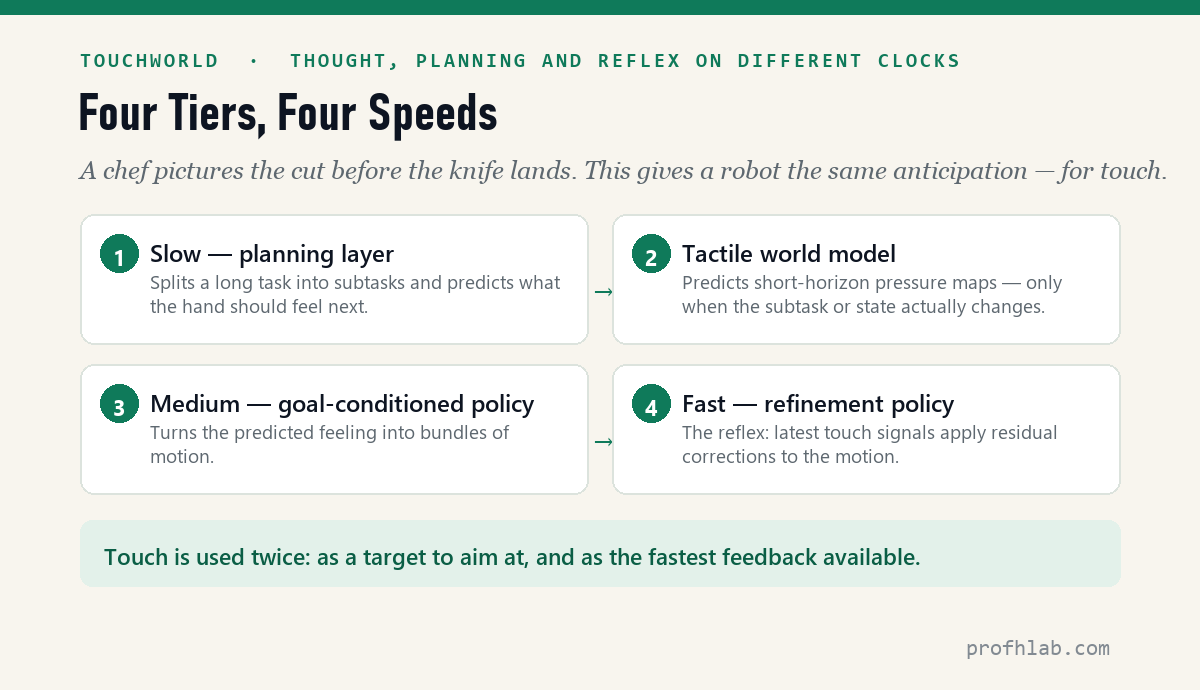
The heart of this paper is the Tactile World Model. Think of a chef who, before the knife even touches the board, already pictures “this much force will cut like this.” TouchWorld has the robot predict, before it reaches out, what pressure the palm is about to feel — rendered like a short video — and then moves with that prediction as its goal (a subgoal).
The architecture divides into four tiers, each running at a different speed — the same idea as human thought, planning, and reflex running on different clocks.
- High-Level Planning Layer — runs at slow, semantic speed; splits a long task into executable subtasks and predicts tactile subgoals.
- Tactile World Model — a fine-tune of the video-generation model Wan2.2-TI2V-5B that predicts short-horizon visual and tactile subgoal observations. To save compute, it generates predictions only when a new subtask starts or the state changes meaningfully, not at every moment.
- Visuo-Tactile Goal-Conditioned Policy — runs at medium speed and produces the basic bundles of motion (action chunks).
- Tactile-Conditioned Refinement Policy — the fastest feedback loop; takes the latest tactile and proprioceptive signals and applies residual corrections to the motion. In human terms, the unconscious reflex.
In other words, touch is used two ways at once — as a predictive reference and as a fast feedback signal. That double duty is what the title’s “Predictive and Reactive” means.
Source: arxiv.org/abs/2607.07287
The theory in plain words
Most robot policies run a single straight line: see → move. The problem is that the world changes violently at the instant of contact. When you insert a plug, being off by 0.5 mm completely changes the outcome — and the camera, blocked by the hand, misses exactly that moment.
TouchWorld’s idea is to extend the world model into touch. A world model is a neural network that imagines “if I take this action now, what will I see next?” Add touch, and it also imagines “what will I feel?” The imagined pressure map becomes the target, and the hand moves so that real pressure comes to match it. The goal stops being a position and becomes a feeling.
The training data is interesting too. Robot demonstrations total a relatively small 10 hours — about 1.08 million frames at 30 FPS. Instead, the model leans on large-scale human interaction data called EgoTouch: first-person and wrist-view video, two-hand pose, and dense bilateral palm pressure maps, all synchronized. The model first learns the pressure patterns of human touch (a two-stage curriculum) and then adapts them to the robot’s body — a strategy that ports human hand experience into the robot’s prior knowledge.
Source: arxiv.org/abs/2607.07287
Real-world results
Evaluation ran on real hardware — a JQ-Industries tactile glove and the Wuji hand — across six long, contact-heavy tasks:
- Watering a plant (Water Flower)
- Clearing a desk (Tabletop Clearing)
- Inserting a cup (Cup Insertion)
- Inserting a power plug (Power Plug Insertion)
- Wiping a pot (Pot Wiping)
- Pulling a tissue (Tissue Pulling)
The results, as average success across the 6 tasks:
| Model | Normal conditions | With human interference |
| TouchWorld | 65.0% | 53.7% |
| FTP-1 | 49.3% | 35.2% |
| Pi-0.5 | 40.7% | 27.7% |
| GR00T N1.7 | 39.3% | 26.0% |
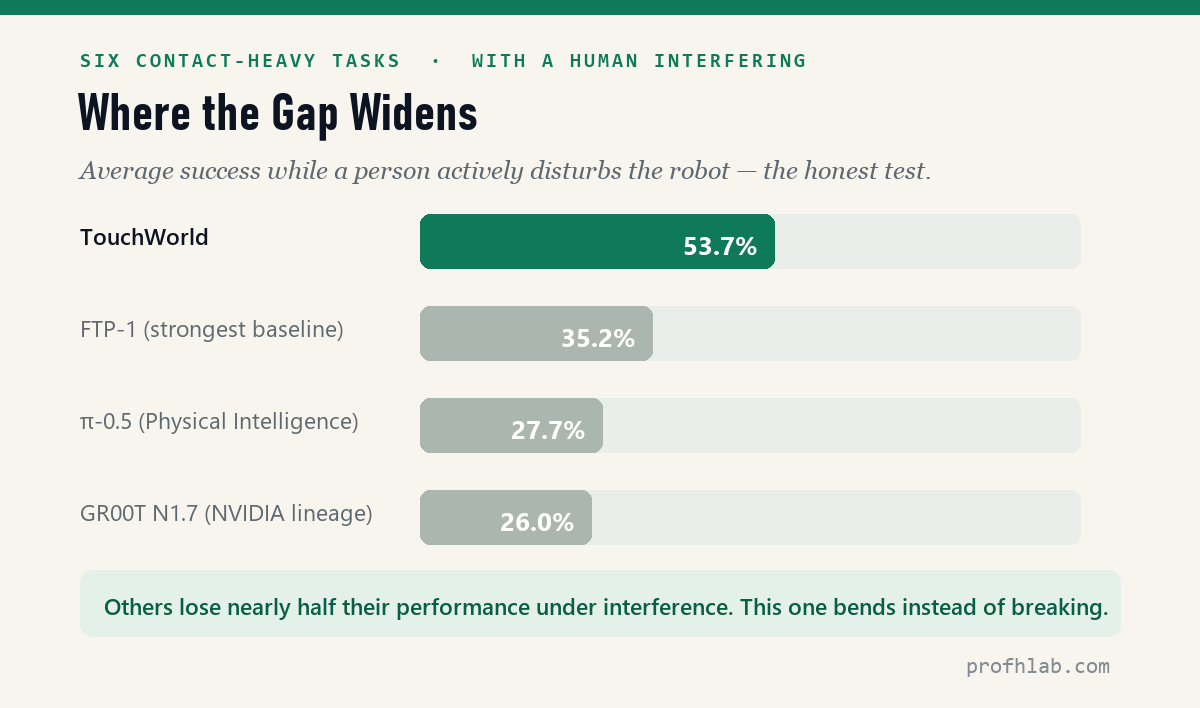
Against FTP-1, the strongest baseline, TouchWorld led by 15.7 percentage points in normal conditions and 18.5 points when a human interfered. Note where the gap grows: under interference. Other models lose close to half their performance when disturbed; TouchWorld degrades far less. That is the signal that the fast tactile-correction tier actually works.
The ablation experiments back this up: removing the tactile input caused the largest performance drop; removing the refinement policy collapsed the interference condition in particular; removing the subtask planner hurt long-horizon consistency; and removing the tactile world model weakened contact-aware goal conditioning. Four tiers, four distinct jobs — supported by experiment.
The paper is equally direct about its limits. ① Evaluation is confined to six tasks; extending to the diversity of real homes needs more validation. ② The tactile world model predicts only short-horizon subgoals; long-horizon prediction remains an open problem. ③ The policy is tied to a specific sensor layout, so moving to a different tactile sensor requires separate adaptation. ④ The scheduling hyperparameters are fixed values; making them adaptive could improve reactivity further.
A 65% success rate is impressive as research but far from commercial reliability (typically 99% or higher). Expect first validation in controlled settings like logistics and assembly rather than in homes.
Source: arxiv.org/abs/2607.07287
Why it matters
First, the choice of opponents is telling. Pi-0.5 and GR00T N1.7 are flagship general-purpose robot foundation models from the Physical Intelligence and NVIDIA camps. A comparatively small model that takes touch seriously beating giant vision-language generalists on contact tasks suggests that for contact-heavy work, sensory composition may matter more than scale.
Second, a shift in data strategy. Ten hours of robot demonstrations is a small amount by industry standards. Filling the shortfall with human hand video and pressure data offers a realistic detour for companies weighed down by the cost of robot data collection.
Third, tactile sensors, gloves, and data pipelines emerge as a new competitive front. Rainbow Robotics and Doosan Robotics on the hardware-strength side, LG and Samsung on the appliance side — all carry product lines that live and die by “hands” and “contact.” What this paper actually demonstrates, though, is the value of a pipeline for collecting human data for pretraining, more than any sensor itself. (Note: the paper does not cover individual companies’ tactile-research status; we note only the implications of the technical trajectory.)
Source: arxiv.org/abs/2607.07287
Who should care
- If you invest: a signal that the dominance of general-purpose VLA models is not absolute across all tasks. A specialized approach winning in the “contact” niche hints that the robotics value chain may split into multiple layers rather than one winner-take-all. (A reading of technology currents, not a judgment on any specific stock.)
- If you study or research: “world model + touch + hierarchical speed separation” is a combination you will be seeing often. In particular, the result that a fast residual-correction tier resists disturbance is a fine case study linking control and learning.
- If you build products: if robot data is scarce, collecting human work video and pressure data first can be the alternative. Data-collection design is model performance.
Source: arxiv.org/abs/2607.07287
The 3–5 year view
Picture three to five years out, and a robot’s “fingertip intuition” becomes common sense. Today’s robots treat contact like an accident: bump into something and stop, slip and fail. A robot with a tactile world model treats contact as part of the plan. Before seating a cup it already expects the little “click” of it catching, and when reality differs from the expectation, it micro-adjusts its fingers at once.
This matters because the spaces people live in are a continuum of contact. Turning a doorknob, folding clothes, washing dishes — all of it is finished by the fingertips, not the eyes. Holding 53.7% while a person actively interferes reads as progress that lowers the threshold that matters most: leaving the predictable lab for the unpredictable home. On the road from robots that “see” the world to robots that “feel and anticipate” it, this paper plants a milestone.
Why 65% matters when GR00T scored 39.3% and Pi-0.5 40.7%
What exactly is a world model?
A neural network that imagines “if I take this action now, what will I see and feel next?” — the way a person guesses a cup’s weight and texture before grasping it. TouchWorld folds touch (pressure maps) into that imagination, and moves the hand toward the imagined feeling as its goal.
Why is a 65% success rate a big deal?
The comparison matters more than the absolute number. Under identical conditions, NVIDIA-lineage GR00T N1.7 scored 39.3% and Physical Intelligence-lineage Pi-0.5 scored 40.7%. Leading by a wide margin on contact tasks where the giant general-purpose models struggled — and widening the lead when a human interfered — is what makes it meaningful.
Next on this shelf: recent sim-to-real transfer research — moving skills learned in simulation onto physical robots.
This article reinterprets published research for a general audience; for full details, see the original paper. The rest of the decoded-papers shelf lives on the Physical AI page.
Columbia’s Yunzhu Li on world models that use touch
Full index
Every guide in the Physical AI library — 27 of them, grouped so you can find the one you need.
Start here
- Physical AI Foundations: World Models, Robot Foundation Models, and Sim2Real — From Zero
- Physical AI Explained: Why a Chatbot Knows the Cup Falls but a Robot Doesn’t
- The Physical AI Toolbox: Six Free Simulators, a $249 Hardware Ladder, and What the 2026 Papers Admit
Research papers, decoded
- RoboVLMs, Explained: What Actually Makes a Robot Foundation Model Work
- Ψ0 (Psi-Zero), Explained: The Humanoid Foundation Model That Learns From Human Video
- MotionWAM, Explained: One-Shot Imagination Brings Real-Time Humanoid Loco-Manipulation
- XHugWBC, Explained: One Policy That Drives 12 Different Humanoids
- Vision-Tactile Pretraining, Explained: A Robot Hand Learns Human-Like Dexterity From a Webcam
- ▸ TouchWorld, Explained: A Robot Hand That Predicts Touch Before Making Contact (you are here)
- HOUND and APT-RL, Explained: One Transformer Brain for Walking, Running, and Jumping in the Wild
Machines, priced
- Tesla Optimus V3 Release Date, Price and Specs: What Tesla Has Confirmed
- Buying a Humanoid Robot in 2026: What a Unitree R1 Really Costs, Retail vs Import
- Robot Dog Prices in 2026: From ≈$2,900 to ≈$71,000 — and Spot Still Has No Price Tag
- Tesla FSD Goes Subscription-Only in Korea — and the ‘5-Year Break-Even’ Everyone Quotes Is Wrong
Home robots, tested
- Narwal Freo Z10 Ultra Review: 18,000Pa, a 75°C Mop Wash, and Three Honest Drawbacks
- 22,000Pa vs 240 Air Watts: Robot Vacuum Suction Numbers, Decoded (2026)
- Robot Vacuum or Stick Vacuum? I Split Housework Into 10 Tasks — Only One Truly Overlaps
- The Sour Smell Isn’t the Mop: Robot Vacuum Odor by Zone, and a 7–9x Consumables Gap
- Drain Height Decides Your Robot Vacuum: Samsung 0.4 m, Roborock 50 cm, LG 1.5 m
- Robot Vacuum Repair Costs 2026: A $140 Fix and a 56.5% Resolution Rate
- Robot Vacuum Subscription vs Buying: What iRobot Select Really Costs
- Are Window-Cleaning Robots Worth It? The Break-Even vs Hiring a Pro
- Smart Speakers in 2026: The Hardware Is $99 — the Assistant Is the Real Price
- Serving Robot Costs in 2026: $399 a Month, and Why 73.3% Saw No Change
Chips & companies
- HBF and zHBM, Explained: Samsung and SK Hynix Give Opposite Answers to the Same Memory Problem
- Korea’s Chip Equipment Makers, Compared: Profits Fell 68% — So Why Did Pay Jump 29%?
- Samsung DS vs DX: One Company, a $450,000 Bonus Gap — and Why the Simple Story Is Wrong
- ASML Korea’s Starting Pay Is $31K — or $46K: Anatomy of a 2.15x Salary-Data Gap
Looking for the other library? Generative AI — tools, tested →
Prof.’s H Newsletter
One short email a month, with the numbers in it
What actually moved in AI hiring, AI prices, and the scams aimed at older Americans. Counted here, dated, and linked to the source. One email a month, and your address goes nowhere else.