Robot Vacuum or Stick Vacuum? I Split Housework Into 10 Tasks — Only One Truly Overlaps
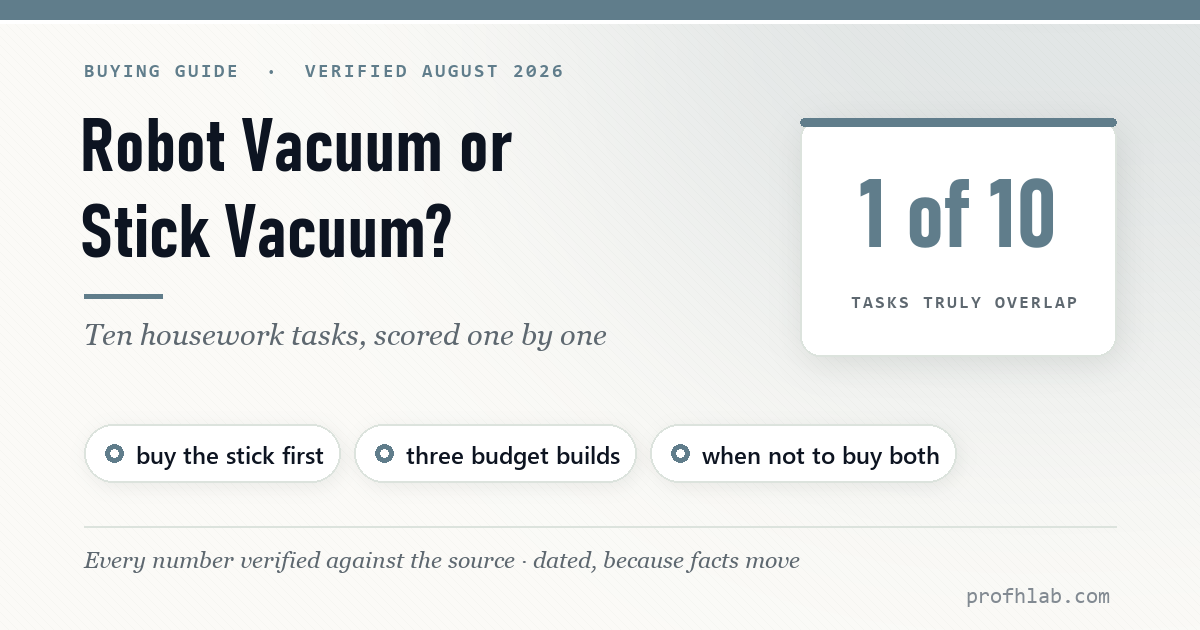
The short version: a robot vacuum and a stick vacuum are not two machines doing the same job. Split house cleaning into ten tasks and only two of them overlap. So “both” is often the right answer — but when the budget is finite, the order matters far more. And in most homes that order is already decided. Below, the best combination at $500, $1,000 and $1,600 (≈$500, $1,000 and $1,570), worked out on street prices checked in July 2026.
How this was checked
Every price here is US retail, verified August 11, 2026 against manufacturer stores and current listings. The ten-task scoring is mine, and it is the part that does not expire — models change every spring; which machine can climb onto a mattress does not.
The week after the robot vacuum arrived, my cousin bought a broom
My cousin bought himself a robot vacuum as a housewarming present. It cost about $500. For a solid week the family group chat filled up with it — the map the app drew of his flat, a photo of the dust that came out from under the sofa, the sentence “I get home from work and the floor is already clean.”
Then, in week three, one more photo. A broom and a dustpan from the discount store.
“Why do you need that?”
“It can’t get over the balcony threshold. And when the kid spilled a bag of crisps, the robot dragged the crumbs across the entire flat.”
It is a funny story, but it isn’t really funny. Spending $500 and still needing a broom means that $500 bought part of the housework, not the housework. And the problem is not that he bought the wrong machine. It is that nobody told him exactly which job a robot vacuum takes over before he bought it.
So let’s take that question head on. Do you need both? If you only buy one, which comes first? And how does the answer change at $500 versus $1,000 versus $1,600?
First, a market check: the sales figures already know the answer
Start with a statistic that surprises people. For all the talk about robot vacuums taking over, the machine that actually sells more is the stick vacuum.
Here is the market check that answers the question before any spec does. In the US, iRobot still holds roughly 35–40% of robot vacuum sales while quoting some of the lowest suction figures in the category — and cordless stick vacuums remain the larger category outright, led by Dyson and SharkNinja. Both markets are growing at once. If one machine truly replaced the other, that could not happen: households are not buying two of the same tool, they are buying two different ones.
That gap — robots winning the conversation while stick vacuums win the sales — is this article’s conclusion arriving early. People do not buy a robot vacuum first. They already own a stick vacuum, and they add a robot on top of it.
Split the cleaning into ten tasks and score both machines
The reason “do I need both?” never resolves is that people compare the two machines whole. You can weigh suction against battery life all evening and still get no answer. The unit of comparison has to change from the machine to the job.
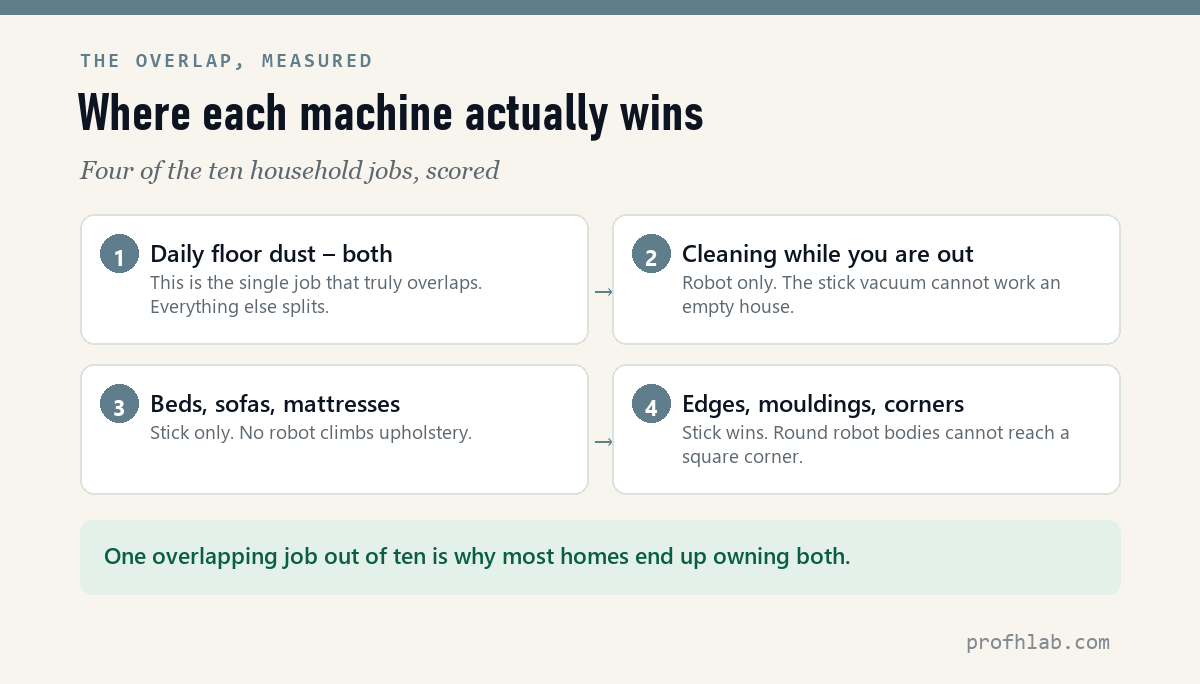
So here are the ten cleaning jobs that actually occur in a home, with each machine scored against each one. Yes means it handles the job on its own. Partly means it manages, with reservations. No means it can’t.
| # | Cleaning job | How often | Robot vacuum | Stick vacuum |
|---|---|---|---|---|
| 1 | Floor dust and hair, living room and bedrooms | Daily | Yes | Yes |
| 2 | Mopping the floor | 2–3× a week | Yes | Partly (mop-capable models only) |
| 3 | Cleaning while you’re out of the house | Daily | Yes | No |
| 4 | Wall mouldings, edges, corners | Weekly | Partly | Yes |
| 5 | Beds, mattresses, sofa surfaces | Weekly | No | Yes |
| 6 | Stairs | Weekly | No | Yes |
| 7 | Car interior | 1–2× a month | No | Yes |
| 8 | Shelf tops, top of the air conditioner, high places | Monthly | No | Yes |
| 9 | Dealing with something the moment it spills | Whenever it happens | Partly (slow, and it spreads the mess) | Yes |
| 10 | Crossing a threshold into the next room | Daily | Partly (limited by threshold height) | Yes |
Now count the marks.
- Jobs where the robot vacuum scores a solo Yes: 3 (1, 2, 3)
- Jobs where the stick vacuum scores a solo Yes: 8 (1, 4, 5, 6, 7, 8, 9, 10)
- Jobs where both score Yes — the genuine overlap: 1 (job 1, floor dust). Count mop-capable stick vacuums and it becomes 2
What that table says is not subtle. Eight of the ten jobs can only be done by the stick vacuum, and exactly one job can only be done by the robot — number 3, cleaning while you’re out. And yet robot vacuum owners are famously happy with them. The reason sits in the frequency column: that one job comes around more often than the other eight put together.
Which gives us the sentence this whole piece turns on. A robot vacuum does not replace a kind of work. It replaces a frequency of work. It takes jobs 1 and 2 — the daily ones — off your hands entirely, and it cannot touch the other eight. That is precisely why my cousin ended up buying a broom. Rows 9 and 10 of that table became his Tuesday evening.
For what it is worth, this limitation is not my private opinion — manufacturers state it themselves. Read any robot vacuum manual and you will find the same instruction: clear the floor first, and expect to finish edges, stairs and upholstery by hand. The machine is sold as maintenance between real cleanings, not as the real cleaning.
Which is why the first machine to buy is the stick vacuum
Three purchase-order rules fall straight out of that table.
Rule 1. If you own no vacuum at all, your first machine is a stick vacuum.
Because it carries eight of the ten jobs by itself. Buy the robot first and you are handling jobs 4 through 10 — seven of them — with a broom and a hand cloth. That is the road that ends at the discount store with $500 already spent.
Rule 2. If you already own a stick vacuum, the next machine is a robot vacuum — and this is where the improvement feels biggest.
You are handing over the daily repetition of jobs 1, 2 and 3 in a single move. What you save is not cleaning ability. It is your evenings.
Rule 3. The exception — if all three of these are true, you may buy the robot first.
① Your home is flat, with almost no thresholds. ② There is little carpet or rug. ③ You already own some minimal backup — even an old corded vacuum counts. Under those conditions most of the robot’s Partly marks rise to Yes. The mirror image — an older apartment full of thresholds, or a home with stairs or a second floor — is the single most common regret route when the robot is bought first.
Since thresholds have come up, one number worth knowing: most current flagships clear a bump of roughly 2 cm on their own, and several advertise a stepped climb of up to about 6 cm. Measure the tallest threshold in your home before you shortlist anything — a robot that cannot get into the bedroom is not cleaning the bedroom, whatever its suction figure says.
Best combination by budget — $500 / $1,000 / $1,600
Here is the practical part. Using street prices you could actually find in July 2026, these are the combinations by budget band.
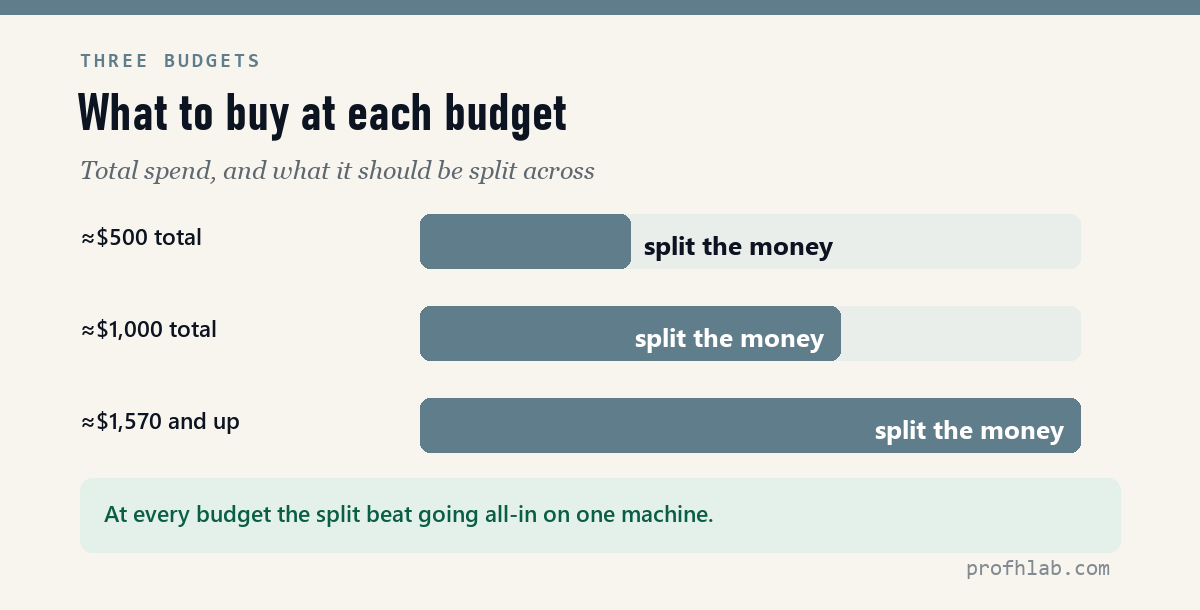
| Budget | Option A: all-in on stick | Option B: all-in on robot | Option C: split the money | Pick |
|---|---|---|---|---|
| About $500 | Shark Vertex Pro cordless, $299.99 — and $200 left unspent | Roborock Qrevo S Pro, under $400, or eufy C10 at $250–$400 | Shark Detect Pro $199.99 + Roborock Q5 Max+ under $200 | Option C |
| About $1,000 | Dyson V15 Detect, $849.99 list, often nearer $600 on deal | Dreame X50 Ultra, about $850–$900 | Dyson V15 Detect on deal (~$600) + Roborock Qrevo S Pro (~$350) | Option C |
| About $1,600 and up | Dyson Gen5detect, $1,049.99 | Narwal Flow 2, $1,499.99 list and $1,099.99 on promotion | Dyson Gen5detect $1,049.99 + eufy X10 Pro Omni $400–$500 | Option C |
A note on prices. They move constantly with colour, bundle and promotion. The figures above were confirmed on July 28, 2026 — always check the seller’s final price before you pay.
That all three rows land on Option C is the finding of this piece. But the reason differs at each band.
$500 — the surprise is that this combination exists at all.
Shark’s Detect Pro cordless sits at $199.99 and Roborock’s Q5 Max+ has been holding under $200 with LiDAR mapping and a self-emptying base. Together that is under $400 — less than either category’s mid-range single machine, and it covers nine of the ten jobs. Five years ago this combination did not exist at any price.
$1,000 — this is the sweet spot for most people.
At this budget the split gets comfortable. A Dyson V15 Detect bought on one of its regular discounts runs near $600 against a $849.99 list, and that leaves roughly $350 for a Roborock Qrevo S Pro — a robot with anti-tangle hardware, hot-water mop washing at 167°F and warm-air drying. You are not compromising on either side.
$1,600 and up — still split it, but tilt the money toward the robot.
In this band, extra spend on the stick vacuum stops paying off steeply. Dyson’s Gen5detect at $1,049.99 is the ceiling worth reaching, and past it you are buying refinements you will not feel. Put the remaining money into the robot instead: a eufy X10 Pro Omni at $400–$500 adds a self-washing mop dock, which is the feature owners actually notice every week.
That robot vacuum — how much an hour are you buying?
One more calculation: what the time a robot vacuum gives back actually costs. What follows layers an assumed usage pattern on top of verified prices and running costs, so treat it as an estimate — your floor plan and habits will move it.
Say a three-bedroom flat of roughly 100m2 (about 1,080 sq ft) takes 20 minutes to do with a stick vacuum, four times a week. That is 80 minutes a week. Hand the job to a robot and you still spend around 10 minutes a week emptying the bin, freeing whatever it swallowed and moving mats out of its way. You are still left with 70 minutes a week — roughly 60 hours a year.
Now the cost side. A $500 robot vacuum used for five years is about $100 a year. Then consumables: brushes, filters, mop pads and dust bags run roughly $90 to $150 a year if you buy the manufacturer’s own parts, or $45 to $75 if you mix genuine parts for the brush and filter with good third-party pads and bags. Call it $160 to $250 a year, all in.
So roughly $200 a year buys back about 60 hours — a shade over $3 an hour. If that reads as cheap, buy it. If it reads as “for that money I’ll push the vacuum myself,” that is a completely respectable answer, and you should buy a better stick vacuum instead.
Three cases where you should not buy both
For balance, the other side. If you are in one of these three situations, two machines is waste.
1) A studio flat under about 33m2 (roughly 350 sq ft). With that little floor, a stick vacuum finishes in five minutes. Spending $200 to $500 to automate five minutes never pays back. And a robot vacuum’s docking station permanently occupies floor space, which in a studio is more expensive than it looks. One stick vacuum, and a light one, is the answer. (A Shark Detect Pro at $199.99 or a Dyson V15 Detect on discount will both finish that floor faster than any robot.)
2) A home with a lot of stuff on the floor. A robot vacuum only works on an empty floor. If toys, charging cables, rug fringes and pet bowls live down there permanently, clearing up before every run becomes the chore. At that point pushing the vacuum yourself is faster. Before you buy a robot you have to buy the habit of keeping the floor clear — and that is not for sale.
3) A home where pet hair is the main reason you clean. The tier chart quoted above names pet hair as a robot vacuum limit. Hair does not only sit on the floor; it works into sofa, bed and rug fibres, which is row 5 of the table, where the robot scores No. In this house, putting the budget into a higher-end stick vacuum produces a happier owner.
Buying the robot first, and the two cheapest times to buy one
Q. Can I just buy the robot vacuum and add a stick vacuum later?
Yes. Just decide now what handles jobs 4 through 10 until “later” arrives. If a broom and a hand cloth will do, no problem; if that sounds like a daily irritation, flip the order. One note: stick vacuum batteries typically run 30–60 minutes on a charge, so postponing the cordless side does not get you better performance for waiting.
Q. When is the cheapest time to buy a robot vacuum?
Two windows, reliably. The big retail sale events — Prime Day, Black Friday, Memorial Day — where flagships routinely run $200 to $400 under list. And the run-out window: when a brand ships its new flagship in spring, last year’s drops hard and stays down. The catch with run-out stock is consumables, so check that pads, filters and bags for that exact model are still sold before you commit.
Q. If I buy both, should I match the brands?
No need. There is almost nothing to gain from pairing them. If anything, the market structure argues the other way: stick vacuums are more than 70% domestic brands (LG, Samsung) with strong local service, while robot vacuums are majority Chinese with better price-performance. Domestic brand for the stick, value brand for the robot is the natural combination in today’s market.
The broom
About a month later another photo landed in the group chat. This time it was a stick vacuum hanging on the wall by the front door, with a robot vacuum’s docking station parked underneath it.
“What about the broom?”
“Threw it out.”
What it took to throw the broom out was not a more expensive robot vacuum. It was one other machine to cover the eight jobs the robot cannot do. Had he known the order from the start, the same money would have saved him three weeks.
Choosing a vacuum, in the end, is not choosing specs. It is counting, honestly, the ten things that actually happen in your home. When you get in tonight, do just two of them: measure the height of your thresholds, and count the objects lying on your floor. Those two numbers settle about 80% of this decision.
Sources: manufacturer product pages and US store listings for Dyson, Shark, Roborock, Dreame, eufy and Narwal, verified August 11, 2026; published US market-share estimates for robot vacuums; manufacturer replacement-part pricing for the consumables math. The ten-task scoring is my own.
Part of the Physical AI library — research decoded and machines compared, in plain English: profhlab.com/physical-ai.
A head-to-head test of a robot vacuum against a stick vacuum
Full index
Every guide in the Physical AI library — 27 of them, grouped so you can find the one you need.
Start here
- Physical AI Foundations: World Models, Robot Foundation Models, and Sim2Real — From Zero
- Physical AI Explained: Why a Chatbot Knows the Cup Falls but a Robot Doesn’t
- The Physical AI Toolbox: Six Free Simulators, a $249 Hardware Ladder, and What the 2026 Papers Admit
Research papers, decoded
- RoboVLMs, Explained: What Actually Makes a Robot Foundation Model Work
- Ψ0 (Psi-Zero), Explained: The Humanoid Foundation Model That Learns From Human Video
- MotionWAM, Explained: One-Shot Imagination Brings Real-Time Humanoid Loco-Manipulation
- XHugWBC, Explained: One Policy That Drives 12 Different Humanoids
- Vision-Tactile Pretraining, Explained: A Robot Hand Learns Human-Like Dexterity From a Webcam
- TouchWorld, Explained: A Robot Hand That Predicts Touch Before Making Contact
- HOUND and APT-RL, Explained: One Transformer Brain for Walking, Running, and Jumping in the Wild
Machines, priced
- Tesla Optimus V3 Release Date, Price and Specs: What Tesla Has Confirmed
- Buying a Humanoid Robot in 2026: What a Unitree R1 Really Costs, Retail vs Import
- Robot Dog Prices in 2026: From ≈$2,900 to ≈$71,000 — and Spot Still Has No Price Tag
- Tesla FSD Goes Subscription-Only in Korea — and the ‘5-Year Break-Even’ Everyone Quotes Is Wrong
Home robots, tested
- Narwal Freo Z10 Ultra Review: 18,000Pa, a 75°C Mop Wash, and Three Honest Drawbacks
- 22,000Pa vs 240 Air Watts: Robot Vacuum Suction Numbers, Decoded (2026)
- ▸ Robot Vacuum or Stick Vacuum? I Split Housework Into 10 Tasks — Only One Truly Overlaps (you are here)
- The Sour Smell Isn’t the Mop: Robot Vacuum Odor by Zone, and a 7–9x Consumables Gap
- Drain Height Decides Your Robot Vacuum: Samsung 0.4 m, Roborock 50 cm, LG 1.5 m
- Robot Vacuum Repair Costs 2026: A $140 Fix and a 56.5% Resolution Rate
- Robot Vacuum Subscription vs Buying: What iRobot Select Really Costs
- Are Window-Cleaning Robots Worth It? The Break-Even vs Hiring a Pro
- Smart Speakers in 2026: The Hardware Is $99 — the Assistant Is the Real Price
- Serving Robot Costs in 2026: $399 a Month, and Why 73.3% Saw No Change
Chips & companies
- HBF and zHBM, Explained: Samsung and SK Hynix Give Opposite Answers to the Same Memory Problem
- Korea’s Chip Equipment Makers, Compared: Profits Fell 68% — So Why Did Pay Jump 29%?
- Samsung DS vs DX: One Company, a $450,000 Bonus Gap — and Why the Simple Story Is Wrong
- ASML Korea’s Starting Pay Is $31K — or $46K: Anatomy of a 2.15x Salary-Data Gap
Looking for the other library? Generative AI — tools, tested →
Prof.’s H Newsletter
One short email a month, with the numbers in it
What actually moved in AI hiring, AI prices, and the scams aimed at older Americans. Counted here, dated, and linked to the source. One email a month, and your address goes nowhere else.