Robot Vacuum Repair Costs 2026: A $140 Fix and a 56.5% Resolution Rate
There was a knocking sound on the living room floor. Tap, tap, tap.
The robot vacuum making it was only a few months old. When the owner asked the manufacturer about it, the answer that came back was that it might be the wooden flooring. The scene ran on SBS 8 News in Korea last year, and the headline summed the situation up: instead of taking responsibility, blaming the customer.
The reason that story is not somebody else’s problem is in the numbers.
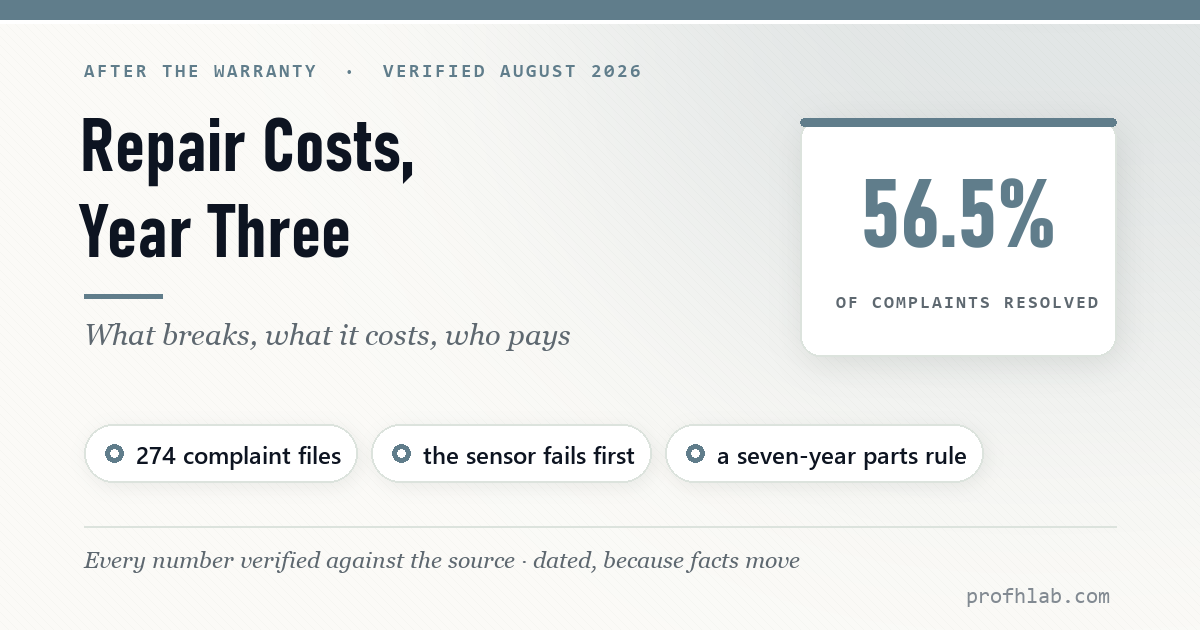
Damage-relief claims about robot vacuums filed with the Korea Consumer Agency — the government’s consumer-dispute body — went from 55 in 2023 to 105 in 2024, a rise of 90.9%. The first half of 2025 alone brought 77, roughly double the same period a year earlier. 74.5% of them were product defects.
And the number that stings is the last one. Among the cases filed as product defects, the share where the consumer actually came away with a refund or a repair was 56.5%. Ten people report a fault; four of them go home with nothing.
Figures verified August 9, 2026,
The short version. The most common robot vacuum failure is the sensor, at 24.9% — yet the component brands single out in their warranty documents is the battery. Samsung and LG send a technician to your home (call-out fee $20 $20), so you are done inside two days; Roborock and Dreame collect by courier, so you pay shipping both ways and wait five to ten days.
And when the same fault returns after a paid repair, the free re-warranty runs anywhere from two months (Samsung and LG, no part replaced) to one year (Coway) — a sixfold spread. Before you buy, those three lines matter more than suction power does.
Where this evidence comes from
Warranty terms and repair prices here are US, verified August 11, 2026. The failure-rate breakdown is different: no US agency publishes one. The figures below come from Korea’s government consumer agency, which does publish complaint data by fault type — and since the machines are the same models sold here, what breaks is the same. Use it for what fails, and use the US table for what it costs you.
What 274 complaint files say: the thing that breaks is the sensor
When we shop for a robot vacuum we compare suction in pascals and mop rotations per minute. The part that actually fails is not on that list. Here is what the Korea Consumer Agency found when it analysed the 274 cases filed between 2022 and June 2025.
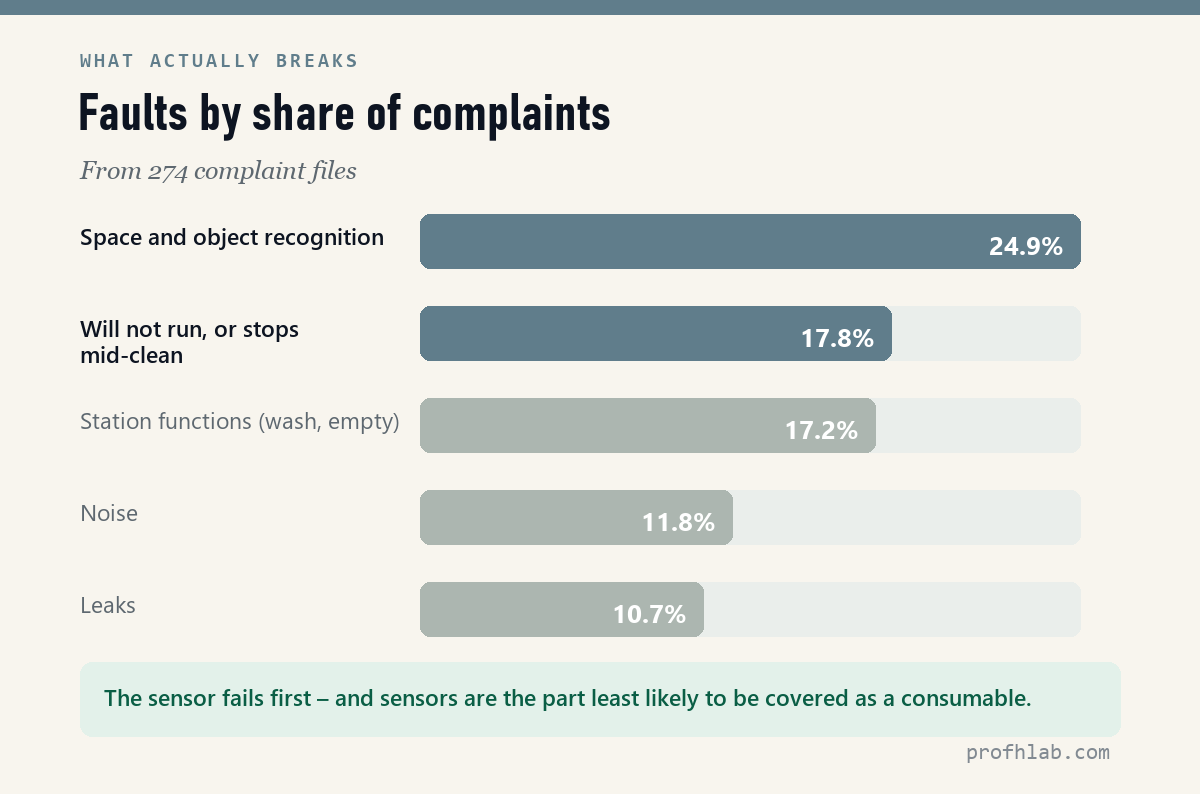
| Fault type | Share | What it looks like |
|---|---|---|
| Space and object recognition sensor | 24.9% | Bad mapping, obstacles not detected, the same patch cleaned over and over |
| Will not run, or stops mid-clean | 17.8% | Power faults, halting mid-run, failing to return to the dock |
| Add-on function faults | 17.2% | Station functions — mop washing, mop drying, dust emptying |
| Noise | 11.8% | Abnormal sound while driving or vacuuming |
| Leaks | 10.7% | Water escaping from the tank or the supply line |
Source: Korea Consumer Agency press release, August 12, 2025. The fault-type breakdown is drawn from the 169 cases where the symptom was documented in detail.
Sensors top the list. And here is where it gets odd. Read these brands’ warranty pages one by one and the component they break out with its own coverage period is almost always the battery. The LDS lidar module — the number-one failure point — is hard to find mentioned separately on any official page.
In other words, the failure consumers hit most often and the warranty item brands explain most carefully point in different directions. That mismatch is the background to the 56.5% figure. A report that “the sensor is behaving strangely” can be ruled a hardware fault or dismissed as normal software behaviour, and when a call like that is close, the consumer loses. “It might be your flooring” is exactly that structure at work.
Warranty structures side by side, US market
This is the table to read before you fall in love with a spec sheet. The differences are not marketing — they are the difference between a $0 repair and a $250 one in year two.
| Brand | Standard warranty | Worth knowing |
|---|---|---|
| iRobot | 2 years on most models | Sells a separate protection plan that extends coverage past the warranty |
| Roborock | 2 years | Explicitly covers the dock and its components — not every brand does |
| SharkNinja | 2 years | Backed by an established US appliance support network |
| Dreame | 1 year, extendable to 2 | The second year is free but requires registering within 30 days of purchase |
| ECOVACS | 1 year in most cases | Some retailers and regions offer longer terms — check at checkout |
Two things to take from it. First, Dreame’s free second year is the most commonly forfeited benefit in this category — it costs nothing and almost nobody registers. Second, dock coverage is worth reading closely: the station is now the most mechanically complex part of the product, and it is the part several brands are quietest about.
Out of warranty, US repair pricing clusters like this: most common repairs land between $80 and $250, while jobs involving the docking station, the motor or several components at once run $350 to $400. A battery replacement sits in the middle. Against a machine that cost $400, a $250 repair in year three is a real decision, not a formality.
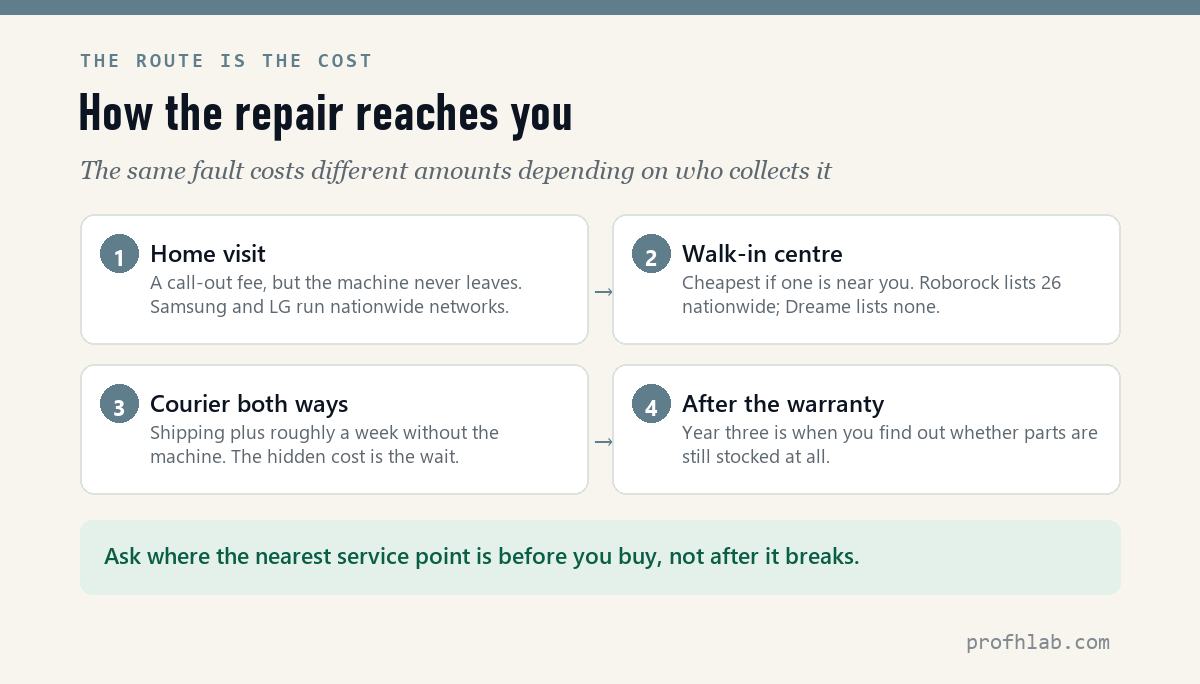
The repair route is the cost: a $20 call-out vs shipping both ways and seven days without it
The same fault costs different things depending on the brand, because you are paying for different items. Samsung Electronics Service and LG Electronics both publish their call-out fees, and the two schedules are identical down to the won.
| Category | Samsung Electronics Service | LG Electronics |
|---|---|---|
| Off-peak base (Jan–May, Sep–Dec) | $20 | $20 |
| Off-peak surcharge (weekdays after 18:00, weekends, holidays) | $24 | $24 |
| Peak season base (Jun–Aug) | $24 | $24 |
| Peak season surcharge | $27 | $27 |
Source: Samsung Electronics Service fee schedule and LG Electronics fee and warranty guidance, checked August 9, 2026. On a paid repair the call-out fee is charged separately from parts and labour.
It is August as I write this, which is peak season. Call someone out on a weekend and $30 goes onto the bill before anyone has touched the machine.
Brands like Roborock and Dreame run the other model: courier collection. There is no call-out fee, but the standard arrangement is that the customer pays shipping both ways on a paid repair — and, more to the point, the vacuum is not in your house for a while. The turnaround Roborock service write-ups consistently quote is three to seven days for the repair itself, five to ten days once you count the courier legs.
The real cost of courier service is not the shipping — it is the seven days without a vacuum. Take the $27 monthly fee on a subscription robot vacuum and the daily value works out to roughly $0.90, so seven days is about $6 of use. On the money alone that looks cheaper than a $20 call-out.
But in a household where the machine runs every day — two working parents, a pet — a week back on your hands and knees costs far more than that number suggests. Run it once or twice a week and you will barely notice the machine is gone. I broke the subscription fee itself down in the subscribe-or-buy math.
When the same fault returns after a paid repair: two months, or a year
This is the most important section in the piece, and it is missing from every top-ranking page I checked.
You pay for a repair, and a few months later the same symptom comes back. How long the company will fix it again for free varies enormously.
| Brand | Free re-warranty after a paid repair | Conditions |
|---|---|---|
| Coway | 1 year | Regardless of whether a part was replaced; no other conditions |
| Cuckoo | 3 months | If the same symptom recurs |
| Roborock | 3 months | Same symptom, and only where the same part needs replacing |
| Samsung Electronics | 2 months (no part replaced) / 1 year (part replaced) | Limited to the same part |
| LG Electronics | 2 months (no part replaced) / 1 year (part replaced) | Limited to the same part |
| SK Magic | 2 months | If the same fault occurs |
Source: Consumer News, January 15, 2025, reported by Song Hye-rim. The baseline principle in the Fair Trade Commission’s consumer dispute resolution standards is that if the same fault recurs in the same part within two months of a paid repair, the repair is free.
Samsung and LG look worst in that table at two months. The trap is in the next column across. If a part was replaced, Samsung and LG give you a full year. Robot vacuum repairs almost always involve replacing something, so in real situations Samsung’s and LG’s one year is likely to work out better than Roborock’s three months. Flip it around, though: if the problem was solved by cleaning and reassembly alone, Samsung and LG give two months where Roborock gives three.
Real disputes have turned on exactly this. According to that same report, one Roborock owner had the same symptom return four months after a paid repair and was billed again, with the explanation that “the free warranty on repaired parts is two months.” Two months or three, most customers are never told the period at the moment they hand over the money.
So the field technique is simple. When you take the receipt for a paid repair, ask how long the re-warranty on that repair runs, and ask them to put it in a text message or a written note. It takes a minute, and it can save you $70 a few months later.
The 2026 complaint survey: Dreame holds 19.3% of the market and 9.5% of the complaints
How a brand actually handles service shows up better in complaint data than in its terms and conditions. These are the results of a 2026 consumer-complaint assessment run by Korea’s Consumer Grievance Centre across five robot vacuum brands.
| Brand | Share of complaints | Notable |
|---|---|---|
| Roborock | 28.6% | Quality is the largest slice of its complaints, at 41.7% |
| Xiaomi | 23.8% | 80% of its complaints were about after-sales service — worst of the five |
| Ecovacs | 21.4% | Service and refund/exchange complaints in similar proportion |
| Narwal | 16.7% | Service complaints 42.9% |
| Dreame | 9.5% | Less than half its 19.3% market share (assessment score 95.1, award winner) |
Source: Consumer News, June 1, 2026, reported by Lee Beom-hee, using figures compiled by the Consumer Grievance Centre. Across all complaints the type breakdown was: after-sales service 42.9%, quality 23.8%, refund or exchange 16.7%, installation or removal 7.1%, service handling 7.1%, false advertising 2.4%.
Two things fall out of it.
First, the number-one complaint category for robot vacuums is not the product — it is after-sales service, at 42.9%, nearly double the 23.8% for quality. What makes people angry is not “it broke.” It is “they will not fix it.”
Second, look at the gap between market share and complaint share. Dreame holds 19.3% of the market but 9.5% of the complaints, 9.8 percentage points lower. Roborock has the largest market share and also the largest complaint share, at 28.6%. It is natural for the brand that sells the most to generate the most complaints — but the fact that one brand inverts that ratio is worth writing down.
One caveat, and it matters: this is a five-brand survey on a small sample, and it can be skewed by how each brand’s Korean sales channels are structured. Read it for its structure — service is the number-one complaint category — rather than as an absolute ranking.
Year three, warranty expired: what does a repair actually cost?
Here I need to be straight with you. Not one brand publishes a price list for robot vacuum repairs. Samsung and LG disclose the call-out fee and handle parts and labour with “varies by product and symptom.” Roborock, Dreame and Ecovacs do the same. So the parts figures in the table below are not official prices. They are collected from user reports and service write-ups where the same numbers recur, and they should be read as a rough range and nothing more.
| Route | Example job | Parts + labour (collected) | Fixed extras | Days without it | Estimated out of pocket |
|---|---|---|---|---|---|
| Samsung home visit | Jet Bot wheel and wheel bracket replacement | $140 ($140, includes $10 labour) | Call-out $20 ($20 in peak season) | 0–2 days | About $160 |
| Roborock courier | Mop plate not recognised | About $65 | Shipping both ways, about $7 | 5–10 days | About $70 |
| Roborock courier | Drive wheel replacement | About $40 | Shipping both ways, about $7 | 5–10 days | About $45 |
| Any brand | Battery replacement | About $55–$105 | Varies by route | Varies by route | About $65–$130 |
Amounts are collected from user reports and service guidance as of August 9, 2026 and are not official published prices. They can vary by model, symptom and region, so always get a quote when you file the job.
What to read in that table is not the individual numbers — it is the structure. Home-visit repair means higher parts costs and a short wait. Courier repair means lower amounts and a long wait. And either way, one fault after the one-year warranty expires asks for 10–20% of what the machine cost. Buy a $710 vacuum, keep it three years, and a single repair in that window runs about ten times your annual consumables bill, which sits at $5–$15 a year. I put the consumables side of the ledger together in the running-cost guide.
Which leads to the conclusion. If you are torn between a model around $430 and one around $640, spending that $210 on a brand with a walk-in service centre, rather than on more suction, is more likely to win on three-year total cost. One repair costs you $45–$160 out of pocket — and the 274 files at the consumer agency show the odds of needing one are nowhere near low.
Will parts still exist in year four? How to check before you buy
Some countries set a legal floor for how long a manufacturer must keep spare parts available. The US does not have a single federal rule for home appliances, which means parts availability here is a company policy, not a guarantee — and policies change when a model is discontinued.
So check it yourself. It takes about four minutes and it is the single most useful thing you can do before buying a discounted run-out flagship.
- Open the brand’s own accessories page and search the exact model name. If the mop pads, filters and dust bags for that specific machine are listed and in stock, you are fine for now. If only “compatible with” third-party listings come up, that is a warning.
- Check the previous generation, not just this one. Whether the brand still stocks parts for the model it replaced two years ago tells you exactly how it will treat the machine you are about to buy.
- Look for the battery. Batteries are the part that decides whether a robot reaches year five. If nobody sells a replacement battery for the model, the machine has a hard expiry date.
- Find the repair route before you need it. Home visit, walk-in service centre, or ship-it-both-ways? That answer is worth more than any spec on the box, and it varies more between brands than the warranty length does.
A five-minute checklist before you buy
- Is there a walk-in centre where I live? Roborock has 26 sites nationwide — 15 official plus 11 Himart repair centres — and Himart stores will also take a unit in on your behalf. Many other imported brands only do courier collection, so search the brand name plus “service centre” for your area before you buy.
- Screenshot the warranty wording on the sales page. The more a brand breaks out main unit, battery and sensor separately, the less there is to argue about later. The screenshot is the evidence.
- Ask up front who pays round-trip shipping on a paid repair. With a courier-service brand this is a fixed cost that recurs every single time.
- Register the product the day it arrives. Parallel imports and direct overseas purchases can fall outside official domestic service. Same model, different purchase route, different warranty.
- Get the re-warranty period written on the paid-repair receipt. Two months, three months or a year is the difference between your next repair costing something and costing nothing.
Do all of that, and then compare suction. Reverse the order and you regret it three years later. If you are stuck at the earlier question of which model to buy, start with the flagship comparison; and if you are weighing a model with an automatic water hookup, the install-cost breakdown completes the total-cost picture.
Battery coverage by brand, and where a Roborock gets serviced
Q. Is the battery covered by the free warranty?
It depends on the brand. Dreame states the built-in battery at the same 12 months as the main unit. Samsung and LG exclude the battery from the warranty if it is judged to be a consumable part. Roborock’s official page does not list the battery separately at all. The wording on the warranty document at the time you buy is what governs, so screenshot it.
Q. If I bought a Roborock at Himart, can Himart service it?
Eleven Lotte Himart repair centres can carry out the actual repair, and stores nationwide will accept the intake on your behalf. That applies to units sold by Thinkware Mobile, Roborock’s official Korean distributor. Direct overseas purchases and parallel imports can fall outside it, so check your purchase route.
Q. I sent it in for repair and they say it is “customer negligence,” so I have to pay.
The consumer dispute resolution standards are the reference point. Start by documenting the situation in which the symptom occurs, with photos or video, and keep a copy of the symptom description you gave at intake so you can compare it against the final ruling.
If you cannot reach an agreement, the Korea Consumer Agency’s damage-relief service is available (dial 1372 in Korea). As we saw, the resolution rate on product-defect cases is 56.5% — barely better than a coin flip. But the side with a paper trail is clearly at an advantage.
Choose by service center and warranty, not by suction
Robot vacuum advertising always shows you the opening scene. Dust disappearing, the mop washing itself, the machine sliding quietly back into its dock.
The moment a customer is actually tested comes on some evening in year two, when the machine stops in the middle of the floor and blinks a red light.
What protects you then is not 36,000 pascals of suction. It is one service centre thirty minutes from your house, and one line printed on a warranty card. That is what 274 damage-relief files and a 56.5% resolution rate are quietly saying. If you have a product page open right now, close the spec sheet and click the service tab once. It changes what your evening looks like three years from now.
Sources: SBS 8 News; Korea Consumer Agency press release of August 12, 2025 and its damage-relief case records; Samsung Electronics Service and LG Electronics published fee and warranty guidance; Roborock Korea’s official service and warranty page; Thinkware Mobile’s Korean after-sales guidance; CNET Korea, July 29, 2026, on Roborock’s service-centre count; Consumer News, January 15, 2025 and June 1, 2026, with figures compiled by the Consumer Grievance Centre; the Fair Trade Commission’s consumer dispute resolution standards. All figures checked August 9, 2026,
Part of the Physical AI library — research decoded and machines compared, in plain English: profhlab.com/physical-ai.
Three broken robot vacuums torn down to see what fails
Full index
Every guide in the Physical AI library — 27 of them, grouped so you can find the one you need.
Start here
- Physical AI Foundations: World Models, Robot Foundation Models, and Sim2Real — From Zero
- Physical AI Explained: Why a Chatbot Knows the Cup Falls but a Robot Doesn’t
- The Physical AI Toolbox: Six Free Simulators, a $249 Hardware Ladder, and What the 2026 Papers Admit
Research papers, decoded
- RoboVLMs, Explained: What Actually Makes a Robot Foundation Model Work
- Ψ0 (Psi-Zero), Explained: The Humanoid Foundation Model That Learns From Human Video
- MotionWAM, Explained: One-Shot Imagination Brings Real-Time Humanoid Loco-Manipulation
- XHugWBC, Explained: One Policy That Drives 12 Different Humanoids
- Vision-Tactile Pretraining, Explained: A Robot Hand Learns Human-Like Dexterity From a Webcam
- TouchWorld, Explained: A Robot Hand That Predicts Touch Before Making Contact
- HOUND and APT-RL, Explained: One Transformer Brain for Walking, Running, and Jumping in the Wild
Machines, priced
- Tesla Optimus V3 Release Date, Price and Specs: What Tesla Has Confirmed
- Buying a Humanoid Robot in 2026: What a Unitree R1 Really Costs, Retail vs Import
- Robot Dog Prices in 2026: From ≈$2,900 to ≈$71,000 — and Spot Still Has No Price Tag
- Tesla FSD Goes Subscription-Only in Korea — and the ‘5-Year Break-Even’ Everyone Quotes Is Wrong
Home robots, tested
- Narwal Freo Z10 Ultra Review: 18,000Pa, a 75°C Mop Wash, and Three Honest Drawbacks
- 22,000Pa vs 240 Air Watts: Robot Vacuum Suction Numbers, Decoded (2026)
- Robot Vacuum or Stick Vacuum? I Split Housework Into 10 Tasks — Only One Truly Overlaps
- The Sour Smell Isn’t the Mop: Robot Vacuum Odor by Zone, and a 7–9x Consumables Gap
- Drain Height Decides Your Robot Vacuum: Samsung 0.4 m, Roborock 50 cm, LG 1.5 m
- ▸ Robot Vacuum Repair Costs 2026: A $140 Fix and a 56.5% Resolution Rate (you are here)
- Robot Vacuum Subscription vs Buying: What iRobot Select Really Costs
- Are Window-Cleaning Robots Worth It? The Break-Even vs Hiring a Pro
- Smart Speakers in 2026: The Hardware Is $99 — the Assistant Is the Real Price
- Serving Robot Costs in 2026: $399 a Month, and Why 73.3% Saw No Change
Chips & companies
- HBF and zHBM, Explained: Samsung and SK Hynix Give Opposite Answers to the Same Memory Problem
- Korea’s Chip Equipment Makers, Compared: Profits Fell 68% — So Why Did Pay Jump 29%?
- Samsung DS vs DX: One Company, a $450,000 Bonus Gap — and Why the Simple Story Is Wrong
- ASML Korea’s Starting Pay Is $31K — or $46K: Anatomy of a 2.15x Salary-Data Gap
Looking for the other library? Generative AI — tools, tested →
Prof.’s H Newsletter
One short email a month, with the numbers in it
What actually moved in AI hiring, AI prices, and the scams aimed at older Americans. Counted here, dated, and linked to the source. One email a month, and your address goes nowhere else.