Tesla Optimus V3 Release Date, Price and Specs: What Tesla Has Confirmed
Not yet. As of September 28, 2026, Tesla has not unveiled Optimus V3, has not published a price or a spec sheet for it, and has not announced the start of production. Its latest official word, the July 22, 2026 quarterly update, says Tesla is “installing the first-generation lines for Optimus, where we expect to start production soon,” and that the first robots will stay inside Tesla for training.
For anyone hoping to buy one, the date that matters is later. Elon Musk said at Davos on January 22, 2026 that Tesla would “probably” be selling humanoid robots to the public “by the end of next year,” which means late 2027. The only price he has attached to Optimus is a long-run $20,000 to $30,000, reported from his October 2024 product event.
What we checked on September 28, 2026
We read Tesla’s three 2026 quarterly updates in full (January 28, April 22 and July 22), the transcripts of the April and July earnings calls, CBS News’s account of Musk’s Davos interview, and the 15 most recent uploads on Tesla’s YouTube channel. Anything Tesla has not said itself is marked as reported, with the outlet named.
- 0 public unveilings of V3. The first target was the first quarter of 2026.
- 0 official V3 specifications: no height, weight, joint count, walking speed, battery life or payload.
- 1 price on record, from October 2024: $20,000 to $30,000, as a long-run goal.
Correction, September 28, 2026: the July 2026 version of this page listed 173 cm, 57 kg and 37 joints as V3 specifications, stated a summer 2026 production start as fact, and gave an “under $20,000” target. Tesla has published none of those for V3. The 173 cm and 57 kg figures come from the 2021 concept. We removed them.
Written and checked by Prof. H. An AI assistant helped draft this update and gather the filings; every quote below was read in the original document on the date shown. Nothing here is investment advice.
Every date Tesla put on Optimus V3 in 2026
Tesla moved the V3 dates in public, in its own documents. The ledger below sets each statement next to what had happened by September 28, 2026.
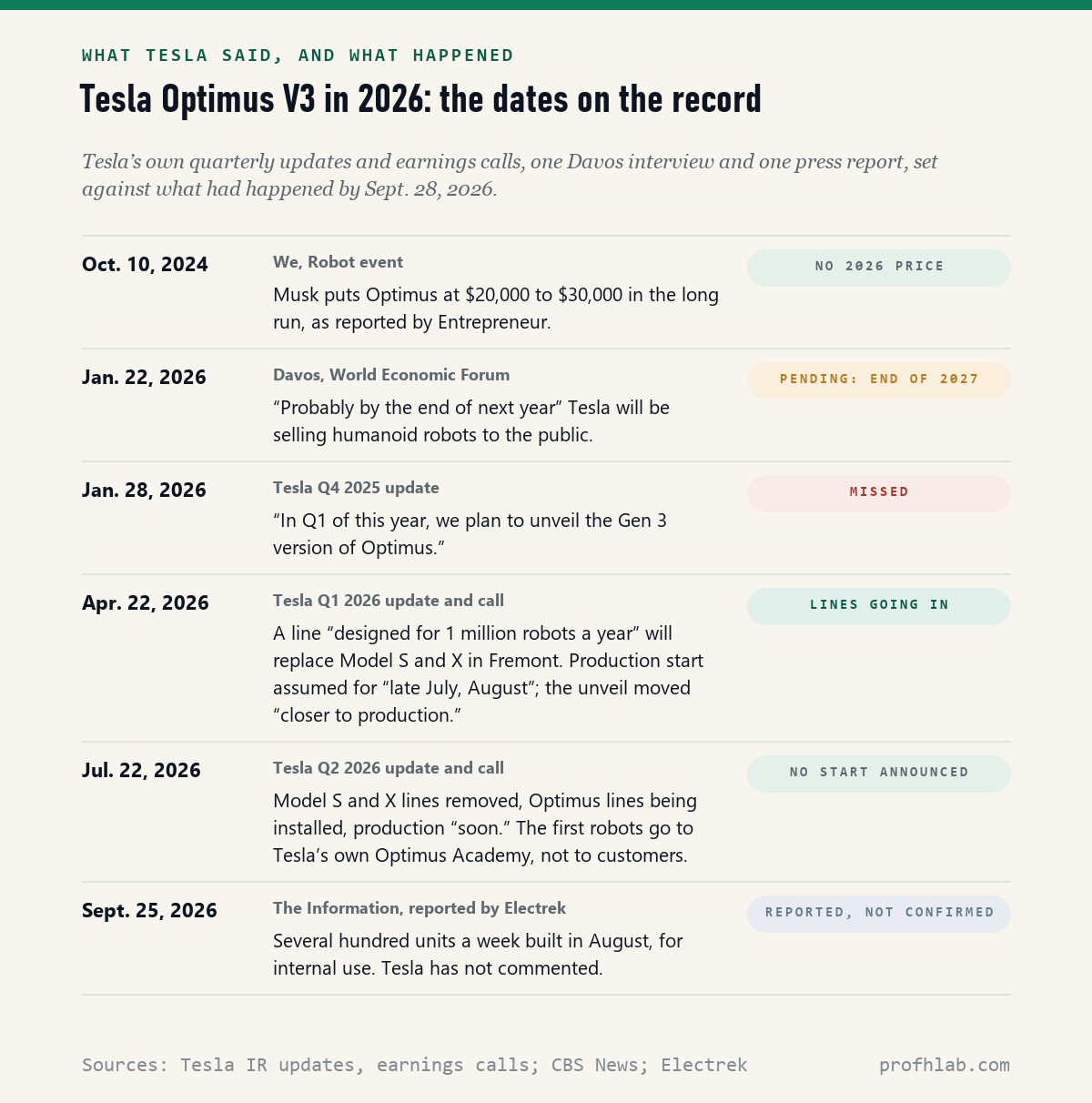
The unveiling slipped the furthest. Tesla’s January 28 update said, “In Q1 of this year, we plan to unveil the Gen 3 version of Optimus.” On April 22, Musk said Tesla wanted to “push the Optimus 3 unveil maybe closer to production,” so rivals could not study the design frame by frame. On July 22 he said only that it “deserves to have its own day in the spotlight.”
That day has not come. Electrek’s editor Fred Lambert wrote on September 25, 2026 that the promised mid-2026 reveal “still hasn’t happened.” Tesla’s 15 most recent YouTube uploads, from June 16 to September 6, 2026, include no Optimus video; the last one we found is from October 6, 2025.
Is Optimus V3 being built in Fremont yet?
The factory space is real. Tesla’s April 22 update said a first-generation line “designed for 1 million robots a year” would replace the Model S and Model X lines in Fremont. It also said Gigafactory Texas is being prepared for a second-generation line designed for a long-term “10 million robots” a year.
By July 22 the car lines were gone. The second-quarter update says Tesla has “decommissioned the manufacturing lines for Models S & X” and is “installing the first-generation lines for Optimus, where we expect to start production soon.” The first robots are for Tesla itself: “The initial Optimus builds will be used in our Optimus Academy for training data collection and further functionality development.”
What happened next is only reported. The Information, as summarized by Electrek on September 25, 2026, said Tesla went from “a few dozen” units a week in second-quarter testing to “several hundred a week in August,” all for internal use, aiming for more than 1,000 a week by the end of the year. Tesla has not confirmed those numbers.
Musk has kept expectations low himself. On July 22 he called Optimus “the hardest product to scale manufacturing that we’ve ever made at Tesla.” In April he said, “I don’t know what the production rate of Optimus will be this year.” The same Electrek report says the hand and forearm still contain over 100 screws and small parts that workers assemble by hand.
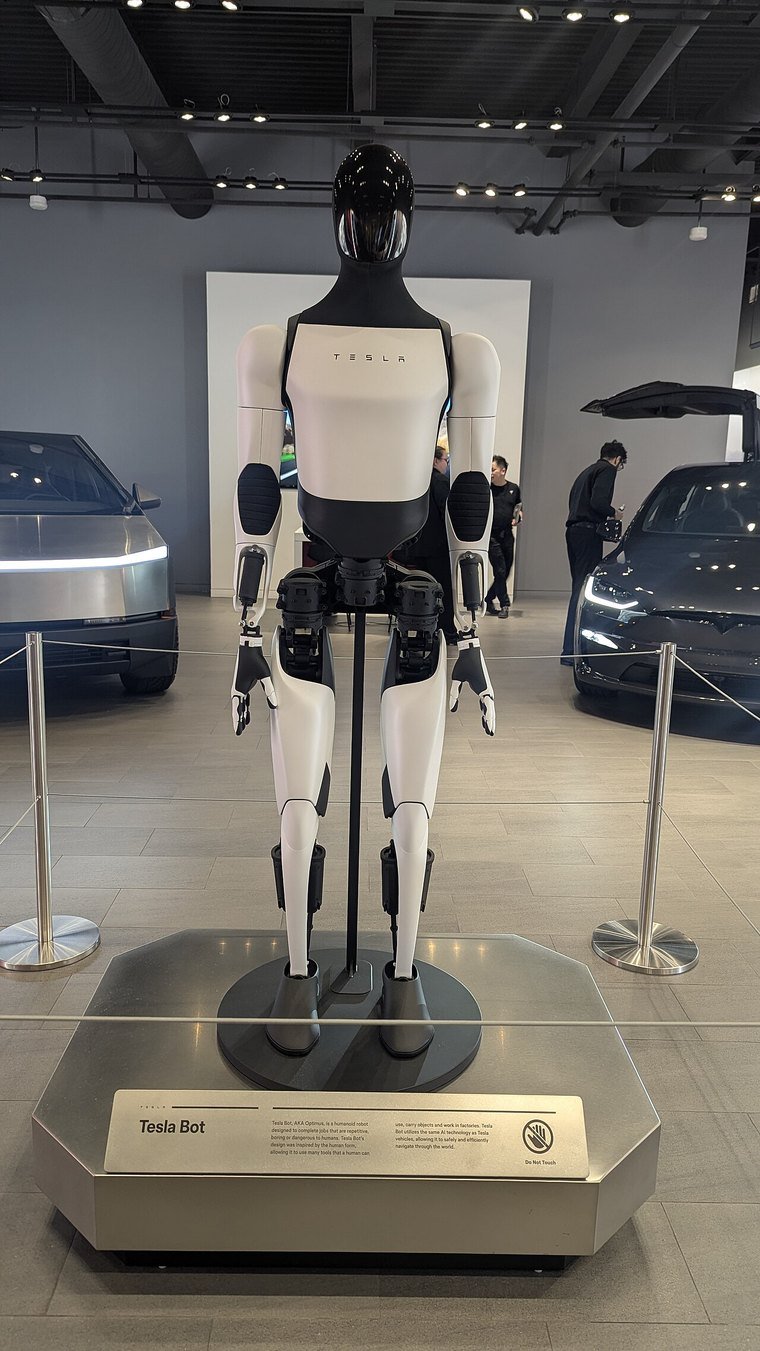
What Tesla has actually published about the V3 body
Almost nothing. We searched the April 22 update and call transcript for a V3 height, weight, joint count, walking speed, battery life and payload, and found none of them. What does exist is scattered across several years:
| Item | What is on the record | For V3? |
|---|---|---|
| Height and weight | 173 cm and 57 kg were the 2021 concept figures. The 2022 prototype weighed 160 lb (TechCrunch, Sept. 30, 2022). | No figure published |
| Joints | The “37 joints” repeated online does not appear in any Tesla update or 2026 earnings call. | No figure published |
| Hands | The 2024 hand had 22 degrees of freedom plus 3 in the wrist and forearm (Electrek, Nov. 29, 2024). | Earlier hand |
| AI chip | AI5 taped out April 15, 2026. Musk on July 22: “AI5 will initially go into Optimus.” Tesla lists AI5 production for 2027. | Planned, not yet |
| Voice | Musk on April 22: for Optimus’s voice, “Grok is actually very good for that.” | Stated |
| Design goal | January 28 update: “The Gen 3 is our first design meant for mass production.” | Official |
So the honest V3 spec sheet is short: a design meant for mass production, a planned move to the AI5 chip, and a Grok voice. A page that lists a V3 height, weight or joint count is quoting something Tesla has not said.
How much will Optimus cost?
The only number Musk has put on Optimus came at the We, Robot event on October 10, 2024, where, as Entrepreneur reported, he priced the robot at $20,000 to $30,000 in the long run. Tesla gave no price on any of its three 2026 earnings calls. Read the range as a mass-production target, not a sticker you can budget against.
When could a household or a business actually get one?
Not before 2027 on Tesla’s own timeline. Musk told his Davos interviewer on January 22, 2026: “probably by the end of next year, I think we’d be selling humanoid robots to the public.” Six months later, Tesla’s July update still described the first builds as robots for its own training program.
If you want a humanoid in 2026, you would be buying from someone else. This is what five other makers say publicly:
| Maker and robot | What the company says | Stated on |
|---|---|---|
| 1X NEO | Early access for $20,000, which “includes priority delivery in 2026”; $499 a month for units shipped later | 1X product page |
| Unitree R1, G1, H2 | From $4,900; from $13,500; $29,900 in its US store | Sept. 28, 2026 |
| Figure F.03 | Working at BMW’s Spartanburg plant on a parts “sequencing use case” | June 30, 2026 |
| Agility Digit 5 | “More than $300 million in multi-year customer orders”; general availability by the end of 2027 | Sept. 15, 2026 |
| Boston Dynamics Atlas | “All Atlas deployments are already fully committed for 2026” | Jan. 5, 2026 |
None of these is a direct Optimus substitute, and several sell only to factories. The point is timing: other companies already quote prices and delivery dates, and Tesla does not yet.
Tesla’s own Optimus footage, 2023 and 2025
These are the two Optimus videos Tesla has posted on its own channel that show the robot in motion. Neither shows V3. Both were checked as embeddable on September 28, 2026.
Optimus V3 release date, price and joints: short answers
When is the Tesla Optimus V3 release date?
Tesla has not given one. As of September 28, 2026, Optimus V3 has not been unveiled. The July 22, 2026 Tesla update says production at Fremont will start soon and that the first robots will be used for internal training. Elon Musk said on January 22, 2026 that Tesla would probably be selling humanoid robots to the public by the end of next year, meaning late 2027.
Can I buy a Tesla Optimus robot now?
No. As of September 28, 2026, Tesla has not announced any sale, lease or delivery of Optimus to the public or to another company.
How much will Tesla Optimus cost?
Tesla has not set a price. The only figure on record is the long-run range of 20,000 to 30,000 dollars that Elon Musk gave at the We, Robot event on October 10, 2024. No price was given on any of the three 2026 earnings calls.
Is Optimus V3 in production yet?
Tesla has not announced a start of production. Its July 22, 2026 update says the first-generation Optimus lines were being installed at Fremont, with production expected soon. The Information reported, as summarized by Electrek on September 25, 2026, that several hundred units a week were built in August for internal use. Tesla has not confirmed this.
How many joints does Optimus V3 have?
Tesla has not published a joint count for V3. The figure of 37 joints that circulates online does not appear in any Tesla quarterly update or 2026 earnings call.
What chip does Optimus V3 use?
Elon Musk said on July 22, 2026 that AI5 will initially go into Optimus. Tesla lists AI5 production for 2027, and it has not said which chip the robots built in 2026 use.
Sources
- Tesla, Q4 and FY 2025 Update, published January 28, 2026.
- Tesla, Q1 2026 Update, published April 22, 2026.
- Tesla, Q2 2026 Update, published July 22, 2026.
- Q1 2026 earnings call transcript (Investing.com) and Q2 2026 earnings call transcript (StockAnalysis), read September 28, 2026.
- CBS News, Musk at the World Economic Forum, January 22, 2026.
- Electrek, Optimus production ramp report by Fred Lambert, September 25, 2026 (summarizing The Information).
- Electrek, AI5 tape-out, April 15, 2026, and the 2024 Optimus hand, November 29, 2024.
- TechCrunch, the 2022 Optimus prototype, September 30, 2022.
- Entrepreneur, We, Robot event coverage, October 2024.
- Company pages: 1X NEO; Unitree store, checked September 28, 2026; Figure at BMW; Agility Digit 5; Boston Dynamics Atlas.
- Photos: Steve Jurvetson and Sikander via Wikimedia Commons, licenses as captioned.
Part of the Physical AI library — research decoded and machines compared, in plain English: profhlab.com/physical-ai.
Full index
Every guide in the Physical AI library — 27 of them, grouped so you can find the one you need.
Start here
- Physical AI Foundations: World Models, Robot Foundation Models, and Sim2Real — From Zero
- Physical AI Explained: Why a Chatbot Knows the Cup Falls but a Robot Doesn’t
- The Physical AI Toolbox: Six Free Simulators, a $249 Hardware Ladder, and What the 2026 Papers Admit
Research papers, decoded
- RoboVLMs, Explained: What Actually Makes a Robot Foundation Model Work
- Ψ0 (Psi-Zero), Explained: The Humanoid Foundation Model That Learns From Human Video
- MotionWAM, Explained: One-Shot Imagination Brings Real-Time Humanoid Loco-Manipulation
- XHugWBC, Explained: One Policy That Drives 12 Different Humanoids
- Vision-Tactile Pretraining, Explained: A Robot Hand Learns Human-Like Dexterity From a Webcam
- TouchWorld, Explained: A Robot Hand That Predicts Touch Before Making Contact
- HOUND and APT-RL, Explained: One Transformer Brain for Walking, Running, and Jumping in the Wild
Machines, priced
- ▸ Tesla Optimus V3 Release Date, Price and Specs: What Tesla Has Confirmed (you are here)
- Buying a Humanoid Robot in 2026: What a Unitree R1 Really Costs, Retail vs Import
- Robot Dog Prices in 2026: From ≈$2,900 to ≈$71,000 — and Spot Still Has No Price Tag
- Tesla FSD Goes Subscription-Only in Korea — and the ‘5-Year Break-Even’ Everyone Quotes Is Wrong
Home robots, tested
- Narwal Freo Z10 Ultra Review: 18,000Pa, a 75°C Mop Wash, and Three Honest Drawbacks
- 22,000Pa vs 240 Air Watts: Robot Vacuum Suction Numbers, Decoded (2026)
- Robot Vacuum or Stick Vacuum? I Split Housework Into 10 Tasks — Only One Truly Overlaps
- The Sour Smell Isn’t the Mop: Robot Vacuum Odor by Zone, and a 7–9x Consumables Gap
- Drain Height Decides Your Robot Vacuum: Samsung 0.4 m, Roborock 50 cm, LG 1.5 m
- Robot Vacuum Repair Costs 2026: A $140 Fix and a 56.5% Resolution Rate
- Robot Vacuum Subscription vs Buying: What iRobot Select Really Costs
- Are Window-Cleaning Robots Worth It? The Break-Even vs Hiring a Pro
- Smart Speakers in 2026: The Hardware Is $99 — the Assistant Is the Real Price
- Serving Robot Costs in 2026: $399 a Month, and Why 73.3% Saw No Change
Chips & companies
- HBF and zHBM, Explained: Samsung and SK Hynix Give Opposite Answers to the Same Memory Problem
- Korea’s Chip Equipment Makers, Compared: Profits Fell 68% — So Why Did Pay Jump 29%?
- Samsung DS vs DX: One Company, a $450,000 Bonus Gap — and Why the Simple Story Is Wrong
- ASML Korea’s Starting Pay Is $31K — or $46K: Anatomy of a 2.15x Salary-Data Gap
Looking for the other library? Generative AI — tools, tested →
Prof.’s H Newsletter
One short email a month, with the numbers in it
What actually moved in AI hiring, AI prices, and the scams aimed at older Americans. Counted here, dated, and linked to the source. One email a month, and your address goes nowhere else.