XHugWBC, Explained: One Policy That Drives 12 Different Humanoids
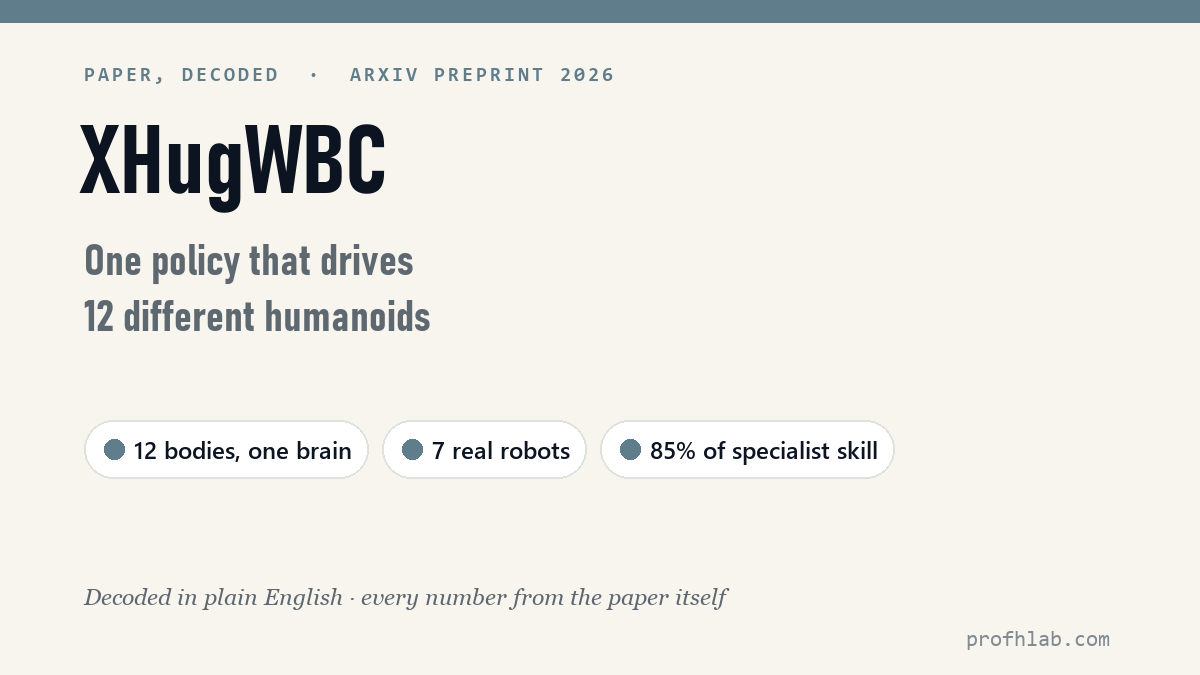
Every robot has different arm and leg lengths, joint counts, and centers of mass. So the standing assumption in humanoid control AI has been “one robot, one freshly trained policy.” The paper in this edition breaks that assumption: a single neural network from a single training run gets 12 differently shaped humanoids walking — including new robots it never saw during training. It is the latest result in cross-embodiment whole-body control: a brain that still works when the body changes.
| Item | Details |
| Original title | Scalable and General Whole-Body Control for Cross-Humanoid Locomotion |
| Authors | Yufei Xue, YunFeng Lin, Wentao Dong, Yang Tang, Jingbo Wang, Jiangmiao Pang, Ming Zhou, Minghuan Liu, Weinan Zhang — 9 authors |
| Affiliations | Shanghai Jiao Tong University (SJTU) · Shanghai AI Laboratory, and others (as listed in the paper) |
| Published | arXiv preprint 2602.05791 (v1: 2026-02-05, v3: 2026-06-09) — preprint, before peer review |
| DOI / paper | 10.48550/arXiv.2602.05791 · arxiv.org/abs/2602.05791 · project page xhugwbc.github.io |
| Proposed framework | XHugWBC (Cross-Humanoid Whole-Body Control) |
Source: arxiv.org/abs/2602.05791
The core technique
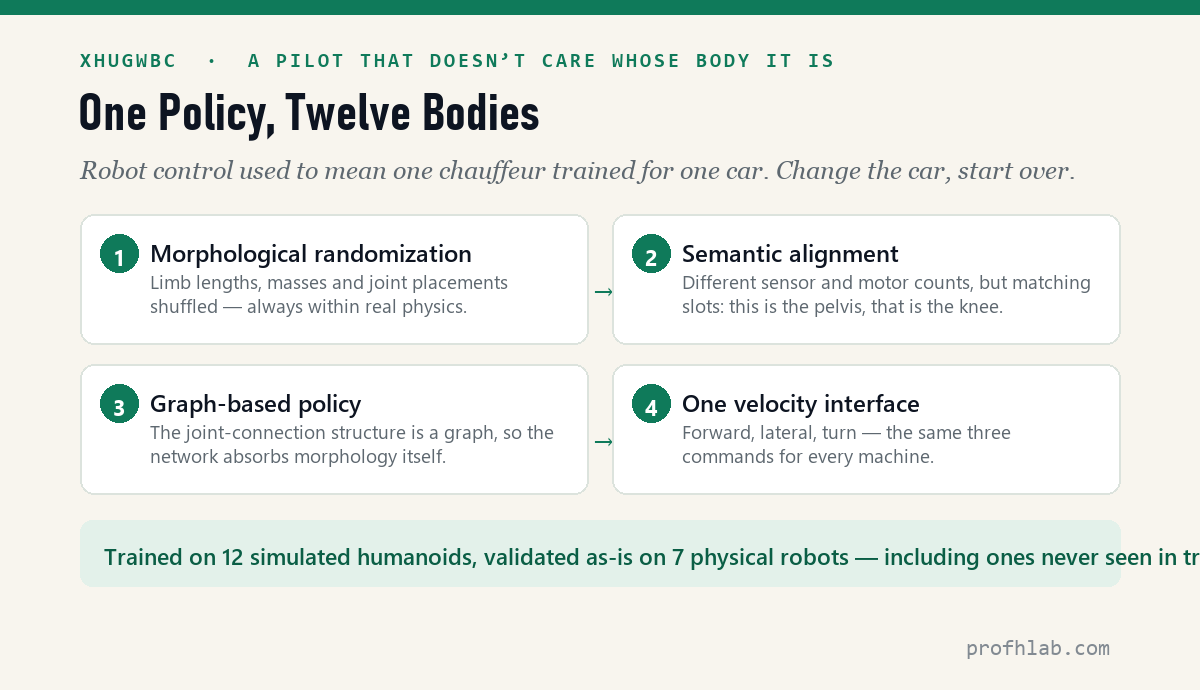
The heart of the paper is XHugWBC, a pilot that does not care whose body it is flying. By analogy: robot control AI so far has been a chauffeur trained for one specific car. Change the vehicle and the training starts over from zero. XHugWBC aims to be the all-purpose driver who climbs into a compact, an SUV, or a truck and simply drives.
Three mechanisms make this work. ① Physically consistent morphological randomization — during training, the robot’s limb lengths, masses, and joint placements are shuffled wildly, but always within the bounds of physics, so the AI cannot overfit to any one body type. ② Semantically aligned observation and action spaces — even when robots differ in sensor and motor counts, slots with the same meaning are lined up (“this is the pelvis, that is the knee”), so different bodies read as one language. ③ A graph-based policy — the robot’s joint-connection structure is expressed as a graph, letting the neural network absorb morphology and dynamics on its own.
Source: xhugwbc.github.io
The theory in plain words
Whole-body control means treating arms, legs, and torso not as parts that act separately but as one bundle, solving balance and motion at the same time. To avoid falling while walking, foot placement, the upper body’s center of mass, and joint torques must coordinate in real time.
XHugWBC solves this with reinforcement learning (RL). Inside a simulator, robots fall down and stand back up hundreds of millions of times, learning against a reward for “how precisely can you track commanded forward, lateral, and turning velocities without collapsing.” Combine that with the morphological randomization above, and the AI learns the balance principles shared by humanoids as a category rather than “this one robot.” Unifying the command interface around velocity (forward, lateral, turn) is the key that kept the learning simple.
Source: arxiv.org/abs/2602.05791
Real-world results
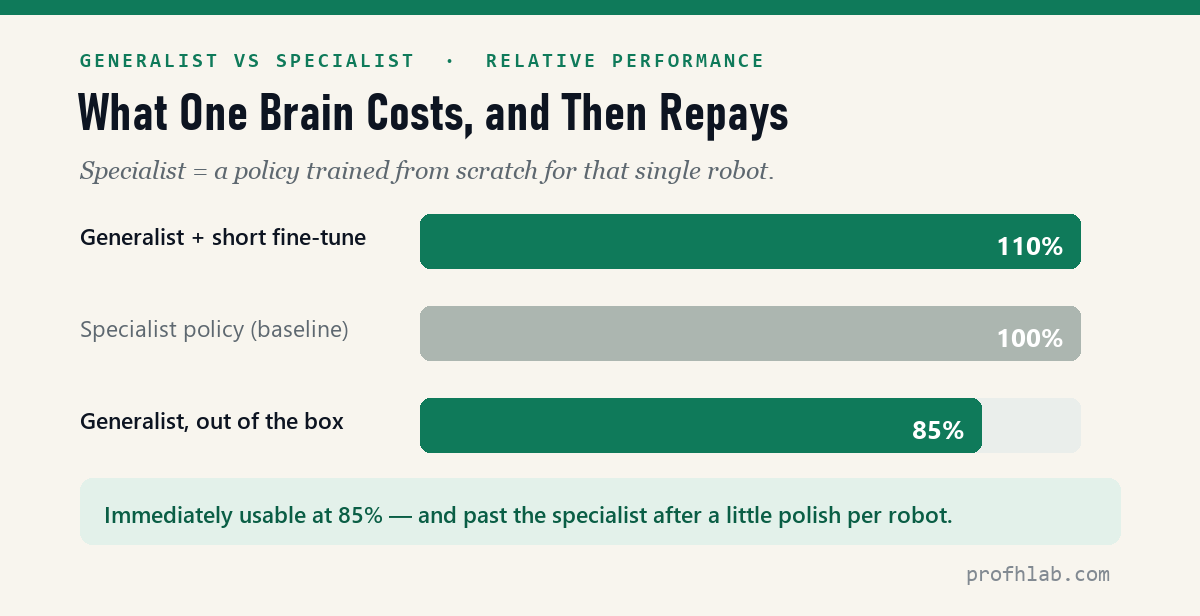
The paper trains this single policy on 12 simulated humanoids and validates it, as-is, on 7 physical robots: Booster T1, Fourier N1, Unitree G1 (both the 23-joint and 29-joint versions), Agibot X2, Dobot Atom, and Unitree H1-2 — commercial and research models many readers will recognize. The single policy reached about 85% of the performance of “specialist” policies trained separately for each robot, and with a short per-robot fine-tune it actually went roughly 10% above the specialists. Beyond walking, the team demonstrated teleoperation-driven whole-body motion and loco-manipulation (movement plus manipulation): tidying toys, opening doors, grasping objects, squatting down to reach.
The limits are just as clear. Velocity-tracking precision trails the specialists slightly (for example, forward-velocity error of 0.084 m/s vs. the specialist’s 0.060 m/s), and because everything rides on the unified command interface, precise motion imitation — dance, martial-arts moves — still needs per-robot retargeting.
Source: xhugwbc.github.io
Why it matters
Training each robot from scratch has been a heavy cost for manufacturers: every new humanoid meant rebuilding the control AI from the beginning. A cross-humanoid policy converts that into “train once, deploy across models” — a candidate for the standard control layer of the robot foundation-model era.
The implications reach Korea’s industry, which our home lab watches closely. When Rainbow Robotics (in the Samsung orbit, maker of the RB humanoid series) or LG and Samsung extend their own hardware across generations, a common policy could be reused instead of rewriting control for every generation. For a collaborative-robot maker like Doosan Robotics widening into humanoids, morphology-generalization technology lowers the entry barrier too.
Source: arxiv.org/abs/2602.05791
Who should care
- If you invest: the current of “hardware diversification → control-software reuse” lifts the value of companies with software and simulation muscle. (Informational only, not a recommendation of any specific stock.)
- If you engineer: morphological randomization + graph policies is a recipe that transfers as-is to cross-embodiment training of VLA and manipulation models, not just locomotion control.
- If you study: reinforcement learning, graph neural networks, and simulated physics meet in a single project — an ideal case study for entering robot learning.
The 3–5 year view
Three to five years out, humanoids will likely move toward a smartphone-like structure: bodies (hardware) differ by manufacturer, while the brain (the control policy) is shared — an Android for the physical world. Factory, logistics, and home robots with different bodies downloading the same “motor-intelligence OS” and immediately walking off to work — cross-humanoid whole-body control like XHugWBC is the kernel of that OS.
Does one policy beat specialists, and is it peer reviewed yet?
Does “one policy” mean top performance on every robot?
No. It starts at about 85% of the level of a specialist policy trained for that specific robot, and passes the specialist by about 10% after a short additional fine-tune per robot. The combination is “immediately usable generalist + a little polish makes it best.”
Is this fully validated, settled science?
Not yet — it is an arXiv preprint (before peer review). The results are impressive, but numbers and claims can be refined during journal review, so it is best received as leading current research rather than established fact.
Next on this shelf: a recent paper on tactile-sensor-based dexterous manipulation — the precise handwork that fingertip sensing makes possible. Read it here: the vision-tactile robot hand edition.
This article reinterprets published research for a general audience; for full details, see the original paper. The rest of the decoded-papers shelf lives on the Physical AI page.
See learned whole-body control running on humanoid hardware
Full index
Every guide in the Physical AI library — 27 of them, grouped so you can find the one you need.
Start here
- Physical AI Foundations: World Models, Robot Foundation Models, and Sim2Real — From Zero
- Physical AI Explained: Why a Chatbot Knows the Cup Falls but a Robot Doesn’t
- The Physical AI Toolbox: Six Free Simulators, a $249 Hardware Ladder, and What the 2026 Papers Admit
Research papers, decoded
- RoboVLMs, Explained: What Actually Makes a Robot Foundation Model Work
- Ψ0 (Psi-Zero), Explained: The Humanoid Foundation Model That Learns From Human Video
- MotionWAM, Explained: One-Shot Imagination Brings Real-Time Humanoid Loco-Manipulation
- ▸ XHugWBC, Explained: One Policy That Drives 12 Different Humanoids (you are here)
- Vision-Tactile Pretraining, Explained: A Robot Hand Learns Human-Like Dexterity From a Webcam
- TouchWorld, Explained: A Robot Hand That Predicts Touch Before Making Contact
- HOUND and APT-RL, Explained: One Transformer Brain for Walking, Running, and Jumping in the Wild
Machines, priced
- Tesla Optimus V3 Release Date, Price and Specs: What Tesla Has Confirmed
- Buying a Humanoid Robot in 2026: What a Unitree R1 Really Costs, Retail vs Import
- Robot Dog Prices in 2026: From ≈$2,900 to ≈$71,000 — and Spot Still Has No Price Tag
- Tesla FSD Goes Subscription-Only in Korea — and the ‘5-Year Break-Even’ Everyone Quotes Is Wrong
Home robots, tested
- Narwal Freo Z10 Ultra Review: 18,000Pa, a 75°C Mop Wash, and Three Honest Drawbacks
- 22,000Pa vs 240 Air Watts: Robot Vacuum Suction Numbers, Decoded (2026)
- Robot Vacuum or Stick Vacuum? I Split Housework Into 10 Tasks — Only One Truly Overlaps
- The Sour Smell Isn’t the Mop: Robot Vacuum Odor by Zone, and a 7–9x Consumables Gap
- Drain Height Decides Your Robot Vacuum: Samsung 0.4 m, Roborock 50 cm, LG 1.5 m
- Robot Vacuum Repair Costs 2026: A $140 Fix and a 56.5% Resolution Rate
- Robot Vacuum Subscription vs Buying: What iRobot Select Really Costs
- Are Window-Cleaning Robots Worth It? The Break-Even vs Hiring a Pro
- Smart Speakers in 2026: The Hardware Is $99 — the Assistant Is the Real Price
- Serving Robot Costs in 2026: $399 a Month, and Why 73.3% Saw No Change
Chips & companies
- HBF and zHBM, Explained: Samsung and SK Hynix Give Opposite Answers to the Same Memory Problem
- Korea’s Chip Equipment Makers, Compared: Profits Fell 68% — So Why Did Pay Jump 29%?
- Samsung DS vs DX: One Company, a $450,000 Bonus Gap — and Why the Simple Story Is Wrong
- ASML Korea’s Starting Pay Is $31K — or $46K: Anatomy of a 2.15x Salary-Data Gap
Looking for the other library? Generative AI — tools, tested →
Prof.’s H Newsletter
One short email a month, with the numbers in it
What actually moved in AI hiring, AI prices, and the scams aimed at older Americans. Counted here, dated, and linked to the source. One email a month, and your address goes nowhere else.