Generative AI vs Agentic AI: One Writes the Answer, the Other Does the Job
Update · September 13, 2026
What agents are actually doing in production, measured
This page explains the difference in concept. Here is the difference in outcomes, now that enough agentic code has shipped to measure it. Every row is somebody counting, not predicting.
| What was measured | Result | Who measured it |
|---|---|---|
| Vibe-coded apps with at least one security hole traced to an AI hallucination | 91.5% of 200+ apps | Q1 2026 assessment |
| AI-generated code failing OWASP Top-10 benchmarks | 45% | Same body of work |
| Logic and correctness errors in AI-assisted pull requests | 1.75× higher | CodeRabbit, 470 open-source PRs |
| AI code changes needing extra debugging after deployment | 43% | Lightrun survey, 2026 |
| Enterprises seeing production failures rise with AI code adoption | 81% | CloudBees |
| “Successful” agent solutions containing exploitable vulnerabilities | ~80% | Agent security benchmark |
The code usually runs. That is the problem. Working and safe are separate tests, and an agent only passes the first one. How this plays out with the newest model.
PART 1 OF 11 · THE VIBE CODING COURSE
Ask a chatbot to fix a bug in your code and it writes you a corrected function. Ask an agent the same thing and it opens the file, makes the change, runs your tests, reads the error it just caused, and fixes that too.
Same request. Completely different thing happening on the other side.
The short version
Generative AI produces an answer. Agentic AI pursues a goal. One hands you output and stops; the other plans, executes, checks its own work and tries again. In 2026 this stopped being theoretical — Google’s Antigravity 2.0 and Anthropic’s Claude Code both run teams of agents that touch real files on your machine. This page explains the difference using the tools that actually exist right now, and ends with the part most comparisons skip: what it costs you in review.
Most articles comparing these two define them and stop. This one names the tools, gives the dates, and corrects a mistake that shows up in nearly every comparison you will read.
The difference in one sentence
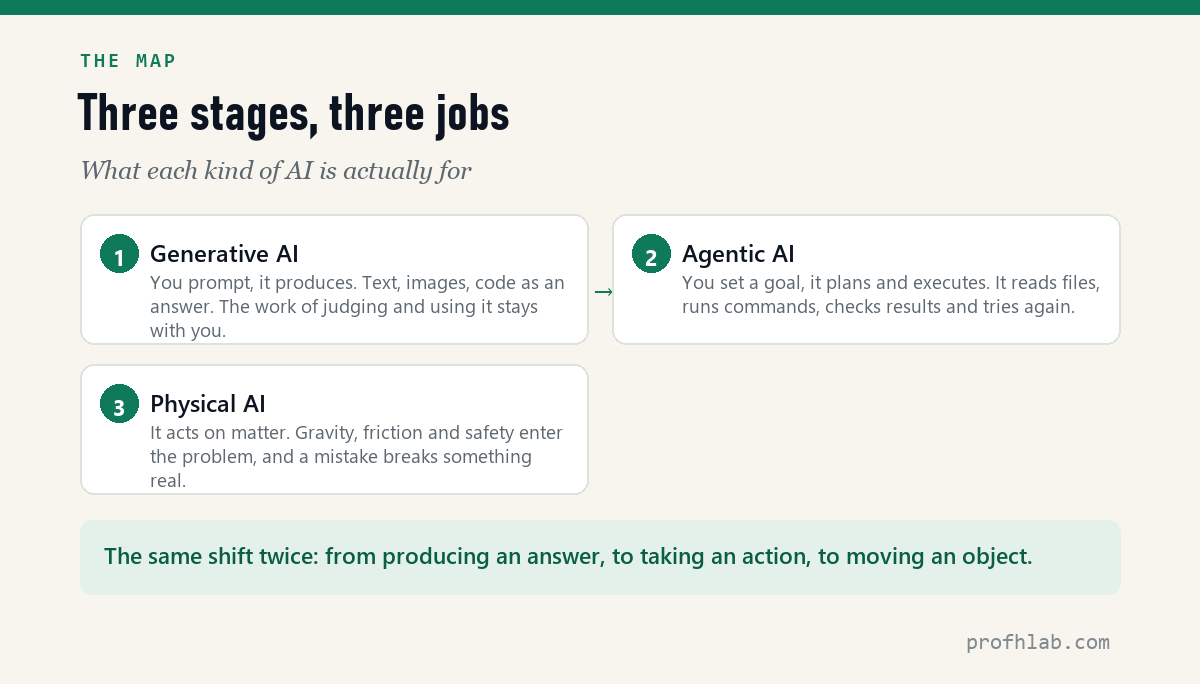
Generative AI is asked for a thing. Agentic AI is given a goal.
That sounds like word play until you watch it happen. A generative model returns text and the work of judging, applying and correcting it stays with you. An agent takes the outcome as its own problem: it breaks the goal into steps, runs them, looks at what came back, and decides what to do next.
The technical word for the second one is a loop. Act, observe, adjust, repeat. Everything else — subagents, tool permissions, plan mode — is machinery built around that loop.
What most comparison articles get wrong
Search this question and you will find the same example repeated everywhere: agentic AI is Siri, Alexa, self-driving cars.
Voice assistants are not agentic AI. Asking Alexa to set a timer is a command with a fixed response. The assistant does not form a plan, does not choose between approaches, does not notice that its first attempt failed and try a second one. It matches an intent and executes a preset action. That was true in 2015 and it is still true.
The distinction that matters is not “does it do something for me?” — a light switch does something for you. It is “does it decide what to do next based on what just happened?”
The second common error is the technology list. Comparisons often say agentic AI runs on reinforcement learning, decision trees and sensor fusion. That describes an academic field, not the thing you can install this afternoon. The agents people actually use in 2026 are large language models wrapped in a loop, with permission to run commands.
IBM Technology (1.76M subscribers) covers the same distinction from the enterprise side — useful if you want a vendor-neutral framing next to ours. 1,748,601 views as of 11 August 2026.
What agentic AI actually looks like in 2026
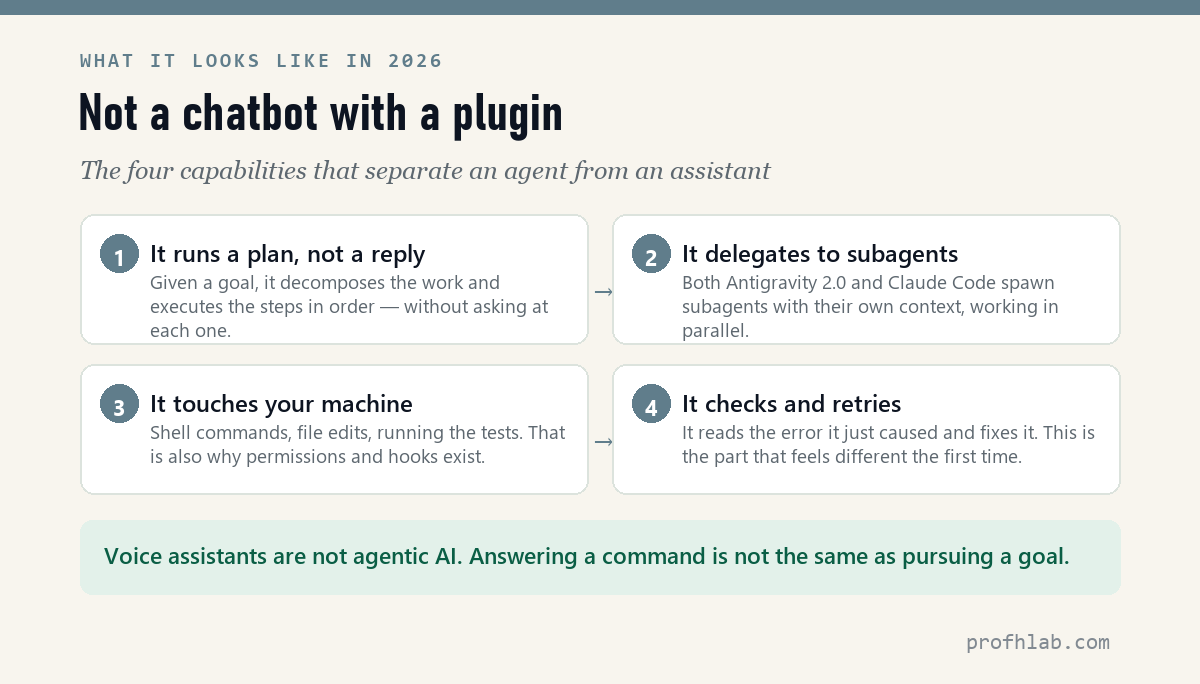
Two products define the category for ordinary developers right now, and they arrived from opposite directions.
| Google Antigravity 2.0 | Anthropic Claude Code | |
|---|---|---|
| What it is | An agentic development platform — desktop command centre, CLI and SDK | An agent that lives in your terminal |
| Released | Version 2.0 announced May 19, 2026 at Google I/O | Continuous releases; 1M-token context became generally available March 2026 |
| How it delegates | Runs several agents in parallel, spawns subagents to split a job, schedules tasks to run in the background | Subagents with their own context windows; since July 2026 they run in the background by default |
| Safety controls | Permission prompts before actions | Hooks that fire at defined points — PreToolUse is the checkpoint before any tool runs |
| Price | Free for individual developers | Included in Pro ($17/mo annual, $20 monthly), Max ($100 or $200/mo) |
Try the agentic side
Claude Code, in the table above, runs on any paid Claude plan. My referral link starts a one-week Pro trial — card required, converts to paid after 7 days unless cancelled. Disclosure: referral link — I receive credit if you subscribe; your price is unchanged.
Two details are worth pausing on.
The free one is not a trial. Antigravity is available at no charge for individual developers, running on Gemini 3.6 and 3.5 Flash. If you have been waiting for a reason to try this, the reason is that it costs nothing.
Google retired the previous generation. Consumer access to the Gemini CLI and the Gemini Code Assist IDE extensions ended on June 18, 2026. If you are following a tutorial written before that date, it is pointing you at something that no longer exists — which is a good reason to check the date on anything you read about this field, including this page.
Why the date matters more here than anywhere else
This category rewrote itself in under a year. A guide from last spring recommends tools that have since been discontinued, at prices that have since changed. Everything on this page carries the date it was checked. When it goes stale, that will be visible rather than hidden.
The worker and the conductor
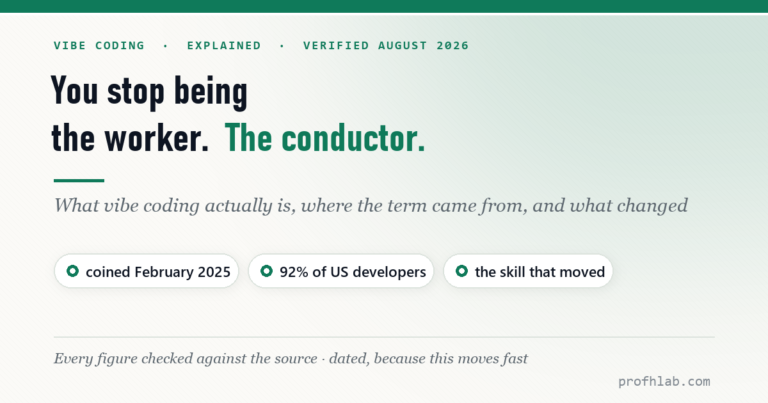
There is a way of describing this shift that I have found lands better than any definition, and it comes from teaching it: you stop being the worker and start being the conductor.
Traditional coding is bottom-up. You type each line, you own each decision, and your attention goes to syntax, libraries and file structure. Agentic work is top-down. You state intent at a high level, the agent generates, and your attention moves to what the thing should be — the user experience, the business logic, the design.
Errors change shape too. Before, you read the log and fixed it yourself. Now the agent shows you the error and proposes a strategy, and your job is to approve or redirect it.
This is genuinely a different skill, and it is why people who cannot write JavaScript are shipping working applications while some experienced developers get worse results. The bottleneck moved from can you write it to can you specify it.
How big is this, actually
The adoption numbers are larger than most people assume.
- 92% of US developers have adopted these practices, and roughly 60% of new code written in 2026 is AI-generated.
- 84% of developers use or plan to use AI tools, up from 76% in 2024.
- GitHub Copilot reports 20 million all-time users and 4.7 million paid subscribers; Cursor reports about 7 million monthly active users.
Which makes the next number the interesting one.
The part nobody puts in the comparison table
The gap that defines this moment
96% of developers say they do not fully trust that AI-generated code is functionally correct. Only 48% always review it before committing.
Read those two numbers together. Nearly everyone doubts the output, and fewer than half check it. That gap — not capability — is the real story of agentic AI in 2026.
Comparison articles describe agentic AI as “fully autonomous,” which is where they mislead you most. Autonomy does not remove the review. It relocates it. You are no longer checking each line as you write it; you are checking a finished result you did not watch being made. That is harder, not easier, and almost nobody teaches it.
It also explains something I saw repeatedly while teaching this: the students who got the best results were not the ones who prompted best. They were the ones who checked.
So which one should you use?
Not a competition. They answer different questions.
- Use generative AI when you want the thinking. Draft this, explain this, give me three approaches, what is wrong with my reasoning. You stay in control of what happens next.
- Use agentic AI when you want the doing. Build this page, migrate these files, fix the failing tests, set up the project. There are steps, and you do not want to run each one.
- Use neither for things you cannot check. If you would not be able to tell a good result from a bad one, automating it just produces confident wrongness faster.
If you are starting today: install the free one, give it a small real task, and watch what it does. Fifteen minutes of watching an agent read an error and fix itself will teach you more than any comparison table, including the one above.
Jeff Su (1.85M subscribers) gives the plainest short answer to what makes an agent an agent. 4,706,468 views as of 11 August 2026.
Siri, Alexa and the loop that turns a model into an agent
Is agentic AI just generative AI with extra steps?
Underneath, yes — today’s agents are language models in a loop. But that loop changes what you get: an outcome instead of an output. The model is the engine; the loop is the car.
Are Siri and Alexa agentic AI?
No. They match an intent and run a preset action. They do not plan, do not choose between approaches, and do not react to their own failures. This example appears in many comparison articles and it is wrong.
Do I need to be a programmer?
To build software with one, less than you would think — people who cannot write JavaScript are shipping real applications. To know whether what it built is any good, more than you would like. That is the honest answer.
What does it cost to start?
Nothing, if you start with Google Antigravity — it is free for individual developers. Claude Code comes with a Claude Pro subscription at $17 a month billed annually, or $20 monthly. Prices verified August 11, 2026.
Is my code safe if an agent can run commands?
That is the right question to ask early. Both tools gate actions: Claude Code fires hooks before any tool runs, with PreToolUse as the security checkpoint, and Antigravity prompts for permission. Start with a scratch project, not your production repository.
Where does physical AI fit alongside generative and agentic AI?
Same progression, one step further out. Generative AI produces something you read or look at. Agentic AI takes actions inside software — files, commands, a browser. Physical AI takes actions in the world, which means it also has to predict what the world does back: that the cup tips, that the floor is slippery. The hard part is not the language model. It is that a wrong action in software can be undone and a wrong action with a robot arm cannot. We keep a separate library for that half.
Where this leaves you
Generative AI gave us a machine that produces. Agentic AI gives us one that acts. The next library on this site covers what happens when that action leaves the screen and moves an object — that is physical AI, and it is the same shift a third time.
Everything else in this library is downstream of one idea: an agent that can act needs a human who can check. The tools are free or cheap, the adoption is already near-universal, and the skill that separates good results from bad ones is verification.
Sources: Google’s Antigravity announcements and product documentation; Anthropic’s Claude Code documentation and pricing pages; published 2026 developer-adoption surveys. All verified August 11, 2026. Prices and product capabilities in this category change frequently — check the current ones before you commit.
THE AGENTIC AI SERIES
Eleven articles, in order
- 1. Generative AI vs Agentic AI — One writes the answer, the other does the job. (you are here)
- 2. What Is Vibe Coding, Really? — The shift from worker to conductor.
- 3. The IAFA Prompt Framework — Four boxes between a grey button and a great one.
- 4. Your First Page in Ten Minutes — No install, no account, one file.
- 5. From a File to a Live URL — Three routes, and which ones survive a year.
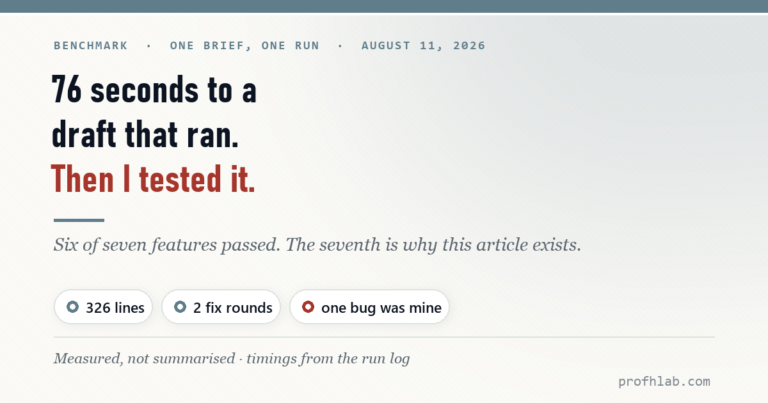
- 6. An Honest Agent Benchmark — 76 seconds to a draft, then two failures.
- 7. Verify Before You Ship — Four passes, with three failures I actually hit.
- 8. The 100-Point Scorecard — Grade your own site before anyone else does.
- 9. Adding a Database — A file cannot remember anything.
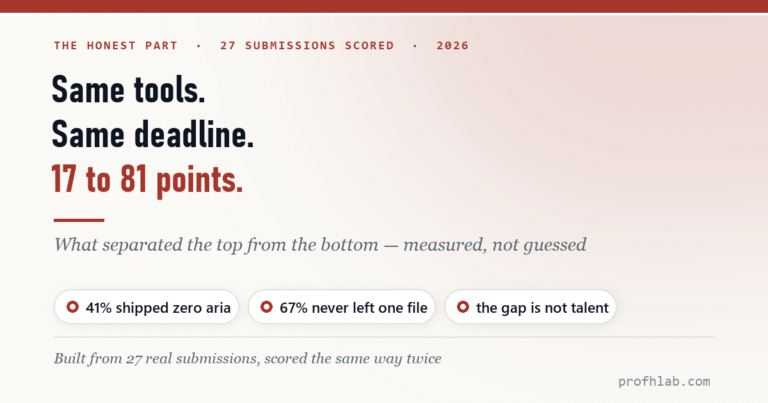
- 10. When Vibe Coding Fails — Same tools, same deadline, 17 to 81 points.
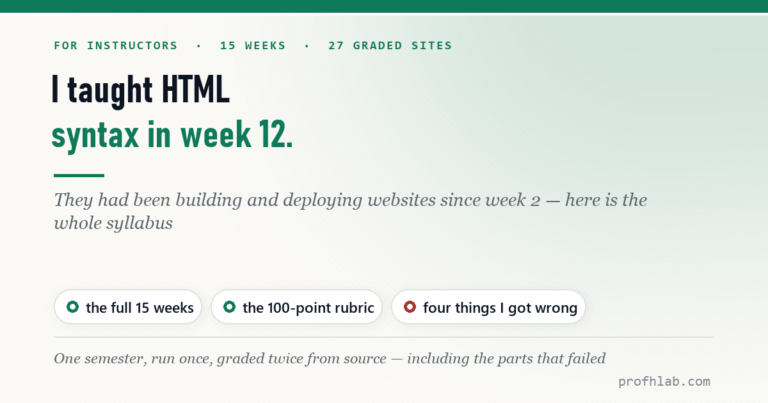
- 11. Teaching Vibe Coding — A 15-week course, and what I would change.
Start at the Agentic AI library.
Prof.’s H Newsletter
One short email a month, with the numbers in it
What actually moved in AI hiring, AI prices, and the scams aimed at older Americans. Counted here, dated, and linked to the source. One email a month, and your address goes nowhere else.